
过去完成时及现在完成时用法
Chapter 12 模块二Unit 3单元语法集训——过去完成时及现在完成时用法◆现在完成时与过去完成时的区别1.现在完成时着眼于现在,强调过去发生的某动作对现在造成的影响和结果,或是由过去持续到现在的动作。
1) I have cleaned the classroom.我打扫干净教室了。
(强调扫地所产生的结果:地干净了!)2) They have lived here for twenty years.他们住在这二十年了。
(“住”从过去持续到现在的动作用现在完成时)3) We have lived in Beijing since we came China.自我们来中国就住在北京了。
(“住”是从过去持续到现在的动作用现在完成时)2.过去完成时则主要体现过去发生的两动作的先后有别,表达的是“过去的过去”,即比过去发生的某动作都还要“过去”,两动作中先发生的就用过去完成时,后发生的则只用一般过去时。
运用过去完成时的句子往往有两过去的时间或动作。
1) Mr Smith had lived in London for ten years before he came to China.史密斯先生在来中国之前就已经在伦敦住过十年了。
(“来”中国已成过去,而先前“住”在纽约就是过去的过去!)2) We had learned 2000 words by the end of last term.在上期期末,我们就已经学了2000个单词。
(“上期期末”已过去,而在其前“学”的就更过去了!)基础巩固一、单项填空1. When Li Ming hurried home, he found that his mother ____already ____to hospital.A. has; been sentB. had; sentC. has; sentD. had; been sent2. The students _______ several new English songs by the end of last term.A. had learnedB. learnedC. have learnedD. will have learned3. Lu Mei told me she _____breakfast, so she was very hungry after having two classes.A. has hadB. hasn't haveC. have hadD. hadn't had4. Hardly ______ to the bus stop when the bus left, which drove them crazy.A did they getB they gotC had they gotD has they got5. She _____her keys in the office so she had to wait until her husband ____home.A has left; comesB had left; would comeC had left; cameD left; had come6. Mr. Black said that it was at least ten years since he _____a good drink.A had enjoyedB was enjoyingC have enjoyedD have been enjoying7. I ______ to catch the first train but I got up too late this morning.A. hopingB. had hopedC. has hopedD. would hope8. Dr. Brown was very disappointed that one third of the guests _____ when he _____ at the party.A. left; had arrivedB. left; arrivedC. had left; had arrivedD. had left; arrived9. Tom first met me 10 years ago. I______ in a radio factory at that time.A. had workedB. have workedC. was workingD. has been working10. ---- What ______ when I phoned you? ---- I ______ my work, and wanted to go out for a walk.A. have you done; finishedB. were you doing; have finishedC. did you do; had just finishedD. were you doing; had just finished11. It is very clear that you were in a hurry. You ______ your sweater inside out.A. had wornB. woreC. were wearingD. are wearing12. ---- We ______ that you would fix the TV set this week.---- I’m sorry. I ______ to fix it this week, but I’ve been too busy.A. had expected; had intendedB. are expecting; had intendedC. expect; intendD. expected; intend13. ---Alice came back home the day before yesterday.---Really? Where ______?A. has she beenB. had she beenC. has she goneD. had she gone14. Mr. Green and I are familiar with each other; we ______ to each other at an international conference.A. are introducedB. are being introducedC. were introducedD. had been introduced15. --- Did he notice you enter the room?--- I don’t think so. He ______ to the radio with his eyes shut.A. listenedB. was listeningC. has listenedD. had listened16. Tom and Jack met again in the street that day. Until then, they _____ each other for nearly two years.A. didn’t seeB. hadn’t seenC. haven’t seenD. haven’t been seen17. ---Jane, do you still remember the first time we met?---Of course I do. You ______ in the library.A. were readingB. had readC. have readD. read18. A lot of my friends want to buy that kind of cloth because they _____ the cloth ______ well.A. have told; washesB. have been told; washesC. was told; washedD. have been told; is washed19. The young professor talked for about nearly two hours yesterday. Never ______ him talk so much.A.I heardB. did I hearC.I had heardD. had I heard20. Ms Wang ______ to the office than she got down to writing the report.A. has no sooner gotB. had hardly gotC. no sooner gotD. had no sooner got21. My dictionary ______. I have looked for it everywhere but still ______it.A. has lost; don’t findB. is missing; don’t findC. has lost; haven’t foundD. is missing; haven’t found22. --- Excuse me, sir. Would you do me a favour? --- Of course. What is it?--- I ______ if you could take me to the station.A. would wonderB. did wonderC. was wonderingD. had wondered23. ---Hi, L iu Tao. I dropped in at your house at about ten last night, but you weren’t in.---Oh, I ______ regular exercise at the club.A. didB. was doingC. had done D have been doing24. All the policemen’s attention was suddenly caught by a small dusty box which____ placed in the corner of the room.A. has beenB. was beingC. had beenD. would be25. By the time I got home yesterday, my husband _______ cooking the dinner.A. had finishedB. finishedC. has finishedD. finishes26. My friend asked me whether it was the first time that I ______ skiing.A. wentB. has goneC. had goneD. would go27. To everyone’s surprise, Mr Smith’s son spent much more mo ney than he ______ on the journey.A. will planB. has plannedC. would planD. had planned28. If he ________ to the meeting yesterday, I would have met him.A. had comeB. cameC. would comeD. was coming29. I was late for the interview yesterday. I ________ the road to be so crowded.A. wouldn’t expectB. haven’t expectedC. wasn’t expectingD. hadn’t expected30. ---How long had the hotel _______ fire when the firemen got there?---For an hour or so.A. caughtB. been caughtC. been onD. been catching能力提高一、用所给动词的正确形式填空1 By the time we got to the airport, the plane _______ (take) off.2 The children ________ (have) the book for two weeks before they returned it to the library.3 He ______ (study) English for five years before he came here.4 When I woke up this morning, I found that it ________ (stop) snowing.5 The boy _____ (not watch) the movie because he had watched it twice.6 Kate told me that it was the second time that she _______ (go) skating.7 When Jim _____ (come) to China two years ago, he found people didn't understand him at all though he ________(learn) some Chinese in his own country.8 I saw Han Mei yesterday. We _____ (not see) each other since we left Beijing.9 If you _______ (work) harder, you would have passed the examination.10 No sooner had we got there than it ______ (begin) to rain.二、句子改错1. When she got home last night, her three children went to bed.2. I didn't go to see the firm because I saw it before.3. The wind was still blowing, but the rain has stopped.4. By the end of last term we learned about 1,500 English words.5. Jim got seriously ill. He didn’t eaten anything since Tuesday.三、中译英1. 当我们到达电影院时,电影已经开始十分钟了。
语法:6-7现在完成时、过去完成时
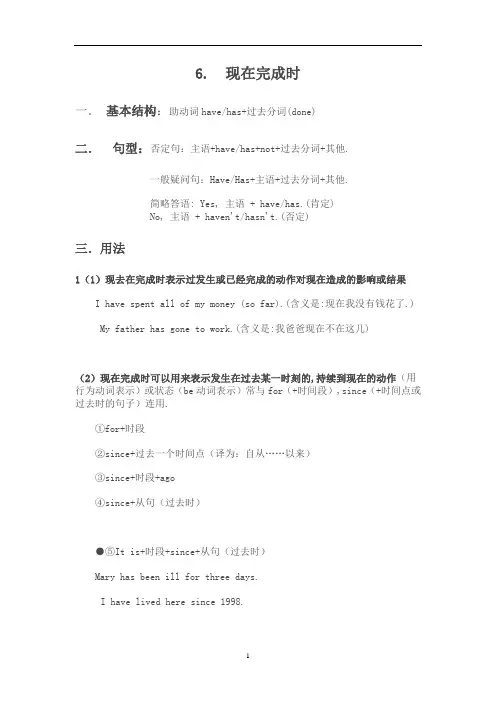
6. 现在完成时一.基本结构:助动词have/has+过去分词(done)二.句型:否定句:主语+have/has+not+过去分词+其他.一般疑问句:Have/Has+主语+过去分词+其他.简略答语: Yes, 主语 + have/has.(肯定)No, 主语 + haven't/hasn't.(否定)三.用法1(1)现去在完成时表示过发生或已经完成的动作对现在造成的影响或结果I have spent all of my money (so far).(含义是:现在我没有钱花了.)My father has gone to work.(含义是:我爸爸现在不在这儿)(2)现在完成时可以用来表示发生在过去某一时刻的,持续到现在的动作(用行为动词表示)或状态(be动词表示)常与for(+时间段),since(+时间点或过去时的句子)连用.①for+时段②since+过去一个时间点(译为:自从……以来)③since+时段+ago④since+从句(过去时)●⑤It is+时段+since+从句(过去时)Mary has been ill for three days.I have lived here since 1998.四.has gone (to),has been (to), has been (in) 的区别Have/Has gone(to) : 去了(现在不在说话现场) 例如:例如: Where is your father?He has gone to Shanghai.Have/Has been (to) :去过(已不在去过的地方)My father has been to Shanghai.Have/has been in:呆了多久(还在所呆的地方)My father has been in Shanghai for two months. /since two months ago.五.现在完成时的标志1. 现在完成时的含义之一是过去完成的动作对现在仍有影响,用以下四大标志词可以表达这种含义:* 以already, just和yet为标志He has already got her help. 他已得到她的帮助。
现在完成时与过去完成时
现在完成时与过去完成时现在完成时和过去完成时都是英语中的时态形式,用于描述动作或事件发生的时间。
虽然两者都表示过去发生的动作或事件,但它们的用法和概念稍有不同。
下面将逐一介绍现在完成时和过去完成时的用法及特点。
一、现在完成时 (Present Perfect)现在完成时用于描述过去发生的动作或事件对现在造成的影响或结果。
它的基本结构是“have/has + 过去分词”。
以下是现在完成时的几个主要用法:1. 表示过去发生的动作对现在造成的影响或结果:常与表示经验、常态或持续性的副词或时间状语连用,例如:already(已经)、yet (还)、never(从不)、ever(曾经)、so far(到目前为止)、recently(最近)、up to now(到目前为止)等。
例如:- I have already finished my homework.(我已经完成作业了。
)- Have you ever been to Paris?(你曾经去过巴黎吗?)2. 表示动作或事件发生时间不明确的情况下,强调的是结果或经验:常与表示程度或数量的副词连用,例如:just(刚刚)、already(已经)、never(从不)、ever(曾经)、yet(还)等。
例如:- I have just seen the movie.(我刚刚看过那部电影。
)- He has never traveled abroad.(他从未出过国。
)3. 表示过去开始的动作或事件一直延续到现在:常与表示时间段的状语连用,例如:for(表示时间段)、since(表示时间点)、howlong(多久)等。
例如:- They have lived in this city for five years.(他们在这座城市已经住了五年了。
)- I have known her since 2010.(我认识她自2010年起。
)二、过去完成时 (Past Perfect)过去完成时用于描述过去的某个时间点或之前发生的动作或事件。
现在完成时和过去完成时的区别
现在完成时和过去完成时的区别现在完成时和过去完成时是英语中两种表示过去事件的时态。
两者有些许区别,主要体现在动作发生的时间和对过去事件的强调上。
一、现在完成时:现在完成时用于表示过去发生的动作对现在的影响或结果。
它的构成是由助动词“have”或“has”加上动词的过去分词构成。
主要有以下几种用法:1. 表示过去的动作对现在的结果:这时,谓语动词强调的是发生的结果或影响。
例如:I have finished my homework.(我已经完成了作业。
)They have moved to a new house.(他们已经搬到新房子了。
)2. 表示过去开始的动作一直延续到现在:这时,动作开始于过去,延续到现在,表示一种持续的状态。
例如:She has lived in this city for ten years.(她在这座城市已经住了十年了。
)He has worked in the company since 2010.(自2010年以来,他一直在这家公司工作。
)3. 表示过去发生的动作在过去和现在之间多次重复:这时,动作在过去和现在之间多次发生。
例如:They have visited Japan three times.(他们已经去过日本三次了。
)I have read this book twice.(我已经读过这本书两次了。
)4. 表示过去经历或完成的动作对现在的补充说明:这时,过去发生的动作为现在提供了相关信息。
例如:I have studied English for five years.(我学英语已经有五年了。
)She has been on vacation for two weeks.(她已经度假两周了。
)二、过去完成时:过去完成时用于表示过去的动作在另一个过去事件之前发生。
它的构成是由“had”加上动词的过去分词。
主要有以下几种用法:1. 表示过去发生的动作在另一个过去事件之前完成:这时,过去完成时强调在过去某个时间之前就已经完成的动作。
现在完成时与过去完成时的综合运用
现在完成时与过去完成时的综合运用现在完成时和过去完成时是英语中比较常用的两个完成时态。
它们在不同的语境中起到不同的作用,让我们来详细了解一下它们的用法和运用。
一、现在完成时现在完成时表示过去发生的动作或事情对现在造成的影响,也可以用来表示过去发生的一系列事情中的最新动态。
现在完成时的基本结构为:助动词have/has + 过去分词。
1. 表示已完成的动作或经历的时间没有具体提及:I have finished my homework.(我已经完成了作业。
)He has traveled to many countries.(他已经去过很多国家。
)2. 表示过去发生的一系列动作中的最新动态:She has read three books this week.(她这周已经读了三本书了。
)They have seen that movie twice.(他们已经看过那部电影两次了。
)3. 表示经验和经历:I have never been to Paris.(我从未去过巴黎。
)He has lived in London for three years.(他已经在伦敦住了三年了。
)4. 句中可同时存在具体的时间状语或状语从句:We have visited the museum this morning.(我们今天上午参观了博物馆。
)She has already left when I arrived.(当我到达时,她已经离开了。
)二、过去完成时过去完成时表示过去某个时间点之前已经完成的动作或事情。
过去完成时的基本结构为:had + 过去分词。
1. 表示在过去某个时间点之前已经完成的动作:I had finished my homework when my friend came over.(当我的朋友过来时,我已经完成了作业。
)They had left the office before the boss arrived.(老板到达之前,他们已经离开了办公室。
现在完成时与过去完成时

现在完成时与过去完成时现在完成时和过去完成时是英语语法中的两种时态,它们分别用来表达不同的时间关系和动作完成情况。
本文将详细介绍现在完成时和过去完成时的用法及其区别。
一、现在完成时的用法现在完成时用来表达过去发生的动作对现在产生的影响或者与现在有关的经历、经验等。
它的构成是由助动词"have/has"加上过去分词形式的动词来完成的。
1. 表示经历或经验例如:I have visited Beijing several times.(我去过北京几次了。
)She has worked in that company for five years.(她在那家公司工作了五年了。
)2. 表示动作从过去进行到现在或仍在进行例如:He has lived in this city since 2010.(他从2010年就在这个城市居住。
)We have known each other for a long time.(我们认识很久了。
)3. 表示过去发生的动作对现在产生的影响例如:I have lost my keys.(我的钥匙丢了。
)She has broken her leg, so she can't walk now.(她摔断了腿,所以现在无法行走。
)二、过去完成时的用法过去完成时用来表达在过去某一时间或动作之前已经完成的动作或状态。
它的构成是由助动词"had"加上过去分词形式的动词来完成的。
1. 表示过去某一时间或动作之前已经完成的动作或状态例如:I had finished my homework before my mom came back.(我在我妈妈回来之前已经完成了作业。
)They had already left when we arrived.(当我们到达时,他们已经离开了。
)2. 用于虚拟语气的条件句中例如:If I had studied hard, I would have passed the exam.(如果我努力学习,我就能通过考试。
现在完成时和过去完成时的用法
现在完成时和过去完成时的用法
现在完成时(PresentPerfect)和过去完成时(PastPerfect)是英
语中的两种常用时态,这两个时态常常在语言使用中混淆,但它们有很大的不同。
现在完成时表示某个过去时间和当前之间发生的动作或即将发生的动作,而过去完成时则表示某个事件发生在另一个事件之前。
现在完成时的时间范围通常是从过去某个时间到现在,所以它可以把一段时间表示得比较简洁。
例如,“我今年已经找到了一份工作。
”,表示从今年开始就找到一份工作,直到现在还没有改变。
过去完成时则通常表示某个动作发生在另一个动作之前,因此在表达发生先后时常常用到它。
例如,“我已经订好机票,然后才查看
了机场的相关规定。
”,表示先订好机票,然后再查看机场的相关规定。
这两种时态在语法上各有不同,现在完成时对应的助动词是
have/has+动词的过去分词,而过去完成时对应的助动词则是had+过去分词,用法上也有很大的不同。
一般来说,在表达某件事发生在过去某个时间之前时会使用过去完成时,而在表达过去某个时间点和现在之间发生的动作则会用到现在完成时。
例如,“我去年买了一辆新车”,这句话表示的就是现在完成时,它表示的是去年到现在去买了一辆新车,是一个持续的动作,直到现在还没有改变。
而“我去年买完车,然后再去买了一台冰箱”,这句
话表示的就是过去完成时,表示的是先买完车,然后再过去买冰箱的
动作,说明发生的先后关系。
现在完成时和过去完成时都是英语中常用的两种时态,它们可以让表达变得更加简洁,也可以帮助表达发生先后关系,因此在使用英语时,一定要掌握这两种时态的用法,才可以更好地表达出自己的意思。
过去完成时和现在完成时的区别是什么?
过去完成时和现在完成时的区别是什么?过去完成时(Past Perfect)和现在完成时(Present Perfect)是英语中两个不同的时态,它们在用法上有一些区别。
以下是它们之间的主要区别:1. 时态的基本含义:- 过去完成时:过去完成时表示在过去某个时间点之前完成的动作或事件,强调过去某个时间点之前发生的情况。
- 现在完成时:现在完成时表示过去开始并一直延续到现在的动作或事件,强调对现在的影响。
2. 句子结构:- 过去完成时:过去完成时的句子结构是“had + 过去分词”,例如:“I had finished my homework before I went to bed.”(我在上床睡觉之前已经完成了作业。
)- 现在完成时:现在完成时的句子结构是“have/has + 过去分词”,例如:“I have lived in this city for five years.”(我在这个城市已经住了五年。
)3. 时态转换:- 过去完成时可以用于转述过去的时间和事件,变为间接引语时不需要改变时态。
- 直接引语:She said, "I had already eaten when she arrived."(她说:“她到的时候我已经吃过饭了。
”)- 间接引语:She said that she had already eaten when she arrived.(她说她到的时候已经吃过饭了。
)- 现在完成时需要根据转述时的时间进行时态转换。
- 直接引语:He said, "I have finished my work today."(他说:“我今天已经完成了我的工作。
”)- 间接引语:He said that he had finished his work that day.(他说他那天已经完成了工作。
)4. 时间表达:- 过去完成时通常和表示过去某个时间的副词或短语连用,如:before(在...之前)、by the time(到...的时候)、already(已经)等。
现在完成时和过去完成时的用法
现在完成时和过去完成时的用法
在英语中,有两种常用的完成时态:现在完成时态和过去完成时态。
每种时态都有某些特定的用法,不同的用法得到不同的解释和涵义。
现在完成时态可以用来表达一种持续性或经常性的动作。
在它的句子中,通常会出现一个有关过去动作的时间状语,例如“for 10 days”(10天)、“since 9 oclock(自9点),以及表示长期持续的副词(如“already”,“yet”,“recently”等)。
例如:
I have studied English for ten days.
从这个句子中可以明显看出,学习英语已经持续了10天。
另一方面,过去完成时态用来表达一种已经完成的动作,并且通常在这种情况下,句子中会出现“by +体时间”的时间状语。
例如: I had finished my homework by 9 oclock.
从这个句子中可以明显看出,我在9点之前完成了我的家庭作业。
另外,它们也可以用于表达相反的意思,即用过去完成时态来表达一种持续或经常性的动作,用现在完成时态来表达一种瞬间动作。
例如:
He had been living in London for three years.
这个句子表达的是他过去3年里一直住在伦敦。
The boss has just signed the contract.
这个句子表达的是老板刚刚签定了合同。
总之,现在完成时态和过去完成时态都是一种有用的时态。
在使
用它们之前,应该明确它们有什么用法,从而避免误解和混淆。
在学习它们时,最好结合实际的句子来学习,以便更好地理解并使用。
过去、现在完成时用法
过去完成时:表示发生在过去的两个动作在前的那一个,它表示句子中描述的动作发生在“过去的过去”。
基本形式:过去完成时由had+过去分词构成,因此无人称变化肯定式:I had/I'd worked等否定式:I had not/hadn't worked等疑问式:had I worked等否定疑问式:had I not/hadn't I worked等时态用法:1. 过去完成时是与现在完成时相当的过去式:现在完成时:Ann has just left.If you hurry you’ll cat ch her.(安刚刚走。
如果你快一点,就能追上她。
)过去完成时:When I arrived Ann had just left.(我到的时候,安刚刚离开。
)但是,过去完成时不像现在完成时那样限于表达未指明时间的动作,因此可以说:He had left his case on the 4∶40 train.(他把手提箱丢在4点40分的火车上了。
)2.现在完成时可以和since/for/always等词连用,表示一个开始于过去并仍在继续或刚刚结束的动:与此同理,过去完成时也可以用来表示在所说的过去某一时刻之前就已开始的动作。
1)在该时刻仍然在继续。
例如:Bill was in uniform when I met him.He had been a soldier for ten years.(我遇到比尔的时候,他身穿军服。
那时他已经当了十年兵了。
)2)在该时刻停止或刚刚停止。
例如:The old oak tree, which had stood in the churchyard for 300 years, suddenly crashed to the ground.(屹立在教堂墓地上已300百年之久的老橡树突然间哗啦一声巨响倒在地上。
)但应注意,过去完成时还可以用来表示:3)在所说时刻之前某一时候停止的动作。
现在完成时和过去完成时的区别
现在完成时和过去完成时的区别现在完成时和过去完成时是英语语法中的两个时态,它们有一些区别,本文将详细介绍这两个时态的用法和区别。
现在完成时(Present Perfect)通常用来描述已经发生的动作或状态,并与现在的情况有关系。
它的基本结构是“已经+动词的过去分词”。
现在完成时常与时间状语词如“ever”, “never”, “already”, “just”, “recently”等连用。
例如,我们可以说:“我已经吃过晚饭了。
”(I have already had dinner.)这句话表示动作“吃晚饭”已经在过去的某个时间完成,但与现在的情况相关。
现在完成时可以用来表述一些与现在有关联的经历、经验、习惯或者到目前为止已经发生的动作。
它不显式指明具体发生的时间,而是侧重强调与现在有关的情况。
过去完成时(Past Perfect)则用来描述在过去某一特定时间之前已经发生或完成的动作或状态。
它的基本结构是“had + 动词的过去分词”。
过去完成时经常与表示过去的时间状语连用,如“before”, “after”, “until”, “when”等。
例如,我们可以说:“他们已经离开了,当我到达那里时。
”(They had already left when I arrived there.)这句话表示在过去的某个时间点之前,他们已经离开了,我到达那里时他们已经不在了。
过去完成时用来描述过去某个时间点之前已经发生的动作或状态,强调过去发生的顺序或先后关系。
它常常与过去的时间状语连用,以更明确地表示动作发生的时间。
总结一下,现在完成时和过去完成时在用法上有一些区别。
现在完成时强调与现在的关联,描述已经发生但和现在有关的动作或状态;过去完成时强调与过去某个时间点之前的关联,描述在过去某一特定时间之前已经发生的动作或状态。
它们都是用来描述过去发生的事情,但关注点略有不同。
然而,需要注意的是,中文与英文的时态在表达上有一些差异,所以直接翻译的结果可能不够准确。