
人教版八年级下册英语Unit3知识点.docx
Unit3 Could you please clean your room ?
名:
rubbish 垃圾shirt衫fairness 公正性;合理性floor 地板finger手指neighbor 居
mess 乱stress 力
:
fold 折叠borrow 借来depend 依靠
sweep打lend借出develop 展
throw扔hate drop落下
pass ;通provide 提供
形容:
ill 有病的fair 合理的;公正的unfair不合理的;不公正的副:
anyway 而且;加之
:
while当⋯⋯;然而since从⋯⋯以后;因,既然
兼:
neither adv也不 pron 两者都不since conj 因,既然
waste n 垃圾 v浪
短:
take out the rubbish倒垃圾depend on 依靠
all the time一直;繁take care of 照
as soon as 一⋯⋯就⋯⋯sweep the floor 地
in order to 了
知点:
1、 rubbish垃圾;物不可数名= garbage = trash
2、 floor 地板;楼
the first floor第一the second floor 第二
the + 序数+ floor 第几
3、 at least至少
at most至多
The ticket will cost at least 200 yuan. 票至少花200 元。
It will take 2 hours at most to get there.最多花两小就可到达那里。
4、 finish doing sth完成做某事
He finished writing the English paper.他写完了那篇英文。
喜介意;enjoy/miss/mind doing sth
完成愉快勤;finish/have fun/practice doing sth
忙得禁不住想放弃; be busy/can't help/give up doing sth
5、 invite sb to do sth邀某人做某事
invite sb to +地点邀某人去某地
He invited me to the party.他邀我去个聚会。
Peter invites Anna to have a dinner. Peter 邀 Anna 吃晚。
6、( 1) sb spend + 金 /+ on sth =sb spend + 金 /+( in )doing sth
在某事 /某物上花金/
She spent two hundred yuan on this dress.= She spent two hundred yuan ( in) buying this dress.
她花了 200 元条裙子。
( 2) sth cost( sb) + 金某物花(某人)多少
The shirt costs me 100 元 .件衫花了我100 元。
(3) It takes sb ++ to do sth 做某事花某人多
It takes me two hours to do my homework.做作花了我两个小。
( 4) sb pay + 金 + for sth某人某物付多少
Mike pays 100 yuan for these books. Mike 些花了100 元。
7、 It is + adj + for sb + to do sth某人来做某事怎么
It's difficult for him to learn English.于他来,学英很困。
8、 Could you please do sth?能你⋯⋯?
Could you please not do sth ?能你不要⋯⋯?
肯定回答:
Yes, sure. 是的。
Of course. 当然。
No problem.没。
Sure./Certainly. 当然可以。
否定回答:
Sorry, I can't. I have to do sth.不起,我不能。
我得⋯⋯
Sorry, I'm going to do sth.不起,我将⋯⋯
I'm afraid not.恐怕不行。
— Could you please tell me the way to the park ?你能告我公园怎么走?— Of course. 当然。
— Could you please go hiking with me ?明天你能和我一起去足?
— Sorry, I can't. I have to do my homework. 不起,我不能。
我得做作。
表示求的几种方式:
Would you like to do sth ?你愿意做某事?
Would you please do sth ?你能做某事?
Would you mind doing sth ?你介意做某事?
Let's do sth. 我做某事吧。
Unit 3人教版八年级下册英语word课本及讲解

Unit 3 Could you please clean your room?一、单词1.rubbish 不可数名词rubbish bin2.fold--foldedfold the clothes3.sweep swept sleepsweep the floor4.mess a mess5.throw threw thrownthrow away 扔掉、错过throw down 扔下,扔掉throw sth. to sb. 把某物扔向某人shoutthrow sth. at sb. 用某物砸某人6.all the time = alwaysin time /on time /at times /some time7.neither either both all/noneneither…nor…动词就近原则Neither Tom nor I am sick.Neither I nor Tom is sick.neither of +名词复数+动词(三单)Neither of them is sick.either…or…both…and…(否定)neither+助/情/系+主语,(肯定)so +助/情/系+主语.表示前面叙述的否定/肯定情况也适合另一个人或物A: I ..like…8.as soon as 强调两个动作在时间上接连发生He starts to study English as soon as he gets up. “一…就…”可以用于引导条件状语从句主将从现I will call you as soon as Tom comes back.9.pass passed pastpass sth to sb. pass sb. sth give10. borrow …from…lend …to… lend sb. sth. lend -lent11.hate to do /doing sth. dislike/like12. do chores13.while whenwhen 既可以指时间点,也可以指一段时间。
(word完整版)英语八年级下册第三单元知识点总结,文档
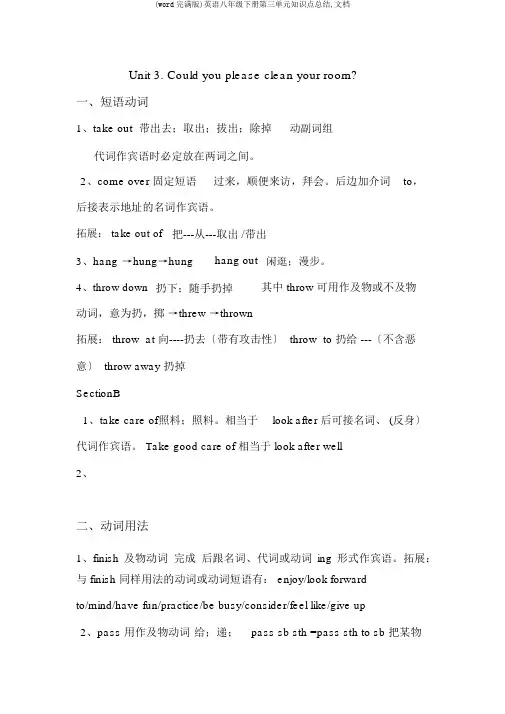
Unit 3. Could you please clean your room?一、短语动词1、take out 带出去;取出;拔出;除掉动副词组代词作宾语时必定放在两词之间。
2、come over 固定短语过来,顺便来访,拜会。
后边加介词to,后接表示地址的名词作宾语。
拓展: take out of把---从---取出 /带出3、hang→hung→hung hang out闲逛;漫步。
4、throw down扔下;随手扔掉其中 throw 可用作及物或不及物动词,意为扔,掷→threw →thrown拓展: throw at 向----扔去〔带有攻击性〕 throw to 扔给 ---〔不含恶意〕 throw away 扔掉SectionB1、take care of照料;照料。
相当于look after 后可接名词、 (反身〕代词作宾语。
Take good care of 相当于 look after well2、二、动词用法1、finish 及物动词完成后跟名词、代词或动词ing 形式作宾语。
拓展:与 finish 同样用法的动词或动词短语有: enjoy/look forwardto/mind/have fun/practice/be busy/consider/feel like/give up2、pass 用作及物动词给;递;pass sb sth =pass sth to sb 把某物递给某人。
走过、经过〔考试等〕作不及物动词,〔时间〕过去,流逝3、borrow sth from sb向某人借某物。
非连续性动词Lend(lent;lent) sb sth=lend sth to sb借给某人某物。
非连续性动词Keep 由“保存〞引申为“借〞,连续性动词,可与时间段连用。
四川 -----Excuse me,can I_____your pen?-----sorry,I have_____it to Bob.A.borrow;lendB.borrow;borrowedC.lend;borrowedD.lend;lent4、hate 及物动词厌恶;讨厌,表示一种感情或心理状态,不能够用于进行时态。
八年级人教版英语下册unit3知识点
八年级人教版英语下册unit3知识点Unit 3 Language in use一、句型结构1. What did you do…?A: What did you do yesterday?B: I cleaned my room.2. What was …like?A: What was the weather like yesterday?B: It was warm and sunny.3. When did …?A: When did you finish your homework?B: I finished it at nine o’clock last night.4. How was …?A: How was your weekend?B: It was great! I went to the park and played basketball with my friends.二、动词时态1. 一般过去时:表示过去经历或已经完成的动作或状态。
I walked to school yesterday.She watched a movie last night.2. 过去进行时:表示过去某一时刻正在进行的动作。
We were playing basketball at six o’clock yesterday evening.They were studying English when the teacher came in.3. 过去完成时:表示过去的某个时间或动作之前已经完成的动作。
He had finished his homework before he went to bed.I had never been to Shanghai before last year.三、被动语态被动语态的构成:be动词(am、is、are、was、were)+过去分词。
1. 一般现在时被动语态:The apples are picked by the farmers.2. 一般过去时被动语态:The book was written by Li Bai.3. 现在进行时被动语态:The dishes are being washed by my sister.四、语态转换主动语态变被动语态,被动语态变主动语态。
人教版八年级下册英语Unit3知识点总结

精品基础教育教学资料,仅供参考,需要可下载使用!Unit3 Could you please clean your room? 一.情态动词could 的用法1.提出礼貌的要求Could you please (not) do sth ?请你(做)......好吗?用于提出请求,希望得到对方的肯定回答,说话的语气比较客气委婉。
Could 不是can 的过去式,是委婉、礼貌的说法。
回答用can.肯定回答:Yes,sure./ Yes, I can./Of course,I can./ Certainly./No problem./ With pleasure .否定回答:Sorry , I can’t / I’m afraid I can’t. I have to (I)m going to…(说明理由)2.表示请求许可Could I do a sth? 我可以做......吗?肯定回答:Yes, you can ./ Yes ,please / Of course / Certainly./ No problem.否定回答:Sorry , you can’t / I’m afraid you can’t.3.could 为can的过去式,表示过去的能力。
= was / were able toSection A1. take out the rubbish把垃圾带出去2. do the dishes = wash the dishes洗碗碟3. fold your clothes折衣服4. sweep the floor扫地5. make your bed整理床铺6. clean the living room打扫起居室7. do some washing/ shopping/ cleaning洗衣服/ 购物/ 做清洁8. go out for dinner出去吃晚饭9. go to the movies去看电影10. stay out late/ until nine呆到很晚/ 呆到9点钟11. get a ride撘车12. give sb a ride to town开车送sb到镇上13. need to do something需要做……14. have to do something不得不做……15. help out with a few things帮助做些事情16. at least至少,多指数量或程度上的最低限度。
Unit3 知识点人教版英语八年级下册
Unit 3Section A1.Peter,could you please take out the rubbish?(1) Could you please+动词原形?其否定形式是"Could you please+not+动词原形…?”。
肯定回答常用“Yes,sure./Sure. Certainly./Of course./ No problem/ With pleasure.”否定回答常用"I'm sorry, I can’t./Sorry, I can’t. /I’m afraid I can’t /I’m sorry, but...例Could you please hand out these books?Yes,sure./Sorry,I can’t. I have to sweep the floor.例题Could you please help me carry the heavy bag?A. It's a pleasureB. With pleasureC. You're welcomeD. It doesn’t matter(2)take out 带出去,取出,拔出,除掉动副短语Please take out a piece of paper. =Please take a piece of paper out.Please take it out.[拓展]take... out of...意为“把…从…取出/带出”。
Please take the books out of your schoolbag.(3) rubbish用作不可数名词,意为“垃圾;废弃物。
2 sweep the floor扫地(1) sweep( swept swept)此处用作及物动词,意为“扫;打扫”。
(2)floor用作可数名词,意为“地板”,通常指室内地面on the fl oor“在地板上”。
英语八年级下(人教版)第三单元重点知识总结
八年级下册重点语法和短语 Unit 1 Will people have robots? 一般将来时态肯定句式主 + will / shall + 动词(原形) + 其他②主 + be going to +动词(原形) + 其他否定句式will /shall / be 后 + not 一般疑问句式will / shall / be 提到主语的前面特殊疑问句式 + 一般疑问句 Therebe 的将来时→There will be / There is going to be won't= will not from now on = in future 从今以后 in the future在将来 in + 时间段 . “在……之后”通常用于将来时对它提问→用How soon ( 还要多久 ) live to be + 基数词 + yearsold “活到……岁” many / much more most 多更多最多 littleless lest 少更少最少 few fewer fewest 少更少最少 agree with sb 同意某人的观点 / 意见 fly to + 地点“飞往某地” fall in love with “爱上/喜欢上……” onthe weekend “在周末” on the weekdays “在工作日”one day “曾经有一天、总有一天”the other day 不久前 have fun doing sth 做某事很有趣come true 实现 be used by 被……使用 / 利用 no one 没有人 , 做主语时谓语动词用第三人称单数 help sb with sth 帮助者 help sb (to) do sth 帮助某人做某事 such a / an + 形容词 + 可数名词单数“如此 / 这样的一个……” try to dosth 尽力做某事 try doing sth 尝试做某事 be able to dosth. = can do sth能够做某事 hundreds of 数以百计的 ,大量的 thousands of 数以千计的 look for 寻找the same as 和……一样 be different from 和……不同 It is + 形容词 + for sb to do sth Wake up 醒来 Make sb do sth 让某人做某事Unit 2 What should I do? 重点语法should ,would都可以用来提出建议 Should / would +动词原形“应该 / 可以做……”重点短语 1、 be in style 流行的 be out of style 过时了 2、 write sb a letter =write a letter to sb 给某人写一封信 3、 call sb up 给某人打电话 = make a call to sb 4、be surprised at……对……感到吃惊、 to one’s surprise, 使某人吃惊的是…… 5、argue with sb 与某人争论 / 辩论 argue about sth 为某事争论 6、pay for sth 支付 sb pay + 钱for sth 某人花了多少钱买…… 7、have no idea 不知道 8、borrow sth from sb 向某人借东西 lend sth to sb 把某物借给某人 9、ask sb for sth 向某人要…… ask sb todo sth. 请求某人做某事 ask sb not to do s th. 请求某人不要做某事 10、buy sb sth = buy sth for sb 给某人买某物 11、 the same + 名词 + as 和……一样…… thesame as 和……一样 be different from 与……不同12、be popular with 受……的欢迎 13、find out 找出look for 寻找 14、invite sb to do sth 邀请某人做某事 15、be angry with sb 对某人生气 be angry at sth 对某事生气 16、get on well with sb / sth 与……相处得好7、have a fight with sb 和某人打架 18、give sb some advice 给某人一些建议 19、not …… untill 直到……才 20、 fit ……into 安排时间做…… 21、complain about doing sth 抱怨做…… 22、compare A with B 把A和B相比 compare A to B 把A比作 B 23、all kinds of 各种各样的 24、on the one hand , on the other hand , ……。
人教版八下英语Unit 3 重点单词、短语、句型
Unit 3重点单词、短语、句型单词rubbish n.垃圾;废弃物fold v.折叠;对折sweep v.(swept)扫;打扫floor n.地板mess n.杂乱;不整洁throw v.(threw)扔;掷neither adv.也不shirt n.衬衫pass v.给;递;走过;通过borrow v.借;借用lend v.(lent)借给;借出finger n.手指hate v.厌恶;讨厌while conj.与……同时;当……的时候;而;然而chore n.杂务;乏味无聊的工作stress n.精神压力;心理负担waste n.浪费;垃圾v.浪费;滥用provide v.提供;供应anyway adv.而且;加之depend v.依靠;信赖develop v.发展;壮大fairness n.公正性;合理性since conj.因为;既然prep.,conj.& adv.从……以后;自……以来neighbor(=neighbour) n.邻居ill adj.有病;不舒服drop v.落下;掉下fair adj.合理的;公正的unfair adj.不合理的;不公正的snack n.点心;小吃;快餐independence n.独立independent adj.独立的;自主的短语take out the rubbish 倒垃圾all the time频繁;反复as soon as 一……就……stay out呆在户外;不在家中in order to目的是;为了depend on 依靠;信赖a waste of time浪费时间take care of 照顾;处理句型1.Peter,could you please take out the rubbish? 彼得,你能把垃圾倒了吗?2.And she won't be happy if she sees this mess.而且如果她看到这么乱,她会不高兴的。
人教版八年级下册英语 Unit 3 基础知识单词、短语、句子默写版可直接打印
9.浪费时间
10.给某人提供某物
11.上一所好大学
12.介意做某事
13.为某人买某物
14.公平的想法
15.尽某人的责任
16.不知道
17.结果
18.照看;照顾
19.花费某人的时间做某事
20.生病
21.发展孩子的独立性
22.同意某人
重点句子
★
1.我不理解为什么一些父母让他们的孩子在家帮忙做家务和杂活。
over.
5.我和你一样累。
I'm just as tired as you are!
6.—请你倒一下垃圾好吗?
—好的,当然可以。
—Could you please take out the rubbish?
—Yes,sure.
7.现在妈妈随时会购物回来。
Mom will be back from shopping any minute now.
14.放学回家
come home from school
15.解决问题
solve the problem
16.生某人的气
be angry with sb.
17.讨厌做某事
hate to do sth.
18.没问题
no problem
19.出去吃晚饭
go out for dinner
20.去看电影
go to the movies
22.同意某人
agree withsb.
重点句子
★
1.我不理解为什么一些父母让他们的孩子在家帮忙做家务和杂活。
I do not understand why some parents make their kids
(完整版)人教版部编版八年级下册英语第三单元复习知识点梳理
(完整版)人教版部编版八年级下册英语第三单元复习知识点梳理
1. 语法知识点
- 一般现在时:表示经常性动作或现在的状态
- 一般过去时:表示过去发生或存在的动作或状态
- 现在进行时:表示现在正在进行的动作
- 过去进行时:表示过去某一时刻正在进行的动作
- 现在完成时:表示过去某一时刻发生的动作对现在产生的影响
- 过去完成时:表示过去某一时刻之前已完成的动作
2. 词汇知识点
- 动词的不定式
- 预先研究一些常见的动词短语
- 研究动词的过去分词形式
- 研究一些常见的形容词和副词
3. 句型知识点
- 肯定句:主语 + 动词 + 其他成分
- 否定句:主语 + 动词 + not + 其他成分
- 一般疑问句:助动词/系动词 + 主语 + 动词 + 其他成分?
- 特殊疑问句:疑问词 + 一般疑问句
4. 对话和情景交际
研究并熟悉课本中的对话和情景交际,理解对话中的语言表达和交流。
5. 阅读理解
通过阅读短文,理解文章大意,研究并掌握一些常见的词汇和表达方式。
6. 写作技巧
- 研究常用句式和表达方式
- 练写一些简短的句子和段落
- 注意语法和拼写错误的纠正
以上是人教版部编版八年级下册英语第三单元的复知识点梳理,希望对你的研究有所帮助。
*注意:此文档梳理的内容来源于人教版部编版八年级下册英
语教材,仅供参考学习使用。
*。
Unit 3知识点精析(下)+课文注释人教版英语八年级下册
人教版丨初中英语八年级下册Unit 3知识点精析(下)+课文注释1.invite my friends to a party邀请我的朋友们来参加聚会要点精析invite为及物动词,意为“邀请”。
invite sb.to do sth.意为“邀请某人做某事”。
例:We invited all our friends.我们邀请了我们所有的朋友。
Kate invited me to go to the movies with her.凯特邀请我和她一起去看电影。
知识拓展invite 的名词形式为invitation,意为“邀请;请帖”。
例:Thank you for your kind invitation.谢谢你的盛情邀请。
2. I do not understand why some parents make their kids help with housework and chores at home.我不理解为什么一些父母让他们的孩子在家帮忙做家务。
要点精析make their kids help with housework and chores 是 make sb. do sth.结构,此结构意为“让/使某人做某事”。
例:This good news made her laugh happily.这个好消息使她开心地笑了。
3.Housework is a waste of their time.(做)家务是浪费他们的时间。
要点精析a waste of...意为“浪费……”,其中waste是名词,意为“浪费;滥用”。
例:Playing computer games is a waste of time.玩电脑游戏是浪费时间的。
知识拓展waste还可作动词,意为“浪费”。
例:Don't waste your money on clothes.别把你的钱浪费在衣服上。
4. They should spend their time on schoolwork in order to get good grades and get into a good university.为了取得好成绩,进入一所好大学,他们应该把他们的时间花在学业上。