
新人教版七年级英语下册unit3-4测试题
Unit 3—4测试题Ⅰ.单项选择( 20 分)( )1.We can eat in the dining hall. But we _______ eat in the classroom.A. don’tB. didn’tC. can’tD. aren’t( )2. __________ Lucy and Kate go to school?A.HowB.How doesC.How doD.How are( )3.__________ your father usually go to work by car?A.DoB.IsC.DoesD.Are( )4. How do they go out tomorrow, ______ bike or ____ foot?A. by, byB. on, onC. by, onD. on, by( )5. ____________ does it take her to get to school?----It takes her around ________ minutesA. How far,twenty—fiveB.How long , twenty—fiveC.How far, twenty fiveD. How long,twenty five( )6.I have ______rules in my home. We have______homework to do today.A. too many, too muchB. too much , many tooC. too many, much tooD. much too, many too( )7.-Can your brother swim?-________.A. Yes, he can’tB. Yes, please .C. No, he can’tD. Yes, he does( )8. How ______ is it _______ your school to the Children’s Palace?A. long, toB. far, toC. long, fromD. far, from( )9.He’s never ________ class.A. arriveB. late forC. arrive lateD. late( )10. There is a river between his school and home, so he takes a _____ to school every day.A. busB. taxiC. boatD. train( )11. Mr Wang leaves ________ Guangzhou today.A. toB. withC. inD. for( )12. -________ is it from your home to school?-Three miles.A. How farB. How muchC. How soonD. How long( )13. —________________?—Yes. I don’t know how to get to the hospital.A. Excuse meB. Can I help youC. What should I doD. What’s the matter( )14. Please listen ___ the teacher carefully (认真).A. toB. onC. atD. of ( )15. —How many people are there in the house? —______.A. Hundred ofB. Two hundredsC. Two hundreds ofD. Two hundred( )16. I often go to work ________.A. ride my bikeB. by bikeC. by a bikeD. on bike( )17. It will take the men half a year ________ the work.A. doB. doingC. to doD. does( )18. Molly goes to school _______ her father’s car and Larry goes to school ______ foot.A. by; onB. in; byC. in; onD. on; by( )19. Don’t _____ TV after class.A. watchB. watchingC. to watchD. to watching ( )20. --- Don’t run in the hallways.--- ______, I won’t do it again.A. SorryB. Excuse meC. Thank youD. NoII.完型填空:(10分)I work in a school library. There are many kinds of 1 in it. For example, books 2 English, science, history, music, and so on . You 3 do some reading or borrow(借入) books from it. But there are some 4 . You must obey (遵守) them.When you are reading in the library, you have to 5 quiet. Don’t talk loudly 6 make any noise(喧哗). You 7 listen to music, either(也). You 8 take your bags or wet umbrellas into the library. 9 or drink in the library. You can borrow books from the library, 10 you can’t lend(借出) them to others. You have to take good care of (好好保管) them and return them on time(按时归还). If the library books are lost, you have to pay for them.( ) 1. A. people B. books C. magazines D. newspapers ( ) 2. A. in B. for C. about D. on ( ) 3. A .can B. have to C. can’t D. don’t ( )4. A. way B. rules C. rule D. ways ( )5. A. be B. are C. / D. have ( )6.A. and B. but C. or D. because ( )7.A .don’t B. can’t C. have to D. can ( )8. A. aren’t B.don’t C. can’t D. can ( )9. A. No eating B. Not eat C. Don’t eat D. Can’t eat ( )10.A. but B. if C. when D. where III.阅读短文,选择正确答案。
(10分,每题2分)We all learn English, but how can we learn English well? A student can know a lot about English, but maybe(可能)he can’t speak English.If you want to know how to swim, you must(必须) get into the river. And if you want to be a football player, you must play football.So, you see. You can learn English only by using it. You must listen to your teacher in class. You must read your lessons every day. You must speak English to your classmates and also you must write something sometimes. Then one day, you may find your English very good.( )1. You know a lot about English but maybe you __________.A. can speakB. can study itC. can’t study itD. can’t use it ( )2. If you want to learn to swim you have to _________.A .get into the river B. read books about swimmingC. learn from other people firstD. play football well first( )3. If you want to be a football player, you have to _______.A. buy a good footballB. practice footballC. watch others play footballD. put your football away ( )4.The story of learning swimming and playing football tells us ________.A. we learn English by using itB. swimming needs waterC. playing football is easyD. learning English is difficult( )5.If you want to study English well, you must often _________.A. speak EnglishB. write in Eng ishC. listen to EnglishD. A, B and C IV.,每空2分)Dear Dr. Know,I have a friend. He 1 to get up at six o’clock every morning. But for lunch, he eats in the dininghall, because he lives far from his school. On weekends, he has to 2 his room and 3 bed. After breakfast, he likes 4 the dishes. Later he goes to the Children’s Palace5 the piano. He is very busy every day. Zhao PingV. 按要求填空(共40分)(一)句型转换(每空一分)1.We have to clean the room. (提问)__________ do you have to __________?2. My mother goes to work by bike. (就画线部分提问)_______ ________ your mother ________ to work?3.We can listen to music outside the hallways.(对画线部分提问)________ ________ we listen to music?4.Uncle Wang does housework on weekends.(改一般疑问句)_______ Uncle Wang _______ housework on weekends?5.You can’t listen to the radio in the school library. (改为祈使句)________ _______ on the radio in the school library.6.Jenny often takes a bus to school. (同义句转换)Jenny often goes to school _______ _______.7.It usually takes him two hours to do homework on school nights.(画线提问)________ ________ does it usually take him to do homework on school nights?8.Miss Brown usually gets to school on foot.(改为同义句)Miss Brown usually _____ ______ school.(二).根据汉语完成句子(每空一分)1.我不得不做英语作业。
新人教版七年级下册《unit 3 how do you get to school》单元测试卷
新人教版七年级下册《unit 3 how do you get to school》单元测试卷一、英汉互译.1.(3分)英汉互译.1.对…有好处2.到达学校3. Have a good day!4.骑自行车5.步行到学校6. between.., and•• •7. 一个11岁的男孩8.实现9.火车站.二、用括号内所给单词的适当形式填空.2.(3 分)Can you tell me how (get) your home?3.(3 分)The two (bridge) are too old. The villagers want two new ones.4.(3 分)Larry and Dick are waiting for you at the bus (stop).5.(3 分)Lin Yue wants to know where David (live)6.(3 分)The boy (cross)the river every day.7.(3 分)It is easy (write) a story in English-8.(3 分)Mr. Brown likes (go) fishing on the weekend.9.(3 分)(thank)for your help and I know how to do it.10.(3 分)The old woman (cross) the road with the help of a student.11.(3 分)It takes me half an hour (do) my homework every day.三、单项选择.12.(3 分)--does it take to get to school?--Twenty minutes.()A. HowB. How farC. How longD. How many13.(3 分)--is it from the radio station to your home?--It's about 5 kilometers.( A. How long B. How far C. How much D. How many14. (3 分)--How do you school?--I take the train.( ) A. getB. get toC• arriveD. arrive at15. (3 分)I walk to school every day. ?( )A. What about you doB. What do you C • How about youD • How do you16. (3 分)How do the students get to school Monday morning?( )-Yes, she does.( )18. (3 分)I never go to school by bus ; I walk to school20. (3 分)--How does your father go to work?a bus there every day.()21. (3 分)--How many Chinese players (运动员)were there in the 2012 London Olympics(奥运会)?--About.( )A. three hundred C • three hundred ofD • three hundreds of22. (3 分)--How do you get from the village?-- Ona ropeway.( ) A • to homeB • to schoolC. to hereD. the room23. (3 分)Nancy loves stories for children.()A. onB. inC. atD. for 17. (3 分)your teacher home?A. Do ; driveB. Does ; drive C- Do ; drivesD- Does ; drivesA. usually B • sometimes C. often D. every day19. (3 分)He has to take a boat to work.()A. getB. to getC. gotD. getsA. takesB• doesC. walksD. goesB. three hundredsA. writeB. writesC. to writeD. wrote24.(3 分)How long it to get to his home? ()A. do; takeB. do; takesC- does; take D. does; takes25.(3 分)Mr. Han has a son and he is happy.()A. 3 year oldB. 3 - year - oldC. 3 - years - oldD. 3 years old26.(3 分)What do you this new club?Ifs nice and big-()A. get toB. think ofC. live toD. go to27.(3 分)It usually takes about ten minutes to school-()A•by b汰e B. on a bike C. to ride D. ride四、句型转换.28.(3 分)He walks to school every day.(同义句替换)He goes to school every day.29.(3 分)2 takes about 20 minutes to go there by bus.(对画线部分提问)does it to go there by bus?30.(3 分)Its two kilometers from my home to school.(划线提问)it from home to school?31.(3 分)The boy often rides a bike to school.(对画线部分提问)Often a bike to school?32.(3 分)I need to see my friend.(对画线部分提问)do you need?五、补全对话.33.(3 分)A- How far is it from here?B.Turn left at the first crossing.C.Where is the bus stop?D・ Thank you very much.E. Can I take a bus there?A: Excuse me, sir. Where is the museum?B: Go along this street (1)The museum is next to the bank.A.(2) _______B: It's only about twenty minutes on foot.A: I see. (3)B: Yes, you can. The No.8 bus will take you there.A: (4) _______B.The bus stop? Oh, ifs over there. Look!The bus is coming.A: (5) .六、写作34. (3分)假如你的名字叫Tony, 12岁了,现在要给你的朋友Alice写封信告诉她你每天去学校的情况:包括几点起床,早饭吃什么,几点离开家去学校,如何去学校,你家与学校的距离以及你所花费的时间等.开头已给出.Dear Alice,How are you?新人教版七年级下册^unit 3 how do you get to school^单元测试卷参考答案与试题解析一、英汉互译.1.(3分)英汉互译.1.对…有好处好good for2.到达学校get to school3. Have a good day!祝你愉快4.骑自行车ride a bike5.步行到学校walk to school6. between.., and, •・在・••和•••之间7.一个11 岁的男孩an 11 - year - old boy8.实现come true9.火车站train station ・【分析】1.对…有好处be good for2.到达学校get to school3. Have a good day!祝你愉快4.骑自行车ride a bike5.步行到学校walk to school6. between.., and…在…和…之间7. 一个11 岁的男孩an 11 - year - old boy8.实现come true9.火车站train station.【解答】1.对…有好处be good for10到达学校get to school11Have a good day!祝你愉快12骑自行车ride a bike13步行到学校walk to school14between.., and…在…和…之间15一个11 岁的男孩an 11 - year - old boy16实现come true17火车站train station.【点评】解答翻译这类试题时,翻译既要忠实于原文,又要符合汉语和英语的语法规则和表达习惯,准确翻译.二、用括号内所给单词的适当形式填空.2.(3 分)Can you tell me how to get to (get) your home?【分析】你能告诉我怎样去你家吗?【解答】答案:to get to.根据Can you tell me how - - (get) your home,可知你能告诉我怎样去你家吗?how+to 引导的不定式短语,get to表示到达.故填to get to.【点评】本题考查用所给单词的适当形式填空,首先要根据语境明确句意,然后再根据相关语法对所给单词在形式上做出正确的变化.3.(3 分)The two bridges (bridge) are too old. The villagers want two new ones.【分析】这两座桥太老了,村民们想要两座新的.【解答】答案:bridges, bridge”桥,桥牌”是名词,变成复数直接加s,因是两个,应用知数bridges,由题干”这两座桥太老了,村民们想要两座新的.”可知,故应填bridges.【点评】本题考查名词的单、复数变化形式,做此类题时要牢记变化规则,从而填出正确答案.4.(3 分)Larry and Dick are waiting for you at the bus stop (stop).【分析】拉里和迪克在公共汽车站等你.【解答】答案:stop可以当名词,’车站,停止,逗留”. the bus stop”公共车站”,bus”公共汽车”是名词,可以来修饰名词,相当于形容词.由题干”拉里和迪克在公共汽车站等你”可知,故答案应该填stop.【点评】主要考查学生”识词、记词和用词”的能力.这类试题体现了“词不离句”的特点,要求学生注意单词在句子中的确切含义与正确形式,而不是孤立地死记硬背单词.5.(3 分)Lin Yue wants to know where David lives (live)【分析】林跃想知道大卫住在哪里.【解答】live”居住,生存”.是动词,where David…在句中是宾语从句,在句中应是自然语序,又因主句是用的一般现在时,从句就用它原来的时态,原来时态是一般现在时就用一般现在时.David主语是第三人称单数,所以live应该用第三人称单数形式lives.由题干”林跃想知道大卫住在哪里.”可知,故应填lives..【点评】本题考查了时态及宾语从句的语序,在做此类题时要注意变宾语从句的规则,从而填出正确答案.6.(3 分)The boy crosses (cross) the river every day.【分析】这男孩每天都穿过这条河.【解答】cross”横过,渡过",every day“每天",是时间状语,说明此句是一般现在时,又因主语the boy是第三人称的单数形式,后面动词用第三人称单数形式.根据动词变成第三人称单数形式变化规则,以s, ss, o, x, ch, sh等结尾的单词变成第三人称单数加es,由题干”这男孩每天都穿过这条河."可知,故答案应该填crosses.【点评】本题考查时态应用,做这类题抓住时间状语是关键,才能判断所用时态,从而填出正确答案.7.(3 分)It is easy to write (write) a story in English.【分析】用英语写一个故事是容易的.【解答】答案:to write. write”写作,书写",根据It' s+adj to do. ”做某事…样.这句型, 该句应该用不定式,由题干”用英语写一个故事是容易的”可知,故答案应该填to write.【点评】本题考查了固定短语,做此类题要注意平时多积累.8.(3 分)Mr. Brown likes going (go) fishing on the weekend.【分析】布朗先生喜欢周末去钓鱼.【解答】答案:going考查单词填空.句意:布朗先生喜欢周末去钓鱼.根据单词提示,可知like doing sth喜欢做某事.故答案为going.【点评】做这类题型,首先根据所给单词明确句子所要考查的单词或短语,再结合相关语法知识对单词或短语做出形式上的变化.9.(3 分) Thanks (thank) for your help and I know how to do it.【分析】谢谢你的帮助,我知道该怎么做.【解答】答案:Thanks考查单词填空.句意:谢谢你的帮助,我知道该怎么做.根据单词提示,可知Thanks for sb sth感谢某人做某事,故答案为Thanks.【点评】做这类题型,首先根据所给单词明确句子所要考查的单词或短语,再结合相关语法知识对单词或短语做出形式上的变化.10.(3 分)The old woman crossed (cross) the road with the help of a student.【分析】那位老妇人在一名学生的帮助下过马路.【解答】答案:crossed考查单词填空.句意:那位老妇人在一名学生的帮助下过马路.根据单词提示,可知句子是一般过去时,主语是The old woman单数,cross的过去式是crossed.故答案为crossed.【点评】做这类题型,首先根据所给单词明确句子所要考查的单词或短语,再结合相关语法知识对单词或短语做出形式上的变化.11.(3 分)It takes me half an hour to do (do) my homework every day.【分析】我每天花半小时做家庭作业.【解答】根据II takes me half an hour - - (do) my homework every day.可知句子考查It takes sb some time to do sth表示花费某人多长时间做某事.故填to do.【点评】做这类题型,首先根据所给汉语明确句子所要考查的单词或短语的拼写,再结合相关语法知识对单词或短语做出形式上的变化.三、单项选择.12.(3 分)--does it take to get to school?--Twenty minutes.( )A. HowB. How farC. How longD. How many【分析】- -到学校要多长时间?--二十分钟.【解答】答案:C.考查疑问词组.how怎么.how far多远.how long多久,对一段时间或长度提问.howmany多少,修饰可数名词复数.根据回答“二十分钟. 可知,对一段时间提问用疑问词组how long多长时间.选C.【点评】疑问词组通常用来构成疑问句,要根据回答的具体内容进行选择,注意一些固定搭配,分清疑问词的用法.13.(3 分)--is it from the radio station to your home?--It's about 5 kilometers.( )A. How longB. How farC. How muchD. How many【分析】- -从广播站到你家有多远?--大约5公里.【解答】答案:B.考查疑问词组.how long多久,对一段时间或长度提问.how far多远,对距离提问.how much多少钱.How man不搭配.结合回答”大约5公里.可知, 对距离提问用疑问词组how far.故选:Bo【点评】疑问词通常用来构成疑问句,要根据回答的具体内容进行选择,注意一些固定搭配,分清疑问词的用法.14.(3 分)--How do you school?--I take the train.( )A. getB. get toC. arriveD. arrive at【分析】你怎样去上学?乘火车.【解答】答案:B分析句子,结合选项,推测意思是你怎样去上学?乘火车.考查短语get to school,故选B到达.A得到,C到达,常与介词in和at搭配.故选:B.【点评】解答这类试题时,务必充分理解上下文的语境和前后文的逻辑关系,找到解题的依据,同时正确区分选项的细微差别,准确作答.15.(3 分)I walk to school every day. ?( )A. What about you doB. What do youC. How about youD. How do you【分析】我每天步行上学.你呢?【解答】答案:C考查情景对话.句意:我每天步行上学.你呢?问怎么样或怎样做,就用how about you.或what about you?结合本题应该是问问怎么样或怎样做.故选C.【点评】做这类题型,首先结合语境,再结合相关语法知识完成句子.16.(3 分)How do the students get to school Monday morning?( )A. onB. inC. atD. for【分析】星期一上午学生们是怎么到校的?【解答】答案:A.考查介词.on表示在具体某一天. in表示在一个具体范围.at在具体的几点.for为了…结合语境”星期一上午”.可知,具体某一天的上午,用介词on.选A.【点评】考查介词用法,这个知识点很广泛,有一些固定用法,需要日常积累,结合语境选择正确介词完成习题.17.(3 分)-your teacher home?-Yes, she does.( )A. Do; driveB. Does; driveC. Do; drivesD. Does; drives【分析】■你的老师开车回家吗?-是的,她开车回家。
人教版七年级下册英语新Unit3--4测试题

初中英语学习资料madeofjingetieji新 Go for it版七(下)Unit 3--4测试题Unit 3How do you get to school?Unit 4Don’t eat in class听力部分一、听句子,依据所听句子的内容和所提的问题,选出切合题意的最正确选项。
1. How does the man go to school every day?A. By bus.B. By train.C. By subway.2. When did the bus leave?A. 15 minutes ago.B. 5 minutes ago.C. 5 hours ago.3. How far is the school?A. 15 minutes ’walk.B. 5 minutes ’walk.C. 15 minutes ’ride.4. How does Jim ’s mother go to work every day?A. By bus.B. On foot.C. By subway.5. How does Mike ’s brother go to school?A. By bike.B. On foot.C. By bus.二、听对话,回答每段对话后边的问题,选出切合题意的最正确选项。
听第一段对话,回答第 6 题。
6.Where are the people from?A.They are from Hong Kong.B.They are from the USA.C.They are from Japan.听第二段对话,回答第7 题。
7. When is the early bus coming?A. It ’s at 6:00 am.B. It ’s at 6:15 pm.听第三段对话,回答第8 题。
8.How can the woman get to the post office?A.She can take the No. 31 bus.B.She can take the No. 13 bus.C.She can take the No. 30 bus.听第四段对话,回答第9 题。
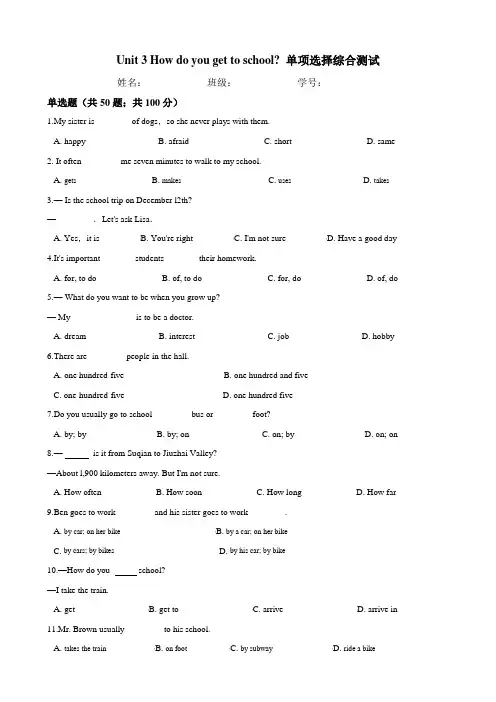
人教版七年级下册unit3--4单词测试题无答案
人教版英语七年级下3---4单元测试题一、单项选择( ) 1. Let’s to the zoo.A. go B. goes C. to go D. going( ) 2 . --do you like dolphin? –Because they are cute.A. HowB. WhenC. WhyD. What( ) 3. What animals do you like?A. other B. the other C. another D. others( ) 4. My pet dog likes around me.bA. run B. runsC. to running D. running( ) 5. Dogs are intelligent friendly, I like them very much.A. and, butB. but, andC. and, soD. but, so( )6. I want a teacher when I grow up. A. be B. am C. being D. to be ( ) 7. My brother wants me in a TV station.A. workB. worksC. to workD. working( ) 8. where your brother ?A. do, workB. does, workingC. does, workD. does, works ( ) 9. Let’s see the dolphins .A. first B. the first C. firstly D. a first ( ) 10. Julia is shy. A. a kind of B. kind of C. all kinds ofD. a kind( ) 11. She’s very shy, so please very quiet.A. isB. doC. areD. be( ) 12. Bill sleeps during the day, but he gets up and eats grass.A. nightB. at the nightC. at nightD. in night( )13.She is a little ugly, she is very cute.A. soB. butC. becauseD. though( )14.—What’s your sister? --.A. She’s a worker.B. She is nice.C. She’s cooking supper.D. She works in a shop.( )15. Jenny talking to people.A. doesn’t likesB. don’t likeC. doesn’t likeD. doesn’t liking二、完成下列句子1.你爸爸在哪工作?your father work?2 他是干什么的?his job?3. 长大后她弟弟想干什么?What does her brother want when he grows up?4. 来为我们工作,做一名记者吧。
人教新目标版七年级英语下册Unit 3~4过关测试卷含答案及听力材料
Unit 3~4过关测试卷(时间:90分钟满分:100分)班级:__________ 学号:__________ 姓名:__________ 成绩:__________一、听力理解(本大题分为A、B、C、D四部分,共25小题,每小题1分,共25分)A.听句子(共5小题,每小题1分,共5分)根据所听句子的内容和所提的问题,选择符合题意的图片回答问题,并将答案写在题前的括号内。
每小题听一遍。
( )1.How does Dave go to school?A B C( )2.Where does Mr. Smith work?A B C( )3.What can Sam do?A B C( )4.What is the rule in their school?A B C( )5.Where does Mrs. Green want to go?A B CB. 听对话(共10小题,每小题1分,共10分)根据所听对话的内容和所提的问题,在各小题所给的三个选项中选出一个最佳选项,并将答案写在题前的括号内。
每段对话听两遍。
听第一段对话,回答第6小题。
( )6.How far does Jeff live from Big Library?A.Eight kilometers.B.Ten kilometers.C.Eleven kilometers.听第二段对话,回答第7小题。
( )7.How does Linda go to school?A.On foot.B.By subway.C.By bus.听第三段对话,回答第8小题。
( )8.Where is Jack’s friend from?A.Canada.B.America.C.Japan.听第四段对话,回答第9小题。
( )9.Where does Katrina’s mother often go on Sunday?A.Center Zoo.B.City Park.C.Green Beach.听第五段对话,回答第10小题。
人教版初一七年级下册英语【单元测试 含答案】Unit 3 04
人教新目标七年级英语下册单元测试Unit3How do you get to school?一.单项选择1.This book_______Bob’s.Look!That’s his name.A.may beB.must beC.can’t beD.must not be2.What do you_________the transportation in your city?A.think aboutB.think ofC.think overD.think3.—_______does it take you to get to Beijing?—Twenty hours.A.How oftenB.How farC.How manyD.How long4.How do you get to school,______bike or____foot?A.by,byB.on,onC.by,onD.on,by5.-What do you think_______the idea?-I think it's funny.A.forB.withC.inD.of6.-How far is your cousin's school?-It's about two_______ride.A.hour'sB.hoursC.hours'D.hour7.—______does your father go to work?—He rides his bike.A.WhereB.WhenC.HowD.Why8.For some students,it’s difficult______school.A.to get toB.get toC.to getD.get9.Don't be_______!We can ask the policeman for help.A.tidyB.earlyC.happyD.afraid10.She has too_______homework this weekend.A.muchB.manyC.someD.a lot二.完形填空John is70years old.He likes smoking(抽烟).He smokes10cigars(雪茄烟)a(n)1.Today,he feels(觉得)bad,So he goes to see a2.The doctor looks at him and says."You don't3medicine(药).Go to a relaxing place and live there4a month,go to bed early,5a lot and just smoke one cigar a day,and then you will feel better." Soon John goes to a small6and lives there.A month later,the doctor7and says,"I'm glad to see you.You look very8 ""Oh,Doctor,"says John."I feel healthy now.I'm having a good time.I go to bed 9.I walk a lot.10smoking one cigar a day doesn't make feel good."1.A.hour B.day C.week D.month2.A.doctor B.teacher C.villager D.friend3.A.take B.like C.buy D.need4.A.at B.between C.for D.in5.A.walk B.run C.play D.think6.A.room B.village C.club D.library B.me C.them D.him8.A.healthy B.funny C.tidy D.freete st C.early D.first10.A.So B.But C.Or D.And三.阅读理解AAnnaI work in a bank from Monday to Friday.My house is near a park and is about ten kilometers from my office.I usually go to work by train.I usually get up at6:30a.m.and take the train at7a.m.It usually takes me about thirty minutes to get to my office.The train is quick and cheap.I'm never late for work.JoeI'm a student.My house is near a beautiful lake.My school is across from the lake.I can walk to school across a bridge.It takes me about thirty minutes.But I often go to school by boat, because it is more interesting.It takes me about twenty minutes.I'm a waiter.I work in a restaurant from Monday t Saturday.I often go to work by bus.It is about five kilometer from my house t the restaurant.It takes me about twenty five minutes to get to my workplace.Sometimes I'm late for work because the traffic is very busy.1.Anna usually arrives at her office at about a.m.A.6:30B.7:00C.7:30D.8:002.Joe often____to school.A.takes a busB.takes a trainC.walksD.takes a boat3.Nancy lives about____kilometers from her workplace.A.fiveB.tenC.fifteenD.twenty4.The underlined word“traffic”means____in Chinese.A.餐馆B.交通C.市场D.车站5.Which of the following is TRUE according to the passage?A.Anna is sometimes late for work.B.Joe lives near a river.C.Nancy works five days a week.D.Anna,Joe and Nancy go out by different means of transportation.BJoy always rides her bike to school.It’s four miles(英里)to school and it takes her about fifteen minutes.Joy likes riding to school.She says it’s good for her health.Edward usually goes to school by bus.He likes talking with his friend on the bus.It’s about ten minutes’journey to school by bus.Mary’s home is near to school.She usually walks to school.It’s about five minutes’walk.Mary says she likes taking walks after meal.1.How does Joy go to school?________________________________________________________2.How far is it from Joy’s home to her school?________________________________________________________3.Why does Joy like riding to school?________________________________________________________4.How long does it take Edward to get to school by bus?________________________________________________________5.How far is it from Mary’s home to her school?________________________________________________________四.根据提示填单词。
人教版英语 七年级下册 Unit 3--UNIT 4单项选择综合测试(含答案)
Unit 3 How do you get to school? 单项选择综合测试姓名:__________ 班级:__________ 学号:__________单选题(共50题;共100分)1.My sister is ________of dogs,so she never plays with them.A. happyB. afraidC. shortD. same2. It often ________ me seven minutes to walk to my school.A. getsB. makesC. usesD. takes3.— Is the school trip on December l2th?— ________.Let's ask Lisa.A. Yes,it isB. You're rightC. I'm not sureD. Have a good day4.It's important _______ students _______ their homework.A. for, to doB. of, to doC. for, doD. of, do5.— What do you want to be when you grow up?— My ______________ is to be a doctor.A. dreamB. interestC. jobD. hobby6.There are ________ people in the hall.A. one hundred-fiveB. one hundred and fiveC. one-hundred-fiveD. one hundred five7.Do you usually go to school ________ bus or ________ foot?A. by; byB. by; onC. on; byD. on; on8.—is it from Suqian to Jiuzhai Valley?—About l,900 kilometers away. But I'm not sure.A. How oftenB. How soonC. How longD. How far9.Ben goes to work ________ and his sister goes to work ________.A. by car; on her bikeB. by a car; on her bikeC. by cars; by bikesD. by his car; by bike10.—How do you school?—I take the train.A. getB. get toC. arriveD. arrive in11.Mr. Brown usually ________ to his school.A. takes the trainB. on footC. by subwayD. ride a bike12.For them,it's not easy ________ school every day.A. GetB. get toC. to get toD. to get13.—________ do you think of your school life?— It's very exciting (令人兴奋的).A. WhenB. HowC. WhyD. What14.Ma Huan likes _______with her friends.A. talkB. talksC. talkingD. talked15.Thank you _____ your bike.A. ofB. inC. toD. for16.— How did you get there?— I got there________, because it is only 1.5 kilometers.A. by bikeB. walkC. by trainD. in a bus17.—How do you usually go to work, Nancy?—I usually ______ to work.A. take the busB. by busC. on footD. by a bike18.—How many people were invited to the meeting?—About six ________.A. hundredB. hundredsC. hundred ofD. hundreds of19.______people are in the supermarket.A. HundredB. Three hundredsC. Three hundredD. Three hundred of20.Mrs. Brown is like a grandma _____ me.A. withB. inC. atD. to21.— is it from your home to school?—About two kilometers.A. How farB. How longC. How muchD. Howold22.A boat an help us ______________ the river.A. swimB. crossC. goD. play23.Mrs.Yang has ________ eleven-Year-old son.A. aB. anC. theD. /24.—Have a good day at school!—________.A. You, tooB. You're welcomeC. That's trueD. That's for sure25.Everyone thinks Judy ______ her mother.A. likeB. is likesC. likingD. is like26.Sam has a bike. He ______ it to school every day.A. takesB. ridesC. walksD. drives27.Bill _____ with his grandparents in a flat (公寓).A. driveB. drivesC. liveD. lives28.The funny film makes me________.A. laughB. to laughC. laughingD. to laughing29.It ________ about eight minutes for sunlight (阳光)to travel from the sun to the earth.A. takesB. spendsC. costsD. pays30.— Does Lisa walk to school?— _____. She goes by car.A. Yes, she doesB. No, she doesn'tC. Yes, she isD. No, she isn't31.—Where is the bed?—It's ________ the desk and the bookcase.A. inB. onC. betweenD. under32.—How does your mother ?—By bike.A. to thereB. get to thereC. go thereD. go here33.There is a bed ______ the desk ______ the sofa.A. from; toB. next; toC. between; onD. between; and34.More than two trees are planted in our neighbor-hood every year.A. hundredB. hundredsC. hundreds ofD. hundred of35.The party is at 7:00. I must _____ there at 6:50.A. getB. get toC. takeD. takes36.— ________ do you need to get home from here?— Only 10 minutes.A. How farB. How longC. How muchD. How old37.He walks ________ the subway station and takes the subway.A. onB. forC. toD. in38.—How long does it ________ them to get to school every day?—About half an hour.A. takeB. getC. haveD. need39.—is the nearest hospital from here?—Er, it's about ten minutes' walk.A. How longB. How farC. How often40.— How does your mother go to work?— She _____ her bike.A. takeB. takesC. rideD. rides41.The train station is ______ from the museum.A. 20 minutes' walkB. an hour on footC. three hoursD. 2 kilometer away42.Mr.Miller has a _______ daughter.A. five year's oldB. five-year-oldC. five years oldD. five-years-old43.—Please ________ slowly (慢地) when you pass(经过) a school.—OK.A. driveB. runsC. walksD. rides44. —Do you know the old woman funny glasses? —Yes, I do.A. byB. atC. ofD. with45.Tom often _______TV on weekends. Today is Sunday.He ________TV now.A. watch, is watchingB. watches, is watchingC. watches, watchingD. watches, watches46.My schoolbag is too old. I need to buy a(n) ________ one.A. bigB. tidyC. easyD. new47.It ________ Grace 30 minutes ________ to school by bus.A. take;goB. take;to goC. takes;to goD. takes;go48. Don't play a trick _______ him.A. atB. onC. toD. for49.They cross the river ________.A. by a ropewayB. in a ropewayC. on a ropewayD. at a ropeway50.It often takes me thirty minutes my homework.A. doB. doesC. to doD. doing答案1. B2. D3. C4. A5. A6. B7. B8. D9. A 10. B 11. A 12. C 13. D 14. C 15. D 16. A 17. A 18. A 19. C 20. D 21. A 22. B 23. B 24. A 25. D 26. B27. D 28. A 29. A 30. B 31. C 32. C 33. D 34. A 35. A 36. B 37. C 38. A39. B 40. D 41. A 42. B 43. A 44. D 45. B 46. D 47. C 48. B 49. C 50. CUnit 4 Don’t eat in class. 单项选择专题训练姓名:__________ 班级:__________ 学号:__________一、单选题(共50题;共100分)1.—Don't play near the classroom, please.—_______.A. Yes, I doB. Sorry, I won'tC. No, I don'tD. Not at all2.Don't music in the classroom in the hallways.A. listen; orB. listen to; orC. listen; andD. listen to; and3.Don't be late _____ class.A. atB. forC. inD. to4.It's warm (暖和的). You _________ to wear your coat (外套).A. mustB. don't haveC. haveD. don't have to5.—I have an English test this afternoon.—Good ________ to you.A. morningB. luckC. dreamD. number6.—Don't eat in class.— .A. Good ideaB. Sorry,Mr. Wang,I won'tC. Thanks a lotD. That sounds fun7.I hope you ________ to school early.A. to comeB. comeC. comingD. to coming8.—How do you like the scarf?—Very much. It _________ soft.A. smellsB. tastesC. feelsD. sounds9.—Must I start now?—No, you _______.A. mustn'tB. can'tC. needn't10.—________ arrive late for school.—I won't, Mom.A. Don'tB. NoC. Aren'tD. Can't11.Jack, you can't put your things everywhere. ________ your room ________.A. Feel; tidyB. Keep; tidyC. Feel; wellD. Keep; well12.Boys and girls, ________ learning and have fun!A. keepB. to keepC. keepingD. kept13.Sorry,you play basketball in the classroom.A. can’tB. don’tC. don’t have toD. aren’t14.Can we________ hats at school?A. put onB. to put onC. to wearD. wear15. be late school.A. Don't; toB. Don't; forC. Can't; toD. Can't; for16.This is a very interesting book with lots of new words. Please ______ it carefully.A. lookB. readC. look atD. see17.My teacher usually _________ a pair of glasses.A. puts onB. wearsC. withD. dress18.Can you _______ to an Englishman? Yes, if he can ________ Chinese.A. tell; speakB. speak; sayC. talk; speakD. tell; talk19.Our teacher is strict ______ us ______ everything.A. in; withB. in; inC. with; withD. with; in20.He has to help his mother breakfast on weekends.A. makeB. makesC. makingD. to makes21.— Dale, don't always ________ that old jacket. It looks terrible.— But I think it's cool, mom.A. take offB. dressC. put onD. wear22.— I will have an exam tomorrow.— ________.A. Thank youB. Good luckC. Congratulations23.The teachers hope all of us hand ________ our homework ________ time every day.A. up; inB. out; onC. on; inD. in; on24.— I can't go out on school nights. It's boring.— I can't go out, _____.A. alsoB. tooC. eitherD. or25.—Your hat is very _________. You must keep it clean.—OK. I will clean it.A. noisyB. quietC. goodD. dirty26.My parents are very strict ________ me ________ my lessons.A. at; inB. in; withC. with; inD. in; at27.— Can we play volleyball this evening?— _____. We have to see your grandma.A. Yes, they canB. Yes, we canC. No, we can'tD. No, they can't28.Tom, let's ________ Cindy's birthday party at 7: 00 p. m.A. arriveB. getC. arrive atD. get in29.—dressed now! We have to go in ten minutes.—OK, Mom.A. GettingB. GetC. To getD. Gets30.—Can they swim in the lake?—________.A. Yes, they doB. No, they don'tC. Yes, they canD. No, they didn't31.There are things you can do.A. manyB. muchC. a lotD. a little32.Mary practices _____ the piano every day.A. playB. to playC. playsD. playing33.I have homework to do and Jim has books to read.A. much; muchB. much; manyC. many; manyD. many; much34.The only one ________ a white shirt _________ the Open Day is our English teacher, Mr. Wang.A. is in; inB. is in; onC. in; onD. in; in35.Don't forget to wash your hands _________ you have meals.A. beforeB. untilC. thoughD. unless36.I like ________ story books, but my friend Alice likes ________ TV shows.A. reading; watchingB. seeing; looking atC. reading; seeingD. watching; seeing37.I usually arrive _____ the bus stop at 7:30 in the morning.A. inB. forC. toD. at38.Please remember _____ your room.A. cleanB. to cleanC. cleaningD. to cleaning39. –– ______ is it from your home to your school?––It’s about ten minutes’ walk.A. How farB. How longC. How oftenD. How much40.Nobody likes him because he often fights _________ his classmates.A. forB. withC. againstD. at41.Tigers wait ________ it is dark, then go out to look for food.A. sinceB. untilC. asD. because42.Mary _____ do her homework first after school.A. doesn't have toB. doesn't has toC. not have toD. has not to43.Is your cousin good at _______ ?A. swimB. swimsC. swimingD. swimming44.Alice wants to learn this Sunday.Can you help her?A. swimB. swimsC. to swimD. swam45.It's raining, so I_______ stay at home.A. can'tB. have toC. has toD. am46.Mike doesn't get on well with his sister and he often ________ with her.A. arguesB. playsC. worksD. talks47. let that dog come here.I am afraid of it.A. Doesn'tB. NotC. Don'tD. No48.— Tom, can you _____ the book to me?— Sure.A. bringB. cutC. buyD. play49.Don't talk ________ in the library.A. loudB. loudlyC. lowD. lowly50.—________ is today? —It's Monday.A. What dateB. What dayC. What’s the dateD. What’s the day答案1. B2. B3. B4. B5. B6. B7. B8. C9. C 10. A 11. B 12. A 13. A 14. D 15. B 16. B 17. B 18. C 19. D 20. A 21. D 22. B 23. D 24. C 25. D 26. C27. C 28. C 29. B 30. C 31. A 32. D 33. B 34. C 35. A 36. A 37. D 38. B 39. A 40. C 41. B 42. A 43. D 44. C 45. B 46. A 47. C 48. A 49. B 50. B。
人教版英语七年级下册 Unit3 — Unit4 阶段测试(含答案)
人教版七下Unit3-Unit4 阶段测试一、用所给单词的适当形式填空:(5分)1.It_______(be)six thirty in the morning now. The Smiths_______(be) always _______(have) breakfast at this time.2.—What _______Mary _______(do) on Sunday mornings?--- She often ______(clean) her room.3. Scott _______(work) very long hours.4.Either you or Tom _______(go)shopping with me.5.She _______(go) to bed at 9:30pm.二、基础知识:(10分)(1)按要求写出下列词语的形式:6. work(名词)7. mother(对应词)8. late(反义词) 9. long(反义词)10.good(最高级) 11.black(反义词)12.photo(同义词) 13.television(缩写形式)14.jobs(单数) 15.brother(所有格形式)(2)首字母填词(句)(5分)16. Miss Gao is i____ in hospital.17. Look! He is waiting for a bus at the bus s_____.18.We usually go to school at half p___ seven.19. One k____ is 1,000 meters.20. In China, bikes are the most p______ means of transportation.三、选择题:(30分)( )21、--How do you get to school, Han Mei? -- _____.A. By footB. On footC. On feet( )22、_____ do you get to school, Emma? I take a train.A. WhatB. WhenC. How( )23、Mary ____ her bike to school every day.A. takesB. ridesC. starts( )24、____ does it take you to get from home to school? Thirty minutes.A . How long B. How many C. How much( )25、How do the students ____ the world get to school?A. onB. aroundC. about( )26、In North America, most students go to school ____ the school bus.A. onB. byC. in( )27. It’s ___________________________ today.A. Wednesday, September 10thB. August 8th, MondayC. Saturday, 1 June( )28. She likes _________________ teacher, Miss Gao.A. her music’sB. her musicC. she music( )29. --_____________ do you have P.E.? ---On Monday afternoon.A. WhyB. HowC. When( )30. --__________ do you like music? ---Because it’s relaxing.A. WhyB. WhenC. How( )31. I’m _____________ you like green because it’s your favorite color.A. sorryB. sureC. not( )32. Miss Han teaches ___________ Chinese and we like ________ a lot.A. us, herB. our, sheC. us, she( )33. --_____________ do you like music? --Very much.A. HowB. WhyC. When( )34. It’s _________________ to play footbal l.A. funsB. a funC. fun( )35. He knows _________________ China.A. many aboutB. much aboutC. lot of about四、完形填空:(10分)My name is Li Ping. I am 36 student of No. 15 Middle School. Our school isn’t very big. It 37 about four 38 students.Every morning we come to school by bus or 39 bike. My home isn’t far from the school. So I always walk(步行) 40 .I am in Grade Two. There are four classes in Grade Two. 41 are fifty students in my class. Twenty-seven are boys. 42 are girls. We study Chinese, English, maths and 43 subjects. We have sports in the afternoon. Our teachers 44 very good teachers. They love45 work and love their students.( )36. A. a B. an C. the D. /( )37. A. have B. has C. there has D. there is( )38. A. hundred B. hundred of C. hundreds D. a hundred( )39. A. on B. to C. in D. by( )40. A. it B. school C. there D. here( )41. A. Here B. There C. Has D. Have( )42. A. Four B. Two C. Twenty-one D. Twenty-three( )43. A. other B. others C. the other D. the( )44. A. is B. are C. have D. am( )45. A. them B. they C. their D. theirs五、阅读理解:(10分)AAmerican schools begin in September after a long summer vacation(假期). There are two terms in a school year: the first term is from September to January, and the second is from February to June. Most American children go to public schools(分立学校). High school students take only four or five subjects at a time. They usually go to the same classes every day, and they have an assignment for every class. After class they have many activities. After high school, many students go to college.( )46. Most American children start school life in ______________.A. SeptemberB. FebruaryC. JuneD. January( )47. How many vacations do American children have each year?A. One.B. Two.C. Three.D. Four.( )48. Students in the high school have _____________ subjects at a time.A. fourB. fiveC. sixD. four or five( )49. Which of the following is false(错误)?A. In July students don’t need to go to school because of vacation.B. Students have the same classes every day.C. Students don’t have homework for every class.D. Most American children go to public schools.( )50. After class students _________________________.A. do homeworkB. go back homeC. have many activitiesD. go to moviesBI am a school girl. My brother and I are twins. We are both at school. We like school. My parents are both teachers. They work hard. My brother and I study at No. 1 Middle School. There are twenty-five boys and eighteen girls in our class.We go to school from Monday to Friday. We have no classes on Saturdays and Sundays. We usually get up at six, and have breakfast at 6:30. We come to school at 7:00. Classes begin at eight. We have four lessons in the morning and two in the afternoon. We have lunch at 12:15. At three fifty we have sports.We study Chinese, maths, English, geography, physics, history, politics and other lessons. We like Chinese. We like English, too. Some of us are good at it. We go home at 5:00. We have supper at 6:00. We do our homework at seven every evening and go to bed at half past nine, but sometimes we go to sleep at about ten.We work hard, we study for the people.( )51. My brother is ______________ and I am ______________.A. a worker, a studentB. a student, a workerC. a student, a teacherD. a student, a student( )52. We have _______________ at fifteen past twelve.A. breakfastB. lunchC. supperD. dinner( )53. We begin to do our homework from ________ to __________ every evening.A. Monday, FridayB. seven, nineC. school, homeD. six, eight( )54. There are _________ boys and ___________ girls in our class.A. 25, 20B. some, anyC. 25,18D. many, much( )55. Do they often have sports in the morning or in the afternoon?A. Yes, they do.B. No, we don’t.C. In the morning.D. In the afternoon.六、单词拼写:(10分)56. My __________________________________________(最喜爱的) sport is soccer.57. How many ______________________________(科目) do you learn in Grade One?58. She likes ___________________________________(科学) very much.59. I don’t like _______________________________(历史), it’s boring.60. Is English _____________________________________(难的)?61. I don’t like maths ______________________________(因为) it’s not interesting.62. P.E is very _______________________________(令人兴奋的), and we all like it.63. September 10th is _______________________________(教师) Day.64. Our teachers are very friendly and ________________________________(严格的).65. Are you ______________________________________(疲倦的) after class?七、句型转换:(10分)66. My science teacher is Mr. Wang.(对划线部分提问)_________________ _____________ ______________ science teacher?67. He likes the bag because he likes its colour.( 对划线部分提问)______________ ______________ he ______________ the bag?68. She likes green very much. (同义句)___________________ _____________ _________________ is green.69. I think that subject is boring.(同义句)I __________________ think that subject is ___________________.70. He goes to bed at about ten.(对划线部分提问)_______________ _______________ he ___________________ to bed?八、补全对话:(5分)A: Hi, Jack. What do you like doing after school?B: 71.A: Do you like to have a race with Class 2?B: 72.C: May I join your team too?A: 73.B: Who else is good at running?C: Charlie.A: Is he in the classroom?C: 74.B: Where is he now?C: 75.A: Let’s ask him to join us.B and C: OK. Let’s go.九、书面表达请根据下表的内容写一篇关于Li Lei的文章:(10分)_______________________________________________________________________________________________________________________________________________________________________________________________ _____________________________________________________________________________________________________________________________ _______________________________________________________________________________ _____________________________________________________________________________________________________________________________________________________________人教版七下Unit3-Unit4 阶段测试答案一、用所给单词的适当形式填空:(5分)1. is are having2. does do cleans3. works4. goes5. goes二、基础知识:(10分)(1)按要求写出下列词语的形式:6. works7. father8. early9. short 10. best 11. white 12. picture 13. TV 14. job 15. brother’s(2)首字母填词(句)(5分)16. ill 17. stop 18. past 19. kilo 20. popular三、选择题:(30分)21-25 BCBAB 26-30 AABCA 31-35 BAACB四、完形填空:(10分)36-40 ABAAB 41-45 DACBC五、阅读理解:(10分)A) 46-50 ABDCC B) 51-55 DBBCD六、单词拼写:(10分)56. favourite 57. subjects 58. science 59. history 60. difficult61. because 62. exciting 63. Teachers’64. strict 65. tired七、句型转换:(10分)66. Who is your 67. Why does he like 68. Her favourite colour is69. don’t interesting 70. When does go八、补全对话:(5分)71. I like running.72. Yes, that's a good idea.73. Sure.74. No, he isn't.75. He's on the playground.九、书面表达请根据下表的内容写一篇关于Li Lei的文章:(10分)略。
Unit3 -Unit 4单元测试2022-2023学年人教版七年级英语下册
初一年级(下)英语学科大练习(三)Unit 3 &Unit4 合卷满分:100 分27.You should do your homework28.It’s quite easy for me(quick). Then you can get relaxed. (go)to school every day.29.To keep healthy, my brother often does (exercise) in the morning.30.I have to stop (walk) outside, because it’s raining now.一、基础知识(共60 分)I.在下列各句的空白处填入一个适当的词,使句子意思完整、语法正确。
(20 分)31.Don’t be (noise) in the museum.32.Mom usually does the (dish) after dinner.1.—What’s forty and fifty? —It’s2.There are 1,000 meters in a3.I love my teacher because she is..a mother to me.33.It’s not easy (learn) math and English well.34.Mary often practices (dance) for an hour on Saturday.35.What a (relax) weekend I had!4. I want to _ the river by boat. It must be very interesting. 36. I am very _ (luck) to have a nice English teacher.5. My father has a new car. He wants to it to work tomorrow. 37. It’s(importance) for you to have breakfast every morning.6. —I want to know you come from. —Beijing. 38. Please wash your (dirt) clothes on Sunday.7.My alarm clock doesn’t work, so I have to buy a8.My sister and I get up early, because weone.far from school.39.Tom has time to make (he) bed on weekends.40.Mike’s mother is ill, so he (have) to cook for himself.9.There are three and sixty-five days in a year.10.We are late for class. Let’s a taxi.11.As a student, we must the rules at school.12.Everyone has to be _ in the library. We can’t talk there.13.Students in our school have to wear the school on school days.14.To keep healthy, we should wash hands meals.15.I have a lot of homework to do. After dinner, I c an’t relax, _.16.Don’t to music in class.17.My father is making dinner in the .18.Our math teacher is very with us, but everyone likes her.19.Boys, please keep your short, or you will have to go to the barber’s(理发店).20.Many of the students are late because of the traffic(交通).II.用所给词的适当形式填空。
Unit 3~4能力提升卷人教版英语七年级下册
Unit 3~4 能力提升卷一、单项选择.(15分)1.-How far is it from your home to school?-It's about twenty_________ walk.A. minute'sB. minutes'C. minutesD. minute2.-Do you know the_________ of the Confucius Institutes(学院)around the world?-More than three hundred, I guess.A. listC. numberD. country3.-What about_________ a rest?-OK! Let's go for a walk.A. to haveB. hadC. haveD. having4.Hurry up! If we miss_________ last bus, we'll have to get home by_________ taxi.A. a;/B. the; aC. the;/D. a; a5.It_________ Mr. Green an hour to fix up his bicycle yesterday.A. costB. paidC. spentD. took6.A_________ girl named Dong Xinyi looked after her disabled father,A. three-year-oldB. three-years-oldC. three years oldD. three year old7.Do you know_________ Zunyi or not tomorrow?A. whether are they leaving forB. whether they are leaving forC. if they are leaving forD. if are they leaving for8.-Must I go home?-No, you_________.A. can'tB. mustn'tC. have toD. needn't9.On weekends I usually go to the farm_________ my parents.A. to helpB. helpC. for helpingD. helping10.Mrs.White asked her son_________ with water.A. not playB. don't playC. not to playD. don't to play11.She was_________ tired because she did_________ housework today.A. too much; too manyB. much too; too muchC. too much; too muchD. too many; too much12.We have to get to the bus station_________ 6 o'clock, or we'll be late.A. onB. inC. byD. for13.We have to_________ uniforms at school.A. wearB. wearsC. put onD. puts on14.She has to help her mom_________ dinner today.A. makesB. makingC. madeD. make15.It's too dark. I_________ go home.A. canB. have toC. need D .may答案:1.B【解析】名词所有格,表示“二十分钟的步行”;另外,复数minutes的所有格形式为minutes',故选B.2.C【解析】由答语More than three hundred(超过上百个),可知问的是“全世界孔子学院的数量”,故选C.3.D【解析】句型What about doing sth?表示“做某事怎么样?”表达一种建议.4.C【解析】the last bus意为“最后一班公共汽车”;另外,by taxi“乘出租车”,中间不用冠词.5.D【解析】句型It took sb some time to do sth表示“做某事花费了某人多长时间”,故选D.6.A【解析】数词和名词合成的形容词,中间用连字符,名词用单数.故选A.7.B【解析】考查宾语从句.宾语从句要用陈述句语序,所以排除A、D选项;if不能与or not连用,故选8.D 【解析】must的问句否定回答用needn’t9.A【解析】动词不定式作目的状语.句意为“在周末我经常去农场帮助父母”.10.C【解析】考查ask sb to do sth,其否定结构是ask sb not to do sth,故选C.11.B【解析】本题考查too many, too much和much too三个短语的区别.too many意为“太多”,后接可数名词的复数;too much也意为“太多”,后接不可数名词; much too 意为“太;过于”,用来修饰形容词或副词.句中的tired是形容词,前面用much too 修饰;housework是不可数名词,前面用too much修饰,故选B.12.C【解析】由or we'll be late“否则我们会迟到”可以推测:我们必须在六点前到达汽车站.介词by意为“在······之前,不迟于”,故选C.13.A【解析】情态动词have to后接动词原形,所以排除B、D选项;put on强调“穿衣”的动作;wear表示“穿着”的状态,由句意可知应选A.14.D【解析】本题考查help sb(to)do sth,故选D.15.B【解析】It's too dark.意为“天太黑了”,是客观事实.只有have to表示客观上的“不得不,必须”,故选B.二、完形填空.(20分)My name is Li Ping. I am 1 student of No.15 Middle School. Our school isn't very big. It 2 about four 3 students.Every morning we come to school by bus or 4 bike. My home isn't far from the school. So I always walk(步行) 5 .I am in Grade Two, There are four classes in Grade Two. 6 are fifty students in my class. Twenty-seven are boys. 7 are girls. We study Chinese, English, math and 8 subjects. We have sports in the afternoon. Our teachers 9 very good teachers. They love 10 work and love their students.1.A.a B. an C. the D./2.A.have B. has C. there has D. there is3.A.hundred B. hundred of C. hundreds D. a hundred4.A.on B. to C. in D. by5.A.it B. school C. there D. here6.A.Here B. There C. Has D. Have7.A.Four B. Two C. Twenty-one D. Twenty-three8.A.other B. others C. the other D. the9.A.is B. are C. have D. am10.A.them B .they C. their D. theirs答案:1.A2.B3.A4.D5.C6.B7.D8.A9.B 10.C三、阅读理解.(36分)AEric is my brother. He is nine years old. He is a good student. But he cannot get up early. He sleeps until nine or ten in the morning, so he often arrives late for school.My father doesn't want him to be late for school, so he buys an alarm clock for Eric. He says to Eric, “You must get up when you hear the clock ring.”“Yes,Dad,” Eric says. After that Eric gets up at six when he hears the clock ring.One day my father forgot to wind up(上发条)the clock. And the next day Eric didn't get up at six. It was timefor breakfast. My father went to his room. Eric was in bed and his eyes were open. "“Why didn't you get up?” My father said angrily.“You told me I must get up when I heard the clock ring. And now I am waiting for the clock."根据短文内容,判断句子的正(T)误(F).( )1.Eric isn't a good student and he often arrives late for school.( )2. Eric's mother doesn't want him to get up late.( )3. Eric's father bought a clock for Eric because Eric likes it.( )4.One day the clock didn't ring but Eric got up early.( )5.Eric was waiting for the clock to ring.答案:1.F2.F3.F4.F5.TBAmerican boys and girls love to watch television. Some children spend six hours a day in school and four to six hours a day in front of the television set. Some even watch television for eight hours or more on Saturdays.Televisions are like books or films. A child can learn bad things and good things from them. Some programs(节目)help children to understand the news, others show people and places from other countries or other time in history. With television a child does not have to go to the zoo to see animals or to the ocean to see a ship. Boys and girls can see a play, a concert or a game at home.Television brings many places and events into our homes. Some programs show crime(犯罪)and other things that are bad for children, so parents sometimes help them to find other interesting things to do.6.Some children spend eight hours or more_________.A. studyingB. playing gamesC. watching TVD. helping their. parents7.On television children can see_________.A. gamesB. big animalsC. oceansD. almost everything8.Children usually spend_________ a day in school.A. six hoursB. more than eight hours.C. only a few hoursD. four hours9.“Television brings places and events into our homes." means_________.A. televisions makes things happen in homesB. we can know places and events without going to see themC. we can see houses and buildings on TVD. we can find them easily10. Parents sometimes help their children find other things to do when there is_________ for children.A. a bad programB. an animalC. a gameD. an uninteresting film答案:6.C7.D8.A9.B 10.ACThere are trains to carry people, trains to carry animals or carry things. There are fast trains and slow ones. Some trains go through hills. In big cities, the streets are usually very busy. So you can find trains under the ground. They are called subway in America. They carry people quickly in and out of the city. Can a train run over water? Yes, it can. There are many bridges over the rivers. The trains can easily run over the water. But it is not easy to build the bridges. Today's trains have dining rooms for people. You may eat something in them on the way if you are hungry. Trains are useful to men, women and children. Many children have model trains. With the model trains they can build their own rails (铁轨)and enjoy the wonderful world of trains.11.There are all kinds of trains. Here “all kinds of trains” means_________.A. fast trains and slow trainsB. many different kinds of trainsC. trains to go through hillsD. trains to carry people12. The trains carry people in and out of the big cities under the ground because_________.A. the streets are very busyB. the cities are bigC. the trains have dining roomsD. the cities are too small13.If you are hungry, you may go to_________ of the train to have something to eat when you are traveling by train.A. some roomsB. some shopsC. the dining roomsD. the station14.It's_________ for trains to run over the water but_________ to build bridges.A. easy; easyB. easily; not easyC. difficult; easilyD. easy; difficult15.Which of the following is WRONG?A. There are dining rooms in trains.B. There are fast trains and slow trains.C. The trains can only carry people.D. We can see trains under the ground.答案:11.B 12.A 13.C 14.D 15.CDPeople are often killed when they cross the road. Most of these people are old people and children. Old people are often killed because they usually can't see or hear very well. Children are often killed because they are not careful. They forget to look and listen before they cross the road. The only safe way to cross the road is to look both ways, left and right. So it is important to be careful when you cross the road.根据短文内容,选择最佳答案.16.People are often killed when they_________ the road.A. walk by the side ofB. stand byC. go from one side to the other side ofD. drive their cars on17.Children are often killed on the road because they_________.A. don't look and listen carefully before they cross the roadB. are very carefulC. can't see or hear very wellD. are quite young18. _________ are mostly killed on the road.A. Only old peopleB. Only young peopleC. Both old people and childrenD. Both men and women答案:16.C 17.A 18.C四、句型转换.(9分)1.He goes to bed at about ten.(对画线部分提问)_________ _________ he_________ to bed?2.Close the window, please.(改为否定句)_________ _________ the window, please.3.Don't be late for class.(改为同义句)You_________ _________ late for class.4.I have to play the guitar every day.(改为一般疑问句)_________ you_________ to play the guitar every day?答案:1.when does, go2.Don't close3.can't be4.Do,have五、从II栏中选出I栏各句的相应答语,将序号填入题前的括号内.(5分)I( )1.How far is it from your office to your home?( )2. When does he leave from home?( )3.How long does it take to get your home?( )4.How does she get to the office?( )5.How far do you live from school?IIA. I live 2 kilometers from school.B. She takes the bus.C. It takes two hours.D. At around9 o'clock.E. It's 10 miles.答案:1.E2.D3.C4.B5.A六、书面表达.(15分)阅读下列规则,然后写一篇短文来介绍Tom's rules.词数:40~60.Tom's rules:1.Get up at 6:00.2.Go to school at 6:15.3.Don't eat outside.4.Don't listen to music on school days.5. Don't watch TV on school nights.6. Be back home by 12;00 in the morning and by 9:20 in the evening.____________________________________________________________________________________________ ____________________________________________________________________________________________ ____________________________________________________________________________________________ ____________________________________________________________________________________________ ____________________________________________________________________________________________ 答案:Tom has many rules. He has to get up at 6:00 every morning. He must go to school at 6:15.He can't eat outside. He can't listen to music on school days and he can't watch TV on school nights. He must be back home by 12:00 in the morning and by 9:20 in the evening.。
(完整版)新人教版七年级英语下册unit3-4测试题
Unit 3 —4 测试题Ⅰ.单项选择 ( 20 分)( )1.We can eat in the dining hall. But we _______ eat in the classroom.( A. don ’ t B. didn ’ t C. can ’ t D. aren ’t )2. __________ Lucy and Kate go to school?A.HowB.How doesC.How doD.How are ( )3.__________ your father usually go to work by car? ( A.Do B.Is C.Does D.Are)4. How do they go out tomorrow, ______ bike or ____ foot? ( A. by, by B. on, on C. by, on D. on, by )5. ____________ does it take her to get to school? ----It takes her around ________ minutes , twenty —fiveA. How far,twenty —fiveB.How long (C.How far, twenty fiveD. How long,twenty five )6.I have ______rules in my home. We have______homework to do today.A. too many, too muchB. too much , many too (C. too many, much tooD. much too, many too )7.-Can your brother swim? -________. ’ t B. Yes, please . A. Yes, he canC. No, he can ’ tD. Yes, he does( )8. How ______ is it _______ your school to the Children ’ s Palace?( A. long, to B. far, to C. long, from D. far, from)9.He ’ s never ________ class. ( A. arrive B. late for C. arrive late D. late)10. There is a river between his school and home, so he takes a _____ toschool every day. C. boat D. train ( A. bus B. taxi)11. Mr Wang leaves ________ Guangzhou today. ( A. to B. with C. in D. for )12. -________ is it from your home to school?-Three miles. ( A. How far B. How much C. How soon D. How long)13. — ________________?— Yes. I don ’ t know how to get to the hospital.A. Excuse meB. Can I help youC. What should I doD. What ’ s the matter ()14. Please listen ___ the teacher carefully ( 仔细 ). (A. toB. onC. atD. of )15. — How many people are there in the house? — ______.A. Hundred ofB. Two hundredsC. Two hundreds ofD. Two hundred ()16. I often go to work ________. D. on bike (A. ride my bikeB. by bikeC. by a bike )17. It will take the men half a year ________ the work. (A. doB. doingC. to doD. does )18. Molly goes to school _______ her father ’cars and Larry goes toschool ______ foot. ( A. by; on B. in; by C. in; on D. on; by )19. Don ’t_____ TV after class.1A. watchB. watchingC. to watchD. to watching( )20. --- Don ’trun in the hallways.--- ______, I won ’tdo it again. A. Sorry B. Excuse me C. Thank you D. NoII. 完型填空:( 10分)I work in a school library. There are many kinds of 1 in it. For example,books 2 English, science, history, music, and so on . You 3 do some reading orborrow( 借入 ) books from it. But there are some 4 . You must obey (恪守 )them.When you are reading in the library, you have to 5 quiet. Don ’t talkloudly 6 make any noise(吵闹 ). You 7 listen to music, either( 也). You 8 takeyour bags or wet umbrellas into the library. 9 or drink in the library. You canborrow books from the library, 10 you can ’tlend( 借出 ) them to others. Youhave to take good care of ( 好好保存 ) them and return them on time( 准时送还 ). If the library books are lost, you have to pay for them.( ) 1. A. people B. books C. magazines D. newspapers ( ) 2. A. in B. for C. aboutD. on ( ) 3. A .can B. have toC. can ’tD. don ’t ( )4. A. way B. rules C. ruleD. ways ( )5. A. be B. are C. /D. have ( )6.A. and B. but C. orD. because ( )7.A .don ’t B. can ’t C. have to D. can( )8. A. aren ’t B.don ’t C. can ’t D. can( )9. A. No eating B. Not eatC. Don ’teatD. Can ’teat ( )10.A. but B. if C. whenD. where III. 阅读短文,选择正确答案。