
人教八年级英语上册-Unit 7 Section A Grammar Focus-3c(附音频)
in the future与in future
“在将来,未来”。多指较遥远的将 in the future 来的某一时间,在时间概念上一般不
包括现在。
in future
“从今以后”。相当于from now on; “不久的将来”,相当于in the near future或soon。多指从现在开始近期的 将来,在时间上包括现在。
They won’t go to school.
Countable nouns
Uncountable nouns
There will be more people. There will be more pollution. There will be fewer trees. There will be less free time.
3). be going to 含有“计划,准备”的意思, 而will则没有计划性。 例:She is going to lend us her book. He will be here in half an hour.
4). 在有条件从句的主句中,一般不用 be going to, 而用will。 例:If any beasts comes at you, I’ll stay with you and help you.
Unit 7 Will people have robots?
Section A Grammar Focus-3c
Lead-in
I will be …
He/she will be …
Talk
Five years ago
He was … He played …
He had …
Today
He is … He plays … He has …
5. 一般将来时常用的时间状语:
tomorrow 明天
next week 下周
next month 下个月 next year 明天
soon 不久
the year after next 后年
the day after tomorrow 后天
the week after next 下下周 in the future / in future 将来 in+一段时间……之后 from now on 从今往后 this year/term/week … 今年/这个学期/这周……
3. I think that England ____ next time.
A. will win B. won C. is winning D. wins
4. There __________ a meeting tomorrow
afternoon.
A. will be going to
B. will going to be
(2)否定式:在will/shall/be后加not。 例:这些男孩今天下午不踢足球。 The boys won’t play football this afternoon.
(3)一般疑问句:将will/shall/be提到主语前面。 例:学生们要去看比赛吗? Will the students watch the match?
(4) 我们什么时候再见面? When shall we meet again?
4. be going to 和 will 的区别: 1). be going to 表示近期、眼下就要发生的事情, will 表示的将来时间则较远一些。 例:He is going to write a letter tonight. He will write a book one day.
2). be going to 表示根据主观判断将来肯定发生的 事情,will表示客观上将来势必发生的事情。 例:He is seriously ill. He is going to die. He will be twenty years old.
3b Complete the predictions with what you
think will happen.
1. Kids study at school now. In 100 years, __k_id_s__w_i_ll_ _s_tu_d_y__a_t_h_o_m__e_o_n__c_o_m_p_u_t_e_r_s_. ____
Exercise
1. I think kids will study at home on computers
____ ten years.
A. at B. for
C. after D. in
2. Hurry up! The train ____ in two minutes.
A. go B. went C. will go D. goes
2. In 100 years, there will be _m__o_r_e_ cars because there will be _m__o_r_e_ people in the cities.
3. There will be _f_e_w_e_r_ jobs for people because _m__o_r_e_ robots will do the same jobs as people.
trees.
Will people use money in 100 years?
No, they won’t. Everything will be free.
Will there be world peace? Yes, I hope so.
Kids will study at home on computers.
No, I shall not. / No, I won’t.
3. 一般将来时的句式结构:
(1)肯定式: ①主语+will/shall +动词原形+其他. ②主语+be going to+动词原形+其他.
will用于各种人称,shall用于第一人称,be随人称、 数和时态的变化而变化,will在人称代词后常缩写 为’ll。
4. I think there will be _m__o_r_e_ cities because people will build _m__o_r_e_ buildings in the country.
5. In 50 years, people will have _m__o_r_e_ free time because there will be _f_e_w_e_r_ things to do.
C. is going to be
D. will go to be
5. — ________ you ________ free tomorrow? — No. I ________ free the day after tomorrow. A. Are; going to; will B. Are; going to be; will C. Are; going to; will be D. Are; going to be; will be
Language points
一般将来时
1. 一般将来时的概念:表示将来某个时间要发生的动 作或存在的状态,或将来经常、反复发生的动作。 例:下周我将回家乡。 I will go back to my hometown next week.
2. 基本句型:
肯定句: 主语 + shall / will + v.原形 否定句: 主语 + shall / will +not + v.原形 一般疑问句: shall / will +主语 + v原形 特殊疑问句: 特殊疑问词 + 一般疑问句 简略回答: Yes, I shall. / Yes, I will.
3. People now usually live to be about 70-80 years old, but in the future _p_e_o_p_le__w_i_ll_l_i_v_e_t_o_b_e__2_0_0_y_e_a_r_s_o_l_d_.
4. Families usually spend time together on weekends, but maybe in 200 years _e_v_e_r_y_d_a_y_c_a_n__b_e_w__e_ek_e_n_d__, _b_e_ca_u__se__th_e_y__h_a_v_e_r_o_b_o_t_s_t_o_d__o_e_v_e_r_y_th_i_n_g_._______
In five years
He will be … He will play … He will have …
New words
n.和平 /piːs/ peace n.海;海洋 /siː/ sea v.建筑;建造 /bɪld/ build
v.天空 /skaɪ/ sky
Grammar Focus
Cities will be more polluted. What will the future be like? And there will be fewer
’ll = will won’t = will not
3a Fill in the blanks with mouture, there will be _l_e_s_s_ fresh water because there will be _m__o_r_e_ pollution in the sea.
英语人教版八年级上册Unit7 Section A Grammar Focus
Unit7 Willpeople have robots?Section A Grammar focus平乡四中赵婷婷学习目标1. 归纳、梳理一般将来时用法和基本句子结构。
2.了解will与be going to 的区别学习重点:一般将来时的用法和基本句子结构学习难点:一般将来时的运用教学过程1.导入:谈话导入,并将全班同学分A、B、C三组。
2.合作探究:小组活动。
(1)仿照例句,在49-50页找出同样的句子。
A、B、C三组分别寻找对应的句子类型。
A.People will have robots in their homes in 100 years.B.People won't use money in the future.C.Will people use money in 100 years ?(2)根据以上句子回答下列问题。
1).含义2).助动词will后的动词形式3).助动词wil受主语的人称和数的影响吗?4).一般将来时肯1定句、否定句和一般疑问句的句子结构5).常用的时间状语有什么3.拓展.观察下面两组句子,比较will与be going to 用法有什么异同?I'm going to learn another foreign language next yearWe are going to make the subway better.Cities will be very big and crowded in the future.She will be 8 years old next year.We will have robots in our homes in 100years.4.小结一般将来时的含义,句子结构,常用时间状语Will 与be going to 的异同5.课堂练习(PPT)板书:Unit7 Willpeople have robots?Section A Grammar focus含义:表示将来要发生的动作或存在的状态。
人教版英语八年级上册 Unit7 SectionA(Grammar Focus-3c)精品教案
〔最新版〕Unit7 SectionA〔Grammar Focus-3c〕精品教案一、教学目标:1. 语言知识目标:1) 学习掌握以下词汇:peace, sea, sky2) 进展一步复习稳固运用Section A 局部所学的生词和词组。
3) 进一步学习运用所学的知识来陈述自己对将来的看法;学会谈论自己的对将来的预言。
4) 掌握情态动词will来表达一般将来时态这一语法知识;2. 情感态度价值观目标:通过引导学生展望未来,及对未来生活的设计,来到达前景教育的目的,同时也通过对前景的设想,让学生在潜移默化中反省自己的现状,使之对目前的学习、生活习惯作适当的调整,并不断的改善自己的现状,使学生的理想观和价值观更为科学,更具开展价值。
二、教学重难点1. 教学重点:1) 进一步学习运用所学的知识来陈述自己对将来的看法;学会谈论自己的对将来的预言。
2) 掌握情态动词will来表达一般将来时态这一语法知识;并运用所学的知识来表达将来的活动。
2. 教学难点:掌握情态动词will来表达一般将来时态这一语法知识;三、教学过程Ⅰ. Warming- up and revision1. Have a dictation of the new words learned in the last class.2. Ask some Ss to give some predictions.T: What’s your prediction about the future?S1: There will be less free time.S2:There will be more pollution.3. Role-play the conversation in 2d.Ⅱ. Grammar Focus.1. 学生阅读Grammar Focus中的句子,然后做填空练习。
①将来会是什么样子?② What ______the ____ be _____?城市污染将会更多。
Unit7SectionA(GrammarFocus-3c)教案人教版英语八年级上册
Unit7 SectionA(Grammar Focus3c)教学目标1.掌握重点单词、短语、句型2.用助动词will来表达将来时,并能熟练运用there be句型表达将来时3.明确区分可数名词和不可数名词;正确使用more,less,fewer教学难点1. will构成的一般将来时态的陈述句、否定句、疑问句及回答。
2. There be句型的一般将来时。
教学过程一、Lead inWhat will happen 100 years later?There will be …将会有……There will be fewer trees.There will be less water.ObjectivesTo learn new words peace, sea, build, skyTo master the use of future tense with willSelflearning1. Students look at Grammar Focus, try to make summary the use of future tense with willl (2')2. Have a check.(2’)3aFill in the blanks with more, less or fewer. (P 51)1. In the future, there will be _____ fresh water because there will be ______ pollution in the sea.2. In 100 years, there will be_______ cars because there will be ______ people in the cities.3. There will be_______ jobs for people because_______ robots will do the same jobs as people.4. I think there will be _____ cities because people will build _____ buildings in the country.5. In 50 years, people will have _____ free time because there willbe _____ things to do.3bplete the predictions with what you think will happen. (P 51)1、Kids study at school now. In 100 years,___________________________________2. I sometimes see blue skies in my city, but in the future________________________3. People now usually live to be about 7080 years old, but in the future汉译英。
Unit+7Section+A+Grammar+Focus 人教版英语八年级上册
( C )7.A.are
B.were
C.will be
Others can do the same jobs 8 people over and over again and they
will never get tired.They will help people do all the heavy and difficult jobs
I think there will be more tall buildings and fewer cars in the future.
三、语法选择
Robots are helpful for people st weekend, I went to a
show.There were all kinds of 1 on show in the hall.They 2 lots of
(如③)
3.那个男人说明天将会下大雨。The man says it will rain heavily tomorrow .
4.比尔将在两小时后完成他的工作。Bill will finish his work in two hours .
三、一般将来时的注意事项 ▶观察 ①I'm going to watch that football match this evening.今天晚 上我打算看那场足球赛。 ②There will be a football match this evening.今天晚上将有一场 足球赛。 ③The new term starts on September 1st.新学期将于9月1日开始。 ④We will go hiking if it doesn't rain tomorrow.如果明天不下雨,我们 将去远足。
Unit7Section A (Grammar Focus-3c)课件人教版英语八年级上册

4. Families usually spend time together on weekends, but maybe in 200 years, _e_v_e_ry__d_a_y_c_a_n__b_e_w__e_e_k_e_n_d_,_b_e_c_a_u_s_e_t_h_e_y_h_a_v_e__r_o_b_o_ts__to__d_o_e_v_e_r_y_t_h_in__g_. __
We will have a school trip tomorrow. We will go to Green Park. We will plant trees there. we won’t come back for lunch.
1. 肯定句: 主语+__w_i_ll__ +__V_._原__+其它;
句型转换
1. I will call you this evening. (改为否定句) I won’t call you this evening.
2. Sally won’t visit the Great Wall tomorrow. (改为肯定句) Sally will visit the Great Wall tomorrow.
will be free.
Will there be world peace? Yes, I hope so.
Kids will study at home on computers.
人教版八年级上册英语Unit 7 Section A(Grammar focus-3c)-word文档
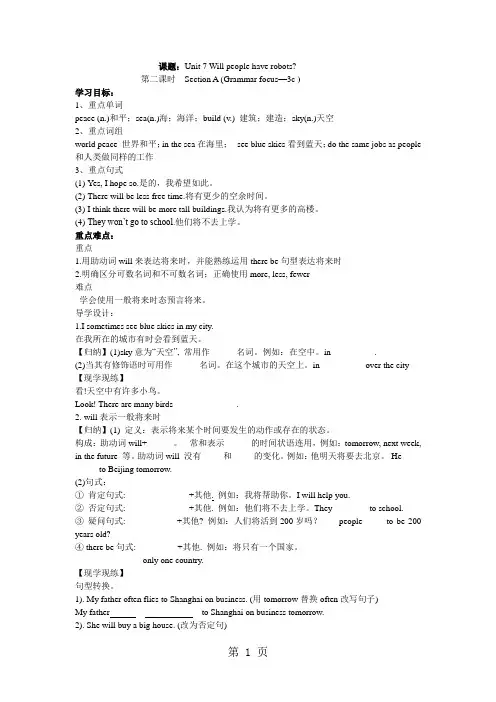
课题:Unit 7 Will people have robots?第二课时Section A (Grammar focus—3c )学习目标:1、重点单词peace (n.)和平;sea(n.)海;海洋;build (v.) 建筑;建造;sky(n.)天空2、重点词组world peace 世界和平;in the sea在海里;see blue skies看到蓝天;do the same jobs as people 和人类做同样的工作3、重点句式(1)Yes, I hope so.是的,我希望如此。
(2)There will be less free time.将有更少的空余时间。
(3)I think there will be more tall buildings.我认为将有更多的高楼。
(4)They won’t go to school.他们将不去上学。
重点难点:重点1.用助动词will来表达将来时,并能熟练运用there be句型表达将来时2.明确区分可数名词和不可数名词;正确使用more, less, fewer难点学会使用一般将来时态预言将来。
导学设计:1.I sometimes see blue skies in my city.在我所在的城市有时会看到蓝天。
【归纳】(1)sky意为“天空”, 常用作______名词。
例如:在空中。
in ____ _____.(2)当其有修饰语时可用作______名词。
在这个城市的天空上。
in ____ _____ over the city 【现学现练】看!天空中有许多小鸟。
Look! There are many birds ____ _____ ____.2.will表示一般将来时【归纳】(1) 定义:表示将来某个时间要发生的动作或存在的状态。
构成:助动词will+______。
常和表示______的时间状语连用,例如:tomorrow, next week, in the future 等。
人教版英语八年级上册Unit7SectionAGrammarFocus3c教学设计
-句子改写:将一般过去时的句子改写为过去进行时的句子。
2.结合课堂所学,编写一段小对话,至少包含三个过去进行时的句子,并使用本节课所学的词汇和短语。
-要求:对话内容要贴近生活,能够体现过去进行时的时间背景。
3.观察并记录生活中至少三个使用过去进行时的场景,以日记或小故事的形式呈现。
(一)教学重点
1.掌握过去进行时的构成和用法。
2.能够运用过去进行时进行情景交际。
3.掌握本节课所学的词汇和短语,如:practice, swimming, at 9:00, quarter past nine等。
(二)教学难点
1.区分一般过去时与过去进行时的用法。
2.在实际语境中灵活运用过去进行时。
2.方法目标:采用任务型教学法,将语法知识融入到真实的语境中,让学生在实际的语言环境中感知、体验、运用语法知识。同时,引导学生通过观察、分析、总结等学习方法,发现并掌握语法规则。
(三)情感态度与价值观
1.情感目标:通过学习本节课,培养学生积极向上的生活态度,鼓励学生参与体育活动,增强身体素质。同时,教育学生珍惜时间,合理安排自己的生活和学习。
2.技能目标:培养学生运用过去进行时进行情景交际的能力,提高学生的听说读写综合运用能力。通过小组合作、角色扮演等活动,使学生能够熟练运用所学知识进行日常交流。
(二)过程与方法
1.过程目标:通过多媒体展示、情景创设、小组合作、角色扮演等教学活动,激发学生的学习兴趣,引导学生积极参与课堂,提高学生的课堂参与度。
3.提高学生的听说读写综合运用能力。
教学设想:
1.创设情境:以学生熟悉的生活场景为背景,如体育活动、日常作息等,引导学生关注过去进行时,激发学生的学习兴趣。
Unit7SectionAGrammarFocus-3c课件人教版英语八年级上册
We can use less water and plant more trees. Everyone should play a part in saving the earth.
2d Role-play the conversation
Nick: What are you reading, Jill?
_l_e_s_s_beer.
3a Fill in the blanks with more, less or fewer.
1. In the future, there will be l_e_s_s____ fresh water because there will bemore _____ pollution in the sea.
be fewer trees and the environment will be in greats bad! Will we have to move to other planets? Jill: Maybe. But I want to live on the earth. Nick: Me, too. Then what can we do? Jill: We can use less water and plant more trees. Everyone should play a part in saving the earth.
3. People now usually live to be about 70-80 years old, but in the future_____________ _p__eo__p_le__w_i_ll_l_iv_e__to__b_e_2_0_0__y_e_a_r_s_o_ld__. _____
Unit7SectionAGrammarFocus3c课件人教版八年级英语上册
5. There ___C____ a meeting tomorrow afternoon.
A. will be going to
B. will going to be
C. is going to be
D. will go to be
观察表格more, less, fewer各搭配什么名词?
Countable nouns There will be more people.
(3)Mrs Green will do some shopping tomorrow afternoon. (对画线部分提问)
___W__h_a_t_w_i_l_l _ Mrs Green ____d_o___ tomorrow afternoon? (4)The children play tennis every Sunday afternoon. (用next Sunday afternoon改写句子) The children _w__il_l_p_l_a_y_t_e_n_n_is___ next Sunday afternoon.
D. are going to be
3. Hurry up! The train ____C____ in two minutes.
A. go B. went C. will go D. goes
4. I think that England ____A___ next time.
A. will win B. won C. is winning D. wins
Uncountable nouns There will be more pollution. There will be less free time.
Unit 7 Section A Grammar Focus-3c 课件 人教版英语八年级上册
the year after next 后年
the week after 式结构
肯定句: 主语 + will + v.原形 + 其他. 否定句: 主语 + will not/won’t + v.原形 + 其他.
例句:她下周五去看牙医。 She ___w_il_l__s_eea dentist next Friday. 她下周五不去看牙医。 She _w__o_n_’t_ _s_e_e_ a dentist next Friday.
一般疑问句: Will +主语 + v.原形 + 其他?
肯定回答: Yes, 主语 + will. 否定回答: No, 主语 + won’t. 例句:50年后,我们会有更多的空闲时间吗?
—_W__ill_ we _h_a_v_e _m_o_r_e free time in 50 years? 是的,我们会有。/ 不,我们不会有。
2)表示将来经常或反复发生的动作。 ► 从现在起,我每天都来。
From now on, I _w__i_ll_ _c_o_m__e every day.
’ll = will
你以前还学过哪些
won’t = will not 缩写形式呢?
I’m =I am
There’s = there is
You’re = you are There’re = there are
—_Y_e_s_, we w__il_l_. / __N_o_, we _w_o__n_’_t .
一般疑问句: Will +主语 + v.原形 + 其他?
肯定回答: Yes, 主语 + will. 否定回答: No, 主语 + won’t. 例句:100年后,人们还会使用钱吗?