
牛津译林版英语七年级上册Unit6 Grammar参考教案
Unit6 Grammar参考教案
Teaching aims:
1. To recognize and use countable nouns.
2. To master the rules of forms the plural forms of countable.
3. To master how to show the amounts of uncountable nouns.
Teaching important points:
To master the rules of forms the plural forms of countable.
Teaching difficult points:
To master how t o show the amounts of uncountable nouns.
Teaching methods: Situation and Communicative approach
Teaching aids: pictures, record and multimedia
Teaching procedures:
Step1 Presentation
1.Show some pictures of different kinds of foods to the students. Teacher points at an
apple, asking: What’s this? S : It’s an apple.
Write “an apple” on the blackboard. Present “a banana” in the same way.
2. Let students watch and say the differences b etween “an apple” and “a banana”.
Teacher asks : How to use “a” and “an”.
2.Teacher also points at two cakes and asking “What are they?”Ss : They are two
cakes .”
Write “two cakes’ on the blackboard and circle “s’. Let students read and think “Why add “s”?
3.Show more words on the blackboard and ask students to say out their plural.
4.Teacher says :most countable nouns add “s” to change the m into plural. What about
another countable nouns? Let students look at the table on page 73 and have a discussion in groups of 4. Ask : How to change them into plural forms? Get the students to find the rules
5.Present : write the rules of forming the plural forms of countable. Ask students read
the table on page120. Pay attention to “s” and “es” pronunciation ,let stud ents read after the teacher.
Step2 .Exercise
Give some countable nouns for the students to change them into the plural forms. Step3.Presentation
1. Show a bottle of water , and ask :What is it? It’s water. But can we say it’a water? Ss answer “No”. T: Because water is uncountable noun. Write “water” on the blackboard.
T: Now, can you tell me some more uncountable nouns? Ss answer .
Write “ juice rice tea meat milk chicken bread” on the blackboard, let students read.
2. Show two bottles of water to the students and ask students :
Can we say two waters ? S: No , why? What can we say about it ?
Get the students to look at the pictures on the page74 and find the method of describing.
3. Show some uncountable things for the students to describe ,and teach the new words: Packet salt tea kilo carton
4. Get the students to find more uncountable things in groups.
T: When we talk about the amount of the uncountable nouns, we can use nouns before them.
Step4: Practice
1.Get the students to ask and answer with the pictures on tpage74 like this;
plete the dialogue on page74, practice in pairs. Divide all the st udents into
groups to read the dialogue.
3.Get the students to make up similar dialogue with nouns in them.
Step5: Homework
How to show the amounts of uncountable nouns.
Do the exercise.。
牛津译林版英语7AUnit6Grammar教学设计
5.鼓励学生在日常生活中的英语表达中,尽量运用所学时态,提高英语实际运用能力。
五、作业布置
为了巩固学生对本章节一般现在时、现在进行时和一般将来时的掌握,以及提高他们的实际应用能力,特布置以下作业:
1.完成教材Unit 6 Grammar部分的练习题,包括填空、选择、改错等题型,要求学生在规定时间内独立完成。
4.通过头脑风暴活动,让学生列举更多关于日常习惯和正在进行的动作的例子,为新课的学习做好铺垫。
(二)讲授新知
1.教师结合教材内容,讲解一般现在时、现在进行时和一般将来时的概念和用法。
2.通过示例句子和情境,让学生理解并区分这三种时态的用法,如:
-一般现在时:描述日常习惯、客观事实,如:“I always get up at 6:00 in the morning.”
四、教学内容与过程
(一)导入新课
1.教师通过播放一段关于日常生活的视频,引导学生观察并描述视频中人物的动作和状态。
2.学生观看视频后,教师邀请他们分享观察到的内容,如:“The man is reading a book.”或“The girl is playing with her cat.”
3.教师根据学生的回答,板书一般现在时和现在进行时的句子,引导学生回顾这两种时态的用法。
(2)新授:结合教材内容,以任务型教学法引导学生学习一般现在时、现在进行时和一般将来时的用法。
(3)练习:设计形式多样的练习题,让学生在不同场景中运用所学语法知识,提高他们的实践能力。
(4)巩固:开展小组讨论、情景剧表演等活动,让学生在实际运用中巩固所学知识。
(5)拓展:鼓励学生课后收集与单元话题相关的素材,进行拓展学习,提高他们的自主学习能力。
初中英语七年级上册(牛津译林版)Unit6Grammar优秀教学案例

4.知识与技能、过程与方法、情感态度与价值观的综合培养:本案例在教学过程中注重培养学生的知识与技能,同时也关注他们的过程与方法,情感态度与价值观的培养,使得学生在全面发展的基础上,提高了英语语法的学习效果。
3.培养学生勇于表达、乐于交流的合作精神,增强他们的自信心。
4.通过英语学习,让学生认识到一般现在时态在实际生活中的重要性,提高他们对英语的实际运用能力。
三、教学策略
(一)情景创设
1.利用实物和图片:通过展示教室里的物品、人物图片等,让学生直观地感知一般现在时态的运用场景,激发学生的学习兴趣。
2.创设生活情境:设计一些与学生日常生活相关的问题,如描述自己的家庭成员、兴趣爱好等,让学生在真实语境中运用一般现在时态。
2.通过真实语境的创设,让学生在实践中感知一般现在时态的用法。
3.设计具有针对性的练习题,让学生在练习中巩固所学知识,提高语法运用能力。
4.组织小组合作学习,培养学生的团队协作精神和沟通能力。
(三)情感态度与价值观
1.激发学生对英语学习的兴趣,让他们在轻松愉快的氛围中掌握一般现在时态。
2.培养学生积极思考、主动探究的学习态度,提高他们的自主学习能力。
(四)反思与评价
1.让学生自主总结:在课堂的最后阶段,让学生自主总结一般现在时态的构成规则和用法,加深他们对知识的理解。
2.设计课后作业:布置一些与一般现在时态相关的课后作业,让学生在实际运用中巩固所学知识。
3.评价与反馈:对学生的学习过程和成果进行评价,及时给予反馈,鼓励他们持续进步。同时,关注学生的情感需求,关心他们的学习进步,为学生提供个性化的指导和支持。
牛津译林版英语7AUnit6Grammar教学设计
b.创设校园生活场景,让学生用英语描述自己和同学的学习、活动情况,提高学生在实际语境中运用时态的能力。
2.利用多媒体教学资源,如动画、图片、视频等,辅助讲解语法知识点,帮助学生形象地理解时态的概念和用法。
5.课后作业设计要富有针对性、拓展性和趣味性,让学生在课后继续巩固所学知识,提高学生的自主学习能力。
a.布置一些与时态相关的写作任务,如写一篇关于自己的日常生活的短文,要求运用所学时态。
b.推荐一些英语学习网站、APP等资源,让学生在课后自主练习,拓展学习视野。
四、教学内容与过程
(一)导入新课
1.教学活动设计:教师以一首英文歌曲《The wheels on the bus》作为课堂导入,让学生在轻松愉快的氛围中进入学习状态。同时,歌曲中包含了本节课所要学习的三种时态(一般现在时、现在进行时、一般过去时),为接下来的语法学习做好铺垫。
2.教学过程:
a.教师发放练习题,包括填空、选择、改错等类型;
b.学生独立完成练习题,教师巡回指导;
c.教师选取部分学生的答案进行展示和讲解,纠正错误;
d.学生互相批改练习,共同提高。
(五)总结归纳
1.教学活动设计:教师引导学生回顾本节课所学内容,总结三种时态的用法,并进行课堂小结。
2.教学过程:
a.教师提问:“What have we learned today?”,引导学生回顾所学时态;
5.通过课堂讲解、例句展示、练习巩固等多种方式,让学生逐步掌握语法知识点。
(三)情感态度与价值观
在本章节的教学中,教师将关注学生的情感态度和价值观培养,使学生在学习语法知识的同时,形成以下情感态度和价值观:
牛津译林版七年级英语上册Unit6Grammar1教学设计
五、作业布置
在课堂教学结束后,我将会布置针对本节课内容的家庭作业,以帮助学生巩固所学知识,并促使他们在课后进行自主学习。作业的布置需要具有针对性、多样性和适量性,以满足不同学生的学习需求。
1.针对一般现在时态的构成和用法,我将会布置一些填空题和选择题,让学生通过练习来加深对一般现在时态的理解和运用。例如,填空题可以要求学生根据给定的情境,填入正确的一般现在时态动词形式;选择题可以要求学生选择正确的一般现在时态句子,以描述某个人的特点或习惯。
此外,学生的学习水平和学习能力存在差异,有的学生可能需要更多的练习和巩固,而有的学生可能需要更多的挑战和拓展。因此,在教学过程中,我需要设计不同难度的任务和活动,以满足不同学生的学习需求。
同时,学生对英语学习的动机和目标也各不相同。有的学生可能对提高英语成绩感兴趣,有的学生可能对提高口语表达能力感兴趣,有的学生可能对提高阅读理解能力感兴趣。因此,在教学过程中,我需要关注学生的个性化需求,引导学生明确学习目标,并提供针对性的指导和支持。
为了帮助学生有效克服上述重难点,我设想采用以下教学策略和方法:
1.情境教学法:通过展示图片、视频等素材,创建生动的生活情境,让学生在实际语境中感知和理解一般现在时态。
2.任务驱动法:设计各种任务,让学生在完成任务的过程中,自然地运用和巩固一般现在时态的知识。
3.小组合作学习:组织学生进行小组讨论和合作,培养学生团队合作精神和语言运用能力。
牛津译林版七年级英语上册Unit6Grammar2优秀教学案例
一、案例背景
牛津译林版七年级英语上册Unit6 Grammar2主要讲解了一般现在时态的构成和用法。一般现在时态表示经常发生的动作或存在的状态。在这个单元中,学生需要掌握一般现在时态的构成(主语+动词原形),以及如何用一般现在时态描述习惯、性格和客观事实。同时,学生还需要了解助动词do/does在疑问句和否定句中的用法。
(三)学生小组讨论
1.教师布置讨论任务,如设计一段对话,其中一个角色用一般现在时态描述自己的生活习惯。
2.学生分组进行讨论,共同完成练习任务,培养他们的合作精神和团队意识。
3.教师巡回指导,对各小组进行评价,关注学生的个体差异,给予针对性的建议和指导。
(四)总结归纳
1.教师引导学生进行自我反思,回顾本节课所学习的一般现在时态的构成和用法,让学生自主总结学习心得。
5.教学策略的灵活运用:教师在本节课中灵活运用了情景创设、问题导向、小组合作等教学策略,使得课堂内容丰富多样,激发了学生的学习兴趣,提高了他们的参与度。此外,教师还注重给予学生个性化的关爱和指导,确保他们在课堂上充分展示自己,实现自己的潜能。
3.鼓励学生提出问题,教师及时解答,如学生可能会有疑问:“为什么这里要用一般现在时态呢?”教师可以回答:“一般现在时态用来描述经常发生的动作或存在的状态,表示一种习惯或事实。”
(三)小组合作
1.学生分组进行讨论,共同完成练习任务,如设计一段对话,其中一个角色用一般现在时态描述自己的生活习惯。
2.小组内成员互相检查作业,确保每个人都能够正确运用一般现在时态,培养学生的合作精神和团队意识。
在教学过程中,我将注重引导学生从知识与技能、过程与方法、情感态度与价值观三个维度全面提高自己的英语水平。通过激发学生的学习兴趣,培养他们的自主学习能力,使他们能够更好地应对未来的学习和生活挑战。同时,我还将关注每个学生的个体差异,给予他们个性化的关爱和指导,确保他们在课堂上充分展示自己,实现自己的潜能。
牛津译林版英语七年级上Unit6 Grammar教学设计
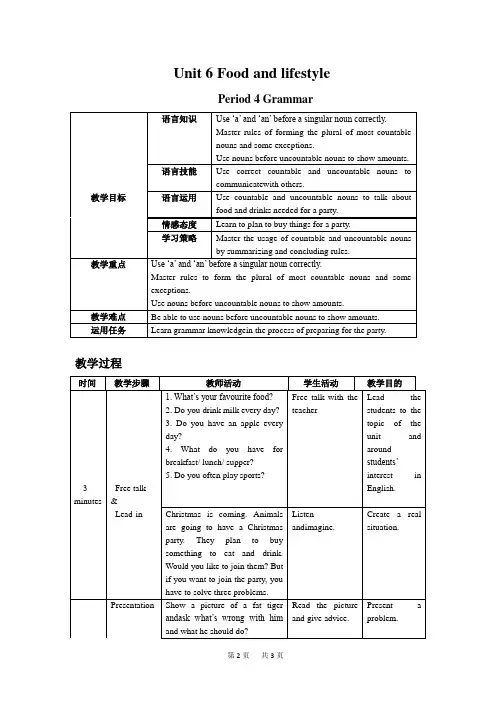
Unit 6 Food and lifestylePeriod 4 Grammar教学过程课堂检测Rose’s Food DiaryAt 7 o’clock in the morning, I eat breakfast, a drink of milk, a bowl of cereal with milk and a banana.At 8 o’clock I arrive at school. I eat some biscuits before lessons begin.At morning break I eat grapes and a carton of orange juice. My friend gives me a piece of chocolate.At 1 o’cloc k I have lunch in the cafeteria. I choose chicken salad and a glass of water.At 4 o’clock on my way home from school, I buy a strawberry ice cream. It’sdelicious.When I arrive home, I have a Coke and a biscuit while I do my homework.We have a meal at 7 o’clock. We eat beef with carrots and potatoes.I have a drink of milk before I go to bed.Do you think I’m a healthy eater?I.Read the article and choose the correct answer.( ) 1. This passage is about _________.A. Rose’s school dayB. what Rose does in a day.C. what Rose eats in a day.D. a healthy eater( ) 2. What does Rose have for breakfast?A. Milk, cereal and a banana.B. Orange juice, bread and an egg.C. Milk, break and an egg.D. Orange juice and some biscuits.() 3. What does Rose do while she does her homework?A.She watches TV.B. She listens to music.C. She has a strawberry ice cream.D. She has a Coke and a biscuit.II.Read and answer the following questions.1.Do you think Rose’s breakfast is healthy?_________________________________________________________________________ 2.What does Rose do before lessons begin? Is it necessary for her to do that?_________________________________________________________________________I. 1. C 2. A 3. DII. 1. I think Rose’s breakfast is healthy. (students’ own answers)2. She eats some biscuits. I don’t think it’s necessary to eat them. (students’ ownanswers)。
牛津译林版英语七年级上册Unit6 Grammar参考教案
Unit6 Grammar参考教案Teaching aims:1. To recognize and use countable nouns.2. To master the rules of forms the plural forms of countable.3. To master how to show the amounts of uncountable nouns.Teaching important points:To master the rules of forms the plural forms of countable.Teaching difficult points:To master how t o show the amounts of uncountable nouns.Teaching methods: Situation and Communicative approachTeaching aids: pictures, record and multimediaTeaching procedures:Step1 Presentation1.Show some pictures of different kinds of foods to the students. Teacher points at anapple, asking: What’s this? S : It’s an apple.Write “an apple〞on the blackboard. Present “a banana〞in the same way.2. Let students watch and say the differences b etween “an apple〞and “a banana〞.Teacher asks : How to use “a〞and “an〞.2.Teacher also points at two cakes and asking “What are they?〞Ss : They are twocakes .〞Write “two cakes’ on the blackboard and circle “s’. Let students read and think “Why add “s〞?3.Show more words on the blackboard and ask students to say out their plural.4.Teacher says :most countable nouns add “s〞to change the m into plural. Whatabout another countable nouns? Let students look at the table on page 73 and have a discussion in groups of 4. Ask : How to change them into plural forms? Get the students to find the rules5.Present : write the rules of forming the plural forms of countable. Ask students readthe table on page120. Pay attention to “s〞and “es〞pronunciation ,let students read after the teacher.Step2 .ExerciseGive some countable nouns for the students to change them into the plural forms.1. Show a bottle of water , and ask :What is it? It’s water. But can we say it’a water? Ss answer “No〞. T: Because water i s uncountable noun. Write “water〞on the blackboard.T: Now, can you tell me some more uncountable nouns? Ss answer .Write “ juice rice tea meat milk chicken bread〞on the blackboard, let students read.2. Show two bottles of water to the students and ask students :Can we say two waters ? S: No , why? What can we say about it ?Get the students to look at the pictures on the page74 and find the method of describing.3. Show some uncountable things for the students to describe ,and teach the new words: Packet salt tea kilo carton4. Get the students to find more uncountable things in groups.T: When we talk about the amount of the uncountable nouns, we can use nouns before them.Step4: Practice1.Get the students to ask and answer with the pictures on tpage74 like this;plete the dialogue on page74, practice in pairs. Divide all the st udents intogroups to read the dialogue.3.Get the students to make up similar dialogue with nouns in them.Step5: HomeworkHow to show the amounts of uncountable nouns.Do the exercise.。
牛津译林版英语七年级上册U6Grammar教案
牛津译林版英语七年级上册U6Grammar教案《英语》(七年级上册)Unit 6 Food and lifestyleGrammarI. Teaching aims and learning objectivesBy the end of the lesson, students should be able to:1. tell the difference between countable and uncountable nouns;2. form the plural of countable nouns, including regular and irregular forms;3. use nouns before uncountable nouns to show their amounts.II. Teaching contents1. New words and phrases: piece, glass, salt, cup, kilo, bottle, plate, carton, a piece of, a glass of,a packet of, two bags of, three cups of, four kilos of, six bottles of2. New structures: What do we need to buy?III. Focus of the lesson and predicted area of difficulty1. Know how to form the plural of countable nouns;2. Use nouns before uncountable nouns to show their amounts.IV. Teaching proceduresStep 1 Lead-in1. Odd One OutPlay a game called “Odd One Out”. Let Ss choose one picture which is different from the other three. They should tell the reasons.(1) apple pear lemon breadReason 1: Apple, pear and lemon are fruits. Bread is not fruit.Reason 2: Apple, pear and lemon are countable nouns. A countable noun refers to something we can count. For example, an apple, two pears and ten lemons. Butbread is an uncountable noun. An uncountable noun refers to something wecannot count. For example, we cannot say a bread.Explain Reason 2 slowly to make students understand whata countable noun and an uncountable noun are.(2) milk juice cola carrotReason 1: Milk, juice and cola are drinks. Carrot is a kind of vegetable.Reason 2: Milk, juice and cola are uncountable nouns. Carrot is a countable noun.(3) photo potato tomato mangoReason 1: Potato, tomato and mango are something that we can ea t. But we can’t eat photo.Reason 2: We should add es to potato, tomato and mango to form their plural forms. But we just add s to photo to form its plural form.(4) man policewoman child toyReason 1: Man, policewoman and child refer to people.Reason 2: The plural forms of man, policewoman and child are irregular. The plural form of toy is regular, just plus s.【设计意图:把本单元第一课时中出现的食物名词融合在游戏中,让学生通过已有知识来学习新知识,降低难度。
牛津译林版七年级上册英语全册教案Unit6Grammar2
练习题做错的要及时弄懂及改正。
第三次备课(反思)
得:会背会默写第六单元单词、词组及句型,熟练掌握日常交际用语
失:练习题做错的学生要及时弄懂改正,克服困难。
改:课后各组组长及时检查背诵课文,单词默写情况,及时上报老师。
9,需要吃些鱼10,feel hungry
二,用所给单词的适当形式填空。
1,We can see some______(sheep) on the hill.
2,You Ming and Chend Long are both_____(Chinese).
3,Look!This table has only there______(leg).
课题
Unit 6 Grammar2
主备
Lu Li
主核
Ma Haixia
使用者
Lu Li
课型
New
使用Байду номын сангаас期
11.25
【学习目标】词汇:piece glass salt cup kilo bottle
词组:a piece of a glass of , a packet of two bags of ,three cups of
2,我需要两袋糖。
I need _____ ______ ______ _______.
3,冰箱里有3瓶果汁。
There are ______ ______ ______ ______in the fridge.
4,我可以喝一玻璃杯果汁吗?
May I have ______ _______ _______ _______ _______
2,Jim doesn’t come to school todaybecause he is ill.
牛津译林版英语七年级上册U6 Grammar 教案
《英语》(七年级上册)Unit 6 Food and lifestyleGrammarI. Teaching aims and learning objectivesBy the end of the lesson, students should be able to:1. tell the difference between countable and uncountable nouns;2. form the plural of countable nouns, including regular and irregular forms;3. use nouns before uncountable nouns to show their amounts.II. Teaching contents1. New words and phrases: piece, glass, salt, cup, kilo, bottle, plate, carton, a piece of, a glass of,a packet of, two bags of, three cups of, four kilos of, six bottles of2. New structures: What do we need to buy?III. Focus of the lesson and predicted area of difficulty1. Know how to form the plural of countable nouns;2. Use nouns before uncountable nouns to show their amounts.IV. Teaching proceduresStep 1 Lead-in1. Odd One OutPlay a game called “Odd One Out”. Let Ss choose one picture which is different from the other three. They should tell the reasons.(1) apple pear lemon breadReason 1: Apple, pear and lemon are fruits. Bread is not fruit.Reason 2: Apple, pear and lemon are countable nouns. A countable noun refers to something we can count. For example, an apple, two pears and ten lemons. Butbread is an uncountable noun. An uncountable noun refers to something wecannot count. For example, we cannot say a bread.Explain Reason 2 slowly to make students understand what a countable noun and an uncountable noun are.(2) milk juice cola carrotReason 1: Milk, juice and cola are drinks. Carrot is a kind of vegetable.Reason 2: Milk, juice and cola are uncountable nouns. Carrot is a countable noun.(3) photo potato tomato mangoReason 1: Potato, tomato and mango are something that we can eat. But we can’t eat photo.Reason 2: We should add es to potato, tomato and mango to form their plural forms. But we just add s to photo to form its plural form.(4) man policewoman child toyReason 1: Man, policewoman and child refer to people.Reason 2: The plural forms of man, policewoman and child are irregular. The plural form of toy is regular, just plus s.【设计意图:把本单元第一课时中出现的食物名词融合在游戏中,让学生通过已有知识来学习新知识,降低难度。