
中考英语 动词的时态和语态
中考英语专项复习(九)动词的时态和语态01 命题趋势考标导向化近几年对动词的时态考查主要集中在对一般现在时、一般过去时、一般将来时、现在进行时、过去进行时和现在完成时六种主要的时态上;对动词被动语态的考查主要以一般现在时、一般过去时的被动语态和含有情态动词的被动语态为主。
02 定义概念清晰化动词的时态指的是谓语动词用来表示动作或情况发生时的各种动词形式。
英语中一共有16种时态,但在初中阶段常考的时态有以下9种:一般现在时、一般过去时、一般将来时、现在进行时、过去进行时、现在完成时、过去完成时、现在完成进行时、过去将来时。
考查重点集中在一般现在时在条件状语从句和时间状语从句中的用法、终止性动词在现在完成时中不能与for,since短语或从句连用、have been to与have gone to的用法以及在具体语境中动词的用法等。
动词的语态是表示句子主语与谓语动词之间关系的一种动词形式。
英语中的动词语态有两种:主动语态和被动语态。
主动语态表示的主语是动作的执行者或发出者,被动语态表示的主语是动作的承受者。
被动语态是中考中的必考内容之一,其中考查的重点是一般现在时、一般过去时和含有情态动词的被动语态。
03 知识归类知识网络化1.在时间、条件和让步状语从句中,如果主句谓语动词是一般将来时,从句用一般现在时。
如:We’ll have a picnic if it is fine next Sunday.如果下个星期日天气晴朗,我们将去野餐。
I’ll call you as soon as I get to Beijing tomorrow.我明天一到北京就给你打电话。
2.某些表示起始、往返、出发、到达之意的动词,可用一般现在时表示按规定、计划或安排将要发生的动作(此时一般都有一个表示未来时间的状语)。
这类动词有:begin, come, go, leave, start, arrive, end, stop, open, close等。
如:The meeting begins at 2:00 p.m. tomorrow.这个会议明天下午2点开始。
The next train leaves at 7 o’clock this evening.下一列火车将在今晚7点离开。
3.现在进行时与always, continually, forever等副词连用,表示反复出现或习惯性的动作,这种用法往往表达说话人的某种感情,如赞扬、遗憾、讨厌或不满等。
如:The rich woman is always laughing at the poor.这个有钱的夫人总是嘲笑穷人。
4.现在完成时中表示短暂动作的动词不能与for, since等引导的时间状语连用。
如与一段时间连用,要把瞬间动词转化为意思相近的延续性动词。
常见的变化有:误:I’ve left this school for ten years.正:I’ve been away from this school for ten years.【题组训练】一般现在时与一般过去时( )1.(2014·徐州)What a surprise to see you here! When ____ you _____back?A.do;getB.did;getC.have;gotD.will;get( )2.(2014·十堰)—Have you finished using my dictionary?—Yes,I put it back on your desk just now.Who _____ it away?A.will takeB.is takingC.tookD.has taken( )3.(2014·北京)—What do you often do at weekends?—I often ________ my grandparents.A.visitB.visitedC.have visitedD.will visit( )4.(2014·河南)—Are you going anywhere?—I _______ about visiting my sister,but I have changed my mind.A.think B .have thoughtC.will thinkD.thought( )5.(2014·云南)If there _______ no buying and selling of animals,there will be no killing in nature.A.isB.will beC.hasD.will have现在进行时与过去进行时( )6.(2014·十堰)—The book store _____ a big sale. The books there must be very cheap now. —Sounds great. Let’s go into it and have a look.A.will haveB.hadC.is havingD.was having( )7.(2014·北京)—What were you doing when we were playing basketball yesterday afternoon?—I _______ the classroom.A.was cleaningB.have cleanedC.will cleanD.clean( )8.(2014·河北)Someone _____ at the door.Can you open it?A.knocksB.knockedC.is knockingD.was knocking( )9.(2014·孝感)—I was at the cinema at 8 o’clock last night.What about you?—I ________ the Internet at home.A.am surfingB.surfedC.will surfD.was surfing( )10.(2014·来宾)—Would you mind turning down your music player?Everybody ________now! ——I’m sorry.I’ll do it right now.A.sleepB.sleptC.is sleepingD.are sleeping一般将来时与过去将来时( )11.(2014·河北)I’m busy now. I ______ to you after school this afternoon.A.talkB.talkedC.will talkD.have talked( )12.(2014·天津)Robots ______more heavy work for us in the future.A.will doB.didC.have doneD.were doing( )13.(2014·铜仁)There ________ a sports meet in our school next week.A.isB.will haveC.areD.will be( )14.(2014·河南)—Does this bus go to the beach?—No.You ________ the wrong way.You want the Number 11.A.goB.were goingC.are goingD.would go( )15.(2014·丽水)Hurry up! The sky is cover ed with black clouds. I’m afraid it_______ .A.rainsB.is going to rainC.rainedD.was raining现在完成时与过去完成时( )16.(2014·宁波)—Are you surprised at the ending of the movie?—No,because I ________ the story.A.readB.will readC.have readD.was reading( )17.(2014·滨州)—Jim isn’t in the classroom.Where is he now?—He _________ the library.A.will go toB.has been toC.has gone toD.goes to( )18.(2014·泰安)—Can you find our city _____ a lot in recent years?—Yes.The road is wider and the buildings are taller.A.has changedB.changesC.changedD.will change( )19.(2014·南京)—Lily,why are you still here?School is over for half an hour. —Because I ________ my task yet.I still need one more hour.A.Won’t finishB.didn’t finishC.haven’t finishedD.hadn’t finished( )20.(2014·随州)—I wonder when you ______ the new watch.—Well,I _________ it for two weeks.A.have bought;have hadB.bought;have boughtC.bought;have hadD.have bought;have bought1.open,lock,write,read,sell,clean,wash,cut,drive等词作不及物动词时,它们的主语为物,可用主动语态表示被动意义。
如:This kind of pen writes very smoothly.这种钢笔写起来很流畅。
The kind of shirts sells well here.这种样式的衬衫在这里卖得很好。
2.look,sound,taste,smell等系动词用主动形式表示被动意义。
中考动词知识点总结
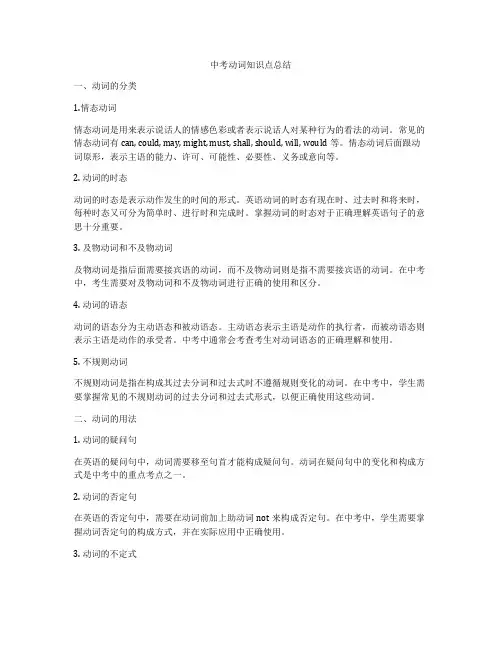
中考动词知识点总结一、动词的分类1.情态动词情态动词是用来表示说话人的情感色彩或者表示说话人对某种行为的看法的动词。
常见的情态动词有can, could, may, might, must, shall, should, will, would等。
情态动词后面跟动词原形,表示主语的能力、许可、可能性、必要性、义务或意向等。
2. 动词的时态动词的时态是表示动作发生的时间的形式。
英语动词的时态有现在时、过去时和将来时,每种时态又可分为简单时、进行时和完成时。
掌握动词的时态对于正确理解英语句子的意思十分重要。
3. 及物动词和不及物动词及物动词是指后面需要接宾语的动词,而不及物动词则是指不需要接宾语的动词。
在中考中,考生需要对及物动词和不及物动词进行正确的使用和区分。
4. 动词的语态动词的语态分为主动语态和被动语态。
主动语态表示主语是动作的执行者,而被动语态则表示主语是动作的承受者。
中考中通常会考查考生对动词语态的正确理解和使用。
5. 不规则动词不规则动词是指在构成其过去分词和过去式时不遵循规则变化的动词。
在中考中,学生需要掌握常见的不规则动词的过去分词和过去式形式,以便正确使用这些动词。
二、动词的用法1. 动词的疑问句在英语的疑问句中,动词需要移至句首才能构成疑问句。
动词在疑问句中的变化和构成方式是中考中的重点考点之一。
2. 动词的否定句在英语的否定句中,需要在动词前加上助动词not来构成否定句。
在中考中,学生需要掌握动词否定句的构成方式,并在实际应用中正确使用。
3. 动词的不定式不定式是动词的一种特殊形式,它可以有自己的主语和宾语,并且可以放在句子的任何位置。
中考会考查学生对不定式的正确使用和理解。
4. 动词的动名词动名词是由动词加上-ing构成的名词形式,它可以充当名词使用。
在中考中,学生需要掌握动名词的构成方式和用法,以便正确使用动名词。
5. 动词的情态动词和助动词情态动词和助动词在句子中的作用是不同的,学生需要掌握情态动词和助动词的用法和区别。
初中英语动词时态及语态

Grammar一、动词时态及语态语法学习表时态意义标志词语构成公式被动语态一般现在时经常性、习惯性的动作,存在的状态,或客观真理often, always, usually,sometimes, once aweek, every day主语+V原形(主语是第三人称单数时,V加s或es)主语+is /am/are+V过分现在进行时现在正在发生的动作now,Look!, Listen!,at this moment 主语+am/is/are+V-ing 主语+am/is/are+being+V过分现在完成时过去的动作对现在有影响或过去的动作一直持续到现在already , yet ,since, sofar主语+have/has +V过分主语+have/has+been+V过分一般过去时过去发生的动作yesterday ,lastweek, …ago, in 1998,just now 主语+V过去式主语+was/were +V过分过去进行时过去时间内正发生的动作或存在的状态at this time yesterday,just then, at 6:00 lastSunday, when+一般过去时主语+was/were+V-ing 主语+was/were+being+V过分过去完成时过去已完成的动作by the end of +过去的时间,by the time +一般过去时主语+had+V过分主语+had+been+V过分一般将来时将要发生的动作或将来的状态tomorrow, next week,in the future, in twodays, in 2100主语+am/is/are goingto +V原形,或主语+will+V原形主语+will be+V过分过去将来时过去时间内将要发生的动作或存在的状态常用于主句是一般过去时的宾语从句主语+was/were+goingto+V原形,或主语+would +V原形主语+would+be+V过分现在完成进行时过去的动作一直延续到现在“since+时间点/从句/时间点ago”或“for+时间段”主语+have/has+been+V-ing含情态动词can/may/must等+V原形can/may/must等+be +V过分考点精讲考点1 一般现在时有哪些特殊用法?(1)表示此时此刻正在发生的动作或存在的状态。
初中英语语法专项8动词的时态和语态
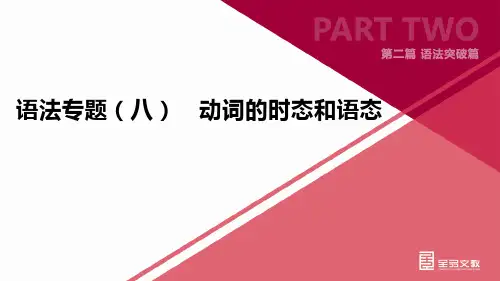
【中考考点】
(1)动词的第三人称单数形式、过去式、过去分词和现在分词的构成。 (2)动词的八种时态的基本结构及用法。 (3)动词的被动语态的基本结构及用法。 (4)动词的主动形式表示被动意义的用法。
动词的时态
考点一 一般现在时
1.结构 一般现在时主要用动词原形表示(当主语是第三人称单数时,谓语动词用第三人称单数形式)。 2.动词的第三人称单数形式变化规则 (1)直接加-s。如:work—works (2)以“辅音字母+y”结尾的词,先变y为i,再加-es。如:carry—carries, cry—cries, try—tries, study—studies (3)以s, x, o, ch, sh结尾的词加-es。如: pass—passes, fix—fixes, go—goes, do—does, teach—teaches, wash—washes (4)特殊:have—has, are—is
动词的时态
考点四 过去将来时
1.结构 would+动词原形 was/were+going to+动词原形 2.用法 表示从过去的某一时刻看,将要发生的动作。 His uncle said that there would be a good harvest the next year.他叔叔说第二年会有一个 好收成。 【注意】 在由if引导的条件状语从句中,如果主句用过去将来时,那么if从句需用一般过去时代替过 去将来时。 If he were here, he would show us how to do it. 如果他在这儿,他就会向我们展示该如何做。
动词的时态
4.动词过去式的变化规则 (1)一般情况下,在动词原形后加-ed。如: watch—watched (2)以不发音的字母e结尾的加-d。如:live—lived (3)以“辅音字母+y”结尾的,变y为i,再加-ed。如: study—studied, carry—carried, cry—cried (4)以重读闭音节结尾,且末尾只有一个辅音字母的,先双写该辅音字母,再加-ed。如: stop—stopped, plan—planned, prefer—preferred (5)不规则动词的过去式需特殊记忆。
中考时态知识点归纳

中考时态知识点归纳在中考英语中,时态是语法部分的一个重要考点,掌握好时态对于提高英语成绩至关重要。
以下是对中考英语时态知识点的归纳:1. 一般现在时:表示经常发生的动作或状态,或表示客观事实。
构成:主语+动词原形(第三人称单数时动词要加-s或-es)。
2. 一般过去时:表示过去发生的动作或状态。
构成:主语+动词的过去式。
3. 一般将来时:表示将来发生的动作或状态。
构成:主语+will+动词原形。
4. 现在进行时:表示说话时正在进行的动作。
构成:主语+be动词(am/is/are)+动词的现在分词(-ing形式)。
5. 过去进行时:表示过去某一时刻正在进行的动作。
构成:主语+was/were+动词的现在分词。
6. 将来进行时:表示将来某一时刻正在进行的动作。
构成:主语+will be+动词的现在分词。
7. 现在完成时:表示过去发生的动作对现在造成的影响或结果。
构成:主语+have/has+动词的过去分词。
8. 过去完成时:表示在过去某个时间或动作之前已经完成的动作。
构成:主语+had+动词的过去分词。
9. 将来完成时:表示将来某个时间之前已经完成的动作。
构成:主语+will have+动词的过去分词。
10. 现在完成进行时:表示从过去某一时间开始,一直持续到现在,并且可能还要继续下去的动作。
构成:主语+have/has been+动词的现在分词。
11. 过去完成进行时:表示在过去某一时间之前开始,一直持续到过去某一时间的动作。
构成:主语+had been+动词的现在分词。
12. 被动语态:表示动作的承受者而非执行者。
被动语态的构成根据时态不同而变化,一般形式为:be动词的各种时态形式+动词的过去分词。
掌握这些时态的构成和用法,对于理解和运用英语时态至关重要。
在复习时,可以通过做练习题、阅读例句和进行实际对话来加深理解。
同时,注意时态之间的转换和使用场合,以确保在中考中能够准确无误地使用各种时态。
结束语:通过上述的归纳,希望同学们能够对中考英语中的时态有一个清晰的认识和掌握,为中考取得优异成绩打下坚实的基础。
2023年英语中考语法总复习—8.动词时态和语态
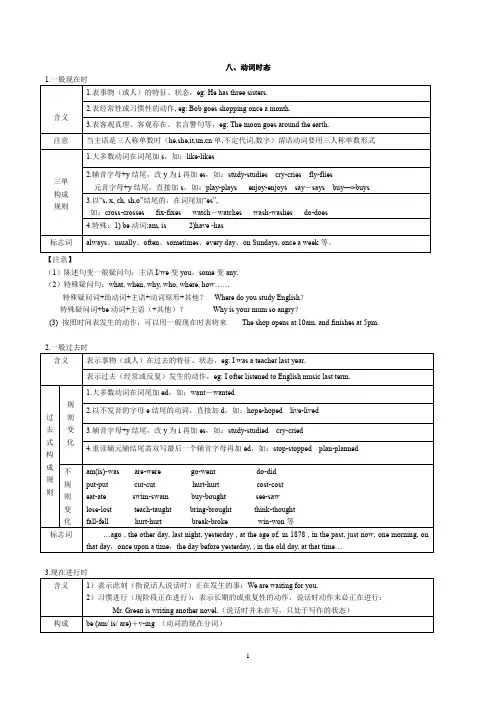
八、动词时态【注意】(1)陈述句变一般疑问句:主语I/we变you,some变any.(2)特殊疑问句:what, when, why, who, where, how……特殊疑问词+助动词+主语+动词原形+其他?Where do you study English?特殊疑问词+be动词+主语(+其他)?Why is your mum so angry?(3) 按照时间表发生的动作,可以用一般现在时表将来The shop opens at 10am. and finishes at 5pm.【注意】(1)always也可用于现在进行时,表示一种强烈的感情色彩,译为“总是”He is always telling lies.(2)某些特殊动词不能用于现在进行时。
① have当“有”讲时,不能用现在进行时。
I have two books now.②“belong to” The two people belong to me now.③表示“心理活动/状态/感觉”的词I want a dog now.① be going to主要用于:主观判断(1)表示事先经过考虑、安排好打算要做的事情:I’m going to play the violin.(2)表示根据目前某种迹象判断,某事非常有可能发生(有迹象表明要发生的事)。
Look!There come the dark clouds. It is going to rain.② will主要用于:(1)客观上将来势必发生的事情, 未经事先考虑, 临时决定的They will go to visit the factory tomorrow.(2)表示不以人的意志为转移的自然发展的未来的事:Today is Saturday. Tomorrow will be Sunday.(3)表意愿。
问对方是否愿意做某事或表示客气地邀请或命令:Will you please turn on the radio?(1) have/has been to “去过已回”She has been to Japan twice.have/has gone to. “去了未回”Where is your twin sister? She has gone to Japan.have/has been in “待在某地” She has been in Japan for 2 years. (2) 动词从词义上可以分为延续性和非延续性两种。
初中英语人教版 中考 语法专题 10 动词的时态和语态
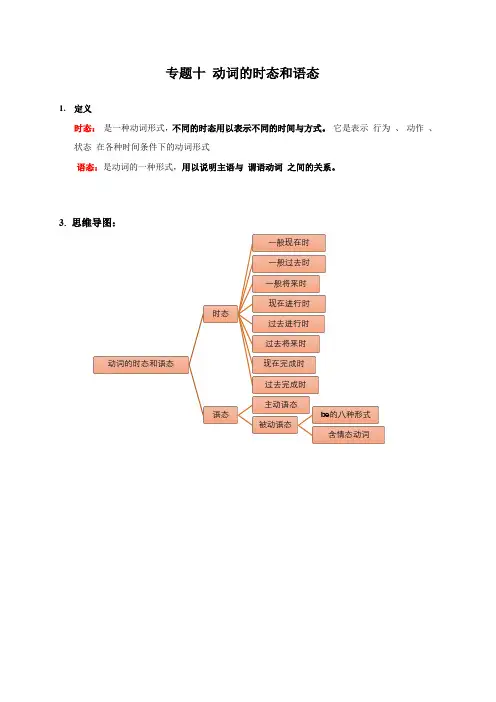
专题十动词的时态和语态1.定义时态:是一种动词形式,不同的时态用以表示不同的时间与方式。
它是表示行为、动作、状态在各种时间条件下的动词形式语态:是动词的一种形式,用以说明主语与谓语动词之间的关系。
3. 思维导图:动词的时态和语态时态一般现在时一般过去时一般将来时现在进行时过去进行时过去将来时现在完成时过去完成时语态主动语态被动语态be 的八种形式含情态动词1.动词的时态1.常考的时态构成及用法a.一般现在时d.现在进行时e.过去进行时f.过去将来时g.现在完成时h.过去完成时2. 动词的语态a. 分类:主动语态:表示主语是动作的执行者被动语态:表示并语是动作的执行者c.主动语态和被动语态的转换规则典型例题总分:50分姓名:得分:1.单选题(每小题1分,共50分)( ) 1. Jenny, together with the Greens the White Tower Park if it tomorrow.A.are going to; isn't rainyB.is going to; doesn't rainC.are going to; won't rainD.is going to; isn't rain( ) 2. The old man for quite some time.A.has diedB.dieC.has deadD.has been dead( ) 3. It is reported that a tall building in the city next year.A.will be builtB.were buildC.have builtD.will build( ) 4. My sister for 2 years.A.has marriedB.have got marriedC.has been marriedD.married( ) 5. Chinese ________in many schools around the world and many people love to learn it.A.teachesB.is teachingC.has taughtD.is taught( ) 6. When Tom was in primary school, he ________the piano every day.A.playsB.playedC.was playingD.has played( ) 7. A baby's first month birthday is a special event in China and _____with a special Party.A.celebratesB.is celebratedC.was celebratedD.will celebrate( ) 8. -Were you at home at 9 o'clock last night?-Yes, I a shower at that time.A.tookB.was takingC.was takenD.am taking( ) 9. National Day celebrations for China's seventieth birthday in about three months.A.will be heldB.will holdC.is heldD.was held( ) 10. We don't know if he tomorrow. If he, I will call youA.will come, will comeB.will come, comeses, will comees, comes( ) 11. He told me that he ______ his uncle in Thailand the next day.A.will visitB.has visitedC.is going to visitD.would visit( ) 12. -Tom, do you know ________? -In Beijing.A.where will the 24th Winter Olympics be heldB.where the 24th Winter Olympics will holdC.where the 24th Winter Olympics will be heldD.where will the 24th Winter Olympics hold( ) 13. Peter with his classmates ________ for the bus when the earthquake happened.A.is waitingB.was waitingC.are waitingD.were waiting( ) 14. his museum ________ here for over 80 years. It ________ one of the oldest buildings in this city.A.is; wasB.had been; isC.was; has beenD.has been; is( ) 15. -Mrs. Brown, how long can books from the school library ?-At most two weeks.A.borrowB.keepC.be borrowedD.be kept( ) 16.-An AI robot _____in our school dining hall next term.-I'm looking forward to it.A.will useB.will be usedC.is usedD.was used( ) 17. Usually a baby's face ____ smooth.A.is feelingB.feltC.feels likeD.feels( ) 18. She _____ an English magazine when I came in.A.readsB.has readC.will readD.was reading( ) 19. I will call you as soon as he______ here.A.arriveB.will arriveC.arrivesD.arrived( ) 20. Boys and girl, ______ learning and have fun!A.keepB.to keepC.keepingD.kept( ) 21. There ______a basketball game between these two grades in the gym this afternoon.A.willB.is going to haveC.is going to beD.will have( ) 22. We ______TV from seven to nine last night.A.were watchingB.will watchC.watchedD.watch( ) 23. Jack's mother taught me how ________ Yunnan rice noodles last weekend.A.to makeB.makingC.makeD.to making( ) 24. Mrs. Green said the plates ________ right away,or they would become difficult to wash.A.will be washedB.should washC.will washD.should be washed( ) 25. The documentary Under the Dome (《苍穹之下》)which ________ by Chai Jing showed us that the air pollution in China was very serious.A.producesB.producedC.is producedD.was produced( ) 26. -What did you do last night?- I ________ my homework and watched TV.A.didB.doC.am doingD.will do( ) 27.The hospital is very famous. It _______ in 2001.A.buildsB.builtC.was builtD.is built( ) 28.These rules are made the disabled.A.protectB.protectedC.to protectD.protecting( ) 29. -How much does the TV ?-Not too much. It's just a second-handed one.A.costB.spendC.takeD.pay for( ) 30. -Have you ever ________ an amusement park?- Yes, I have ________ Fun Times Amusement Park last year.A.been to, have gone toB.gone to, have been toC.go to, went toD.been to, went to( ) 31.We are glad to hear that the terrorists ________ by the brave policemen several days ago.A.are caughtB.were caughtC.have been caughtD.are going to be caught ( ) 32. -Why didn't you go to the party last night? - Because I _____.A.wasn't invitedB.didn't invitedC.haven't invitedD.don't invited ( ) 33. -What _____ you supposed ____ when you are in China?- You should shake hands.A.are, to doB.do, to doC.are, doingD.have, to do( ) 34. So far, we ________ English for three years.A.have learntB.learnC.learntD.had learnt( ) 35.The boy was made ______ the words again and again.A.copyB.copyingC.copiesD.to copy( ) 36. The sports meeting in our school now.A.being heldB.is havingC.is holdingD.is being held( ) 37. The window ____ ten minutes ago, and the room is bright now.A.can be cleanedB.is cleanedC.was cleanedD.will be cleaned( ) 38. -Oh, Mrs. King, your necklace looks nice. Is it new?-No, I _______ it for 2 years.A.hadB.have hadC.boughtD.have bought( ) 39. He has ordered a watch on line for his father and it _______ to him before Father's Day.A.sendB.will be sentC.was sentD.sent( ) 40. There ______ a funny cartoon on CCTV 6 this evening.A.willB.will haveC.is going to beD.is going to have( ) 41. -________ did your uncle leave his home town? -He ___________ for nearly twenty years.A.When, has leftB.When, has been awayC.How long, has leftD.How long, has been away ( ) 42. My uncle ________ Germany on business many times.A.has been onB.has gone toC.has been toD.has been in( ) 43. Her life ________ a lot during the last three years.A.changedB.changingC.has changedD.will change( ) 44. -Lisa was seen ______ an old man go across the street this morning. -What a kind girl she is!A.helpingB.helpedC.to helpD.helps( ) 45. My computer has broken down. I'll get it _______ this afternoon.A.repairsB.repairedC.to repairD.repairing。
中考英语备考 专题03 动词时态及语态(含解析)
专题03 动词时态及语态【考点综述】:动词是谓语动词所表示的动作或情形发生时刻的各类形式。
英语动词有16种时态,可是经常使用的只有9种:一样此刻时、一样过去时、一样以后时、此刻进行时、过去进行时、此刻完成时、过去完成时、过去以后时、此刻完成进行时。
当句子的主语是动作的执行者时,谓语的形式叫主动语态。
句子的主语是动作经受者时,谓语的形式叫被动语态。
被动语态由助动词be + 过去分词组成,时态通过be 表现出来。
动词是中考考查的重点,动词的时态和语态更是考查的重中之重。
动词不仅有人称和数的转变,而且有时态、语态、语气和非谓语形式等语法现象。
这些都是中考考查的内容。
【中考真题再现】:1. 【2021江苏南京】---Millie, where is Miss Li?---She _________ a speech on Chinese art to the first-year students in the hall.A. givesB. gaveC. is givingD. has given2. 【2021江西】— Have you had your b reakfast yet?—Yes. Mom _____ it for me.A. was cookingB. is cookingC. will cookD. cooked3. 【2021山东菏泽】—Linda, I called you this morning, but nobody answered the phone.—I'm sorry. I football with my friends then.A. playB. playedC. am playingD. was playing4. 【2021陕西】The mobile phone has influenced people’s life a lot since it .A. inventsB. inventedC. is inventedD. was invented【答案】D【解析】考查动词时态及语态。
(人教版)中考英语总复习语法:专题8-动词的时态、语态(101页)
(2)过去完成时与现在完成时的主要区别是时间参 照点不同: 过去完成时的时间参照点是某个“过去的” 时间;现在完成时的时间参照点是“现在”。因此现在 完成时中的很多规则,也适用于过去完成时。 When I got to the cinema, the film had been on. 当我到达电影院时,电影已经开始了。
以辅音字母+y结尾的动词, 把y变为i再加-ed
以一个元音字母加一个辅音 字母结尾的重读闭音节词, 双写结尾字母再加-ed
study→studied carry→carried stop→stopped drop→dropped prefer→preferred
3.一般将来时 (1)表示将来某个时间要发生的动作或存在的状 态,其构成形式:“will/shall+动词原形”。常与表 示将来的时间状语tomorrow,next week,in+一段时 间等连用。 当主语是第一人称I或we时,问句中一般用shall。
③表单纯性的将来,与人的主观愿望和判断无关 时。 If it's made of wood, it will float on water. 这要是木材做的,它能浮在水面上。 (4)当主句为一般将来时态时,在if,as soon as, until, when等引导的状语从句中用一般现在时代替一 般将来时。 I will call you as soon as I get there. 我一到那儿就给你打电话。
特殊情况:have→has,am/are→is 考查热点:如果主句为一般将来时,if,unless等 引导的条件状语从句和when,until,as soon as等引导 的时间状语从句常用一般现在时表示将来。 What about going climbing if it doesn't rain tomorrow? 如果明天不下雨,去爬山怎么样?
专题10 动词的时态和语态(课件)-2024年中考英语复习(全国通用)
14.(2022·湖北武汉·统考中考真题)—I don’t think sixteen-year-olds should be allowed
to drive. —I ________. It’s not safe. A.agree B.agreed C.will agree
D.had agreed
apples in the fridge now.
A.is
B.are
C.was
D.were
【答案】A 【解析】句意:现在冰箱里有一些果汁和几个苹果。考查一般现在时及 “there be”。根据“now”,排除过去时态的CD,由于there be的就近原则, some juice不可数,所以应是is。故选A。
5.(2023·甘肃白银·校考一模)Thanks to those cleaners who ________ hard on the streets, we can have a beautiful city. A.work B.worked C.have worked D.were working
真理。
时态的辨析 满分秘籍
易失分点
提分特训
时态 谓语动词
意义
例句
一般
表示过去
过去 was/were,did 的动作或
时
状态。
When he was a child, he often swam in the river.当他小的时候,他经常在河里游泳。
16.(2023·江苏南通·统考一模)—What will the weather be like tomorrow? —I was on the phone and ________ most of the weather report. A.have missed B.was missing C.will miss D.missed
中考语法知识点归纳动词时态语态与非谓语动词
中考语法知识点归纳动词时态语态与非谓语动词动词时态、语态与非谓语动词是中考英语中的重要考点,掌握好这些知识,将有助于提升语法水平和英语写作能力。
本文将对中考语法知识点进行归纳总结,帮助同学们更好地理解和应用。
一、动词时态动词时态是指动词表示的动作或状态发生的时间或状态。
常见的动词时态有以下几种:1. 一般现在时:表示经常性、习惯性的动作或客观真理。
例句:He plays basketball every day.2. 一般过去时:表示过去某个时间发生的动作或状态。
例句:I watched a movie last night.3. 一般将来时:表示将来要发生的动作或状态。
例句:I will go to Beijing next week.4. 现在进行时:表示现在正在进行的动作。
例句:She is reading a book now.5. 过去进行时:表示过去某个时间正在进行的动作。
例句:I was studying when he called me.6. 现在完成时:表示过去的动作对现在造成的影响或结果。
例句:She has visited Paris three times.7. 过去完成时:表示对过去某个时间之前发生的动作进行的描述。
例句:They had already left when I arrived.二、动词语态动词语态是指动作发出的主体和动作所受的影响关系。
英语中常见的动词语态有以下几种:1. 主动语态:表示主语是动作的发出者。
例句:He fixed the car yesterday.2. 被动语态:表示主语是动作的承受者。
例句:The car was fixed by him yesterday.3. 进行时态:表示主语正在进行的动作处于进行状态。
例句:The book is being read by her.4. 完成时态:表示主语已经完成的动作处于完成状态。
例句:The book has been read by her.注意:被动语态需要根据动作的时态来变换,同时需要适当更改时态动词。