
中考英语《主动语态和被动语态》课件
The Structure is
助动词be+及物动词的过去分词
(be+P.P.)
He is regarded as a brilliant. 他被认为很有才气。 This book was written in 1969. 一般现在时: am / is / are done 这本书是 1969 年写成的。 一般过去时: was / were done The broken bike is being repaired now.
I was given a nice present by my friend yesterday.
典型题例
例1 将下列句子改为被动语态。 We clean our classroom every day.
Our classroom is cleaned (by us) every day.
在改写中应注意:
(强调书被发现而不是强调由谁发现)
被动语态的用法:
1.强调动作的承受者; 如:Table tennis is played all over China. English is spoken by many people. 2.不需要指出动作的执行者或动作的执 行者难以说出或不必说出. 如:Another bridge has been built across the Changjiang River. The Party was founded on July 6,1924. A note was passed up to the speaker.
5. Two years ago we used the machines to make shoes for children.
Two years ago those machines were used (by us) to make shoes for children.
一般将来时的被动语态: will / be going to + be + 过去分词
Many letters had been received by the end of last week
They would have a party the next day.
A party would be had (by them) the next day.
七嘴八舌
(变被动语态)
1.People use knives for cutting things.
Some fruits were bought for his friend yesterday
4.Aby can take good care of Tina . Tina can be taken good care of by Aby. 情态动词:
S+ can/may/must/should + be+过去分词
Ten computers were bought (by them) last term. 一般过去时:S+was/were +过去分词
He bought his friend some fruits yesterday.
His friend was bought some fruits yesterday.
What is the Passive Voice?
What is it?
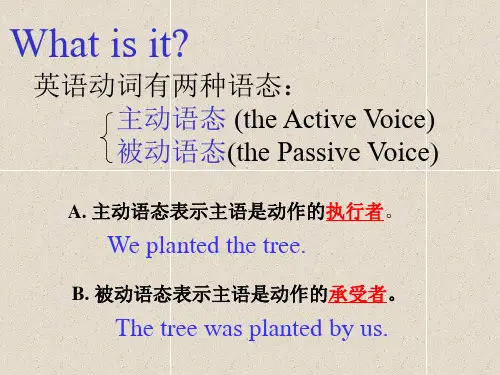
英语动词有两种语态: 主动语态 (the Active Voice) 被动语态(the Passive Voice)
A. 主动语态表示主语是动作的执行者。
We planted the tree.
B. 被动语态表示主语是动作的承受者。
Many students study English.(主动语态)
English is studied by many students.(被动语态)
When to use it?
1. 当我们不知道谁是动作的执行者,或没有必 要指出谁是动作的执行者时。 The dictionary is well kept. 这本词典被保存完好(不需要说明是谁保存的) 。 2. 当我们需要强调动作承受者,而不是动作的 执行者。 These book were found in the 1920s. 这些书是在二十世纪二十年代发现的。
现在进行时: am / is / are being done 那辆坏了的自行车正在被修理。 He told us the cat was being 过去进行时: was / were beingwashed done when 现在完成时: have / has been done we called him. The pen has been used for several years. 过去完成时: had been done 他告诉我们打电话时他正在给猫洗澡。 一般将来时: shall / will be done ; be going 这支钢笔已经用了几年。 He said the factory had been opened . to be done 他说这家工厂已经开张。 当句中含有情态动词时,句子结构为 can / must The work will be finished in three hours. / have to…be done
He can carry the basket easily.
The basket can be easily carried by him.
They can sing some beautiful songs.
Some beautiful songs can be sung by them.
“We must put them in the fridge.”The dogs thought .
The windows were broken by him.
一般现在时的被动语态: am/are/is + 过去分词
1. People play football all over the world.
Football is played all over the world by people .
工作将于三小时后完成。 The baby must be looked after well. 这孩子必须被好好照顾。
被动语态的结构:
被动语态由“助动词be+及物动词的过去分词” 构成,助动词be有人称、数的变化,其变化规 则与be作为连系动词时一样。 如: The desk is made of wood. The desks are made of wood. He is asked a question by the teacher.
They are holding a sports meeting now.
A sports meeting is being held (by them) now.
We have made twenty more keys.
Twenty more keys have been made by us. 现在完成时:
1.把原来的宾语提到前面作被动语态的主语; 2.把动词变成“be + 过去分词”; 3.主动语态中的主语变为介词by的宾语。
主变被解题步骤: 1. 找宾语 ----即动作的承受者 2. 判断宾语的单复数 ----即be动词的单复数. 3. 判断动词的时态 ----即be动词的时态. 4. 修改谓语的时态 ----即原句动词改为过去分词 5. 修改原句的主语 ----即by+ 主语.
Our homework has to be finished (by us) on time
.
He rides the
motorbike to his factory every
day.
The motorbike is ridden to his factory every day.
We call the snowman Mr Strong.
情态动词的被动语态: must/have to/can等 + be + 过去分词
8. You must throw the broken pottery away at once.
The broken pottery must be thrown away (by you) at once.
9. We have to finish our homework on time.
2. Mr. Green teaches us this term.
We are taught (by Mr. Green) this term.
一般过去时的被动语态: was/were + 过去分词
4. People built the Great Wall long ago.
The Great Wall was built (by people) long ago.
The snowman is called Mr Strong.
We usually hear him play in the next room.
He is usually heard to play in the next room.
2. They term.
bought
ten computers last
6. We will write a diary next class.
A diary will be written (by us) next class.
7. Tom is going to hold a birthday party.
A birthday party is going to held by Tom
The tree was planted by us.
合集下载
初三被动语态专题讲解ppt课件
t
let (让) let let preuatd((放读)) repaudt/red/purtead /red/ set (放置 ) set set shut (关闭) shut shut
7
二、 AAB型(动词原形与过去式同形)
beat (跳动) beat beaten
三、 ABA型(动词原形与过去分词同形)
study—studied carry—carried
try—tried
worry—worried
4:末尾只有一个辅音的重读闭音节,先双写该辅音字 母,再加-ed.( fix的过去式和过去分词x不双写,为fixed. )
stop—stopped plan—planned
5
中考英语不规则动词过去式、过去分词 归类表
1
一、 英语动词有两种语态:
主动语态 (the Active Voice) 被动语态 (the Passive Voice)
A. 当主语为动作的执行者时,谓语的形式为主动语态。
Many people speak English.
B. 当主语为动作的承受者时,谓语要用被动语态
English is spoken by many people.
learn (学习) learnt / learned learnt / learned
light (点燃) lit/lighted
lit / lighted
smell (嗅;闻) smelt / smelled smelt / smelled
speed (加速) sped/speeded sped / speeded
情态动词:
S+ can/may/must/should + be+过去 分词
let (让) let let preuatd((放读)) repaudt/red/purtead /red/ set (放置 ) set set shut (关闭) shut shut
7
二、 AAB型(动词原形与过去式同形)
beat (跳动) beat beaten
三、 ABA型(动词原形与过去分词同形)
study—studied carry—carried
try—tried
worry—worried
4:末尾只有一个辅音的重读闭音节,先双写该辅音字 母,再加-ed.( fix的过去式和过去分词x不双写,为fixed. )
stop—stopped plan—planned
5
中考英语不规则动词过去式、过去分词 归类表
1
一、 英语动词有两种语态:
主动语态 (the Active Voice) 被动语态 (the Passive Voice)
A. 当主语为动作的执行者时,谓语的形式为主动语态。
Many people speak English.
B. 当主语为动作的承受者时,谓语要用被动语态
English is spoken by many people.
learn (学习) learnt / learned learnt / learned
light (点燃) lit/lighted
lit / lighted
smell (嗅;闻) smelt / smelled smelt / smelled
speed (加速) sped/speeded sped / speeded
情态动词:
S+ can/may/must/should + be+过去 分词
九年级英语被动语态详解(PPT)5-3

3. 一般将来时: They will send cars abroad by sea. Cars will be sent abroad by sea. They will give plenty of jobs toቤተ መጻሕፍቲ ባይዱschool-leavers. Plenty of jobs will be given to school-leavers.
想借贵报一角~几句。 【补办】动事后办理(本应;短信群发 短信群发 ;事先办理的手续、证件等):~住院手续。 【补报】动①事后 报告;补充报告:调查结果将于近日~。②报答(恩德):恩深似海,无以~。 【补仓】∥动指投资者在持有一定数量的证券的基础上,又买入证券。 【补 差】①(-∥-)动补足原工资和退休金之间的差额(用于退休人员继续工作时)。②名指补差的钱:他被单位返聘,每月拿五百块钱的~。 【补偿】动抵 消(损失、消耗);补足(缺欠、差额):~损失|~亏欠。 【补偿贸易】国际贸易的一种方式,买方不以现汇支付,而以产品或加工劳务分期偿付进口设
4. 过去将来时: The manager said they would complete the project by the
end of the year. The manager said the project would be completed by the
end of the year. The workers told me they would mend the car as soon as
备、技术、专利等费用。 【补充】动①原来不足或有损失时,增加一部分:~兵员|~支弹|对他的发言,我再做两点~。②在主要事物之外追加一些:~ 意见|~教材。 【补丁】(补钉、补靪)?名补在破损的衣服或其他物品上面的东西:打~|~摞~。 【补过】∥动弥补过失:将功~。 【补花】(~儿) 名手工艺的一种,把彩色布片或丝绒缝在枕套、桌布、童装等上面,构成花鸟等图案。 【补给】动补充、供给弹和粮草等:前线急需及时~。 【补给舰】名 供应舰。 【补给线】名军队作战时,输送物资器材的各种交通线。 【补剂】名补。 【补假】∥动①职工应休假而未休假,事后补给假日。②补办请假手续。 【补角】名平面上两个角的和等于一个平角(即°),这两个角就互为补角。 【补救】动采取行动矫正差错,扭转不利形势;设法使缺点不发生影响:发现
主动语态和被动语态(课堂PPT)

1. People play football all over the world.
Football is played all over the world by people .
2. Mr. Green teaches us this term.
We are taught (by Mr. Green) this term.
I bPealiessvieveI cVaonicfely
被动语态
This song is enjoyed by people all
over the world.
1
EEnnglgislihsh iiss ssppookkeenn bpyetohpele most people in the world.
2. The students in this school study German.
German __is_____ __s_tu_d_i_e_d_ by the
students in this school.
11
3.I found the ticket on the floor. The ticket __w_a_s__ f_o_u_n_d__ on the floor. 4.I told her to return the book in time. She __w__a_s_ __t_o_ld___ to return the book in time.
2
TThheeGGrreeat wWaalll wasbubilutilt by Chinese people.
3
The ttrreeeess wereplpalnatnedted by students.
4
Football is played all over the world by people .
2. Mr. Green teaches us this term.
We are taught (by Mr. Green) this term.
I bPealiessvieveI cVaonicfely
被动语态
This song is enjoyed by people all
over the world.
1
EEnnglgislihsh iiss ssppookkeenn bpyetohpele most people in the world.
2. The students in this school study German.
German __is_____ __s_tu_d_i_e_d_ by the
students in this school.
11
3.I found the ticket on the floor. The ticket __w_a_s__ f_o_u_n_d__ on the floor. 4.I told her to return the book in time. She __w__a_s_ __t_o_ld___ to return the book in time.
2
TThheeGGrreeat wWaalll wasbubilutilt by Chinese people.
3
The ttrreeeess wereplpalnatnedted by students.
4
初中英语被动语态课件(共26张PPT)

→the sports meeting will be held byBeijing
n 2025.
24
3. Miss Deng teaches us English. → We are taught English by Miss Deng. → English is taught to us by Miss Den.g
18
情型 6:
一些特殊结构的被动结构:
(1)感觉动词(hear, see等)改被动语态 (2)使役动词(let, make等)改被动语态
如动词为 make, see, hear, watch 等,后接 宾语补足语为不带“to”不定式时,变被动 语态时要加上“to” 。如:
I saw him fall off the tree. →He was seen to fall off the tree.
被动语态之我见
1
语态的定义谓语除了注意时态以外, 语态也是谓语的必要形式。在英 语的句子运用中,谓语的时态和 语态是共同构成了谓语的形态。
语态包括:主动语态和被动语态。 主动语态:主语是动词的执行者, 或者说动作是主语的完成者。被 动语态:主语是动作的承受者, 或者说动作不是由主语而是由其 他人完成的。
2
考情分析
中考对语态的考查侧重于以下几个方面: ①主动语态和被动语态的选择,含动词各种 时态的被动语态形式, ②被动语态后的动词形式, ③主动意义表示被动意义的常见结构等等。
3
时态与语态结构
4
典型题例
例1 将下列句子改为被动语态。 We clean our classroom every day.
15
思考1:将下列的主动句变为被动语态:
10.We gave him some books. →He was given some books (by us.) →Some books were given to him (by us. )
2024年上海英语中考复习专题——被动语态教学课件

2. The room was filled (fill) with smoke two hours ago. will be built/ is going to be built
3. The tower ______________(build) next week.
4. The paper ___is_m__a_d_e_____ (make) from wood.
被动语态
Part 1
什么是被动语态?
什么是被动语态?
语态是谓语动词的一种形式,用来表示句子的主语和谓语动词 所表示的动作之间的具体关系,分为主动语态和被动语态两种。
Part 2
被动语态的构成
被动语态的构成(Task 1)
be + 过去分词
变!变!变!
随主语的数/人称/时态而变化
万年不变!!!
Floating Holiday in 2024?
—Yes. The Spring Festival ______ widely in the world nowadays.
A.is celebrated B.was celebrated C.will be celebrated
3.(2024·四川乐山·中考真题)—There has been less and less pollution in Leshan
5. The Great Wall _h_a_s__b_e_e_n__v_is_it_e_d__(visit) for many years.
Part 4
否定句和疑问句 中的被动语态
怎么改为否定句?
Many trees are planted by many students every year.
3. The tower ______________(build) next week.
4. The paper ___is_m__a_d_e_____ (make) from wood.
被动语态
Part 1
什么是被动语态?
什么是被动语态?
语态是谓语动词的一种形式,用来表示句子的主语和谓语动词 所表示的动作之间的具体关系,分为主动语态和被动语态两种。
Part 2
被动语态的构成
被动语态的构成(Task 1)
be + 过去分词
变!变!变!
随主语的数/人称/时态而变化
万年不变!!!
Floating Holiday in 2024?
—Yes. The Spring Festival ______ widely in the world nowadays.
A.is celebrated B.was celebrated C.will be celebrated
3.(2024·四川乐山·中考真题)—There has been less and less pollution in Leshan
5. The Great Wall _h_a_s__b_e_e_n__v_is_it_e_d__(visit) for many years.
Part 4
否定句和疑问句 中的被动语态
怎么改为否定句?
Many trees are planted by many students every year.
九年级英语主动语态和被动语态课件ppt
A. 主动语态表示主语是动作的执行者。
We planted the tree.
B. 被动语态表示主语是动作的承受者。
The tree was planted by us.
经营者提供商品或者服务有欺诈行为 的,应 当按照 消费者 的要求 增加赔 偿其受 到的损 失,增 加赔偿 的金额 为消费 者购买 商品的 价款或 接受服 务的费 用
A birthday party
is going to held by Tom
.
情态动词的被动语态: 经营者提供商品或者服务有欺诈行为的,应当按照消费者的要求增加赔偿其受到的损失,增加赔偿的金额为消费者购买商品的价款或接受服务的费用
must/have to/can等 + be + 过去分词
8. You must throw the broken pottery
典型题例
例1 将下列句子改为被动语态。 We clean our classroom every day.
Our classroom is cleaned (by us) every day.
在改写中应注意:
1.把原来的宾语提到前面作被动语态的主语; 2.把动词变成“be + 过去分词”; 3.主动语态中的主语变为介词by的宾语。
We speak
主语
谓语
English.
宾语
主动语态
English is spoken by us.
主语
谓语
宾语
被动语态
当主语是动作的执行者时,动词用主动语态 经营者提供商品或者服务有欺诈行为的,应当按照消费者的要求增加赔偿其受到的损失,增加赔偿的金额为消费者购买商品的价款或接受服务的费用 (Active Voice);如果主语是动作的承受者, 动词便用被动语态(Passive Voice)。
We planted the tree.
B. 被动语态表示主语是动作的承受者。
The tree was planted by us.
经营者提供商品或者服务有欺诈行为 的,应 当按照 消费者 的要求 增加赔 偿其受 到的损 失,增 加赔偿 的金额 为消费 者购买 商品的 价款或 接受服 务的费 用
A birthday party
is going to held by Tom
.
情态动词的被动语态: 经营者提供商品或者服务有欺诈行为的,应当按照消费者的要求增加赔偿其受到的损失,增加赔偿的金额为消费者购买商品的价款或接受服务的费用
must/have to/can等 + be + 过去分词
8. You must throw the broken pottery
典型题例
例1 将下列句子改为被动语态。 We clean our classroom every day.
Our classroom is cleaned (by us) every day.
在改写中应注意:
1.把原来的宾语提到前面作被动语态的主语; 2.把动词变成“be + 过去分词”; 3.主动语态中的主语变为介词by的宾语。
We speak
主语
谓语
English.
宾语
主动语态
English is spoken by us.
主语
谓语
宾语
被动语态
当主语是动作的执行者时,动词用主动语态 经营者提供商品或者服务有欺诈行为的,应当按照消费者的要求增加赔偿其受到的损失,增加赔偿的金额为消费者购买商品的价款或接受服务的费用 (Active Voice);如果主语是动作的承受者, 动词便用被动语态(Passive Voice)。
【最新】人教版九年级第七单元 被动语态讲解课件(共26张PPT).ppt
Homework
完成被动语态复习试卷
Bye!
9、春去春又回,新桃换旧符。在那桃花盛开的地方,在这醉人芬芳的季节,愿你生活像春天一样阳光,心情像桃花一样美丽,日子像桃子一样甜蜜。 2021/1/112021/1/11Monday, January 11, 2021
10、人的志向通常和他们的能力成正比例。2021/1/112021/1/112021/1/111/11/2021 4:43:01 PM 11、夫学须志也,才须学也,非学无以广才,非志无以成学。2021/1/112021/1/112021/1/11Jan-2111-Jan-21 12、越是无能的人,越喜欢挑剔别人的错儿。2021/1/112021/1/112021/1/11Monday, January 11, 2021 13、志不立,天下无可成之事。2021/1/112021/1/112021/1/112021/1/111/11/2021
2. 连系动词(Link.v.) 如:be, look, seem, feel, sound, smell, taste, get, turn, become…
•Peking Opera __so_u_n_d_s__ (sound) beautiful.
3. 当此动词表示事物的自然属性的时候:
•The pen __w__r_it_es___ (write) very fast. •This kind of sweater ___se_l_ls__ (sell) well.
for 7 days and nights by him.
Computer games have been played for 7 days and nights
现在完成时的被动语态
九年级英语被动语态详解(PPT)3-1
汉语中常用“被”、“给”、“由”、“受”等词用 来表示被动,而英语用:助动词be + 及物动词的过去分词 构成。
木卫三(盖尼米得,Ganymede,Γανυμ?δη?)是围绕木星运转的一颗卫星,公转周期约为7天。按距离木星从近到远排序,在木星的所有卫星中排第七,在 伽利略卫星中排第三。它与木卫二及木卫一保持着::的轨道共振关系。中文名木卫三外文名Ganymede,Γανυμ?δη?别称盖尼米得分类卫星发现时间年质 量.89×kg平均密度g/cm直径km表面温度零下℃逃逸速度km/s离心率.公转周期7天绕木星一周表面积87km体积7.×?km表面引力.8m/s平均半径.km大气成分 氧气,原子氧,臭氧目录简介星体命名星体数据结构特征?星体构成?内部结构?表面特征?大气层和电离层?磁层星体历史运行特点?轨道距离?离心率7探测历 史?冰下海洋?对木星影响?完整;股票知识 股票知识 ; 地图8发现意义简介编辑木卫三(盖尼米得,Ganymede,Γανυμ?δη?)是围 绕木星运转的一颗卫星,公转周期约为7天。按距离木星从近到远排序,在木星的所有卫星中排第七,在伽利略卫星中排第三。它与木卫二及木卫一保持着:: 的轨道共振关系。木卫三是太阳系中最大的卫星。直径大于水星,质量约为水星的一半,木卫三主要由硅酸盐岩石和冰体构成,星体分层明显,拥有一个富
possible. The workers told me that the car would be mended as soonas pFra bibliotekssible.
铁的、流动性的内核。体积大于水星,是太阳系中已知的唯一拥有磁圈的卫星。木卫三最先并非伽利略所发现。在公元前年到公元前年之间(最有可能的是
在公元前年夏天)依据《唐开元占经》引录甘德论及木星时所说的话:“若有小赤星附于其侧”,著名天文学史家席泽宗先生指出:甘德在公元前世纪中叶 就观测到了木星的最后的卫星木卫二。而对于木星的卫星的发现,近代是在7世纪初望远镜发明之后,由意大利大科学家伽利略(Galilei)于年用它观测木星 时才发现的。甘德早伽利略近两千年,而且在没有望远镜的条件,仅凭肉眼就发现了木星的卫星,这真是一个奇迹。而后,天文学家西门·马里乌斯以希腊神 话中宙斯的爱人伽倪墨得斯为之命名。旅行者号航天器精确地测量了该卫星的大小,伽利略号探测器则发现了它地下海洋和磁场。年月日,美国国家航空航 天局宣布,太阳系最大卫星木卫三的冰盖下有一片咸水海洋,液态水含量超过地球。[]星体命名编辑在公元前年到公元前年之间(最有可能的是在公元前年 夏天),中国战国时期的甘德就已经发现了木卫三,比伽利略早了多年。年月日,伽利略·伽利莱观测到三颗靠近木星的星体;第二天晚上,他注意到这三颗 星体发生了用哈勃望远镜拍到的木卫三用哈勃望远镜拍到的木卫三位移接着他又发现了第
木卫三(盖尼米得,Ganymede,Γανυμ?δη?)是围绕木星运转的一颗卫星,公转周期约为7天。按距离木星从近到远排序,在木星的所有卫星中排第七,在 伽利略卫星中排第三。它与木卫二及木卫一保持着::的轨道共振关系。中文名木卫三外文名Ganymede,Γανυμ?δη?别称盖尼米得分类卫星发现时间年质 量.89×kg平均密度g/cm直径km表面温度零下℃逃逸速度km/s离心率.公转周期7天绕木星一周表面积87km体积7.×?km表面引力.8m/s平均半径.km大气成分 氧气,原子氧,臭氧目录简介星体命名星体数据结构特征?星体构成?内部结构?表面特征?大气层和电离层?磁层星体历史运行特点?轨道距离?离心率7探测历 史?冰下海洋?对木星影响?完整;股票知识 股票知识 ; 地图8发现意义简介编辑木卫三(盖尼米得,Ganymede,Γανυμ?δη?)是围 绕木星运转的一颗卫星,公转周期约为7天。按距离木星从近到远排序,在木星的所有卫星中排第七,在伽利略卫星中排第三。它与木卫二及木卫一保持着:: 的轨道共振关系。木卫三是太阳系中最大的卫星。直径大于水星,质量约为水星的一半,木卫三主要由硅酸盐岩石和冰体构成,星体分层明显,拥有一个富
possible. The workers told me that the car would be mended as soonas pFra bibliotekssible.
铁的、流动性的内核。体积大于水星,是太阳系中已知的唯一拥有磁圈的卫星。木卫三最先并非伽利略所发现。在公元前年到公元前年之间(最有可能的是
在公元前年夏天)依据《唐开元占经》引录甘德论及木星时所说的话:“若有小赤星附于其侧”,著名天文学史家席泽宗先生指出:甘德在公元前世纪中叶 就观测到了木星的最后的卫星木卫二。而对于木星的卫星的发现,近代是在7世纪初望远镜发明之后,由意大利大科学家伽利略(Galilei)于年用它观测木星 时才发现的。甘德早伽利略近两千年,而且在没有望远镜的条件,仅凭肉眼就发现了木星的卫星,这真是一个奇迹。而后,天文学家西门·马里乌斯以希腊神 话中宙斯的爱人伽倪墨得斯为之命名。旅行者号航天器精确地测量了该卫星的大小,伽利略号探测器则发现了它地下海洋和磁场。年月日,美国国家航空航 天局宣布,太阳系最大卫星木卫三的冰盖下有一片咸水海洋,液态水含量超过地球。[]星体命名编辑在公元前年到公元前年之间(最有可能的是在公元前年 夏天),中国战国时期的甘德就已经发现了木卫三,比伽利略早了多年。年月日,伽利略·伽利莱观测到三颗靠近木星的星体;第二天晚上,他注意到这三颗 星体发生了用哈勃望远镜拍到的木卫三用哈勃望远镜拍到的木卫三位移接着他又发现了第
主动语态与被动语态ppt
注意:need后可接动名词表被动,又可接动词不定式的被动形式。但若有附加成分有用动词不定式的被动形式。比较: The desk needs repairing. The desk needs to be repaired.
4) 注意动名词的被动形式,(being done) Nobody likes being laughed of. 没人喜欢被嘲笑。
何时用被动语态
4)有些短语不用被动语态 do one’s best, make a face, make room(腾位子), make up one’s mind, belong to
不用被动语态的情况
1)不及物动词不用被动语态;注意:happen, break out ,take place The story was happened in 1934. ( × )
过去进行时态:was/were + being +过去分词
一般将来时态:will + be+过去分词
过去将来时态:would + be+过去分词
7、With the help of the Hope Project, more and more new schools _____ in the poor area. A. built B. have built C. have been built D. have been building 8、He came out and told us that the work __________. A. finished B. was finished C. had finished D. had been finished 9、The programmes _______ easily if you use a short wave radio. A. can pick up B. pick up C. picked up D. can be picked up
4) 注意动名词的被动形式,(being done) Nobody likes being laughed of. 没人喜欢被嘲笑。
何时用被动语态
4)有些短语不用被动语态 do one’s best, make a face, make room(腾位子), make up one’s mind, belong to
不用被动语态的情况
1)不及物动词不用被动语态;注意:happen, break out ,take place The story was happened in 1934. ( × )
过去进行时态:was/were + being +过去分词
一般将来时态:will + be+过去分词
过去将来时态:would + be+过去分词
7、With the help of the Hope Project, more and more new schools _____ in the poor area. A. built B. have built C. have been built D. have been building 8、He came out and told us that the work __________. A. finished B. was finished C. had finished D. had been finished 9、The programmes _______ easily if you use a short wave radio. A. can pick up B. pick up C. picked up D. can be picked up
英语主动语态和被动语态课件
Detailed description
The teacher provides sentences containing grammar errors for students to identify and correct, while explaining the reasons for the errors and the correct usage.
action
It is more direct and consensus, making it suitable for most writing and speaking
situations
The subject of the presence is typically the doorstep of the
Impersonality
The active voice is less personal, focusing on the action compared to the person performing it
Energy and Emphasis
The active voice brings energy and emphasis to the presence, drawing attention to the subject
Passive Voice • Practice of active and passive voice • Notes on active and passive voice
01
The definitions of active and passive
voice
The definition of active voice
It is often used when the focus of the presence is on the action rather than the doer
The teacher provides sentences containing grammar errors for students to identify and correct, while explaining the reasons for the errors and the correct usage.
action
It is more direct and consensus, making it suitable for most writing and speaking
situations
The subject of the presence is typically the doorstep of the
Impersonality
The active voice is less personal, focusing on the action compared to the person performing it
Energy and Emphasis
The active voice brings energy and emphasis to the presence, drawing attention to the subject
Passive Voice • Practice of active and passive voice • Notes on active and passive voice
01
The definitions of active and passive
voice
The definition of active voice
It is often used when the focus of the presence is on the action rather than the doer