
人教新目标版九年级unit10 You're supposed to shake hands.Period 3 SectionA 3a-3c(共12张PPT).pptx
Teresa and Marc are wondering the customs in China. Could you please tell them about the customs in China?
Ideas and customs about ...
China
being on time
visiting a friend’s houቤተ መጻሕፍቲ ባይዱe
making plans with friends asking something personal giving gifts
always on time or a little early
call first, and knock at the door discuss the plan, call to make changes avoid asking … festival gifts being necessary
as many of her friends as she can.
In Switzerland, it’s__i_m_p_o_rt_a_n_t_ to be on time.
We’re _t_h_e_c_a_p_it_a_l o_f___
and
.
For example, someone invites you to meet at 8:00. We are expected to be there at _8_:_0_0___. If not, your friends will _g_et___ __m_a_d_. So Marc always _m_a_k_e_s__ _a_n___ _e_f_f_o_r_t to be on time. He always starts _e_a_r_ly__ to _av_o_i_d__ heavy traffic. He thinks it’s _i_m_p_o_li_te__ to keep others___w_a_it_in_g_. They also
Read and find out the correct sentences.
※ We don't care much about time and we are quite causal. We're pretty relaxed about time.
※ We think it is very important to be with family and friends. We value the time we spend with our family and
_dr_o_p_s_b_y__their friends’ homes. She doesn’t usually have to_m_a_k_e_p_l_a_ns__ to meet her friends. Often she just _w_a_lk_s_a_r_o_u_nd____ the town center, s_e_e_in_g_
In Colombia.
be relaxed about time
They value the time they study with their family and friends in their everyday lives.
valuable adj. 贵重的;宝贵的
value n. 价值
Think about your culture and make statements.
Ideas and customs about ...
China
being on time
In my culture,
visiting a friend’s
you’re supposed to _________.
3b Read and fill in the chart.
Ideas and customs about
Colombia
Switzerland
being on time
be relaxed about time
It’s important to be on time.
visiting a friend’s drop by their
_m_a_k_e__ __p_la_n_s___ to see friends, like calling first. He usually plans to do __so_m_e_t_h_in_g__in_t_er_e_s_t_in_g___, or go somewhere___t_o_g_et_h_e_r____.
house
friends’ homes if always call first
they have time
making plans with friends
don’t usually make plans
always make plans
drop by sb. = drop in on sb. 顺便走访某人 drop by one’s home = drop in (at) +地点 拜访……
may get mad. ※ I try my best to be on time when I meet friends.
I make an effort to be on time when I meet my friends.
Different countries have different c_u_s_t_o_m_s_.
house
you’re not supposed to ______.
making plans with
you’re expected to __________.
friends
asking something it’s impolite to ____________.
personal
it’s important to ___________.
Period 3 3a-3c
Teresa
Marc
Cali, Colombia
a Colombian
Lausanne, Switzerland
a Swiss student
What do you know about Colombia?
It’s in South America.
It is famous for its coffee.
friends in our everyday lives. ※ We just go to see our friends when we want to. We don't usually have to make plans to meet our friends. ※ Your friend may becaome very angry if you are late for some time. If you're even 15 minutes late, your friend
What do you know about Switzerland?
It’s in Europe.
It’s the capital of clocks and watches.
n. 首都
Read and answer. In which country is it OK to be 15 minutes late for dinner?
Homework
1.Make a conversation between Teresa and Marc. Teresa is late and Marc is mad. Write down the conversation, using be supposed to, be expected to.
2. Fill in the blanks with the words in the box in Self Check 1.
For example: Teresa is from Colombia, she is
pretty_r_e_la_x_e_d_ about time. They don’t like to __r_us_h__ar_o_u_n_d_________.If she tells a friend she is going to their house for dinner, it’s okay _i_f_s_h_e_a_r_r_iv_e_s_a_b_i_t_la_t_e__. She often just
人教新目标版九年级英语全册Unit10You’resupposedtoshakehandsgrammar教案新版
复习Grammar Focus中的内容。
Ma ke students be aware of the usage of“be supposed to”.
By summarizing the usage of“be supposed to do sth.”,stuster it better.
2)be expected to表达“被期许(预期)会做某事,希望做某事,表示一种可能性。
3)It be important to do sth.….做某事很重要。
教
后
反
思
2)你应该握手。
You _______ _______ ________ ________ _________.
3)你不应该亲吻。
You ________ ________ _______ kiss.
4)---你应该什么时候到?
---我应当7点钟到。
---When were you ________ _______ _________?
e.g. It is important to learn English well.学好英语很重要。
Step 3 Consolidation
Work on 4a
1.让学生读句子,学习新词,了解句意,选择合适的短语填空。
2. Check the answers with the students.
Work on 4b
2)be expect ed to表达“被期许(预期)会做某事 ,希望做某事,表示一种可能性。
e.g. She was expected to arrive before dinner.希望她晚餐前到达。
be supposed to do相对于be expected to do主观性更强一些。
人教新目标 九年级全册英语unit10 You're supposed to shake hands
Unit10 Section B综合能力训练新词对对碰:重点词语达达标I. 根据句意及首字母或汉语提示完成单词。
1.She wants to be an e _____________student to Australia.2.The old man loves his g _____________very much and he often buys gifts for her.3.Everyone else was invited e _____________me, and I don’t know why.4.On the first day, the coach driver taught us some b _____________skills about driving.5.Lin Yue has gradually g _____________used to the life here.II. 根据中文写出单词或短语。
1.使某事感到宾至如归____________2.格外努力____________3.习惯于____________4.值得麻烦____________5.指着____________要点跟踪练:重点知识演练场I. 单项选择。
1.________it’s summer________ winter, Mount Huang is well worth visiting.A.Both; and B.Not only; but also C.Neither; nor D.Whether; or 2.—Do you know when they will hold their wedding party?—No, I don’t. Their wedding date is a ________ and nobody knows it.A.message B.secret C.suggestion D.request3.The teacher's words were encouraging and ________ me, so I decided to plan my life carefullyand have a new start.A.get on well with B.had an influence onC.took pride in D.got used to4.Today many people give out and receive ____________ red envelopes (红包)on mobile phones. A.natural B.electronic C.national D.basic5.—I don’t know what to do. I need some ___________.—No problem.A.information B.advices C.news D.suggestionsII. 从(II)中选择合适的句子补全(I)对话,有两个选项多余。
2014年人教新目标九年级英语Unit10 You're supposed to shake hands.(全单元)课件

1.( B.)In America, the people are supposed to_____ when they meet for the first time. A. bow B. shake hands C. hug D.kiss 2. Korea, are, expected, you, to, bow, in, (.) You are excepted to bow in Korea. ____________________________________________ 3. 当你遇到某人的时候应该怎么做? are supposed ____to do What ______ you _________ ____ ________ when you meet someone? 4. 下次你该问你应穿什么? should ask what you _______ You ______ ______ ______ are supposed to wear next time?
shake hands
bow v. & n. 鞠躬
kiss v. & n.
亲吻,接吻
Different countries have different customs 习惯, 风俗.
what are people in the United States supposed to do when they meet for the first time?
• 快速阅读3a, 回答下面问题: /kə'lʌ mbɪə/ • 1) Are they relaxed about time in Colombia?
哥伦比亚
Yes, they are.
人教新目标版英语九年级全一册《Unit 10 You’re supposed to shake ha
人教新目标版英语九年级全一册《Unit 10 You’re supposed to shake hands SectionB 3a-3b Self check》教案6一. 教材分析人教新目标版英语九年级全一册《Unit 10 You’re supposed to shake hands Section B 3a-3b Self check》这一部分的内容主要是对Unit 10进行了进一步的巩固和拓展。
通过这一部分的学习,学生能够更好地理解和运用本单元所学的知识,提高他们的综合语言运用能力。
二. 学情分析九年级的学生已经具备了一定的英语基础,对于日常生活中的基本交际用语有了初步的了解和掌握。
但是,他们在语言运用方面还存在一些问题,如口语表达能力较弱,对于一些复杂句型的运用还不够熟练。
因此,在教学过程中,需要注重培养学生的口语表达能力,并通过大量的练习来提高他们对于复杂句型的运用能力。
三. 教学目标1.能够理解和运用本节课所学的词汇和句型。
2.能够通过听力练习,提高听力理解能力。
3.能够运用所学的知识,进行日常交际。
4.培养学生的团队合作精神,提高他们的口语表达能力。
四. 教学重难点1.能够正确理解和使用本节课所学的词汇和句型。
2.提高学生的听力理解能力。
3.培养学生运用所学知识进行日常交际的能力。
五. 教学方法采用任务型教学法,通过听力练习、小组讨论、角色扮演等方式,激发学生的学习兴趣,提高他们的学习积极性。
同时,注重教师的引导和学生的自主学习能力,培养学生的团队合作精神。
六. 教学准备1.教材和教学参考书。
2.录音机和录音带。
3.与本节课内容相关的图片或图片资料。
4.教学PPT。
七. 教学过程1.导入(5分钟)通过复习上一节课的内容,引导学生进入本节课的学习。
2.呈现(10分钟)教师通过图片或图片资料,呈现本节课的主要内容,引导学生进行观察和思考。
3.操练(15分钟)学生听录音,并根据所听到的内容,完成相关的练习。
人教版九年级英语《Unit 10 You’re supposed to shake hands. 》
人教版九年级英语《Unit 10 You’re supposed to shake hands. 》Section A (1a—2d)教学设计一. 教材分析人教版九年级英语《Unit 10 You’re supposed to shake hands. 》Section A(1a—2d)主要讲述了在日常生活中的交际礼仪。
通过本节课的学习,学生能够掌握有关交际礼仪的词汇和表达方式,如“shake hands”,“bow”,“wave”,“clap”,“introduce”,“greet”,“invite”等,并能够运用这些词汇和表达方式进行简单的日常交流。
同时,本节课还介绍了在不同的文化背景下,人们打招呼和交际的方式也不同,如西方人喜欢握手,而东方人则可能更喜欢鞠躬或挥手。
通过对这些内容的学习,学生能够更好地了解和尊重不同文化的交际习惯。
二. 学情分析九年级的学生已经具备了一定的英语基础,能够听懂并运用一些基本的英语句型进行交流。
然而,对于一些关于交际礼仪的专业词汇和表达方式,他们可能还比较陌生。
因此,在教学过程中,教师需要帮助学生掌握这些新词汇和表达方式,并能够灵活运用到日常交流中。
此外,学生可能对不同文化背景下交际方式的了解不多,因此教师在教学过程中还需要注重文化意识的培养。
三. 教学目标1.知识目标:学生能够掌握有关交际礼仪的词汇和表达方式,如“shakehands”,“bow”,“wave”,“clap”,“introduce”,“greet”,“invite”等,并能够运用这些词汇和表达方式进行简单的日常交流。
2.能力目标:学生能够听懂并能够运用本节课所学内容进行日常交流,提高他们的英语口语表达能力。
3.情感目标:通过对比中外交际方式,培养学生的文化意识,使他们能够更好地了解和尊重不同文化的交际习惯。
四. 教学重难点1.重点:学生能够掌握有关交际礼仪的词汇和表达方式,并能够运用这些词汇和表达方式进行简单的日常交流。
人教新目标九年级英语-Unit10单元知识点总结
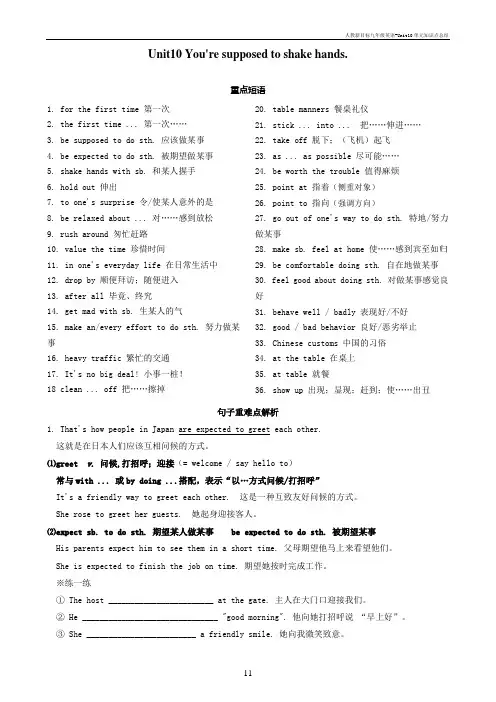
Unit10 You're supposed to shake hands.重点短语句子重难点解析1. That's how people in Japan are expected to greet each other.这就是在日本人们应该互相问候的方式。
⑴greet v. 问候,打招呼;迎接(= welcome / say hello to )常与with ... 或by doing ...搭配,表示“以…方式问候/打招呼”It's a friendly way to greet each other. 这是一种互致友好问候的方式。
She rose to greet her guests. 她起身迎接客人。
⑵expect sb. to do sth. 期望某人做某事 be expected to do sth. 被期望某事His parents expect him to see them in a short time. 父母期望他马上来看望他们。
She is expected to finish the job on time. 期望她按时完成工作。
※练一练① The host ________________________ at the gate. 主人在大门口迎接我们。
② He _______________________________ "good morning". 他向她打招呼说 “早上好”。
③ She _________________________ a friendly smile. 她向我微笑致意。
1. for the first time 第一次2. the first time ... 第一次……3. be supposed to do sth. 应该做某事4. be expected to do sth. 被期望做某事5. shake hands with sb. 和某人握手6. hold out 伸出7. to one's surprise 令/使某人意外的是8. be relaxed about ... 对……感到放松9. rush around 匆忙赶路10. value the time 珍惜时间11. in one's everyday life 在日常生活中12. drop by 顺便拜访;随便进入13. after all 毕竟、终究14. get mad with sb. 生某人的气15. make an/every effort to do sth. 努力做某事 16. heavy traffic 繁忙的交通 17. It's no big deal! 小事一桩! 18 clean ... off 把……擦掉 20. table manners 餐桌礼仪 21. stick ... into ... 把……伸进…… 22. take off 脱下;(飞机)起飞 23. as ... as possible 尽可能…… 24. be worth the trouble 值得麻烦 25. point at 指着(侧重对象) 26. point to 指向(强调方向) 27. go out of one's way to do sth. 特地/努力做某事 28. make sb. feel at home 使……感到宾至如归 29. be comfortable doing sth. 自在地做某事 30. feel good about doing sth. 对做某事感觉良好 31. behave well / badly 表现好/不好 32. good / bad behavior 良好/恶劣举止 33. Chinese customs 中国的习俗 34. at the table 在桌上 35. at table 就餐 36. show up 出现;显现;赶到;使……出丑2. Where I'm from, we are pretty relaxed about time. 我来的那个地方对时间非常放松。
人教版新目标英语九年级Unit 10 You’re supposed to shake hands教案
Unit 10: You’re supposed to shake hands.Part 1: Teaching Design第一部分:教学设计Period 1: Matching, Listening and Speaking(What are people supposed to do…?)Objectives●To learn to understand and use supposed to + infinitive●To listen and speak what you are supposed to doProcedures■Warming up by studyi ng the title “You’re supposed to shake hands.”Hello, class. Is there anyone who is late for school today? I see Li Jianshe is late. He is not here yet. You have to be here for class before the bell ring. That is to say you are supposed to be on time for s chool. By the way do you know what I mean by saying “you are supposed to be on time for school”.be supposed to... 其中to是动词不定式符号,不是介词,其后要跟动词原形。
当be supposedto... 的主语是“人”时,意为“应该……”;“被期望……”,它可以用来表示劝告、建议、义务、责任等,相当于情态动词should。
如:Everyone is supposed to wear a seat-belt in the car. 每个人在汽车里都应该系安全带。
九年级英语全册Unit10You’resupposedtoshakehandsSectionA23a_3c教案人教新目标版
Unit 10 You’re supposed to shake hands.Section A 2 (3a-3c)一、教学目标:1. 语言知识目标:1) 学习掌握下列词汇: relaxed, value, capital, noon, mad, effort, drop by, afterall, get mad, make an effort2)复习 be supposed to句型。
3)如何正确的阅读课文。
2. 情感态度价值观目标:1)通过“应该” 与“不应该”进一步了解一些国家的礼仪和对时间的看法。
2)了解不同国家的不同的时间观念,加强对中国文化的理解。
二、教学重难点1. 教学重点:1) 掌握本部分出现的生词和词组,达到熟练运用的目标。
2) 阅读短文,获得相关的信息。
通过阅读练习,来提高阅读能力。
2. 教学难点:1) 阅读短文,获得相关的信息的能力。
2) 理解并运用所学的词汇及表达方式。
三、教学过程Ⅰ. Warming up1. 师生问候。
2. 让学生展示上节课的演讲稿:各国礼仪的差异Ⅱ. Lead-in1. 展示一个哥伦比亚和瑞士风光的照片。
使学生熟悉这两个国家的情况,通过图片欣赏引出本节内容。
2. Look at the pictures and say something about the two countries.What do you know about Switzerland?What do you know about Colombia?Ⅲ. Reading1. Work on 3a: Tell Ss to read the article and answer the question:In which country is it OK to be 15 minutes late for dinner?Ss read the article quickly and try to find the answer to the question.2. 方法指导:首先,对原文材料迅速浏览,掌握全文的主旨大意。
九年级英语全册Unit10You’resupposedtoshakehands知识点汇总新版人教新目
Unit 10 You re supposed to shake handsSection A1.be supposed to do...词意应该做……=should / ought to表示劝告、建议、义务、责任后+V.原否定形式:be not supposed toeg: You're not supposed to be here. Do you realize I'm supposed to kill you?2.expect句型be expected to do sth.被期待做某事;被期望做某事eg: Soldiers are often left in the dark as to where they will be deployed or what they will be expected to do.expect sb./sth.期待某人或某物eg: Do not expect too much of him.expect (sb.)to do sth.期望(某人)做某事eg: You cannot expect to like all the people you will work with.expect+that从句预料……I expect that we will see more and more joint ventures.3.shake hands握手shake hands with sb.shake one's handshake sb. by the handshake过去式: shook过去分词: shaken4.greet词意v. 和……打招呼;迎接=say hello to后+名词/代词作宾语5.mistaken.错误短语make a mistake / mistakes犯错误eg: I would have made a big mistake only you advised.by mistake错误地;由于差错make no mistake别搞错mistake forv. 把…错认为6.happen词意v. 发生eg. But how and when did it happen?不及物动词,不能用于被动语态辨析take place常指(某事)按计划进行或发生happen常指具体事件的发生,特别指那些偶然的或未能预见的事情的发生7.surpriseto one’s surprise词意:让某人吃惊的是in surprise词意:惊奇地8.relax辨析relaxv. 使放松relaxedadj. 主语通常是人relaxingadj. 主语通常是物9.value作及物动词词意:“重视;珍视”eg: I value friendship very highly.作名词词意:“价值”eg:Good books are of great value to students.10.drop by词意顺便访问;随便进入=come over to后可接表示地点的名词eg:Drop by often when you are free.11.after all词意:毕竟;终归all的相关短语1. first of all,意为“首先”,强调次序2. in all,意为“总共,总计”3. above all,意为“最重要的是,尤其是”,强调要引起特别注意12.effortn. 努力;尽力eg: All their efforts were in vain.effort的常用短语put more effort into sth.更加努力干某事make a good/every/an effort to do sth. 尽一切努力做某事without effort 毫不费力make an effort to do sth. 努力做某事13.keepkeep sb. doing sth.词意:让/使某人一直做某事结构:keep+宾语+宾语补足语eg: I keep them waiting at the gate.keep doing something词意:不断/ 反复/ 坚持做某事eg: He kept asking us to remember teamwork14.withoutprep. 无,没有反义词:with其后可接名词、代词;接动词时要用动词的-ing 形式eg: We got there without any trouble.15.It...句型It+be+adj.+to do sth.意为“做某事是……的”eg:I think it's important to sleep eight hours a night.It + be + adj. + for sb. + to do sth.对某人来说做某事是……的eg:It's hard for me to answer your question.It + be + adj. + of sb. + to do sth.某人做某事真是太……了eg:It was foolish of him to go alone.16. clean...off把……擦掉eg:Please clean the writing off the paper.与clean相关的短语:clean...down 把……清扫干净clean...out 把……的内部清扫干净clean up 清除干净17.knockv. 敲(门)n. 敲击声;敲击eg:There is a knock at the door.短语knock at/on敲knock against与……相撞knock down/off撞倒18.take off脱下(衣服)eg:It's very hot in the room. Take off your coat.(飞机等)起飞eg :The plane will take off in two hours.休假eg:I will take a few days off next week.19.worthadj.值得;有……价值(的)常用短语be worth doing值得做be well worth doing很值得做eg:The film Operation Red Sea is well worth seeing.be worth+钱值多少钱eg:The painting is worth 3,000 yuan.be worth+名词值得……eg:The newly opened museum is certainly worth a visit.20.mannern.方式;方法(pl.)礼貌;礼仪manners常以复数形式出现table manners 餐桌礼仪;have good manners有礼貌;have bad manners没有礼貌。
人教新目标九年级全册 Unit 10 You,re supposed to shake hands
人教新目标九年级全册Unit 10 You,re supposed to shake hands SectionB(1a-1d)教案Unit10 SectionB(1a-1d)教案一、Teaching Aims:1. Language Goals:1) Words: greet, relaxed, value, drop by, capital, after all, noon, get mad, make an effort2) Sentences:A: What are you supposed to do when you meet someone for the first timeB: You are supposed to shake hands.S1: What are the other Chinese table mannersS2: We are supposed to eat after the old people.S3: We are not supposed to put elbows on the table.S4: We are not supposed to talk aloud at the dinner table.2. Ability Goals:Use “be supposed to do” to make sentences.3. Moral Goals:Help students know the different customs in different countries. Weshould know when in Rome, do as the Romans do.二、Teaching important Listening, speaking, reading, writing methods.五、Teaching ProceduresⅠ. Lead-in1. Watch a short movieT: Hello, everyone! We know different countries have different customs. But how do we display impeccable manners Let’s see a movie about how to behave good manners. How do you feel after watching the movie 2. After watching movie, Ss try to answer the questions.Ⅰ. Presentation1. See teaching objectsTo learn the table manners around the world.To read, listen and speak how you are supposed to behave at dinner tables in China.2. Students look at pictures and say different customs in different countries by using “be supposed to do” to make sentences.3. Ask students to turn to P77 to finish 1a and check the answers.4. Ask students about Chinese table manners:After seeing the pictures and say Chinese table manners.Summarize Chinese table manners.Ⅰ. Listening1. T: Steve is going to China to study. His friend Yang Ming is telling himabout table manners in China. Now listen and number the pictures in the order you hear them.2. Play the recording twice. Students number the pictures and match sentences parts.3. Play the recording again. Check the answers with the Ss.Ⅰ. Group workAsk student to make conversations.E.g.S1: What are the other Chinese table mannersS2: We are supposed to eat after the old people.S3: We are not supposed to put elbows on the table.S4: We are not supposed to talk aloud at the dinner table.Give students two minutes to make their conversations and perform their conversations.Ⅰ. Writing1. Ask students to summarize the phrases about Chinese table manners.2. Let some Ss read the information about writing and ask them to use sentence.3. Ss try to write a composition about Chinese table manners by using information in the chart. (Give students five minutes to write their compositions)4. Invite some students to read their compositions and check if there aremistakes.Ⅰ. SummaryAsk students to summarize the key phrases.Ⅰ. Homework:1. Find the differences about the table manners between France and China.2. Write a composition about Chinese table manners.。