
牛津深圳版九年级英语上 9A Unit 4 Problems and advice grammar---句子成分分析教学课件 (共27张PPT)
• Linking verbs: • feel, smell, taste, sound, look, get, turn, become…
She S
is driving V
me O
mad. C
The complement describes the object.
目标检测3
一、用to或者for填空
to 1. Give these papers __________ my secretary.
2. Could you make some coffee __________ me? for
for 3. Book a flight __________ me, will you?
2. Some sentences also have an object (O).
The braces S
hurt V
my teeth. O
The object is the person or thing that receives the action of the verb.
Exercise 2: 找出下列句子中的宾语(O) Object • • • • • • • • 1. They ate some apples just now. O 2. You can invite them to your party. O 3. Mary refused to help the old man. O 4. I regret shouting at my mum. O
The braces
V
am studying
O
C
A
hurt have
my teeth
much homework
I I We
every day
feel
me some advice
shy
should the keep room clean
6. My mum gave me some advice. My gave mum
Exercise 1: 找出下列句子中的主语 S (subject) 和谓语V (verb). • 1. Young people love pop music. • S V • 2. It rained yesterday. • S V • 3. Swimming can help you lose weight. • S V
.
Mum gave me some advice.
My mum gave me some advice.
分析1):Sentence elements: subjects, verbs, objects, complements and adverbials
根据给出的例句分析句子成分.
S
1. I am studying. 2. The braces hurt my teeth. 3. I have much homework every day. 4. I feel shy. 5. We should keep the room clean. I
句子成分和句子结构
导入:翻译句子 .
1)我在学习。 I am studying. I am studying. 2)牙箍伤到了我的牙齿。The braces hurt my teeth The braces hurt my teeth. 3)我每天有很多家庭作业。 much I have I have much homework every day. homework every day. 4)我感到很害羞。 I feel shy I feel shy. 5) 我应该保持房间干净。 We should keep the room clean. the room clean. We should 6)妈妈给了我一些建议。
牢记 下列动词后用to:bring,feed,give,hand, lend,offer,pass,post,sell,send,show, take,teach,tell,write 下列动词后用for:book,buy,choose,cook, fetch,leave,make,order,pick,reserve, save,pay
1. That job drove me crazy. 2. I agree. 3. She will come at 10 p.m. 4. I had some meat. 5. My father gave me a new computer.
二、判断下列划线部分在句子中的成分:
1. She can speak French well. 2. This is why he was late. 3. My job is to protect your safety. 4. He usually eats three apples a day. 5. He enjoys learning English.
S
V
O
S V
C
C
O
A
6. Tom got up early to catch the early bus today. 7. Did you see the boy running into the building?
O
A
V
C
分析句子成分
小结2:
成分 作用 主语S 人或物/事 谓语V 动词 (有时 态变化 ) 宾语O 人或物/事 状语A 表示时间,地点, 代词或相当 代词或相当 方式,比较,条件 于名词的词 于名词的词 等的短语或句子 或短语 或短语 一般位于句 紧跟在 在动词或介 既可在句首,be/情 首,有时态变 主语之 词之后 态动词之后,行为 化的动词之 后 动词之前,也可在 前 句末。
4. Can you post this cheque __________ the hotel? to
to 5. Don’t show these plans __________ anyone. for 6. Leave a message __________ my secretary.
7. Fetch the file __________ me, will you? for
1. Sentences in English usually have a subject (S) and a verb (V).
I S
The subject is the person or thing that does the action.
smile. V
The verb expresses the action.
am studying V
The adverbial adds information about time, place, etc.
Exercise 5: 找出下列句子的状语Adverbial (A)
• 1. There was a big smile on her face.
• 2. Every night he heard the noise. • 3. She loves library because she loves books. • 4. When Tom was 6 years old, he began to learn English
目标检测1
一、根据划线部分判断句子成分: 1. We’re having a great time. (O) 2. The weather is fine. (S) 3. We really enjoy camping. (V) 4. It’s great fun.(C) 5. We saw many sheep on the farm. (A) 6. We like this place. (O) 7. Let’s make the world more beautiful. (C)
The indirect object is the person or thing that receives something.
The direct object is the thing that is received.
Exercise 3:找出下列句子中的直接宾语 DO
(direct object) 和 间接宾语IO (indirect object).
• 1. He gave me a book. • IO DO • 2. My mum bought a bike for me. • DO IO • 3. Please tell us a story. IO DO
注意:在S + V + IO + DO中,如果把直接宾语放在前面强调, 间接宾语前要用借词to或者for连接
• 1. The movie made us happy. • C • 2. I found the book interesting. • C • 3. She asked me to help her. C
5. Some sentences have an adverbial (A).
I saw S V I S a sick lady O two days ago. A at home. A
分析2):Sentence structure:判断基本句子结构
I am studying. The braces hurt my teeth.
1.S+Vi
2. S+V+O
3. S+V+O+A much homework I have every day. I feel shy.
4. S+V+C 5. S+Vi+O+OC
牛津深圳版英语九上Unit 4《Problems and advice》教学设计5

牛津深圳版英语九上Unit 4《Problems and advice》教学设计5一. 教材分析牛津深圳版英语九上Unit 4《Problems and advice》主要讨论了日常生活中可能遇到的问题以及解决这些问题的建议。
本节课的主要内容包括如何描述身体不适、如何提出建议以及如何表达感谢等。
通过本节课的学习,学生将能够更好地运用目标语言进行日常交流,并提高他们的解决问题的能力。
二. 学情分析九年级的学生已经具备了一定的英语基础,能够理解和运用一些基本的英语表达方式。
然而,他们在语言运用方面还存在一定的问题,如口语表达能力较弱,对一些日常用语的掌握不够熟练等。
因此,在教学过程中,需要注重培养学生的口语表达能力,同时帮助他们巩固已学的知识。
三. 教学目标1.知识目标:学生能够掌握描述身体不适的词汇和表达方式,如“havea cold”,“have a fever”等;能够运用目标语言询问和建议,如“What should hedo?”,“He should see a doctor.”等。
2.能力目标:学生能够熟练地运用目标语言进行日常交流,提高他们的口语表达能力。
3.情感目标:培养学生积极主动寻求帮助和建议的习惯,培养他们的合作意识。
四. 教学重难点1.重点:学生能够运用目标语言描述身体不适,提出建议,并进行日常交流。
2.难点:学生能够正确运用目标语言询问和建议,同时能够灵活运用所学知识解决实际问题。
五. 教学方法1.任务型教学法:通过设定各种实际情境,让学生在完成任务的过程中运用目标语言,提高他们的口语表达能力。
2.情境教学法:通过创设各种生活情境,让学生在真实的环境中学习和运用目标语言。
3.合作学习法:通过小组讨论和合作,培养学生积极主动寻求帮助和建议的习惯,提高他们的合作意识。
六. 教学准备1.教师准备:备好相关教学材料,如PPT、单词卡片等。
2.学生准备:预习本节课的内容,了解相关话题的背景知识。
牛津深圳版英语九年级上册:Unit 4 《Problems and advice》 教案4
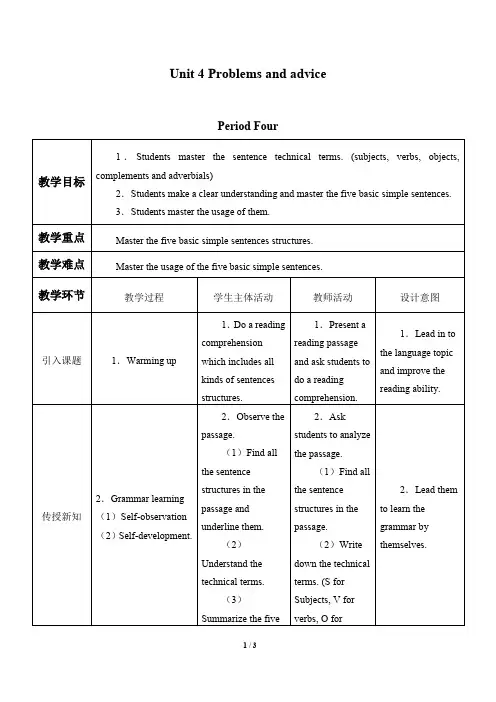
Unit 4 Problems and advicePeriod Four教学目标1.Students master the sentence technical terms. (subjects, verbs, objects, complements and adverbials)2.Students make a clear understanding and master the five basic simple sentences.3.Students master the usage of them.教学重点Master the five basic simple sentences structures.教学难点Master the usage of the five basic simple sentences.教学环节教学过程学生主体活动教师活动设计意图引入课题1.Warming up1.Do a readingcomprehensionwhich includes allkinds of sentencesstructures.1.Present areading passageand ask students todo a readingcomprehension.1.Lead in tothe language topicand improve thereading ability.传授新知2.Grammar learning(1)Self-observation(2)Self-development.2.Observe thepassage.(1)Find allthe sentencestructures in thepassage andunderline them.(2)Understand thetechnical terms.(3)Summarize the five2.Askstudents to analyzethe passage.(1)Find allthe sentencestructures in thepassage.(2)Writedown the technicalterms. (S forSubjects, V forverbs, O for2.Lead themto learn thegrammar bythemselves.basic simple sentences structure.S+VS+V+OS+V+IO+DOS+V+DO+IOS+V+O+A(4)Analyze the sentence elements:What kind of sentence structure are they?(5)Students answer the questions to show if they have understood.(6)Read the sentences loudly. objects, C for complements, A for Adverbials on the blackboard and ask students to understand them.)(3)Ask students to summarize the five basic simple sentences structures according to the passage.(4)Ask the students to analyze the sentence elements in the passage.(5)Ask them to give the answers and give some help if necessary.(6)Ask them to read the sentences loudly.课堂练习3.Play a game.3.Work ingroups, and choose alucky number andanswer some3.Introducethe rules of thegame:(1)The3.Make theclass lively andstrengthen theirgrammar by games.questions to get points. (Some questions are what kinds of sentences structures they are. Some should be make a sentence according to the instruction. Some should be easy enough to write the five simple sentence structure.) name of the gameis Boom.(2)Work ingroups, andchoose one of thenine luckynumber. You mayanswer somequestions to getsome points. Youmay be boomedand lose all points.You may be luckyenough to getpoints withoutdoing anything.4.Cultivatetheir habit of takingnotes.课时小结4.Grammar exercises.4.Finish theexercises.4.Askstudents to finishthe exercises.5.Strengthentheir grammar byexercises.作业布置5.Summary andhomework5.(1)Listencarefully and takenotes.(2)Make 2sentences accordingto each sentencestructure.5.(1)Askstudents to takesnotes.(2)Summarize themain content ofthe grammar.(3)Assignment.6.Summarizeand cultivate theirhabits of takingnotes.。
牛津深圳版英语九年级上册Unit4基础知识讲解+练习题(含答案)
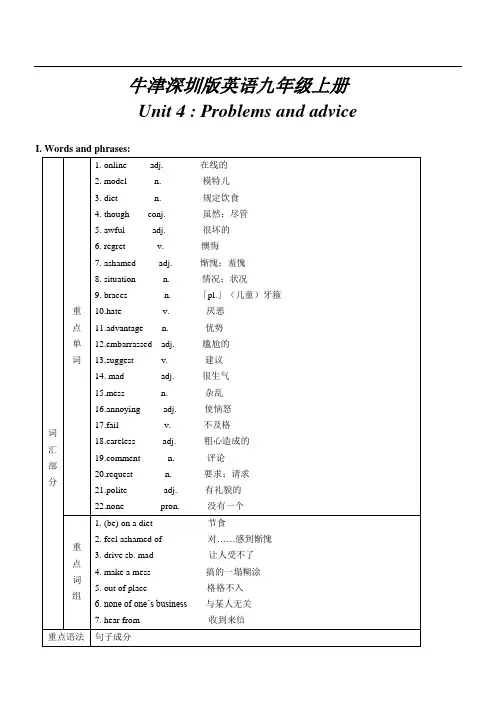
牛津深圳版英语九年级上册Unit 4 : Problems and advice I. Words and phrases:II. Key points of vocabulary:1.online adj. 在线的反义词 off-line You can chat to other people who are online. diet n. 规定饮食(be) on a diet 节食2.regret v. 懊悔同义词 be sorry forregret doing sth regret (that)I now regret leaving school so young.He was beginning to regret that he'd come alone.3.though conj. 虽然, 尽管同义词 although though 可放在句首或句中,不能与but 连用Though she's almost 40, she still plans to compete.Tom kept himself in though he was very angry.4.ashamed adj. 惭愧;羞愧feel ashamed of/at be ashamed to do sth ashamed thatI felt ashamed of the things I'd said to him.I'm ashamed to admit it.I'm ashamed that I haven't replied to your letter yet.5.mad adj. 很生气;气愤 especially angrydrive sb. mad 让某人受不了 mad at sb mad about sth go/get mad We get mad at each other sometimes.There's no need to get mad about it!Look at this mess! Mum will go mad!Her behaviour drives me mad.6.mess n. 杂乱;不整洁messy adj. 杂乱的;不整洁的make a mess 搞得一塌糊涂The house was a _______________ The house was _______________ When I got home, the house was a complete _______________7.annoying adj. 使恼怒的;使生气的annoyed adj. 恼怒的, 气恼的annoy v. 使生气, 惹恼类似构词:interest -interesting-interested surprise-surprising-surprisedfrighten-frightening-frightened excite-exciting-excited8.out of place 格格不入I felt out of place at the birthday party.hear from 收到某人的信件同义词 get/receive a letter from9.none pron. 没有一个;毫无She waited for a reply, but none came.Even an old car is better than none.None of my friends phone me any more.none/no one区别:none:一般用来回答how many +n, how much +n 及含any+n引起的疑问句no one:回答who,及含anyone,anybody引起的疑问句 none of one's business 与某人无关10.careless adj. 粗心造成的反义词 careful11.fail v. 不及格;失败反义词 succeed failure n. 失败 success fail to do sth12.request n. 要求;请求v. 要求;请求13.hate v. 厌恶;憎恶同义词 dislike 反义词love14.polite adj. 有礼貌的反义词 impolite/rude politely adv. politeness n.15.exam n. 考试同义词 examination / test pass/fail an examugh at 嘲笑;讥笑同义词 make fun of17.advantage n. 优势反义词 disadvantageIII. key points of Reading:1. We saw a lady lying in the streetsee sb. doing sth. 看到某人正在做某事see sb. do sth 看到某人做过(经常做)某事 I saw the little girl crying in the park. _______________________________________The old man saw the man play with the cat. _____________________________________________ lie (撒谎) lied lied lying(躺) lay lain lying拓展:hear/notice/watch和see有相同的用法2. It was awful of them to laugh at her,and I regret not saying anything.It is +adj+of sb + to do sth.=sb. is adj. to do sth.They were awful to laugh at her.regret doing sth. 后悔/内疚做过某事 regret to do sth 遗憾地去做某事I regret to tell you that you can't pass the examination ___________________________________3.... it was a mistake for my mother to make me wear these ugly braces.It is +adj+for sb + to do sth.=To do sth is adj for sb.To make me wear these ugly braces was a mistake for my mother. __________________________________ make sb do sth . 使某人做某事wear 穿(戴)着[表状态];put on 穿上[表动作] dress 打扮[后接人]4. She has a habit of playing the piano ... studying,and she always takes my things without telling me. have a habit of doing sth 有做某事的习惯The Smiths have a habit of going out for a walk after dinner. ______________________________________ take one's thing without telling sth 未经允许就拿走某人的东西Little Tom took his classmate's ruler without telling him. _________________________________________5.I try to keep the room tidy,but....try to do sth 尽力做某事try doing sth 尝试做某事You must try to be more careful. _________________________________I tried gardening but didn't succeed. ____________________________________keep sth adj 保持某物某种状态keep sb doing 使某人持续做某事Please keep the window open/closed. ___________________________He kept the little girl laughing. ____________________________Unit 4 : Problems and advice 课后练习一、英汉互译。
牛津深圳版英语九年级上册:Unit 4 《Problems and advice》 教学设计5

牛津深圳版英语九年级上册:Unit 4 《Problems and advice》教学设计5一. 教材分析本课是牛津深圳版英语九年级上册Unit 4《Problems and advice》的教学设计。
本单元的主要话题是讨论问题和提出建议,通过本课的学习,学生能够运用所学知识描述生活中遇到的问题,并提出解决问题的建议。
本课的主要内容是讨论环境问题,学会用英语表达各种环境问题,并能够提出相应的解决方案。
二. 学情分析九年级的学生已经具备了一定的英语基础,能够听懂并运用简单的英语进行日常交流。
但是,对于一些环境问题的专业词汇和表达方式可能还不够熟悉,因此,在教学过程中,需要帮助学生掌握相关词汇和表达方式,并能够灵活运用。
三. 教学目标1.知识目标:学生能够听懂、说出一系列环境问题,并能够用英语提出相应的解决方案。
2.能力目标:通过本课的学习,学生能够提高自己的英语听力、口语和表达能力。
3.情感目标:通过讨论环境问题,学生能够增强环保意识,提高自己的社会责任感和公民素质。
四. 教学重难点1.重点:学生能够掌握与环境问题相关的词汇和表达方式。
2.难点:学生能够运用所学知识,提出针对环境问题的具体解决方案。
五. 教学方法1.任务型教学法:通过设计各种任务,让学生在实际语境中运用所学知识,提高学生的综合语言运用能力。
2.情境教学法:通过创设各种环境问题的情境,让学生在真实的环境中学习和使用英语。
3.小组合作学习:通过小组讨论和合作,提高学生的团队协作能力,培养学生的自主学习能力。
六. 教学准备1.教师准备:教师需要准备相关的教学材料,如PPT、环境问题的图片、视频等。
2.学生准备:学生需要预习本课的内容,了解一些环境问题的背景知识。
七. 教学过程1.导入(5分钟)教师通过展示一些环境问题的图片或视频,引导学生关注环境问题,激发学生的学习兴趣。
2.呈现(10分钟)教师通过PPT呈现本课的主要内容,包括环境问题的词汇和表达方式,以及如何提出解决方案。
深圳牛津英语(2014更新)9AUnit4reading
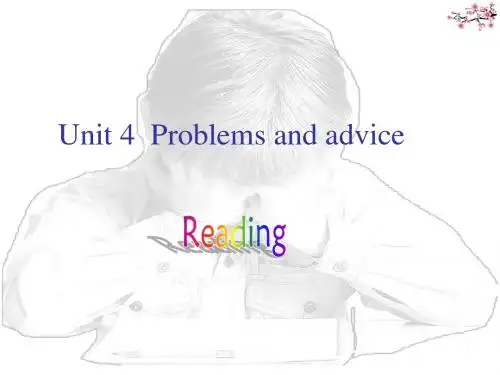
5.She has a habit of playing the piano ... studying,and she always takes my things without telling me. have a habit of doing sth 有做某事的习惯
The Smiths have a habit of going out for a walk after dinner. take one's thing without telling sth 未经允许就拿走某人的东西 Little Tom took his classmate's ruler without telling him.
doing sth. 后悔/内疚做过某事 remember to do sth 遗憾地去做某事 forget
I regret to tell you that you can't pass the examination.
regret
4.... it was a mistake for my mother to make me wear these ugly braces.
C Vocabulary
C1
4.We talked about the problem and suggested Tim__________doing some research first. (put forward an idea or a plan)(line16) 5.Peter's neighbour is making a lot of noise at night. He is driving Peter's family mad __________.( very angry)(line18)
Unit4Writing(problemsandadvice)问题与建议写作课件牛津深圳版英语九年级
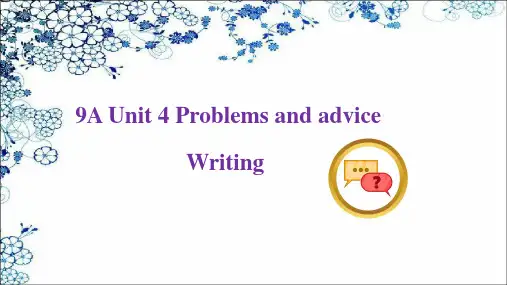
___B___With a little hard work, I believe you will deal with the homework problem
and feel relaxed in your study. Yours, A. In this way, you can improve your learning efficiency(学习效率). Linda B. To sum up, you should stay positive and try different ways to solve the problems.
The sentence patterns to give suggestions: had better (not) do.../ I advise to... Doing...is( a good choice)./ If you..., you will... It’s a good way to... You’re supposed/expected to... I suggest that you (should)...
Act. 3- Read the email again and find out some sentence patterns to give suggestions.
Dear Eric, I learn that you have trouble finishing your homework everyday and you suffer from a
牛津深圳版英语九年级上册:Unit 4 《Problems and advice》 教学设计7
牛津深圳版英语九年级上册:Unit 4 《Problems and advice》教学设计7一. 教材分析《牛津深圳版英语九年级上册》Unit 4《Problems and advice》主要围绕问题和建议展开,让学生学会描述常见的问题以及给出相应的建议。
本节课主要介绍了一些日常生活中的问题,如健康、学习、环境等,并通过对话和阅读材料,让学生学会如何表达这些问题,以及如何给出合理的建议。
教材内容丰富,贴近学生生活,有利于激发学生的学习兴趣和参与度。
二. 学情分析九年级的学生已经具备了一定的英语基础,能够进行简单的日常交流。
但部分学生在表达问题时,可能会受到中文思维的影响,不知道如何用英语准确表达。
此外,学生在给出建议时,可能会出现词汇量不足、句子结构混乱等问题。
因此,在教学过程中,需要关注学生的个体差异,有针对性地进行指导。
三. 教学目标1.知识目标:学生能够掌握描述问题的相关词汇和表达方式,如“haveproblems with”,“give advice”等;2.能力目标:学生能够用英语准确地描述生活中遇到的问题,并给出合理的建议;3.情感目标:培养学生关心他人,乐于助人的品质。
四. 教学重难点1.重点:学生能够用英语描述生活中遇到的问题,并给出合理的建议;2.难点:如何引导学生运用所学知识,准确、流畅地表达问题和建议。
五. 教学方法1.任务型教学法:通过设定各种现实生活中的情境,让学生在完成任务的过程中,学会描述问题和给出建议;2.交际型教学法:鼓励学生积极参与课堂对话,提高他们的口头表达能力;3.情境教学法:通过设定情境,让学生在实际语境中学会运用所学知识。
六. 教学准备1.教材:《牛津深圳版英语九年级上册》Unit 4《Problems andadvice》;2.课件:相关图片、视频、音频等教学资源;3.练习题:针对本节课内容的练习题;4.小组活动准备:分组名单、任务分配等。
七. 教学过程1.导入(5分钟)利用图片或视频展示一些日常生活中的问题,如健康、学习、环境等,引导学生思考并讨论这些问题。
Unit4Problemsandadvice知识点讲解精选精练牛津深圳版英语九年级上册
17.A.peopleB.people’sC.peoplesD.peoples’
18.A.a dayB.one dayC.one weekD.a week
19.A.atB.ofC.forD.to
fail to dosth未能做到某事
failuren.失败
24.carev/n照顾
carefuladj.小心的,仔细的
Hale Waihona Puke carelessadj.粗心的25.be sure todo sth一定去做某事
be sure of/aboutsth对...有把握
26.politeadj.有礼貌的
impoliteadj.不礼貌的
Don’t take your exams too seriously. Some students may think that the rest of their life13them. That’s not true. Instead, just regard the exams as another difficulty14you will overe. You have overe all kinds of difficulties in your life so far. You are15to overe the difficulty of the exams!
diseasen.疾病
15.keep v.保持keephealthy/fit保持健康
keepdoing sth坚持做某事
keepsb from doing sth阻止某人做某事
v.饲养keep cows on the farm在农场里养牛
牛津深圳版英语九上Unit 4《Problems and advice》教学设计3
牛津深圳版英语九上Unit 4《Problems and advice》教学设计3一. 教材分析牛津深圳版英语九上Unit 4《Problems and advice》主要讨论了日常生活中可能遇到的问题以及相应的解决方法。
本节课的教学内容主要包括如何描述问题,如何给出建议,以及如何表达自己的观点。
教材通过丰富的语境和真实的例子,帮助学生掌握相关词汇和句型,提高他们的语言运用能力。
二. 学情分析九年级的学生已经具备了一定的英语基础,能够理解和运用一些基本的词汇和句型。
然而,在描述复杂问题和给出具体建议方面,他们可能还存在一定的困难。
因此,在教学过程中,需要关注学生的个体差异,充分调动他们的积极性,引导他们主动参与课堂活动。
三. 教学目标1.知识目标:学生能够掌握描述问题的词汇和句型,如have problemswith, give advice, suggest doing等;2.能力目标:学生能够在日常生活中运用所学词汇和句型,描述问题并给出建议;3.情感目标:学生能够学会倾听他人的意见,尊重他人的观点,形成良好的沟通习惯。
四. 教学重难点1.重点:描述问题的词汇和句型,如have problems with, give advice,suggest doing等;2.难点:如何运用所学词汇和句型,在实际情境中进行有效的沟通和表达。
五. 教学方法1.情境教学法:通过设定真实的生活情境,让学生在实践中学习和运用词汇和句型;2.交际法:鼓励学生积极参与课堂活动,进行真实的交流和互动;3.任务型教学法:通过完成具体任务,培养学生解决问题的能力和合作精神。
六. 教学准备1.教材:牛津深圳版英语九上Unit 4《Problems and advice》;2.多媒体设备:电脑、投影仪等;3.教学课件:根据教学内容设计的课件;4.练习题:针对本节课内容的练习题。
七. 教学过程1.导入(5分钟)利用图片或实物,引导学生谈论日常生活中遇到的问题,激发学生的学习兴趣。
牛津深圳版英语九上Unit 4《Problems and advice》教学设计4
牛津深圳版英语九上Unit 4《Problems and advice》教学设计4一. 教材分析本单元的主题是“Problems and advice”,主要讨论了生活中可能遇到的问题以及解决这些问题的建议。
通过本单元的学习,学生能够更好地了解如何面对问题,如何寻求建议,并能够用英语进行相关的表达。
二. 学情分析九年级的学生已经具备了一定的英语基础,能够进行简单的英语听说读写活动。
但是,对于一些复杂的情境表达和语法结构可能还不够熟练。
因此,在教学过程中,需要结合学生的实际情况,设计适当难度的任务,让学生能够在掌握知识的同时,提高英语运用能力。
三. 教学目标1.知识目标:学生能够掌握本课的生词和短语,理解并能运用情态动词和固定搭配表达建议。
2.能力目标:学生能够用英语描述生活中遇到的问题,并给出相应的建议。
3.情感目标:学生能够学会面对问题时,积极寻求建议,培养解决问题的能力。
四. 教学重难点1.重点:学生能够掌握本课的生词和短语,理解并能运用情态动词和固定搭配表达建议。
2.难点:学生能够运用所学知识,描述生活中遇到的问题,并给出相应的建议。
五. 教学方法采用任务型教学法,让学生在真实的语境中进行英语学习,通过合作、交流、探究的方式,提高学生的英语运用能力。
六. 教学准备1.教师准备:准备好本课的生词和短语,制作PPT,准备相关的教学材料。
2.学生准备:预习本课的生词和短语,提前了解相关的情境。
七. 教学过程1.导入(5分钟)通过提问的方式,引导学生谈论生活中遇到的问题,引出本课的主题。
2.呈现(10分钟)教师通过PPT展示本课的生词和短语,让学生进行认读和学习。
同时,教师可以给出一些例句,让学生理解这些词汇和短语的用法。
3.操练(10分钟)学生分成小组,用所学的词汇和短语,模拟生活中遇到问题,并给出相应的建议。
教师可以巡回指导,纠正学生的错误,并给予鼓励。
4.巩固(10分钟)教师设置一些情境,让学生进行角色扮演,运用所学的知识进行对话。