
五年级英语下册 Module2 Unit1(2)教案 外研版
外研版五年级英语下册教案
Module2 Grandparents
、 Unit1 She learnt English.
.
、教学目标:
(1)能识读词汇:dancer learnt these foreign language
(2)能运用Did you/he/she +动词原形?”这类语句询问过去的行为,并能用“Yes, I/he/she did.
No, I/he/she didn’t.”回答。
、教材分析:
通过过去与现在作比较,让学生体会二者的不同,并能在适当语境中恰当运用。
通过比较人们的过去和现在,教育孩子们珍惜现在宝贵的学习机会。
、学情分析:
学生通过过去与现在作比较,体会不同之处,学习能在适当语境中恰当运用。
五、教学重点:
教会学生用Did you/he/she +动词原形?”这类语句询问过去的行为,并能用“Yes, I/He/She did.
No, I/He/She didn’t.”回答。
、教学准备:磁带
、教学过程:
Step1: Warming up
1.Greetings
2.Review:(师说出一个动词,要求学生快速说出其过式;也可以请一个学生说,其他人说过去式。
)
is,are,do,go,buy,eat,run,meet,lose,make,have,
live,dance, watch,talk,cook,work.
Step2: leading in and presenting
1.T: what did you do yesterday?
S: I watched TV/…
T: I did ,too.I saw Yang Liping. Do you know Yang Li ping? She’s a famous dancer.
(可以提一下teacher,driver,farmer,worker)
2.T: Now what are we doing?
S: We are having English now.
T: Ok,we are learning English now.
(用learn造词组,如learn Chinese)
3. T: We are learning English now. But did your mother learn English?
S: Yes, she did. /No, she didn’t.
T: She learnt English.
(如果学生是肯定回答,教师通过重复句子,引出learn的过去式learnt)
4. T: Did your father learn English?
S: Yes, he did. /No, he didn’t.
(如果学生肯定回答,可以重复He learnt English.)
T: Did he learn any foreign languages?
S: Yes, he did. / No, he didn’t.
(解释foreign languages的意思,并教读发音。
)
5.板书重点句型,自由对话练习。
(Practice in pairs)
T: Did your grandpa learn English?
S:……
Step3: Listen
1. Listen and circle these new words . (教学these这个单词。
)
2.Listen and repeat
3.Listen and answer these questions.
(1)Who are they?
(2)Why is Lingling’s grandma wearing these clothes?
(3)Which language did she learn?
(4)What was Lingling’s grandpa?
(5) Did he learn a foreign language?
4、各种方式读课文(领读,分读)
Step4: Practice
Guessing Game
学生三人一组,两个背对背,另一个与其一面对面。
面对面的一个做动作一个问,背对的同学猜“Yes or No”,如下:
S1: (Do action)
S2: Did he/she play basketball?
S3: Yes, he/she did. No, he/she didn’t.
Step5: Homework :
1. Read the text, copy the tape as possible as you can.
2. Do a survey:
采访自己身边的长辈,请他们谈谈自己的过去和现在(包括工作,喜好,习惯等)然后根据采访得来的信息,与其他同学进行交流。
板书:
Module 2 Grandparents
Unit1 She learnt English.
Did your grandpa learn English? Yes, he did. / No, he didn’t. We are learning English now.。
五年级下册英语教学设计-Module 2第三课时Unit 2 1~3 外研版(三起)
五年级下册英语教学设计-Module 2第三课时Unit 2 1~3 外研版(三起)一、教学目标1.通过本课学习,学生能够听懂、了解并掌握生日派对上常用的英语表达。
2.学生能够运用所学知识,描述自己或他人的生日派对。
3.学生能够听懂简短对话,并通过模仿、角色扮演等形式进行语言输出。
4.了解生日派对的文化背景,激发学生的学习兴趣。
二、教学重难点重点1.生日派对用语的掌握:如Happy birthday!、blow out the candles、eat cake、open presents等。
2.生日派对场景的描述。
难点1.口语表达训练:如何自然流畅地表达句子。
2.学生间进行英语交流,激发其口语表达自信心。
三、教学内容与活动设计课前准备•教师在教室内张贴各种生日 related 的图片,例如:birthday cake、balloon、gift、party hat、candle、invitation card 等等。
1. Warming-up•教师Show several pictures about birthday parties, ask the students what they see. Then teacher ask what day is one student’s birthday.2. New words learning•教师学生重点讲解新单词:•invite、presents、cake、ribbon、candle、blow、wish 等。
•教师运用图片和举例子的方法,帮助学生加深对单词的印象并感受单词所表达的意思。
3. Listening•Teacher plays the recording of the dialogue, let the students listen and try to understand the dialogue。
•教师可运用接龙的方式反复播放听力,帮助学生更好地理解、记忆。
五年级英语下册 Unit 1 We lived in a small house教案 外研版

课时授课计划授课日期:月日星期授课人:总第 1 课时题目Module 1 ChangingUnit 1 We lived in a small house .教学目标1、Words and phrases: life, different, ago, any, television, us,grandchildren, lady.2. Sentences: There weren’t any buses. We lived in a sm all house.There are lots of buses and cars. We live in a big house.教学重点难点1、新单词与新句型的教学与应用2、如何让学生在课堂上学会There be……,We lived ……many years ago,We live……now 句型,并能在生活中灵活运用。
教学准备cards, pictures, Tape-recorder.教学过程教师活动学生活动Teaching steps :Step 1 Warmer:1. Talking about myself with 'then' and 'now' Look at thepictures and say:Then I was 20years old. Now I am 28 years old.Then she was young. Now she is old.lmMany years ago, I played football. Many years ago, I had lots offood.2. Talking about Part 3, P3A. There was a small house four years ago. He lived it.Now there is a big house. He lives it.B. There was a small tree in the picture four years ago. Now thereis a big tree in the picture.C. There was a dog in the picture. There are three dogs inthe picture.D. He had a kite four years ago. Now he has a MP3 player.Look at the pictureand listencarefullyTalking about andsay the sentencesStep 2、Presentation:1. Look, listen and learn:A.Learn the new words: live, live—lived, life, different, manyyears ago, television, grandchildren, grandmother, were not= weren't, missedB. Listen to the tape and understand the text.C The teacher explains the text, then let the Ss answer the questions. P2 Ex1.D Read the text in the roles.2. Listen and say:A.There weren't any buses. We lived in a small house.B.There are lots of buses and cars. We live in a big house.C. Read and repeat, read and write.Step 3、Practice:Look at the picture ,Listen and read:1. She ran fast many years ago. Now she walks slowly.2. She saw well many years ago. Now she sees badly.3. She cooked badly many years ago. Now she cooks well.4. She was young many years ago. Now she is old.Step 4、Homework:1. Read the text.2. Write the new words. Study the words and readWrite the wordsListen to the tape and read the textRead repeat .read and writeLook at the picture.listen and read板书设计Module 1 ChangingUnit 1 We lived in a small house .live There weren’t any buses .life There are lots of buses and cars . different There is / are ……many years ago There was / wre ……grandchildren We lived in a small house .were not= weren't ……教学反思课时授课计划授课日期: 2011 年 3 月日星期授课人:总第 2 课时题目Module 1 ChangingUnit2 She didn’t have a television教学目标1. Words and phrases:fire, radio telephone, field, hope2.音标教学,字母组合ai/ay, al/au, ar 的发音规则。
(三起点)外研版五年级英语上册《Module2_Unit1_名师教案》

Module2 Unit1教案【内容来源】外研版三起点(2013年审定)五上Module2 Unit1【主题】What did you buy?【课时】此教学设计按单元写,教师可根据实际情况划分课时。
一、教学目标(Teaching aims)1. 全体学生能运用单词list, need, first, can, lost, how much, cheese, any听懂句子What did you buy? How many bananas did you buy?2. 全体学生能运用单词can, how much, any,能说What did you buy?How many bananas did you buy?3. 部分学生能认读并运用单词list, need, first, lost。
二、教学重难点(Teaching points and difficulties)(一)重点(Points)能用What did you buy? How many … did you buy? How many bananas did you buy? 来询间别人并学会问答。
(二)难点(Difficulties)How to make a shopping list? What do we need to buy?三、教学准备(Teaching preparation)多媒体PPT课件、互动答题器或平板。
四、教学过程Step 1: Warm-up & Lead in1. Greetings.师生间简单地打招呼。
T: Hello, boys and girls. Glad to see you!Ss: Me, too.T: Were you happy yesterday?Ss: Yes.T: What did you do yesterday?Ss:... (请同学们谈谈自己的昨天)2. Lead inT: What did you do yesterday?Ss: I did my homework.T: Please guess: What did I do yesterday? 教师呈现购物图片。
【教案设计】Module2Unit1Whatdidyoubuy(教案)外研版(三起)-五年级英语上册
【精品】Module 2 Unit 1 What did you buy?(教案) 外研社(三起) -五年级英语上册【教学目标】知识目标:1.了解本课中的重点词汇:list, need, first, can, lost, how much, cheese, any.2.巩固学习动词过去式:go-went, eat-ate, lose-lost, buy-bought, make-made3.学习句型和语法:(1)一般过去时态的特殊疑问句及答语;(2)How many的用法;(3)some和any的用法。
技能目标:1.能听懂,会读本课单词,短语及动词过去式;2.能用特殊疑问句谈论过去发生的事情;3.理解并能够朗读本课故事。
情感目标:乐于感知并积极尝试使用英语。
【教学重难点】重点:1.能正确朗读本课的故事。
2.能用--疑问词+did+主语+动词原形+其他?--主语+动词过去式+其他.谈论过去发生的事情。
难点:能在一定的语境下用一般过去时态的特殊疑问句正确询问和正确回答,同时注意how many和any的用法。
【课前准备】1.一些水果的图片。
2.Unit 1教学课件及音视频。
【教学流程】Step 1: Warm up(热身运动)1. 老师与学生打招呼2. 教师展示一些水果的图片,然后询问学生Do you know the friut? 学生可自由讨论发言,不认识的单词老师可教读,学生积累总结到笔记本上。
Step 2: Presentation (新课呈现)(一)引入故事话题1.老师展示幻灯片,我们去超市购物了,让学生们猜一猜:我们都买了什么?学生自由回答,引出句型What did we buy?2.老师展示幻灯片,看图片,来说一说We bought...3.老师展示幻灯片,数一数这些水果的数量,引出How many...(二)学习故事。
1.老师出示幻灯片,让学生看图说一说,并猜猜What did Dad give to Sam? What did Samdo?2.老师播放故事,让学生通过看故事得出答案。
外研社五年级下册Module1 Unit2 She didn’t have a television.教学案
教学案编号:2【科目】英语【主备人】【审批人】【教学内容】Module1 Unit2 She didn’t have a television. 【授课时间】2019 年月日【教学目标】1.知识目标:(1)新单词fire, radio telephone, field, hope(2)时态一般过去时的教学:She didn’t have a television. She worked in the fields.2.技能目标:(1)培养学生听、说、读、写、做的能力(2)谈论人们过去和现在的生活。
3.情感目标:(1)使学生体验学习、参与、合作、竞争的乐趣。
(2)比较过去与现在的生活体会到我们现在生活在幸福的社会主义,让学生感觉到社会主义就是好,培养学生的爱国主义情操。
【重点】新单词学习,用过去时谈论生活中发生的事。
【难点】一般过去时的运用。
【教学过程】一、预习学案(一)写出下列动词过去式1.can______e_____3.have___4.work____(二)英汉互译1. talk about2.on a fire3.昨天晚上4.与…谈话5. 在田地里(三)我会读:fire, radio, telephone, field, hope(四)我理解:运用一般过去时和一般现在时谈论过去和现在的生活。
二、导学流程教学环节/步骤学生活动教师活动设计意图热身进入1.Look at the picture andanswer the question.学生根据图片内容回答问题。
2.Listen to the tape andanswer the question.听音频,回答问题。
3. Watch the video and read afterit.观看动画并跟读。
1.Hello, boys and girls. Welcome to ourclass. Look at the picture and answermy question:What animals can you see?观察图片,根据图片回答问题。
外研版小学英语(新标准三起)五年级下册教案(全册)
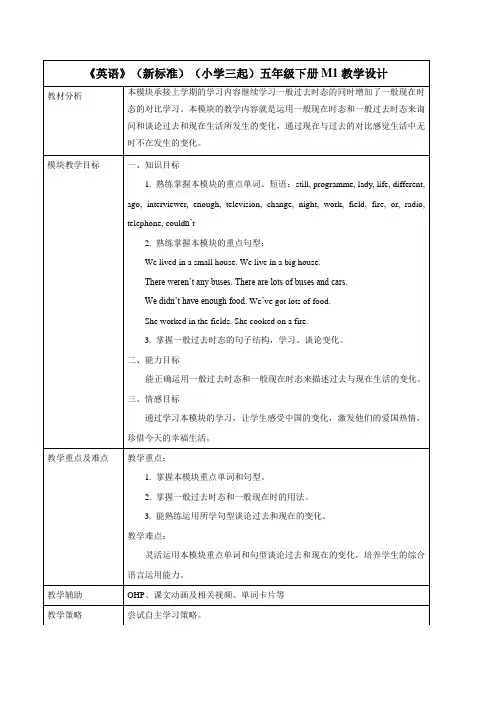
We lived in...We live in....
We didn’t have...We’ve got...
There weren’t....There are…
家庭作业:
1.Listen and read the text.
2.Talk about your parents’life, andthen write it down.
She worked in the fields.(新授:field)
She cooked on a fire.(新授:fire)
She didn’t have a television or a radio.
(超链接:区分and和or)
There are many televisions and radios now.
ManyYearsAgo
Now
House
Transportation
Food
Clothes
综合操练本模块语言内容。
通过衣、食、住、行等方面介绍自己家庭生活的变化,达到学以致用的学习目标。
Step 5:EmotionalEducation(about 2 minutes)
Cherish our life, love our life!
2.熟练掌握本模块的重点句型:
We lived in a small house. We live in a big house.
There weren’t any buses. There are lots of buses and cars.
We didn’t have enough food.We’ve got lots of food.
五年级下册英语教学设计-Module2Unit 1 What did she have for lu
五年级下册英语教学设计-Module2Unit 1 What did she havefor lunch (2) 外研版(一起)一、教学目标1.学习新词汇:sandwiches, grapes, banana, hamburger, orange juice, chicken。
2.通过写作和口语练习巩固现在完成时态的用法。
3.能够用正确的语法和词汇描述他人的午餐食物。
4.通过听、说、读、写的综合活动培养学生的英语语言技能。
二、教学重点和难点教学重点:1.学生通过学习新词汇,巩固现在完成时态的用法。
2.能够用正确的语法和词汇描述他人的午餐食物。
教学难点:1.学生在实际交流中运用已学知识。
2.理解现在完成时态的概念和用法。
三、教学准备1.多媒体课件,包含有关新词汇图片、动画和声音。
2.白板、白板笔和橡皮擦。
3.课堂活动练习材料,包括练习册和作业本。
四、教学过程时间教学过程教学方法5min1. 导入新课程,介绍学习目标和重点问答教学法2. 师生互动,了解学生在上课中的经验和感受讨论和分享10 min 3. 新词汇学习1:呈现新单词和图片,教授单词的发音、拼写和意思,并运用多媒体播放[1]演示和讲解,多媒体教学法15min4. 完成课堂活动练习1和练习2,巩固新词汇课堂活动10 5. 现在完成时态的引入:呈现新单词和图片,并引出演示和讲解,多min句子及其构成,学生模仿运用媒体教学法20 min 6. 完成课堂活动练习3,巩固现在完成时态的用法和构成课堂活动10 min 7. 能力提升:要求学生描述他人的午餐食物,教师给出范例及提示问答教学法,多媒体教学法20 min 8. 完成课堂活动练习4,让学生在小组内互相练习描述他人的午餐食物小组合作和交流10 min9. 课程总结:对今天的课程进行总结,回答学生的问题,预告下节课内容问答教学法五、作业布置1.完成练习册上的习题。
2.准备口语展示,描述自己和家人的午餐食物。
2021春外研版五年级英语下册 Module 1 Unit 2 授课+习题课件
or 连接;or 常用于疑问句或否定句中, and 用于肯定句中。 例句:She hasn’t got an apple or an orange. 她没有苹果,也没有橘子。
讲解来自《点拨》
五、单项选择。
( C )1. I ________ a television programme last night.
A. watch
B. is watching C. watched
点拨:last night是表示过去的时间,所以句 子时态为一般过去时,动词用过去式。
( B )2. They didn't have a television ________ a
(昨天晚上).
习题来自《点拨》
二、改为否定句。 1. We went to the zoo last week.
We __d_i_d_n_’_t_ ____g_o___ to the zoo last week. 2. There were some shops.
There _w__e_r_en__’t_ ___a_n_y___ shops. 3. I watched a programme last week.
谓语动词为实义动词,时态为一般过去时的否定句 句型结构: 主语 +didn’t+ 动词(短语)原形 + 其他 .
典例 句型转换。 Tom had a big house.(变为否定句) _T_o_m__d_i_d_n_’t__h_a_v_e_a__b_ig__h_o_u_s_e_. ________
三、请在下列单词前加一个字母, 使之变为另一个 单词, 并仿照例子写一个短语。【加法记忆法】 例: long — along along the river 1. go —____a_g_o__ ____fi_v_e_d_a_y_s__a_g_o__ 2. any —__m__a_n_y__ ____m_a_n_y__b_o_o_k_s___ 3. our —__h__o_u_r__ ____h_a_lf_a_n__h_o_u_r___
外研社(三年级起点)小学英语第五册 Module2 Unit1优秀教案及教学反思
外研社(三年级起点)小学英语第五册Module2 Unit1优秀教案及教学反思本节主要学习“How many do you want?”以及新单词need需要 food食物 shopping list购物单 cheese奶酪how much多少 kilo千克;要求学生通过学习本节,能在设置的情景中听得懂以及能够运用“How many do you want?”来询问需求量。
学情分析这是本单元第一节课,学生对本节课的内容比较陌生,但教学对象是五年级的学生,他们活泼好动,上课时能够积极主动的发言,善于提问,为教学提供了有利的条件。
在本节中,本人设置了一个近似真实生活语言教学情境。
通过创设情境,以学生为中心设计任务,用听、说、模拟、竞赛等多种形式来进行教学,让学生在情景中习得,在任务的驱动下学习目标语言,提高学生语言应用能力,能够用所学目标语言进行日常交流。
教学目标针对本节的学习,本人制定了一下目标:一、知识目标:学生能准确读出本节所学的新单词need、food、shopping list、cheese、how much、kilo并且了解其中的含义。
能够熟练运用“How many bananas/apples/oranges/...do you want?”来学问需求量。
二、能力目标:通过所设计的任务展开活动,采取教师引领、学生自主学习与合作学习相结合,运用所学知识进行语言交际,提高学生的听、说能力。
三、情感目标:让学生在学习中进行合作交流、竞争,提高学生的团队协作能力以及增强学生的集体荣誉感。
教学重点和难点教学重点:掌握新单词,以及句型“How many apples/pears/bananas... do you want?”教学难点:How many +可数名词的复数形式+ do you want?教学环节教师活动预设学生行为设计意图1. Warming-up 2. Leading-in 3. Presentation 4. Consolidation 5. Review 6. Homework1.1 Greeting. Hello, boys and girls. I am very happy today. Are you happy?1.2 Students stand up and sing the song “Where did you go?”2.1Wow,you did a good job. Tell me “Where did you go last saturday?” .I went to supermarket.3.1 I need some food. Showing a card to students. Read after me “need, need”“food,food”.So I make a shopping list. Look at this, “shopping list, shopping list”. I want one kilo of apples. “kilo, kilo, one kilo”. I want two kilos of cheese. “cheese, cheese, two kilo of cheese.” 3.2 “Do you like bananas?”“xxx, How many bananas/apples/pears...... do you want?”“One kilo or two kilos” Practice the sentence like that. Ok, Lingling and Ms Smart go to supermarket now, let’s goto see what are they doing?3.3 Now, look at my questions, then answer them. Q1. What did they buy? Q2. How many bananas do they want? Listen to the tape, then anwser these questions. 4.Work in pairs, one is salesclerk(售货员),the other one is customer(顾客). Practice “How many apples/pears/oranges.... do you want? One kilo of apples/two kilo of pears.....”5. New words: need, food, shopping list, cheese, kilo, how much.Sentence: How many.......do you want?6.Finish workbooks.1. Students answer the teacher and sing the song.2. Students associate a scene in supermarket.3.1 Students read and practice new words one by one or group by group.3.2 Students answer questions and practice sentences. 3.3 Students read the text, then, answer questions. Reading the text after the tape. Playing the roles “Lingling, Ms Smart”4. Inviting several groups to show.5.Students read the content they have learned.6. Students finish their homework.1.Students are put in a excited English sceneby singing the song.2.Puting student in a scenewhich is familar to their real life. 3. Making them master the new words and setences. Playingthe roles will put them in the scene. They may be more interested in the English class. 4. Improving students’ teamwork spirit.5. Strengthen the new konwledge. 6. Review the content they have learned.板书设计Need需要 food食物shopping list购物单 how much多少 cheese奶酪 kilo千克How many apples/pears/oranges/bananas do you want?How many +可数名词的复数形式+do you want? 学生学习活动评价设计评价学生的语言: good job, excellent, very good, well done, so clever评价学生的动作:全班有节奏地鼓掌,教师用动作表示“You are very good”.评价的学生的其他方式:一般以组为单位,奖励为画小苹果、小气球或者小鱼吐泡泡等等。
外研三起五年级下册英语Module2Unit1教案
外研三起五年级下册英语Module 2 Unit 1 教案教学内容:本课为外研三起五年级下册英语Module 2 Unit 1,主题为“ My Favourite Season”。
教学内容包括四个季节的单词和句型,以及描述天气和活动的句型。
通过学习本课,学生能够用英语描述自己喜欢的季节及原因。
教学目标:1. 知识与技能:(1)学生能够听懂、会说、会读本课单词:spring, summer, autumn, winter。
(2)学生能够听懂、会说、会读本课句型:“Which season do you like best? I like best. Because ”2. 过程与方法:(1)通过图片、视频等教学资源,让学生直观地了解四个季节的特点。
(2)通过小组合作、角色扮演等活动,提高学生的英语口语表达能力。
3. 情感态度与价值观:培养学生热爱生活、积极向上的情感态度,学会珍惜时间、感受四季的美好。
教学难点:1. 四个季节单词的发音和拼写。
2. 句型“Which season do you like best? I like best. Because ”的运用。
教具学具准备:1. 教具:PPT、视频、图片、卡片。
2. 学具:课本、练习册、笔。
教学过程:1. 导入(1)播放关于四季的视频,让学生感受四季的变化。
(2)引导学生谈论自己喜欢的季节,激发学习兴趣。
2. 新课呈现(1)展示四个季节的图片,教授单词:spring, summer, autumn, winter。
(2)通过问答游戏,引导学生运用句型“Which season do you like best? I like best. Because ”3. 操练(1)学生分小组,用所学单词和句型进行对话练习。
(2)邀请学生上台展示,给予鼓励和评价。
4. 巩固拓展(1)完成练习册上的相关练习,巩固所学知识。
(2)学生自主编写关于四季的小短文,提高写作能力。