
unit9 Have you ever been to a museum sectionB
Food: ______________________ Beijing Duck
1d. What places have you been to? Ask your partner.
Have you visited ... ?
Have you been to …?
Have you seen …? Have you tried …?
在东南亚
不费劲找到米饭
尝试新食物 西餐 夜间野生动物园 似乎很奇怪 天黑 在白天 如此特殊 醒来
try new food western food Night Safari seem strange It’s dark. during the daytime so special wake up It’s the best time to do…. a more natural environment
a normal zoo 一个普通的动物园
几乎相同
一年到头 靠近赤道
almost the same
all year round
be close to the equato
离„„不太远
be not too far from…
2b. Read the article. How many reasons can you find for visiting Singapore?
Making Notes
After reading, write down three or
more things you have learned. We
always remember things better if
we take time to reflect.
Singapore — A Place You Will Never Forget!
找不到可以吃的东西。
Most large cities have zoos, but have you ever been to a zoo at night? Singapore has a Night 天色晚的 ,黑暗的 Safari. 夜间野生动物园 It might seem strange to go to a zoo when it’s dark. However, if you go to see lions, tigers or foxes 狐狸 during the daytime, they’ll 睡着的 probably be asleep! A lot of animals only wake up at night, so this is the best time to watch them. At the Night Safari, you can watch these 环境 animals in a more natural environment than in a normal zoo.
1b. Listen to a student interviewing a foreign student. Check (✓) th questions you hear.
____ ✓ Have you visited the Palace Museum?
✓ Have you been to the Great Wall? ____
the Palace Museum
the Terracotta Army
the Bird’s Nest
1a. Match the pictures with the names.
c ___the Terracotta Army ___ a the Great Wall ___the Birds Nest ___ b the Palace Museum d
A: Have you tried …?
What do you know about Singapore?
Introduce Singapore briefly
Made up: main island 63 small islands
Area: 697.1 square kilometres. Population: 3,437,300 (Chinese 76.2%, Malays马来人 13.8%, Indians 8.3%, Others 1.7% )
in Southeast Asia a wonderful place to take a holiday 度假胜地 more than three quarters of… 超过四分之三的„„ a good place to practice English outside of China 练习英语的好地方 fear that… 中国以外(的地方food ) from China 担心„„ not have any problem finding rice 来自中国的食物 feel brave an excellent place
thousand num.
一千
thousands of
数以千计的
safe adj.
fear v. & n.
安全的
害怕;惧怕
Japanese adj.
Indian adj.
印度人;印度的
日本人; 日本的
fox n.
equator n.
狐狸
赤道
spring n.
春天
Have you ever been to these places? the Great Wall
(2) Putonghua _____________ and ____________ English
Chinese food, (3) __________________ Indian food, western _____ food and Japanese food.
Name of the night (4) ___________ Night Safari zoo in Singapore
3. 我很久没有看到你了。 I _______ you for a long time. haven’____ t seen 4. 雨下了多久了? How long ___ has __ it ____ been raining? 5. 他很友好,从没有和任何人争吵过。 He is very friendly and has ___ _____ never argued with anyone.
Fill in the blanks according to the article.
Singapore’s A small island (1) geographical position ________________ in Southeast Asia (地理位置)
Language(s) people speak in Singapore Food we can find in Singapore
____ Have you been to the Birds Nest?
____ Have you seen the Terracotta Army?
✓ Have you tried Chinese food? ____
1c. Listen again and take notes.
Peter Name:_______________ Australia Country:______________ For two weeks How long in China:______________
Have you ever been to Singapore? For thousands of tourists from China, this small island in Southeast Asia is a wonderful and safe place to take 东南亚 a holiday. On the one hand, more than three 四分之三 of the population 人口 quarters are Chinese, so you can simply speak Putonghua a lot of the time. On the other hand, Singapore is an English-speaking country, so its also a good place to practice your English! 对于很多中国人来说,这个东南亚的小岛
是个非常棒的度假胜地。
Have you ever tried Chinese food outside of 担心 that you won’t be able China? Maybe you fear to find anything good to eat when you travel. In Singapore, however, you'll find a lot of food from China; you wont have any problem getting rice, noodles or dumplings. Singapore is also an excellent place to try new food. 精彩的 ,优秀的 Whether you like Indian food, Western food or Japanese food, you’ll find it all in Singapore! 也许你会担心人在国外
Places visited:__________________________ the Palace Museum; the
___________________________ Great Wall; the Birds Nest;
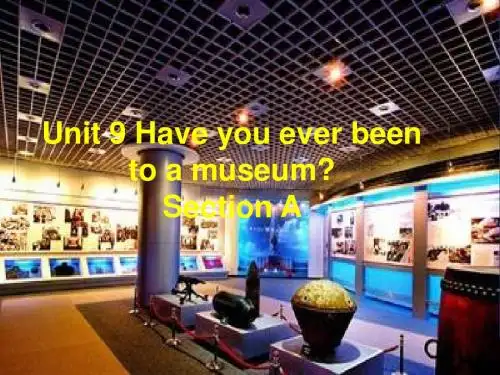
Unit9Haveyoueverbeentoamuseum_SectionA1a-2c课件人教版英语
Free talk Have you ever been to a/an_...? Yes, I have. /No, I haven’t.
have been to (去过),可 以与never[从没], ever [曾经], just[刚刚], once [一次], before[之前]连接。
ahsnmsciapsiawetutaruonscatrrecetmeymemrmzumeopusnuuoeastsuserepeumkuuammrmk
“我也是”结构: So+助动词/情态动词/be+主语(肯定) “So+助动词/be动词/情态动词+主语I.”=Me,too.
Drills --I have ever been to _a_s_c_i_en__ce__m__u_se_u_m___.
Have you ever been there?
回答1:Yes, __I_h_a_v_e___.
➢ 拓展:表示后者与前者情形相同,即“……也不……”时, 常用Me neither.或neither/nor引起的倒装句: Neither/Nor+助动词/系动词be/情态动词+主语.
时态上与前文保持一致,数要与其后的主语一致。
例:—I have never been to a water park.
Look at the map of the town. Listen and circle the places you hear.
2b Listen again and circle T for true or F for false.
Conversation 1
1. Tina went to the space museum last year. T/F
八年级英语下册Unit9Haveyoueverbeentoamuseum知识汇总笔记(带答案)
八年级英语下册Unit9Haveyoueverbeentoamuseum知识汇总笔记单选题1、In fact he knows this place very well, for he ________ there three times.A.has beenB.has been toC.has goneD.has gone to答案:A句意:事实上他对这个地方非常熟悉,因为他去过那儿三次了。
考查现在完成时。
there是副词,前面不可加介词to,因此排除BD两项;又因为该句是说“他去过那儿”,所以用he has been there。
has/have gone to一般是表示某人去了某地,还没回来。
故选A。
2、Every year, _________ books are given away to the poor children in the countryside. A.thousandB.thousands ofC.thousand ofD.thousands答案:B句意:每年,成千上万的书被分发给农村的贫困儿童。
考查thousand的用法。
当thousand前有具体基数词时,表示确数,thousand后不加-s,也不加of;当thousand前没有具体基数词时,表示约数,thousand后既加-s,也要加of。
故选B。
3、______ visitors come to Gulangyu during May Day holiday every year.A.Thousands ofB.Two thousandsC.Thousand ofD.Thousand答案:A句意:每年在五一期间成千上万的游客来鼓浪屿。
thousand千,表示具体数时,与数词连用,不加s;表示约数时,与of连用,加s,thousands of成千上万,故选A。
4、Before you ask someone for help, find out he is the right person for your problem. A.sinceB.thatC.whetherD.unless答案:C句意:在你向别人寻求帮助前,先确定他是否是适合你的问题的人。
人教版新目标Unit9_Have_you_ever_been_to_a_museum全单元
TALK
neither have I = me neither .
I have been to the zoo a lot of times. 答语
______________ .\
. ( 我也是)
I’ve never been to a water park. 答语
____________ \ _______ . ( 我
• 1 h过某地(去过已回来);
• 2 have / has gone to +地名 去了某地(还没回来);
• 3 have / has been in +地名 在某地住了有多长。
• A: Have you ever been to the Great Wall? • B:Yes, I have. What about you? • A: Me too. • =So have I. • =I have ever been there, too. • So+助动词/be动词/情态动词+主语.
4. A: How about __g_o_i_n_g___ (go) to the art museum? There are some special German paintings there right now.
B: Sure. When do you want _t_o_g_o___ (go) ? 5. A: Have you ever __v_is_i_te_d___ (visit) the
• A: Have you ever been to the Great Wall? • B: No, I haven’t. What about you? • A: Me neither. • =Neither have I. • =I haven’t been there, either. • Neither+助动词/be动词/情态动词+主语.
Have you ever been to a museum 全单元教案

Unit 9 Have you ever been to a museum ?Period 1 Section A 1a-2cTeaching AimsKey vocabulary: amusement; neitherTarget language:Lets' go somewhere different today.Have you ever been to…? Yes, I have./ No, I haven’t.How about/what about…?How are we going to get there?We can take the subway/…Ability AimsSs can talk about the past experiences with been, ever, never and language chunks.To train students’ listening and speaking skills.Moral AimsImprove the cooperative spirit of the Ss and let the Ss be proud of the interests of the world. Teaching key Points1. Key vocabulary in this period.2. Target language in this period.Teaching Difficult PointsLearn to talk about the past experiences by using “Have you ever been to....?”.Teaching ProceduresStep1 Warming-upWatch a video the interests of the worldStep2 Presentation1. Checking the words .2. Study the new language in group. Get students to work in groups to practice theconversation: “Have you ever been to…”“Yes, I have”/ Not, I haven’t.Step 2 Work on 1a .1. T: OK. Now open your books on Page 65. In Part 1a, 6 places are given. Please read thenames of these places. (Teacher writes the names on the blackboard.) Which of these places would you like to visit? Rank them from 1 to 5.2. Talk about the pictureStep 3 Listening 1b1. Look at the picture and answer.Explain: Me , too . Me, neither.Know the names of the five museums.2. Listen and check.3. Sum up the chart:Claudia has been to.... But she has never been to....Sarah has been to.... But she has never been to....4. Listen again and answer:When did Sarah visit the National Science Museum?A. TodayB. YesterdayC. Last year2. When did Claudia visit the nature museum?Last year B. Last summer C. Last school trip3. What may the relationship be between the two speakers?A. FriendsB. Teacher and studentC. Mother and kid.Listen and repeat.5 .Follow the tape.Step 4 Pair work.1. Example :A: Let’s go somewhere different today.B: OK. Where do you want to go?A: Have you ever been to the spacemuseum?B: No, 1 haven’t. How about you?A: A: Me neither. / Neither have I.2. Students work.Step 5 Listening (2a 2b)1. Talk about the pictures by using “Have you ever been to...?” and “How did you go there?”2. Ss listen and circle the places.3. Check.4. Read and translate the sentences in 2b.5. Listen and circle “T” or “F”.6. Check.7. Read the listening passage and correct the mistakes.Step 6 work on 2c.Look at the map in 2a and make conversations about the places.A: Have you ever been to the space museum?B: Yes, I have. How about you?A: No, I haven’t.B: Oh, it’s fantastic. Let’s go tomorrow.A: OK. How are we going to get there?B: We can take the subway.Step 7 Homework.Period 2 Section A 2d & GrammarTeaching AimsKey vocabulary: camera; invention ;a couple of ; German; theme; ride; provinceTarget language:It’s a great way to spend a Saturday afternoon.I learned about the inventions that led to color movies, too.Have you ever been to a science museum?Yes, I’ve been to a science museum./No, I’ve never been to a science museum.Have you ever visited the space museum?Yes, I have. I went there last year./No, I haven’t.I’ve been to the art museum many times.Me, too. And I’ve also visited the nature museum.Teaching Key PointsThe present perfect tense.How to use the present perfect tense.Teaching DifficultiesTo understand and use the present perfect tense.Teaching procedures:Step 1 : Review.Show the pictures and ask and answer:Have you ever been to .....?Yes I have. /No, I haven’t./No, never.\ Not yet.Step 2 Work on 2d.1. Learn the words.2. Listen and choose: What’s it about?A: About their clothes.B: About the food.C: About their last weekend.3. Scan(寻读) the conversation and answer the following questions.4. Listen and imitate5.Role-play conversationStep 3 Grammar.1.Ask students to read the sentences of Grammar focus aloud.2. Explain. Learn the Present Perfect TenseStep 4 Work on 4a.1. Finish 4a on textbook. Put the correct form of the verbs in the blanks.2. Check the answer.Step 5 Work on 4b.1. Finish 4b on textbook. Fill in the blanks with the correct forms of the verbs in brackets.2. Check the answer.Step 5 Work on 4c.Finish 4c on textbook. Answer the survey questions and then ask your partner.Make a survey:What fun places have your classmates been to ?How did they get there?Write a report according to their charts.Today I asked our classmates about their journey. Here are the results.__________________________________________Step 6 Homework.Period 3 Section A (3a-4c)Teaching AimsKey vocabulary:unbelievable, progress, rapid, unusual, toilet, encourage, social, peaceful, performance, perfect, itself, collectTarget language:I wonder how much more computer will be able to do in the futureWatching them prepare the tea with the beautiful tea sets is just as enjoyable as drinking the tea itselfI’ve also learned that there was a special computer.Ability Aims1.Ss can understand the passage,to train students’reading ability2. To get students know some knowledge about many kinds of museums.Moral AimsTo raise students’interest of learning English.Teaching key Points1. Key vocabulary:2. Target language:Teaching Difficult Points1.How to improve reading skill.2. To understand the passage and the culture.Teaching ProceduresStep1 Warming-upStep 1, Free talkAsk Ss to talk about some places.A: Have you ever been to…?B: Yes, I have. I went there last…/ No, I haven’t. How about you?A: Me too./ So have I. I went there …/ Me neither./Neither have I.Step 2, pre-readingShow Ss a picture about a museum ,ask Ss to guess what kind of mesuem it is.Show Ss pictures for new words .Step 3, While reading1.skimming.Give Ss 1 or 2 minutes to ask them to read the passage quickly and answer the question.Which three museum do you think about ?What do they think of the museums?2. Careful readingA .Read Para. 1 to answer the 2 questionsWhat is Ken interested in in the American Computer Museum?Answer like this: Ken is interested in _________.B . Read Para 2 to answer the 2 questionsWatch video 1 ,what do you think of the museum?Watch video 2, what can you learn from the video?Read paragraph 2, and answer:Why does Amy think the museum is unusual ?What has Amy learned at the International Museum of Toilets?C . Read Para.3 to answer the following questionsWatch the video, and compare, which sentence is better,why ?The tea art performances show how to make a perfect cup of tea with beautiful tea sets.The tea art performances show how to make a cup of tea with tea sets.What does Linlin think of the tea performances and the tea drinking?3. Enjoy reading.What do you think is the most interesting museum ?Read the sentences you like in 3a with your feelings.Step 3 post reading -- Work on 3c.Ask Ss to finish 3c by themselves , then check the answers.Step 4 Homework.1.Level A: Listen and read the passage.2. Level B: Talk about your favorite museum and write it down.Period 4 Section B 1a-1dTeaching AimsKey vocabulary:the Terracotta Army; the Great Wall; the Bird’s Nest;the Palace MuseumTarget language:Have you visited …?Have you been to …?Have you seen …?Have you tried …?Ability AimsTo train students’ listening and speaking skills..Moral AimsTo raise students’interest of learning English.Teaching Key Points1. Key vocabulary in this period.2. Target language in this period.Teaching DifficultiesImprove students’ listening.Teaching ProceduresStep1 Warming-upHave you ever been anywhere interesting in Beijing?Have you ever been anywhere interesting outside Beijing?Learn the phrases: the Terracotta Army; the Great Wall; the Bird’s Nest;the Palace Museum Read these places of interestStep 2 Work on 1a.1.Finish exercise 1a on textbook. Match the pictures with names.2. Check the answers.Step 3 Listening1. work on 1b.Listen to a student interviewing a foreign student. Check (√) the question you hear.Check the answers.2. Work on 1c.Listen again and take notes.Check the answers.3. post listening.Complete the sentences about Peter’s visit in China.Peter has been in China for _____ weeks.Peter went to ___________________ last week.When Peter visited the Great Wall, he saw many ________ there.Peter said that the Terracotta Army was __________.____________ is Peter’s favorite Chinese dish.Step 4 Pair work,1. demonstrate:How long have you been in China?Have you visited the Palace Museum?Have you been to the Great Wall?Have you tried Chinese food?2. Work in pairs to ask your partner where she/he has been to?Have you visited …?Have you been to …?Have you seen …?Have you tried …?Step 5 self check.1. self check 1.Think about the things below and write an answer for each one.Check the answers.2.self check 2.Check the answers.Step 6 Homework.Teaching Aims:Key vocabulary:quarter; fear; Indian; dark; fox; whenever; equator; island; whether; English-speaking ;take a holiday; three quarters; all year round;Ability AimsTry to develop the st udents’ abilities of reading and writing.Train students’ integrating skills.Train students’ reading comprehension and cooperation spirit.Teaching Key PointsNew words and key phrases.Understand the passage correctly .Teaching DifficultiesHow to describe a place.How to take notes about a passageMoral object:Be interested in knowing about the culture of foreign countries.Teaching ProceduresStep 1 Warm up.1. Play a song before class.2. Greet the class and ask the students if they know the name of the song. (Traveling light).3. Ask the students if they like traveling or not. If they plan to travel to some place, Wheredo they want to go?Step 2 before reading1. Show the symbol (Merlion) of Singapore and ask the students if they know the city, thenshow some pictures of Singapore2. Read the title: From the title , we can infer Singapore is a __________ place.Step 3 while reading .1.Fast reading What four aspects(方面)of Singapore are mentioned?2.Careful reading of each paragraphDiscussion: How many reasons can you find for visiting Singapore.(underline them in each paragraph)3. Task 2. Read the article and use the information to correct the wrong sentences.4. Fill in the conversation about Singapore using the information from the article.Step 4 Post-reading.Make notes about Singapore. Write down anything that you remember. Do not look atthe article.Step 5 HomeworkLevel 1. Introduce Singapore to your parents.Write sth about the hometown or a place the students like.Teaching Aims:Target language.Have you ever tried/seen/been…?If you…, you will/can…You should…One great thing about …is…Ability AimsTo train students speaking and writing abilities.Teaching Key PointsTarget language in this period.Teaching DifficultiesImprove students’ writing ability.Teaching ProceduresStep 1 RevisionWhat do you know about Singapore?Step 2 Work on 3a.Make a list of facts about your hometown or a place you have been to. Think aboutthese topics.1. Pre-writingSize and location:_________________Population:_______________________Weather:________________________History:_______________________Places to visit:___________________Things:___________________________2. example:A: Hainan IslandHave you ever tried/seen/been…?Have you ever been to Hainan Island?I have been there only once before, and I want to go there again.But I know it is thesecond largest island in China. It’s a fantastic place.If you go there, you should walk along the beaches and enjoy the sunshine.The weather in Hainan is very hot, so people like doing many water sports, such as scubadiving (潜水), fishing, swimming, surfing and boating.One great thing about Hainan is that you can try many kinds of sweet fruit in Hainan.If you go to Hainan, I’m sure you will enjoy yourself.Step 3 Work on3b.Write an article to advertise your hometown or a place you have been to.Useful language:Have you ever tried/seen/been …?If you …, you will/can …You should …专注:心无旁骛,万事可破One great thing about … is …Another example:I have been to Beijing, the capital of China. As the capital of the PRC,Beijing is located in northern China.The city covers an area of more than 16,410 square kilometers and has a population of 14.93 million.If you go to Beijing, you should try Beijing Duck because it is very delicious. If you go to Beijing in winter, you should wear warm clothes because it can get very cold.One great thing about Beijing is that there are a lot of historical places to visit, such as the Great Wall and the Summer Palace.They are all very interesting places!Step 4 Homework .1.Revise the language points.plete your article in 3b.11 / 11。
人教版英语八下U9Have you ever been to a museum 讲义
Unit9 Have you ever been to a museum?一、重点词汇及拓展1. amusement n. 娱乐;游戏e.g. The old ladies played the games just for amusement.老太太们玩这个游戏只是为了取乐。
amuse v. 消遣,逗笑;使开心,使愉快amusing adj. 有趣的,好玩的,好笑的amused adj. 被逗乐的;感到好笑的2.amusement park 游乐场e.g. The amusement park is open from May through October.游乐园从五月到十月开放。
3.somewhere adv. 在何处;到某处pron. 某个地方e.g. Maybe the keys are somewhere in the dining room.也许钥匙在餐厅某个地方。
I need to find somewhere to stay tonight.我得找到今晚要住的地方。
4.camera n.照相机;摄影机;摄像机e.g. I heard your parents bought you a cameras as a gift.我听说你的父母亲给你买了一台照相机作为礼物。
5.invention n.发明;发明物e.g. Do you think mobile phone is a great invention?你认为手机是一个伟大的发明吗?6.invent v.发明;创造inventor n.发明家invention n.发明;发明物e.g. As we all know that Edison invented light bulb.我们都知道爱迪生发明了灯泡。
7. unbelievable adj. 难以置信的;不真实的unbelievably adv. 难以置信地;不真实地unbelievably bad/good 坏得/好得令人难以置信incredible adj. 难以置信的e.g. I still find this story both fascinating and unbelievable.我仍然觉得这个故事非常有趣和难以置信。
Unit-9-Have-you-ever-been-to-a-museumSection-A
place. I !
Show Time!
1.Write an article about the most interesting place you have ever been to.
Protect the environment Save the earth
history museum
Use the following sentences to make a short conversation one by one . (注:以四人
为一小组,第一位问第二位,第二位回答后用相同的句 式问第三位,依次进行。但每小组中地点不能重复) A: Have you ever been to the space museum? B: Yes, I have.I have ever been to… No, I haven’t.I have never been toe museum (科技馆)
an art museum (美术馆)
What kinds of parks do you know ?
an amusement park (游乐园)
a water park (水上乐园)
a history museum
Sarah √
√
√
√ √
√
Listening 2 2a
Look at the map of the town. Listen and circle the places you hear.
Listening 2 2b Listen again and circle T for true or F for false. Conversation 1 1. Tina went to the space museum last year. T/F 2. John has never been to the space museum. T/F 3. They are going to take the subway. T/F
(完整版)优秀课件unit-9-Have-you-ever-been-to-a-museum
zoo
A: Have you ever been to a zoo? B: Yes, I’ve been to a zoo.
space museum 太空馆
A: Have you ever been to a space museum? B: No, I’ve never been to a space museum.
6.He has been in London for half a month. 他来伦敦已有半个月了。
1.sb.have /has been to sp. 意为“某人曾经去过某地”,
但现在已不在那里了, ”已经回来,侧重指经历,后 可接次数, 如once, twice, three times等, 表示 “去过某地几次”, 也可和 just, never, ever等连用。
4.我了解了一些电影的知识。 I _le_a_r_n_e_d_a_b_o_u_t_ some information about movie. 5.他的粗心导致了这次失败。 His carelessness _l_e_d_ _t_o_ this failure.
选用have, has填空: 1.I __h__a_v_e_ told him the news. 2.She ___h_a_s___ come back from school. 3.You ___h_a_v_e__ won the game.
2.sb.have/has gone to sp.
意为“某人已经去某地了”, 可能在去某地的路上, 也可能到达了某地。总之, 说话时该人不在现场, 一般不用第一人称、第二人称代词作句子的主语。
3.sb.have/has been in sp.
表示“在某地呆了多少时间”, 常与时间段状语连用
Unit-9--Have-you-ever-been-to-a-museum--知识整理
Unit 9 Have you ever been to a museum?1.—Have you ever been to …? ---你曾经去过…吗?Yes ,I have. / No ,I haven ’t. ever 曾经 (用于现在完成时。
ever 用于疑问句、否定句)2.(1). have/ has been to + 地名;“曾经去过某地”,现在已经回到原地。
(2). have gone to “已经去某地了”,说话时该人不在现场。
(3). have been in +地点 待在某地,常与时间段搭配。
3. 在英语中,表示“也”的知识归纳如下:A. 否定句中的“也”主语 + neitherneither +助动词/be + 主语 完整的否定句后加either ,但要加逗号隔开。
B. 肯定句中的“也”主语 + tooso +助动词/be+ 主语 完整的肯定句后加too ,且要用逗号隔开。
4.Let sb. do sth 让某人做某事 (sb.应用人称代词的宾格形式)5. go somewhere different 去不同的地方 6. invent v 发明→inventor n 发明家→ invention n 发明lead to sth 导致……lead sb. to sw 引导某人去某地lead sb. to do sth 引导某人干某事7.take the subway 乘地铁①take the/a +交通工具+to +地点“乘坐……” (放于句中) take the train 乘火车 ②by+交通工具 “乘坐……” (放于句尾) by bus 乘公共汽车Eg :I go to school by bus.=I take the bus to school.8.It is a great way to do sth 这是一个做某事的好方法9. go skating 去滑冰10. .on the weekend 在周末11. science museum 科学博物馆history museum 历史博物馆12.all the old movie cameras所有的古老的电影摄影机13.camp in the mountains 在大山里露营14.learn about 了解获知,得知learn about sth.了解有关……的情况15. an amusement park 一个游乐场16. the International Museum国际博物馆17. put up a tent 搭帐篷put up 搭起;举起;张贴rmation信息;资料(不可n.)some informationa piece of information 与about 连用,表示:“关于……的信息”19.It’s unbelievable that+从句“令人难以置信的……”20. make progress 取得进步make progress in 在......方面取得进步21.in such a rapid way 以如此迅猛的方式22.play chess 下棋23.be able to+V原能够做某事24.in the future在将来25.wonder 想要知道= want to know①后接从句eg:I wonder who she is.②也可接“疑问词+不定式”eg: I wonder what to do next.26.I couldn’t believe my eyes我无法相信我的眼睛。
八下新目标英语Unit_9_Have_you_ever_been_to_a_museum?
【2012贵州贵阳】 “Have you ever been to Tokyo?” “Yes, I ______ there twice. It’s a modern city.”
A. have gone B. have been C. had gone
【答案】B
考查动词时态及动词的用法。问句用的是现 在完成时,答句也应该用现在完成时,前后 时态一致。have gone意为“去过,但还没回 来”;have been意为“去了,回来了”。根 据句意:你去过东京吗?我去过两次,它是 一个现代城市。故选B.
the final.
— I think so. He ________ for it for months.
A. is preparing
B. was preparing
C. had been preparing
D. has been preparing
2. By the time he realizes he _________ into a
D. Did; show
8. — Hi, Tracy, you look pale.
— I am tired. I ______ the living room all day.
A. painted
B. had painted
C. have been painting D. have painted
C. considered D. is going to consider
7. —______ you ______ him around the museum
yet?
—Yes. We had a great time there.
A. Have ; shown
unit9haveyoueverbeentoamuseum教案
unit 9 have you ever been to amuseum教案1教案题目:Unit 9 "Have You Ever Been to a Museum?"教学目标:1. 学生能够掌握并正确使用本单元的词汇和短语。
2. 学生能够运用所学的句型和表达方式描述博物馆和展览。
3. 学生能够通过听说读写的综合训练,提高自己的综合语言运用能力。
教学重点:1. 本单元的词汇和短语的掌握和运用。
2. 对博物馆和展览进行描述的能力。
3. 学生的听说读写的综合训练。
教学难点:1. 对博物馆和展览进行描述的能力。
2. 学生的听说读写的综合训练。
教学准备:幻灯片、多媒体设备、展示物品、课件、练习册。
教学过程:Step 1: Warm-up (5 minutes)1. Greet the students and ask them if they have ever been to a museum.2. Show some pictures of famous museums and ask the students to name them。
3. Discuss with the students about their experiences in museums and what they have seen。
Step 2: Presentation (15 minutes)1. Present the new vocabulary and phrases related to museums and exhibitions using flashcards or pictures。
2. Introduce the target language structures through a short dialogue between a student and a teacher, using phrases like "Have you ever been to a museum?" and "What did you see there?"3. Model the pronunciation and intonation of the target language structures and have the students repeat after you。