
非谓语动词(一)---作主宾表
回顾总结
非谓语动词解题步骤
方法总结:
谓非谓, 找主语,
辨“谓与非谓”
析语态,
定时态
找逻辑主语
分析语态
分析时态
6. it作形式宾语, 代替真正作宾语的 Example: I find it difficult to understand him. We thought it wrong not to help her. They believe it impossible to get everything ready in time. We found it no good making fun of others.
注意1:主语是以aim, duty, hope, idea, intention, mistake, plan, proposal, job, suggestion 等为中心词的名词词组,或以 what 引导的名词性从句表示, 后面通常接不定式做表语说明其内容。
Example: My idea is to climb the mountain from the north. Your mistake was not to write that letter. My suggestion is to start work at once. What I would suggest is to start work at once.
例:*I regret to tell you that I can’t come. *I still remember being taken to the Famen Temple and what I saw there.
4. 不定式作decide, know, consider, forget, learn, remember, show, understand, see, wonder, hear, find out, explain, tell等动 词或动词短语的宾语时, 前面常带引导词how, what, whether, where, when, who等。“动词 + 疑问词 + 带 to 的不定式结构” (这种不定式结构接近一个名词从句) Example: I don’t know what to do
(2)it作形式主语, 代替真正作主语的动词不定式或动名 词。代替动名词常见句型有: It is/was no use/good+doing sth. ; It is/was not any use/good + doing sth. ; It is/was of little use/good + doing sth. ; It is/was useless doing sth. ; It’s a waste of time doing sth... 代替不定式常见句型有: It is adj. (for sb) to do sth; It is adj. of sb to do sth; It is + a pleasure/an honor/a pity... to do; It takes sb +time to do...等。
√
√
非谓语动词 作主语、表语和宾语
• 非谓语动词作主语、表语 • 非谓语动词作宾语 • 回顾与总结与解题步骤
非谓语动词作主语、表语
(1)动名词作主语表示一般的、抽象的或习惯性的动作, 不定式作主语表示具 体的、一次性的或尚未做的动作。 *Facing your problems rather than running away from them is the best approach to working things out. *To complete the program needs much effort.
5.He seemed quite ___d_e_li_g_h_t_e_d at the idea. (delight) 6.The present situation is __e_n_c_o_u_r_a_g_in.g (encourage)
非谓语动词作宾语 1. 只能跟动名词作宾语的动词和短语: suggest, imagine, mind, admit, practice, allow, advise, risk, keep, keep on, avoid, escape, enjoy, consider, excuse, finish, miss, insist on, look forward to, feel like, get down to, object to等。
可接动名词作宾语的动词巧记如下: 考虑建议盼原谅(consider,suggest/advise, look forward to, excuse, pardon) 承认推迟没得想(admit, delay/put off, fancy) 避免错过继续练(avoid, miss, keep/keep on, practice) 否认完成停止赏(deny, finish, stop, enjoy/appreciate) 不禁介意准逃亡(can't help, mind, allow/permit, escape) 不准冒险凭想象(forbid, risk, imagine)
Example: I’ve arranged to meet him at ten o’clock. I didn’t expect to find you here.
3. 既可跟动名词又可跟不定式的动词和短语: remember, forget, regret, stop, go on, mean, start, begin, try等。
注意2:当主语部分有动作动词do 时,作表语的不定式可以省略符号 “to” Example: All we have to do is push the button. The only thing I can do now is go on by myself. All I could do was send him a telegram.
sentences.
3. Above all,
I have come to understand that
__b_r_in_g_i_n_g(bring)happiness to others is getting ourselves happiness.
4. __W__a_l_k_in_g(walk)in a happy style makes people feel happy, while adopting the gait(步法) of a depressed person can bring on sadness.
非谓语动词(一)
非谓语动词有哪些形式?
非谓语动词
主动形式
一般 进行式 式
完成式
被动形式
一般式
完成式
动词不定式 to do to be doing to have done to be done to have been done
动词-ing形
式
doing
having done being done having been done
【点津】get, become, look, seem, appear等系动词后可跟过去 分词作表语, 表示被动或主语的状态。 *This quotation from Winston Churchill tells us that we shouldn’t get discouraged right after failures.
2. 非谓语动词中能作表语的有现在分词、过去分词、动名词和 不定式。注意现在分词作表语意为“令人感到……的”, 而过 去分词作表语意为本身“感到……的”。 *My dream is to enter Beijing University. *Please describe a dog that is frightening. *Please describe a dog that is frightened.
过去分词
done
及物动词的过去分词既表示 被动又表示动作已完成, 个 别动词的过去分词只表示完 成(多数为不及物动词)
※非谓语动词的句法功能
非谓语动词就是不能作句子谓语而具有其他语法功能的动词。
成份 主语 宾语 定语 表语 补语
状语
类别 不定式
√ √√√√√
动词-ing
√
√
√√Βιβλιοθήκη √√过去分词
×
×√
√
2. 只能跟不定式作宾语的动词和短语: wish, hope, decide, refuse, promise, pretend, manage, plan, fail, choose, would like, arrange,expect等。
“动词 + 带 to 的不定式结构”。这类动词常见的有: 同意提出做计划(agree,offer,plan) 要求答应来帮忙(ask,demand,promise,help) 准备决定遭拒绝(prepare,decide,refuse) 敢于选择有希望(dare,choose,hope, wish) 不能做到莫假装(fail,pretend) 设法做成决心坚( manage,determine,decide)
【题组训练】
1. _W__o_r_r_y_i_n_g(worry) about a problem doesn’t help.
2.The children are just beginning to get e_x_c_i_te_d_(excite) about using
words and forming
I haven’t decided whether to sell it or not. We must find out where to put it.
非谓语动词(一)---作主宾表

【题组训练】
1. Before leaving, we spent half an hour _p_la_y_in_g__(play) with the students there. 2.You can imagine how excited I was when I saw the bike, and I begged my uncle to teach me how _t_o_r_id_e_(ride) it right away. 3. However, a 38-year-old craftsman, Li Jiangzhong, is committed to _k_e_e_p_in_g_(keep) the art of sugar painting alive. 4. Too much love from parents may prevent children from b_e_i_ng__(be) independent. 5. Halfway through his talk, the speaker stopped and decided _t_o_c_r_ea_t_e_(create)a group activity.
注意2:当主语部分有动作动词do 时,作表语的不定式可以省略符号 “to” Example: All we have to do is push the button. The only thing I can do now is go on by myself. All I could do was send him a telegram.
【点津】get, become, look, seem, appear等系动词后可跟过去 分词作表语, 表示被动或主语的状态。 *This quotation from Winston Churchill tells us that we shouldn’t get discouraged right after failures.
非谓语动词语法讲解

❖ ③remember to do记得要做某事此事未做/ remember doing记得某事已做过此事已做 e g :I remember seeing her once somewhere
You must remember to take your umbrella when you leave home ❖ ④go on to do继续做另一件事 go on doing接着做同 一件事
composition We all like playing to play table tennis
❖ 但也有细微区别:
❖ *指具体某次的行为常用不定式;指惯常的行为常 用~ing形式
❖ 如:I like reading books of this kind 惯常行为
❖ I hate to say so;but really I can't go with you 具体某次行为
Hearing the bell ;the students stopped playing and ran into the classroom ❖ ②forget to do忘记做某事此事未做/ forget doing忘记曾做过某事此事已做
He forgot to post the letter when he walked past the post office
作宾语
❖ 3 I found him swimming in the river 作宾补
❖ 4 His favourite sport is swimming
作表语
❖ 5 He is the man swimming in the river just
英语非谓语动词总结表
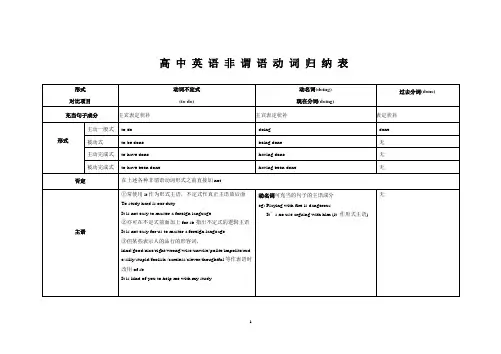
eg:spoken English
running water
a book writen by a peasant
the boy standing under the tree
宾语
①可以直接跟不定式作宾语,这类动词有:want/like/hope/wish/prefer/hate/decide/expect/desire/try/
She was the first person to think of the idea.
②当名词被序数词或the only、the next、the last修饰,且该名词是作定语的非谓语的执行者时,用不定式主动形式做定语。
She was the first woman to win the gold medal in the Olympic Games.
②亦可在不定式前面加上for sb.指出不定式的逻辑主语
It is not easy for us to master a foreign language.
③但某些表示人的品行的形容词,kind/good/nice/right/wrong/wise/unwise/polite/impolite/rude/silly/stupid/foolish /careless/clever/thoughtful等作表语时改用of sb.
manage/start/begin/remember/forget/ask/offer/continue/agree/choose/promise/mean/pretend等
如:I want to borrow your dictionary.
②常使用it作为形式宾语,不定式作真正主语放后面
如:I find it interesting to study English.
高中语法学案--非谓语动词做主宾表(附答案)

非谓语动词作主语表语宾语一、动名词-ing 和不定式to do都可在句中作主语和表语1. -ing和-to do做主语和表语,表示抽象的、泛指的动作。
1) ___________________________________(swim) is a good sport in summer.2)My favourite sport is ______________________________(swim).3)___________________________________________(teach) is my job.4)My job is ____________________________________(teach).5)Her job is _______________________________(keep) the lecture hall as clean as possible.6)____________________________________(keep) the lecture hall as clean as possible is her job.2.如表示某个特定的、具体的动作,尤其是将来的动作,多用to do作主语和表语1)__________________(smoke) so much is not good for you .2)___________________(smoke) is not good for health.3)You must speak out if we are _____________________(remain) friends.4)My task now is ______________________(have) my bicycle mended.5) _________________(arrive) at the party five minutes earlier is necessary.3. 当主语是aim,purpose,idea,plan,wish,decision,choice等词时常用to to作表语。
非谓语做主干成分(主语宾语表语)-高考英语一轮复习
此外,afford,strive,happen,fail,prepare,demand, wait, 等也要用不定式 to do作宾语。
afford to do sth 负担得起做某事
strive to do sth 努力做某事
happen to do sth 碰巧做某事
fail to do sth
capacity on surveying deep-sea environment. 4.We intended to visit the theme park but end up _g_o_i_n_g__ (go) to the zoo. 5.She enjoys __l_ea_r_n_i_n_g_ (learn) about body language in different cultures
未能够做某事
prepare to do sth 准备做某事
demand to do sth 要求做某事
wait to do sth
等待做某事
2.只能用doing作宾语的动词
避免(avoid)错过( miss )少延期( delay ) 建议( suggest/advise)完成( finish )多练习( practice ) 喜欢( enjoy )想象( imagine )禁不住( resist ) 承认( admit )否定( deny )与妒忌( envy ) 逃脱( escape )冒险( risk )莫原谅( pardon ) 忍受( stand )保持( keep )不在意( mind )
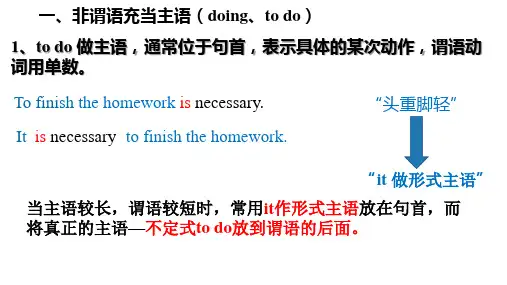
一、非谓语充当主语(doing、to do)
1、to do 做主语,通常位于句首,表示具体的某次动作,谓语动 词用单数。
To finish the homework is necessary. It is necessary to finish the homework.
非谓语动词作主宾表定状补
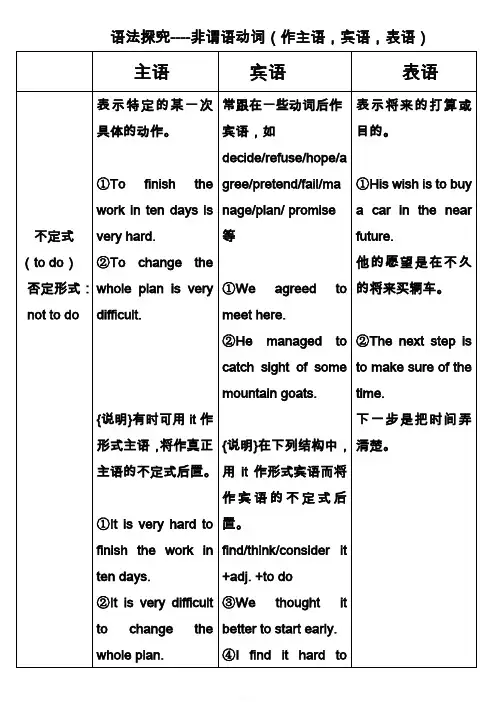
语法探究----非谓语动词(作主语,宾语,表语)主语宾语表语不定式(to do)否定形式:not to do 表示特定的某一次具体的动作。
①To finish thework in ten days isvery hard.②To change thewhole plan is verydifficult.{说明}有时可用it作形式主语,将作真正主语的不定式后置。
①It is very hard tofinish the work inten days.②It is very difficultto change thewhole plan.常跟在一些动词后作宾语,如decide/refuse/hope/agree/pretend/fail/manage/plan/ promise等①We agreed tomeet here.②He managed tocatch sight of somemountain goats.{说明}在下列结构中,用it作形式宾语而将作宾语的不定式后置。
find/think/consider it+adj. +to do③We thought itbetter to start early.④I find it hard to表示将来的打算或目的。
①His wish is to buya car in the nearfuture.他的愿望是在不久的将来买辆车。
②The next step isto make sure of thetime.下一步是把时间弄清楚。
work with him.--ing形式(doing)否定形式:not doing 表示经常性的抽象的行为。
①Swimming is abest sport insummer.②Living without anaim is like sailingwithout acompass(指南针).{说明}在下列句型中唱常用it作形式主语。
非谓语主宾表
1.3非谓语动词一(第1次课---主宾表)【知识梳理】一.非谓语动词的概括1. 1.在句子中充当除谓语以外的句子成分的动词形式叫做非谓语动词。
2.形式:不定式(to do/do),动名词(doing),和分词(doing和done)二.考点分类解析:1.不定式做主宾表不定式的形式:主动被动一般式to write to be written进行式to be writing /完成式to have written to have been written1)作主语:To finish the work in ten minutes is very hard.To lose your heart means failure.动词不定式短语作主语时,常用形式主语it作形式主语,例如上面两句可用如下形式:It is very hard to finish the work in ten minutes.It means failure to lose your heart.2)作表语:Her job is to clean the room.He appears to have caught a cold.3)作宾语:常与不定式做宾语连用的动词有:want, hope, wish, offer, fail, plan, learn, pretend, refuse, manage, help, agree, promise, prefer, 如果不定式(宾语)后面有宾语补足语,则用it作形式宾语,真正的宾语(不定式)后置,放在宾语补足语后面,例如:Marx found it important to study the situation in Russia.动词不定式也可充当介词宾语,如:I have no choice but to stay here.He did nothing last Sunday but repair his bike.动词不定式前有时可与疑问词连用,如:He gave us some advice on how to learn English.【经典例题】【例1】We’ve had a good start, but next, more work needs _____to achieve the final success. (2012湖南卷, 21)A. being doneB. doC. to be doneD. to do【例2】The more active you are, the more likely you’ll be _____ new friends. (2013 北京西城期末)A. madeB. to makeC. makingD. to have made2.动名词做主宾表动名词的形式:主动语态被动语态一般式Doing being done完成式having done having been done1)作主语:Reading aloud is very helpful. 朗读是很有好处的。
非谓语动词作主、宾默写
非谓语动词作主语1、done不能做主语2、to do放句首做主语,表示一次性的动作或现在,将来的动作3、doing放句首做主语,表示经常性的动作或过去的动作4、如有特殊疑问词,只能用to do;(这条也适用于做其他成分)5、doing放句首做主语,它的逻辑主语应该用所有格,即sb’s doing sth….6、加了形式主语it, 真正的主语放在句末,我们一般都用to do作真正的主语,除4种形式:it is no use doing sth.It is no good doing sth (对比:it is not good to do sth)It is useless doing sth.It is a waste of time and money doing sth.7、注意it is adj. for sb to do和It is + adj. of sb. to do sth.的对比adj. 能修饰sb.用of, 不能用for8、there is no doing 没有,禁止There is no smoking. 禁止吸烟There is no denying that…不可否认There is no laughing 不准笑9、There is no point (in) doing sth. 做某事没有意义10、There is no + n. 为多,it is no +n. 较少,他们有:It is no use doing sth.It is no good doing sth.It is no wonder/surprise that…难怪其他的基本都是there isthere is no need to dothere is no doubt that….11、it takes (sb.) some time to do sth. = it takes some time (for sb. ) to do sth.It takes (sb.) some money to do sth.非谓语动词作表语1、to do表示一次性的动作或将来的动作2、doing表示经常性的动作或过去的动作3、注意missing, lost, gone表示不见了,可做表语4、词汇本身的形容词:advanced, experienced, skilled, learned等5、be to blame= should be blamed非谓语动词作宾语(动词后加非谓语)1、常接动名词的动词admit, deny, confess, deny; delay, postpone, enjoy, avoid, escape, miss, fancy, imagine, finish, involve, resist, risk, practice, mind, keep, appreciate, forgive, excuse.2、常接不定式的动词afford, agree, aim, ask, claim, choose, decide, demand, desire, determine, expect, long, hope, wish, fail, manage, offer, plan, intend, pretend, promise, refuse, threaten; arrange, attempt, hesitate, promise, volunteer3、即可接动名词又接不定式的动词1)mean to do 打算做某事(注意:had meant to do= meant to have done过去本打算做但事实上没有做)mean doing意味着2)try to do 尽量达到的目的try doing 尝试某种手段3)like, dislike, prefer, hateto do一次性doing 经常性should/ would like to do4) go on to do继续不同的事go on doing继续同一件事5)stop doing停止手中的事stop to do停止去做某事6) begin/ start to do 三种情况A)主语为物B) begin/start本身为进行时beginning/starting C) do 为心理活动的词或半系动词(get, become等);上述三种情况都用to do;其他to do与doing可以互换7)can’t help (to) do 没法帮忙作某事can’t help doing情不自禁作某事can’t help but do不得不作某事4、advise, allow, permit, forbid, recommend (sb’s) doingadvise, allow, permit, forbid, recommend sb. to do5、consider doingbe considered to dobe considering doing6. be worth doing7. need/want/ require to be done= need/want/ require doing8. look forward to, turn to, devote… to, contribute to, object to, be opposed to, pay attention to, take to, lead to, ….。
高考英语二轮复习非谓语动词(作主宾表宾补)课件48张
非谓语动词的形式
主动形式
被动形式
肯 不定式 to do, to be doing, to be done,
定
to have done
to have been done
式
v.-ing doing,
形式 having done
being done, having been done
v.-ed 形式
done
否 定 以上肯定形式前加not, 如:not to do, not doing, 式 not to be done, not having done等。
复合 动名词 名词所有格、形容词性物主代词+动名词 结构 不定式 for/of sb./sth. to do
非谓语动词句法功能
主动答应 选计划 同意请求 帮一帮
对应动词
例句
decide/determine, 1. She pretended not to
learn, want,
see me when I passed by.
expect/hope/wish 2. We agreed to meet
refuse, manage, here but so far she hasn't
调整;使适应于
He didn’t mean to hurt (hurt) you. 他并没打算伤害你。 She couldn't help bursting (burst) into tears. 她禁不住突 然大哭起来。 That can’t help to improve (improve) your English. 那对 你提高英语水平没有帮助。
We don’t allow smoking in the hall.
非谓语动作主宾表
二、不定式与动名词做宾语: 不定式与动名词做宾语:
● stop to do sth. 停下来去做某事 stop doing sth. 停止做某事 ● try to do sth. 设法…,想法…, 试图… 设法 ,想法 , 试图 try doing sth. 试一试, 试试看 试一试, 打算…,想要…, ● mean to do sth. 打算 ,想要 ,有…的意图 的意图 mean doing sth. 意味着,意思是, 意味着,意思是, ● can’t help to do sth. 不能帮忙做某事 can’t help doing sth. 禁不住做某事
二、不定式与动名词做宾语: 不定式与动名词做宾语:
• 1. 下列动词后常跟不定式做宾语: 下列动词后常跟不定式做宾语: afford, agree, aim, appear, attempt, choose, claim, decide, expect, fail, happen, hesitate, hope, intend, long, manage, offer, plan, prepare, pretend, promise, prove, refuse, seem, strive, tend, threaten, wait等。 等 • e.g. He agreed to get someone to help us. • They promised not to break the school rules again.
二、不定式与动名词做宾语: 不定式与动名词做宾语:
2. 在下列动词或动词短语后常用动名词做宾语: 在下列动词或动词短语后常用动名词做宾语: admit, advise, allow, appreciate, avoid, ban, consider, delay, deny, enjoy, escape, finish, forbid, give up, imagine, involve, keep, mention, mind, permit, postpone, practise, quit, recall, recommend, resist, risk, suggest, understand等。 等