
人教版小学五年级英语下册重点知识归纳
Unit One My day重点单词:eat breakfast吃早餐have… class上…课play sports进行体育运动exercise活动,运动do morning exercises做早操eat dinner吃晚饭clean my room打扫我的房间go for啊walk散步go shopping去买东西,购物take 学习,上课dancing 舞蹈,跳舞take a dancing class 上舞蹈课when 什么时候重点句子:1.When do you finish class in the morning? 你们上午的课几点结束?2.We finish class at 1 o’clock.我们一点钟结束上午的课.3.What do you do on the weekend? 你周末在做什么?4.I often watch TV and play ping-pong with my father. 我经常看电视,也常和我爸爸一起打乒乓球.口语交际:一A: When do you finish class in the morning? 你们上午的课几点结束?B: We finish class at 1 o’clock. Then we eat lunch at home. 一点结束。
然后我们回家吃午饭。
A: Wow! When do you go back to school after lunch? 午饭后几点到校?B: At 2:30. Classes start at 3 o’clock. 两点半到校,三点上课。
A: When do you usually eat dinner in Spain? 在西班牙你们通常几点吃晚饭?B: Usually at 9:30 or 10 o’clock. 通常在九点半或十点。
A: Wow! That’s too late! 哇,也太迟了吧二A: Why are you shopping today? 今天你怎么去购物了?B: My mum worked last night, so I’m shopping today. 我妈妈昨晚上夜班了,所以今天我购物.A: Good girl! So what do you do on the weekend? 好孩子!那你周末做什么?B: I often watch TV and play ping-pong with my father. 我经常看电视,也和我爸爸打乒乓球.A: That sounds like a lot of fun. 听起来很有意思吧.B: Yes, but I’m also hard-working. I usually wash my clothes. Sometimes I cook dinner. 是啊, 不过我也很爱干活,通常洗洗衣服,有时也做做饭.A: You’re so busy! You need a robot to help you! 你也太忙了,你需要个机器人帮忙.语音训练:辅音字母组合的发音:Cl [kl] clean clock class cleverPl [pl] plate eggplant please playUnit Two My favourite重点单词:spring春天summer夏天autumn秋天winter冬天season季节picnic野餐goon a picnic去野餐pick摘,采集pick apples摘苹果snowman雪人make a snowman堆雪人go swimming去游泳which哪一个重点句子:1.Which season do you like best? 你最喜欢哪个季节?2.I like winter best, I can sleep all day. 最喜欢冬季了. 可以整天睡觉。
3.Why (do you like summer)? 你为什么喜欢夏天呢?4.Because I like summer vacation! 因为我喜欢暑假。
口语交际;A: Do you like the music, children? 孩子们,你们喜欢音乐吗?B: Yes, it’s very beautiful. What is it? 是的,音乐太美了。
是什么音乐呢?A: The Four Seasons. Today we’ll draw the seasons. Which season do you like best, Mike? 四季歌。
今天我们学画季节。
迈克,你最喜欢哪个季节?B: Winter. I like snow. 冬天,我喜欢雪。
A: I like snow, too. Which season do you like best, Wu Yifan? 也喜欢雪。
一帆,你最喜欢哪个?C: Spring. 春季。
A: Why do you like it? 为什么呢?C; It’s pretty. 它很美。
A: Yes , it is. 可不是嘛。
语音训练;字母组合br和gr的发音:[br]和[gr][br] brown library brother umbrella[gr] green grape grandpa growUnit Three My school calendar重点单词;January 一月February二月March三月April四月May五月June六月July七月August八月September九月October 十月November十一月December十二月重点句子:1.When is the party? 聚会什么时候举行?2.It’s in April. 在4月.3.When is the trip this year? 今年的秋游在什么时候?4.It’s in October. We’ll go to the Great Wall. 在十月. 我们要去长城.口语交际:A: We have a few fun things in spring. 春季我们有几件令人开心的事情.B: What are they? 什么事呢?A: After the sports meet. We have an Easter party. 运动会后, 我们要举行复活节聚会呢B: When is the party? 聚会在什么时候?A: It’s in April. We have a school trip, too. 在4月, 我们还要进行一次郊游呢.B: When is that? 在什么时候?A: It’s in May 在5月份.B: Cool! 太好了!二A: I like autumn. I really like the colours. 我喜欢秋天, 我真的很喜欢秋天缤纷的色彩.B: I like autumn, too. We usually have a school trip in autumn, 我也喜欢秋天。
秋天我们通常要进行秋游。
A: Great! When is the trip this year? 太好了。
今年的秋游在什么时候?B; It’s in October. We’ll go to the Great Wall. 在10月。
我们会去长城。
A: Cool! I love the Great Wall. 太棒了!我就喜欢长城。
语音训练:字母组合sh和ch的发音:[ʃ]和[ʧ][tʃ] China chicken lunch teacher[ʃ] sheep fish shirt shortsUnit four When is Easter?重点单词;first第一second第二third第三fourth第四fifth第五twelfth(12th) 第十二twentieth(20th) 第二十twenty-first(21st) 第二十一twenty-third(23rd)第二十三thirtieth(30th)第三十重点句子:1.When is April F ool’s Day? 愚人节是哪天?2.It’s on April 1st. 是在四月一日3.When is your birthday? 你的生日是哪天?4.My birthday is on April 4th. 我的生日是四月四号.5.What do you usually do on Mid-Autumn Day? 中秋节你通常做什么?6.We eat mooncakes.我们吃月饼.口语交际:A: There are some special days in April四月有几个特别的日子。
B: What are they? 是什么呢?A: April Fool’s Day and Easter. 愚人节和复活节呀。
B: When is April Fool’s Day? 愚人节在什么时候?A: It’s on April 1st.四月一日。
B: And Easter? 复活节呢?A: It’s on April 5th this year. 在今年四月五日。
B: Wow! I love April. 哇,我喜欢四月。
A: When is your birthday? 你生日是什么时候?B: My birthday is on April 4th. 是在四月四日。
A: That’s my mother’s birthday, too. 那也是我妈妈的生日。
B: Cool ! What will you do for your Mum? 太妙了,你会为你妈妈做些什么吗?A: I’ll cook noodles for her. 我会为她煮面条。
B: Chinese noodles are delicious! 中国面条太好吃了。
A: Please come then, we can have a birthday party for both of you! 那就来我家吧,我们一起为你俩过生日。
语音训练字母组合th的发音:[θ]和[ð][θ] three thin thirteen maths[ð] this that mother brotherUnit Five Whose dog is it?重点单词:mine我的yours你的,你们的his他的hers她的theirs他们的,她们的,它们的ours我们的climbing(正在)攀登, 攀爬eating正在吃(东西) playing正在玩耍jumping正在跳drinking正在喝水sleeping正在睡觉重点句子:1.The yellow picture is mine.那张黄色的画是我的.2.Are these all ours? 这些都是我们的画吗?3.Whose is it? 这是谁的?4.It’s Zhang Peng’s. 是张鹏的。
人教版小学五年级英语下册重点知识归纳
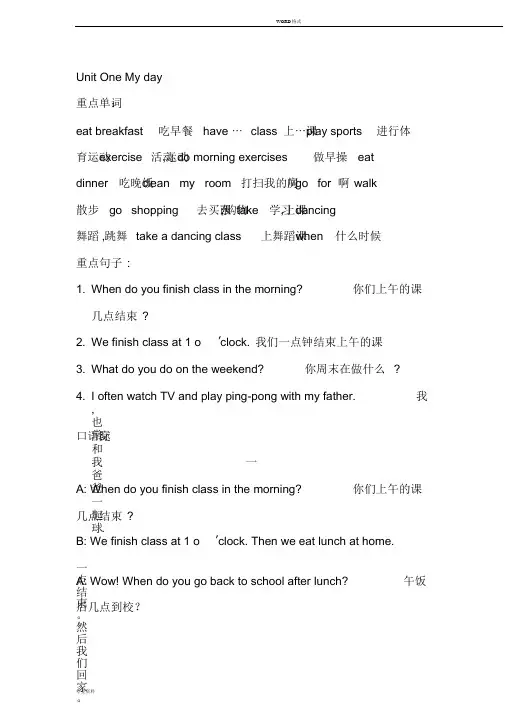
Unit One My day 重点单词: eat breakfast吃早餐 have ⋯ class 上⋯课p lay sports 进行体育运动e xercise 活动,运动d o morning exercises做早操 eatdinner 吃晚饭c lean my room 打扫我的房间go for 啊 walk 散步 go shopping去买东西,购物t ake 学习,上课d ancing舞蹈 ,跳舞 take a dancing class 上舞蹈课w hen 什么时候重点句子 :1. When do you finish class in the morning? 你们上午的课几点结束 ?2. We finish class at 1 o’clock. 我们一点钟结束上午的课.3. What do you do on the weekend?你周末在做什么 ?4. I often watch TV and play ping-pong with my father. 我 ,也常和我爸爸一起球.口语交际: 一 A: When do you finish class in the morning? 你们上午的课 几点结束 ? B: We finish class at 1 o ’clock. Then we eat lunch at home. 一点结束。
然后我们回A: Wow! When do you go back to school after lunch? 午饭后几点到校?B: At 2:30. Classes start at 3 o ’clock. 两点半到校,三点上课。
A: When do you usually eat dinner in Spain? 在西班牙你们通常几点吃晚饭?B: Usually at 9:30 or 10 o ’clock. 通常在九点半或十点。
人教版小学五年级英语下册知识点汇总(完整版)
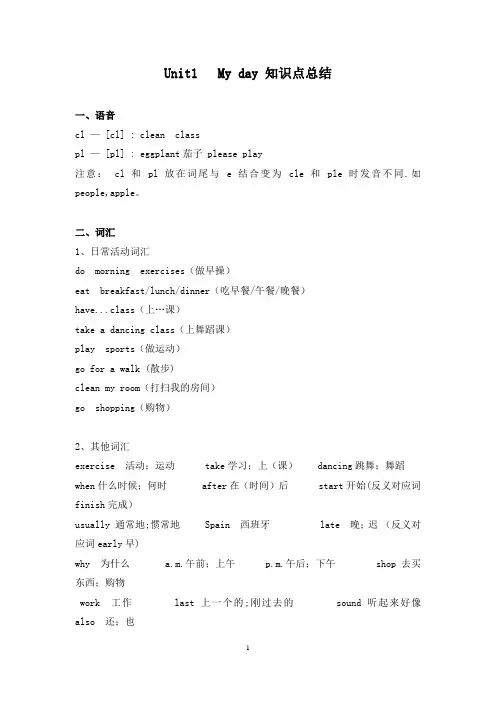
Unit1 My day 知识点总结一、语音cl — [cl] : clean classpl — [pl] : eggplant茄子 please play注意:cl 和 pl 放在词尾与 e 结合变为cle 和 ple 时发音不同.如people,apple。
二、词汇1、日常活动词汇do morning exercises(做早操)eat breakfast/lunch/dinner(吃早餐/午餐/晚餐)have...class(上…课)take a dancing class(上舞蹈课)play sports(做运动)go for a walk (散步)clean my room(打扫我的房间)go shopping(购物)2、其他词汇exercise 活动;运动 take学习;上(课)dancing跳舞;舞蹈when什么时候;何时 after在(时间)后 start开始(反义对应词finish完成)usually 通常地;惯常地 Spain 西班牙 late 晚;迟(反义对应词early早)why 为什么 a.m.午前;上午 p.m.午后;下午 shop去买东西;购物work 工作 last上一个的;刚过去的 sound听起来好像also 还;也busy 忙的need 需要play 戏剧剧本 letter 信Live 居住island 岛always 总是;一直 cave 山洞;洞穴go swimming 去游泳win 获胜。
三、句型以及语法知识点1、询问别人什么时候做某事某种活动的when特殊疑问句型,使用时间短语回答。
When do you do morning exercises? 你何时做早操?I do morning exercises at 7:00.我七点钟做早操。
When do you finish class in the morning? 你们上午的课到什么时候结束?We finish class at 1 o’clock.我们一点钟结束上午的课。
最新人教版五年级下册英语知识点(非常有用)
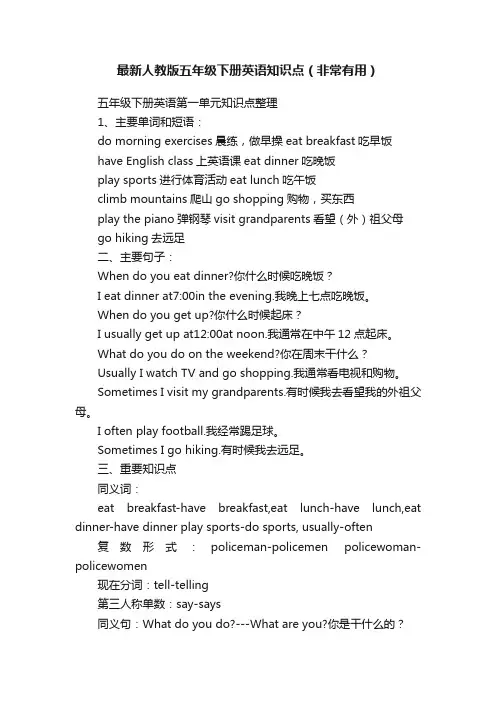
最新人教版五年级下册英语知识点(非常有用)五年级下册英语第一单元知识点整理1、主要单词和短语:do morning exercises晨练,做早操eat breakfast吃早饭have English class上英语课eat dinner吃晚饭play sports进行体育活动eat lunch吃午饭climb mountains爬山go shopping购物,买东西play the piano弹钢琴visit grandparents看望(外)祖父母go hiking去远足二、主要句子:When do you eat dinner?你什么时候吃晚饭?I eat dinner at7:00in the evening.我晚上七点吃晚饭。
When do you get up?你什么时候起床?I usually get up at12:00at noon.我通常在中午12点起床。
What do you do on the weekend?你在周末干什么?Usually I watch TV and go shopping.我通常看电视和购物。
Sometimes I visit my grandparents.有时候我去看望我的外祖父母。
I often play football.我经常踢足球。
Sometimes I go hiking.有时候我去远足。
三、重要知识点同义词:eat breakfast-have breakfast,eat lunch-have lunch,eat dinner-have dinner play sports-do sports, usually-often 复数形式:policeman-policemen policewoman-policewomen现在分词:tell-telling第三人称单数:say-says同义句:What do you do?---What are you?你是干什么的?表示频度的副词:always总是,一直;usually通常,常常;often经常;sometimes有时候以复数形式出现的词组:visit grandparents,plant trees介词后跟表示时间的词语时,表示在某年、某月、某个季节,某个时候(在上午,在下午,在晚上)用in;表示在某一天,在星期几用on,在具体的几点几分用at.too和either的用法区别:too和either都是“也”的意思,但too用于肯定句,either用于否定句。
人教版小学五年级下册英语知识点整理
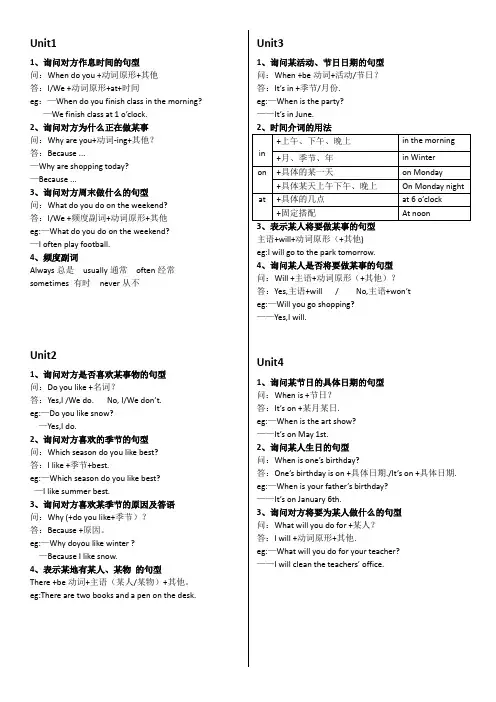
Unit11、询问对方作息时间的句型问:When do you +动词原形+其他答:I/We +动词原形+at+时间eg:—When do you finish class in the morning?—We finish class at 1 o’clock.2、询问对方为什么正在做某事问:Why are you+动词-ing+其他?答:Because ...—Why are shopping today?—Because ...3、询问对方周末做什么的句型问:What do you do on the weekend?答:I/We +频度副词+动词原形+其他eg:—What do you do on the weekend?—I often play football.4、频度副词Always总是usually通常often经常sometimes 有时never从不Unit21、询问对方是否喜欢某事物的句型问:Do you like +名词?答:Yes,I /We do. No, I/We don’t. eg:—Do you like snow?—Yes,I do.2、询问对方喜欢的季节的句型问:Which season do you like best?答:I like +季节+best.eg:—Which season do you like best?—I like summer best.3、询问对方喜欢某季节的原因及答语问:Why (+do you like+季节)?答:Because +原因。
eg:—Why doyou like winter ?—Because I like snow.4、表示某地有某人、某物的句型There +be动词+主语(某人/某物)+其他。
eg:There are two books and a pen on the desk.Unit31、询问某活动、节日日期的句型问:When +be动词+活动/节日?答:It’s in +季节/月份.eg:—When is the party?——It’s in June.主语+will+动词原形(+其他)eg:I will go to the park tomorrow.4、询问某人是否将要做某事的句型问:Will +主语+动词原形(+其他)?答:Yes,主语+will / No,主语+won’t eg:—Will you go shopping?——Yes,I will.Unit41、询问某节日的具体日期的句型问:When is +节日?答:It’s on +某月某日.eg:—When is the art show?——It’s on May 1st.2、询问某人生日的句型问:When is one’s birthday?答:One’s birthday is on +具体日期./It’s on +具体日期. eg:—When is your father’s birthday?——It’s on January 6th.3、询问对方将要为某人做什么的句型问:What will you do for +某人?答:I will +动词原形+其他.eg:—What will you do for your teacher?——I will clean the teachers’ office.1、描述物品归属的句型物品+ be动词(is/are)+(mine/his/hers/yours/ours/theirs) eg:The book is yours.2、确认物品归属地句型问:be动词+this/that/these/those(+其他)+某人的?答:Yes,it is. Yes,they are./ No,it,is’t. No,they aren’t. eg:—Is that crayou his?——Yes,it is.3、询问物品归属的句型问:单数Whose+is it/this/that?复数Whose+are they/these/those?答:It’s/They’re+名词性物主代词/ 名词所有格eg:—Whose bag is this?——It’s mine.4、现在进行时的一般疑问句问:Be动词+主语+动词-ing(+其他)?答:Yes,主语+be动词/ No,主语+be动词+not. eg:—Is she listening to music?——Yes,she is.5、描述某人正在做某事主语+be动词(am/is/are)+动词-ing(+其他).eg:I’m doing my homework now.6、询问某人能否做某事问:Can+主语+动词原形+其他?答:Yes,主语+can. /No,主语+can’t.eg:—Can I play football?——Yes,you can.Unit61、询问多个人或动物正在做什么的句型问:What are +主语(复数)+doing?答:主语(复数)+are+动词-ing+其他.eg:—What are the boys doing?——They are jumping2、询问单个人或动物正在做什么的句型问:What is +主语(单数)+doing?答:主语(单数)+is+动词-ing+其他.eg:—What is Tom doing?——He is playing football.。
(完整版)人教版五年级英语下册Unit1知识点汇总
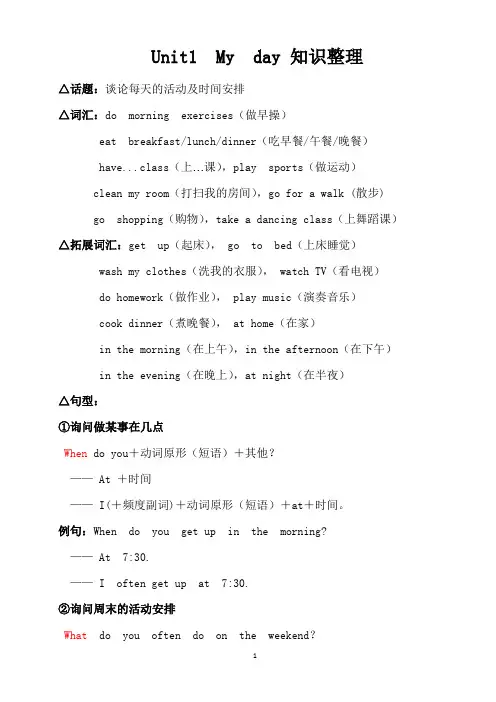
Unit1 My day 知识整理△话题:谈论每天的活动及时间安排△词汇:do morning exercises(做早操)eat breakfast/lunch/dinner(吃早餐/午餐/晚餐)have...class(上…课),play sports(做运动)clean my room(打扫我的房间),go for a walk (散步) go shopping(购物),take a dancing class(上舞蹈课)△拓展词汇:get up(起床), go to bed(上床睡觉)wash my clothes(洗我的衣服), watch TV(看电视)do homework(做作业), play music(演奏音乐)cook dinner(煮晚餐), at home(在家)in the morning(在上午),in the afternoon(在下午)in the evening(在晚上),at night(在半夜)△句型:①询问做某事在几点When do you+动词原形(短语)+其他?—— At +时间—— I(+频度副词)+动词原形(短语)+at+时间。
例句:When do you get up in the morning?—— At 7:30.—— I often get up at 7:30.②询问周末的活动安排What do you often do on the weekend?I often (always/sometime/usually) +…(周末的活动)+with … (某人)+on the weekend (on Saturdays/on Sundays ).例句:What do you do on the weekend ?I often take a dancing class with my friend on Sundays. △知识点:1:注意介词的搭配at +具体时间(几点)/night/home at 9 o ’clock in +国家/季节 in Spainon +星期 on the weekend/on Sundays with +人 with my father/mother/friend 2:表示时间频率词的区别always 表示总是,一直;usually 表示经常,通常;often 表示经常,常常;sometimes 表示有时,间或。
人教版五年级英语下册 知识点总结

Unit 1 This Is My Day对话一:A: When do you get up ? 你什么时候起床啊?B: I usually get up at 6:30.When do you eat breakfast?A: At 6:20. What about you? / And you? 你呢?B: I usually eat breakfast at 7:00.对话二:A: Excuse me .Can I ask you some questions ? 打扰了,我能问你几个问题吗?B: Sure.A: What do you do ? 你是做什么的?B: I am a policeman .A: When do you go to work ? 你什么时候去上班?B: I usually go to work at 9:00 in the evening.A: When do you go home ?B: I go home at 5:00 in the morning .A: Thank you for telling me about your day.谢谢你告诉我你的一天。
B: You’re welcome.对话三:A: What do you do on the weekend ? 你周末干什么呀?B: Usually I watch TV and go shopping. Sometimes I visit my grandparents.What about you ? 我通常看电视和购物。
有时候去拜访我的祖父母。
你呢?A: I often play football . Sometimes I go hiking .B: That’s fun .好玩句型:1、询问某人的生活,学习规律——when do you +动词(短语)——I(usually)+动词(短语)+at + 时间.2、Excuse me . 用在打扰别人时的一种客气说法,意为:打扰了。
新人教版PEP 【小学五年级英语下册】 单元知识点 归纳总结
新人教版PEP 【小学五年级英语下册】单元知识点归纳总结Unit 1 My DayIn this unit。
we learn some core vocabulary words。
phrases。
and XXX.Core Vocabulary:1.Verbs: take (studying)。
go to (class)2.Nouns: dancing。
exercise。
sports3.Phrases: do morning exercises。
eat breakfast。
play sports。
eat dinner。
go for a walk。
go shopping。
clean my room。
take a dancing class。
have a classXXX Vocabulary:1.Verbs: start。
shop。
work。
need。
live。
win。
sound2.Nouns: Spain。
play。
letter。
island。
cave3.ns: after4.XXX: when。
XXX。
a.m。
p.m。
why。
last。
also。
busy5.nal Vocabulary: frequency adverbs (always。
usually。
sometimes)Phrases:watch TV。
eat lunch。
go to bed。
go swimming。
go home。
go to schoolCore Sentence Structure:When do you do morning exercises?" "At 7 o'clock."XXX phrase is "good job" to praise XXX.Which season do you like best。
I like winter best。
This sentence means "which one do you like the most" and "like。
【口袋书】人教版PEP五年级下册英语 基础知识汇总
人教版PEP五年级下册基础知识汇总Unit 1 My day.重点单词:[四会]dancing 跳舞;舞蹈exercise 活动;运动take 学习;上(课)[三会]after 在(时间)后start 开始usually 通常地;惯常地Spain 西班牙late 晚;迟a.m.午前;上午p.m.午后;下午why 为什么shop 去买东西;购物work 工作last 上一个的;刚过去的sound 听起来好像also 还;也busy 忙的need 需要play 戏剧;剧本letter 信live 居住island 岛always 总是;一直cave 山洞;洞穴win 获胜重点短语:eat breakfast 吃早饭have … class 上…课play sports 进行体育运动do morning exercises 做早操eat dinner 吃晚饭clean my room 打扫我的房间go for a walk 散步go shopping 去买东西;购物take a dancing class 上舞蹈课go swimming 去游泳start class 开始上课last night 昨天晚上after lunch 午饭以后a lot of fun 许多乐趣live on an island 住在一座岛上be good at sports 擅长体育运动字母组合cl 发/kl/ 音:clean 打扫clock 钟class 课;班级clever 聪明的clock 钟字母组合pl 发/pl/ 音:plate 盘子;碟子eggplant 茄子please 请play 玩耍;戏剧重点句型:1.询问别人什么时候做某事的问句及回答:-- When do/does + 主语+ 动词(短语)原形(+ 其他)?-- 主语(+ 频度副词)+ 动词(短语)原形/ 第三人稀单数形式+ at + 具体时间/ At + 具体时间.-- When do you get up? 你什么时候起床?-- I get up at 5 o'clock. 我5点起床。
人教版PEP小学英语五年级下册知识点汇总(最新)
人教版PEP小学英语五年级下册知识点汇总(最新)Unit One: This Is My DayBasic Vocabulary:Activities: get up。
do morning exercises。
have English class。
play sports。
play the piano。
climb mountains。
go shopping。
go hiking。
visit grandparents。
eat breakfast。
eat dinner.Basic XXX Structures:1.Asking about daily routines:When do you。
(你什么时候。
)XXX I。
(我通常在。
(点钟)。
(做什么事)。
有时。
)XXX: When do you go to school。
(你每天几点去上学?)I usually go to school at 7:00.Sometimes I go to school at7:10.2.Asking about XXX:What do you do on the weekend。
(你周末做什么?)XXX I。
(我通常/经常。
有时。
)XXX: What do you do on the weekend?I often play XXX I go shopping with my mom.3.Introducing one's own habits:Every weekend。
I go hiking。
(我每个周末远足。
)Every day。
I do my homework at 8:00 in the evening。
(我每天晚上8点做作业。
)4.Asking XXX:What do you do。
(你是干什么的?)Time:morning。
afternoon。
evening。
noon。
at night。
6:00.on Sunday。
人教版PEP小学英语五年级下册知识点汇总(最新)
人教版PEP小学英语五年级下册知识点汇总Unit One This Is My Day【基本词汇】:Activities(活动) Time(时间)频率词get up 起床do morning exercises 晨练 have English class上英语课 play sports 进行体育活动 play the piano 弹钢琴climb mountains 爬山go shopping 购物go hiking 去远足visit grandparents 看望外/祖父母eat breakfast 吃早饭eat dinner 吃晚饭morning 早上in the afternoon下午evening 晚上noon 中午at night 夜晚6:00 具体时间on Sunday 在星期天when 什么时候always总是usually通常often经常sometimes有时seldom很少never从不注:表格拉长排版乱的话把手机横过来就OK啦【基本句型】:1. 询问生活规律:---- When do you ……?你什么时候……?---- I usually… at …Sometimes I….我通常在…(点钟)…(做什么事)。
有时…E.g. --- When do you go to school ? 你每天几点去上学?--- I usually go to school at 7:00. Sometimes I go to school at 7:10.2. 询问生活习惯:--- What do you do on the weekend? 你周末做什么?--- I usually / often ….. Sometimes I …..E.g. --- What do you do on the week?--- I often play football. Sometimes I go shopping with my mom.3. 介绍自己的生活习惯:Every weekend I go hiking. 我每个周末远足。