
人教版九年级英语第三单元 Unit 3 Section B 知识点精讲
人教版九年级英语第三单元Unit 3 Section B 知识点精讲Section B单词
1. convenient/ kən'viniənt/ adj.便利的;方便的
典例convenient transportation便利的交通
It is very convenient to pay by credit card.用信用卡付款非常方便。
联想convenience n.便利
2. corner/kɔ:(r)nə(r)/ n.拐角;角落
助记* 玉米(corn)的儿(er)子在角落里。
典例He waited until the man had turned a corner.
他一直等到那个男人拐过街角。
She sat in the corner.她坐在角落里。
短语in the corner在(里面的)拐角处
at the corner在(外面的)拐角处
3. politely /pə'laɪtli/ adv.礼貌地;客气地
助记polite(adj.礼貌的)+-ly(副词后缀)=politely
典例greet him politely礼貌地和他打招呼
联想polite adj.有礼貌的
impolite adj.不礼貌的;粗鲁的
4. request/ rɪ'kwest/ n&v.要求;请求
典例Don' t lose heart if your request is refuse. (名词)如果你的请求被拒绝了不要灰心。
The boy requested to go boating with his schoolmates.
(动词)那个男孩请求与他的同学们一起去划船。
短语by request应…的请求
5. direction /də'rekʃn/ n.方向;方位
助记direct(v.指导)+-ion(名词后缀)= direction
典例He lost direction.他迷失了方向。
The instruments will register every change of direction or height.
这些仪器将会记录每一个方位或高度的变化。
6. correct /kə'rekt/ adj.正确的;恰当的
助记虫(c)子还是(or)阿姨(re)要做CT(ct)?请给出正确的答案。
典例Your answer to the question is correct. 你对这个问题的回答是正确的。
近义right adj.正确的
反义wrong adj.错误的
联想correctly adv.正确地
7.polite /pə'laɪt/ adj.有礼貌的;客气的
助记这家伙破例(poli)了,特(te)别有礼貌。
典例Lucy is polite and helpful. We all like her.露西既有礼貌又乐于助人,我们都喜欢她反义* impolite adj.不礼貌的
短语be polite to sb.对某人有礼貌
8. speaker /'spi:kə (r)/ n讲(某种语言)的人;发言者
助记speak(v.说)+er(名词后缀)= speaker。
人教版英语九年级unit3 SectionB知识点讲解

eg:He requested some hot water from me.
b.request sb. to do sth.要求/请求某人做某事
eg:I request her to go alone.
c.request+that从句(用虚拟语气,(should)+do)
eg:I request that she (should) go alone.
价格的高低用high/low.
eg:The price of the car is high.
英语中常见的否定前缀有: 1)dis-"不;非"
like→dislike agree→disagree 2)in-(im-,ir-)" 不;非”
expensive→inexpensive polite→impolite possible→impossible 3)un-"不;非" crowded→uncrowded happy→unhappy healthy→unhealthy
everyone__p_o_li_te_ly___.
• request n.&v.要求;请求
1) n.[C] the request for.... ......的要求/请求
eg:We must make a request for help.
2) v.
(提出请求)
a.request sth (from sb.) (向某人)要求某物
(在建筑物内部)
eg:I found a boy crying in the corner of the room.
2)at/on the corner of... 在......拐角处 (在建筑物外部)
人教版九年级英语全一册知识梳理第三单元《Unit 3 Section B》
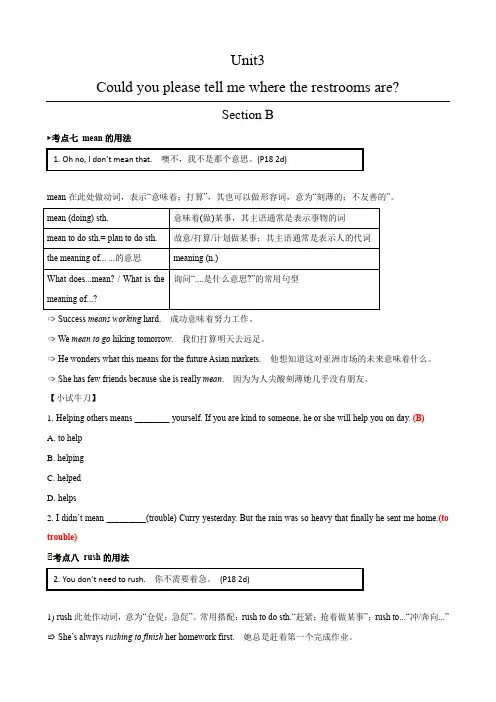
Unit3Could you please tell me where the restrooms are?Section B▶考点七mean的用法1.Oh no, I don’t mean that. 噢不,我不是那个意思。
(P18 2d)mean在此处做动词,表示“意味着;打算”,其也可以做形容词,意为“刻薄的;不友善的”。
➩ Success means working hard. 成功意味着努力工作。
➩ We mean to go hiking tomorrow. 我们打算明天去远足。
➩ He wonders what this means for the future Asian markets. 他想知道这对亚洲市场的未来意味着什么。
➩ She has few friends because she is really mean. 因为为人尖酸刻薄她几乎没有朋友。
【小试牛刀】1.Helping others means ________ yourself. If you are kind to someone, he or she will help you on day. (B)A.to helpB.helpingC.helpedD.helps2.I didn’t mean _________(trouble) Curry yesterday. But the rain was so heavy that finally he sent me home.(to trouble)▶考点八rush的用法2.You don’t need to rush. 你不需要着急。
(P18 2d)1)rush此处作动词,意为“仓促;急促”。
常用搭配:rush to do sth.“赶紧;抢着做某事”;rush to...“冲/奔向...”➩ She’s always rushing to finish her homework first. 她总是赶着第一个完成作业。
人教版英语九年级上Unit 3Section B 单词讲解
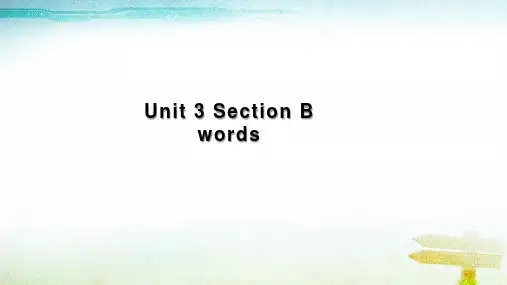
12.speaker[可数名词]讲(某种语言)的人;发言者 那个演讲者作了一场精彩的演讲。
The speaker gave a wonderful speech. singer (歌手) writer (作者;作家) inventor (发明家 ) artist(艺术家)
13.whom 是who的宾格形式,作动词或介词的宾语, 在口语或非正式文体中常用who来代替, 但如果紧跟在介词后作宾语时则只能用whom。
②in- (im- , ir-)“不、无” impossible (不可能的) impoite (不礼貌的)
③un-"不、非” unable unlike uncrowded unhappy unhealthy.
3. uncrowded adj. 不拥挤的;人少的 crowded. adi. 拥挤的 crowd v.拥挤
刚才你在和谁说话? Whom/Who were you talking to just now?
= To whom were you talking just now?
14.address 地址
I’ll tell you my address and phone number.
15.underground①.[ 形容词]地下的
8.request 1)n.要求,请求
多指对某事物所提出的礼貌或正式的恳请。 当该词之后接具体内容表示哪方面的请求时,常用介词for与之搭配。
这是有关问路的类似的请求。
These are similar requests for directions. 2)[及物动词]要求;请求常 见用法有: ① request sth. ( from sb.) ( 向某人)请求某事/某物
英语人教版九年级全册Unit 3 Section B
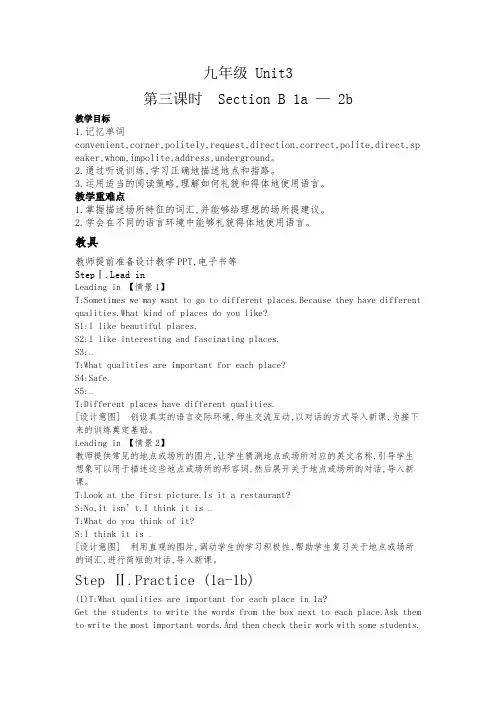
九年级 Unit3第三课时Section B 1a — 2b教学目标1.记忆单词convenient,corner,politely,request,direction,correct,polite,direct,sp eaker,whom,impolite,address,underground。
2.通过听说训练,学习正确地描述地点和指路。
3.运用适当的阅读策略,理解如何礼貌和得体地使用语言。
教学重难点1.掌握描述场所特征的词汇,并能够给理想的场所提建议。
2.学会在不同的语言环境中能够礼貌得体地使用语言。
教具教师提前准备设计教学PPT,电子书等StepⅠ.Lead inLeading in 【情景1】T:Sometimes we may want to go to different places.Because they have different qualities.What kind of places do you like?S1:I like beautiful places.S2:I like interesting and fascinating places.S3:…T:What qualities are important for each place?S4:Safe.S5:…T:Different places have different qualities.[设计意图] 创设真实的语言交际环境,师生交流互动,以对话的方式导入新课,为接下来的训练奠定基础。
Leading in 【情景2】教师提供常见的地点或场所的图片,让学生猜测地点或场所对应的英文名称,引导学生想象可以用于描述这些地点或场所的形容词,然后展开关于地点或场所的对话,导入新课。
T:Look at the first picture.Is it a restaurant?S:No,it isn’t.I think it is …T:What do you think of it?S:I think it is …[设计意图] 利用直观的图片,调动学生的学习积极性,帮助学生复习关于地点或场所的词汇,进行简短的对话,导入新课。
人教版九年级英语Unit3知识点总结
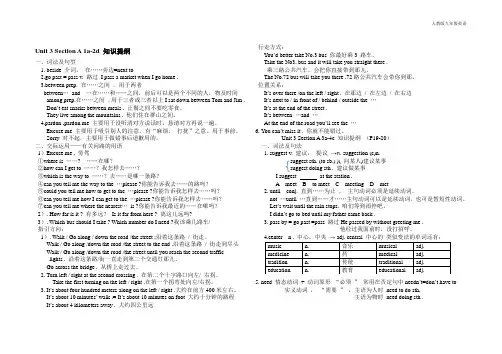
Unit 3 Section A 1a-2d 知识提纲一、词法及句型1. beside 介词,在……旁边=next to2.go past = pass v. 路过I pass a market when I go home .3.between prep. 在……之间,用于两者between…and …在……和……之间,前后可以是两个不同的人,物及时间among prep.在……之间,用于三者或三者以上I sat down between Tom and Jim .Don’t eat snacks between meals . 正餐之间不要吃零食。
They live among the mountains . 他们住在群山之间。
4.pardon ,pardon me 主要用于没听清对方说话时,恳请对方再说一遍。
Excuse me 主要用于吸引别人的注意,有“麻烦,打扰”之意。
用于事前。
Sorry 对不起,主要用于做错事后道歉用的。
二、交际运用——有关问路的用语1)Excuse me , 劳驾①where is ……? ……在哪?②how can I get to ……?我怎样去……?③which is the way to ……?去……是哪一条路?④can you tell me the way to the …please ?你能告诉我去……的路吗?⑤could you tell me how to get to the …please ?你能告诉我怎样去……吗?⑥can you tell me how I can get to the …please ?你能告诉我怎样去……吗?⑦can you tell me where the nearest…is ?你能告诉我最近的……在哪吗?2). How far is it ? 有多远?Is it far from here ? 离这儿远吗?3). Which bus should I take ? Which number do I need ?我该乘几路车/指引方向:1). Walk / Go along / down the road /the street ;沿着这条路/ 街走。
Unit3SectionB(1a-1e)课件人教版九年级英语全册

Section B (1a-1e)
Words Review
fascinating adj. 迷人的;极有吸引 力的
inexpensive adj. 不昂贵的 uncrowded adj. 不拥挤的;人少的 convenient adj. 便利的;方便的
F. uncrowded
Talk about the places in our city using the words above.
A: The Fine Arts Museum is really interesting.
B: Yes, and it’s beautiful, too.
Look at the picture and look through the conversations, then answer the questions .
e.g.Internet makes it convenient for us to get in touch with each other.
互联网使得我们相互联系便利了。
convenience是convenient的名词形式,既可作可数名词,意 为“便利的设施”,也可作不可数名词,意为“方便,便 利”。 ►The house has all the modern convenience.
Summary
What have we learnt today? Some adjectives : fascinating, inexpensive,
uncrowded, convenient … …
How to ask for information politely
人教版英语九年级Unit 3 重点知识归纳及讲解
九年级上Unit 3知识清单Section A一、重点短语1. get some magazines/stamps买些杂志/邮票2. a pair of shoes 一双鞋3. ask for the information about the town 询问关于这个小镇的消息4. pass (by) a bookstore = go past/by a bookstore 走过一家书店5.beside the back = next to/ at the side of the bank 在银行旁边6. go to the second floor 去二楼7. get some postcards 买一些卡片8. try the rides 尝试些乘骑项目9. go on sth继续某事10.be excited to do sth兴奋地做某事be excited about sth/doing sth.11. start with = begin with 以...开始end with 以…结束12. hold my hand 抓住我的手13. come on 加油;得了吧14. walk up to 走向15. go east along 沿着…(向东)走16. on one’s way to sp在去某地的路上17. get angry 饿了18. at the door 在门口19. mail a letter 寄封信20. the Italian restaurant nearby 附近的意大利餐馆二、重点句型1. I was scared first, but shouting did help. 该句话中, “did”的用法是助动词表强调,起加强语气的作用。
同类例句如:I’m not joking, we did go camping last weekend. The summer holiday does start next Monday.2. 英语常见问路/指路表达方式:1) 问路Excuse me/Pardon me, where is the nearest post office?Excuse me, which is the way to the nearest post office?Excuse me/Pardon me, can/could you (please) tell me the way to the post office?Excuse me/Pardon me, how can I get to the nearest post office?Could you please possibly tell me how to get to the library?Excuse me/Pardon me, do you know if there’s a post office around here?Would you please tell me if there is a bank nearby?I wonder +…可加以上所有句型。
人教版九年级unit3 Could you please tell me where the restrooms are Section B说课稿
人教版九年级英语Unit3 Section B (2a-2d)说课稿今天我说课的内容是九年级英语unit3 Could you please tell me where the restrooms are? Section B 第二课时;我将从以下几个方面来进行我今天的说课:一教材分析(一)教材的地位及作用1、新目标英语教材概述《九年级英语》教材的语言教育理念是:知识用于行动强调“语言应用”,培养“创新、实践能力”,发展“学习策略”。
它采用任务型语言教学(Task-based Language Teaching)模式。
教材中每单元都设计一个或几个与该单元话题有关的任务,让学生在完成任务的过程中,使用英语获取信息,用英语进行交流,培养运用英语解决实际问题的能力。
2、单元分析及教材的处理本课是新目标英语九年级第3单元,教材以礼貌询问为中心话题,结合向他人礼貌询问信息的方法,进一步学习问路和指路的表达方式,培养学生获取、分析、处理和使用信息的能力。
本课教学内容与学生的实际生活密切相关,易于引发学生运用简单的英语进行交际和交流。
在学习活动中,学生通过礼貌询问比如地点位置和方向等等,促进学生之间和师生之间的情感交流,增进情谊。
本节课为Section B的第二课时,主要学习内容是:复习以前学习的询问方向方式,学习一种更加有礼貌的询问方式“could you please tell me where the restrooms are .?”和“Excuse me, do you know when...?”二.学情分析1.初中生的抽象能力较低,形象思维能力强。
但注意力容易分散。
本单元通过多媒体课件,增强学生的兴趣和注意力。
2.初中生的学习心理特点1)兴趣对英语普遍感兴趣,求知欲盛。
2)记忆对刺激记忆手段多的知识记忆深刻,遵从记忆规律。
三教学目标根据课标及第三单元的内容,我将本节课教学目标细化为以下五方面:语言目标,能力目标,情感和态度目标,策略目标及文化意识目标。
人教版九年级上册英语Unit3 单元词句梳理SectionB(2a-2d)
必背短语
10. ____d_e_p_e_n_d_o_n_______取决于,依靠 11. __________________导入,引入
leadinto 12. ____________________________花费时间做
某事spendtime(in)doingsth. 13. _in_d_i_ff_e_re_n_t_s_it_u_a_ti_o_n_s ____在不同的情况下 14. __________________________与某人更好地
看起来礼貌地说话比直截了当地说话更难。
seem
tospeak
必背单词
5. speakern. 讲(某种语言)的人;发言者→v. ___sp_e_a_k____说(某种语言);说话
6. whompron. 谁;什么人→______pron. 谁(主格 )→______pron. 谁的 who
7. adwdrheosssen. 住址;地址;通讯处 8. undergroundadj. 地下的n. 地铁 9. coursen. 课程;学科
communicatebetterwithsb. 交流
必背句子
15.
whom
Theexpressionstheyusemightdependon______they
arespeakingtoor能取决于他们在和谁说话或他们
彼此的熟悉程度。
2. requestn. &v. 要求;请求→______________提出请
求
makerequests
3. directionn. 方向;方位→d_i_re_c_t__adj. 直接的;直率的
4. correctadj. 正确的;恰当的→_________adj. 不正确
新人教版九年级英语 unit3 Section B3-优质课件.ppt
• 11、夫学须志也,才须学也,非学无以广才,非志无以成学。2020/6/92020/6/92020/6/9Jun-209-Jun-20
• 12、越是无能的人,越喜欢挑剔别人的错儿。2020/6/92020/6/92020/6/9Tuesday, June 09, 2020
• 13、志不立,天下无可成之事。2020/6/92020/6/92020/6/92020/6/96/9/2020
Where you wsilol mstuedypolite, indirect
questions about the following
What activititeos pyoiucsc.an do
Travel to school
other
3b Write a polite letter to the school asking for the
• 17、一个人如果不到最高峰,他就没有片刻的安宁,他也就不会感到生命的恬静和光荣。2020/6/92020/6/92020/6/92020/6/9
谢谢观看
• 9、春去春又回,新桃换旧符。在那桃花盛开的地方,在这醉人芬芳的季节,愿你生活像春天一样阳光,心情像桃花一样美丽,日子像桃子一样甜蜜。 2020/6/92020/6/9Tuesday, June 09, 2020
• 10、人的志向通常和他们的能力成正比例。2020/6/92020/6/92020/6/96/9/2020 11:50:20 AM
information you want to know. Use your notes in 3a.
In your letter, you should: • introduce yourself • say when you are coming • politely ask for information • thank the person for helping you