
PEP英语六年级下册 Unit 4单元知识梳理
Unit 4 Then and now
一、单词
dining hall 饭厅grass草坪gym 体育馆ago 以前cycling 骑自行车运动go cycling去骑自行车
ice-skate滑冰badminton羽毛球运动
二、短语
…years ago (几)年前
…months ago(几个)月前
last year 去年
last month上个月
play badminton 打羽毛球
三、句子
1.There was no library in my old school.我以前的学校里没有图书馆。
2.Tell us about your school, please.请给我们讲讲您的学校吧!
3.How do you know that?你是怎么知道的?
4.There was no computer or Internet in my time.我那时候没有电脑也没有网络。
5.Before,I was quiet. Now I am very active in class.我以前很安静。
现在我在课堂上很活跃。
6.I was short, so I couldn't ride my bike well.我以前个子小,自行车骑得不好。
7.Now I go cycling every day.现在我天天骑车。
四、作文: Last weekend
I was busy last weekend. Saturday morning , I did my homework . Then, I visited my grandparents. In the afternoon, I went swimming with my friends. Sunday morning, my parents and I went to a park. We went boating and flew kites. It was a happy weekend.
六年级下册单元知识点
第四单元
四会单词:learn Chinese—learned Chinese学汉语sing and dance—sang and danced 唱歌和跳舞eat good food—ate good food吃好吃的食物take pictures—took pictures 照相climb—climbed 爬have—had buy presents—bought presents买礼物
row a boat—rowed a boat 划船see elephant—saw elephant 看大象
go skiing—went skiing 去滑雪go ice-skating—went ice-skating 去滑冰
how怎么,如何get—got 到达last上一个的,仅余的,留在最后的
四会句型:Where did you go on your holiday? 你去哪里度假了?
I went to Xinjiang. 我去新疆了。
How did you go there? 你怎么去那儿的?
I went by train.我坐火车去的。
应该掌握的知识点:
1、时间前介词的用法:
英语中不同的时间前所用的介词不相同,一般有如下规则
(1)在表示一段时间的词语前用in,如在年份、月份、季节前用in,如in2009, in May, in spring等。
另外在上午、在下午、在晚上也用in. in the morning, in the afternoon, in the evening.
(2)表示在某一天,在星期几,在几月几日时用on,如on Monday , on May 1st. 另外还有on Tuesday morning.
(3) 表示具体的时刻,在…几点钟时用at。
如at 6 o’clock. at 7:20.
2、英语书信的书写格式;
(1)称呼:指导对收信人的称呼。
一般从信纸的左边顶格写起。
(2)正文:指信的主体部分。
从称呼的下一行第一段顶格或空四到五个字母开始写。
(3)结束语:一般是表示自己对收供信人一种礼貌客气的谦称。
常用Love, Yours或Sincerely等。
通常在正文结束后另起一行左边顶格写。
(4)签名:指发信人签名。
写在结束语下一行,也顶格写。
3、序数词是由基数词转变而来,表示“第…个”。
(1)1—3 分别为first, second, third,没有规律。
(2)4—19通常由基数词加th构成,特殊的有:five—fifth , eight—eighth, nine—ninth, twelve—twelfth .
(3)整十的数词,其后缀—ty要先变成tie再加—th .如twenty—twentieth.
(4)两位数只把后一个数词变为序数词,前面的数词仍保留其基数形式。
如, twenty-one—twenty-first
巧学妙记:基数词变序数语口诀
基变序,有规律,词尾加上th;
一二三,特殊记,八去t, 九去e;
five, twelve两兄弟,ve要用f 替;
将y变成ie, 词尾加上th.
若是遇到几十几,只变个位就可以。
26个英文字母及发音音标如下:
A a [ei]
B b [bi:]
C c [si:] Dd [di:] E e [i:] F f [ef] Gg [d3i:] H h [eit∫] I i [ai] J j [d3ei] K k [kei] L l [el]
M m [em] Nn [en] O o [ u] P p [pi:] Q q [kju:] R r [ɑ:]
S s [es] T t [ti:] U u [ju:] V v [vi:] W w [′d blju:]
X x [eks] Y y [wai] Z z [zi:]或[zed]
4、字母发音归类
以上我们可以看出,英语字母中有一些含有共同的元音音素.如:
1)含元音音素[ei] 4个
字母: aa hh jj kk
音标: [ei] [eit∫][d3ei] [kei]
2) 含元音音素[i:] 8个
字母: bb cc dd ee gg pp tt vv
音标: [bi:] [si:] [di:] [i:] [d3i:] [pi:] [ti:] [vi:] 3) 含元音音素[e] 7个
字母: ff ll mm nn ss xx zz
音标: [ef] [el] [em] [en] [es] [eks] [zed]
4) 含元音音素[ju:] 3个
字母: uu qq ww
音标: [ju:] [kju:] [`d∧blju:]
5) 含元音音素[ai] 2个
字母: ii yy
音标: [ai] [wai]
6)[ou]: o;
7)[a:]: r。
PEP-新版小学六年级英语Unit4-Then-and-now重点知识总结
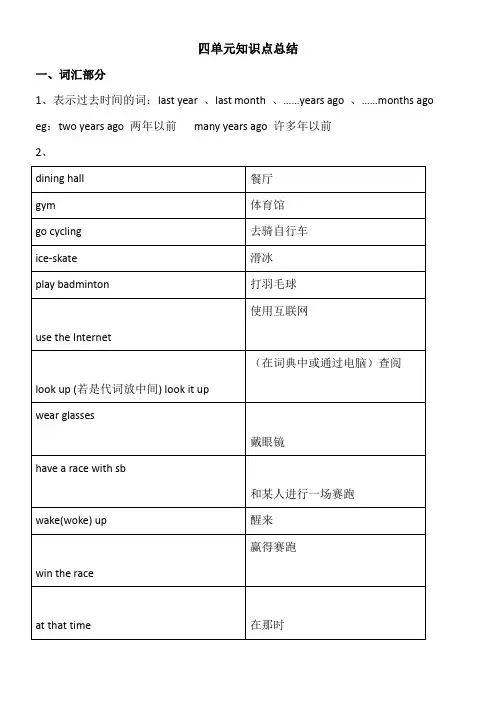
四单元知识点总结一、词汇部分1、表示过去时间的词:last year 、last month 、……years ago 、……months ago eg:two years ago 两年以前many years ago 许多年以前2、3、情态动词:do(did) don’t (didn’t) can(could) can’t (couldn’t)+动词原形eg: I didn’t like winter before.I couldn’t go cycling.二、句型1、There be 句型时刻记住There be 句型的就近原则。
eg : There is a cat and two dogs in this room.本单元用到There be 句型的过去时态。
当be 动词后主语为单数或不可数时用was ,若为可数名词复数用were 。
eg: There was no library in my old school. 后面主语为library ,为单数用was.There were no computers or Internet in my time. 主语为复数computers所以用were.2、描述某人过去和现在的不同Before, 主语+ was /were + 形容词.“以前,某人是……”Now, 主语+ am/ is /are +形容词.“现在,某人是……”参考词汇:eg: Before, I had long hair . Now , I have short hair.Before, I didn’t like football. Now, I like play football. I often play football with my friends.Before, I cou ldn’t ride my bike well. Now, I go cycling every day.作文:Change in Me描述自己过去与现在的不同。
2020人教PEP版英语六年级下册第四单元知识点梳理 附复习要点Unit4 Then and now

人教PEP版小学英语六年级下册第四单元知识点梳理(Unit4Then and now)附复习要点第四单元Unit4Then and now知识点归纳一.必背词汇:dining hall饭厅ago以前gym体育馆…years ago…年前grass草坪表示…months ago…月前四会词cycling去骑自行车运动过去时间last month上个月go cycling去骑自行车last year去年ice-skate滑冰at that time在那时play badminton打羽毛球其它单词归纳:dining hall饭厅grass草坪gym体育馆ago以前cycling骑自行车运动ice—skate滑冰badminton羽毛球运动star(stars)星easy容易的Internet互联网different(same)不同的(相同的)active积极活跃的;race赛跑nothing没有什么think—thought想feel—felt感觉cheetah猎豹trip绊倒wake—woke醒dream梦star星easy容易的look up查阅Internet互联网different不同的active活跃的race赛跑nothing没有什么thought想felt感觉cheetah猎豹trip绊倒woke醒wake up醒来短语归纳:go cycling去骑自行车play badminton打羽毛球look up查阅last month/year上月/去年at night在晚上play basketball打篮球use the Internet使用互联网wear glasses戴眼镜dream梦win the race赢得比赛have a race with…和…进行一场赛跑一、句子归纳:1、There was no library in my old school.我以前的学校里没有图书馆。
六年级下册英语知识粗菜 Unit 4 Then and now 知识详解 人教Pep

Unit4 知识详解A Let’s talk 知识详解重难点1. 表达以前没有某物的句型—— There was / were no ...课文应用:There was no library in my old school. 我以前的学校没有图书馆。
There were no computers or Internet in my time. 我那时候没有电脑也没有网络。
句型结构:There was / were no + 某物+ 其他.重点解析:此句型用来描述以前没有某物,be动词要用过去式形式was/were。
当所表示的某物为可数名词单数或不可数名词时,be动词用was;反之用were 。
生活实例:以前,学校教学设备缺乏,没有电脑。
现在学校有许多台电脑,让我们一起去看一看:— There were no computers here before. 以前这里没有电脑。
—There are lots of computes here now. 现在这里有许多台电脑。
易混辨析:there be与haveBob知道“there be” 写“have” 都可以表示“有”,但是他总也分不清它们的区别。
今天他决定向Miss. White请教这个问题,让我们和Bob一起学习一下吧!(1) there be指的是客观存在的“有”,表示在某地有某物或某人,是一种存在关系。
例如:There is a book on the desk. 书桌上有一本书。
(2) have指的是主观上的“拥有;持有”,表示某人拥有某物,是一种所属关系。
例如:I have a toy car. 我有一辆玩具小汽车。
2. 如何请求别人讲述关于某方面的信息— Tell us about ...课文应用:Tell us about your school, please. 请给我们讲讲您的学校吧。
句型结构:Tel us about + 其他.重点解析:此句型用于请求别人讲述关于某方面的信息,是一个祈使句,要用动词原形开头。
PEP英语 六年级下册 第四单元 Then and now
Now, I go cycling every day. I like it very much.
Talk about your school
What was your school like five years ago? What is it like now? Draw and talk.
5 yeas
ago
Now
There was … There were …
There is ... There are ...
知识点2 请求别人给我们讲述关于某方面的信息的句型
课文原句:Tell us about your school,please. 句型结构:Tell us about+其他.
此句型用于请求别人给我们讲述关于某方面的信 息,是一个祈使句。
例句:—Tell us about that film.
—OK.
Presentation
Let's learn
What's this?
grass
What can we do
on the grass?
We can play football and play sports on the
grass.
grass
联想:tree/flower 短语:on the grass 在草坪上 Don't run on the grass.
Summary
(听、说、认读)词汇: star, easy, look up, Internet
句子: 1.There was no library in my old school. 2.Tell us about your school,please. 3.How do you know that? 4.There were no computers or Internet in
2020春PEP版六年级英语 下册 Unit 4 课时4 授课课件+习题
A.
B.
二、根据句意和图片完成句子。 (1) I _w_e_n_t__cy_c_l_in__g yesterday.
习题来自《点拨》
(2) He cห้องสมุดไป่ตู้uld __i_c_e_-s_k_a_t_e__ well.
(3) I didn’t _p_la_y__b_a_d_m__in__to_n_ well before.
我认为她是一位好老师。 形近词:bought v. (buy的过去式)买
What do you like?
习题来自《点拨》
一、选择与句子相符的图片。 ( B )(1) Now I go cycling every day.
A.
B.
( A )(2) Now I love to ice-skate.
类推联想记忆法:
讲解来自《点拨》
play basketball 打篮球 play football踢足球
play后接球类名词时,球类名词前不加定冠词the。
讲解来自《点拨》
知识点4 thought /θɔːt / v. (think的过去式)想;认为 例句:I thought she was a good teacher.
ago. 2. She__d_id_n_'_t _li_k_e_(not like)winter before. 【规律记忆法】
方法点拨:此题用规律记忆法 解答。先判定时态,再根 据主语的人称及数的不同,选择不同的助动 词加not来否定即可。本句有before,因此句 子为过去时,那再根据一般过去时的句式结 构,所缺部分就是“didn't do”形式,所以填 didn't like。
And I_c_o_u_l_d_n_'t_(can't)___sw__im___(swim).
新版PEP小学英语六年级Unit4Ihaveapenpal知识整理.pdf

PEP小学英语六年级Unit4 I have a pen pal重点知识整理重点词组我的笔友my pen pal 练武术do kung fu住在农场上live on a farm 读故事书read stories 游泳do swimming 我最好的朋友my best friends 放风筝fly kites 唱英语歌sing English songs 做运动play sports 爬山climb mountains听音乐listen to music 看电视watch TV弹琵琶play the pipa 画卡通draw cartoons踢足球play football 写邮件write an email猜字谜do word puzzles 去远足go hiking制作中国食物cooks Chinese food 学汉语study Chinese每一天every day重点句型1. This is my pen pal peter.这是我的笔友皮特。
2. What are his hobbies?他的爱好是什么?3. He likes doing kung fu and swimming.他喜欢练武术和游泳。
4. What are Peter’s hobbies?皮特的爱好是什么?5. He likes flying kites and singing English songs.他喜欢放风筝和唱英文歌曲。
6. What are your hobbies?你的爱好是什么?7. I like playing football。
我喜欢踢足球8. Does he live in Sydney?他住在悉尼吗?--No,he doesn’t.--不,他不是。
9. Does he like doing word puzzles? 他喜欢猜字谜吗?--Yes, he does.--是的,他喜欢。
最新人教pep版小学英语毕业课本知识点单元复习第28课时六年级下册 Unit 4
Oliver's school
10 years ago There was no gym.
Now
6.___T_h__e_r_e_a_r_e_t_w__o_g_y_m__s_.____
7.___T_h_e_r_e__w_a_s_n__o_d_i_n_i_n_g__h_a_ll_.___
There are two dining halls.
lot. It is 2. __b_i_g_g_e_r___ than before. In my mother's time, there was only one building. Now there are 3. ____m_o_r_e___. Students can eat in the dining 4. ___h_a_l_l____. They can do sports in the gym, draw pictures in the art room and sing songs in the 5. __m__u_s_ic____ room.
第一篇 温故知新
第28课时 六年级下册
Unit 4 Then and now
返回目录
重点词句归纳
重 1. dining hall 饭厅
2. grass草坪
点 3. gym体育馆
4. ago 以前
单
词 5. cycling 骑自行车运动(或活动)
和 6. go cycling 去骑自行车
词 7. ice-skate 滑冰
返回目录
返回目录
二、Read and choose.根据上下文,选择合适的句子补全对话, 并将其字母编号写在横线上。
A. Yes, I did. B. No, I didn't. C. What was it like? D. Was there a gym in the school? E. You can play with me now. F. Is there a gym? G. Did you play football there?
pep六年级英语下册知识点总结
六年级下册英语知识点总结第一单元(Unit1 How tall are you?)单词: tall—taller更高的short—shorter 更矮的strong—strong更强壮的old—older年龄更大的young—younger 更年轻的big—bigger更大的heavy—heavier 更重的long—longer 更长的thin—thinner更瘦的small—smaller 更小的 dinosaur恐龙 hall大厅 metre,meter 米kilo meter千米than比 both A and B两个都 kilo gram千克,公斤 countryside乡村 country乡村,国家low—lower更低的shadow阴影,影子 smart—smarter更聪明的 become开始变得,变成-became-become句子: 1、That's the tallest dinosaur in this hall.那是这个厅里最高的恐龙。
2、You’re older than me. 你比我大。
3、How tall are you ?你有多高? I’m 1.65 metres.我身高1.65米。
point点4、What size are your shoes ?你穿多大号的鞋?5、My shoes are size 37. 我穿37号的鞋。
6 、Your feet are bigger than mine .你的脚比我的大。
名词性物主代词=形容词性物主代词+名词7、How heavy are you ?你有多重? I’m 48 kilograms .我体重48公斤。
8、It’s taller than both of us together .它比我们俩加在一起还高。
应该掌握的知识点:1、形容词变为比较级的变化规则:(1)一般情况下,在形容词的词尾直接加er。
如: tall—taller short—shorter.(2)以字母e结尾的形容词,在词尾直接加r,如:nice—nicer. late—later(3)以重读闭音节结尾(辅+元+辅),且结尾只有一个辅音字母的词,先双写这个辅音字母,再加er.如:big—bigger thin—thinner fat—fatter(4)以辅音字母加y结尾的双音节形容词,先变y为i , 再加er。
人教PEP版英语六年级下册Unit 1-4知识点总结(期末复习)
Unit1How tall are you?一、核心词汇互为反义词的比较级:shorter更矮的/更短的—taller更高的/longer更长的older更年长的—younger更年轻的thinner更瘦的—stronger更强壮的/heavier更重的bigger更大的—smaller更小的拓展词汇——形容词比较级:1.形容词比较级一般情况下直接在原级词尾加-er。
如:clean—cleaner;2.以不发音的e结尾的单词直接加-r。
如:large—larger nice—nicer;3.以“辅音字母+y”结尾的单词变y为i,再加-er。
如:easy—easier busy—busier happy—happier funny—funnier;4.以重读闭音节结尾的单词,要先双写词尾的辅音字母,再加-er。
如:red—redder fat—fatter sad—sadder;5.不规则变化。
如:good—better bad—worse many—more little —less6.多音节词和部分双音节词则在词前加more。
如:beautiful—more beautiful exciting—more exciting二、了解词汇dinosaur恐龙hall大厅metre米(美式英语:meter)than比both两个都kilogram千克;公斤countryside乡村lower(low的比较级)更低地shadow阴影;影子smarter(smart的比较级)更聪明的become开始变得;变成三、核心句型1.—How tall are you?你有多高?—I’m1.64metres.我身高1.64米。
2.—What size are your shoes,Mike?迈克,你穿多大号的鞋?—Size7.7号。
3.—How heavy are you?你体重多少?—I’m48kilograms.我体重48公斤。
人教PEP版英语六年级下册Unit 4 知识清单
Unit 4 Then and now一、核心词汇grass草坪gym体育馆ago以前cycling骑自行车运动(或活动)ice-skate滑冰badminton羽毛球运动dining hall 饭厅go cycling去骑自行车二、了解词汇Internet互联网easy容易的star星different不同的active积极的race赛跑nothing没有什么thought想felt感觉dream梦cheetah 猎豹look up 查阅tripped and fell绊倒wake up醒来三、核心句型1. There was no library in my old school. 我以前的学校里没有图书馆。
解读:在过去的时间里某处没有某物的句型。
否定句句型结构: There + be 动词(was/were) + not + 主语 + 过去的时间 + 其他.举一反三: There was a tall building five years ago. 五年前这里有一座高建筑物。
(肯定句)There was not a tall building five years ago. 五年前这里没有一座高建筑物。
(否定句)= There was no tall building five years ago. 五年前这里没有高建筑物。
(否定句)通常情况下, there be句型的否定我们常用第二种形式。
即: There + be 动词(was/were) + no + 主语 + 过去的时间 + 其他.(注意,这里some和any 的变化, some 用于肯定句, any 用于疑问句和否定句。
)2. Before, I was quiet. Now, I m very active in class. 以前,我很安静。
现在,我在课堂上非常活跃。
解读:表示过去和现在对比的句型,注意一般现在时和一般过去时的区别。