
【免费】沪教版牛津八年级下册英语第2单元教案设计
沪教版牛津八年级下册英语第五单元教案设计(桂林路校区) 一、授课内容:(一)单词:daily 每天adj. The museum is open daily from 9 a.m. to 5 p.m.amount 数量;数额n. He spent a large amount of money on books.increase (使)增加v. The population in the town has increased by 5000remain 仍然是v. I went to the city, but my brother remained at home.symbol 符号n. A dove is the symbol of peace.flow 流动v. This river flows into the North Sea.washbasin 洗脸盆n. Clean the washbasin, it’s too dirty.vanish 突然消失v. I thought it would rain, but the clouds have vanished and it’s a fine day.drain 下水道n. Y our kitchen drain has been blocked by tea leaves.impatient 不耐烦的adj. As a teacher, you have to be patient with the children.obey 违反;不服从v. Soldiers have to obey orders.float 漂浮v. Can you see something red floating on the water?comfortably 舒服地adv. He sat comfortably in his armchair.relax 放松v. I spent the evening relaxing after a hard day at work.puzzled 困惑的adj. She was puzzled why he didn’t answer her letter.treatment 处理加工n. The workers are building a sewage treatment plant in the suburb.works 工厂n. The steal works is closing down.thorough 彻底的;adj. It was a thorough waste of time.cleaning 打扫;清洁n. They pay someone to do the cleaning.pipe 管子;管道n. They are laying pipes under the road.until 直到…为上conj. Stay in bed until you feel better.sewage 下水道污水;污物n. Chemicals in the factory’s sewage system have polluted the whole area.pump 用泵输送v. The villagers had pumped the well dry, and could get no more water.precious 宝贵的adj. Nothing is more precious than friendship.liquid 液体n. V apour can be changed into liquid by cooling.rest 休息v. We worked all morning and then rested for an hour before starting to work again.ordinary 普通的adj. It was a very ordinary day today.manufacture 机械化生产v. Cars are manufactured in that factory.equipment 设备n. The medical equipment of the hospital is advanced.龙文教育-------您值得信赖的专业化个性化辅导学校tool 工具n. Hammers and nails are necessary tools for a family.chart 图表n. Can you read the weather chart?(二)短语及句型clean up 净化The room needs cleaning up.sewage plant 污水处理厂The sweage plant served the neighboring communities;be on 连接中;使用中;上映中The light were all on./ That movie will be on next week.pour into 流入Water was pouring into the washbasin and vanishing down the drain.(pour常加介宾短语或副词修饰,以人作主语意思为“倾倒”;以物作主语意思为“涌出;倾泻出) turn on/ turn off 把…接通;打开/ 断开;关闭Would you please turn the fan off? I feel a little cold.look around 环顾四周People came out of their houses and looked around.It is +形容词+of/for +sb. + to do sth. It was foolish of you to go there. ( Y ou are foolish to go there)(如形容词是不定式逻辑主语特征,用of)It is necessary for you to do morning exercises.(Y ou are necessary……)(如形容词不是不定式逻辑主语特征,而是修饰主语从句,用for)I suppose 我猜想From the tap, I suppose.(插入语)I suppose that you are right.我想你是对的。
(后接宾语从句)I don’t suppose that he can finish this work. 我认为他无法完成这份工作(否定前置)Let us suppose his answer is right.让我们假定他的答案是对的(假定)(口语)I suppose so。
我认为如此。
I don’t suppose so.(我不认为如此)drop…into…将……扔入……Y ou should drop rubish into the litter bin.carry…to…将……带(送)到……Simon carried the suitcase to the Smiths'get + 过去分词被……She got hurt in the car ccident last week.(通常不用by 加动作执行者)常用短语:get broken/ get burnt/ get killed/ get lost/ ge married/ get woundedfinish with…不再需要…;用完…When you finish with the book, may I see it?pump…into…将…吸入…Push the button , the water in the toilet will be pumped into the drain.龙文教育-------您值得信赖的专业化个性化辅导学校remember to do sth. 记得要做某事Remember to post the letter for me.remember not to do sth. 记得不要做某事Remember not to waste or pollute water. remember doing sth. 记得做过某事I remember seeing him once.mean by…意思是…What do you mean by saying that?(三)语法: 谈论数量1、no ; noneno= not any,置于名词前,意为“没有任何一点”There is no milk in the fridge. (=There isn’t any milk in the fridge.) There are no eggs either.none of = not any of 置于冠词及其它限定词(如a; the ;this; that ; my ; her等)之前None of these shoes fit me.(= Not any of these shoes fit me.) None of the boots fit either.2、much; many; a lot of; lots of; plenty of; little; few(1)much, little , a little 用于修饰不可数名词,又可以修饰不可数名望many, few , a few用于修饰可数名词;a lot of , lots of, plenty of既可用于修饰可数名词,又可以用来修饰不可数名词。
(2)much 和many 常用于疑问句和否定句,表示“多”的意思。
如:How much ice cream would you like? There aren’t many peaches on the tree this year.much和many用在顺中显得比较正式。
因此,在非正式文体和口语中,a lot of, lots of, plenty of则更常用,且多用于肯定句中。
如:I’d like lot’s of ice cream. He eats a lot of peaches.当much 和many 用于肯定句中时,常与as,too,so等搭配。
如:I picked as many peaches as I could from the tree.I’ve got too many clothes. I must give some to my sisters.We ate so much that we felt ill.(3)表示“少”的含义时,可以使用 a little/ little 和 a few/ few。
沪教牛津版八年级下册英语 Unit 2 1- Reading 教案
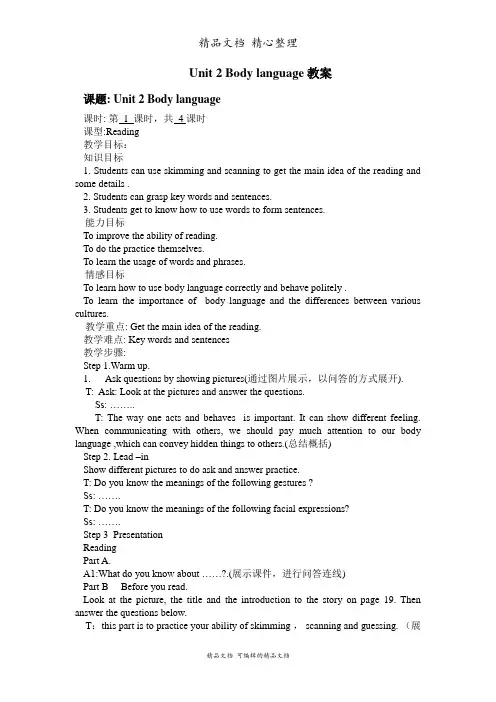
Unit 2 Body language教案课题: Unit 2 Body language课时: 第 1 课时,共 4 课时课型:Reading教学目标:知识目标1. Students can use skimming and scanning to get the main idea of the reading and some details .2. Students can grasp key words and sentences.3. Students get to know how to use words to form sentences.能力目标To improve the ability of reading.To do the practice themselves.To learn the usage of words and phrases.情感目标To learn how to use body language correctly and behave politely .To learn the importance of body language and the differences between various cultures.教学重点: Get the main idea of the reading.教学难点: Key words and sentences教学步骤:Step 1.Warm up.1.Ask questions by showing pictures(通过图片展示,以问答的方式展开).T: Ask: Look at the pictures and answer the questions.Ss: ……..T: The way one acts and behaves is important. It can show different feeling. When communicating with others, we should pay much attention to our body language ,which can convey hidden things to others.(总结概括)Step 2. Lead –inShow different pictures to do ask and answer practice.T: Do you know the meanings of the following gestures ?Ss: …….T: Do you know the meanings of the following facial expressions?Ss: …….Step 3 PresentationReadingPart A.A1:What do you know about ……?.(展示课件,进行问答连线)Part B Before you read.Look at the picture, the title and the introduction to the story on page 19. Then answer the questions below.T:this part is to practice your ability of skimming , scanning and guessing. (展示课件,提醒学生速读时把握关键点)Listen to the passage and answer the questionsT: Listen to the reading .(展示问题,利用Reading练习听力,一举两得)Part CV ocabularyC1 T:Let’s revise vocabulary and try to guess which words or phrases in the reading have similar meanings to the words below. .(展示课件并通过实例讲解做题的技巧,边提示边练习)C2: T:Complete their conversation with the words from the box.(展示课件,问答,提醒学生注意使用正确的形式)StrategyIdentifying the speaker(展示课件,利用Reading中的例句引导,并提醒学生注意标点符号)Part DComprehensionD1 Simon is talking to a friend on the phone. Read the story on P19 and complete his words with the information from the story.(展示课件,边问边答)D2 Read the story again and answer the questions below in complete sentences. T: D2 are mainly about how much you have learned about the reading. Let’s have a check.(利用课件进行问答)D3 Group workIn pairs ,discuss what your classmate’s body language is saying about him/her . Offer two questions to help them.And ask them to report y result to the whole class. Let’s see which group is the best! (让学生问题为话题,展开讨论。
整理沪教版牛津八年级下册英语第2单元教案设计
3、教师小结:
4、小竞赛:看谁在相应的时间里成为钓鱼能手?
5、小结:
1、说说今天你的收获?
2、请学生说出方向键的使用方法,指法。
3、教师总结:
进入情境
板书课题
学生演示操作
合作学习
师生交流
再次玩游戏
竞赛
总结
激发学生学习兴趣
自由练习,培养动手动脑能力
教师讲授,学生进一步了解图标的意义。
2、你还会用其他的方法来打开小游戏吗?
3、总结:用双击的方法也能打开游戏。
4、请学生动手试一试。
5、游戏怎样开始呢?哪一个是进入的按钮?
6、怎样才能钓到鱼呢?
师生交流
1、你是怎样来钓鱼的?有什么好方法?
2、请你到前面展示给同学们看?
3、用什么方法挪动鱼竿?
4、鱼上钩后又该怎么办?
1、再次来玩这个游戏,教师巡回指导。
合作学习,促进学生学习兴趣
达到复习巩固的目的
通过比赛检验学生学习成果及掌握情况
收获收获
板
书
设
计
11、钓鱼
整理丨尼克
本文档信息来自于网络,如您发现内容不准确或不完善,欢迎您联系我修正;如您发现内容涉嫌侵权,请与我们联系,我们将按照相关法律规定及时处理。
教 案 设 计
课题
11、钓鱼
教
学
目
标
1、学习掌握方向键来玩此小游戏。
2、掌握用双击的方法打开文件过游戏。
3、熟练鼠标操作。
4、熟悉方向键的指法。
5、培养对信息技术的兴趣爱好。
重点
1、学习掌握方向键来玩此小游戏。
2、掌握用双击的方法打开文件过游戏。
2022年牛津版八下 U2 Water教案 牛津上海版
Unit 2 Water教学目标Language objectives:Make the students understand the main idea of the passage.Teach the students how water goes into our flats.Ability objectives:Students learn to retell the water’s journey according to some key words. Students can learn some reading skills.Emotional objectives:Let the students know it is not easy for water to get to our flats and make them realize the value of water. Ask the students to save water.2重点难点1.to master the reading method2.to know about the circulation of water and try to express it3教学过程教学活动活动1【导入】warming-up1) Do a quiz about waterstudents have a competition.Purposes:To arouse the students’ interest in class activities and to know much more about water.2) Review how to use waterstudents talk about how to use water.Purposes:to enable the students to practice their oral ability.And let them know water is useful.It is also provide clues for the next discussion.3) Review how rain formsstudents read the sentences and put them in right order.Purposes:Let them know where rain comes from and think about how rain comes to our house.Lead to our passage.活动2【讲授】While-taskPart I:1) Ask the students to open their booksstudents number the paragraphs.2) Divide the whole passage into three parts.Part I: Para 1-3Part II: Para 4-12Part III: Para13-17Ask the students to read the first part.students read the first part.3) Show a picture that shows tap, sink and drain together.students to speak them out according to the picture.Purposes:Be familiar with tap, sink and drain.4) Guess and choose the meaning of froze, impatient, faint and vanishing. students guess and choose.Purposes:To let the students have a further master of the new words.Part II:1) Ask the students to read Part II. Before reading give them two questions:Q1. Is it easy for the water to get to Daisy’s bathroomQ2. How many places has the water been to during his journeyStudents read Part II.After reading answer the questions2) Show a map of the water’s journey.students complete the map.3) Look at the pictures and tell the journey again and ask some questions about it. Students answer some questions about the long journey.4) Ask the students to read and complete a short passage about the journey. Students fill in the blanks.Purposes:Let the students pay attention to water’s journey for the first time.Let the students pay attention to the names of the “stations〞 of the water’s journey.Be familiar with the “stations〞 of the long journey.To be familiar with the long journey.Part III:Reading1) Ask the students to read Part III and answer two Qs:Q1. Why did the water say it was like liquid goldQ2. Why did Benny think his sister was weirdStudents read the third Part and answer Qs.2) Let students to choose the right answers of the new words.Students guess and choosePurposes:To know the meaning of the new words.Speaking and writingDivide the students into 5 groups and let them have a discussion and write down something about water.Students write something about water and choose some students to make a report. Ask students to know some features of water and water is precious we should save water. So next lesson I will ask students to talk about how to save water.活动3【作业】作业1. Finish Ex1-3.2. Read and then retell the long journey.3. Think about how to save water第二课时Integrated skillsI. Teaching aims and learning objectivesBy the end of the lesson, students should be able to:1. get a general understanding about a volunteer project;plete the notes with the information obtained from listening material;3. talk about ways to help people in need in our daily lives.II. Teaching contentsNew words and phrases: south-west, north-west, project, a training plan, keep in touch,talk on the phone, improve their livesIII. Focus of the lesson and predicted area of difficulty1. Learn about a volunteer project.2. Talk about ways to help people in need in our daily lives.IV.Teaching proceduresA Working in a mountain areaStep 1Lead-in1. Play a videoT: This girl is Judy. She is Peter’s cousin. She likes travelling. Last year, she went on a trip to Guizhou and visited a local primary school. Do you know where Guizhouis It’s in the south-west of China. And what about Xinjiang It is in the north-west of China.She took some photos about the students there. Let’s see some pictures. 2. Have a talkT: After seeing the video, we know that children in mountain areas live a hard life. Let’s work together to take care of those children and their dreams. 【设计意图:展示Judy去旅行时拍摄的有关山区小学的照片, 从衣食住行等方面阐述山区学校学生的学习和生活状况,让学生从细微处体会山区孩子生活的艰难。
牛津英语八下Unit2 教案
总课题
Unit 2 Traveling
课题
Welcome to this unit &Comic strip
教学目标
知识目标
To introduce well-known attractions in foreign cities and popular places of interest
—Where have you been?
There are some pictures of some popular tourist attractions. Now look at these pictures one by one.
—What is it? It’s the Leaning Tower of Pisa inItaly. —Where is it? It’s in…
2. Work in pairs to talk about each of the photos.
Use the conversation between Daniel and Millie’s on page 21 as a model. You may expand the model conversation to include things you know and want todo yourselves.
Present your information and some interesting facts to the class.
—Do you like traveling to other cities or countries? —Yes, I do.
—Why? —Because I think the trip is wonderful. (fantastic) /I can learn a lot about other cites or countries. /I can make many friends. …
八年级英语下册 Unit 2 Water教案 (新版)牛津上海版

Unit 2 Water1教学目标Language learning objectivesTo learn the new words and phrasesTo be familiar with water’s journeySkill and ability objectiveTo develop listening and speaking skillsInstructional objectiveTo be aware of the preciousness of water2学情分析我任教的是本校一个普通班级,在过去的两年多时间里,充分利用好教材(牛津教材)所提供的丰富教学资源,我认真解析文本、创设语言学习环境、设计和实施教学活动,学生的英语听说读写的能力得到了有效的训练和提升。
3重点难点本课教学内容是牛津教材8B Chapter 6,是一篇关于水的科普性短文。
文章较长,且有一定难度,无法在30分钟时间内完成对整篇文章的教学,所以我选择文章中介绍水流程的一段。
原因是:1)这部分相对独立,意思完整;2)这部分是课文学习的教学重点;3)这部分包含了本课的重点词汇。
本课作为第一教时,我希望能突破教学的重点和难点,为后面的教学打好基础,消除障碍。
4教学过程学时重点Language learning objectivesTo learn the new words and phrasesTo be familiar with water’s journeySkill and ability objectiveTo develop listening and speaking skillsInstructional objectiveTo be aware of the preciousness of water学时难点作为科普性文章,单词有一定难度,需要进行图片,实物等引入帮助学生理解单词全文围绕水的旅程展开,对重要句型的运用有较高要求,需要进行铺垫教学活动活动1【导入】课文导入:Do you want to know more about water? Do you want to talk with water? Can wat er talk? In today’s le sson water can really talk. I am a drop of water today. You can call me Miss water. Look at the title “Water Talk”I will talk with you. It is a good chance for you to ask me some questions. Go ahead!How do you come here?Where can we see you?通过问题--“What does the sound make you think of?”,导入主题,活跃气氛,同时检测学生已有知识。
八年级英语下册 Unit2 Traveling教案 牛津版

Step I Lead-in
教师用多媒体或投影仪展示自己旅游时的照片,导入“旅游”这一话题。教师向学生提问:Where was I? Do you like traveling?
StepⅡPresentation
1、教师说:Lots of people like traveling.Our friends Eddie and Hobo also like traveling.They'll go on a trip for their holiday.Will Eddie have a happy holiday? Why or why not? Let's listen to their conversation.让学生看课本第24页的漫画,听录音并回答问题。
(5)What did they buy as souvenirs?(Some stationery, a beautiful purse and a pretty hair clip.)
7、学生两人一组,完成课本第28页B部分的对话。学生完成后,要求他们分角色朗读对话。
8、组织学生进行四人小组讨论,根据课文中出现的表示先后顺序的时间词语和短语,完成Kitty的活动行程。
come on your dream holiday popular tourist attractions
go hiking go skiing see the beautiful view
take photos a symbol of…
句型:I've been there many times.
2、教师再播放一遍录音,让学生跟着录音朗读对话,回答细节问题。
(1)Where is Eddie going?(He is going on a trip to South Hill.)
Unit 2教案 2022-2023学年牛津上海版英语八年级下册
2022-2023学年牛津上海版英语八年级第二学期unit two教案Material: Oxford English 8B Unit 2 WaterLesson type: Reading Water talk (1)Teaching objectives:By the end of the class, the students are expected to1. 通过文本阅读理解部分核心词汇的含义及用法,知道部分拓展词汇的含义,并在作业中加以巩固。
2. 通过阅读理解文本的主旨(water’s journey),通过扫读理解文本主要话题内容(生活用水的来源、加工及污水处理) 和相关细节信息。
Focus on learning:通过阅读理解文本的主旨,通过扫读理解文本主要话题内容(生活用水的来源、加工及污水处理) 和相关细节信息。
Potential difficulties in learning:通过阅读理解文本的主旨,通过扫读理解文本主要话题内容(生活用水的来源、加工及污水处理) 和相关细节信息。
Teaching procedureStages Learning activities PurposesThink in mind Look at the pictures and finish task 1.To set up a situation andconsolidate the key words Look andlearnLook at the pictures and learn the new words.Look and predict Read the title and pictures and predict.∙Who are having a talk?∙What are they talking about?To predict what informationmay be read.Read and find out Read through the passage and get the mainidea.∙Is this an informational article or a story?∙Where does the story take place?∙Who are the main characters in the story?∙What is the story mainly about?To help students read forgeneral idea.Read and find out Read the story from line1 to line 11. Find theanswers to these questions.∙Why did the water drop start talking toDaisy?∙Where was the water going when Daisy wasbrushing her teeth?Read the story from line 12 to line 29. Find outthe places the water drop went to on its journeyand circle them in your textbooks.T o develop students’ abilities ofreading.Read and answer Read the story and find the answers.∙What was the water drop doing in thecloud?∙How did it travel from the cloud to thestream?∙How did it travel from the stream to theYangtze River?∙How long did the water drop stay in thecloud?∙Where did the water drop go after it ran intothe Huangpu River?∙How did the water treatment works clean upthe water drop?∙Where was the water drop before it came toDaisy’s bathroom?∙Where did the water drop go after it leftDaisy’s bathroom?To develop students’ abilities ofreading.∙What did the sewage plants do to the water drop?∙Was the sea the last place of its journey?Read and find out Complete Exercise D1 on page 19.To help students furtherunderstand the text.Read and write Find proper words in the story to complete the flow chart of a water drop’s journey. Use the simple past tense.AssignmentsCopy the new words and phrases you learnedin today's lesson. Then read them aloud after therecording.Correct the answers in Task 2 on yourWorksheet.Complete Exercises C (C1, C2 and C3) andD2 on pages 18 and 19 of your Student's Book.Read the story aloud after the recording.To consolidate what is learnt inclass.Material: Oxford English 8B Unit 2 WaterLesson type: Reading Water talk (2)Teaching objectives:By the end of the class, the students are expected to1. 运用恰当的词汇,描述水的旅程;2. 分析小说类文本写作手法在描述科学概念中的作用;3. 增强节约用水和合理用水的意识。
初中英语 牛津上海版八年级下Unit2基础知识点复习教案
e. g. I am going to play table tennis with my friends this afternoon.(2) be going to还表示客观情况下(非主观打算)即将要发生的动作。
e. g. The weatherman says it is going to rain tomorrow.【随堂练习】ⅠRead and choose the best answer.()1. _______ Tai Mountain is the most famous mountain in Shandong.A. TheB. AnC. AD. /()2. There are ________ trees in my neighbourhood. We should plant some more.A. a lot ofB. fewC. a littleD. little()3. It's time ________ a rest. You have read the story book for a long time.A. to haveB. havingC. hasD. had()4. Don't ________ harmful chemicals into the river or lake.A. bringB. takeC. rushD. pour()5. The lights are still on in the lab. Please remember before leaving.A. turning them offB. to turn them offC. turning off themD. to turn off themⅡ. Rewrite the sentences as required.1.The man cut down a magnolia tree. (改为否定句)The man down a magnolia tree.2.He enjoyed the view on the thirtieth floor of Jinmao Building. (就划线部分提问)he _________ on the thirtieth floor of Jinmao Building?Ⅲ. Reading comprehension.AOnce upon a time some tiny frogs held a competition. The first to reach the top of a very high tower would be the winner.A big crowd gathered around the tower to see the race and cheer them on.The race began. No one in the crowd really believed that any of the tiny frogs would reach the top of tower. "They will never get to the top," someone said.One by one, the tiny frogs began to fall off.The crowd kept yelling," It's too difficult! No frog will make it!"More tiny frogs got tired and gave up, but one continued climbing, higher and higher. This one wouldn't give up.In the end, he was the only one left. It got to the top. The other frogs naturally wanted to know: How did the frog make it?One frog stepped forward to ask the winner. Then the frog found that the winner was deaf.He had won because he was able to keep his own mind. He couldn't hear criticism(批评) ; neither could he hear praise(表扬). There is a lesson for us all in the little frog's story. Don't let others block you on your way to your goal.True or false.() 1. No one came to see the race.() 2. No one believed any of the frogs would win.() 3. The crowd kept yelling because one frog reached the top of the tower.() 4. All the frogs stopped climbing because it was too difficult.() 5. The winner could hear nothing.。
牛津上海版八年级下册 Unit 2 Water 说课稿
牛津上海版八年级下册 Unit 2 Water 说课稿一. 教材分析牛津上海版八年级下册Unit 2 Water是本册教材的第二个单元,主题是水。
本单元通过讨论水的特点、用途、以及保护水资源的重要性,引导学生关注自然环境,提高他们的环保意识。
教材内容丰富,包括词汇学习、语法练习、阅读理解和口语表达等,旨在全面提高学生的英语能力。
二. 学情分析八年级的学生已经具备了一定的英语基础,对于日常生活中的词汇和简单的语法结构已经有了一定的了解。
然而,他们在阅读理解、口语表达和写作方面还存在一定的困难。
因此,在教学过程中,我们需要关注学生的个体差异,因材施教,鼓励他们积极参与课堂活动,提高他们的英语运用能力。
三. 说教学目标1.知识目标:学生能够掌握与水相关的词汇和短语,理解水量单位、水的用途和保护水资源的重要性。
2.能力目标:学生能够运用所学知识进行阅读理解,提高他们的信息提取和分析能力。
3.情感目标:学生能够增强环保意识,认识到保护水资源的重要性。
四. 说教学重难点1.重点:学生能够掌握与水相关的词汇和短语,正确使用一般现在时描述水的特点和用途。
2.难点:学生能够理解阅读材料,提取关键信息,运用所学知识进行口语表达和写作。
五. 说教学方法与手段1.任务型教学法:通过讨论、、汇报等形式,激发学生的学习兴趣,提高他们的参与度。
2.情境教学法:创设真实的情境,让学生在实际语境中学习词汇和语法。
3.合作学习:鼓励学生分组讨论,培养他们的团队协作能力。
六. 说教学过程1.导入:通过展示图片,引导学生谈论水的特点和用途,激发学生的学习兴趣。
2.新课呈现:介绍一般现在时,让学生通过观察图片和阅读材料,掌握一般现在时的用法。
3.课堂活动:学生进行小组讨论,讨论水的用途和保护水资源的重要性,培养他们的口语表达能力。
4.阅读理解:学生阅读文章,提取关键信息,回答问题,提高他们的阅读理解能力。
5.语法练习:学生完成练习题,巩固一般现在时的用法。
2019-2020学年八年级英语下册 Unit 2 Travelling教案2 牛津版.doc
1. Learn some new words with the help of some pictures.
2. Skimming
Read the article as quickly as they can and
Answer the questions.
1).How long did Kitty and her parents spend in Hong Kong Disneyland?
To learn about some famous places of interest all over the world and love travelling.
教学
重难点
To know about Kitty’s trip in Hong Kong.(importance)
To finish some exercises according the articles.(importance)
预习要求
To search for the Totalk about some famous places of interestaround the worldon the Internet.
教学内容及活动设计
二次复备及教学随感
Step 1 Checking
Show some pictures and let the Ss say the names of the places of interest
2.背诵Comic strip和B部分的对话。
3.完成《课课练》
预习Reading
教学反思
课题
8B Unit 2 Travelling
Reading 1