
【最新】人教版七年级英语下册Unit5 SectionA(1a-2d)优质课课件
tiger elephant
panda giraffe lion
koala
new words
tigers elephants pandas lions giraffes koalas Africa(非洲)
Who is quick?
What animals do you like…?
Julie: Well, I don’t like ______. lions
John: Why don’t you like them?
really _______. scary Julie: Because they’re _______
John: Where are they from?
South Africa Julie: Most of them are from ______ ______.
Animals
Enjoy a video.
Animals are our friends. We live in the same world.
To love animals is to love ourselves. Let’s protect(保护) the animals.
Homework
fun smart
lazy beautiful
Listen and answer.
Where are they from?
South Africa(南非)
2b. Listen again and complete the conversation.
pandas Julie: Let’s see the ________. John: Why do you like them?
of Julie: Because they’re kind ______interesting. John: Where are they from? China Julie: They’re from ________.
2b. Listen again and complete the conversation. koalas John: Well, I like ___________.
They are from China. 1.__________ pandas really scary Lions are really scary.
2a. Listen and write the animals you hea and match the followings.
Australords. 2. Practice the conversations with your classmates and recite (背诵) 2b.
Animals Description Words Countries Pandas are kind of interesting.
I like…because they are /kind of/ really very … I don’t like… because they are kind of/ really/very …
What is it? It’s strong and big. It eats meat. It runs fast. It looks like the cat. It’s the king of the forest.
What is it?
What is it?
What is it?
1c. Pairwork
A: Let’s see the lions. B: Why do you want to see them? A: Because they are interesting. cute interesting
Theylions are from South Africa. South Africa kind of interesting 2.__________ Koalas are very cute. China very cute koalas They are from Australia. 3.__________
Lily’s like and dislike
I like because because they they are are cute. kind of cute.
I don’t like
because they are scary. really scary.
用kind of/really/ very说两句, 你能行!
(大多数)
Summary(小结)
tiger koala elephant panda lion giraffe cute interesting fun Description words smart lazy beautiful Why do/ don’t you like…? Sentences Because they are… Where are… from? They are from…
Julie: Why do you like them?
very______. cute John: Because they’re ______
Julie: Where are they from?
Australia John: They’re from __________.
2b. Listen again and complete the conversation.
description words(形容词)
fun interesting smart (聪明的) beautiful (美丽的) cute(可爱的) lazy(懒惰的) scary(可怕的)
boring shy(害羞的) friendly(友好的)
Talk in pairs.
A: Do you like…? B: Yes, I do./ No, I don’t. A: Why do/ don’t you like…? B: Because they are …
人教版七年级下册英语Unit5SectionA(1a-2d)优质教学设计(含教学反思)

⼈教版七年级下册英语Unit5SectionA(1a-2d)优质教学设计(含教学反思)Unit 5Why do you like pandas?第⼀课时Section A(1a-2d)Target Navigation【⽬标导航】Key words and phrases:panda,zoo,tiger,elephant,lion,giraffe,animal,cute,lazy,smart,beautiful,kind,Australia,south,Africa,pet,leg,cat,sleep,kind of,South Africa Key sentences:(1)Let's see the pandas first.They're my favorite animals.(2)—Why do you like lions?—Because they're interestingSkills: 学会表达喜欢某类动物及说明喜欢的原因。
Emotion:Train the students' feelings of loving animals.The guidance of learning methods【学法指导】⼩组合作Learning important and difficult points【学习重难点】1.学会表达喜欢某类动物及说明喜欢的原因。
2.祈使句Let's…的⽤法。
Teaching Steps【教学过程】Autonomous Learning Scheme【⾃主学习⽅案】预习指导与检测(⼀)预习指导1.预习1a-1c中的⽣词,根据⾳标会读、知道汉语意思。
2.朗读1a中的句型,能英汉互译。
(⼆)预习检测Ⅰ.英汉互译。
1.welcome to the zoo____________ 2.my favorite animals____________ 3.want to see them____________ 4.⼤象____________5.树袋熊,考拉____________ 6.长颈⿅____________(Keys:1.欢迎来动物园,2.我最喜爱的动物,3.想见他们,4.elephant,5.koala,6.giraffe)Ⅱ.完成书中第25页1a的练习。
人教版七年级英语下册Unit5 SectionA1a-2d优质课课件
9. There are __C____ hours in a day.
A. seven
B. twelve C. twenty-four
D. forty– eight
Ⅲ. 用适当的介词填空。
1. Koalas are kind __o_f_ interesting. 2. She likes to play _w__it_h_ her friends. 3. Bill gets up __a_t__ nine. 4. Lingling sleeps _d_u_r_i_n_g_ the day. 5. Lions are _f_r_o_m__ the South Africa. 6. We’re in USA now, but we’rfero_m_____ China.
smart
A: Let’s see the koalas. B: Why do you want to see them? A: Because they are smart.
smart
fun
lazy
cute
interesting
beautiful
The animals and the countries
China
2b. Listen again and complete the conversation with the words in the box.
Julie: Let’s see the ____p_a_n_d_a_s________. John: Why do you like them? Julie: Because they’re __k_in__d_o_f_____ interesting. John: Where are they from? Julie: They’re from ___C__h_i_n_a_____.
人教版英语七年级下册Unit5SectionA1a2c优秀教学案例

作为一名特级教师,我深知教学策略在教学过程中的重要性。通过情景创设、问题导向、小组合作和反思与评价等策略,我将努力激发学生的学习兴趣,培养他们的思维品质和团队协作能力。同时,我也将关注学生的个体差异,给予他们个性化的指导和关爱,帮助他们实现全面发展。在今后的教学工作中,我将继续探索和研究,为学生的英语学习提供更有针对性的教学策略,助力他们成为具有全球视野的新时代青年。
针对不同学生的学习需求,我还设计了分层作业,让学优生拓展球类运动的知识点,学困生则通过模仿和练习提高英语基础。在课后,我还进行了课堂反馈,了解学生的学习情况,为下一步教学提供依据。
本节课在轻松愉快的氛围中结束,学生对球类运动的英文表达有了更深入的了解,同时也提高了他们的英语应用能力和团队协作精神。在今后的教学中,我将继续关注学生的个体差异,设计更贴近学生生活的教学活动,为他们的英语学习奠定坚实基础。
在案例中,我担任七年级某班的英语教师,面对的学生英语水平参差不齐,但都对球类运动充满热情。为了提高教学效果,我设计了以学生兴趣为导向的教学活动,注重激发学生的学习兴趣和参与度,培养他们的合作意识和语言运用能力。
在教学过程中,我遵循了循序渐进的原则,首先通过热身活动让学生熟悉球类运动的英文表达,接着引入本节课的主题。在课堂活动中,我采用任务型教学法,将学生分成小组,让他们完成一系列关于球类运动的任务,如:讨论喜欢的球类运动、编写球类运动的小短文等。在完成任务的过程中,学生互相交流、合作,提高了英语口语表达能力和团队协作能力。
4.通过创设情境,激发学生的学习兴趣,使他们能够主动参与到课堂活动中,提高学习效果。
(二)问题导向
1.引导学生思考球类运动对自己和他人的意义,如:为什么喜欢球类运动?球类运动对身体有哪些好处?
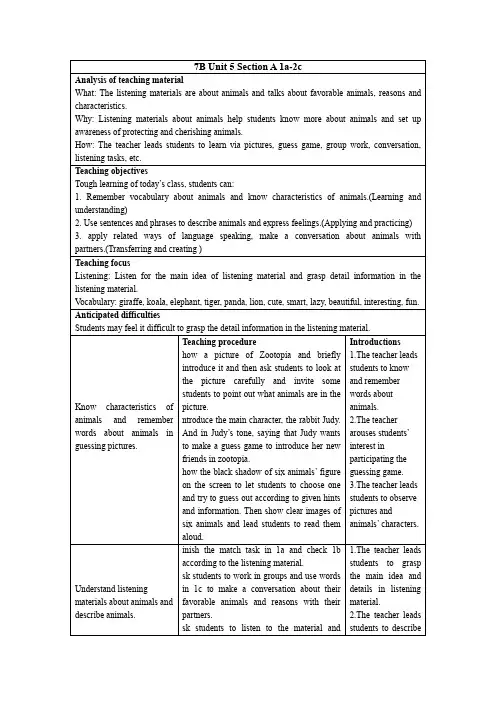
Unit5SectionA1a-2c教案人教版七年级英语下册(1)
Reflection
e topic and guess game to arouse students’interest.
2.Give students enough time and chance to make group work and practice communicative conversation.
3.Consolidate words and sentence structure through practice.
Lead students to use extensive listening and intensive listening to better understand listening material.
sk students to work in groups and use words in1cto make a conversation about their favorable animals and reasons with their partners.
sk students to listen to the material andfinish 2a, and then the teacher asks students to answer with the sentence pattern of “...(the name of animals) are ... (adjective). They are from ...”
1.The teacher leads students to make conversation and role-play
Homework
1.Read and recite the conversation of 2d in 26
Unit5SectionA(1a2d)课件人教版英语七年级下册
B:She _s_l_e_e_p_s__a_l_l__d_a_y____ . A:Why doesn’t Jenny like the cat? B:Because she’s k_i_n_d__o_f__b_o_r_i_n_g___ __l_a_z_y__ .
. And she is
◎学法指导:为保证听的效果,不但要熟记关于动物的单 词,还要熟记教材上的形容词,如:scary、cute、interesting 等。
A:Why does Peter like the dog? B:Because it’s c_u_t_e__a_n_d__s_m_a_r_t__ .
A:What’s the name of the cat? B: _L_a_z_y_____ . A:Whose cat is it? B:It’s ___J_e_n_n_y_’__s__m_o_t_h_e_r_’__s____. A:What does the cat do every day?
知识拓展· 1.koala作名词,意为“树袋熊;考拉”。树袋熊,树袋熊 科,有袋目的一种,又称考拉(音译)。树袋熊仅分布于澳大利亚 的昆士兰、新南威尔士、维多利亚等地,树栖,体肥硕,体长 60~70厘米,无尾。它们体被厚密绒毛,呈灰褐色;鼻大裸露,眼 睛小;耳生有绒毛;择食性专一,以桉树叶为食。雌树袋熊的育 儿袋开口向后,每次产仔一只(偶见两仔),幼仔在育儿袋中哺乳 半年。
难点 1.用because来说明喜欢某种动物的原因 2.形容词的准确运用
教学建议 1.本单元通过谈论动物,学习描述动物的形容词和用正确的 语句表达自己的观点。建议教学时教师利用简笔画、PPT或动 物的图片来更加直观地教单词,增强学生学习的兴趣并加深其 对知识的理解。
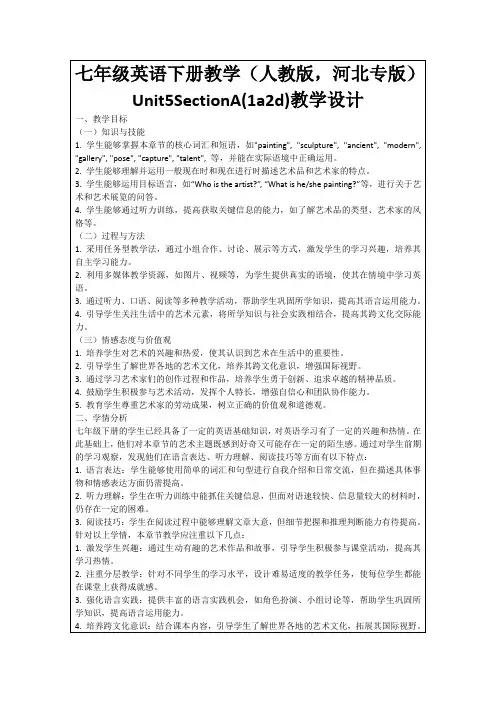
七年级英语下册教学(人教版,河北专版)Unit5SectionA(1a2d)教学设计
(四)课堂练习
1.教师设计一系列与艺术相关的练习,如填空、选择、匹配等,帮助学生巩固所学知识。
2.学生完成练习后,教师及时给予反馈,针对共性问题进行讲解。
3.教师组织学生进行角色扮演活动,模拟参观美术馆的情景,让学生在实际语境中运用所学知识。
5.教育学生尊重艺术家的劳动成果,树立正确的价值观和道德观。
二、学情分析
七年级下册的学生已经具备了一定的英语基础知识,对英语学习有了一定的兴趣和热情。在此基础上,他们对本章节的艺术主题既感到好奇又可能存在一定的陌生感。通过对学生前期的学习观察,发现他们在语言表达、听力理解、阅读技巧等方面有以下特点:
6.学生在家中与家长共同欣赏一幅艺术作品,用英语分享自己的看法和感受,增进家庭成员之间的交流。
注意事项:
1.作业布置要注重培养学生的实践能力和跨文化素养,将所学知识与生活实际相结合。
2.作业难度要适中,确保学生能够在课后顺利完成。
3.教师在批改作业时,要关注学生的语言运用、思维品质和学习态度,给予及时反馈和鼓励。
3.完成课后练习册中与本节课相关的练习,巩固所学知识,提高语言运用能力。
4.观察生活中的艺术元素,如街头涂鸦、雕塑作品等,尝试用手机或相机记录下来,并结合本节课所学的时态和词汇,用英语描述这些艺术作品给人们带来的感受。(字数要求:不少于60词)
5.鼓励学生利用网络资源,了解国内外知名艺术馆和艺术展览,选择一个感兴趣的主题,用英语写一篇观后感。(字数要求:不少于100词)
2.学生能够理解并运用一般现在时和现在进行时描述艺术品和艺术家的特点。
3.学生能够运用目标语言,如“Who is the artist?”, “What is he/she painting?”等,进行关于艺术和艺术展览的问答。
人教版七年级英语下册Unit 5 Section A(1a-2d)优质课课件
Animals
Description Words Countries
1.__p_a_n_a_d__a_s_
really scary
2.__l_io__n_s____ kind of interesting
3.__________
koalas
very cute
Australia South Africa
15、一年之计,莫如树谷;十年之计,莫如树木;终身之计,莫如树人。2021年7月2021/7/272021/7/272021/7/277/27/2021
16、提出一个问题往往比解决一个更重要。因为解决问题也许仅是一个数学上或实验上的技能而已,而提出新的问题,却需要有创造性的想像力,而且标志着科学的真正进步。2021/7/272021/7/27July 27, 2021
So many things to tell her. But how to make her see? The truth about my past? Impossible! She’d turn away from me.
He’s holding back. He’s hiding. But what I can decide? Why won’t he be the king I know he is, the king I see him inside?
dolphin
beautiful lovely fun interesting friendly cute
penguin
beautiful fun cute friendly shy
2a. Listen and write the animals you hear and match the followings.
人教版英语七年级下册Unit5SectionA1a~2d教学设计
教学策略:通过讨论体育活动中的正能量故事,激发学生的情感共鸣,促进他们的情感态度和价值观的形成。
6.评价反馈:在教学过程中,教师应关注学生的个体差异,给予及时、具体的反馈,帮助他们建立自信,不断进步。
教学策略:采用形成性评价和终结性评价相结合的方式,全面评估学生的学习过程和成果。
(二)讲授新知
1.教学活动:教师通过PPT展示一般现在时的语法点,包括陈述句、一般疑问句和否定句的结构,并结合体育活动进行讲解。
2.教学策略:采用讲解与示例相结合的方式,让学生在理解语法规则的基础上,学会在实际语境中运用。
3.教学内容:针对体育活动这一话题,教授目标词汇和短语,如:play basketball, exercise every day等,并让学生模仿例句进行练习。
5.预习作业:
-预习下一课的内容,提前准备相关的词汇和语法点,为课堂学习做好准备。
作业布置的目的是为了让学生能够将所学知识应用到实际中,通过不同形式的练习,提高他们的英语综合运用能力。同时,教师应鼓励学生在完成作业的过程中,发挥创意,主动探索,培养自主学习的能力。在作业批改和反馈环节,教师应注重个性化指导,针对学生的不同情况进行详细讲解,帮助他们克服困难,不断提升英语水平。
3.语法讲解:在学生交流的基础上,适时引入一般现在时的语法点,通过例句和练习,帮助学生理解和掌握语法规则。
教学策略:采用归纳法,让学生从实际语言使用中发现语法规则,并通过练习巩固所学。
4.语言实践:设计角色扮演、小组竞赛等实践活动,让学生在实际语境中使用目标语言。
教学策略:采用任务型教学法,为学生提供真实的语言环境,培养他们的语言运用能力。
人教版初中英语七年级下册Unit 5 Section A名师课件(二课时)
kind of very really quite pretty
cute fun lazy elegant
interesting smart beautiful intelligent
South Africa North America
North Pole Asia
South Australia
Pole
Julie: Let’s see thepandas . John: Why do you like them, Julie? Julie: Because they’rekind of interesting. John: Where are they from? Julie: They’re from China .
Africa
It comes from Africa, too. It’s from Africa, too.
Australia South Pole
North America
South America
Where is this penguin from?
North Pole
Europe
Asia
Africa
Animals pandas 1. koalas
2. lions
3.
Description words
really scary kind of interesting
very cute
Countries Australia
South Africa China
2a Listen and complete the conversation.
初一下Unit5SectionA公开课
eat dinner What are you doing? I’m eating dinner.
1c. Practice
What are you doing?
I’m …
talking on the phonng homework
cleaning
What’s she doing? She is … (What’s =What is)
What are they doing?
They are _________.
are _____ they _______ doing ? What_____ . They _____ are cleaning ______ ________.
Happy apartment
There are many people in the happy apartment. What are they doing?
,
What is he doing? He is playing basketball.
Pair work
What’s he/she doing? He/She is ….
What are they doing?
Watching TV
What are they doing?
They are eating.
a b c f
e
1b
Listen. What are these people doing? Write numbers from 1a.
A. Jenny ___ 2 B. Dave and Mary ____ 4 C. John___ 1
Bob: Hello, Jenny.
Jenny: Hi, Bob. Bob: Jenny, what are you doing? Jenny: I’m watching TV. Bob: Do you want to play tennis? Jenny: No, this TV show is interesting. What’s John doing? Bob: He’s doing his homework. Jenny: Well, what’re Dave and Mary doing? Bob:They’re eating dinner.