
初中英语八大时态练习题--讲解
初中英语八大时态练习题1.I will tell him as soon as he _____ backA. comeB. comesC. will comeD. came2. Mary _____ on shoes when she ____ them.A. tries…buysB. tries… buiesC. trys… buysD. trys… buies3. The girl often ______ cold when she ______.A. cathcs dancesB. catches dancesC. catchs danceesD. catches dancee4. _____ he ____ himself thereNo, I don't think so.A. Do enjoyB. Does enjoiesC. Does enjoysD. Does enjoy5. _____ your teacher ____ from them very often Certainly.A. Do hearB. Does hearC. Do receiveD. Receive6. _____ your mother _____ some cleaning on SundaysA. Does doesB. Do doesC. Does doD. Do do7. _____ Tom _____to work hard to help his familyYes, he _____.A. Has x doesB. Has x doesC. Does has hasD. Does have does8. Which teacher _____ lessons to you every dayA. does givesB. does giveC. do giveD. gives9. Smith does not go fishing on weekdays, ____ _____ , he does.A. does he NoB. does he YesC. doesn't he NoD. doesn't he Yes10.Mr Black often _____ fishing on Sundays, _____ heA. goes doesn'tB. Goes isn'tC. doesn't go doesD. doesn't go is11.He usually _____ TV on Sunday evening.A. watchB. watchesC. watchingD. is watching12. We'll go to play with snow if it ______ tomorrow.A. snowB. snowsC. will snowD. snowed13. Neither I nor he ______ French.A. speakB. doesn't speakC. speaksD. doesn't speak14. Nobody ______ how to run this machines.A . know B. have known C. knows D. is knowing15. The Young Pioneer _____ water for the old man every day.A. carryB. bringC. takesD. Carries16. Some are ______ in the river and some are ______ games.A. swimming playingB. swimming plaiingC. swimming playingD. swimming plaing17. Look ! The boy students are _____ football while the girls are _____ .A. playing danceB. playing dancingC. play dancingD. play dance18. He _____ to do his lessons at eight every evening.A. is beginningB. is beginningC. beginD. begins19. _____ he _____ on well with his friends this termA. Does getsB. Does getC. Is gettingD. Is geting20. Mr Smith _____ short stories, but he ____ a TV play these days.A. is writings writingB. is writing writesC. writes is writingD. writes writes21. I _____ to the cinema. I ______ there every Sunday.A. go…goB. am going…goC. go… am goingD. am going…am going22. Look, they______ a good time, ____ theyA. have…doB. have…don'tC. are having…areD. are having aren't23. You ______ about the future now, ______ youA. don't think don'tB. aren't thinking aren'tC. don't think doD. aren't thinking are24. She always ______ something whenever she ______.A .studied played B. Studied plaiedC.. studied plaiedD. studied played25. He often _____ late in the forest. It _____ me very much.,A. stayed worriedB. staied worriedC. stayed worryedD. staied worried26. I ______that the boy _____ with no tears in his eyes.A. noticed cryedB. noticed criedC. noticed criedD. noticed cryed27. We _____the floor and _____ all the windows.A. mopped cleannedB. moped cleanedC. mopped cleanedD. moped cleaned28. When I _____ the Children's Palace, the children _____ with joy.A. visited jumppedB. visited jumpedC. visited jumpedD. visited jumpped29. ______ a sports meet last Sunday Yes , they ______.A. Did they have didB. Did they have hadC. Had they hadD. Had they did30. ____ you _____out for a walk after supper Yes, I ______.A. Did went wentB. Did go wentC. Did went didD. Did go did31. _____ Jack _____ on with his work or ______ to have a restA. Did went stoppedB. Did go stopC. Did went stopD. Did go stopped32. You gave them a talk two days ago, _____you Yes, I ______.A. did didB. did gaveC. didn't didD. didn't gave33. ____ your brother _____ a letter to My father.A. Who wroteB. What wroteC. Who did writeD. What did write34. They _____ about the TV news then in the sitting-room. They often ____ such talksA. talked hadB. Talk haveC. were talking hadD. are talking have35. He ______ some cooking at that time, so _____ me.A. did heardB. did didn't hearC. was doing heardD. was doing didn't hear36—40 BDACB36. " _____ you angry then " "They_ too much noise."A. Are were makingB. Were were makingC. Are madeD. Were made37. This time yesterday Jack _____ his, bike. He _____ TV.A. repaired didn't watchB. was repairing watchedC. repaired watchedD. was repairing wasn't watching38. We _____ for Tom at ten last Sunday. He often kept us ______.A. were waiting waitingB. were waiting waitC. waited waitingD. waited wait39. When you _____ at the door, I _____ some washing.A. knocked didB. was knocking didC. knocked was doingD. knock am doing40. The boy_____ English on the radio when I _____ his door.A. learned was openingB. was learning openedC. learned openedD. is learning open41.When they______ through the forest, a bear _____ at them.A. walked… was comingB. were walking…cameC. were talking… c omesD. walk… is coming42. A young man _____ her while she _____ her work .A. watched was finishingB. was watching finishedC. watched finishedD. was watching was finishing43. While mother _____ some washing, I ______ a kite for Kack.A. did madeB. was doing madeC. was doing was makingD. did was making44. I _____ myself French from 7 to 9 yesterday morning. I _____ to work.A. was teaching didn't goB. taught didn't goC. was teaching wentD. taught went45. He _____ a model plane when I came to see him.A. makesB. is makingC. was makingD. Made46. I ______ a letter at nine last night.A. is writingB. was writingC. wroteD. is writing47. The teacher_____ (give) us a history lesson when Tom walked into the classroom.A. gaveB. is givingC. was givenD. was giving48. There will be a football match in two days, that is _______.A. last SundayB. next SundayC. every SundayD. this Sunday49. We ______ class meeting this November.A. hadB. haveC. will haveD. are having50. He ______ in his garden every morning next year.A. will workB. worksC. workedD. is working51. Be careful. The train ______.A. will comeB.C. comesD. is coming52. Look at those clouds. It _____ soon, I'm afraid.A. is going to rainB. is rainingC. will rainD. won't rain53. The radio says it ______ the day after tomorrow.A. is going to snowB. is snowingC. will snowD. snows54. _____ he _____ some shopping tomorrow afternoonA. Will doesB. is going to doC. Is doingD. Shall do55. What day _____ it ______ tomorrow Wednesday.A. is going to beB. will beC. shall beD. does be56. The boy _______ sixteen years old next year.A. is going to beB. is growing to beC. will beD. is57. _____ you ____ me up at six, pleaseA. Are going to wakeB. Are wakingC. Will wakeD. Do wake58. If he ______ to college, he _____ a lot more.A. will go will learnB. will go is going to learnC. is going is going to learnD. goes will learn59. When she _____ next time ,I ______ her everything.A. is going to come shall tellB. will come shall tellC. comes will tellD. come will tell60. What day ____ it ____ tomorrow It ____Tuesday.A. is…going to be… isB. will…be…willC. is…going to be…is goingD. will be…will be61. She _____that she _____ her best to help them the next term.A. says will doB. said will doC. said would doD. says would do62. People _____ that the Smiths _____ for a holiday next week.A. say will goB. said will goC. said would goD. Say would go63. Nobody _____ us that he _____ even stricter with usA. tell will beB. tells would beC. told will beD. told would be64. Please _____ him that we _____ able to help him.A. tell will beB. tells would beC. told will beD. told would be65. Jack _____ that they _____ surprised to see it this Friday.A. know would beB. knows will beC. knew would beD. knew will be66. I _____to know if Mary_____ by train that afternoon.A. want would goB. want will goC. wanted would goD. wanted will go67. _____ he _____ that they _____ home tomorrowA. Does learn would goB. Does learn will goC. Did learn would goD. Did learn will go68. We _____ that they _____ a sports meet tomorrow.A. learn would haveB. have learned would haveC. learn will haveD. have learned will have69. ____ you _____ that he _____ his lost son one dayA. Do think will findB. Do thought would findC. Did think will findD. Did thought would find70. I _____ that you _____ good care of her that day.A. thought will takeB. thought would takeC. think will take B. think would take71. The visitors _____ where they _____ a short test.A. ask would takeB. ask will takeC. asked would takeD. asked can take72. John ____ sure that he ____ good at chemistry soon.A. be will beB. is, would beC. was will beD. was would be73. She ____ ill so she ____ able to go skating the next day.A. is won't beB. is wouldn't beC. was won' beD. was wouldn't be74. He _____ the thief to the police when he _____ the man again.A. would take would meetB. would take metC. will take will meetD. will take meet75. Mother ____ me a new coat yesterday, I _____ it on. It fits me well.A. has made have triedB. made have triedC. has made triedD. Made tried76. " He ____ to draw horses already ."" When ____he ". " Last year. "A. learned hasB. learned didC. has learned hasD. has learned did77. Tom ____ up into the tree. Look, he _____ high up there !A. has got isB. has climbed wasC. got wasD. climbed is78. _____you _____ the text yet Yes, we _____ it two hours ago.A. Did copy didB. Have copied haveC. Have copied didD. Did copy had79. "Why she angry " "Because he _____ at he just now.A. did get, shoutedB. has got shoutedC. did get has shoutedD. has got has shouted80. _____ you ______ the film before? Where ____ you _____ itA. Have…seen…did…seeB. Did…see…die…watchC. Have…seen… have… seenD. Did…see…have…seen81. You _____ me waiting for two hours. I _____ for you since five.A. kept waitedB. have kept waitedC. kept have waitedD. have kept have waited82. Where _____John _____ to the library. He _____ there for an hour.A. has been has goneB. has gone has beenC. did go wentD. did be went83. _____ the baby still _____ No, it ______ crying.A. Has cried has stoppedB. Is crying stoppedC. Did cry stoppedD. Is crying has stopped84. I _____ the way. I ______ here for quite many years.A. knew have livedB. knew liveC. know have livedD. know live85. _____ you ever _____America Yes, I have.A. Have gone toB. Have gone inC. Have been toD. Have been in86. My brother _______ college for over three years.A. has gone toB. has been toC. has been inD. has been for87. He _____ the Army by the end of 1992. He ____ in the army since then.A. joined isB. has joined has beenC. had joined isD. had joined has been88. By the time I _____ back they ____ up ten metres.A. came have climbedB. came had climbedC. come have climbedD. had come climbed89. Jack ____ over five lessons by seven o'clock. Then he____ a test.A. went tookB. went had takenC. had gone tookD. had gone had taken90. We _____ out by that time that he ____ a thief for a long time.A. had found had beenB. had found wasC. found had beenD. found was91. Before the new _____ him, he ____ to know about it.A. reaches has gotB. reached had gotC. reached gotD. had reached got92. I _____ him a second letter before I _____ from him.A. wrote heardB. wrote had heardC. had written heardD. have written hear93. We _____ in a good harvest because we ______ enough rain.A. didn't get had hadB. got had hadC. had got had badD. got hadn't had94. They ____for five hours when they ____ in New York.A. flew arrivedB. had flown had arrivedC. flew had arrivedD. had flown arrived95. She ____ that ____ it for two days by that day.A. says has rainedB. says had rainedC. said had rainedD. said rained96. John _____ there since the year before, so he ____ them.A. had worked knewB. had worked.had knownC. worked knewD. worked had known'97. He _____ angry because he _____ for a long time.A. had got had waitedB. got waitedC. had got waitedD. got had waited98. Paper _____ first invented in China.A. isB. areC. wasD. were99. The Greens _____ China for five years.A. has been inB. have been inC. went toD. has gone to100.There _____ an eraser under the desk. Is it yoursA. isB. hasC. wasD. had。
初中八种英语时态精讲精练(含答案)
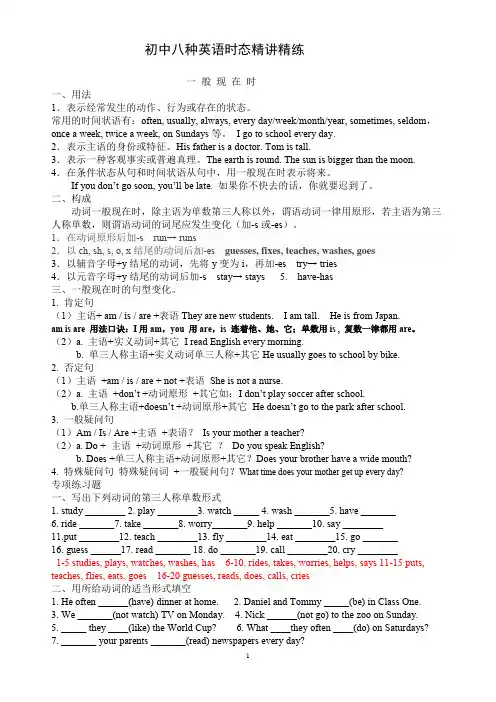
初中八种英语时态精讲精练一般现在时一、用法1.表示经常发生的动作、行为或存在的状态。
常用的时间状语有:often, usually, always, every day/week/month/year, sometimes, seldom,once a week, twice a week, on Sundays等。
I go to school every day.2.表示主语的身份或特征。
His father is a doctor. Tom is tall.3.表示一种客观事实或普遍真理。
The earth is round. The sun is bigger than the moon. 4.在条件状态从句和时间状语从句中,用一般现在时表示将来。
If you don’t go soon, you’ll be late. 如果你不快去的话,你就要迟到了。
二、构成动词一般现在时,除主语为单数第三人称以外,谓语动词一律用原形,若主语为第三人称单数,则谓语动词的词尾应发生变化(加-s或-es)。
1.在动词原形后加-s run→ runs2.以ch, sh, s, o, x结尾的动词后加-es guesses, fixes, teaches, washes, goes3.以辅音字母+y结尾的动词,先将y变为i,再加-es try→ tries4.以元音字母+y结尾的动词后加-s stay→ stays 5. have-has三、一般现在时的句型变化。
1. 肯定句(1)主语+ am / is / are +表语They are new students. I am tall. He is from Japan.am is are 用法口诀:I用am,you 用are,is 连着他、她、它;单数用is , 复数一律都用are。
(2)a. 主语+实义动词+其它I read English every morning.b. 单三人称主语+实义动词单三人称+其它He usually goes to school by bike.2. 否定句(1)主语+am / is / are + not +表语She is not a nurse.(2)a. 主语+don’t +动词原形+其它如:I don’t pla y soccer after school.b.单三人称主语+doesn’t +动词原形+其它He doesn’t go to the park after school.3. 一般疑问句(1)Am / Is / Are +主语+表语?Is your mother a teacher?(2)a. Do + 主语+动词原形+其它?Do you speak English?b. Does +单三人称主语+动词原形+其它?Does your brother have a wide mouth?4. 特殊疑问句特殊疑问词+一般疑问句?What time does your mother get up every day?专项练习题一、写出下列动词的第三人称单数形式1. study ________2. play ________3. watch _____4. wash _______5. have _______6. ride _______7. take _______8. worry_______9. help _______10. say ________11.put ________12. teach ________13. fly ________14. eat ________15. go _______16. guess ______17. read _______ 18. do _______19. call ________20. cry ________1-5 studies, plays, watches, washes, has 6-10. rides, takes, worries, helps, says 11-15 puts, teaches, flies, eats, goes 16-20 guesses, reads, does, calls, cries二、用所给动词的适当形式填空1. He often ______(have) dinner at home.2. Daniel and Tommy _____(be) in Class One.3. We _______(not watch) TV on Monday.4. Nick ______(not go) to the zoo on Sunday.5. _____ they ____(like) the World Cup?6. What ____they often ____(do) on Saturdays?7. _______ your parents _______(read) newspapers every day?8. The girl _______(teach) us English on Sundays.9. She and I ________(take) a walk together every evening.10. The moon ________ (travel) round the earth.11. It usually ________ (take) me more than two hours to finish my homework.12. I will tell him the good news as soon as he ________ (come) back.13. Miss Gao is very busy. She ________ (sleep) six hours a day.14. Look! Susan ________ (dance) in the garden. She often ________ (dance) there.15. The children will go to the Summer Palace if it ________ (not rain) tomorrow.16. I _________ any pears (not have). But Mary _________ some (have).17. What language ____ you _____? (speak) 18. My brother _____ to be a scientist. (not like) 19. We ______ Japanese at school. (not study) 20. He _____ playing football. (not like)1. has2. are3. don’t have4. doesn’t go5. Do like6. do, do7. Do, read8. teaches9. take 10. travels 11. takes 12. comes 13. sleeps 14. is dancing, dances 15. doesn’t rain 16. don’t have, has 17. do, speak 18. doesn’t like 19. don’t study 20. doesn’t like三、按照要求改写句子1. Daniel watches TV every evening.(改为否定句)_________________________2. I do my homework every day.(改为一般疑问句,并作肯、否定回答)________________________________________________________3. Amy likes playing computer games.(改为一般疑问句,并作肯、否定回答)___________________________________________________4. We go to school every morning.(改为否定句)____________________________5. Sun Yang usually washes some clothes on Saturday.否定句: _____________ 一般疑问句: ________________ 划线提问: ____________6. Tom does his homework at home.否定句: ______________ 一般疑问句: ____________ 划线提问_____________1. Daniel doesn’t watch TV every evening.2. Do you do your homework every day? Yes, I do. No, I don’t.3. Does Amy like playing computer games? Yes, she does. No, she doesn’t.4. We don’t go to school every morning.5. Sun Yang doesn’t usually wash any clothes on Saturday. Does Sun Yang usually wash any clothes on Saturday? What does Sun Yang usually do on Saturday?6. Tom doesn’t do his homework at home. Does Tom do his homework at home? Where does Tom do his homework?四、选用所给的词语适当形式填空give, rain, enjoy, sing, return, borrow, keep1. It often ______ in my hometown in summer.2. Sometimes the birds _______ in the tree.3. Joe usually ____ books from the school library, but she never _____ them on time.4. May I ________ the dictionary for a week?5. The little boy ________ himself in the garden on Saturdays.6. Mary is a good girl. She often ________ me a hand when I need some help.1. rains2. sing3. borrows, returns4. keep5. enjoys6. gives一般过去时的用法一、定义:表示过去某一时间所发生的动作或存在的状态;表示在过去一段时间内,经常性或习惯性的动作。
初中英语八大时态全套精讲及练习题(K12教育文档)

初中英语八大时态全套精讲及练习题(word版可编辑修改)编辑整理:尊敬的读者朋友们:这里是精品文档编辑中心,本文档内容是由我和我的同事精心编辑整理后发布的,发布之前我们对文中内容进行仔细校对,但是难免会有疏漏的地方,但是任然希望(初中英语八大时态全套精讲及练习题(word版可编辑修改))的内容能够给您的工作和学习带来便利。
同时也真诚的希望收到您的建议和反馈,这将是我们进步的源泉,前进的动力。
本文可编辑可修改,如果觉得对您有帮助请收藏以便随时查阅,最后祝您生活愉快业绩进步,以下为初中英语八大时态全套精讲及练习题(word版可编辑修改)的全部内容。
初中英语八大时态全套精讲及练习题.1 一般现在时的用法1)经常性或习惯性的动作,常与表示频度的时间状语连用。
时间状语: every…, sometimes,ofen,always,usually, twice a week, at…, on Sunday I leave home for school at 7 everymorning。
He watches Tv once a week 。
2) 客观真理,客观存在,科学事实.The earth moves around the sun。
Shanghai lies in the east of China.3)表示格言或警句中。
Pride goes before a fall。
骄者必败。
注意:此用法如果出现在宾语从句中,即使主句是过去时,从句谓语也要用一般现在时。
例:Columbus proved that the earth is round。
.4) 现在时刻的状态、能力、性格、个性.I don't want so much.Ann Wang writes good English but does not speak well。
比较:Now I put the sugar in the cup.I am doing my homework now。
初中英语 八大时态详解练习

初中英语50个必考句型+ 八大时态结构必背句型句型1:There+be +主语+地点状语/ 时间状语There're three books on the table.桌子上有三本书。
句型2:What's wrong with+sb. / sth.? What's wrong with your telephone?你的手机有什么毛病?句型3:How do you like…?How do you like China?你觉得中国怎么样?句型4:What do you like about…?What do you like about China?你喜欢中国的什么?句型5:had better(not)+动词原形You'd better ask that policeman over there.你最好去问问那边的那个警察。
句型7:Thank+sb.+for (doing) sth. Thank you for coming to see me.感谢你来看我。
句型8:So+be / 情态动词/ 助动词+主语He is a student. So am I.他是一个学生,我也是。
句型9:not…until…He didn't have supper until his parents came back.直到他的父母回来他才吃饭。
句型10:比较级十and+比较级The baby cried harder and harder.那孩子哭得越来越厉害。
句型11:the+比较级,the+比较级The more one has, the more one wants.拥有的越多,想要的越多。
句型12:…as+adj. / adv.+as……not as(so)+adj. / adv.+as…Last Sunday the weather was not so wet as it is today.上个星期天的天气不如今天的天气潮湿。
初中英语时态讲解及练习(全)

时间状语:Tomorrow, next day(week, month, year…),soon, in a few minutes, by…,the day after tomorrow, etc.
否定形式:主语+am/is/are not going to do ; 主语+will/shall not do+其他 一般疑问句:be放于句首;will/shall提到句首。
1.I ____(write, am writing, is writing, are writing) a letter now. 2.Look, it _____(begin, is beginning, am beginning, are beginning) to rain. 3.They ____(study, is studying, am studying, are studying) medicine at the Medical Institute of Chengde these days. 4.He _____(teach, am teaching, is teaching, are teaching) an English lesson at this time.
谓语动词使用过去式形式, 加ed,分为规则和不规则变 化。表示过去经常发生的动 作,也可用“used to do ” 和“would +动词原形”。
1. He____(be, was, were, been) here a moment ago. 2. They ____(be, was, were, been) here just now. 3. The scientists _____(leave, leaves, leaved, left) for America yesterday. 4. Last week we ______(visit, visited ) the Science Museum. 5. When I was a child, I often ____(play, played) football. 6. The students ran out of the classroom as soon as the bell ____(ring, rang, rung).
初中英语八大时态用法详解及真题巩固练习

初中英语八大时态用法详解及真题巩固练习一般现在时1. 概念:经常、反复发生的动作或行为及现在的某种状况。
2. 基本结构:①is/am/are;②do/does否定形式:①am/is/are + not ; ②此时态的谓语动词若为行为动词,则在其前加don't,如主语为第三人称单数,则用doesn't,同时还原行为动词。
3. 一般疑问句:①把 is/am/are 动词放于句首;②用助动词do提问,如主语为第三人称单数,则用does,同时,还原行为动词。
4. 用法:1) 经常性或习惯性的动作,常与表示频度的时间状语连用。
例如:I leave home for school at 7 every morning. 每天早上我七点离开家。
2) 客观真理,客观存在,科学事实。
例如:The earth moves around the sun. 地球绕太阳转动。
Shanghai lies in the east of China. 上海位于中国东部。
3) 表示格言或警句。
例如:Pride goes before a fall. 骄者必败。
注意:此用法如果出现在宾语从句中,即使主句是过去时,从句谓语也要用一般现在时。
例如:I knew that the earth goes around the sun when I was little.我小时候就知道地球绕太阳转。
4) 现在时刻的状态、能力、性格、个性。
例如:I don't want so much. 我不要那么多。
Ann writes good English but does not speak well.安英语写得不错,讲的可不行。
5) 一般现在时表示将来含义a. 下列动词 come, go, arrive, leave, start, begin, return 的一般现在时可以表示将来,主要用来表示在时间上已确定或安排好的事情。
初中英语八大时态练习试题及答案(详解)

初中英语八大时态练习试题及答案(详解)时间状语通常是:often。
always。
usually。
sometimes。
every day/week/month/year。
etc.When I was a child。
I always played with my XXX.3)表示过去的真实情况,与现在相反或不同。
He didn't have a car when he was young.I didn't know how to swim until I was 10 years old.4)表示过去的条件、假设、愿望。
If I had time。
I would go to the concert.I XXX I had XXX.注意:在虚拟语气中,过去式常用于主语从句和宾语从句中。
3现在进行时的用法1)表示现在正在进行的动作,常与时间状语now。
at the moment。
right now等连用。
I am studying English now.XXX.2)表示现阶段正在进行的动作,但不一定是此时此刻正在进行。
He is learning Chinese this semester.XXX.注意:现在进行时表示的动作必须是正在进行的,而不是已经完成的或惯性的动作。
4过去进行时的用法1)表示过去某一时刻正在进行的动作。
I was watching TV when she called me.They were having dinner at 7 o'clock last night.2)表示过去某段时间内正在进行的动作。
I was XXX.He was working on the project for two weeks.注意:过去进行时强调的是动作的持续性和进行性,常与表示过去的时间状语连用。
5一般将来时的用法1)表示将来某一时刻要发生的动作或存在的状态。
I will go to the beach XXX.She will be 30 years old next month.2)表示将来经常性或惯性的动作。
初中英语语法八大时态总结及练习题
英语语法八大时态一.一般现在时结构肯定句式: 主语+动词原形/动词的第三人称单数+其他否定句式: 主语+(助动词)don't/doesn't +动词原形+其他一般疑问句式: Do/Does+主语+动词原形+其他简略回答: (肯)Yes,主语+do/does (否)No,主语+do/does not缩写形式: don't = do not doesn't = does not例句:He often goes swimming in summer.I usually leave home for school at 7 every morning.二.一般过去时态结构肯定句式: 主语+动词过去式+其他否定句式: 主语+(助动词)didn’t +动词原形+其他一般疑问句式: Did+主语+动词原形+其他基本结构否定句一般疑问句Be动词was/were+not was/were提前,放于句首行为动词didn’t+do(动词原形)Did+主语+do(动词原形)三.一般将来时结构结构1:肯定句式:主语+助动词will+动词原形+其他否定句式:主语+助动词will+动词原形+not+其他一般疑问句式:助动词Will+主语+动词原形+其他简单回答:在口语中,will在名词或代词后常缩为’ll,wii not常简缩为won’t。
在疑问句中,主语为第一人称时(I和we)时,常用助动词shall。
例如:She’ll go to play basketball.Shall we go to the zoo?结构2:肯定句式:主语+be going to +动词原形+其他否定句式:主语+be not going to +动词原形+其他一般疑问句式:Be+主语+going to+动词原形+其他简略回答:(肯)Yes,主语+be (否)No,主语+be not将来时其他表示法1)be going to表示将来表示说话人的打算、计划、安排或根据迹象判断必然或很可能发生的事情。
(完整word)初中英语八大时态的详细讲解与练习
初中英语语法:八种时态详解与练习一.概念:英语中表示不同时间发生的动作或存在的状态,需用不同的动词形式表示,这种不同的动词形式称为时态。
二.种类:(基本时态)一般现在时一般过去时现在进行时过去进行时一般将来时过去将来时现在完成时过去完成时一般现在时一、概念:经常、反复发生的动作或行为及现在的某种状况。
二、常搭配的时间状语:always, usually, often, sometimes, every week (day, year, month…), once a week,on Sundays, etc.三、基本结构①be动词(is,am,are);②行为动词(主语是第三人称单数时谓语动词要加s或es外) 否定形式:①am/is/are+not;②此时态的谓语动词若为行为动词,则在其前加don't,如主语为第三人称单数,则用doesn't,同时还原行为动词。
一般疑问句:①把be动词放于句首;②用助动词do提问,如主语为第三人称单数,则用does,同时,还原行为动词。
例句:I go to school at 6 every morning. 每天早上我七点去上学。
Summer follows spring. 春天之后是夏天。
I learned that the earth goes around the sun when I was in primary school. 我在小学就学过地球是围绕太阳转的。
Pride goes before a fall. 骄者必败。
四、基本用法:1) 描述当前时间内经常出现、反复发生的动作或存在的状态。
在这种情景中,句子常带有表示频率的时间状语:always , everyday , often , once a week (month , year , etc.) , sometimes , seldom , usually等等,以表示句中的动作或状态是习惯性的、经常性的。
初中英语八大时态全套精讲及练习题(附答案)
初中英语八大时态全套精讲及练习题.1 一般现在时的用法1)经常性或习惯性的动作,常与表示频度的时间状语连用。
时间状语: every…, sometimes,ofen,always,usually, twice a week, at…, on SundayI leave home for school at 7 every morning. He watches Tv once a week .2) 客观真理,客观存在,科学事实。
The earth moves around the sun. Shanghai lies in the east of China.3) 表示格言或警句中。
Pride goes before a fall. 骄者必败。
注意:此用法如果出现在宾语从句中,即使主句是过去时,从句谓语也要用一般现在时。
例:Columbus proved that the earth is round..4) 现在时刻的状态、能力、性格、个性。
I don't want so much.Ann Wang writes good English but does not speak well.比较:Now I put the sugar in the cup.I am doing my homework now.第一句用一般现在时,用于操作演示或指导说明的示范性动作,表示言行的瞬间动作。
再如:Now watch me, I switch on the current and stand back.第二句中的now是进行时的标志,表示正在进行的动作的客观状况,所以后句用一般现在时。
二. 构成及变化1、be动词的变化肯定句:主语+be(am,is,are)+其它。
如: I am a boy. 我是一个男孩。
否定句:主语+ be + not +其它。
如:He is not a worker. 他不是工人。
初中英语八种时态讲解与练习
初中英语八种时态讲解与练习动词时态综合练习( )1. He ________ me since I was a little child.A. has knownB. had knownC. knowsD. knew( )2. A number of students ____ at the school gate.A. has gatherB. have gatheredC. isD. was( )3. When I saw his smiling face, I knew he_______ good news of his parents.A. has hadB. had hadC. was havingD. has( )4. Tom some history books from the school library yesterday.A. borrowsB. borrowedC. will borrowD. have borrowed( )5. There is going to___ a volleyball match on our school playground. The match isgoing to___ at six this evening.A. have; beB. be; haveC. be; beD. have; have( )6. Let’s go to the park as soon as school_________.A. was overB. be overC. is overD. will be over( )7. Say something about what you tomorrow and what you yesterday.A. are going to do, didB. will do, doC. will do , have doneD. have done, did( )8. When Miss Zhao came into the classroom, the students___.A. talkedB. were talkingC. talkingD. talk ( )9. We_______ the problem before, but we enjoyed hearing it again.A. heardB. have heardC. had heardD. was hearing ( )10.By the time he was twelve, Edison__________ to make a living by himself.A. would beginB. has begunC. had begunD. was begun( )11.When___to learn EnglishA. does she beginB. did she beginC. has she begunD. she began( )12.Could you ring me up as soon as he ___A. arrivedB. would arriveC. arrivesD. will arrive ( )13.Don’t get off the bus until it _______.A. has stoppedB. stoppedC. will stopD. shall stop( )14.I the film several times already.A. seesB. sawC. have seenD. will( )15.-Excuse me. Look at the sign: NO SMOKING!-Sorry, I___it.A. don't seeB. didn't seeC. haven't seenD. won't see ( )16.That dinner was the most expensive mealwe_________.A. would haveB. have hadC. had never hadD. had ever had( )17.We won't go to the Great Wall if it ___ tomorrow.A. snowsB. snowedC. snowD. will snow( )18.Tell me who to our party tomorrow.A. is comingB. was comingC. comeD. have come ( )19.4 The sun ___ in the east and___ in the west.A. raises; setB. rise; setsC. rises; setsD. rises; set( )20.I _________ ten minutes to decide whether I should refuse the offer.A. gaveB. was givenC. was givingD. had given( )21.Mr Li came in just now and worried.A. lookedB. lookC. looksD. has looked ( )22.When Jack arrived he learned Mary______ for almost an hour.A. had goneB. had set offC. had leftD. had been away ( )23.Meimei ___ English on the radio every morning.A. had studiedB. studiesC. studyD. studied( )24. ___ the girl ___ to schoolA. Where does; goB. How do; goC. How does; goesD. How does; go( )25.The boy off the horse two minute ago.A. fallB. fallsC. fellD. felt( )26.The pen I ______ I ______ is on my desk, right under my nose.A. think; lostB. thought; had lostC. think; had lostD. thought; have lost( )27.How ____ it in EnglishA. you sayB. do you sayC. to speakD. about talk ( )28.She will go if it ___ tomorrow.A. isn't rainB. don't rainC. doesn't rainD. didn't rain( )29.-Tom didn't go to see the film with you last night, did heA. No, he didB. No, he doesn'tC. Yes, he didD. Yes, he didn't( )30.Listen! Someone___ at the door of the meeting-room.A. knockedB. knocksC. is knockingD. was knocking( )31.I first met Lisa three years ago. She_________ at a radio shop at the time.A. has workedB. was workingC. had been workingD. had worked( )32.-- you ___ your breakfast-Yes, I have.-When ___ you ___ it-Twenty minutes ago.A. Have; have; have; hadB. Did; have; did; haveC. Have; had; do; haveD. Have; had; did; have ( )33.--Who is Jerry Cooper---- _____________ I saw you shaking hands with him at the meeting.A. Don’t you meet him yetB. Hadn’t you met him yetC. Didn’t you meet him yetD. Haven’t you met him yet.( )34.Will you please ___ this rubber to Xiao LingA. to giveB. givingC. gaveD. give( )35.The old man ___ out for a walk in the evening.A. used to goingB. goC. is used to goingD. will go( )36.I have no idea what ___ while I was asleep.A. has happenedB. was happenedC. happenedD. had happened( )37.-I have finished my homework. -When ____ you ____ itA. have; finishedB. do; finishC. did; finishD. will; finish( )38.He is good at maths and he ___ hard.A. always studyB. always is studyingC. is always studyingD. studies always( )39.They don’t live here. They to FuShan a year ago.A.moveB.movedC. will moveD. has moved( )40.-What is he doing now-He___a picture.A. drawsB. drewC. is drawingD. was drawing( )41.-He has been in the next room.-Sorry, I thought that he___ in Shanghai.A. wasB. isC. will beD. has been( )42.Don't talk with each other. The baby___.A. sleepsB. sleptC. was sleepingD. is sleeping ( )43.My father often in the office very late.A. worksB. is workingC. workedD. has worked( )44.-Who sings best in your class -Mary____.A. isB. willC. doesD. do( )45.The bread bad now. Throw it away at once.A.smellB.smeltC. smellsD.will smell ( )46.By the end of last term, we___over two thousand new words.A. learnedB. have learnedC. will learnD. had learned( )47.There___ two English films next week.A. is going to beB. are going to haveC. will haveD. are going to be( )48.Next year my little sister ____ ten years old.A. is to beB. is going to beC. shall beD. will be ( )49.Lucy ___ to Shanghai once.A. wentB. has goneC. has beenD. had been ( )50.The old man ___ in this house since 1949.A. has livedB. had livedC. is livingD. lives KEY:(1-5) ABBBB (6-10) CABCC (11-15) BCACB (16-20) DAACB (21-25) ADBDC (26-30) BBCCC(31-35) BDDDC (36-40) DCCBC (41-45) ADACC (46-50) DDDCA一般现在时1. 表示事物或人物的特征、状态。