
unit1reading and thinking
Read and finish the tasks as quickly as possible.
Read the text quickly and then tick the information mentioned in the text.
The Tibetan antelope's average life is 8 years. Tibetan antelopes are being hunted, illegally,
1. Why does the author describe the surroundings at the beginning of para.1? To give the background of the passage; To introduce the topic; To reflect the theme of the passage.
1. The government, however, does not intend to
Sentence
analysi插ng入f语or
better
intend to
do
sth.
打算做某事
stop the pruotnedcteiornstparnodgirnamg mes, since the threats
Tibetan antelope? 4. What does “national protection” mean?
Can you list more examples? 5. How does the writer feel about modern
life? How do you know?
1. Why did the writer visit Tibet? He visited to observe Tibetan antelopes.
2. What happened to the Tibetan antelope in the 1980s and 1990s? In the 1980s and 1990s the antelope population dropped by more than 50%, as they were shot by hunters for profit.
3. What's the function of the sentence “I'm also reminded of the danger they are in” in para.2?
It serves as a connecting link between the preceding and the following.
5. How does the writer feel about modern life? How do you know? The writer thinks modern life goes against nature, because he says we must change the way we live if we really want to protect wildlife and the planet.
area and the wildlife that live there.
P16 1-1
Look at the pictures below. What do you think the text is about?
Possible answer: We can see some antelopes in the pictures, so the text must be about them.
animals. 3. _I__ Human activities are threatening animals and plants. 4. _L__ The Tibetan antelope is not an endangered species
now.
on the plains of Tibet, Xinjiang and 1. __Q_i_n_g_h_a_i______
since引导的原因状语从句
to the Tibetan antelope have not yet disappeared.
Learn about protecting endangered animals
Which animal appeared in the video? What do you know about it?
Height: 75-85 cm
Weight: 30-60 kg Average life: 8 years Main habitat: live on the plains of Tibet,
* The population of Tibetan antelopes dropped sharply;
* Their habitats 3. _b_e_c_a_m__e_s_m__a_ll_e_r.
* The Chinese government placed Tibetan antelopes under 4. _n_a_t_io_n__a_l p__ro_t_e_c_t_io_n________;
3. What did people do to help protect the Tibetan antelope?
The people volunteered to watch the antelopes day and night to protect them. Bridges and gates were built to help them move around safely.
(This is implied by “The air is thin”.) 1. _I__ When they first saw the antelopes, they were very
far away. 2. _I__ We should not buy goods made from endangered
Xinjiang and Qinghai
TShoemy ohraevaentdhemfoinreest apnodacwhaerrms easptpheaairreidn. tThhee aknilliimngasl kminagddeotmhe. Tibetan antelopes at the
P17 3
Read the sentences below, and decide if each idea is the literal meaning [L] of the text or only implied [I] by the text.
EXAMPLE _I__ The Tibetan antelope lives high above sea level.
for their valuable fur. Tibetan antelopes have the finest and warmest
hair in the animal kingdom. The antelope population has recovered. The Tibetan antelope was removed from the
unit1
reading and thinking
antelope n. 羚;羚类动物 Tibetan antelope 藏羚羊
reserve n. (动植物)保护区;储藏(量) Readvat.ft预er订th;e预ta留pe;保留 plaanind nsp. e平a原k ouadt jt.h简e 单明了的;直
sacred adj. 神圣的;受尊敬的 shoot vt.&vi.(shot, shot)射杀;射伤;发射 profit n. 利润;利益 watch over 保护;照管;监督 day and night 日日夜夜;夜以继日 attack n.,vi.&vt. 攻击;抨击 effective adj. 有效的;生效的
4. What does “national protection” mean? Can you list more examples? “National protection” means something is protected across the whole country, meaning it is illegal to harm it.
Chines率e 的im;m平ed凡ia的tely.
make out 看清;听清;分清
herd n. 牧群;兽群 observe vt. 观察(到);注视;遵守 beauty n. 美;美人;美好的东西 remind vt. 提醒;使想起
remind sb. of 使某人想起(类似的人或物)
sb./sth. fur n. 毛(皮);毛皮衣服
recover vi. 恢复;康复 vt. 找回;寻回
remove vt. 去除;移开;脱去 intend vi.&vt. 打算;计划;想要 threat n. 威胁 threaten vt. 威胁;危及
exist vi. 存在;生存 harmony n. 和谐;融洽
goods n. 商品;货物 creature n. 生物;动物
which can be sold
more than $15,000!
The Changtang National Nature Reserve
BIteicsaiunsweeosftehrunmCahni’nsaparontdectoiovner,sthaenTairbeeataonf about a1n20te,0lo0p0essq’ unaurmebmeirlsesa.rIet nwoaws crerecaotveedritnogp. rotect the
【教案】Unit+1Reading+and+Thinking(人教版2019必修第一册)
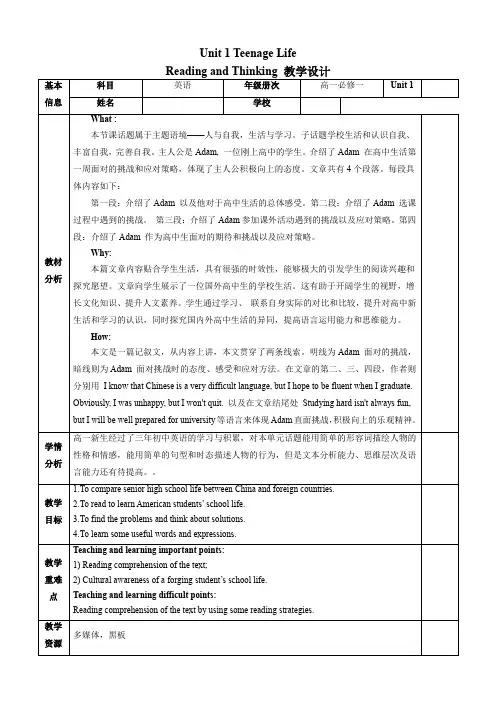
Unit 1 Teenage Life基本信息科目英语年级册次高一必修一Unit 1姓名学校教材分析What :本节课话题属于主题语境——人与自我,生活与学习。
子话题学校生活和认识自我、丰富自我,完善自我。
主人公是Adam, 一位刚上高中的学生。
介绍了Adam 在高中生活第一周面对的挑战和应对策略,体现了主人公积极向上的态度。
文章共有4个段落。
每段具体内容如下:第一段:介绍了Adam 以及他对于高中生活的总体感受。
第二段:介绍了Adam 选课过程中遇到的挑战。
第三段:介绍了Adam参加课外活动遇到的挑战以及应对策略。
第四段:介绍了Adam 作为高中生面对的期待和挑战以及应对策略。
Why:本篇文章内容贴合学生生活,具有很强的时效性,能够极大的引发学生的阅读兴趣和探究愿望。
文章向学生展示了一位国外高中生的学校生活。
这有助于开阔学生的视野,增长文化知识、提升人文素养。
学生通过学习、联系自身实际的对比和比较,提升对高中新生活和学习的认识,同时探究国内外高中生活的异同,提高语言运用能力和思维能力。
How:本文是一篇记叙文,从内容上讲,本文贯穿了两条线索。
明线为Adam 面对的挑战,暗线则为Adam 面对挑战时的态度、感受和应对方法。
在文章的第二、三、四段,作者则分别用I know that Chinese is a very difficult language, but I hope to be fluent when I graduate. Obviously, I was unhappy, but I won't quit. 以及在文章结尾处Studying hard isn't always fun, but I will be well prepared for university等语言来体现Adam直面挑战,积极向上的乐观精神。
学情分析高一新生经过了三年初中英语的学习与积累,对本单元话题能用简单的形容词描绘人物的性格和情感,能用简单的句型和时态描述人物的行为,但是文本分析能力、思维层次及语言能力还有待提高。
Unit 1 Reading and thinking 课文知识点详解(教学课件)-高中英语

4. _h_o_p_e__t_o_d_o__st_h_.__________
希望做某事
5. _b__e_f_l_u_e_n_t______________
说得流利
6. _g_r_a_d_u_a_t_e_______________
v.毕业
7.re_c_o_m__m__en__d_e_d_t_h_a_t_s_b_._s_h_o_u_ld do sth建. 议某人做某事
Para. 2 (长难句分析)
1. First, I had to think very carefully about which courses I wanted to take. 首先,我必须非常仔细地考虑我想上哪些课程。
1. My adviser recommended that I should sign up for advanced literature because I like English and I’m good at it.
找到做某事的方法
7. on my own
靠自己
Para. 3 (语言点巩固)
8. so that 9. make the team 10.joined a volunteer club 11. instead 12.at a soup kitchen 13. hand out 14. homeless people 15.in the community
因为我喜欢英语而且成绩不错,我的指导老师建议 我选修高级文学。
recommend that sb. should do sth remmond sb. to do sth.
1. 他的英语老师建议他多做听力和阅读。 His English teacher recommend he _s_h_o_u_ld__ _d_o__ more
英语人教版高中选择性必修二教案Unit 1 Reading and Thinking
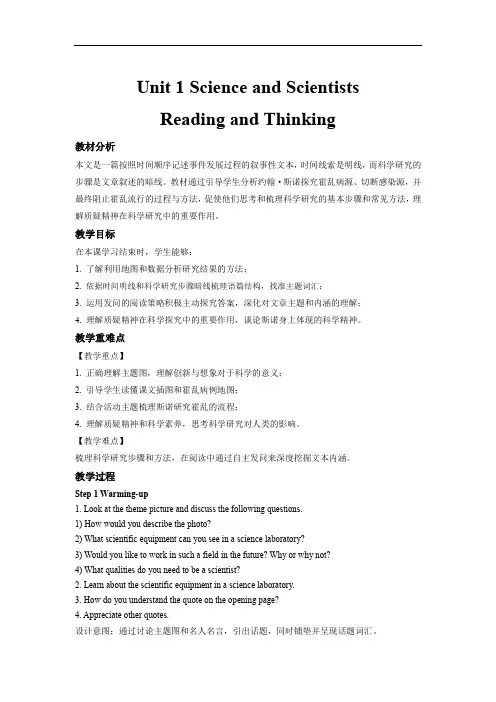
Unit 1 Science and ScientistsReading and Thinking教材分析本文是一篇按照时间顺序记述事件发展过程的叙事性文本,时间线索是明线,而科学研究的步骤是文章叙述的暗线。
教材通过引导学生分析约翰·斯诺探究霍乱病源、切断感染源,并最终阻止霍乱流行的过程与方法,促使他们思考和梳理科学研究的基本步骤和常见方法,理解质疑精神在科学研究中的重要作用。
教学目标在本课学习结束时,学生能够:1. 了解利用地图和数据分析研究结果的方法;2. 依据时间明线和科学研究步骤暗线梳理语篇结构,找准主题词汇;3.运用发问的阅读策略积极主动探究答案,深化对文章主题和内涵的理解;4. 理解质疑精神在科学探究中的重要作用,谈论斯诺身上体现的科学精神。
教学重难点【教学重点】1. 正确理解主题图,理解创新与想象对于科学的意义;2. 引导学生读懂课文插图和霍乱病例地图;3. 结合活动主题梳理斯诺研究霍乱的流程;4. 理解质疑精神和科学素养,思考科学研究对人类的影响。
【教学难点】梳理科学研究步骤和方法,在阅读中通过自主发问来深度挖掘文本内涵。
教学过程Step 1 Warming-up1. Look at the theme picture and discuss the following questions.1) How would you describe the photo?2) What scientific equipment can you see in a science laboratory?3) Would you like to work in such a field in the future? Why or why not?4) What qualities do you need to be a scientist?2. Learn about the scientific equipment in a science laboratory.3. How do you understand the quote on the opening page?4. Appreciate other quotes.设计意图:通过讨论主题图和名人名言,引出话题,同时铺垫并呈现话题词汇。
高中英语选择性必修二Unit 1 Reading and Thinking教学设计

高中英语选择性必修二Unit 1 Reading and Thinking教学设计一、教学目标(一)语言技能目标1.学生能够理解课文内容,掌握重要词汇和短语。
2.提高学生的阅读理解能力,包括细节理解、推理判断和主旨归纳等。
3.学生能够运用所学词汇和句型进行口头和书面表达,讨论科学发现相关话题。
(二)学习策略目标1.培养学生的阅读策略,如预测、略读、扫读等。
2.鼓励学生合作学习,共同探讨问题,分享观点。
(三)情感态度目标1.激发学生对科学的兴趣和好奇心,培养科学精神。
2.增强学生的跨文化意识,了解不同国家的科学成就。
二、教学重难点(一)教学重点1.理解课文内容,掌握重要词汇和短语。
2.培养学生的阅读理解能力和表达能力。
(二)教学难点1.引导学生分析课文结构,理解作者的写作意图。
2.帮助学生运用所学知识进行创造性表达。
三、教学方法(一)任务型教学法:通过设计各种任务,让学生在完成任务的过程中学习语言知识和技能。
(二)合作学习法:组织学生进行小组讨论和合作活动,培养学生的合作意识和团队精神。
(三)情景教学法:创设真实的语言情景,让学生在情景中运用语言,提高语言运用能力。
四、教学过程(一)导入(Lead-in)播放一段关于科学发现的视频或展示一些科学成就的图片,引起学生的兴趣。
提问学生对科学发现的看法,引导学生思考科学发现的重要性和意义。
(二)预习检测(Pre-reading check)检查学生的预习情况,让学生回答一些与课文相关的问题,如:What do you know about scientific discoveries? Have you heard of any famous scientific discoveries?教授一些新单词和短语,为学生的阅读做好准备。
(三)阅读(Reading)1.快速阅读(Skimming):让学生快速浏览课文,回答问题:What is the main idea of the passage?2.仔细阅读(Scanning):学生仔细阅读课文,完成以下任务:回答细节问题,如:Who made the scientific discovery mentioned in the passage? What did they discover? How did they make the discovery?3.找出课文中的重要词汇和短语,并理解其含义。
【教案】Unit 1 Reading and Thinking 教学设计 人教版必修第一册
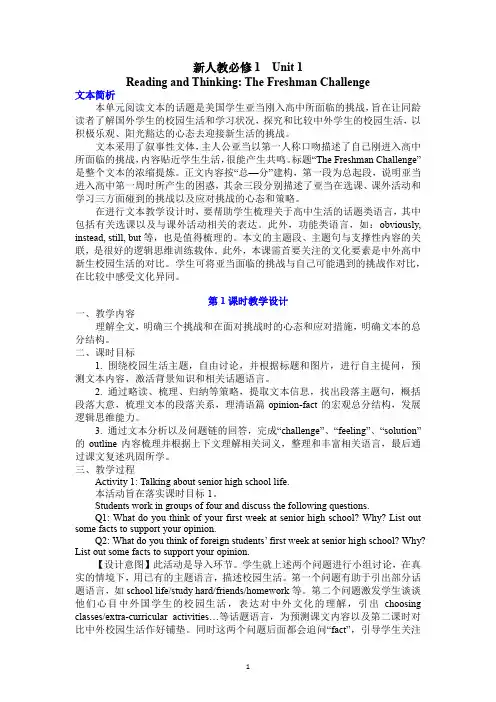
新人教必修1 Unit 1Reading and Thinking: The Freshman Challenge文本简析本单元阅读文本的话题是美国学生亚当刚入高中所面临的挑战,旨在让同龄读者了解国外学生的校园生活和学习状况,探究和比较中外学生的校园生活,以积极乐观、阳光豁达的心态去迎接新生活的挑战。
文本采用了叙事性文体,主人公亚当以第一人称口吻描述了自己刚进入高中所面临的挑战,内容贴近学生生活,很能产生共鸣。
标题“The Freshman Challenge”是整个文本的浓缩提炼。
正文内容按“总—分”建构,第一段为总起段,说明亚当进入高中第一周时所产生的困惑,其余三段分别描述了亚当在选课、课外活动和学习三方面碰到的挑战以及应对挑战的心态和策略。
在进行文本教学设计时,要帮助学生梳理关于高中生活的话题类语言,其中包括有关选课以及与课外活动相关的表达。
此外,功能类语言,如:obviously, instead, still, but等,也是值得梳理的。
本文的主题段、主题句与支撑性内容的关联,是很好的逻辑思维训练载体。
此外,本课需首要关注的文化要素是中外高中新生校园生活的对比。
学生可将亚当面临的挑战与自己可能遇到的挑战作对比,在比较中感受文化异同。
第1课时教学设计一、教学内容理解全文,明确三个挑战和在面对挑战时的心态和应对措施,明确文本的总分结构。
二、课时目标1. 围绕校园生活主题,自由讨论,并根据标题和图片,进行自主提问,预测文本内容,激活背景知识和相关话题语言。
2. 通过略读、梳理、归纳等策略,提取文本信息,找出段落主题句,概括段落大意,梳理文本的段落关系,理清语篇opinion-fact的宏观总分结构,发展逻辑思维能力。
3. 通过文本分析以及问题链的回答,完成“challenge”、“feeling”、“solution”的outline内容梳理并根据上下文理解相关词义,整理和丰富相关语言,最后通过课文复述巩固所学。
高二英语选择性必修第二册(2020版)Unit1_Reading_and_Thinking知识点解析
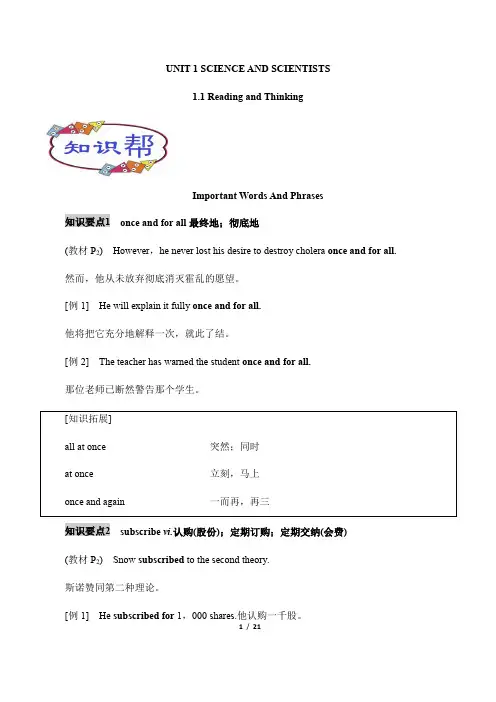
UNIT 1 SCIENCE AND SCIENTISTS1.1 Reading and ThinkingImportant Words And Phrases知识要点1once and for all最终地;彻底地(教材P2)However,he never lost his desire to destroy cholera once and for all.然而,他从未放弃彻底消灭霍乱的愿望。
[例1]He will explain it fully once and for all.他将把它充分地解释一次,就此了结。
[例2]The teacher has warned the student once and for all.那位老师已断然警告那个学生。
知识要点2subscribe vi.认购(股份);定期订购;定期交纳(会费)(教材P2)Snow subscribed to the second theory.斯诺赞同第二种理论。
[例1]He subscribed for 1,000 shares.他认购一千股。
1/ 212 / 21[例2] I subscribed to that magazine.It is put out every week.我订阅了那本杂志,它是周刊。
知识要点3 (教材P 2) Snow suspected that the water pump was to blame.斯诺怀疑是水泵的问题。
(1)suspect vt.& vi.怀疑;疑有;不信任 n.犯罪嫌疑人;可疑对象[例1] I suspect him to know everything about that.我猜想那件事他全都知道了。
[例2]She had no reason to suspect that Sylvia had not told the truth.她没有理由怀疑西尔维娅没说实话。
人教版Unit1readingandthinking阅读课讲解
Para 4: Different a_tt_it_u_d_e_s towards commercialization
of festivals.
Para 5: _si_g_n_i_fi_c_a_n_ce_ of the festivals.
While-reading Why do we celebrate festivals?
What the type of the text is it? A. 论说文 议论文+说明文 B. 记叙文 C. 应用文
While-reading Why do we celebrate festivals?
1. Find the main idea of each paragraph.
1 Festivals are celebrated all around the
Para 5: _si_g_n_i_fi_c_a_n_ce_ of the festivals. 总
While-reading The influencing factors of celebrating festivals.
4. Think about the following questions.
Enjoy delicious Zongzi,
month of the lunar calendar
dragon boat race…
The fifteenth day of the eight Admire the moon, enjoy the
month of the lunar calendar
religious belief personal interest different hobbies
While-reading Why do we celebrate festivals?
人教必修一Unit1_Reading_and_Thinking_名师教学设计
Unit 1 Reading and Thinking名师教学设计●课时内容Compare school life in different places主题语境:人与自我——生活与学习主题群下的学校生活。
语篇类型:一篇记叙文文本分析:[What]这篇记叙文以第一人称叙述了Adam作为高一新生所要面临的挑战:如何选课、如何选择课外活动、初高中生活的不同之处以及面临这些挑战时作者的心态。
[Why]该语篇从选课、选择课外活动、心态调试等方面,叙述了作者从初中升入高中后面临的种种不适与挑战,心态从迷茫、不高兴、焦虑到快乐、积极应对,旨在帮助学生认识到初高中学习和生活等方面的差异、面临的挑战和应该树立的目标,积极思考并寻找解决办法、调整心态,帮助学生形成正确、乐观的态度以应对初高中生活衔接的不适。
[How]该语篇以学生刚从初中升入高中会遇到的问题这种真实情境为依托,每一段有一个主题句,每段有主干句型复现“I had to…,I know…”使得文章脉络清晰,内容分布合理;通过使用“First,too,still”使得文章行文逻辑联系紧凑。
●课时目标1.能识别主题句,提取文章主要信息和相关细节。
2.能介绍Adam升入高中遇到的挑战,说明在遇到这挑战时Adam的心态变化和应对办法,形成正确、积极生活和学习态度。
3.推断出作者的性格特点,借鉴别人处理问题的方法对自己所面临的挑战。
●重点难点重点:学生通过阅读,获取关于作者作为高一新生面临挑战主要信息。
难点:学生通过阅读、讨论等活动,形成自己面临时的应对策略。
●教学准备教师准备:提前了解自己学生升入高一时遇到的困惑和挑战,让学生匿名将自己初高中衔接遇到的问题用英语写在信封里。
学生准备:提前了解阅读的各种技巧,阅读初高中生活差异及中外学校生活的相关文章,为理解做好背景知识贮备。
教学过程Step I 学习理解活动一:Brainstorm首先让学生小组讨论:What do you want to know about school life in other countries?What would you tell a teenager from another country about school life in China?【设计意图】通过Brainstorm活动,联系了学生的生活实际,引发学生对主题的思考,激活学生的背景知识和相关经验。
【课件】Unit 1Reading and Thinking 课人教版(2019)选择性必修第二册
What's the main idea of the passage?
A. How John Snow found the cause of cholera and defeated it.
B. The cause of cholera was polluted water.
C. The source of all drinking water should be examined.
of John’s work.
cholera n. 霍乱 severe adj. 极为恶劣的;十分严重的;
严厉的
diarrhoea n. 腹泻 dehydration n. 脱水
frustrated adj. 懊恼的;沮丧的;失意的 once and for all 最终地;彻底地
contradictory adj. 相互矛盾的;对立的;不
一致的
infection n. 感染;传染 infect vt. 使感染;传染 germ n. 微生物;细菌;病菌
subscribe vi. 认购(股份);定期订购;定期
subscribe to 交纳(会费)同意;赞同
proof n. 证据;证明;检验 multiple adj. 数量多的;多种多样的
3rd stage: Think of a method
Para. 3: Snow began by marking on a map the
exact places where all those who died had lived. There were multiple deaths near the water pump in Broad Street (especially house numbers 16, 37, 38, and 40). …
Unit 1 Reading and thinking(课件)高中英语人教版(2019)选择性必修二
Para. 3
Snow's contributions.
Para. 4
John Snow desired to destroy cholera.
Para. 5
Truth of the infection of cholera.
Activity 3 careful-reading 1.Which of the following did John Snow believe in?
1. What are the two theories? Which theory did John Snow think was reasonable? 2. What did John Snow investigate when another outbreak hit London in 1854?
Who ? How ? What ? The text is mainly about __J_o_h_n__S_n_o_w__ and __h_o_w___ he defeated king cholera.
scientific research
Stages of Scientific Research
While reading
Activity 1: Read the whole text quickly and match the main idea
Para. 1
Snow began his study by marking on the map.
Para. 2
John Snow decided to prove the second theory.
Besides coronavirus, what other kinds of epidemics (流行病)do you konw?