
jazz age
This Side of Paradise by F. Scott Fitzgerald portrays the lives and morality of post-World postWar I youth. The Sun Also Rises by Ernest Hemingway is about a group of expatriate Americans in Europe during the 1920s.
The Roaring Twenties
The spirit of the Roaring Twenties was marked by a general feeling of discontinuity associated with modernity, modernity, a break with traditions.
Novels of F. Scott Fitzgerald
This Side of Paradise reat Gatsby Tender Is the Night The Last Tycoon
The Great Gatsby
The Great Gatsby is a novel by
Everything seemed to be feasible through modern technology. New technologies, especially automobiles, moving pictures and radio proliferated 'modernity' to a large part of the population. Formal decorative frills were shed in favor of practicality in both daily life and architecture. At the same time, jazz and dancing rose in popularity, in opposition to the mood of the specter of World War I. As such, the period I. is also often referred to as the Jazz Age. Age.
The Jazz Age and the Roaring Twenties
Background introduction The Jazz Age describes the period after the end of World War I, I, through the Roaring Twenties, Twenties, ending with the onset of the Great Depression. Depression.
F. Scott Fitzgerald
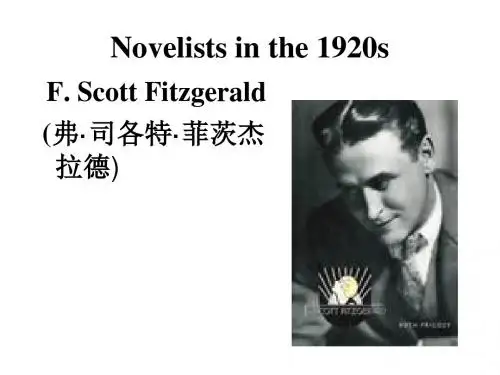
Francis Scott Key Fitzgerald (September 24, 1896 – December 21, 1940) was an American author of novels and short stories, stories, whose works are the paradigm writings of the Jazz Age, Age, a term he coined himself. He is widely regarded as one of the twentieth century's greatest writers. Fitzgerald is considered a member of the "Lost Generation" of the Generation" 1920s.
Literature
The Roaring Twenties was a period of literary creativity, and works of several notable authors appeared during the period.
Books that take the 1920s as their subject include: The Great Gatsby by F. Scott Fitzgerald is often described as the epitome of the "Jazz Age" in American literature. All Quiet on the Western Front by Erich Maria Remarque recounts the horrors of WWI and also the deep detachment from German civilian life felt by many men returning from the front.
The novel chronicles the anomie following the First World War. American society enjoyed unprecedented War. levels of prosperity during the "roaring" 1920s as the "roaring" economy soared. At the same time, Prohibition, the ban Prohibition, on the sale and manufacture of alcohol as mandated by the Eighteenth Amendment, made millionaires out of Amendment, bootleggers and led to an increase in organized crime. crime. Although Fitzgerald, like Nick Carraway in his novel, idolized the riches and glamour of the age, he was uncomfortable with the unrestrained materialism and the lack of morality that went with it, a kind of decadence. decadence.
盖茨比信奉这盏绿灯,这个一年年在我们眼前渐 盖茨比信奉这盏绿灯, 渐远去的极乐的未来.它从前逃脱了我们的追求, 渐远去的极乐的未来.它从前逃脱了我们的追求, 不过那没关系--明天我们跑得更快一点 明天我们跑得更快一点, 不过那没关系--明天我们跑得更快一点,把胳臂 伸得更远一点……总有一天 总有一天…… 伸得更远一点……总有一天…… 于是我们奋力向前划,逆流向上的小舟, 于是我们奋力向前划,逆流向上的小舟,不 停地倒退,进入过去.( .(So 停地倒退,进入过去.(So we beat on, boats against the current, borne back ceaselessly into the past.) ——《了不起的盖茨比》 ——《了不起的盖茨比》
�
小议《了不起的盖茨比》中的爵士时代(英文)
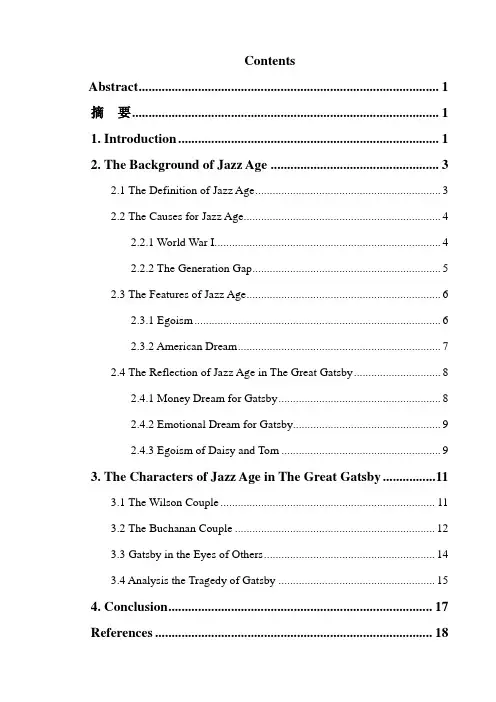
ContentsAbstract (1)摘要 (1)1. Introduction (1)2. The Background of Jazz Age (3)2.1 The Definition of Jazz Age (3)2.2 The Causes for Jazz Age (4)2.2.1 World War I. (4)2.2.2 The Generation Gap (5)2.3 The Features of Jazz Age (6)2.3.1 Egoism (6)2.3.2 American Dream (7)2.4 The Reflection of Jazz Age in The Great Gatsby (8)2.4.1 Money Dream for Gatsby (8)2.4.2 Emotional Dream for Gatsby (9)2.4.3 Egoism of Daisy and Tom (9)3. The Characters of Jazz Age in The Great Gatsby (11)3.1 The Wilson Couple (11)3.2 The Buchanan Couple (12)3.3 Gatsby in the Eyes of Others (14)3.4 Analysis the Tragedy of Gatsby (15)4. Conclusion (17)References (18)AbstractThe Jazz Age is named by the famous American novelist Francis Scott Fitzgerald, who considers the Jazz Age as the best time as well as the worst time.The Great Gatsby, one of his representative works, portrays Gatsby, Daisy, Tom, Myrtle, Wilson, and the environment and the state in which they live. This paper presents the background with typical features of the Jazz Age, through describing living and status of the characters in the novel. By describing the causes and characteristics of the society appearance, this paper focuses on the analysis of the image and structure of the main characters in the novel, as well as the expression of sorrows for the protagonist' s ending, then reveals the theme of the human nature changes of the time. Through the analysis, we can find that the original beautiful, fascinating, inspiring people to continue to progress in the aim, American Dream, has undergone a qualitative change, finally became synonymous with the pursuit of money. The American society of the 20s was transformed into a dirty, ugly, deformed and money-worship society, which was vividly shown in the novel.Keywords:The Great Gatsby; Fitzgerald; Jazz Age; American Dream; Egoism摘要爵士时代是由美国著名小说家弗朗西斯·斯科特·菲茨杰拉德命名的。
Fitzgrald 菲茨杰拉德

The Jazz Age
American short-story writer and novelist famous for his depictions of the Jazz Age (the 1920s), his most brilliant novel being The Great Gatsby (1925). His private life ... in both America and France, became almost as celebrated as his novels. ——《Encyclopedia Britannica》 Nhomakorabea45
• ...his finest novel, sensitive and symbolic treatment of themes of contemporary life related with irony and pathos to the legendry of the American dream. • 《The Oxford Companion to American Literature》
(1986-1940)
金幪 1102027005
• American short sotry wirter novelist • Born in 1986 in Minnesot • Upper-middleclass family • Princeton University • U.S.Army
Zelda Screen play writer Jazz Age The lost generation The Great Gatsby Alcohol
Jazz Age
• So we beat on, boats against the current,borne back ceaselessly into the past. • 于是我们奋力搏击,好比逆水行舟,不停地被 水浪冲退,回到了过去。 姚乃强译
爵士乐时代英语作文

爵士乐时代英语作文Jazz Age English Essay。
The Jazz Age was a period in American history that spanned from the 1920s to the early 1930s. It was a time of great social and cultural change, marked by the rise ofjazz music and the emergence of a new generation of young people who were eager to embrace new ideas and ways of living.The Jazz Age was characterized by a vibrant andexciting cultural scene, with jazz music at its center.Jazz was a new and innovative form of music that washeavily influenced by African-American rhythms and melodies. It was a music that was both rebellious and sophisticated, and it quickly became popular among young people who were eager to break free from the constraints of traditional society.One of the most famous figures of the Jazz Age was thewriter F. Scott Fitzgerald. Fitzgerald was a master of the short story and the novel, and he captured the spirit ofthe Jazz Age in his writing. In his most famous novel, The Great Gatsby, Fitzgerald tells the story of a young man named Jay Gatsby who is obsessed with the idea of achieving the American Dream. Gatsby is a symbol of the Jazz Age, a man who is both driven and doomed by his desire for success.The Jazz Age was also a time of great social change. Women began to assert their independence and demand greater rights and freedoms. They began to wear shorter skirts and bob their hair, and they started to participate in traditionally male-dominated activities like smoking and drinking. The Jazz Age was a time when women were breaking free from the constraints of traditional society and asserting their right to live life on their own terms.Despite its many successes, the Jazz Age was also atime of great turmoil and conflict. The stock market crashof 1929 marked the end of the era, and the Great Depression that followed brought widespread hardship and suffering to millions of Americans.In conclusion, the Jazz Age was a time of great social and cultural change in American history. It was a time when young people were eager to break free from the constraints of traditional society and embrace new ideas and ways of living. Jazz music was at the center of this cultural revolution, and it remains an enduring symbol of the Jazz Age to this day.。
Jazz Age
Jazz AgeFrom Wikipedia, the free encyclopediaJump to: navigation, searchFor the 2012 album by Bryan Ferry, see The Jazz Age (The Bryan Ferry Orchestra album). For the 1998 album by Jack, see The Jazz Age (Jack album). For the 1929 film, see The Jazz Age (film).The Jazz Age was a term coined by F. Scott Fitzgerald, and was a feature of the 1920s when jazz music and dance became popular. Jazz played a significant part in wider cultural changes duringthe period, and its influence on pop culture continued long afterwards.Contents[hide]∙ 1 African Americans∙ 2 Radio∙ 3 Youth∙ 4 Women∙ 5 Classical music∙ 6 See also∙7 Notes∙8 Further reading∙9 External linksAfrican Americans[edit]The birth of jazz music is generally credited to African Americans,[1]but expanded and over time was modified to become socially acceptable to middle-class white Americans. White performers were used as a vehicle for the popularization of jazz music in America. Even though the jazz movement was taken over by the middle class white population, it facilitated the mesh of African American traditions and ideals with the white middle class society.[2]Cities like New York and Chicago were cultural centers for jazz, and especially for African American artists. Some famous black artists of the time were Ella Fitzgerald, Louis Armstrong, Duke Ellington, and Count Basie.[3] Urban radio stations played African American jazz more frequently than suburban stations, due to the concentration of African Americans in urban areas such as New York and Chicago. Younger demographics popularized the black-originated dances such as the Charleston as part of the immense cultural shift the popularity of jazzmusic generated.[4] The migration of African Americans from the American south introduced the culture born out of a repressive, unfair society to the American north where navigating through a society with little ability to change played a vital role in the birth of jazz.[5]Radio[edit]The spread of jazz was encouraged by the introduction of large-scale radio broadcasts in 1932. The radio was described as the "sound factory." Radio made it possible for Americans to experience different styles of music without physically visiting a jazz club. The radio brought America a trendy new avenue for exploring the world through broadcasts and concerts from the comfort of their living room.[6]These were broadcast from cities such as New York, Chicago, Kansas City, and Los Angeles. There were two categories of live music on the radio: concert music and big band dance music. The concert music was known as "potter palm" and was concert music by amateurs, usually volunteers. This type of radio was a way of making broadcasting cheaper. Unfortunately, this type of radio's popularity started to decrease as commercial radio increased. This type of music is known as big band dance music. This type is played by professionals and was featured from nightclubs, dance halls, and ballrooms.[7] Jazz artists like Louis Armstrong originally received very little airtime because most stations preferred to play the music of white American jazz singers. Other jazz vocalists include Bessie Smith and Florence Mills. In urban areas, such as Chicago and New York, African American jazz was played on the radio more often than in the suburbs. Big-band jazz, like that of James Reese Europe and Fletcher Henderson in New York, attracted large radio audiences.[7]Youth[edit]Under the influence of jazz, youth revolted against the traditional culture of previous generations. This youth rebellion of the 1920s went hand-in-hand with fads like bold fashion flappers, women smoking cigarettes, free talk about sex, and new radio concerts. Dances suddenly became popular among the youth. Traditionalists were amazed at what they considered the breakdown of morality.[8]Women[edit]W ith women’s suffrage at its peak with the ratification of the Nineteenth Amendment on August 18, 1920, and the entrance of the flapper, women began to make a statement within society and the Jazz Age was not immune to thesenew ideals. With women taking part in the work force after the end of the First World War, there were many more opportunities for women in terms of social life and entertainment. The ideas such as equality and free sexuality were extremely popular during the time. and women seemed to capitalize during this period. The 1920s saw the emergence of many famous women musicians including Bessie Smith. Bessie Smith also gained attention because she was not only a great singer but also an African American woman. She has grown through the ages to be one of the most well respected singers of all time. Singers such as Billie Holiday and Janis Joplin were inspired by Bessie Smith.[9] Another exception to the common stereotype of women at this time was piano player Lil Hardin Armstrong, Louis Armstrong's wife. She was originally a member of King Oliver's band with Louis, and went on to play piano in her husband's band the Hot Five and then his next group called the Hot Seven[10]It was not until the 1930s and 1940s that many women jazz singers, such as Bessie Smith and Billie Holiday were recognized as successful artists in the music world.[10]These women were persistent in striving to make their names known in the music industry and lead the way for many more women artists to come.[11]Classical music[edit]As jazz flourished, American elites who preferred classical music sought to expand the listenership of their favored genre, hoping that jazz wouldn't become mainstream.[12] Controversially, jazz became an influence on composers as diverse as George Gershwin and Herbert Howells。
jazz age名词解释

jazz age名词解释
“爵士时代”是指20世纪20年代和30年代初期的美国文化时期,这个时期被誉为“狂欢时代”,因为当时的年轻一代意气风发,追求自由和狂欢。
以下是一些与“爵士时代”相关的术语和定义:
1. 爵士乐:一种源于黑人音乐的音乐风格,强调即兴演奏和复杂的和声,是“爵士时代”最具代表性的文化元素之一。
2. 禁酒令:一项法律,旨在禁止生产、销售和消费酒精饮料,从而打击酒类走私和酗酒问题。
禁酒令期间,很多人将酒精饮料非法地制造和销售,这导致了“地下酒吧”的兴起和爵士时代的文化繁荣。
3. 狂欢派对:在爵士时代,狂欢派对是非常流行的活动,通常在地下酒吧和私人住宅中举行。
这些派对的主题包括爵士乐、酒类、时尚和社交活动。
4. 电影:电影在20世纪20年代和30年代初期成为了流行文化的一部分。
无声电影和有声电影的出现让电影成为了一种受欢迎的娱乐方式,也促进了“好莱坞黄金时代”的出现。
5. 妇女权利:爵士时代是女性争取平等权利的时期。
女性开始涉足工作领域,参加政治活动,并追求社会和经济上的平等。
这些进展对整个美国社会产生了深远的影响。
6. 流行文化:爵士时代是美国流行文化的转折点。
人们开始关注娱乐、时尚和消费,这种文化现象在后来的年代中继续发展。
7. 大萧条:20世纪30年代早期,美国经历了一场经济大萧条。
这场危机对美国社会和文化产生了深远的影响,也标志着“爵士时代”文化的结束。
总之,“爵士时代”是一个充满活力和创造力的时期,对美国文化和社会产生了重要的影响。
这个时期的文化元素和社会进展对我们今天的生活仍然具有重要的意义。
F. Scott Fitzgeraldy 菲茨杰拉德
theme
• the hollowness of the American worship of riches • the American dream: of love, splendor and gratified desires. • It presents the American life during Jazz Age. • This novel reveals the falseness of ideals and moves toward disillusion.
Fitzgerald and the American Dream:
• (1) Fitzgerald's fictions often deal with the bankruptcy of the American Dream, which is high1ighted by the disillusionment of the protagonists' personal dreams due to the clashes between their romantic vision of life and the sordid reality. • (2) Fitzgerald's own life was a mirror of the 1920s. He was the victim of his "American Dream."
Works:
(1) This Side of Paradise《天堂的这一边》 (2) The Beautiful and the Damned《美女和
被诅咒的人》
(3) The Great Gatsby 《伟大的盖茨比》 (4) Tender is the Night 《夜色温柔》 (5) Tales of the Jazz Age 《爵土时代的故事》 (6) The Last Tycoon 《最后一个巨头》
Fitzgerald——The angel of the Jazz Age
尼克:智叟
尼克形象最鲜明的特点就是他敏锐的洞察力。叙述伊始尼 克便在自我介绍中称自己被误认为一个“政客”。这种指 控的根据就是他拥有对人心敏锐的观察力。
ห้องสมุดไป่ตู้
埃克尔堡医生:上帝之眼
埃克尔堡医生是某眼科医生的一幅大型广告画,屹立在西 埃格与纽约间约一半路程的地方, “一个诡秘的农场”, 那里正是默特尔被黛西撞死的地方。
Fitzgerald---The angel of the Jazz Age
1896年9月24日,菲茨杰拉德出生于 美国明尼苏达州圣保罗市一个小商 人家庭。他的祖上曾经阔气富有, 传到父母这辈已家道衰落。 十八岁的他在舞会上认识了吉内 瓦·金,一位富有的美丽千金。两 人一见倾心,但吉内瓦清醒地明白, 出身清贫的恋人和自己是难以走到 一起的。 1916年8月菲茨杰拉德最后一次去吉 内瓦的家,她的父亲明确告诉他: 穷小子休想娶富家千金。这句话终 结了这段感情,也在他心上打上了 一个屈辱的印记。
灭所 的有 过生 程命 。都 ”是 《一 崩个 溃毁 》
“
诗人和梦想家的气质和风格
在小说创作方面,他受到了俄罗斯作家屠格涅夫、 法国作家福楼拜、英国作家康拉德的影响,但他 最为之倾心的作家却是英国浪漫主义大诗人济慈 。 从小说艺术方面看,菲茨杰拉德擅长叙述故事, 作品风格幽默细腻,言语流畅,结构严谨,尤其 是人物对话写的自然逼真,富有个性。 菲茨杰拉德的毕生主题是美国幻梦及其破灭,这 个题材以一种主题的整体性将他个人的生活,职 业生涯、和他的著作连接起来。菲茨杰拉德的作 品更加注重对于自身生活的真实呈现、叙述有意 思的故事和美国都市生活的摩登气息。
创作背景:“喧嚣年代”
菲茨杰拉德
ⅢThe Great Gatsby
1.story
Major Characters: Jay Gatsby,Nick Carraway, Tom Buchanan, Daisy Buchanan, George B. Wilson ,Myrtle Wilson, Jordan Baker
Three groups:
3 . He was one of the great stylists in American literature. His clear, lyrical, colorful, witty style evoked the emotions associated with time and place.
① rich, arrogant, contemptuous 傲 慢 的 , pretentious 自 命 不 凡 的 , talking about science and art, but definitely lacking in intellectuality理智 ②vulgar, speaking in bad grammar
6.bold impressionistic and colorful quality
7.choice of a dramatic narrator with limited omniscience 8 . The chief theme of Fitzgerald’s works is the
disillusionment\ Dream.
A spokesman of Jazz Agge
ⅠLife introduction
American novelist and short story writer
英美文学选读试题详解4
英美文学选读-阶段测评4成绩:30分一、Multiple Choice 共 40 题题号: 1 本题分数:2.5 分( )is generally regarded as the forerunner of the 20th—century “stream—of—consciousness” novels and the founder of psychological realism.A、Theodore DreiserB、William FaulknerC、Henry JamesD、Mark Twain(P498.para.2)亨利.詹姆斯是美国现实主义文学大师,他的作品往往涉及美国之外的主题,其作品的风格是“心理活动”。
被誉为20世纪美国意识流文学的先驱。
标准答案:C考生答案:D本题得分:0 分题号: 2 本题分数:2.5 分Closely related to Dickinson’s religious poetry are her poems concerning( ),ranging over the physical as well as the psychological and emotional aspects of death.A、love and natureB、death and universeC、death and immortalityD、family and happiness(P518para2)迪金森的诗歌涉及宗教和爱情两方面,而其涉及宗教的诗歌往往是以死亡和永恒为主题的,所以答案是C。
标准答案:C考生答案:A本题得分:0 分题号: 3 本题分数:2.5 分H.L.Mencken considered( )“the true father of our national literature”.A、Bret HarteB、Mark TwainC、Washington IrvingD、Walt Whitman(P477.para1)马克.吐温是美国文学巨匠,他以两部“历险记”创造可美国文学史上的一个奇迹,那就是开创了美国文学的一个新时代,所以将他誉为“真正的美国文学之父”。
The Jazz Age(美国的爵士乐时代)
The Jazz Age
• The Jazz Age describes the period of the 1920s and 1930s.The 1920s began with high hopes. World War One was over. The twenties ended with a huge drop in stock market prices that began the Great Depression. • The nation's values had changed in this period. Many Americans were concerned mainly with having a good time and doing what you will. American society enjoyed unprecedented levels of prosperity. People broke the law by drinking alcohol and lived in a corrupt society. They danced to jazz music, and women wore short skirts.
• 这既是一个浮华享乐的年代,又是人们尤其是年轻人普遍感到 迷惘失落的年代,“一切神明统统死光,一切仗都已打完,以 往关于人的一切信念完全动摇。”这还是美国文化变革转型、 美国文学蓬勃发展的年代。
Contents
• • • • • Jazz music Literature Technology The general mood End of the Roaring Twenties
Roaring Twenties