
人教版七年级英语下册电子教案七下Unit2四课时
第四课时 Section B (1a-1e)Teaching Goals:一Knowledge goals:1.Enable the students to master new words “half, past, quarter and do (one’s) homework,run, clean,take a walk .”2.Master sentences When do students usually eat dinner?—They usually eat dinner at a quarter to seven in the evening.—When does Tom usually do his homework?—He usually does his homework at half past five in the evening. ”correctly.二Ability goals:Listen to the recording and get some information about Tom’s day.三Process goals:Enable students ask and answer in pair by using sentences四Emotional goals :Enable students to form a healthy daily habits and arrange their life reasonably .( 具体详细的表达了本节课的知识、能力和情感目标,一目了然。
) Teaching and learning steps:Step1. Pre-listening activities.1.PreviewAsk the students to translate the following Chinese into English.(1) 早晨六点半 (2) 下午三点十五(3) 晚上六点四十五 (4)晚上九点四十五_______________ (5)做家庭作业 ____ (6) 上床睡觉________________(7)打扫我的房间 __ (8) 散步________________Ask the students to translate the following sentences.(1)学生通常什么时间吃晚饭?______________________(2)汤姆通常什么时间起床?_________________________(3)他通常在五点半起床。
__________________________(课前预习通过对文本中的重点短语和句型的提前呈现,能够帮助学生课上有针对性的听讲,同时帮助学生更好的理解文本,教师可以有针对性的教,学生可以有针对性的学。
) 2.Warming up and lead-in. Task1. What time is it? T: Well.What time is it?Ss: It ’s eight 。
(以我们通常上课的时间为例)T :OK,class.Today we ’ll learn another ways of saying time first.Look at the pictures,what ’s the time of the day?in the morning in the afternoon in the evening am(AM) pm(PM) pm(PM) T:When do people usually eat breakfast/lunch/dinner? Ss: They usually eat breakfast in the morning. Ss: They usually eat lunch in the afternoon.. Ss: They usually eat dinner in the evening.T: Good job! Now let ’s learn the other way of saying time. What time is it? Give students examples one by oneA: What time is it? A: What time is it? A: What time is it?B:It ’s a quarter past eight. B:It ’s a half past seven. B:It ’s a quarter to twelve. (此环节先真实的时间 ,把学生很好的带入学习的情境之中。
再进行to 和past 时间法的学习,学生的学习兴趣就被调动了起来。
)Ask students to say out the times one by one.Give them help if necessary.126119378451012126119378451012126119378451012A: What time is it? B:It ’s half past seven A: What time is it?B: It ’s a quarter to twelve .a quarter past … half past …a quarter to ninea quarter to six twenty past nine(时间的练习实际上是一个Game show .依次闪现上面七个时间,每闪一个时间就让学生直接站起来抢答。
答对的学生可以为本组得一分。
学生可以把两种不同的时间表达都说出来,最后在一起呈现齐读一遍。
) Task2. Enjoy the activities T: Do you know these activities?get up run eat breakfast go to schoolgo home do homework eat dinner go to bed Show the activity pictures one by one ,and then let the students read the activities after the teacher,We can read twice .T: At different times, we ’ll do different things. Is it right? Ss:Yes.T: Ok, look at these times and activities. What time does the boy go to bed?Ss:He go es to bed at ten o’clock.T: Good! What time does the boy do homework?Ss: He do es homework at seven o’clock.T: Good! What time does the boy go home?Ss: He go es home at half past five.(在学习和复习有关日常活动的同时,又一次对重点动词的三单形式和本次课学习的时间表达进行了初步的巩固和渗透。
这对后面听力活动的练习做好的铺垫。
)T: We’ll do different things at the right time.When do students usually do these things? Match the activities with the time of day.Let students compare the phrases and then find out the differences by themselves.half past six (in the morning )(早上)6点30分小大大小a quarter past three( in the afternoon) (下午)三点15分小大大小a quarter to seven (in the evening ) (晚上)6点45分a quarter to ten (in the evening ) (晚上)9点45分(引导学生自己通过观察、比较,然后总结出:汉语时间是按照“由大到小”的顺序排列,而英语时间是按照“由小到大”的顺序排列。
以帮助学生减轻母语的负迁移。
)T:Please look at 1a ,when do students usually do these things? Prepare with their partner like the sentences in1b.A: When do students usually……?B: They usually eat dinner at…….(本环节主要是对时间和活动的较正式的练习,通过前面的渗透和讲解,学生本环节的练习效果较好。
)Step2. While-listening activities.Listen for the general idea听取大意1.Listen and choose the main idea of the conversation.The general idea of the conversation is to talk about.A. the times of Tom’s activitiesB. the places of Tom’s activitiesC. the ways of Tom’s activities(让学生通过听录音整体感知并找出谈论的主旨大意。
听听力之前要对学生进行相关听力策略的指导。
这样能提高学生整体理解听力内容的能力,并能提高学生的听力效能。
)2.Listen for the specific ideas听取细节Task1. Listen and circle the activities that you hear.Task2. Match the times and the activities and check their answers.get up run eat breakfast go to school 4:15pm 5:30 am 9:00pm 7:45am (在A 部分的教学中我发现学生对时间的英语还不够敏感,在听、写方面衔接的不够好。
所以在1d 环节,我采用了连线的方式,在一定程度上降低了难度。
在我的课堂教学中的效果还不错。
) Step3.Post-listening activities. Task1. Listen and repeat.First ask students to read after the tape,then underline the sentences about Tom ’s activities and the times.Interviewer:Tom,I want to know about your day. Tom:OK.Interviewer :When do you get up?Tom: When do I get up?ually about half past five. Then I run at six1c Listen and circle the activitiesyou hear.1. get up ___ 7. clean my room __2. run ___ 8. eat dinner ___3. eat breakfast____ 9. take a walk ___4. go to school ___ 10. go to bed ___5. go home ___6. do my homework ___o’clock.Interviewer :You run at six in the morning?Tom:Uh-huh.Interviewer :And what time do you eat breakfast?Tom:Breakfast? Usually about seven. And then I usually go to school at a quarter to eight.Interviewer :Wow! And you go home at…?Tom:A quarter past four in the afternoon.Interviewer :And what do you do in the evening?Tom:I do my homework at about five thirty,and I eat dinner at seven fifteen.I go to bed at nine o’clock.Interviewer :That’s early! But then you get up early.Tom:Uh-huh.Let students listen to the recording and repeat after it to get their pronunciations right.(跟读模仿是初中学生学习英语的一条重要途径。
七年级英语下册-Unit 2 Section B 第4课时 教案
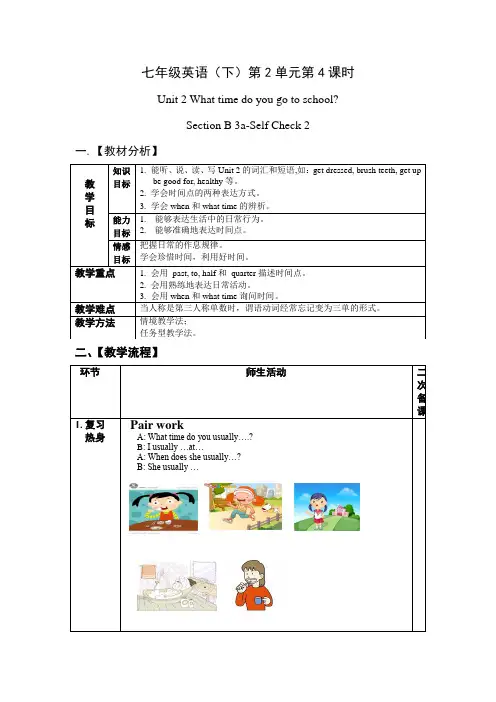
七年级英语(下)第2单元第4课时Unit 2 What time do you go to school?Section B 3a-Self Check 2一.【教材分析】二、【教学流程】环节师生活动二次备课I.复习热身Pair workA: What time do you usually….?B: I usually …at…A: When does she usually…?B: She usually …教学目标知识目标1. 能听、说、读、写Unit 2的词汇和短语,如:get dressed, brush teeth, get upbe good for, healthy等。
2. 学会时间点的两种表达方式。
3. 学会when和what time的辨析。
能力目标1.能够表达生活中的日常行为。
2.能够准确地表达时间点。
情感目标把握日常的作息规律。
学会珍惜时间,利用好时间。
教学重点 1. 会用past, to, half和quarter描述时间点。
2. 会用熟练地表达日常活动。
3. 会用when和what time询问时间。
教学难点当人称是第三人称单数时,谓语动词经常忘记变为三单的形式。
教学方法情境教学法;任务型教学法。
Ⅱ.感知体验1. Do 3a.Number these sentences in order to make a story about a daily routine. Check the answers: 3-2-5-4-6-7-1-8-92. Do 3b.Write about your own daily routine.写作指导:(1)要根据时间顺序来描述自己日常的习惯。
(2)能够恰当的使用频率副词:usually, always, never等。
(3)能够使用恰当的连词及短语: then, after that, when, either…or…等。
After reading the writing strategies, read a model article together.3.Pair workImagine you are a famous movie star. Fill in the timetable with the things you usually do. Then share the information with your partner.4. Language points.(1)They usually eat dinner at a quarter to seven in the evening.他们通常晚上六点四十五分吃晚饭。
新人教版七年级下册英语 Unit 2 第4课时 教案(教学设计)
6. Some Ss show their reading.
通过分层阅读,让学生对整篇短文有一个整体的理解,在通过大声朗读,找出重要的语言点和难点,培养学生的自主学习能力。
(2)Let Ss read after the tape.
(3) Let Ss read the passage aloud by themselves, and then check some Ss’ reading.
1. Read the passage of 2a quickly and answer the question.
教学环节
教师活动
学生活动
备课札记
Step 3
Practice (3a)
1. 3aLet Ss number these sentences in order to make a story about a daily routine.
2. Check the answers.
Number these sentences
句型
①When I get home, I always do my homework first.
②In the evening, I either watch TV or play computer games.
③She knows it’s not good for her, but it tastes good!
I don’t want to go there, either.我也不想去那儿。
2. taste的用法:
(1)作系动词(系动词/及物动词),意为“尝起来”,后面跟形容词作表语。
Unit2TheFourthPeriod2023-2024学年七年级下册英语同步教案(人教版)

引导学生分析错误原因,避免类似错误再次发生。
(五)拓展延伸(预计用时:3分钟)
知识拓展:
介绍与本节课内容相关的拓展知识,拓宽学生的知识视野。
引导学生关注学科前沿动态,培养学生的创新意识和探索精神。
情感升华:
结合本节课内容,引导学生思考学科与生活的联系,培养学生的社会责任感。
3.学生可能遇到的困难和挑战:在学习本节课的过程中,学生可能会遇到一些困难。首先,一些学生可能对一般过去时的用法不够熟练,特别是在构造句子和时态转换方面。其次,听力材料中可能包含一些生词和短语,学生需要能够理解并正确使用它们。此外,对于如何运用所学知识来描述复杂的事件,学生可能感到挑战。因此,教师需要提供适当的辅导和练习,帮助学生克服这些困难。
《英语学习》杂志:这篇文章介绍了如何运用一般过去时描述过去的事件,并提供了一些实用的例句和练习题,帮助学生更好地掌握一般过去时的用法。
《英语语法实战》:这本书中有关于一般过去时的详细讲解和练习题,可以帮助学生深入理解一般过去时的规则和用法。
2.鼓励学生进行课后自主学习和探究:
观看相关视频:学生可以在课后观看一些与一般过去时相关的英语教学视频,加深对知识点的理解。
设计实践活动或实验,让学生在实践中体验知识的应用,提高实践能力。
在课程结束后,对知识点进行梳理和总结。
强调重点和难点,帮助学生形成完整的知识体系。
(四)巩固练习(预计用时:5分钟)
随堂练习:
随堂练习题,让学生在课堂上完成,检查学生对知识的掌握情况。
鼓励学生相互讨论、互相帮助,共同解决题目。
错题订正:
板书设计
①重点词汇和短语
1. Last week
人教版七年级英语下册Unit2教案
人教版七年级英语下册Unit2教案Unit 2 What time do you go to school?单元教学目标1.Teaching Aims(教学目标)1.Knowledge Object and Ability (知识与技能)--What time is it?--It’s…--What time do you usually get up?--I usually get up at five o’clock.--What time does she usually get up?-- She usually gets up at five o’clock.2.Process and teaching methods(过程与方法):Practicing, Listening and Role playing methods. Group work. Writing.3.Moral Objects(情感态度与价值观):Learn to make good use of time .二、Teaching Key points(教学重点):Words & expressionstime, get up, shower ,take a shower, take, what time, go to school, get up, usually, o’clockGrammar focus .三、Teaching Difficult points(教学难点):1. Words & expressions2. Key sentences and listening practice.四、Teaching methods(教学方法):Practicing, Listening and Role playing methods.五、单元教材分析:--What time is it?--It’s…--What time do you usually get up?--I usually get up at five o’clock.--What time does she usually get up?-- She usually gets up at five o’clock.学会用以上句型结构运用到口语交际当中,并努力创造性的使用语言,达到学以至用,提高学生分析问题和解决问题的能力。
人教版英语七年级下册Unit2教学设计
-学生分享自己喜欢的科目及原因,教师记录并板书相关词汇。
3.创设情境,邀请学生模拟上课场景,引导学生运用一般现在时描述学校生活。
-教师邀请几名学生上台,模拟上课场景,引导学生观察并提问:“What time do they have...?”
4.学生学习策略:学生在学习过程中,已逐渐形成自己的学习策略。教师应关注学生的学习方法,引导他们运用有效的学习策略,提高学习效率。
5.学生合作能力:七年级学生在小组合作中表现出较强的团队意识,能够积极参与讨论和分享。教师应充分运用这一特点,培养学生的合作能力和口语表达能力。
6.学生情感态度:学生在学习英语过程中,存在不同程度的焦虑和紧张。教师需关注学生的情感需求,营造轻松、愉快的学习氛围,帮助学生树立信心,降低焦虑。
四、教学内容与过程
(一)导入新课
1.利用图片展示不同学校的课堂场景,引导学生关注学校生活,激发他们对本单元话题的兴趣。
-教师展示图片,引导学生观察并提问:“Can you guess what subjects they are learning?”
-学生猜测图片中的科目,教师给予反馈。
2.通过头脑风暴活动,让学生列举出他们喜欢的科目,为新课的学习做好词汇准备。
-时态方面:要求学生能够运用一般现在时态描述日常学校活动。
2.难点:对于一般现在时态的理解和运用,以及在不同情景下的词汇和句型转换是学生学习的难点。
-时态运用:学生需要理解一般现在时态表示习惯性动作或存在的状态,并能将其应用到具体情境中。
-句型转换:学生需学会在不同的语境中灵活运用所学句型,进行适当的问答。
-学生用一般现在时回答问题,巩固所学语法知识。
新人教版七年级下册英语 Unit 2 第4课时 教学课件
√ √ __ go to bed early __ eat ice-cream
__eat quickly
√__ play sports
√ __ eat vegetables
__ take a walk
2b Tony and Mary are brother and sister. They have
__3_ I usually exercise from six to seven. __2_ I always get up at six. __5_ After that, I always brush my teeth and go to school at eight.
___ Then I quickly have a shower and eat breakfast.
radio station. 5. Here are your clothes. Go and
_g_e_t_d_r_e_s_s_e_d quickly!
6. I don’t have time to __c_l_e_a_n_m__y__ro_o_m
from Monday to Friday. So I clean it on weekends.
第十五页,共二十六页。
新课讲解
1. 回想一下上个环节中自己一天的作息。 2. 按时间的先后,逐条叙述。 3. 注意运用正确的英语表达方式:
I+ usually/often+动词短语+at+时间。
第十六页,共二十六页。
新课讲解
One possible version
I have a healthy life. I usually get up at half past six. I exercise from seven to half past seven. Then I have breakfast and brush my teeth. I go to school at eight o’clock. I have lunch at twelve o’clock. I get home from school at half past four and do my homework. I have dinner at six then I watch TV. I go to bed at nine thirty.
七年级英语下册2(第4课时)教学设计(新版)人教新目标版
What time do you go to school教学过程活动步骤教与学活动目的及其操作教学资源运用复习时间5 m 1复习已学目标语和谈论时间的话题Read the conversations and answer my questions.- When does the boy get up on Saturdays?- He usually gets up at 7:15 in the morning.2仿照上述对话 ,组织Pair work复习活动OK. Let ,s make up conversations with your partner. Askand answer in pairs.学生两人活动 ,教师抽查几组学生导入时间2 m 3导入新课话题Let ,s watch the cartoon again.Well, we ,re going to go on learning Section B today. 4引入单元标题教师板书或课件显示:Unit 2 Period 4 What time do you go to school?教师询问几个学生:What time do you go to bed?2a 时间7m 5读1c表格 ,集体讨论让学生从中挑出那些可能涉及到 "健康〞概念First, look at the chart. Please discuss for 1 minuteand answer the questions:Which is healthy?(健康的)(get up at 5:30)通过表格呈现出涉及到健康概念的词Now, let ,s read them together.6顺势引出以下说法 ,为学生顺利阅读铺平道路Now let ,s look at the phrases. Can you tell me which arehealthy? (教师板书)(run in the morning / take a walk after dinner) 等Can you read the phrases together? (Yes)7完成2a任务 ,进一步为阅读铺垫Ok, check the activities you think are healthy.(答案不唯一 ,学生有理由可以给予解释)2b 时间9 m 8读前活动 ,观察图片进行预测Please look at the two pictures. What are their names?Whose life is healthy, and whose life is unhealthy, doyou think?(Tony and Mary.)(He eats ice cream. She plays volleyball.)Mary ,s life is healthy. Tony ,s life is unhealthy.引导学生看图 ,预测将要读到的内容 .教师应引导学生关注图中人物动作 .9细读短文 ,完成任务Now, please read the messages twice. Circle the healthyactivities.For example, get up early, is it healthy? (Yes.)第|一遍阅读 ,让学生获取活动内容 ,引导学生关注阅读内容 ,从中提取有用信息;第二遍阅读 ,获取具体信息以完成具体任务 ,即在语篇和语境中判断哪些活动是健康的 .Check your answers.10跟读、齐读、自读短文 ,提高口语和听力First, read the messages after me. Imitate thepronunciation and intonation.Now, read together loudly.This time, read by yourself as quickly as possible.同上2c时间4 m 11为Tony重新设计 "健康生活时间表〞 ,使教学衔接的更加紧密和顺畅 .OK, now we know Tony Brown has an unhealthy routine.That ,s not good for him. Can we help him? Well, I wantyou to write a healthy routine for him. Please use thebox of Activity 2c to write out your ideas.学生写作 ,教师巡视指导 ,进行必要的帮助、点评及辅导 .(提示学生I 变成Tony ,don ,t应变成doesn ,t ,eat变成eats等 .)Mary has unhealthy habits, too. Let ,s help her. OK?12本活动的检查评价 ,转入下一活动We have finished the task. Let ,s talk in groups. Say your owndesign.(Tony usually gets up early. He usually eats vegetables.) Let ,s show some good designs.将一局部优秀的学生作业在班级||中教学展示 ,起到示范交流的作用 .拓展时间9 m 13组织Role -play ,学生扮演角色练习目标语言Well, suppose you are Tony and Mary, work in groups.分别以第|一人称呼出自己的日常安排 ,学生练习时教师巡视 ,给予发音的纠正和适当的语言帮助 .先以第|一人称练习 ,再以第三人称展示 .14 "语言学习〞活动 ,用目标语言解决实际问题OK. Now please find the key words and phrases. 1.either … or …2.get up; go to bed3.after … before …4.带有介词for的句子Let ,s ask 3 or 4 students to show answers. Then write down them.Work in pairs to make new sentences or phrases.Ask some to show the sentences and phrases.OK! I ,ll give you a proverb:Early to bed and early to rise makes a man healthy, wealthy and wise.早睡又早起 ,一个人变得健康、富庶又聪明 .小结时间3 m 15检查评价;归纳反响强化本节课学习目标1.请两名学生进行阅读展示2.会话完成后询问一名学生When do you usually get up / eat breakfast / playbasketball / do homework / go to bed?3.转问其他同学 ,询问刚刚那位学生的日常安排是否健康 ,如何调整 ,例:I usually eat noodles or eggs for breakfast at sixthirty.鼓励学生多表达 .作业1 m 16Homework(布置作业)。
初中七年级英语7下unit2四课时2
教学目标能掌握更多的职业和工作场所的名称。
能运用正确的语句谈论自己的理想。
能了解朗读时常见连读方式,用连读方式读句子。
教学内容掌握单词future/ police station/ job/ post/ artist/ sound/ stick句型①What are you going to be in the future?②I’m going to be a comp uter engineer.教学工具:多媒体Revision: Answer the questionsHow many people are there in W endy’s home?What’s W endy’s father?Where does W endy’s mother work?How does her sister go to work?二、Presentation1, Show some pictures to introduce some jobs. And let students discuss, lead to the topic.Teacher says: look at these jobs. Are they interesting? Which is your favourite?Students answer with their own information.Teacher says: oh, I see, ……is going to be……in the future.Write down on the blackboard: “Future and this sentence”In the same way, show an artist with colourful chalk.2, PracticeTeacher says, Millie is talking with her classmates about their future jobs. Listen to the conversation and do “true or false” exercises.1)Daniel likes computerMillie is going to be a computer engineer.Sandy is going to be a teacher.Amy is going to be a doctorSimon is going to be a basketball star.2)listen to the tape again, then read after the teacherPlease open your books and repeat after the tape. Sentence bysentence, if need read more.Teaching aims:1.能熟练运用本单元所学词组和句型组织语言2.能合理架构文章,介绍社区,开展活动Teaching points:Master the words: notice/information/below/better/anything/group Teaching tools:Multi-mediaRevisionFree talkAnswer the questions①What’s Daniel going to be in the future?②Is Daniel going to be a computer engineer?③What’s Sandy good at doing sth?④What’s Simon going to be?Translation①他在派出所工作。
人教版七年级英语下册Unit2 reading What Do No. 5 High School Students Do in Their Free Time 第四课时
阅读文本的分析
What Do No. 5 High School Students Do in Their Free Time?
2a: 按照most often到least often,对班级同学进行6个日常活动的频率 进行排序,导入调查学生课余活动习惯的主题。 2b: 根据课文信息,针对所调查的三项活动习惯在学生群体中的分布状况, 填写饼形图中缺失的百分数。要求学生使用查读技能,搜寻细节信息。 2c: 根据课文信息,回答与调查相关的5个问题,既有细节问题,也有需 要学生对课文信息做出判断和评价(问题5)。五个问题中有部分问题 涉及的信息与2b重复,须重新设计。 2d: 根据课文信息和饼形图,用所给百分数和三个频率副词写句子。该活 动是读后的语言操练活动。 2e: 从所给5项活动中选择三项,对同学进行调查,统计后用饼形图向全 班展示调查结果。该活动是一个语言运用活动,要求学生运用通过阅 读学会的调查、统计以及报告方法完成一项真实调查任务。
1. 教师应帮助学生适应英语阅读,养成良好的英语阅读习惯。 2. 教师应指导学生学会基本的阅读技能和策略。 3. 教师应为学生的阅读理解过程提供帮助,而不是简单测试 学生阅读理解的结果。 4. 教师应引导学生理解课文字面意义所含有的主要思想和深 层含义。
初级英语阅读课的特点
• 以语言操练为主要目标的精读; • 强调阅读过程中学生已知信息的交流; • 读后语言知识的引导性总结、归纳和 必要的巩固性操练与朗读训练。
读中阶段 (While-reading stage) is the task stage,
where students are encouraged to explore the text focusing on the meaning of text and their interpreting of meaning based on their own background knowledge.
(完整版)人教版七年级英语下册unit2教案.doc
Unit 2 What time do you go to school?Section A (1a-2d)一、教学目:1.言知目:1) 能掌握以下:up, get up, dress, get dressed, brush, tooth (pl. teeth) brush teeth, shower, take a shower, usually, forty, fifty, wow, never, early, job, work, station, radio station,o'clock, funny, exercise能掌握以下句型:①— What time do you usually get up?—I usually get up at six thirty.②— When do you go to work?—I usually go to work at eleven o'clock.③— He has an interesting job.—He works at a radio station.2)用 when 和 what time 引的特殊疑句和的表达法;用所学的目言生活和学活做划,学会合理地安排作息。
二、教学重点1.教学重点:1)掌握的表达方式。
2)学和和制作息表。
2.教学点:when 和 what time 引的特殊疑句和的表达法。
三、教学程Ⅰ. Warming-up and revision1.Greet the Ss as usual.2.Watch a short video program about daily activities.Ⅱ. Presentation1.出示几幅反映日常事 (如:起床、上学、跑步等 )的画、幻灯片或播放件,引学生些日常事 go to school,get up,run,take a shower,eat breakfast等,学有关的短。