
简单句基本句型扩展
3. 由于被同学们取笑,他在学校一点也不开 心。(用-ed分词短语) Laughed at by his _____ classmates ______ _______ _____ _____, he is not happy at all at school. 4. Drinking a cup of coffee in the morning, a habit thatபைடு நூலகம்he has kept for years 他多 _______________________________( 年来保持的一个习惯),makes him full of energy every day.(同位语)
(2) All work and no play makes Jack a dull 并列成分 boy. 增加____________; (3) A friend in need is a friend indeed.
增加________________________; 修饰成分 (定语/状语/同位语)
• 3. The man finished his meal.
• 那人吃完饭,买了单,然后就离开了酒店。 (and) paid _____ the The man finished his meal, ______ bill ______ and then _______the left _____, hotel.
A. 扩展附加成分(定语)
Practice:
1.你看见了在课桌上的书吗? Have you seen the book? Have you seen the book on the desk ?
2. John给Mary一本有趣的书 John gave Mary a books. John gave Mary an interesting books.
②生命是有限的。
Life is limited _______________. 生命是有限的,而知识是无限的。 while __________ knowledge _______ is Life is limited, ______ __________. unlimited 并列句子
即:简单句+并列连词+简单句 如:I am a slow walker, but I never walk backwards . 我走得很慢,但是我从来不后退。
• 4. Some grandparents spoiled their grandchildren.
• 有些爷爷奶奶不是爱而是娇惯他们的孙子。 (rather than) Some grandparents spoil their grandchildren rather than love _____ ______ _____them.
▲I am a student.
I am a student of Senior Three. ▲ I’ll give you some advice. I’ll give you some advice on how to learn English well.
即学即用 下列句子只给出了主干句型,请依据所给的中 文和括弧里的提示扩展下列句子。(一空一词) • 1.为了养活全家,父亲每天工作十小时以上。 (用不定式短语In ) order to support the family To support the family _____ ______ ____ ____, Dad worked over ten hours every day. • 2.多年前,有位老木匠住在这个小屋里。(用时 间状语和-ing短语) Many ______ years _____, ago there was an old ______ living in this cottage. carpenter _______
常用并列连词有那些呢?
and, or, so, but, while, when(这时) not only …but also, both…and, either…or, neither…nor, rather than, as well as等。
即学即用
下列句子只给出了主干句型,请依据所给中文和 括弧里的英语提示扩展下列句子。(一空一词)
• 2. Tom didn’t go to school yesterday. • (1)汤姆昨天没有上学,也没有完成作业。 (neither…nor) neither nor Tom ________went to school _____ did _______his homework yesterday. • (2)汤姆和他兄弟昨天都没上学。 (neither…nor) Neither nor went ________Tom _______his brother ______to school yesterday.
• (2)科技的发展不仅改变了我们的工作方式, 而且也改变了我们的思维方式。(not only…but also) not The development of technology has____ only our ____ way ___ of ________, working ______changed _____ ____ ____ ____ ___ ______. but _____changed also our way of thinking
使用从句 扩展句型的另一主要手段就是使用从句, 包括定语从句、状语从句和名词性从句 ( 宾 语从句、表语从句、主语从句、同位语从 句) 等以构成主从复合句。
如 (1) He has passed the exam. He has passed the exam because he has been working very hard. (2) He is not a true man. He who fails to reach the Great Wall is not a true man.
即学即用 下列句子只给出了主干句型,请依据所给的中 文和括号里的提示扩展下列句子。 • 1. 同学们参观了约翰父亲工作的那家工厂。(定 语从句)
The students visited the factory where /in which___________________. John’s father works ______________
增加修饰成分 在基本句型中我们还可以增加各类修饰语 来对简单句加以扩展。修饰语包括定语、状语 和同位语。例如: He sells socks. He sells women’s socks. He sells old women’s socks. He sells old women’s socks made in China. He sells the best old women’s socks made in China every evening in the market.
•
• 2.我很难相信父亲已经戒烟的这一事实。
(同位语从句) that my father I can hardly believe the fact ____________ has given up smoking ____________________.
• 3. 他缺席讲座的原因是他母亲生病了。(定语从 句;表语从句)
There are two questions to be discussed
today.
A. 扩展附加成分(状语)
根据要求扩展下句:
1.We are working. 我们在努力地工作. We are working hard. (副词作状语,表示程度) 2. We sing. 我们经常在那里唱歌。 We often sing there. (副词作状语,表示频率) (副词作状语,表示地点)
why he was absent from the lecture The reason ____________________________ that his mother was ill was ______________________.
• 4. 无论谁违反了法律都应该受处罚。(主语 从句) Whoever breaks the laws _____________________________should be punished.
• 1. The development of technology has changed our way of communicating.
• (1)科技的发展改变了我们交流的方式,学习的 方式,甚至工作的方式。(and)
The development of technology has changed way ____ of communicating way___ of our ____ ____________, ____ learning _______, and even the way____ of _________. working
(4) Where there is a will, there is a way. 从句 (定语从句/状语从句/名词性从句 使用__________________________ 。 )
增加并列成分(句子) 英语句子中的任何一个成分都可以增 加一个或多个并列成分,从而使句子变得 长而复杂。 并列成分 例如:①John visited a farm. John 并列主语 John, Mike and their classmates went to the countryside and visited a farm and a visited 的并列谓语 nursing home. a farm 的并列宾语
基本句型的 扩展
说说这些句子是六种基本句 型的哪一种呢?
语法1:雅思写作简单句及扩展

英语句子有长在短,有简有繁,从现象看,似乎千变万化,
难以捉摸,但从实质看,可以发现其内在联系,找出其共同 规律。英语句子的基本结构可以归纳成五种基本句型及其扩 大、组合、省略或倒装。掌握这五种基本句型,是掌握各种 英语句子结构的基础。 英语五种基本句型列式如下: 基本句型一: S+V (主+谓) 基本句型二: S+V+P (主+谓+表) 基本句型三: S+V+O (主+谓+宾) 基本句型四: S+V+o+O (主+谓+间宾+直宾) 基本句型五: S+V+O+C (主+谓+宾+宾补)
基本句型 二 此句型的句子有一个共同的特点:句子谓语动词都不能表达一个完整的意思, 必须加上一个表明主语身份或状态的表语构成复合谓语,才能表达完整的意思。 这类动词叫做连系动词。系动词分两类:be, look, keep, seem等属一类,表示 情况;get, grow, become, turn等属另一类,表示变化。be 本身没有什么意义, 只起连系主语和表语的作用。其它系动词仍保持其部分词义。 S+V(是系动词)+ P 1. This │is │an English-Chinese dictionary. 2. The dinner │smells │good. 3. He │fell │in love. 4. Everything │looks │different. 5. He │is growing │tall and strong. 6. The trouble │is │that they are short of money. 7. Our well │has gone │dry. 8. His face │turned │red.
简单句和并列句(二)

比较: 比较: The river is not safe to swim. The river is not safe to swim in. She is pleasant to talk. She is pleasant to talk with.
3) be + 形容词 + to(to 为介词) to( 为介词) 如:similar, equal, dear, close, respectful, sensitive, true, superior, inferior, loyal, sincere, kind, due, accustomed, subject… He is blind to his own mistake. She is indifferent to such trifles. He is opposed to the plan.
方式状语: 方式状语: He faces the accident calmly. She entered the room nervously. He did the work in a casual way. He cooked in the English style. He posted the letter air mail. They dressed the boy cowboy style.
4) be + 形容词 + at clever, pleased, no good, good, surprised, brilliant, better, astonished, puzzled, angry, bad, delighted. He is not expert at English. I am disgusted at his words. She is alarmed at the sound.
简单句的六个基本句型
简单句的六个基本句型句子是语言运用的基本单位。
能正确写句是最基本、最基础的写作微技术。
英语句子变化多端,但都能够由简单句归并或扩展而来,所以掌握简单句的六个基础句型是写好英语句子的第一步。
简单句能够插入定语和状语扩展成为复杂的长句,能够经过增添关系词变为并列复合句或主从复合句。
⑴ 主语+系动词+表语⑵主语 +谓语 ( vi. )⑶主语 +谓语 ( vt. ) + 宾语⑷主语 +谓语 ( vt. ) + 间接宾语 +直接宾语⑸主语 +谓语 ( vt. )+ 宾语 +宾语补足语⑹ there be 句型句型 (1): 主语 +系动词 +表语此中“系动词+表语”一同组成谓语。
常有系动词:①表示“是”的:_______________________________________________________________________________ ②表示“ 起来”的:_____ ( 尝起来 ) , ______( 看起来 ) , ______ ( 听起来 ) , ______( 摸起来;感觉) , _____( 闻起来 )③表示“变为”的:_______________________________________________________________________________ ④表示“保持”的:_______________________________________________________________________________ ⑤表示“仿佛、仿佛”和“证明”的:_______________________________________________________________________________ 注:既无被动语态,也无进行时态。
表语是接在系动词以后的说明主语是什么或处于某种状态、拥有某种特征的成分。
能作表语的主假如名词、代词、形容词、少量副词、介词短语、非谓语动词和表语从句。
简单句5种基本句型

简单句的五种基本句型英语是一种结构型的语言,以谓语动词为核心构成各种句型。
下表是简单句的五[(1)Speakaloudsothateveryonecanfollowyou.() (2)BesidesJapanese,hecanalsospeakSpanish.() (3)Hisfatherusedtoworkhardtomakemuchmoney.() (4)Iintendedtolietohim,butfailed.()(5)Unfortunately,Ifailedthedrivingtest.()2.在每一空格上填上恰当的介词。
(1)Idon’tagree_____youcompletely.Ihavemyownopinion. (2)ThedictionaryisnotTom’s.Itbelongs _____me.(3)Useyourhead,andyouwillthink_____somewaystosolvetheproblem. +宾语(S+Vt.+O)(S +LV +P)“保持或状态”类的有等;等。
我是高中生,他是初中生。
四年后,汤姆成了一名医生。
这故事听起来既有趣,又有教育意义。
(短语)、介词短语、表语从句、分词(短形容词作表语)) )介词短语作表语)表语从句作表语) 过去分词作表语)(现在分词短语作表语)(3)使用系动词应注意的地方:第一,没有被动语态;第二,一般没有进行时(除了feel 以外);第三,有些动词既是系动词又是普通动词。
如:keep,grow,taste,feel,get,smell 等。
第四,非谓语一般用现在分词(这一点仅作了解,高中阶段将涉及。
)例如:Aftertwo-day’streatment,hefeltwellagain.(不用wasfelt) Heremainsanexcellentengineerinthefactory.(不用isremained)比较:We grew sometreesaroundourschoolandthey grow greennow.(grew 是及物动词,意思是________;而grow 是系动词,意思是________) Thepetdog keeps clean.Itis kept byJohnson.(keeps 是________动词,意思是________;而kept 是________动词,意思是________)JustnowI felt thetableandit felt smooth.(摸”;而第二个是________动词,意思是[练习]e)engineer.(2)Putthemeatintherefrigerator(冰箱ce.(7)Pleasekeep__________(安静句型四:主谓双宾结构=主语+及物动词+DO)[讲解](1物为直接宾语。
高考英语简单句的五大基本句型
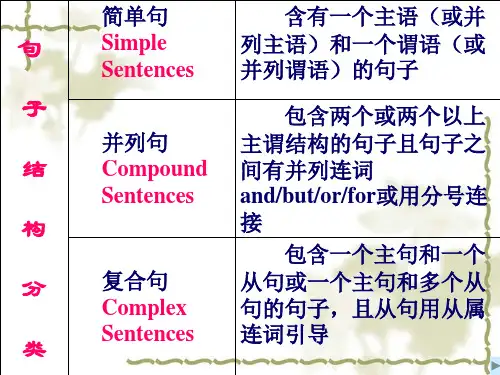
复合句 Complex Sentences
1. He learns German in a university. (一个主语和一个谓语) 2. Both Tom and Jack enjoy country music. (并列主语和一个谓语) 3. We sang and danced yesterday evening. (一个主语和并列谓语) 4. My brother and I go to school at half past seven in the morning and come back home at five in the afternoon. (并列主语和并列谓语)
Correct mistakes:
1. Her voice sounds beautifully. beautiful 2. The whole company was surprising at surprised the news. to 3. To see isΛbelieve. 4. It seem like a good idea. seems 5. The lightsΛ still on. are 6. All the potatoes changed bad. went 7. Jim was remained a worker.
1.形容词及其结构 The flowers are beautiful to look. This maths problem is hard to work out. Girls are afraid of dogs. 2.介词结构 My book is on the desk. 3.个别副词(around, on, off, abroad,everywhere) My daughter is abroad.
简单句五种基本句型

vt宾补谓语
宾 补 动 词 常 有
We all have found English important.
•感官动词: see,hear,find,watch,… •祈使动词: make, have, let, ask,… •判定动词: regard, consider,… •及位动词: put, lay,…
•汉语中形容词、数词、介词可 以直接做谓语,而英语一定要有 be动词、
行为谓语 (vi、vt单宾语、 vt双宾语、vt宾补语)谓语
vi谓语
Li Ming has already gone.
vt单宾语谓语
Mr. Li teaches Chinese.
vt双宾语谓语
Mr. Li teaches us Chinese.
(四).宾语
宾语(object)在句中主要充当动作的承受者,因此一般 皆置于及物动词之后。如:
Our team beat all the others. 我们的球队打败了所有其他球 队。
可以用作宾语的有:名词、代词、数词、名词化的形容词 、副词、不定式、动名词、名词化的分词或从句等
扩展: 宾语中有些动词需要两个同等的宾语,即直接宾语(direct
(二).谓语
谓语(predicate) 或谓语动词(predicate verb) 的位置一 般在主语之后。谓语由简单动词或动词短语(助 动词或情态动词+主要动词)构成。 1.由简单的动词构成。 2.由动词短语构成的谓语。 3.英语常用某些动作名词代替表动态的谓语动词 ,表生动。这种动作名词之前常用没有多大意义 的动词have, get, take, give 等。如: 注意:谓语动词要与主语的人称和数一致。
adj. / adv. infinitive V-ing / V-ed
【精品】初中英语语法专题讲解1--简单句的5种基本句型
初中英语语法专题讲解 1——简单句的五种基本句型英语中千变万化的句子归根结底都是由以下五种基本句型组合、扩展、变化而来的:1)主+ 动(SV)例如:I work.我工作。
2)主+ 动+ 表(SVP)例如:John is busy.约翰忙。
3)主+ 动+ 宾(SVO)例如:She studies English.她学英语。
4)主+ 动+ 宾+ 补(SVOC)例如:Time would prove me right. 时间会证明我是对的。
5)主+ 动+ 间宾+ 直宾(SVOiOd)例如:My mother made me a new dress.我母亲给我做了一件新衣裳。
英语中的各种句子分为简单句和复合句,其中简单句中包含有五种基本句型。
1.S+Vi(Subject主语+Intransitive Verb不及物动词)例:The sun rises in the east.太阳从东方升起。
She is walking along the lake.她正沿着湖边走。
2.S+Vt+O(Subject主语+Transitive Verb及物动词+Object 宾语)例:He found a bird in the tree.他发现树上有一只鸟。
I like this book very much.我非常喜欢这本书。
3.S+link.V+P(Subject主语+link.verb系动词+Predicative 表语)1)句型中系动词的位置可以用be动词来代替。
2)句型中系动词可分为:表状态的系动词:be,keep,lie,look,remain,seem,smell,sound,sit,stand,stay,taste等。
表变化或结果的系动词:become,come,get,grow,go,fall,prove,turn等。
例:Time is up.时间到了。
That man seems kind.那人看起来很善良。
简单句的五大基本句型和转换
简单句Simple Sentences英语中,只含有一个主谓结构并且句子各成分都只由单词或短语构成的独立句子或分句叫做简单句。
在简单句中主语和谓语是句子的主干,是句子的核心。
除口语中的一些特殊句型外,英语的句子必须含有主语和谓语,否则不成句子,无法完整地表达思想。
除了主语和谓语外,简单句中还可以有宾语、表语、补语、状语、定语等。
1.主语+谓语谓语一定是动词这种句型简称为主谓结构,其谓语一般都是不及物动词,例:Things change.事物是变化的。
Nobody went.没有人去。
--Did you go by sea?你们走的是海路吗?--NO,we flew.不,我们是飞去。
2.主语+连系动词+表语也叫做主系表这种句型称为主系表结构,其实连系动词在形式上也是一种谓语动词,但实质上表语成了谓语,例:Mr. Turner is an artist.特纳先生是位画家。
The milk went sour.牛奶变酸了。
She became a lawyer.她当了律师。
3.主语+谓语+宾语宾语有两种:间接宾语和直接宾语这种句型可称为主谓宾结构,它的谓语一般多是及物动词,例:We never beat children.我们从来不打孩子。
My sister will fix everything.我姐姐会料理一切。
4主语+谓语+宾语+宾语这种句型可称为主谓宾宾结构,其谓语应是可有双宾语的及物动词,两个宾语一个是间接宾语,一个是直接宾语,例:He gave the book to his sister.他把这本书给了他的妹妹。
I'll write you a long letter.我将写给你一封长信。
5.主语+谓语+宾语+宾补所谓宾语补足语就是补充说明前面的宾语这种句型可简称为主谓宾补结构,其补语是宾语补语,与宾语一起即构成复合宾语,例:I found the book easy.我发现这本书不难。
简单句五大基本句型
the answer? her. meal everyday. cakes. eating apples. English very much. to have a cup of tea. "Good morning."
1. 常要求接不定式作宾语的动词有
attempt, dare, decide, desire, expect, hope, intend, learn, need, offer, pretend, promise, refuse, want, wish
3. 电梯坏了。 3. The lift is out of order/ has gone wrong. 4. 未来几天天气将持续寒冷。 4. It will stay/remain cold (for) several days. 5. 那个男人证明是个贼。 5. The man proved (to be) a thief.
that he has never been abroad.
即时练习:请用“主语+系动词+表语 ” 句型翻译下列句子。 1. 这台机器的情况良好。
(be in good condition)
1.This machine is in good condition. 2. 丝绸摸起来又软又滑。 2. Silk feels soft and smooth.
I forget to tell you the exciting news. I forget telling you the exciting news.
即时练习:请用“主语+及物动词+宾语”句型 Exercise practice 翻译下列句子。 1.昨晚我写了一封信。 I wrote a letter last night. 2.这本书他读过多次了。 He has read this book many times. 3.他们成功地完成了计划。(carry out) They have carried out the plan successfully. 4.你们必须在两周内看完这些书。(finish doing) You must finish reading these books in two weeks. 5.那位先生能流利地说三种语言。 That gentleman can speak three languages fluently.
简单句五种基本句型
五、主语+及物动词+宾语+宾语补语 (主谓宾宾补) He told me to stay home. 他叫我呆在家里。 The smell made him sick. 这气味使他恶心。
3. He invented cars.
三 、主语+连系动词+表语(主系表)
English is very easy. 英语很容易。 He looks tired. 他看上去是累了。
• 连系动词: • 系动词有:is(was) am(was) are(were) 半系动词有:1,感觉类的feel taste smell sound look 2.变化类的get turn become go come.grow 3.表像类的appear seem 4.表存在的.remain keep
简单句五种基本句型
一、主语+不及物动词(主谓) My head aches. 我头疼。 Everybody laughed. 大家都笑了。
造句: 1.他骑自行车。 2. 雪融化了。 3. 她抱怨。 4. 我辞职了。 1. He cycles.
2. The snow is melting.
3. She complained. 4. I resigned.
四、主语+及物动词+间接宾语+直接宾语 (主谓宾宾) He told her the news. 他把这消息告诉了她。 He gave me an appl• 1. 他给她买了一个包。 • 2. 他给了她一些钱。
He bought her a bag. He gives her some money.
二、主语+及物动词+直接宾语(主谓宾) She likes the flowers. 她喜欢这些花。 Dad bought a car. 父亲买了辆汽车。