
外研版(三起)四上英语Module 3《Unit 2 What’s the elephant doing》课件
外研版三年级起点四年级上册M3U2What is the elephant doing教案
Module 3Unit 2 What is the elephant doing ?第二课时教学目标1. 识别单词:draw ,jump ,sing ,dance .学习句型: What are they doing ?They are playing football.What is the elephant doing ?It is drawing pictures.2. 能口头运用 What are they doing ? They are....What is it doing ? It is...这些句子介绍现在正在发生的事情。
3. 激发和培养学生学习英语的兴趣,使其主动参与课堂实践活动,从而培养他们的合作意识。
教学的重难点:掌握现在进行时的第三人称单数和复数的问句及答语。
Whatare they doing? They are...... What is Amy doing ?She is……培养学生在实际情景中运用。
教学方法:讲授法,演示法,讨论法,创设情境法,自主探究法。
教学过程:Step 1 :Warm-up.(1)、Greetings and sing an English song.(2)、Let’s do.T: doing taijiquan ,rowing a dragon boat,playing chess,drinking soya milk .Ss: Do the actions. (师先发指令,生做动作,再利用多媒体课件依次播放图片,让学生看图说出完整的句子, 如:They are doing taijiquan.( rowing a dragon boat,playing chess;drinking soya milk . )Step 2 : Review (ppt)Let’s chant:doing ,doing ,doing .What are they doing ?playing , playing ,playing .They are playing football.Step 3 : Lead –in出示 ppt,根据上课时所学的现在进行时,把主语换为第三人称,以导入课题,板书,带领学生齐读。
外研版三起四年级上册module 3《unit 2 what’s the elephant doing》优秀教案(重点资料).doc
Module3 Unit2 What’s the elephant doing?一、教材分析:教参二、说学情四年级的学生经过一年学习已经有了一定的英语基础,思维活跃,敢于开口,乐于表现三、教学目标:1、知识目标:识记单词:draw, jump, sing, dance2、能力目标:能描述正在发生的事情,谈论动物们的活动。
3、情感目标:通过了解英语词汇中的汉语借词,初步感知中外文化的异同。
乐于感知并积极尝试使用英语。
四.教学重难点:现在进行时特殊疑问句的使用及回答。
五.教学方法:情境教学法,任务型教学法,TPR教学法(让学生在互动、交流的活动中享受学习的快乐,培养学生英语运用的实践能力。
)六.学法:我将在课堂中运用多种方法促使学生多听多读多说,让学生在互动交流中建立起自信,享受到学习的乐趣,得到相关知识,培养对英语运用的实践能力,让他们成为学习的主人。
七.教学过程:1. Warming up①look and say .出示一些人活动的图片,向学生提问“What are they doing?”“What is \she doing ?”请学生回答。
(通过练习巩固上节课所学内容,并为本节课做铺垫)(老师对学生说:“大家的本领都不简单,那么大家想知道Daming 和 Amy 又去了什么地方吗? Let’s have a look!” )2. Lead in:I 教师展示一张被遮盖部分区域的大象图片问学生:“Do you know what is it doing?”学生会一起猜测,然后老师说:让我们一起去看看吧II .首先让学生盲听看图,询问”what are the monkeys doing?how about elephant,listen again.”然后再次播放动画,听完以后让学生做选择。
同时巩固单词draw-drawing-drawing pictures,让学生用词短语翻译一个简单的句子。
外研版小学英语四年级上册Module 3教案
Unit1What are they doing? 1课时
Unit 2 What'sthe elephant doig?1课时
Unit1 What are they doing?
学习目标
1.学习询问他人正在做什么事情。
2.描述他人正在做的事情。
3.学生能够听、说、认boat chess row soybean milk drink hungry 。
主备人:使用人:课时:2
课题
Module3
课型
新授
修改意见
单元备课
教学内容:谈论人们在公园中的活动,并描述正在发生的行为或动作。本模块是继上一模块对现在进行时态的学习之后,继续对其进行复习和巩固。在复习已学的动词和动词词组的过程中,不断引出更多动词词语的学习。第一单元中Amy和Dming来到公园,乘坐公园bus开始游览。这期间,Dming向Amy介绍许多有趣的事,Amy也对其抱有极大的兴趣。第二单元中则主要学习如何询问和讲述他人正在做的事。
3.请全体学生一起边做动作,边说:I’m doing taijiquan.
4.自主学习单词(Task 1) (1)Listen and underline the new words and the difficult words. (2) Listen and read the new words and the difficult words 3 times. (3)Read the words by yourself.
4.通过创设和谐的氛围,让孩子们轻松愉快地学习英语,并形成良好的英语语 感。
教学重点
1.学说问句What are they doing?
2.掌握句型They’re 动词+ing [+宾语]
四年级上册英语试题- Module 3 Unit 2 What’s the elephant doing 单元测试卷及答案-外研版(三起)
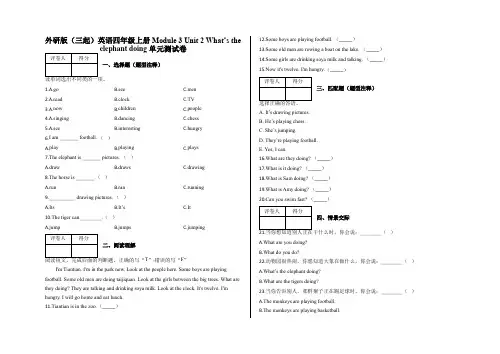
外研版(三起)英语四年级上册 Module 3 Unit 2 What’s theelephant doing 单元测试卷一、选择题(题型注释)1.A.go B.see C.men2.A.read B.clock 3.A.now B.children C.people4.A.singing B.dancing C.chess5.A.see B.interesting C.hungry6.I am _______ football. ()A.playB.playingC.plays7.The elephant is _______ pictures. ()A.drawB.drawsC.drawing8.The horse is _______.()A.runB.ranC.running9.__________ drawing pictures. ()A.ItsB.It’sC.It10.The tiger can ________.()A.jumpB.jumpsC.jumping二、阅读理解T”,错误的写“F”I'm Tiantian. I'm in the park now. Look at the people here. Some boys are playing football. Some old men are doing taijiquan. Look at the girls between the big trees. What are they doing? They are talking and drinking soya milk. Look at the clock. It's twelve. I'm hungry. I will go home and eat lunch.11.Tiantian is in the zoo.(_____)12.Some boys are playing football. (_____)13.Some old men are rowing a boat on the lake. (_____)14.Some girls are drinking soya milk and talking. (_____)15.Now it's twelve. I'm hungry.(_____)三、匹配题(题型注释)A. It’s drawing pictures.B. He’s playing chess.C. She’s jumping.D. They’re playing football.E. Yes, I can.16.What are they doing? (_____)17.What is it doing? (_____)18.What is Sam doing? (_____)19.What is Amy doing? (_____)20.Can you swim fast? (_____)四、情景交际________()A.What are you doing?B.What do you do?22.动物园很热闹,你想知道大象在做什么,你会说:________()A.What’s the elephant doing?B.What are the tigers doing?23.当你告诉别人,那群猴子正在踢足球时,你会说:________()A.The monkeys are playing football.B.The monkeys are playing basketball.24.当你表达露西正在游泳,你会说:________()A.Lucy is swimming.B.Lucy is running.25.当你想邀请你的朋友一起上车,你会说:________()A.Let’s get off the bus.B.Let’s get on the bus.五、连词成句26.monkeys, the, football, playing, are (.)__________________________________________________________________ 27.drawing, elephant, the, pictures, is (.)__________________________________________________________________ 28.jumping, is, tiger, the (.)__________________________________________________________________ 29.singing, the, bird, is (.)__________________________________________________________________ 30.horse, dancing, the, is (.)__________________________________________________________________参数答案1.C2.A3.A4.C5.A略6.B【解析】1.略7.C【解析】2.略8.C【解析】3.略9.B【解析】4.略10.A【解析】5.略11.F12.T13.F14.T15.T略16.D17.A18.B19.C20.E略21.A【解析】6.略22.A【解析】7.略23.A【解析】8.略24.A【解析】9.略25.B【解析】10.略26.The monkeys are playing football.27.The elephant is drawing pictures.28.The tiger is jumping.29.The bird is singing.30.The horse is dancing.略2019-2020学年度译林版(三起)英语四年级上册 Unit 1 Ilike dogs单元测试卷一、选择题1.A. apple B. dog C. cat2.A. boy B. girl C. tiger3.A. three B. ten C. like4.A. cute B. fat C. lion5.A. cakes B. hot dogs C. egg6.A. banana B. grape C. pie7.——Would you like a cup of coffee? ( )——A. Yes, please.B. No, I don’t.C. Yes, I do.8.She likes pandas. cute. ( )A. They’reB. It’sC. He’s9.——Do you like tigers? ( )——A. No, I do.B. Yes, I don’t.C. Yes, I do.10.——Look at bag. ( )——It’s nice.A. theseB. thoseC. that11. are black and white. ( )A. TigersB. LionsC. Pandas12.——Dad, what’s this? ( )——It’s little monkey.A. /B. anC. a13.——Lily, look my new shoes. ( )——They’re very nice.A. inB. atC. on14.——What do you have, Sam? ( )——I have a .A. cakeB. appleC. elephant二、阅读理解T或F表示。
新标准英语四年级上M3U2what's the elephant doing教学设计

外研版小学英语四年级上册Module3Unit2What’s the elephant doing?教学设计一、教学目标:1、知识目标:识记单词:draw, jump, sing, dance认读句子: What’s the elephant doing?2、能力目标:全体学生能运用What’s the elephant doing? 询问不明白的情景,并进行说明。
3、情感目标:学习策略:遇到问题主动向老师或同学请教。
文化意识:通过了解英语词汇中的汉语借词,初步感知中外文化的异同。
情感态度:乐于感知并积极尝试使用英语。
二、教学重难点:识记单词:draw, jump, sing, dance认读句子: What’s the elephant doing?一.1.Greeting .(说出本节课的奖励机制:全班分成六小组,每组发一张苹果树图片,本组成员正确回答问题一次,得到一个苹果,由组长记录,最后看哪组的苹果树上结的苹果最多)2.Sing a song.3.(课件出示拍照、划船、下棋等图片)T: look at here. What is Daming doing?S: He‟s taking pictures.由“师问生答”到“生生问答”。
T:what are they doing ? Look carefully.(课件出示课文第一部分视频): oh tell me ,what are they doing ?S:they‟re playing football.( 出示大象画画图片)T:what is it doing ?S:It‟s drawing pictures.T:what‟s the elephant doing?S: It‟s drawing pictures.(领读并板书)二.1.Today, we will learn to Module 3 Unit 2 “what‟s the elephant doing ?”It‟s drawing pictures.(师领读几遍后,男生问女生答)2.教授drawing pictures.(板书并标有简笔画)3(师做原地跳的动作)T: what am I doing? I can jump,can you ?教授jump(板书——画——领读——每组读——逐个读)T: Look, what are the tigers doing ?S:They‟re jumping 。
外研版(三起)英语四年级上册全册同步练习(20套)附答案
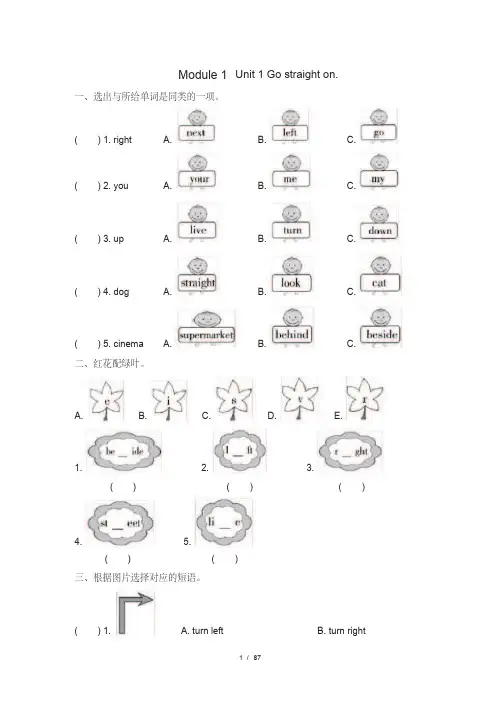
Module 1 Unit 1 Go straight on.一、选出与所给单词是同类的一项。
() 1. right A. B. C. () 2. you A. B. C. () 3. up A. B. C. () 4. dog A. B. C.() 5. cinema A. B. C.二、红花配绿叶。
A. B. C. D. E.1. 2. 3.()()()4. 5.()()三、根据图片选择对应的短语。
() 1. A. turn left B. turn right() 2. A. go straight on B. behind the door() 3. A. next to a supermarket B. on your right() 4. A. in the tree B. behind the tree() 5. A. on your left B. beside the cinema 四、给下列句子或对话选择合适的图片。
() 1. Turn left. You can see the zoo. A.() 2. Where is the cinema? B.() 3. The cat is lost. C.() 4. It's next to a park. D.()5.—Where are you?—We're behind the door. E.五、情景交际。
()1.当你想要问路时,你应该先说:________A. Excuse me.B. Sorry.()2.当体育老师发出指令“Turn left. ”时,你应该:________A.向右转。
B.向左转。
()3.你想要去超市,但是不知道路,你应该问:________A. Where's the supermarket?B. Is it a supermarket?()4.当你想要表达感谢时,你应该说:________A. Thank you so much.B. You're welcome.()5.当别人问你的家庭住址时,你应该说:________A. I'm on your left.B. I live at No. 2 Park Street.答案:一、1. B 2. B 3. C 4. C 5. A二、1. C 2. A 3. B 4. E 5. D三、1. B 2. A 3. A4. B点拨:behind the tree 意为“在树后”。
四年级上册英语教案-Module 3Unit 2 What's the elephant doing
四年级上册英语教案-Module 3 Unit 2 What’s the elephantdoing∣外研版(三起)教学目标1.能听懂、会说、会读单词:elephant, swim, eat, drink, stand, sleep, jump, walk, run, fly。
2.能听懂、会说、会读句型:What’s the elephant doing? It’s swimming/ eating/ drinking/ standing/ sleeping/ jumping/ walking/running/ flying。
3.能结合实际情景进行对话,学会用简单的句子描述动物的行为。
4.通过学习这个单元,培养学生的对动物的兴趣,开发学生的观察力,培养动手、动脑、动口的能力,提高学生的英语交际能力。
教学准备1.教学课件。
2.关于动物的图片或视频。
3.单词卡片。
4.学生课本、练习册。
教学过程导入1.展示图片或视频,让学生先猜测动物在做什么。
2.引导学生一起说出猜测的答案。
学习单词和句型1.分别出示elephant, swim, eat, drink, stand, sleep, jump, walk, run, fly 单词卡片,边出示卡片边念单词,学生跟读。
2.让学生翻到课本Page 24,一起阅读文章,引导学生学习What’s the elephant doing?句型。
3.模仿老师的语音语调,几遍带领学生一起模仿读课本中的句子,帮助学生掌握句型。
操练句型1.让学生两两分组,互相练习操练句型What’s the elephant doing?;2.在教室中布置数个活动点,让学生根据句型What’s the elephant doing?在每个点上模拟不同的动物,通过互动操练句型。
扩展1.让学生通过图片或视频学习更多有关动物的行为、名称等;2.让学生自由发挥,创造更多有趣的问答和情景对话;3.鼓励学生阅读英语故事书或相关内容,培养学生的英语阅读和思考能力。
外研版四年级英语上册《Module 3 Unit 2》课堂教学课件PPT小学公开课
外研版 英语 四年级上册Module 3Unit 2 What’s the elephant doing?第一课时第二课时第一课时Watch and sing together.让我们一起去看马戏团动物们的表演吧!What’s this? bird-bird shorse-horse s tiger-tiger selephant-elephant smonkey-monkey sNew words.The elephant is draw ing pictures.大家猜一猜,马戏团的动物们都会表演什么?The tiger is jump ing.The bird is sing ing.The horse is danc ing.Practise.Read and act.-Whatare you doing ?-I’m…Look and answer.Listen, point and say.-What is she doing? -She’s…-What is he doing? -He’s…-What is it doing? -It’s…-What are theydoing ?-They’re…-What are they doing ?-They’re…Listen and read after it.They’re playing football.What are they doing?It’s drawing pictures.What is it doing?Role play and act out.Listen and say.What’s the elephant doing?-What’s it doing?-It’s drawing pictures.What are the tigers doing?-What are they doing?-They’rejumping.Practise.找不同的同学带着头饰上前扮演动物做动作。
外研社(三起)四年级英语上册教案:Module 3 Unit 2 What’s the elepha
外研社(三起)四年级英语上册教案:Module 3 Unit 2 What’sthe elephant doing Period 1本次课程将围绕四年级上册英语教材的第三模块第二单元展开教学,主要内容为学习一些动物的动作词,学生将通过听、说、读的方式掌握这些词汇。
教学目标本节课的教学目标主要包括以下方面:•学习掌握12个动物的动作词•能够问询和回答“动物在做什么”这个问题•结合图片或实物描述动物的动作•培养学生的英语听、说、读、写四方面的能力教学重点和难点教学重点:•学生能够听懂、理解和运用本节课学习的12个动物的动作词•学生能够通过提问和回答方式进行交际,并通过图片或实物描述动物的动作教学难点:•学生能够更准确地使用本节课所学动作词进行描述•学生能够通过视觉和听觉的信息进行语言的输入与输出教材与工具•教材:《外研社三年级英语上册》•工具:课件、黑板、音响、实物模型教学步骤上课铃响老师在学生到齐后,会让同学大声喊“Good morning”,并询问同学们今天过得怎样,引起学生的注意。
(1)导入•Step 1:开场自我介绍老师首先会介绍自己,然后通过自我介绍的形式,让学生们彼此认识。
•Step 2:唱一首儿歌《The Animals》老师播放儿歌《The Animals》,让学生们跟着歌词动作,学会单词和短语“monkey”,“elephant”,“parrot”,“snake”等。
(2)新授•Step 1:呈现和解释本课单词老师运用课件向学生呈现本课单词,通过连图、音、意等几方面解释其含义和发音规则。
同时老师鼓励学生跟着自己的发音模仿。
•Step 2:呈现图片,描述动物在做什么老师针对新授的词汇,通过图片或实物的形式进行描述,引导学生了解每个动物的体态、动作和习性。
同时鼓励学生模仿教师的描述,使用本节课所学词汇进行口头表述。
(3)训练•Step 1:听音辨词老师播放本单元的音频资料,让学生听音判断哪个动物在做什么。
三起点外研版新标准英语四年级上册期末考试重难点知识点复习及练习
Module1 Unit1 Go straight on.一直往前走。
互动学习精炼重难点:1.表示“迷路的"lost adj.迷路的。
lost是一个形容词,是由动词lose演变而来的。
常用句型是“人∕物+am∕is∕are + lost”,意思是“人∕动物迷路了∕丢失了" 。
例如:My sister is lost。
我的妹妹迷路了.2.表示“住在……"live v.居住常见短语:live in +地点,住在某地。
注意:在某地前一定要加介词in。
例如:I live in Park Road。
我住在公园路。
如果主语是第三人称单数时要用lives.例如:She lives in Canada。
她居住在加拿大。
3.表示“打扰一下”“Excuse me”意思是“打扰一下,对不起”。
当我们要麻烦别人或打扰别人时,如问路,打断别人正在进行的事情,询问问题时,为了表示礼貌或者是歉意,应当先说“Excuse me”,再提出自己的疑问。
4。
询问地点当你想知道“某地在哪里”,或者“到某地怎么走”时,常用句型“Where’s+地点∕处所?”这是由where引导的特殊疑问句,where的意思是“在哪里”,回答时不能用yes或no来回答,而应该用“It's+表示方位的介词短语”回答。
例如:----Where is the supermarket?超市在哪里?--—-It’s on your left。
它在你左边。
5。
指路用语用英语给别人指路的常用语有:Turn right。
向右转。
Turn left. 向左转。
Go straight on. 一直向前走.6。
感谢用语及回答1Thank you。
谢谢你.为感谢用语。
当他人帮助了自己或夸奖、赞美自己时,我们要说“Thank you”来表示感谢。
其回答为:Y ou’re welcome。
不用谢。
Module2词汇:精炼重难点:1.表示“看……”look 表示“看"的这个动作,是不及物动词。