
Unit 1 What's the matter?Section A 精心修改
should shouldn’t =should not
对 症 下 药
stomachache
fever toothache sore throat
--What shouldn’t he do?
--I think he shouldn’t …
shouldn’t = should not He has a sore throat
A: What’s the matter with him ? B: He … has a sore throat. A: What should he do ? B: He should drink some hot tea with honey.
A: B: A: B:
What’s the matter with her ? …She has/has got a (high) fever. What should she do ? She should take … her temperature and drink a lot of water.
d. 头痛
e. 胃痛 f. 牙痛 g. 发烧 h. 重感冒
have a toothache have a high fever have a bad cold
Match the problems with the advice.
1. have a fever 2. have a sore throat 3. have a stomachache 4. have a toothache
a. lie down and rest
b. drink hot tea with honey c. see a dentist
d. take your temperature and drink lots of water
A: What’s the matter with him ? B: … He has/has got a stomachache. A: What should he do ? B: He should lie … down and rest.
What should you do?
stressed out
What shouldn’t you do?
tired
thirsty
hungry
Pairwork:
What’s the matter? sore back I have a_________.
see a doctor You should ____________. exercise You shouldn't___________.
What’s the matter? fever I have a _________. drink lots of water and go to bed You should_____________________________. go out and exercise You shouldn't________________________.
This question is a problem.
They are doing some math problems/exercises. May I ask you a question ?
advice n. 建议,忠告,劝 some/much/a lot of/lots of advice
Grammar Focus
翻译下列句子: 1. 我头痛。
1. I have a headache.
2. You should go to bed.
2. 你应当去睡觉。
3. 他肚子痛。
3. He has a stomachache. 4. She shouldn’t eat anything. 5.She has a toothache.
lots of =a lot of 许多
drink lots of water
should 应该
情态动词,后接动 词原形
A:What’s the matter? B: I have a fever. A: Yes,you don’t look well. You should drink lots of water.
honey n. 蜂蜜
drink hot tea with honey
A:What’s the matter? B: I have a sore throat. A: You should drink some hot tea with honey. B:That sounds like a good idea.
A:What’s the matter? stomachache B:I have a _____________.
lie down and have a rest A:You should_______________________.
You shouldn't _______________________. eat anything for two hours
lie down 躺下
rest/have a rest 休息
lie down and rest
A:What’s the matter? B: I have a stomachache. A: That’s too bad.You should lie down and rest.And don’t eat anything for two hours. B:I guess I should.
A: What’s the matter? B: I’m not feeling well. I have a _____. cold A: When did it start?
two days ago. B: About ___ _____
A: Oh, that’s too bad. You should _____. get some rest B: Yes, I think so. A: I hope you feel better soon.
drink cold drink.
He shouldn’t eat ice cream.
eat hot food.
talk too much.
talk loudly.
I have a cold. What should I do?
You should
• • • • • • •
stay in bed . have a good rest. lie down and rest. wear warm clothes. drink lots of water. drink hot tea. take some medicine.
Grammar Focus
1.What’s the matter with sb. ? …怎么了? = What’s the trouble with sb. ? = What’s wrong with sb. ?
注:with为介词,后跟人称代词宾格, 如 her, him, them 等。
eg: What’s the matter with your mother? What’s wrong with you? What’s the trouble with her?
A: What’s the matter with you ,Tom ? B:
I have a (bad) cold.
What’s the matter with him ?
He has a stomachache.
have a (high) fever
have a toothache
have a headache
3b Use the picture below to make new conversations.
Guessing game *Do you have a …? *Yes, I do. / No, I don’t.
Name
Liu Peng
Illness
headache
Advice
lie down and rest
1b
Listen and look at the picture. Then number the names (1-5).
3 Sarah____ 1 David___ 2 Nancy____
5 Ben ____ 4 Judy __s the matter with him ?
have a sore throat
have a sore back
What’s the matter with him ?
He has a sore neck.
Look and say
a. 喉咙痛
b. 背痛 c. 脖子痛
have a sore throat have a sore back have a sore neck have a headache have a stomachache
.
-What’s the matter?
-I have a … -Maybe you should …
-That’s a good idea./
That sounds like a good idea. / I guess I should./
Yes, you’re right.
Do you have these problems?
A:What’s the matter? a toothache ? Do you have______________ B:Yes, I do. A:You should______________. see a dentist You shouldn't ___________________. eat sweet things .
Unit 1What's_the_matter A 3a-3c精心修改

why
The driver didn’t think about himself. He only thought about saving a life.
Test your memory!
At 9:00 a.m yesterday, bus No.26 was going along Zhonghua Road when the driver saw an old man ______ on the side of the road. A woman _____ to him was ____for help. The bus driver,24-year-old WangPing, _____ the bus without thinking ____.He got off and asked the woman ___ happened. She said that the man had a heart problem and ____ go to the hospital. Mr. Wang knew he had to act ____.He told the passengers that he must take the man to the hospital.
5. Thanks to Mr. Wang and the passengers, the doctors saved the man in time. (1) thanks to…多亏…,由于… 多亏了我的英语老师,我取得了好成绩。 Thanks to my English teacher, I got good grades. 区别:thanks for doing … 为…而感谢…
1. At 9:00 a.m. yesterday, bus No.26 was going along
2014八年级下Unit1_What's_the_matter Section A

2a-2b
Listen and number the pictures 1-5 in the order you hear them. Listen again and match the problems with the advice.
注:with为介词,后跟人称代词宾格, 如her,him,them等。
怎 么 了
eg:What’s the matter with your mother? What’s wrong with you? What’s the trouble with her?
ache 、sore和hurt 的区别: 1. ache 是一个名词后缀,如: toothache 2 . sore形容词,修饰名词,指的是 身体某一部位的酸痛。如:sore back, sore throat sore leg ,sore eyes 3. hurt动词,指“刺痛,使受伤 痛”。如:He hurts his leg.他伤了腿。 还可以说“His leg hurts.”他腿疼。
--I think he shouldn’t …
shouldn’t = should not He has a sore throat
drink cold drink.
He shouldn’t eat ice cream.
eat hot food.
talk too much.
talk loudly.
problem question
n. 问题,难题,习题(有待解决) n. 问题(有待回答)
They are doing some math problems/exercises. May I ask you a question ?
Unit1What's the matter 说课稿(全英文)
说课稿Unit 1:What’s the matter?范围:Section A 1a~2d 课型:听说课Good morning, ladies and gentlemen. I’m。
. I’m from 。
Middle School. I’m glad to stand here to share my teaching ideas with you. Today I’m going to talk about the first period from 1a to 2d in unit 1 “What’s the matter”. Here are 6 parts: part 1, Analysis of teaching material; part 2, Analysis of students;part 3, Teaching methodologies; part 4, Learning methodologies; part 5, Teaching procedures; part 6, Blackboard design. Now I’ll introduce them one by one:Part One :Analysis of teaching material1 .Status And FunctionThe topics of the unit are “health and first aid”. It’s not only very important in this textbook but also plays an important role in our daily life. In addition, the topics are related to our daily life. They are so interesting that it’s useful to attract students’ attention.2.Teaching AimsKnowledge Object:In this lesson, according to words teaching and some practices,students could master the new words such as parts of the body and give some easy advice for the health problems.Ability Object:In this lesson, according to dialog and listening practices, students could develop the ability of communication about health problems.Moral Object :From this lesson, students should learn to take care of others and themselves3. Teaching Keys and DifficultiesAccording to the teaching aims, the key point is how to master the names of body parts and advice for different health problems. And the difficult point is how to express the advice for the healthy problem correctly.Part Two: Analysis of studentsStudents have learned some parts of body in Grade 7, such as nose, eye, face. So they can understand some tasks easily and also learn the new conversations quickly. And this lesson is about health and body. It’s related to their daily life and their body. So students should have a great interest in this lesson.Part Three: Teaching methodologiesIn the lesson, I’ll use a tape recorder ,a projector and a doll, because they can arouse students interest and help students learn better. In accordance with these. I’ll use“r ecognizing method”“l istening method” and “physical display method”Part Four: Learning methodologiesIn order to help students study better and develop their abilities, I will guide them some learning methods such as “Games”, “Role play”and “Group and pair work”.Part Five: Teaching ProceduresStep1 Greet the class .Maybe some teachers think that’s not important. But in fact, it has a great role in a lesson. Anyway, I always insist on the detail step. It makes me know that I must have full passion in this lesson and it also can make students know that the lesson begins. This is a good habit.Step 2 Lead-inIn order to attract students attention and review the old words, I’ll play a song “ If You’re Happy” because in the song, there are some words about parts of body. Then I’ll show some pictures such as neckthroat stomach and so on and question them. In order to help students master these new words, I’ll set a guessing game. I t can improve students interests of learning English.Step 3 PresentationNow that students have mastered the parts of body, then I’ll show apicture about one people goes to the doctor and then question “What’s the matter with him/her?” Next, I’ll show more pictures and then question. This can train students’ language output ability.Step 4 Practice:pair work and discussion in group workIn order to develop students’ communicative skill, I’ll ask them to practice the conversation in pair work for 3 minutes. Then ask them to read the dialogue.To know whether they master the conversation or not, I’ll play the recorder for every one. This also can train students listening ability.After the listening practice, in order to catch students attention, I’ll act I’m stomachache and I’ll ask one student“What’s the matter with me?”and “What should I do?” Then I’ll show more pictures in 2a and question “What’s matter with them and What should they do?”. Now it’s time to discuss for students for 5 minutes. Of course, I’ll join in them. After the discussion, I’ll ask some students to show their ideas about thematter and teach them some advice. This can train students the spirit of cooperation and the ability of communication.To train students listening practice again, I’ll play the recorder again for 2a and 2b.Step 5 ProductionIn order to make students really master this lesson and improve their learning interest, I’ll ask them to play the situation comedy. And praise the best group and encourage the other groups. Whichever subject, we not only teach students knowledge, but also pervade the moral education. So I’ll show some pictures about the disease and two proverbs “ The body is the capital of revolution”“An apple a day keeps the doctor away.”to educate them to take care of themselves.Step 6 SummaryLook at the blackboard writing, then ask students to review the names of body parts. Read should or shouldn’t for each health problem.Step 7 HomeworkMake a list of ways to solve the usual health problems on exercise-book.Part 6 Blackboard designUnit1: What’s the matter?Section A 1a-2dthe matter withParts of body:arm ear eye legback foot headhand head nosemouth neck tooththroat stomach。
人教版八年级英语下册unit 1 what's the matter ?Section A2优件
A: What’s the matter? Do you have a sore throat?
B: No, I don’t. A: Do you have a headache? B: Yes, I do. A: You should lie down and rest.
Name Liu Peng
A:What’s the matter?
B: I’m not feeling well.I have a _s_o_re__t_h_ro_a_t_. A: When did it start? B: About _a__w_e_e_k__ago. A: Oh, that’s too bad.You should
Advice: What should they do? A:What’s the matter with you? B:I have a stomachache. A:You should l_i_e_d_o_w__n_a_n_d__r_e_st_. B: That’s a good idea.
_se_e__a_d_e_n_t_i_st____. B: Yes, I think so. A: I hope you feel better soon.
Game time One student mimes an illness. The other students guess the illness and give advice.
2. I have a sore throat. 我喉咙痛。
(1)have vt. 患(得)病, (不用于 进行时态)
He had a bad cold last week. 他上周患了重感冒。
She often has a stomachache.
人教版英语八年级下册Unit1What’s the matterSection A 1a-1c课件
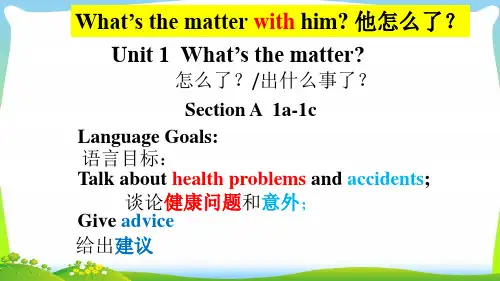
手臂
背部
耳朵
_i_ eye _b_ foot _a_ hand
眼睛
_j_ head
脚(复数feet) 手
_l_ leg _c_ mouth
头
腿
嘴
_d_ neck m__nose _k_ stomach
脖颈 鼻子 胃;腹部
_f_ tooth
牙齿(复数:teeth)
What’s the matter with him/her?
Homework
1. 听力材料抄一遍 2. U1单词matter-hurt,三英一汉抄一遍。
for the first time. 8. If you agree, you can nod(点头) your _h_e_a_d_.
Learning Goals: 1、听录音, 完成相应练习; 2、翻译听力材料,熟读并role-play; 3、能用英语谈谈自己哪里不舒服:
—What’s the matter? —I have a cold.
have a cold 得了流感
have a sore back 背疼
What’s the matter with him/her?
get a stomachache 胃痛
have a toothache 牙疼
What’s the matter with him/her?
have a fever 发烧
New words
matter sore stomachache foot neck
n. 问题;事情 adj. 疼痛的;酸痛的 n.胃痛;腹痛 n. 脚;足 n. 颈;脖子
stomach throat fever lie rest cough
2018年八年级英语下Unit1 what`s the matter精编练习(有答案)

2018年八年级英语下Unit1 what`s the matter精编练习(有答案)本资料为woRD文档,请点击下载地址下载全文下载地址Unit1what`sthematter?I.根据句意及首字母或汉语提示完成单词.Don`tgetstressedout,youshouldlistentosomemusic andr________2.Dongdonghasas____________.Hecan`teatanythingfor24 hours.3.Hecan`tspeakwell.hehaasoret_______________.4.Ihaveat__________.IhavetoseeadentistI`mnotfeelingwell.Ihaveaf____________.6.Ithinkyoushouldtakeyourt_______________7.Idon`tfeelwell.Ihaveah______________.8.Look!Thereisaringaroundthedog`sn___________.9.mostanimalshavefourf_____________.0.Suddenlyhefelloffatreeandh_________hislegs.Itseem edthathecouldn`tmove.II.用所给词的适当形式填空.Nancy_____________allnight,soshelookedtiredthismorning.2.Isawmanyreporterswalkingaroundyourhouse.what`sthe__________?3.youcantouchthecat`sback,butdon`ttouchits___________.4.Theboyfelloffthetreeand_________hisleftfoot.5.missyanghasa________throat,soshecan`ttalkmore.6.Thelittleboywenttoschoolwithout_____________break fastthismorning.7.Nowhisuncleis________onthesofa,enjoyingthemusic.III.按要求完成下列各题。
Unit1_What's_the_matter_SectionA1
【合作探究】:
• 1.What’s the matter?怎么了,其后常与介词with 连用。类似的问
1a. Look at the picture. Write the correct letter [a-m] for each part of the body.
Check the answers!
__h_arm __e_back __g_ear __i _eye _b__foot __a_hand ___j_head __l _leg __c_mouth ___d_neck _m__nose _k__stomach ___f _tooth
I have a fever.
You should _t_a_k_e_y_o_u_r___ _t_em__p_e_r_a_t_u_r_e_.
I cut myself by accident.
You should __p_u_t_s_o_m__e__ _m__ed__ic_i_n_e_o_n__it_._______.
my neck. What should I do? Should I take my temperature? Mandy: No, it doesn’t sound like you
have a fever. What did you do on the weekend? Lisa: I played computer games all the weekend.
Mandy: That's probably why. You need to take breaks away from the computer.
Unit1what’sthematter_SectionA知识点梳理人教版八年级英语下册
人教版八年级下册英语课本知识点梳理Unit 1 wh at’s the matter? sectionA课文内容:What's the matter? 怎么了? (教材第1页)【用法详解】What's the matter? 怎么了?/出什么事了?常用于询问某人患了何种疾病,遇到了什么困难等,也可用于询问某物出了什么故障,其后可接with sb./sth.,表示“某人/某物怎么了?”。
其中matter 用作名词,意为“问题;事情”matter前须加定冠词the。
【例句】What's the matter? 怎么了?Bad luck.I lost my pen. 真倒霉,我弄丢了钢笔.What's the matter with him? 他怎么了?He has a sore back.他背痛【拓展】matter[动词] 要紧;有关系多用在否定句、疑问句或条件句中It doesn't matter.没关系。
(通常用来回答对方的道歉)I have a cold. 我感冒了。
(教材第1页)【用法详解】have a cold (患)感冒。
其中have 用作及物动词,意为“患(病);遭受(病痛)”,常用于结构“have a/an +疾病名称”表示患病或身体某部位不舒服。
此时它不能用于进行时态,其第三人称单数形式为has,过去式为had。
常见的表示病痛的短语还有:have a fever 发烧have a toothache 牙疼have a headache头痛have a cough 咳嗽have a stomachache胃痛Do you often have a cold? 你经常感冒吗?Jim had a stomachache after supper yesterday.吉姆昨天晚饭后胃痛。
l have a stomachache.我胃痛。
( 教材第1 页)【用法详解】stomachache [名词]胃痛;腹痛是由“名词stomach(;腹部)+ache(疼痛)”构成的复合名词。
Unit1What'sthematter?SectionA教案
举例:能够在实际情境中运用句型进行交流,如:“What's the matter, Tom? Are you ill?” “Yes, I have a stomachache.”
(二)新课讲授(用时10分钟)
1.理论介绍:首先,我们要了解如何用英语询问和描述身体不适的基本概念。这些表达方式是日常交流中的重要组成部分,它们帮助我们关心他人并获取帮助。
2.案例分析:接下来,我们来看一个具体的案例。这个案例展示了如何在实际对话中使用今天我们将要学习的词汇和句型。
3.重点难点解析:在讲授过程中,我会特别强调词汇的准确使用和一般现在时态的应用。对于难点部分,我会通过角色扮演和对比不同情境来帮助大家理解。
(4)文化差异:学生需理解在表达关心时,中西方文化中表达方式的差异。
举例:了解西方人可能会直接问“How do you feel?”而中国人可能通过观察和间接询问来表达关心。
四、教学流程
(一)导入新课(用时5分钟)
同学们,今天我们将要学习的是《Unit 1 What's the matter? Section A》这一章节。在开始之前,我想先问大家一个问题:“你们在日常生活中是否遇到过感到不适,需要向别人求助的情况?”(如:有一次我头疼,需要告诉朋友我需要休息。)这个问题与我们将要学习的内容密切相关。通过这个问题,我希望能够引起大家的兴趣和好奇心,让我们一同探索如何用英语表达身体不适的奥秘。
在课程总结环节,我发现部分学生对今天所学知识点的掌握程度仍有待提高。为了巩固学生的学习成果,我打算在课后布置一些相关的练习,让学生在课后继续巩固所学内容。
Unit 1 What's the matter_ Section A 知识点过关
人教版英语八年级下册第一单元Section A重点句子过关Unit1 What’s the matter?1. What’ s the matter? 怎么啦?出什么事情了?matter问题、事情,名词,在此句型中可以改为problem\trouble,What’s the problem\trouble ?注意:当要询问某人怎么了,加上“with sb”,即:What’ s the matter with you? = What’s the trouble with you? = What’ s wrong with you? 你怎么了?温馨提示:matter 和trouble 为名词,其前可加the 或形容词性物主代词,wrong 是形容词,不能加the拓展:matter的用法It doesn’t matter 没关系(用来回答别人道歉时的用语)例题:—I’m very sorry. I ’m late for class.—__________.A. It doesn’t matterB. You’d better notC. Take it easyD. It’s too bad2. I have a cold 我感冒了I have a stomachache 我患胃痛I have a sore back. 我背痛。
关于have 表示“得病”、“患病”have a/an + 疾病名词“患...病”例如:have a sore throat 患喉咙痛have a fever 发烧have a cold =catch a cold 患感冒have a stomachache 患胃痛have a toothache患牙痛have a headache 患头痛have a nosebleed 流鼻血例题:I didn’t eat anything last night, because I _____ a stomachache.A.wasB. wentC. hadD. took参考答案:C,have表示患病,因时间提示是昨天晚上,用动词过去式had注意:have表示“患病”时,在具体运用中要注意“主谓一致”和时态3. She talked too much yesterday and didn’t drink enough water.她昨天说话太多了并且没有喝足够的水。