
where did you go vacation
1.where did you go vacation?A.onB.inC.atD.to2.did you go there?A.howB.whatC.whichD.where3.would you like apples?A.someB.anyC.moreD.much4.I have to tell you.A.something interestingB.interesting somethingC.anything importantD.important anything5.--hey LiCanMing, . --yep,I`m glad you came.A.long time no seeB.Get outC.the same to you .D.ahh..i`d love to6.did you like it?A.whatB.howC.whichD.did7.we took photos there.A.muchB.quite a fewC.muchD.a8.I try down.A.fallingB.fallC.to fallD.my to fall9.--hey fool, what are you doing?--I`m a diary.A.keepingB.wrtingC.keepD.breaking10.I decide the NASA.A.goB.to goC.goingD.to go to.11.when I tried paragliding i felt i was a .A.liked;bulletB.like;birdC.like;rocket12.I know what life was like here.A.wonderB.wantC.want toD.want to know13.I really want to this case.A.find outB.findC.look forD.finding14.i must keep englishA.learnB.learningC.to learn15. do you go to the movies? - Three times a week.A. WhenB. How oftenC. How longD. How many times.16. do you usually watch TV? -About half an hour.A. WhenB. How oftenC. How longD. How many times.17. does she get up every morning? -At 7:00.A. What timeB. How oftenC. How longD. How far18. He goes shopping with his wife .A. some timeB. sometimeC. some timesD. Sometimes19.I like English very much, so I ___ listen to the tape in the morning.A. usuallyB. hardly everC. neverD. don’t20.What does Jim usually do ______ weekends?A. inB. onC. forD. with21. _____ homework, most students do homework every day.A.AsB.ForC.As forD.So22. You should eat _____food and look after your ______ .A. healthy, healthyB. health, healthC. healthy, healthD., health, healthy23.. Is his lifestyle the same______ ?A. to sheB. as herC. from she’sD. as hers24.______ vegetables help you keep in good health.A lot of B. Lots , C. A lot, D. A lots of,25. You must try to eat ______ meat, or you will get heavier.A. moreB. littlerC. muchD. less26. _____ he is young, ____ he is clever.A. Although, butB. Although, /C. Though, butD. because, so27. Tom often helps Mary ______ the bike.A. mendsB. mendingC. to mendD. Mended28.She ______ at home.A. mayB. may beC. may isD. maybe29.It’s raining ______ , he can ______ walk.A. hard, hardB. hardly, hardlyC. hardly, hardD. hard, hardly30.Mother wants me______ milk, but I don’t like it.A. to drink,B. drinksC. drinkingD. to drinking31. Here are ______ books, you can borrow any book you like.A. all myB. my allC. the all myD. all the my32 His grandfather is pretty healthy _____ he exercises every day.A.orB.soC.becauseD.Although33.which is ,stark or bruce?A.strongB.strongerC.more strongD.strongest34.Is tom than SAM?A.smarterB.smartC.smartest35.Does Tara work as as Tina?A.hardB.harderC.hardest36., LiYang is smarter than LiCanMing.A.in factB.althoughC.though37.cat is different dog.A.toB.onC.withD.from38.BaiHao is talented running.A.inB.onC.with39.you should someone you trust to talk to.A.findB.findingC.to find40.i got imformation.A.someB.anyC.aD.an41.This box is________ that one.A. heavy thanB. so heavy thanC. heavier asD. as heavy as42.It was very hot yesterday ,but it is ______today.A.even hotterB.more hotterC.much more hotD..much hot42.43. This book is______ that one, but______ than that one.A. as difficult as; expensiveB. as more difficult as; more expensiveC. as difficult as; more expensiveD. more difficult as; as expensive44. I think the story is not so ______ as that one.A. interestingB. interestedC. more interestingD. most interesting45. His father began to work______ he was seven years old.A. as old asB. as early asC. sinceD. while46. I think science is _______ than Japanese.A. much importantB. importantC. much more importantD. more much important47. This pencil is______ than that one.A.longestB. longC. longerD. as long48. My mother is no _______ young.B.A. shorter B. longerC. littleD. few49. These children are ________ this year than they were last year.A. more tallB. more tallerC. very tallerD. much taller50. It was very hot yesterday, but it is_______ today.A. even hotterB. more hotterC. much more hotD. much hot51.-What do you think of this film? -It’s ________ than the last one, I think.A. interestingB. interestedC. more interestingD. more interested52.My parents ____ at home on weekends.A. are allB. are bothC. all areD. both are53.. ___ me, a good friend likes do the same things ___ me.A. for, withB. For, asC. with, forD. For, for54.-Are you ______ at English? -No, but this time I did _______ in the English exam.A. good, goodB. well, wellC. well, goodD. good, well55..Peter is ___________ than Sam.A. funnyB. funnierC. most funnyD. more funny56. There a notebook, a pencil and some books on the desk.A. isB. areC. hasD. have57.Jack and Peter are brothers, and ___ of ____ study in No.1 Middle School.A, all, them B, all, they C, both, them D, both, they58.- Can you come to my party? -_______A. Of course, I`d like toB.go away kidC.get out,fool59. I’m going to Shanghai by plane _____Monday evening.A. inB. atC. onD. of60. I don’t like the color of the T-shirt. Would you show me ____ one?A otherB the otherC anotherD others61. Thank you for ______ me.A askB askingC asksD to ask62. Paul can’t come to the party. He’s _________ soccer.A. playsB. playC. playedD. playing-63.Bob can't come out to play because he _________help Dad in the garden.A. canB. can'tC. has toD. have to64. I have ____________ homework this weekend.A much tooB too muchC too manyD many too65.—My mother is ill. I have to take care of her at home. —____________.A. Thank youB. Oh, I don't knowC. I'm sorry to hear that.D. That’s all right.66. Linda's new dress is the same as ______.A. meB. myC. mineD. I67. This year red isn’t as as green.A. popularB. more popularC. less popularD. the most popular68.Bob can't come out to play because he __________help Dad in the garden.A. canB. can'tC. has toD. must69. — Can you help me with my math? —_________, I can’t, I’m too busy.A. CertainlyB. NoC. SorryD. Sure70. She can play soccer and guitar.A. /, /B. the, theC. /, theD. the, /71.I`m going a walker.A.to beB.toC. Be72.If it tomerrow,i`ll stay at home.A.rainsB.rainC.raining73.it is now.A.rainingB.rainsC.rain74.i don`t know it if tomorrow.A.rainB.rainsC.raining75.she is able drive car.A.toB.onC.in76.i told you the exciting thing right now.A.withB.aboutC.to do with77.I want to live 548 years.A.to beB.toC.be78.I don`t so. ---what`s your advice?try to us.A.knowB.feelC.think79.there are roberts.A.hundred ofB.aC.hundreds ofD.two hundreds80.there are bananas.A.too manyB.too muchC.a81.there is milk.A.too manyB.too muchC.an82.but SAM leaving until next week.A.isB.areC.isn`tD.aren`t83.Grandmother is sleeping. Ask her_____A. turn down itB. to turn down itC. turn it downD. to turn it down84.What do you usually do in the moring? I usually sleep____.A.too manyB.much tooC.a lot ofD.a lot85.We went to France and stayed there_____a month this summer holiday.A.forB.duringC.inD.after86.Must I have the meeting this afternoon? No,you____.A.mustn’tB.may notC.don’t have toD.can’t87.It’s_____from my home to school.A.ten minutes’s walkB.ten minutes` walkC.ten-minutes walkD.walk ten minute88.There_____a small number of students in that school.A.amB.isC.areD.were89.Bob is better_____singing than heA.inB.atC.ofD.on90.The boy is too young to ____himself.A.not put onB.can’t dressC.put onD.dress91.How much yogurt do we need?____.A.two teaspoon of yogurtB.two teaspoons of yogurtC.two teaspoons of yogurtsD.two yogurts92.Mary has curlier hair than_____.A.TinaB.Tina’sC.Tina is93.Although he is very heavy,____he runs very fast.A./B.butC.so94.The pictures in this book are more beautiful than____.A.those in that bookB.that in that bookC.that book95.Liu ying is my friend.She is___outgoing than meA. muchB. a little muchC. much more96.___all the girls in our class, Lucy is _____.A. In, seriousB. Of, the most seriousC. Of, most serious97.Most students in England go to school ______ their bikes.A. inB. byC. onD. ride98.Playing football is better than ______ classes.A. to haveB. hasC. haveD. having99.We’d better ______ so early.A. not to go outB. to go outC. not go outD. go out not100.--How long may I ______your dictionary, please?--For a week. But you mustn’t _____it to others.A. borrow; lendB. keep; lendC. keep; keepD. keep; borrow。
Unit 1 Where did you go on vacation知识点

Unit 1 Where did you go on vacation知识点词型转换Section A1.wonder →(adj.) wonderful2.I →(反身代词) myself you →(反身代词) yourself yourself →(pl.) yourselves3.seem →(pt.) seemed try →(pt.) triedSection B1.activity →(pl.) activities difference →(adj.) different2.decide →(n.) decision build →(n.) building trade →(n.) trader3.excite→(adj.) exciting/excited →(n.) excitement enjoy→(adj.)enjoyable4.like →(反义词) dislike below →(反义词) above5.bike →(同义词) bicycle词组大归纳Section A1a1.关于活动的词组:go on vacation去度假(强调动作) be on vacation在度假(强调状态)stay at home在家go out with someone 和某人一起出去go to mountains去爬山go to New York City 去纽约城go to the beach去沙滩go to summer camp 去夏令营visit relatives 拜访亲属visit museums 参观博物馆visit还可以作名词“拜访,参观”,构成短语pay a visit to…/be on a visit to…译为“访问(某人)”“参观(某地)”1.keep a diary 写日记play volleyball 打排球of course 当然;自然1. buy something special 买一些特别的东西meet someone interesting 遇见有趣的人2. study for a test/tests 备考study to do sth学习做某事study by oneself =learn by oneself= teach oneself自学2d1.交际用语:1)Long time no see.好久不见2) Nice to meet you.很高兴见到你3) Excuse me.劳驾4)表示建议的几种:How about doing sth?……如何?Shall we do sth?我们能….吗?Let’s do sth.咱们去…. why not +do sth?为什么不做……?Would you like sth?你想要….吗Yes, please./No, thanks.是的,来一点/不,谢谢Would you like to do sth?你想要做…..吗?Yes, I’d love to./ I’d love to, but….是的我愿意/我愿意,但……2. last month 上个月last year 去年next month 下个月next year 明年句中有last+名词出现时用一般过去式,有next +名词出现时用一般将来时。
人教版英语八年级上册UNIT1:Where-did-you-go-on-vacation教学设计

Where did you go on vacation?教学设计(Period1)一、教学目标在本节课结束时,学生将能够:学习本单元的重点短语;用一般过去时就假期活动进行问答;能够口头介绍自己假期的旅游经历等。
知识与能力:通过本课学习,学会使用目标语言进行询问并描述假期活动。
同时在描述自己国内假期活动中学会爱国。
过程与方法:采用二人对话、头脑风暴、小组活动、听力活动和预测听力内容的学习策略,PPT、图片或制作课件等来展开课堂教学、二人对话、小组活动、口头作文等进行谈论假期的经历” 的课堂教学和练习。
利用视频、“询问和本单元的教学法建议:短语教学采取情景引入展开启发式的教学方式,让学生在思考中输出自己的语言,并在句型中学会运用;语音教学让学生进行听对话并跟读听力内容,并在模仿中内化语言,输出语言;口语教学采取pair work 、 report 和口头作文对学生进行教学;听力教学采取听音填表和听音打钩等的方式进行教学,训练学生的听力能力;口头作文教学通过图片启发学生就自己的假期经历进行简单输出;语法教学让学生模仿给出的过去时句子进行模仿,并教师及时纠正。
情感态度与价值观:通过参与课题教学活动,增进同学之间的了解和友情并学会在英语交流中注意他人的情感,同时通过谈论祖国的风景名胜而增强爱国情感。
二、教学重难点教学重点:学生学习并掌握一般过去时的疑问句及答语。
教学难点:帮助学生建立使用助动词did 提问的意识及对谓语动词原形的使用。
三、教学策略语音教学让学生跟读听力材料进行模仿式操练;短语教学采取视频引入话题然后进行启发式教学,并在对话中运用;口语教学采取 pair work 问答式的口语交际活动或小组活动互相操练;听力教学采取听音填表和听音打钩等方式;口头作文教学以对话活动,小组汇报,口头作文等进行口头作文练习;语法教学通过模仿听力材料进行对话练习,在教师的纠正中培养正确的一般过去时语法意识。
四、教学过程Step 1: Lead in通过播放视频引出本节课话题“假期经历”,复习有关假期活动的短语。
八年级英语上册 unit 1 where did you go on vacation(短语+句型+练习)(新版)人教新目标版

Unit1 Where did you go on vacation?一、重点短语归纳go on vacation去度假 go to the mountains去爬山go to the beach去海滩 stay at home待在家里 visit museums 参观博物馆 go to summer camp去参观夏令营quite a few相当多 study for 为……而学习 go out出去 most of the time大部分时间taste good尝起来很好吃 have a good time玩得高兴 of course当然 feel like给……的感觉;感受到go shopping去购物 in the past在过去 walk around四处走走 because of因为one bowl of…一碗…… the next day第二天 drink tea喝茶 find out找出;查明 go on继续take photos照相 something important重要的事 up and down上上下下 come up出来二、重点句型buy sth. for sb. / buy sb. sth.为某人买某物 taste + adj. 尝起来…… look+adj. 看起来……nothing…but+动词原形除了……之外什么都没有 seem+(to be)+ adj. 看起来……arrive in+大地点 / arrive at+小地点到达某地 tell sb. (not) to do sth. 告诉某人(不要)做某事try doing sth.尝试做某事 / try to do sth.尽力去做某事 decide to do sth.决定去做某事forget doing sth.忘记做过某事/ forget to do sth.忘记做某事enjoy doing sth.喜欢做某事 want to do sth.想去做某事 start doing sth.开始做某事stop doing sth. 停止做某事 dislike doing sth. 不喜欢做某事 keep doing sth.继续做某事Why not do. sth.?为什么不做……呢? so+adj.+that+从句如此……以至于……三、重点、难点、考点精讲(一)Section A1.Where did you go on vacation?你去哪里度假了?(P1)1)这是有疑问副词where引导的特殊疑问句,where用来询问地点和场所,放在句首,其后跟一般疑问句。
Unit 1 Where did you go on vacation重点词汇
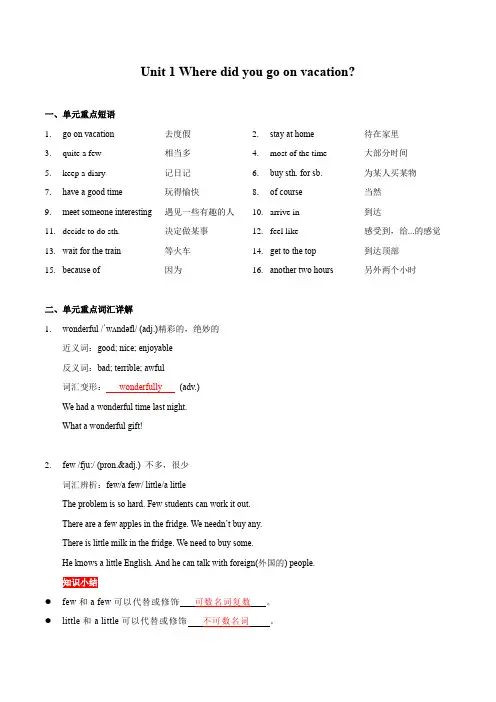
Unit 1 Where did you go on vacation?一、单元重点短语1.go on vacation 去度假2.stay at home待在家里3.quite a few 相当多4.most of the time 大部分时间5.keep a diary 记日记6.buy sth. for sb.为某人买某物7.have a good time玩得愉快8.of course当然9.meet someone interesting遇见一些有趣的人10.arrive in 到达11.decide to do sth. 决定做某事12.feel like 感受到,给...的感觉13.wait for the train等火车14.get to the top到达顶部15.because of因为16.another two hours另外两个小时二、单元重点词汇详解1.wonderful /ˈwʌndəfl/ (adj.)精彩的,绝妙的近义词:good; nice; enjoyable反义词:bad; terrible; awful词汇变形:wonderfully (adv.)We had a wonderful time last night.What a wonderful gift!2.few /fju:/ (pron.&adj.) 不多,很少词汇辨析:few/a few/ little/a littleThe problem is so hard. Few students can work it out.There are a few apples in the fridge. We needn’t buy any.There is little milk in the fridge. We need to buy some.He knows a little English. And he can talk with foreign(外国的) people.●●●●few/a few/ little/a little辨析表3.seem /si:m/ (v.)好像;似乎;看来词汇用法:You seem happy.(seem +adj.)He seems a nice man. (seem +n.)He seemed to be sleeping.(seem+to do)It seems that everyone here likes the little girl. (It seems/seemed that...)4.bored /bɔ:d/ (adj.) 厌倦的,烦闷的词汇辨析:bored/ boring“使/令...”动词-ed/-ing构成一组形容词;-ed结尾的意为“ 让/令人感到...样的”;-ing结尾的意为“ 感到...样的”。
初中英语《Wheredidyougoonvacation?》说课稿
初中英语《Where did you go on vacation?》说课稿一. 教材分析《Where did you go on vacation?》是人教版初中英语八年级下册第6单元的一篇阅读文章。
本文主要讲述了一个学生在暑假期间去海滩度假的经历。
通过阅读这篇文章,学生可以了解暑假度假的经历,同时学习到相关的英语词汇和语法知识。
二. 学情分析学生在学习本课时,已经掌握了基本的英语语法和词汇知识,具备一定的阅读理解能力。
但部分学生对旅游度假的相关词汇和表达可能较为陌生,需要通过教师的引导和学生的自主学习来掌握。
三. 说教学目标1.知识目标:学生能够掌握度假相关的词汇和表达,如:beach,vacation, visit, attraction等。
2.能力目标:学生能够运用所学的词汇和语法知识,描述自己的暑假度假经历。
3.情感目标:激发学生对旅游度假的兴趣,培养他们积极的生活态度。
四. 说教学重难点1.重点:度假相关词汇的掌握和运用。
2.难点:过去式的运用和描述自己的度假经历。
五. 说教学方法与手段1.情境教学法:通过创设度假情境,引导学生运用所学知识进行实际操作。
2.任务型教学法:通过完成各种任务,激发学生的学习兴趣,提高他们的实践能力。
3.合作学习:小组讨论,共同完成学习任务,培养学生的团队协作能力。
六. 说教学过程1.导入:教师通过提问学生“你们暑假去哪里度假了?”引导学生进入话题,激发学生的兴趣。
2.新课呈现:教师展示度假相关的图片,引导学生说出对应的词汇,如:beach, vacation等。
3.自主学习:学生自主阅读文章,理解文章内容,回答相关问题。
4.课堂讨论:学生分组讨论,分享自己的度假经历,运用所学知识进行表达。
5.语法讲解:教师讲解过去式的用法,引导学生正确表达自己的度假经历。
6.实践环节:学生分组完成度假计划,运用所学知识进行实际操作。
7.总结:教师引导学生总结本节课所学内容,巩固知识。
人教新目标八年级英语上册Unit1Wheredidyougoonvacation知识点讲解
Unit 1Where did you go on vacation?知识点讲解一、语法:不定代词(一)、由some, any, no, every与thing, one, body 构成的不定代词称为复合不定代词。
someone / somebody 某人something 某事;某物anyone / anybody 任何人anything 任何事物no one / nobody 无人;没有人everyone / eveybody 每人everything 每一件事物;一切nothing 没有什么1.复合不定代词作主语时,都坐单数看待,谓语动词用第三称单数。
No one knows the answer. 没有人知道这个答案。
There was nothing much to do in the evening. 在晚上无事可做。
Everyone ______ ( have ) a computer in my family. 在我家每人都有一台电脑。
Everything___________ ( begin) to grow in spring. 在春天,万物开始生长。
2.形容词、动词不定式等作定语修饰复合不定代词时,要放在不定代词之后。
There is nothing interesting in the newspaper.报纸上没有什么有趣的事情。
Do you want anything to drink?你想喝点什么吗?I would like something to eat. 我想要些吃的?3. 一般情况下,含有some的复合不定代词someone / somebody, something常用于肯定句,含有any的复合不定代词anyone / anybody, anything常用于否定句、疑问句中代替someone / somebody, anytning表示“ 某人”,“某物”。
Unit_1_where_did_you_go_on_vacation知识点详解
U2 Where did you go on vacation?Important phrases: (重点短语)1.去夏令营2.买一些特别的东西3.为考试准备4.跟某人外出5.去纽约市6.好久不见7.度假8.去某个有趣的地方9.大多数时间10.给母鸡喂食11.除—外一无所有12.当然,自然13.似乎有点无聊14记日记15.令人愉快地活动16.到达17.决定去海边18.尝试滑翔伞运动19.感觉像一只小鸟20.想要骑车21.中国商人的房子22.在过去23许多古老的建筑24步行到山顶25.开始下雨26.等了一个多小时的火车27.下大雨28.忘记带一把雨伞29.又湿又冷30.因为恶劣的天气31.带着足够的钱32.足够大33.好像有点饿34.与—一样好35 不如----好36.照了相当多的相片37.停下来喝水38.继续前进39.激动地跳跃40.二十分钟后41.如此---以至于42.升起43.发现--44.尝起来很好吃45.尽力去做某事46.停止做某事47.不喜欢做某事48.继续做某事49.一碗米饭50为某人买某物重点句子1where did you go on vacation?go on vacation 去度假2.Visited my uncle重点:visit为及物动词,“拜访,探望,参观,游览”后接人或地点改错Did you visit in china?3. Did you buy anything special?1)buy 的过去式为boughtbuy sth.for sb.=buy sb sth.我为Tom买了一个礼物2)anything 不定代词“某物,某事”主要用于疑问句和否定句中一旦anything用于可定句中,则意为“任何事,任何东西”Eg You can ask me anything you want to know3)★形容词修饰不定代词要后置4.Oh,did you go anything interesting?这是一般过去时中不含was/were的句子在变一般疑问句时,需用助动词did。
八年级英语上册 Unit 1 Where did you go on vacation短语、语法知识
Unit 1 Where did you go on vacation一、必背单词短语。
【教材知识点总结】Section A1.Where did you go on vacation? (P. 1)on vacation意为“在度假”,结构“on+名词”表示“在某种状态中”。
例句:My family went to Hainan on vacation last year.2....visited my uncle (P. 1)visit此处用作及物动词,后接人或物做宾语,意为“拜访、看望”,后接表示地点的名词,意为“参观、游览”。
例句:I visited my grandmother last week.例句:Do you want to visit Shanghai?3....go with anyone? (P. 2)(1)anyone用作不定代词,意为“有人、任何人”,相当于anybody,用于疑问句和否定句中,在肯定句中用someone或者somebody。
但是anyone也可以用在肯定句中,表示“任何一个人”。
例句:Did you meet anyone friendly in that city?例句:Anyone can be helpful in some way.(2)anyone只能指人,不可以指物,后面不接of短语;any one既可以指人也可以指物,后可接of短语。
例句:You can ask any one of us about this question.4....buy anything special? (P. 2)(1)buy用作双宾语动词,表示“买”,常用的结构为“buy sb. sth.”或者“buy sth. for sb.”,表示“为某人买某物”。
例句:My father bought me a bike.=My father bought a bike for me.【拓展】可接双宾语的动词还有give, bring, show, tell, sell等。
八年级上册下Unit1-Where-did-you-go-on-vacation
1. _S_o_m_e_o_n_e__ found Mr. Li’s keys and gave them back to him yesterday.
2. ─Did you see _a_n_y_t_h_in_g__ in the big box? ─ No, I didn’t. There’s _n_o_th__in_g_ in it.
It was delicious.
Practice
How were the hamburgers?
They were delicious.
Practice
How was the apple?
It was terrible.
Practice
How was the ice cream?
It was expensive.
3. _N_o__o_n_e___ helped the little boy. He did it himself.
4. My watch doesn’t work. _S_o_m_e_t_h_i_n_g__ is wrong with it.
5. ─Hello, _e_v_e_r_y_o_n_e___! ─Hello, Mr. Smห้องสมุดไป่ตู้th!
much to do in the evening but read. (即使这样)仍然没有人似乎看起来无聊。 Still no one seemed to be bored.
初中英语《Where did you go on vacation?》教学设计
初中英语《Where did you go on vacation?》教学设计一. 教材分析《Where did you go on vacation?》是人教版初中英语八年级下册第三单元的内容。
本节课主要讨论人们假期去哪里旅游以及他们的旅游经历。
通过本节课的学习,学生可以掌握一般过去时的运用,学会如何询问和描述假期活动。
教材内容丰富,插图生动,有利于激发学生的学习兴趣。
二. 学情分析八年级的学生已经掌握了基本的英语语法知识,对于一般过去时也有了一定的了解。
他们在学习过程中,能够通过图片和情境来理解新单词和句型。
同时,他们好奇心强,愿意分享自己的经验和故事。
但部分学生可能在口语表达和听力理解方面存在困难,需要教师在教学过程中给予关注和指导。
三. 教学目标1.知识目标:学生能够掌握一般过去时的运用,学会如何询问和描述假期活动。
2.能力目标:学生能够在真实情境中运用所学知识进行交流,提高口语表达能力。
3.情感目标:通过本节课的学习,学生能够培养对旅游的兴趣,增进同学之间的友谊。
四. 教学重难点1.重点:一般过去时的运用,询问和描述假期活动的句型。
2.难点:一般过去时态的动词形式变化,以及如何在实际情境中灵活运用。
五. 教学方法1.情境教学法:通过设定旅游情境,引导学生运用所学知识进行交流。
2.交际法:鼓励学生积极参与课堂活动,提高口语表达能力。
3.任务型教学法:通过完成小组任务,培养学生的合作精神和团队意识。
六. 教学准备1.教师准备:提前准备教学PPT,包括课文内容、图片、视频等。
2.学生准备:预习课文,了解一般过去时的基本用法。
七. 教学过程1.导入(5分钟)教师通过提问学生“Do you like traveling?”引导学生谈论旅游话题,激发学生的学习兴趣。
然后展示一张旅游图片,引导学生用英语描述图片中的景色。
2.呈现(10分钟)教师播放课文动画视频,让学生初步感知一般过去时的句型。
随后,教师展示课文插图,引导学生看图说话,运用一般过去时描述图片中的情景。