
006年考研英语完形填空真题解析
2006年考研英语完形填空真题解析The homeless make up a growing percentage of America's population. 1 homelessness has reached such proportions that local government can't possibly 2 . To help homeless people 3 independence, the federal government must support job training programs, 4 the minimum wage, a n d f u n d m o r e l o w-c o s t h o u s i n g.5 everyone agrees on the numbers of Americans who are homeless. Estimates6 anywhere from 600,000 to 3 million.7 the figure may vary, analysts do agree on another matter: that the number of the homeless is8 , one of the federal government's studies9 that the number of the homeless will r e a c h n e a r l y19m i l l i o n b y t h e e n d o f t h i s d e c a d e.Finding ways to 10 this growing homeless population has become increasingly difficult. 11 when homeless individuals manage to find a 12 that will give them three meals a day and a place to sleep at night, a good number still spend the bulk of each day 13 the street. Part of the problem is that many homeless adults are addicted to alcohol or drugs. And a significant number of the homeless have serious mental disorders. Many others, 14 not addicted or mentally ill, simply lack the everyday 15 skills needed to turn their lives 16 . Boston Globe reporter Chris Reedy notes that the situation will improve only when there are 17 programs that address the many needs of the homeless. 18 Edward Zlotkowski, director of community service at Bentley College in Massachusetts, 19 it. "There has to be 20o f p r o g r a m s.W h a t w e n e e d i s a p a c k a g e d e a l."1.[A]I n d e e d[B]L i k e w i s e[C]T h e r e f o r e[D]F u r t h e r m o r e2.[A]s t a n d[B]c o p e[C]a p p r o v e[D]r e t a i n3.[A]i n[B]f o r[C]w i t h[D]t o w a r d4.[A]r a i s e[B]a d d[C]t a k e[D]k e e p5.[A]G e n e r a l l y[B]A l m o s t[C]H a r d l y[D]N o t6.[A]c o v e r[B]c h a n g e[C]r a n g e[D]d i f f e r7.[A]N o w t h a t[B]A l t h o u g h[C]P r o v i d e d[D]E x c e p t t h a t8.[A]i n f l a t i n g[B]e x p a n d i n g[C]i n c r e a s i n g[D]e x t e n d i n g9.[A]p r e d i c t s[B]d i s p l a y s[C]p r o v e s[D]d i s c o v e r s10.[A]a s s i s t[B]t r a c k[C]s u s t a i n[D]d i s m i s s11.[A]H e n c e[B]B u t[C]E v e n[D]O n l y12.[A]l o d g i n g[B]s h e l t e r[C]d w e l l i n g[D]h o u s e13.[A]s e a r c h i n g[B]s t r o l l i n g[C]c r o w d i n g[D]w a n d e r i n g14.[A]w h e n[B]o n c e[C]w h i l e[D]w h e r e a s15.[A]l i f e[B]e x i s t e n c e[C]s u r v i v a l[D]m a i n t e n a n c e16.[A]a r o u n d[B]o v e r[C]o n[D]u p17.[A]c o m p l e x[B]c o m p r e h e n s i v e[C]c o m p l e m e n t a r y[D]c o m p e n s a t i n g18.[A]S o[B]S i n c e[C]A s[D]T h u s19.[A]p u t s[B]i n t e r p r e t s[C]a s s u m e s[D]m a k e s20.[A]s u p e r v i s i o n[B]m a n i p u l a t i o n[C]r e g u l a t i o n[D]c o o r d i n a t i o n文章背景本文主要介绍了美国社会中的无家可归者,以及他们目前的现状:他们的数量已经增长至地方政府对付不了的地步,需要联邦政府采取措施帮助他们重新获得自立。
但是,许多无家可归者即使在解决温饱之后仍然游荡街头,这是因为他们要么酗酒或吸毒成瘾,要么患严重的精神疾病,要么就是缺乏能够改变生活现状的生存技能。
因此,要想从根本上帮助这些无家可归者,必须采取综合的彼此协调的一揽子措施。
文章结构本文采用了总分的叙述方式,第一段提出了文章的主题"无家可归者的人数在增加,政府必须采取措施来解决这一问题"。
第二段和第三段作者分别从这两个方面进行了论述,第二段提出无家可归者的人数在未来还会进一步增加;第三段提出了解决这一问题的方法。
答案详解1. 【解析】[A] 语义衔接/逻辑衔接。
The homeless make up a growing percentage of America's po pulation., homelessness has reached such proportions that…。
"无家可归者在美国人口中占越来越大的比例。
……无家可归者所占的比例已经达到如此地步,以至于……。
" 选项A. indeed表示强调;B. likewise与……相似;C. therefore因此(强调结果);D. furthermore进一步说(表示递进)。
根据前一句"make up a growing percentage"与后一句"reach such proportion that"确定后者是对前者的例证强调。
因此,正确答案为A。
2.【解析】[B] 语义衔接题。
本题目选择动词在定语从句中充当谓语。
…homelessness has reached such proportions that local government can't possibly. "无家可归者所占的比例已经达到地方政府都无法……的地步。
"选项A. stand 忍受;B. cope (成功地)对付,应对;C. approve 赞成,批准;D. retain 保留。
stand作为及物动词在句子中要直接连接宾语,但是句子中没有宾语,因此该词不符合句子结构; cope作为不及物动词,可以在句子中表达完整的含义;C、D项与句意不符。
因此,正确答案为B。
3.【解析】[D] 语义衔接题。
本题目选择介词,选择介词与句子中的动词有直接关系。
原文意为:帮助无家可归者达到独立。
D项toward意为"达成,意在达到,以……为目标"。
C项with 可与help构成搭配to help sb. with sth."帮助某人做某事",与题意不符。
因此,正确答案为D。
4.【解析】[A] 语义衔接题。
the federal government must support job training programs,the minimum wage, and fund more low cost housing. "联邦政府必须提供就业培训项目,……最低工资标准,资助建设更多低价住房。
" 句子中"the minimum wage"与前面的短语"support job training program"(提供就业培训项目)和后面的短语"fund more low cost housing"(资助建设更多低价住房)是并列关系。
由提供信息确定选择"提高"之意。
06年英语试题阅读理解部分(A)解析

(4)fit in/into(大小、式样、数量适合)可容纳,装进,如:All the kids will~the back of the car.(所有的孩子都可以坐到车的后排。
)(5)indices(n.)index的复数形式,标志,指标,表征,如:The number of new houses being built is a good index of a contry’s prosperity.(新建房屋的数目是国家繁荣的一个有用指标。
)(6)census(n.)人口(户口)调(普)查,(调查)统计的数字;(v.)调查人口数字(7)bilingual(a.)能讲两国话的;使用两种语言的(8)graveyard(n.)墓地,坟场(9)divisive(a.)区分的,引起分裂的,造成不和的(10)pocket(n.)(与周围不同的)小组织,小区域,如:There are still a few isolated ~s of resistance to the new regime.(现在仍有零星孤立的势力反对新政权。
)(11)seethe(v.)(with/at sth.)强压怒火,生闷气;(with sth.)充满,遍布;如:The resort is seething with tourists all year round.(这处名胜一年四季游人如织。
)五、全文翻译尽管人们喋喋不休地谈论美国社会的差异,美国社会仍然是一部惊人的民族融合的机器。
在美国,大众文化的特点就是“在服饰和谈吐方面大众化的一致性、漫不经心和不拘礼节”。
人们沉迷于一种由19世纪的百货商店掀起的“消费文化”中。
这些商店“在幽雅的环境中供应琳琅满目的商品。
与那些迎合知识精英人士的人情味十足的小商店不同”,这些商店是“任何阶级和背景的人都可以进入的”。
这使得购物转变为一种公共和大众的行为。
大众媒介、广告和体育赛事也促进了民族同化。
06年天津高考英语试题完形填空及详解
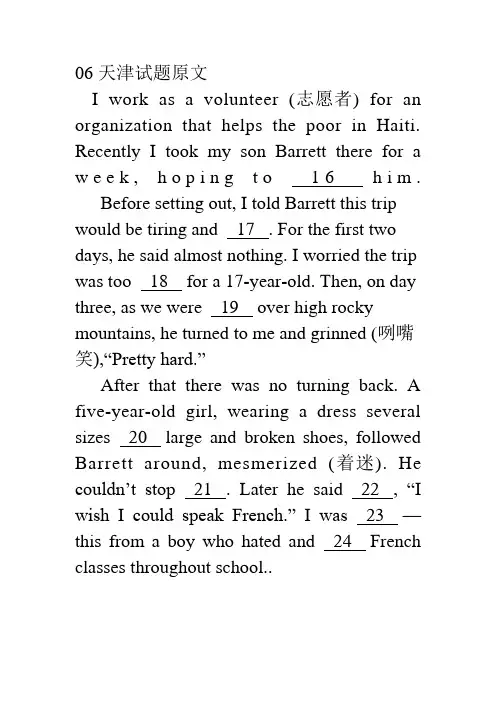
06天津试题原文I work as a volunteer (志愿者) for an organization that helps the poor in Haiti. Recently I took my son Barrett there for a w e e k,h o p i n g t o16h i m. Before setting out, I told Barrett this trip would be tiring and 17 . For the first two days, he said almost nothing. I worried the trip was too 18 for a 17-year-old. Then, on day three, as we were 19 over high rocky mountains, he turned to me and grinned (咧嘴笑),“Pretty hard.”After that there was no turning back. A five-year-old girl, wearing a dress several sizes 20 large and broken shoes, followed Barrett around, mesmerized (着迷). He couldn’t stop 21 . Later he said 22 , “I wish I could speak French.” I was 23 —this from a boy who hated and 24 French classes throughout school..Usually silent, he 25 Gaby, our host, and kept asking questions about the country and its people. He blossomed (活泼起来).26,t h e m o m e n t t h a t r e a l l y took 27 breath away occurred in a village deep in the mountains. I was 28 a woman villager for an article. 135 centimeters tall, she was small in figure but strong in 29 . Through determination, she had learned to read and write, and 30 to become part of t h e l e a d e r s h i p o f the __31__.Learning her story, Barrett was as 32 as I by this tiny woman’s achievements. His eyes were wet and there was a 33 of love and respect on his face. He had finally understood the importance of my work .When leaving for home, Barrett even offered to stay 34 as a volunteer. My insides suddenly felt struck.This 35 achieved all I’d expected. Soon he will celebrate his 18th birthday. He’ll be a man.16.A. comfort B. please C.attractD.educate17.A. rough B.dangerous C.troublesomeD.violent18.A. little B. much C. fast D. slow19.A. moving B. running C.climbingD.looking20.A. too B. very C. even D. so21.A. joking B.crying C.shoutingD.smiling22.A. patiently B.regretfullyC.lightlyD.cheerfully23.A. ashamed B.disappointedC.determinedD.surprised24.A. took up B. went inforC. foughtagainstD.calledoff25.A. B. C. D.befriended disregarded avoided recognized26.A. Thus B. Even C.Meanwhile D. Howev er27.A. my B. his C. our D. her28.A. asking B.interviewing C.arrangingD.describing29.A. brain B. wish C. will D.health30.A. appeared B.struggledC.hesitatedD.failed31.A. village B. city C.organizationD. state32.A. pleased B. bored C.puzzledD.touchedbin ation. B.composition .C.connectionD.satisfaction34.A. in B. behind C. out D.away35.A.B. flightC. articleD. trip interview16—25 DABCA DBDCA 26—35 DABCB ADABD简析:该文综述见第35题。
(完整)2006年考研英语真题及答案,推荐文档
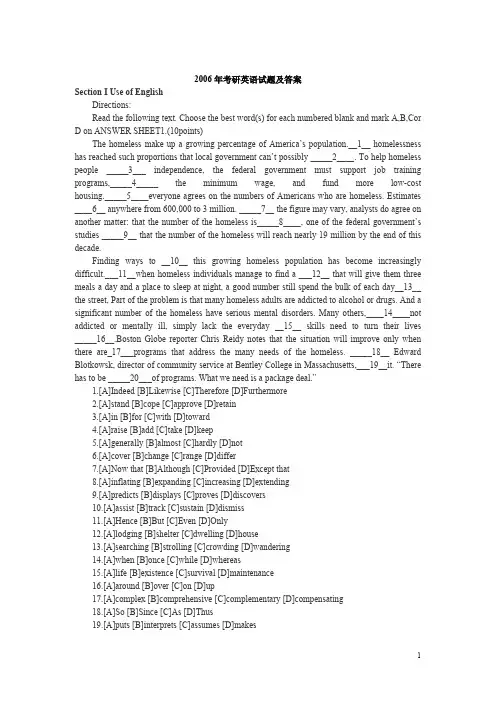
2006年考研英语试题及答案Section I Use of English Directions: Read the following text. Choose the best word(s) for each numbered blank and mark A,B,Cor D on ANSWER SHEET1.(10points) The homeless make up a growing percentage of America’s population.__1__ homelessness has reached such proportions that local government can’t possibly _____2____. To help homeless people _____3___ independence, the federal government must support job training programs,_____4_____ the minimum wage, and fund more low-cost housing._____5____everyone agrees on the numbers of Americans who are homeless. Estimates ____6__ anywhere from 600,000 to 3 million. _____7__ the figure may vary, analysts do agree on another matter: that the number of the homeless is_____8____, one of the federal government’s studies _____9__ that the number of the homeless will reach nearly 19 million by the end of this decade. Finding ways to __10__ this growing homeless population has become increasingly difficult.___11__when homeless individuals manage to find a ___12__ that will give them three meals a day and a place to sleep at night, a good number still spend the bulk of each day__13__ the street, Part of the problem is that many homeless adults are addicted to alcohol or drugs. And a significant number of the homeless have serious mental disorders. Many others,____14____not addicted or mentally ill, simply lack the everyday __15__ skills need to turn their lives _____16__.Boston Globe reporter Chris Reidy notes that the situation will improve only when there are_17___programs that address the many needs of the homeless. _____18__ Edward Blotkowsk, director of community service at Bentley College in Massachusetts,___19__it. “There has to be _____20___of programs. What we need is a package deal.” 1.[A]Indeed [B]Likewise [C]Therefore [D]Furthermore 2.[A]stand [B]cope [C]approve [D]retain 3.[A]in [B]for [C]with [D]toward 4.[A]raise [B]add [C]take [D]keep 5.[A]generally [B]almost [C]hardly [D]not 6.[A]cover [B]change [C]range [D]differ 7.[A]Now that [B]Although [C]Provided [D]Except that 8.[A]inflating [B]expanding [C]increasing [D]extending 9.[A]predicts [B]displays [C]proves [D]discovers 10.[A]assist [B]track [C]sustain [D]dismiss 11.[A]Hence [B]But [C]Even [D]Only 12.[A]lodging [B]shelter [C]dwelling [D]house 13.[A]searching [B]strolling [C]crowding [D]wandering 14.[A]when [B]once [C]while [D]whereas 15.[A]life [B]existence [C]survival [D]maintenance 16.[A]around [B]over [C]on [D]up 17.[A]complex [B]comprehensive [C]complementary [D]compensating 18.[A]So [B]Since [C]As [D]Thus 19.[A]puts [B]interprets [C]assumes [D]makes 20.[A]supervision [B]manipulation [C]regulation [D]coordinationSection II Reading Comprehension Part A Directions: Read the following four texts. Answer the questions below each text by choosing A, B,C, or D. Mark your answers on ANSWER SHEET 1.(40 points) Text 1 In spite of “endless talk of difference,” American society is an amazing machine for homogenizing people. This is “the democratizing uniformity of dress and discourse, and the casualness and absence of consumption “launched by the 19th –century department stores that offered ‘vast arrays of goods in an elegant atmosphere. Instead of intimate shops catering to a knowledgeable elite.” these were stores “anyone could enter, regardless of class or background. This turned shopping into a public and democratic act.” The mass media, advertising and sports are other forces for homogenization. Immigrants are quickly fitting into this common culture, which may not be altogether elevating but is hardly poisonous. Writing for the National Immigration Forum, Gregory Rodriguez reports that today’s immigration is neither at unprecedented level nor resistant to assimilation. In 1998 immigrants were 9.8 percent of population; in 1900, 13.6 percent. In the 10 years prior to 1990, 3.1 immigrants arrived for every 1,000 residents; in the 10 years prior to 1890, 9.2 for every 1,000. Now, consider three indices of assimilation------language, home ownership and intermarriage. The 1990 Census revealed that “a majority of immigrants from each of the fifteen most common countries of origin spoke English “well” or “very well” after ten years of residence.” The children of immigrants tend to be bilingual and proficient in English. “By the third generation, the original language is lost in the majority of immigrant families.” Hence the description of America as a graveyard” for language. By 1996 foreign-born immigrants who had arrive before 1970 had a home ownership rate of 75.6 percent, higher than the 69.8 percent rate among native-born Americans. Foreign-born Asians and Hispanics “have higher rates of intermarriage than do U.S-born whites and blacks.” By the third generation, one third of Hispanic women are married to non-Hispanics, and 41 percent of Asian-American women are married to non-Asians. Rodriguez not that children in remote villages around world are fans of superstars like Amold Schwarzenegger and Garth Brooks, yet “some Americans fear that immigrant living within the United States remain somehow immune to the nation’s assimilative power.” Are there divisive issues and pockets of seething in America? Indeed. It is big enough to have a bit of everything. But particularly when viewed against America’s turbulent past, today’s social induces suggest a dark and deteriorating social environment. 21. The word “homogenizing” (Line 2, Paragraph 1) most probably meansA. identifyingB. associatingC. assimilatingD. monopolizing 22. According to the author, the department stores of the 19th century A.played a role in the spread of popular culture. B.became intimate shops for common consumers. C.satisfied the needs of a knowledgeable elite. D.owed its emergence to the culture of consumption. 23. The text suggests that immigrants now in the U.S. A.are resistant to homogenization. B.exert a great influence on American culture. C.are hardly a threat to the common culture. D.constitute the majority of the population. 24. Why are Amold Schwarzenegger and Garth Brooks mentioned in Paragraph 5? A. To prove their popularity around the world. B. To reveal the public’s fear of immigrants. C. To give examples of successful immigrants. D. To show the powerful influence of American culture. 25. In the author’s opinion, the absorption of immigrants into American society isA. rewardingB. successfulC. fruitlessD. harmful Text 2 Stratford-on-Avon, as we all know, has only one industry—William Shakespeare—but there are two distinctly separate and increasingly hostile branches. There is the Royal Shakespeare Company (ASC), which presents superb productions of the plays at the Shakespeare Memorial Theatre on the Avon. And there are the townsfolk who largely live off the tourists who come, not to see the plays, but to look at Anne Hathaway’s Cottage, Shakespeare’s birthplace and the other sights. The worthy residents of Stratford doubt that the theatre adds a penny to their revenue. They frankly dislike the RSC’s actors, them with their long hair and beards and sandals and noisiness. It’s all deliciously ironic when you consider that Shakespeare, who earns their living, was himself an actor (with a beard) and did his share of noise-making. The tourist streams are not entirely separate. The sightseers who come by bus- and often take in Warwick Castle and Blenheim Palace on the side—don’t usually see the plays, and some of them are even surprised to find a theatre in Stratford. However, the playgoers do manage a little sight-seeing along with their playgoing. It is the playgoers, the ESC contends, who bring in much of the town’s revenue because they spend the night (some of them four or five nights) pouring cash into the hotels and restaurants. The sightseers can take in everything and get out of town by nightfall. The townsfolk don’t see it this way and local council does not contribute directly to the subsidy of the Royal Shakespeare Company. Stratford cries poor traditionally. Nevertheless every hotel in town seems to be adding a new wing or cocktail lounge. Hilton is building its own hotel there, which you may be sure will be decorated with Hamlet Hamburger Bars, the Lear Lounge, the Banquo Banqueting Room, and so forth, and will be very expensive. Anyway, the townsfolk can’t understand why the Royal Shakespeare Company needs a subsidy. (The theatre has broken attendance records for three years in a row. Last year its 1,431 seats were 94 percent occupied all year long and this year they’ll do better.) The reason, of course, is that costs have rocketed and ticket prices have stayed low. It would be a shame to raise prices too much because it would drive away the young people who are Stratford’s most attractive clientele. They come entirely for the plays, not the sights. They all seem to look alike (though they come from all over)---lean, pointed, dedicated faces, wearing jeans and sandals, eating their buns and bedding down for the night on the flagstones outside the theatre to buy the 20 seats and 80 standing—room tickets held for the sleepers and sold to themwhen the box office opens at 10:30 a.m.Text 3 When prehistoric man arrived in new parts of the world, something strange happened to the large animals. They suddenly became extinct. Smaller species survived. The large, slow-growing animals were easy game, and were quickly hunted to extinction. Now something similar could be happening in the oceans. That the seas are being overfished has been known for years. What researchers such as Ransom Myers and Boris Worm have shown is just how fast things are changing. They have looked at half a century of data from fisheries around the world. Their methods do not attempt to estimate the actual biomass (the amount of living biological matter) of fish species in particular parts of the ocean, but rather changes in that biomass over time. According to their latest paper published in Nature, the biomass of large predators (animals that kill and eat other animals) in a new fishery is reduced on average by 80% within 15 years of the start of exploitation. In some long-fished areas, it has halved again since then. Dr Worm acknowledges that the figures are conservative. One reason for this is that fishing technology has improved. Today's vessels can find their prey using satellites and sonar, which were not available 50 years ago. That means a higher proportion of what is in the sea is being caught, so the real difference between present and past is likely to be worse than the one recorded by changes in catch sizes. In the early days, too, longlines would have been more saturated with fish. Some individuals would therefore not have been caught, since no baited hooks would have been available to trap them, leading to an underestimate of fish stocks in the past. Furthermore, in the early days of longline fishing, a lot of fish were lost to sharks after they had been hooked. That is no longer a problem, because there are fewer sharks around now. Dr Myers and Dr Worm argue that their work gives a correct baseline, which future management efforts must take into account. They believe the data support an idea current among marine biologists, that of the "shifting baseline". The notion is that people have failed to detect the massive changes which have happened in the ocean because they have been looking back only a relatively short time into the past. That matters because theory suggests that the maximum sustainable yield that can be cropped from a fishery comes when the biomass of a target species is about 50% of its original levels. Most fisheries are well below that, which is a bad way to do business. 31. The extinction of large prehistoric animals is noted to suggest that A. large animal were vulnerable to the changing environment. B. small species survived as large animals disappeared. C. large sea animals may face the same threat today. D. Slow-growing fish outlive fast-growing ones 32. We can infer from Dr Myers and Dr. Worm’s paper that A. the stock of large predators in some old fisheries has reduced by 90%. B. there are only half as many fisheries as there were 15 years ago. C. the catch sizes in new fisheries are only 20% of the original amount. D. the number of larger predators dropped faster in new fisheries than in the old. 33. By saying these figures are conservative (Line 1, paragraph 3), Dr Worm means that A. fishing technology has improved rapidly B. then catch-sizes are actually smaller then recorded C. the marine biomass has suffered a greater loss D. the data collected so far are out of date. 34. Dr Myers and other researchers hold that A. people should look for a baseline that can’t work for a longer time. B. fisheries should keep the yield below 50% of the biomass C. the ocean biomass should restored its original level. D. people should adjust the fishing baseline to changing situation 35. The author seems to be mainly concerned with most fisheries’ A.management efficiency B.biomass level C.catch-size limits D.technological application. Text 4 Many things make people think artists are weird and the weirdest may be this: artists' only job is to explore emotions, and yet they choose to focus on the ones that feel bad. This wasn't always so. The earliest forms of art, like painting and music, are those best suited for expressing joy. But somewhere in the 19th century, more artists began seeing happiness as insipid, phony or, worst of all, boring as we went from Wordsworth's daffodils to Baudelaire's flowers of evil. You could argue that art became more skeptical of happiness because modern times have seen such misery. But it's not as if earlier times didn't know perpetual war, disaster and the massacre of innocents. The reason, in fact, may be just the opposite: there is too much damn happiness in the world today. After all, what is the one modern form of expression almost completely dedicated to depicting happiness? Advertising. The rise of anti-happy art almost exactly tracks the emergence of mass media, and with it, a commercial culture in which happiness is not just an ideal but an ideology. People in earlier eras were surrounded by reminders of misery. They worked until exhausted, lived with few protections and died young. In the West, before mass communication and literacy, the most powerful mass medium was the church, which reminded worshippers that their souls were in peril and that they would someday be meat for worms. Given all this, they did not exactly need their art to be a bummer too. Today the messages your average Westerner is bombarded with are not religious but commercial, and forever happy. Fast-food eaters, news anchors, text messengers, all smiling, smiling. Our magazines feature beaming celebrities and happy families in perfect homes. And since these messages have an agenda--to lure us to open our wallets to make the very idea of happiness seem unreliable. "Celebrate!" commanded the ads for the arthritis drug Celebrex, before we found out it could increase the risk of heart attacks. What we forget--what our economy depends on is forgetting--is that happiness is more than pleasure without pain. The things that bring the greatest joy carry the greatest potential for loss and disappointment. Today, surrounded by promises of easy happiness, we need someone to tell us as religion once did, Memento mori: remember that you will die, that everything ends, and that happiness comes not in denying this but in living with it. It's a message even more bitter than a clove cigarette, yet, somehow, a breath of fresh air. 36.By citing the example of poets Wordsworth and Baudelaire, the author intends to show that A. Poetry is not as expressive of joy as painting or music. B. Art grow out of both positive and negative feeling. C. Poets today are less skeptical of happiness. D. Artist have changed their focus of interest. 37. The word “bummer” (Line 5. paragraph 5) most probably means somethingA. religiousB. unpleasantC. entertainingD. commercial 38.In the author’s opinion, advertising A.emerges in the wake of the anti-happy part. B.is a cause of disappointment for the general peer C.replace the church as a major source of information D.creates an illusion of happiness rather than happiness itself. 39.We can learn from the last paragraph that the author believes A.Happiness more often than not ends in sadness. B.The anti-happy art is distasteful by refreshing. C.Misery should be enjoyed rather than denied. D.The anti-happy art flourishes when economy booms 40.Which of the following is true of the text? A.Religion once functioned as a reminder of misery. B.Art provides a balance between expectation and reality. C.People feel disappointed at the realities of morality. D.mass media are inclined to cover disasters and deaths.Part B Directions: In the following text, some sentences have been removed. For Questions 41-45, choose the most suitable one from the list A- G to fit into each of numbered blanks. There are two extra choices, which do not fit in any of the blanks. Mark your answers on ANSWER SHEET 1. (10 points) On the north bank of the Ohio River sits Evansville, Ind., home of David Williams, 52, and of a riverboat casino where gambling games are played. During several years of gambling in that casino, Williams, a state auditor earning $35,000 a year, lost approximately $175,000. He had never gambled before the casino sent him a coupon for $20 worth of gambling. He visited the casino, lost the $20 and left. On his second visit he lost $800. The casino issued to him, as a good customer, a Fun Card, which when used in the casino earns points for meals and drinks, and enables the casino to track the user's gambling activities. For Williams, these activities become what he calls electronic morphine. (41)______________. In 1997 he lost $21,000 to one slot machine in two days. In March 1997 he lost $72,186. He sometimes played two slot machines at a time, all night, until the boat locked at 5 a.m., then went back aboard when the casino opened at 9 a.m. Now he is suing the casino, charging that it should have refused his patronage because it knew he was addicted. It did know he had a problem. In March 1998, a friend of Williams's got him involuntarily confined to a treatment center for addictions, and wrote to inform the casino of Williams's gamblers. The casino included a photo of Williams among those of banned gamblers, and wrote to him a” cease admissions” letter notingthe medical/psychological nature of problem gambling behaviors, the letter said that before being readmitted to the patronizing the casino would pose no threat to his safety have to his safety or well-being. (42) ______________. The Wall Street Journal reports that the casino has 20 signs warning: “Enjoy the fun ... and always bet with your head, not over it”. Every entrance ticket lists a toll-free number for counseling from the Indiana Department of Mental Health. Nevertheless, Williams's suit charges that the casino, knowing he was “helplessly addicted to gambling”, intentionally worked to ”love” him to “engage in conduct against his will” well. (43) ______________. The fourth edition of the Diagnostic and Statistical Manual of Mental Disorders (DSM-IV) says “pathological gambling” involves persistent, recurring and uncontrollable pursuit less of money than of taking risks in quest of a windfall, (44) ______________.Pushed by science, or what claims to be science, society is reclassifying what once were considered character flaws or moral failings as personality disorders akin to physical disabilities. (45) ______________. Forty-four states have lotteries, 29 have casinos, and most of these states are to varying degrees dependent on --you might say --addicted to--revenues from wagering. And since the first Internet gambling site was created in 1995, competition for gamblers' dollars has become intense. The Oct. 28 issue of NEWSWEEK reported that 2 million gamblers patronize 1,800 virtual casinos every week. With $3.5 billion being lost on Internet wagers this year, gambling has passed pornography as the Web's most profitable business. (A). Although no such evidence was presented, the casino's marketing department continued to pepper him with mailings. And he entered the casino and used his Fun Card without being detected. (B). It is unclear what luring was required, given his compulsive behavior. And in what sense was his will operative? (C). By the time he had lost $5,000 he said to himself that if he could get back to even, he would quit. One night he won $5,500, but he did not quit. (D). Gambling has been a common feature of American life forever, but for a long time it was broadly considered a sin, or a social disease. Now it is a social policy: the most important and aggressive promoter of gambling in America is government. (E). David Williams’s suit should trouble this gambling nation. But don’t bet on it. (F). It is worrisome that society is medicalizing more and more behavioral problems, often defining as addictions what earlier, sterner generations explained as weakness of will. (G). The anonymous, lonely, undistracted nature of online gambling is especially conductive to compulsive behavior. But even if the government knew how to move against Internet gambling, what would be its grounds for doing so? Part C Directions: Read the following text carefully and then translate the underlined segments into Chinese. Our translation should be written neatly on ANSWER SHEET2. (10 points) Is it true that the American intellectual is rejected and considered of no account in his society?I am going to suggest that it is not true. Father Bruckbergen told part of the story when he observed that it is the intellectuals who have rejected Americans. But they have done more than that. They have grown dissatisfied with the role of intellectual. It is they, not Americans, who have become anti-intellectual. First, the object of our study pleads for definition. What is an intellectual? (46) I shall define him as an individual who has elected as his primary duty and pleasure in life the activity of thinking in Socratic(苏格拉底) way about moral problems .He explores such problem consciously, articulately, and frankly, first by asking factual questions, then by asking moral questions, finally by suggesting action which seems appropriate in the light of the factual and moral information which he has obtained. (47) His function is analogous to that of a judge, who must accept the obligation of revealing in as obvious a matter as possible the course of reasoning which led him to his decision. This definition excludes many individuals usually referred to as intellectuals --- the average scientist for one 48) I have excluded him because, while his accomplishments may contribute to the solution of moral problems, he has not been charged with the task of approaching any but the factual aspects of those problems. Like other human beings, he encounters moral issues even in everyday performance of his routine duties.--- he is not supposed to cook his experiments, manufacture evidence, or doctor his reports. (49) But his primary task is not to think about the moral code, which governs his activity, any more than a businessman is expected to dedicate his energies to an exploration of rules of conduct in business. During most of his walking life he will take his code for granted, as the businessman takes his ethics. The definition also excludes the majority of factors, despite the fact that teaching has traditionally been the method whereby many intellectuals earn their living (50) They may teach very well and more than earn their salaries, but most of them make little or no independent reflections on human problems which involve moral judgment .This description even fits the majority eminent scholars .“Being learned in some branch of human knowledge in one thing, living in public and industrious thoughts,” as Emerson would say ,“is something else.”Section III Writing Part A 51. Directions: You want to contribute to Project Hope by offering financial aid to a child in a remote area. Write a letter to the department concerned, asking them to help find a candidate. You should specify what kind of child you want to help and how you will carry out your plan. Write your letter with no less than 100 words. Write it on ANSWER SHEET 2. Do not sign your name at the end of the letter; use Li Ming instead. You do not need to write the address. (10 points) Part B 52. Directions: Study the following photos carefully and write an essay of 160~200 words in which you should 1.describe the photos briefly, 2.interpret the social phenomenon reflected by them, and 3.give your point of view. 有两幅图片,图1 把崇拜写在脸上图2 花300元做“小贝头” 注:Beckham 是英国足球明星 有两张照片,一张照片上有一位男士脸上写着足球明星的名字,另一张照片上有一个男子在理发,他要求理发师为他设计一个小贝克汉姆的发型。
考研英语历年阅读理解真题精析--2006年part3

Part Three When prehistoric man arrived in new parts of the world, something strange happened to the large animals. They suddenly became extinct. Smaller species survived. The large, slow-growing animals were easy game, and were quickly hunted to extinction. Now something similar could be happening in the oceans. That the seas are being overfished has been known for years. What researchers such as Ransom Myers and Boris Worm have shown is just how fast things are changing. They have looked at half a century of data from fisheries around the world. Their methods do not attempt to estimate the actual biomass (the amount of living biological matter)of fish species in particular parts of the ocean, but rather changes in that biomass over time. According to their latest paper published in Nature, the biomass of large predators (animals that kill and eat other animals)in a new fishery is reduced on average by 80% within 15 years of the start of exploitation. In some long-fished areas, it has halved again since then. Dr Worm acknowledges that the figures are conservative. One reason for this is that fishing technology has improved. Today's vessels can find their prey using satellites and sonar, which were not available 50 years ago. That means a higher proportion of what is in the sea is being caught, so the real difference between present and past is likely to be worse than the one recorded by changes in catch sizes. In the early days, too, longlines would have been more saturated with fish. Some individuals would therefore not have been caught, since no baited hooks would have been available to trap them, leading to an underestimate of fish stocks in the past. Furthermore, in the early days of longline fishing, a lot of fish were lost to sharks after they had been hooked. That is no longer a problem, because there are fewer sharks around now. Dr Myers and Dr Worm argue that their work gives a correct baseline, which future management efforts must take into account. They believe the data support an idea current among marine biologists, that of the "shifting baseline". The notion is that people have failed to detect the massive changes which have happened in the ocean because they have been looking back only a relatively short time into the past. That matters because theory suggests that the maximum sustainable yield that can be cropped from a fishery comes when the biomass of a target species is about 50% of its original levels. Most fisheries are well below that, which is a bad way to do business.11. The extinction of large prehistoric animals is noted to suggest that____ A. large animal were vulnerable to the changing environment. B. small species survived as large animals disappeared. C. large sea animals may face the same threat today. D. Slow-growing fish outlive fast-growing ones12. We can infer from Dr Myers and Dr. Worm’s paper that____ A. the stock of large predators in some old fisheries has reduced by 90%. B. there are only half as many fisheries as there were 15 years ago. C. the catch sizes in new fisheries are only 20% of the original amount. D. the number of larger predators dropped faster in new fisheries than in the old.13. By saying these figures are conservative (Line 1, paragraph 3), Dr Worm means that____ A. fishing technology has improved rapidly B. then catch-sizes are actually smaller then recorded C. the marine biomass has suffered a greater loss D. the data collected so far are out of date.14. Dr Myers and other researchers hold that_____ A. people should look for a baseline that can’t work for a longer time. B. fisheries should keep the yield below 50% of the biomass C. the ocean biomass should restored its original level. D. people should adjust the fishing baseline to changing situation15. The author seems to be mainly concerned with most fisheries’___A. management efficiencyB. biomass levelC. catch-size limitsD. technological application.Unit 13(2006)Part 3重点词汇:1. prey ① n. 被捕获的动物,捕⾷。
2006-2012年历年考研英语一真题(排版好)

2012年考研英语一(试题及答案详解)Section I Use of EnglishDirections:Read the following text. Choose the best word(s) for each numbered blank and mark A, B, C or D on ANSWER SHEET 1. (10 points)Read the following text. Choose the best word(s) for each numbered blank and mark A, B, C or D on ANSWER SHEET 1. (10 points)The ethical judgments of the Supreme Court justices have become an important issue recently. The court cannot _1_ its legitimacy as guardian of the rule of law _2_ justices behave like politicians. Yet, in several instances, justices acted in ways that _3_ the court’s reputation for being independent and impartial.Justice Antonin Scalia, for example, appeared at political events. That kind of activity makes it less likely that the court’s deci sions will be _4_ as impartial judgments. Part of the problem is that the justices are not _5_by an ethics code. At the very least, the court should make itself _6_to the code of conduct that _7_to the rest of the federal judiciary.This and other similar cases _8_the question of whether there is still a _9_between the court and politics.The framers of the Constitution envisioned law _10_having authority apart from politics. They gave justices permanent positions _11_they would be free to _12_ those in power and have no need to _13_ political support. Our legal system was designed to set law apart from politics precisely because they are so closely _14_.Constitutional law is political because it results from choices rooted in fundamental social _15_ like liberty and property. When the court deals with social policy decisions, the law it _16_ is inescapably political-which is why decisions split along ideological lines are so easily _17_ as unjust.The justices must _18_ doubts about the court’s legi timacy by making themselves _19_ to the code of conduct. That would make rulings more likely to be seen as separate from politics and, _20_, convincing as law.1. [A]emphasize [B]maintain [C]modify [D] recognize2. [A]when [B]lest [C]before [D] unless3. [A]restored [B]weakened [C]established [D] eliminated4. [A]challenged [B]compromised [C]suspected [D] accepted5. [A]advanced [B]caught [C]bound [D]founded6. [A]resistant [B]subject [C]immune [D]prone7. [A]resorts [B]sticks [C]loads [D]applies8. [A]evade [B]raise [C]deny [D]settle9. [A]line [B]barrier [C]similarity [D]conflict10. [A]by [B]as [C]though [D]towards11. [A]so [B]since [C]provided [D]though12. [A]serve [B]satisfy [C]upset [D]replace13. [A]confirm [B]express [C]cultivate [D]offer14. [A]guarded [B]followed [C]studied [D]tied15. [A]concepts [B]theories [C]divisions [D]conceptions16. [A]excludes [B]questions [C]shapes [D]controls17. [A]dismissed [B]released [C]ranked [D]distorted18. [A]suppress [B]exploit [C]address [D]ignore19. [A]accessible [B]amiable [C]agreeable [D]accountable20. [A]by all mesns [B]atall costs [C]in a word [D]as a resultSection II Reading ComprehensionPart AText 1Come on –Everybody’s doing it. That whispered message, half invitation and half forcing, is what most of us think of when we hear the words peer pressure. It usually leads to no good-drinking, drugs and casual sex. But in her new book Join the Club, Tina Rosenberg contends that peer pressure can also be a positive force through what she calls the social cure, in which organizations and officials use the power of group dynamics to help individuals improve their lives and possibly the word.Rosenberg, the recipient of a Pulitzer Prize, offers a host of example of the social cure in action: In South Carolina, a state-sponsored antismoking program called Rage Against the Haze sets out to make cigarettes uncool. In South Africa, an HIV-prevention initiative known as LoveLife recruits young people to promote safe sex among their peers.The idea seems promising,and Rosenberg is a perceptive observer. Her critique of the lameness of many pubic-health campaigns is spot-on: they fail to mobilize peer pressure for healthy habits, and they demonstrate a seriously flawed understanding of psychology.” Dare to be different, please don’t smoke!” pleads one billboard campaign aimed at reducing smoking among teenagers-teenagers, who desire nothing more than fitting in. Rosenberg argues convincingly that public-health advocates ought to take a page from advertisers, so skilled at applying peer pressure.But on the general effectiveness of the social cure, Rosenberg is less persuasive. Join the Club is filled with too much irrelevant detail and not enough exploration of the social and biological factors that make peer pressure so powerful. The most glaring flaw of the social cure as it’s presented here is that it doesn’t work very well for very long. Rage Against the Haze failed once state funding was cut. Evidence that the LoveLife program produces lasting changes is limited and mixed.There’s no doubt that our peer groups exert enormous influence on our behavior. An emerging body of research shows that positive health habits-as well as negative ones-spread through networks of friends via social communication. This is a subtle form of peer pressure: we unconsciously imitate the behavior we see every day.Far less certain, however, is how successfully experts and bureaucrats can select our peer groups and steer their activities in virtuous directions. It’s like the teacher who breaks up the troublemakers in the back row by pairing them with better-behaved classmates. T he tactic never really works. And that’s the problem with a social cure engineered from the outside: in the real world, as in school, we insist on choosing our own friends.21. According to the first paragraph, peer pressure often emerges as[A] a supplement to the social cure[B] a stimulus to group dynamics[C] an obstacle to school progress[D] a cause of undesirable behaviors22. Rosenberg holds that public advocates should[A] recruit professional advertisers[B] learn from advertisers’ experience[C] stay away from commercial advertisers[D] recognize the limitations of advertisements23. In the author’s view, Rosenberg’s book fails to[A] adequately probe social and biological factors[B] effectively evade the flaws of the social cure[C] illustrate the functions of state funding[D]produce a long-lasting social effect24. Paragraph 5shows that our imitation of behaviors[A] is harmful to our networks of friends[B] will mislead behavioral studies[C] occurs without our realizing it[D] can produce negative health habits25. The author suggests in the last paragraph that the effect of peer pressure is[A] harmful[B] desirable[C] profound[D] questionableText 2A deal is a deal-except, apparently ,when Entergy is involved. The company, a major energy supplier in New England, provoked justified outrage in Vermont last week when it announced it was reneging on a longstanding commitment to abide by the strict nuclear regulations.Instead, the company has done precisely what it had long promised it would not challenge the constitutionality of Vermont’s rules in the federal court, as part of a desperate effort to keep its Vermont Yankee nuclear power plant running. It’s a stunning move.The conflict has be en surfacing since 2002, when the corporation bought Vermont’s only nuclear power plant, an aging reactor in Vernon. As a condition of receiving state approval for the sale, the company agreed to seek permission from state regulators to operate past 2012. In 2006, the state went a step further, requiring that any extension of the plant’s license be subject to Vermont legislature’s approval. Then, too, the company went along.Either Entergy never really intended to live by those commitments, or it simply d idn’t foresee what would happen next. A string of accidents, including the partial collapse of a cooling tower in 207 and the discovery of an underground pipe system leakage, raised serious questions about both Vermont Yankee’s safety and Entergy’s management–especially after the company made misleading statements about the pipe. Enraged by Entergy’s behavior, the Vermont Senate voted 26 to 4 last year against allowing an extension.Now the company is suddenly claiming that the 2002 agreement is invalid because of the 2006 legislation, and that only the federal government has regulatory power over nuclear issues. The legal issues in the case are obscure: whereas the Supreme Court has ruled that states do have some regulatory authority over nuclear power, legal scholars say that Vermont case will offer a precedent-setting test of how far those powers extend. Certainly, there are valid concerns about the patchwork regulations that could result if every state sets its own rules. But had Entergy kept its word, that debate would be beside the point.The company seems to have concluded that its reputation in Vermont is already so damaged that it has noting left to lose by going to war with the state. But there should be consequences. Permission to run a nuclear plant is a poblic trust. Entergy runs 11 other reactors in the United States, including Pilgrim Nuclear station in Plymouth. Pledging to run Pilgrim safely, the company has applied for federal permission to keep it open for another 20 years. But as the Nu clear Regulatory Commission (NRC) reviews the company’s application, it should keep it mind what promises from Entergy are worth.26. The phrase “reneging on”(Line 3.para.1) is closest in meaning to[A] condemning.[B] reaffirming.[C] dishonoring.[D] securing.27. By entering into the 2002 agreement, Entergy intended to[A] obtain protection from Vermont regulators.[B] seek favor from the federal legislature.[C] acquire an extension of its business license .[D] get permission to purchase a power plant.28. According to Paragraph 4, Entergy seems to have problems with its[A] managerial practices.[B] technical innovativeness.[C] financial goals.[D] business vision29. In the author’s view, the Vermont case will test[A] Entergy’s capacity to fulfill all its promises.[B] the mature of states’ patchwork regulations.[C] the federal authority over nuclear issues .[D] the limits of states’ power over nuclear issues.30. It can be inferred from the last paragraph that[A] Entergy’s business elsewhere might be affected.[B] the authority of the NRC will be defied.[C] Entergy will withdraw its Plymouth application.[D] Vermont’s reputation might be damaged.Text 3In the idealized version of how science is done, facts about the world are waiting to be observed and collected by objective researchers who use the scientific method to carry out their work. But in the everyday practice of science, discovery frequently follows an ambiguous and complicated route. We aim to be objective, but we cannot escape the context of our unique life experience. Prior knowledge and interest influence what we experience, what we think our experiences mean, and the subsequent actions we take. Opportunities for misinterpretation, error, and self-deception abound.Consequently, discovery claims should be thought of as protoscience. Similar to newly staked mining claims, they are full of potential. But it takes collective scrutiny and acceptance to transform a discovery claim into a mature discovery. This is the credibility process, through which the individual researcher’s me, here, now becomes the community’s anyone, anywhere, anytime. Objective knowledge is the goal, not the starting point.Once a discovery claim becomes public, the discoverer receives intellectual credit. But, unlike with mining claims, the community takes control of what happens next. Within the complex social structure of the scientific community, researchers make discoveries; editors and reviewers act as gatekeepers by controlling the publication process; other scientists use the new finding to suit their own purposes; and finally, the public (including other scientists) receives the new discovery and possibly accompanying technology. As a discovery claim works it through the community, the interaction and confrontation between shared and competing beliefs about the science and the technology involved transforms an individual’s discovery claim into the community’s credible discovery.Two paradoxes exist throughout this credibility process. First, scientific work tends to focus on some aspect of prevailing Knowledge that is viewed as incomplete or incorrect. Little reward accompanies duplication and confirmation of what is already known and believed. The goal is new-search, not re-search. Not surprisingly, newly published discovery claims and credible discoveries that appear to be important and convincing will always be opento challenge and potential modification or refutation by future researchers. Second, novelty itself frequently provokes disbelief. Nobel Laureate and physiologist Albert Azent-Gyorgyi once described discovery as “seeing what everybody has seen and thinking what nobody has thought.” But thinking what nobody else has thought and telling others what they have missed may not change their views. Sometimes years are required for truly novel discovery claims to be accepted and appreciated.In the end, credibility “happens” to a discovery claim – a process that corresponds to what philosopher Annette Baier has described as the commons of the mind. “We reason together, challenge, revise, and complete each other’s reasoning and each other’s conceptions of reason.”31. According to the first paragraph, the process of discovery is characterized by its[A] uncertainty and complexity.[B] misconception and deceptiveness.[C] logicality and objectivity.[D] systematicness and regularity.32. It can be inferred from Paragraph 2 that credibility process requires[A] strict inspection.[B]shared efforts.[C] individual wisdom.[D]persistent innovation.33.Paragraph 3 shows that a discovery claim becomes credible after it[A] has attracted the attention of the general public.[B]has been examined by the scientific community.[C] has received recognition from editors and reviewers.[D]has been frequently quoted by peer scientists.34. Albert Szent-Györgyi would most likely agree that[A] scientific claims will survive challenges.[B]discoveries today inspire future research.[C] efforts to make discoveries are justified.[D]scientific work calls for a critical mind.35.Which of the following would be the best title of the test?[A] Novelty as an Engine of Scientific Development.[B]Collective Scrutiny in Scientific Discovery.[C] Evolution of Credibility in Doing Science.[D]Challenge to Credibility at the Gate to Science.Text 4If the trade unionist Jimmy Hoffa were alive today, he would probably represent civil servant. When Hoffa’s Teamsters were in their prime in 1960, only one in ten American government workers belonged to a union; now 36% do. In 2009 the number of unionists in America’s public sector passed that of their fellow members in the private sector. In Britain, more than half of public-sector workers but only about 15% of private-sector ones are unionized.There are three reasons for the public-sector unions’ thriving. First, they can shut things down without suffering much in the way of consequences. Second, they are mostly bright and well-educated. A quarter of America’spublic-sector workers have a university degree. Third, they now dominate left-of-centre politics. Some of their tiesgo back a long way. Britain’s Labor Party, as its name implies, has long been associated with trade unionism. Its current leader, Ed Miliband, owes his position to votes from public-sector unions.At the state level their influence can be even more fearsome. Mark Baldassare of the Public Policy Institute of California points out that much of the state’s budget is patrolled by unions. The teachers’ unions keep an eye on schools, the CCPOA on prisons and a variety of labor groups on health care.In many rich countries average wages in the state sector are higher than in the private one. But the real gains come in ben efits and work practices. Politicians have repeatedly “backloaded” public-sector pay deals, keeping the pay increases modest but adding to holidays and especially pensions that are already generous.Reform has been vigorously opposed, perhaps most egregiously in education, where charter schools, academies and merit pay all faced drawn-out battles. Even though there is plenty of evidence that the quality of the teachers is the most important variable, teachers’ unions have fought against getting rid of bad ones and promoting good ones.As the cost to everyone else has become clearer, politicians have begun to clamp down. In Wisconsin the unions have rallied thousands of supporters against Scott Walker, the hardline Republican governor. But many within the public sector suffer under the current system, too.John Donahue at Harvard’s Kennedy School points out that the norms of culture in Western civil services suit those who want to stay put but is bad for high achievers. The only American public-sector workers who earn well above $250,000 a year are university sports coaches and the president of the United States. Bankers’ fat pay packets have attracted much criticism, but a public-sector system that does not reward high achievers may be a much bigger problem for America.36. It can be learned from the first paragraph that[A] Teamsters still have a large body of members.[B] Jimmy Hoffa used to work as a civil servant.[C] unions have enlarged their public-sector membership.[D]the government has improved its relationship with unionists.37. Which of the following is true of Paragraph 2?[A] Public-sector unions are prudent in taking actions.[B] Education is required for public-sector union membership.[C] Labor Party has long been fighting against public-sector unions.[D]Public-sector unions seldom get in trouble for their actions.38. It can be learned from Paragraph 4 that the income in the state sector is[A] illegally secured.[B] indirectly augmented.[C] excessively increased.[D]fairly adjusted.39. The example of the unions in Wisconsin shows that unions[A]often run against the current political system.[B]can change people’s political attitudes.[C]may be a barrier to public-sector reforms.[D]are dominant in the government.40. John Donahue’s attitude towards the public-sector system is one of[A]disapproval.[B]appreciation.[C]tolerance.[D]indifference.Part BDirections:In the following text, some sentences have been removed. For Questions 41-45, choose the most suitable one from the list A-G to fit into each of the numbered blanks. There are two extra choices, which do not fit in any of the blanks. Mark your answers on ANSWER SHEET1.(10 points)Think of those fleeting moments when you look out of an aeroplane window and realise that you are flying, higher than a bird. Now think of your laptop, thinner than a brown-paper envelope, or your cellphone in the palm of your hand. Take a moment or two to wonder at those marvels. You are the lucky inheritor of a dream come true.The second half of the 20th century saw a collection of geniuses, warriors, entrepreneurs and visionaries labour to create a fabulous machine that could function as a typewriter and printing press, studio and theatre, paintbrush and gallery, piano and radio, the mail as well as the mail carrier. (41)The networked computer is an amazing device, the first media machine that serves as the mode of production, means of distribution, site of reception, and place of praise and critique. The computer is the 21st century's culture machine.But for all the reasons there are to celebrate the computer, we must also tread with caution. (42)I call it a secret war for two reasons. First, most people do not realise that there are strong commercial agendas at work to keep them in passive consumption mode. Second, the majority of people who use networked computers to upload are not even aware of the significance of what they are doing.All animals download, but only a few upload. Beavers build dams and birds make nests. Yet for the most part, the animal kingdom moves through the world downloading. Humans are unique in their capacity to not only make tools but then turn around and use them to create superfluous material goods - paintings, sculpture and architecture - and superfluous experiences - music, literature, religion and philosophy. (43)For all the possibilities of our new culture machines, most people are still stuck in download mode. Even after the advent of widespread social media, a pyramid of production remains, with a small number of people uploading material, a slightly larger group commenting on or modifying that content, and a huge percentage remaining content to just consume. (44)Television is a one-way tap flowing into our homes. The hardest task that television asks of anyone is to turn the power off after he has turned it on.(45)What counts as meaningful uploading? My definition revolves around the concept of "stickiness" - creations and experiences to which others adhere.[A] Of course, it is precisely these superfluous things that define human culture and ultimately what it is to be human. Downloading and consuming culture requires great skills, but failing to move beyond downloading is to strip oneself of a defining constituent of humanity.[B] Applications like , which allow users to combine pictures, words and other media in creative ways and then share them, have the potential to add stickiness by amusing, entertaining and enlightening others.[C] Not only did they develop such a device but by the turn of the millennium they had also managed to embed it in a worldwide system accessed by billions of people every day.[D] This is because the networked computer has sparked a secret war between downloading and uploading - between passive consumption and active creation - whose outcome will shape our collective future in ways we can only begin to imagine.[E] The challenge the computer mounts to television thus bears little similarity to one format being replaced by another in the manner of record players being replaced by CD players.[F] One reason for the persistence of this pyramid of production is that for the past half-century, much of the world's media culture has been defined by a single medium - television - and television is defined by downloading.[G]The networked computer offers the first chance in 50 years to reverse the flow, to encourage thoughtful downloading and, even more importantly, meaningful uploading.Part CDirections:Read the following text carefully and then translate the underlined segments into Chinese. Your translation should be written clearly on ANSWER SHEET 2. (10 points)Since the days of Aristotle, a search for universal principles has characterized the scientific enterprise. In some ways, this quest for commonalities defines science. Newton’s laws of motion and Darwinian evolution each bind a host of different phenomena into a single explicatory frame work.(46)In physics, one approach takes this impulse for unification to its extreme, and seeks a theory of everything—a single generative equation for all we see.It is becoming less clear, however, that such a theory would be a simplification, given the dimensions and universes that it might entail, nonetheless, unification of sorts remains a major goal.This tendency in the natural sciences has long been evident in the social sciences too. (47)Here, Darwinism seems to offer justification for it all humans share common origins it seems reasonable to suppose that cultural diversity could also be traced to more constrained beginnings. Just as the bewildering variety of human courtship rituals might all be considered forms of sexual selection, perhaps the world’s languages, music, social and religious custo ms and even history are governed by universal features. (48)To filter out what is unique from what is shared might enable us to understand how complex cultural behavior arose and what guides it in evolutionary or cognitive terms.That, at least, is the hope. But a comparative study of linguistic traits published online today supplies a reality check. Russell Gray at the University of Auckland and his colleagues consider the evolution of grammars in the light of two previous attempts to find universality in language.The most famous of these efforts was initiated by Noam Chomsky, who suggested that humans are born with an innate language—acquisition capacity that dictates a universal grammar. A few generative rules are then sufficient to unfold the entire fundamental structure of a language, which is why children can learn it so quickly.(49)The second, by Joshua Greenberg, takes a more empirical approach to universality identifying traits (particularly in word order) shared by many language which are considered to represent biases that result from cognitive constraintsGray and his colleagues have put them to the test by examining four family trees that between them represent more than 2,000 languages.(50)Chomsky’s grammar should show patterns of langu age change that are independent of the family tree or the pathway tracked through it. Whereas Greenbergian universality predicts strong co-dependencies between particular types of word-order relations. Neither of these patterns is borne out by the analysis, suggesting that the structures of the languages are lire age-specific and not governed by universals[NxtPage]Section III WritingPart A51. Directions:Some internationals students are coming to your university. Write them an email in the name of the Students’ Union to1) extend your welcome and2) provide some suggestions for their campus life here.You should write about 100 words on ANSWER SHEET2.Do not sign your name at the end of the letter. Use “Li Ming” instead.Do not write the address(10 points)Part B52. Directions: write an essay of 160-200 words based on the following drawing. In your essay you should1) describe the drawing briefly2) explain its intended meaning, and3) give your commentsYou should write neatly on ANSWER SHEET2.(20 points)2012年考研英语一答案解析1.B2.A3.B4.D5.C6.B7.D8.B9.A 10.B11.A 12.C 13.C 14.D 15.A16.C 17.A 18.C 19.D 20.D21.D 22.D 23.A 24.C 25.D26.C 27.A 28.A 29.B 30.B31.A 32.D 33.B 34.D 35.D36.C 37.D 38.B 39.A 40.A41.C 42.D 43.A 44.F 45.G1.【答案】B【解析】从空后信息可以看出,这句表达的是“_ _法官表现得像政治家”的情况下,法庭就不能保持其作为法律法规的合法卫士的形象,所以应该选C,maintain“维持,保持”,其他显然语义不通。
长难句解析

【长难句解析001】先来看句子:①One of them is known as the law of supply and demand, which says that the value of goods and services is determined by the quantity available compared with the number of possible buyers.【译文】它们其中之一被认为是供求定律。
根据定律,商品和服务的价值由与潜在购买者数量比较起来的可利用的总量而决定。
【分析】(1) 该句的主干结构很简单,连词which引导的非限制性定语从句,修饰law。
句子主要难点在于形容词available的作用。
(2) 首先,英语中有不少形容词作修饰语时,既可以置于名词之前也可以置于名词之后,而意思不变,如以-able或-ible结尾的形容词,常见的有:available,eligible,desirable, imaginable,responsible等,当然也有其他没有-able或-ible词缀的形容词:opposite, enough, positive, past, following, preceding, required等。
(3) 应该注意,以-able或-ible结尾的形容词,当其所修饰的名词前面若有only, every, all或形容词最高级修饰时,多后置,而且具有强调意义。
如:②Put into the simplestlanguage possible, criticism is the art of discovering and of stating what is good and what is bad in a book.(4) 其次,有时形容词随着位置不同而意义不同。
一般来说,前置形容词表示相对持久的状态,例如:the visible stars(永远看得见的星星)而the stars visible (在某一特定时间内可以看见的星星)。
2000-考研英语完形填空真题和答案(英语一)之欧阳光明创编
2013年考研英语(一)真题欧阳光明(2021.03.07)Section I Use of EnglishDirections: Read the following text. Choose the best word(s) for each numbered blank and mark A, B, C or D on ANSWER SHEET 1.(10 points)People are, on the whole, poor at considering background information when making individual decisions. At first glance this might seem like a strength that ___1___ the ability to make judgments which are unbiased by ___2___ factors. But Dr Simonton speculated that an inability to consider the big ___3___ was leading decision-makers to be biased by the daily samples of information they were working with. ___4___, he theorized that a judge ___5___ of appearing too soft ___6___crime might be more likely to send someone to prison ___7___he had already sentenced five or six other defendants only to forced community service on that day.To ___8___this idea, they turned their attention to the university-admissions process. In theory, the ___9___ of an applicant should not depend on the few others___10___ randomly for interview during the same day, but Dr Simonton suspected the truth was___11___.He studied the results of 9,323 MBA interviews ___12___ by 31 admissions officers. The interviewers had ___13___ applicants on a scale of one to five. This scale ___14___ numerous factors into consideration. The scores were ___15___ used in conjunction with an applicant’s score on the GMAT, a standardized exam which is ___16___out of 800 points, to make a decision on whether to accept him or her.Dr Simonton found if the score of the previous candidate in a daily series of interviewees was 0.75 points or more higher than that of the one ___17___ that, then the score for the next applicant would___18___ by an average of 0.075 points. This might sound small, but to___19___the effects of such a decrease a candidate would need 30 more GMAT points than would otherwise have been ___20___.1. A grants B submits C transmits D delivers2. A minor B external C crucial D objective3. A issue B vision C picture D moment4. A Above all B On average C In principle D For example5. A fond B fearful C capable D thoughtless6. A in B for C to D on7. A if B until C though D unless8. A. test B. emphasize C. share D. promote9. A. decision B. quality C. status D. success10. A. found B. studied C. chosen D. identified11. A. otherwise B. defensible C. replaceable D. exceptional12. A. inspired B. expressed C. conducted D. secured13. A. assigned B. rated C. matched D. arranged14. A. put B. got C. took D. gave15. A. instead B. then C. ever D. rather16. A. selected B. passed C. marked D. introduced17. A below B after C above D before18. A jump B float C fluctuate D drop19. A achieve B undo C maintain D disregard20. A necessary B possible C promising D helpful2013考研英语(一)答案Section I Use of English1.【答案】A grants【解析】第一句提到“总体而言,当人们自己做决定时,并不擅长考虑背景信息。
历年考研英语真题阅读出处
2008年考研英语真题阅读出处有两篇来自The Economist,且都是科技版块的文章一是完形填空,出处Jun 2nd 2005的文章题目为:The evolution of intelligence Natural genius?链接为:/science/PrinterFriendly.cfm?story_id=4032638二是阅读理解第二篇,出处Sep 22nd 2005 题目为:Scientific publishing The paperless librar y. 链接为: /science ... fm?story_id=4423646注:[以上两篇为收费阅读文章]第一篇阅读理解,出处Gender Inequality: Women Under Stress,链接为/centers/stress/articles/strainofstress/gender.html第三篇阅读理解,出处Scientific American 的Napoleon's Revenge,链接为/article.cfm?chanID=sa006&colID=5&articleID=000F2759-D3C8-1C6F-84A9809EC588EF21第四篇阅读理解,出处U.S. News 的The sorry legacy of the founders 链接为/usnews/culture/articles/040112/12slave.htm翻译题来自:/charles-darwin.html2007年考研英语真题阅读出处Part A第一篇文章来自The New York Timeshttp://2006/05/07/magazine/07wwln_freak.html%3fex=1304654400&en=2cf57fe91bdd490f&ei=5090&partner=rssuserland&emc=rssPart A第二篇文章来自Scientific American;http://www.psych.utoronto.ca/~reingold/courses/intelligence/cache/1198yam.htmlPart A第三篇文章来自Harvard Magazine/on-line/010682.htmlPart A第四篇文章来自The Economist/printedition/PrinterFriendly.cfm?Story_ID=4112390PartB文章来自Times/time/magazine/article/0,9171,1018077-1,00.html2006年考研英语真题阅读出处Part A第二篇文章来自The Observer《观察家报》题目为:Inside Meaning. Michael Swan. Part A第三篇文章来自The Economist (2003年5月15日)题目为:Ocean’s eleventh hour?Part A第四篇文章来自Time (2005年1月17日) 题目为:The Art of Unhappiness2005年考研英语真题阅读出处Part A第一篇文章来自The Economist (2003年9月20日) 题目为:Fair and squarePart A第二篇文章来自U.S. News and Report (2001年6月25日) 题目为:Warming to thetaskPart A第三篇文章来自Newsweek (2002年7月15日) 题目为:Taking ControlPart A第四篇文章来自The Economist(2004年1月31日)题目为:Talking down2004年考研英语真题阅读出处Part A第一篇文章来自U.S. News and Report (1997年10月27日)题目为:Putting the Net to WorkPart A第二篇文章来自The Economist (2001年9月1日) 题目为:As easy as ZYX Part A第三篇文章来自Business (2002年7月15日) 题目为:What’s a Shopper to Do?Part A第四篇文章来自ASBJ(2001年1月美国学校董事会杂志)题目为:Nurturing the Life of the Mind.2003年考研英语真题阅读出处Part A第一篇文章来自Times (1999年1月25日) 题目为:Spies Like UsPart A第二篇文章来自Science (1998年11月20日)题目为:Animal Rights: Reaching the PublicPart A第四篇文章来自Newsweek (2001年8月27日)题目为:The Best Health Care Goes Only So Far2002年考研英语真题阅读出处Part A第三篇文章来自The Economist (1999年11月27日) 题目为:Oil’s pleasant surprise 由上可知,考研阅读文章的来源:Economist、Newsweek和Time等是比较重要的杂志,题材偏重的文章的内容涉及社会科学、自然科学和人文科目各个领域的知识,其中社会科学所占比重较大,自然科学所占比重不大,人文科学近来有增加的趋势。
2006年考研英语完形填空真题解析
2006年考研英语完形填空真题解析The homeless make up a grow ing perce ntage of America's populati on. 1 homeless ness has reached such proport ions that local gover nment can't possibly 2 . To help homeless people 3 in depe ndence, the federal gover nment must support job training programs, 4 the minimum wage, and fund more low-cost hous ing.5 every one agrees on the nu mbers of America ns who are homeless. Estimates6 any where from 600,000 to 3 million.7 the figure may vary, analysts do agree on another matter: that the nu mber of the homeless is8 , one of the federal gover nmen t's studies9 that the nu mber of the homeless will reach nearly 19 million by the end of this decade.Finding ways to 10 this grow ing homeless populatio n has become in creas in gly difficult. 11 whe n homeless in dividuals man age to find a 12 that will give them three meals a day and a place to sleep at night, a good number still spend the bulk of each day 13 the street. Part of the problem is that many homeless adults are addicted to alcohol or drugs. And a sig ni fica nt nu mber of the homeless have serious men tal disorders. Many others, 14 not addicted or men tally ill, simply lack the everyday 15 skills n eeded to turn their lives 16 . Bost on Globe reporter Chris Reedy notes that the situation will improve only when there are 17 programs that address the many needs of the homeless. 18 Edward Zlotkowski, director of community service at Bentley College in Massachusetts, 19 it. "There has to be 20 of programs. What we need is a package deal."1. [A]I ndeed[B]Likewise[C]Therefore[D]Furthermore2. [A]sta nd[B]cope[C]approve[D]reta in3. [A]i n[B]for[C]with[D]toward4. [A]raise[B]add[C]take[D]keep5. [A]Ge nerally[B]Almost[C]Hardly[D]Not6. [A]cover[B]cha nge[C]ra nge[D]differ7. [A]Now that[B] Although[C] Provided[D] Except that8. [A]i nflat in g[B]expa ndin g[C]i ncreas in g[D]exte nding9. [A]predicts[B]displays[C]proves[D]discovers10. [A]assist[B]track[C]sustai n[D]dismiss11. [A]Hence[B] But[C] Even[D] Only12. [A]lodgi ng[B]shelter[C]dwelli ng[D]house13. [A]searchi ng[B]strolli ng[C]crowdi ng[D]wa nderi ng14. [A]whe n[B]o nce[C]while[D]whereas15. [A]life[B]existe nce[C]survival[D]mai nte nance16. [A]arou nd[B]over[C]o n[D]up17. [A]complex[B]comprehe nsive[C]compleme ntary[D]compe nsati ng18. [A]So[B] Sin ce[C] As[D] Thus19. [A]puts[B]i nterprets[C]assumes[D]makes20. [A]supervisio n[ B]ma nipulatio n[ C]regulatio n[ D]coordi natio n文章背景本文主要介绍了美国社会中的无家可归者,以及他们目前的现状:他们的数量已经增长至地方政府对付不了的地步,需要联邦政府采取措施帮助他们重新获得自立。
宁波大学2016年考研真题【006外语学院】211翻译硕士英语(A卷)
考试科目:翻译硕士英语科目代码:211适用专业:英语笔译Part I.Vocabulary and Grammar(30points:20for Section A,and10for Section B)Section A:There are20incomplete sentences in this section.For each sentence there are four choices marked A,B,C and D.Choose the ONE answer that best completes the sentence.1.Even though he was guilty,the________judge did not send him to prison.A.mercifulB.impartialC.conscientiousD.conspicuous2.The education________for the coming year is about$4billion,which is much more than what people expected.A.allowanceB.reservationC.budgetD.finance3.They had fierce________as to whether their company should restore the trade relationship which was broken year ago.A.debateB.clashC.disagreementD.context4.They tossed your thoughts back and forth for over an hour,but still could not make_____of them.A.impressionprehensionC.meaningD.sense5.The politician says he will________the welfare of the people.A.prey onB.take onC.get atD.see to6.If you________the bottle and cigarettes,you’ll be much healthier.A.take offB.keep offC.get offD.set off7.He was________to steal the money when he saw it lying on the table.A.draggedB.temptedC.elicitedD.attracted8.Beijing somewhat short sighted,she had the habit of________at people.A.glancingB.peeringC.gazingD.scanning9.Of the thousands of known volcanoes in the world,the________majority are inactive.A.tremendousB.demandingC.intensiveD.overwhelming10.In general,matters which lie entirely within state borders are the________concern of state governments.A.extinctB.excludingC.excessiveD.exclusive11.The food was rather________and needed gingering up.A.slipperyB.inscribeC.invisibleD.insipid12.I don't________expert knowledge of this subject.A.professB.confessC.confirmD.confront13.He had no________about his talents as a singer.A.illuminationsB.illustrationsC.allusionsD.illusions14.There is not much time left;so I’ll tell you about it________.A.in detailB.in briefC.in shortD.in all15.In this factory,suggestions often have to wait for months before they are fully________.A.admittedB.acknowledgedC.absorbedD.considered16.There is a real possibility that these animals could be frightened,________a sudden loud noise.考试科目:翻译硕士英语科目代码:211适用专业:英语笔译A.being thereB.should there beC.there wasD.there having been17.By the year2000,scientists probably________a cure for cancer.A.will be discoveringB.are discoveringC.will have discoveredD.have discovered18.Jim isn’t________,but he did badly in the final exams last semester.A.gloomyB.dullC.awkwardD.tedious19.The boy slipped out of the room and headed for the swimming pool without his parents’_______.mandB.convictionC.consentpromise20.He had________on the subject.A.a rather strong opinionB.rather strong opinionC.rather the strong opinionD.the rather strong opinionSection B:There are20blanks in the following passage.For each blank there are four choices marked,A,B,C,and D You should choose the ONE that best fits into the passage.Then mark the corresponding letter on the Answer Sheet with a single line through the centre.The human nose is an underrated tool.Humans are often thought to be insensitive smellers compared with animals,__21__this is largely because,__22__animals,we stand upright.This means that our noses are__23__to perceiving those smells which float through the air,__24__the majority of smells which stick to surfaces.In fact,__25__,we are extremely sensitive to smells,__26__we do not generally realize it.Our noses are capable of__27__human smells even when these are__28__to far below one part in one million.Strangely,some people find that they can smell one type of flower but not another,__29__others are sensitive to the smells of both flowers.This may be because some people do not have the genes necessary to generate__30__smell receptors in the nose.These receptors are the cells which sense smells and send__31__to the brain.However,it has been found that even people insensitive to a certain smell__32__can suddenly become sensitive to it when__33__to it often enough.The explanation for insensitivity to smell seems to be that brain finds it__34__to keep all smell receptors working all the time but can__35__new receptors if necessary.This may__36__explain why we are not usually sensitive to our own smells we simply do not need to be.We are not__37__of the usual smell of our own house but we__38__new smells when we visit someone else’s.The brain finds it best to keep smell receptors__39__for unfamiliar and emergency signals__40__the smell of smoke,which might indicate the danger of fire.21.A although B as C but D while22.A above B unlike C excluding D besides23.A limited B committed C dedicated D confined24.A catching B ignoring C missing D tracking25.A anyway B though C instead D therefore考试科目:翻译硕士英语科目代码:211适用专业:英语笔译26.A even if B if only C only if D as if27.A distinguishing B discovering C determining D detecting28.A diluted B dissolved C determining D diffused29.A when B since C for D whereas30.A unusual B particular C unique D typical31.A signs B stimuli C messages D impulses32.A at first B at all C at large D at times33.A subjected B left C drawn D exposed34.A ineffective B incompetent C inefficient D insufficient35.A introduce B summon C trigger D create36.A still B also C otherwise D nevertheless37.A sure B sick C aware D tired38.A tolerate B repel C neglect D notice39.A available B reliable C identifiable D suitable40.A similar to B such as C along with D aside from Part II Reading Comprehension(40points:2×20)Direction:There are four passages in this part.Each passage is followed by some questions or statements.For each of them there are four choices marked A,B,C and D You are expected to make the best choice.Questions41to45are based on the following passage:Moral responsibility is all very well,but what about military orders?Is it not the soldier’s first duty to give instant obedience to orders given by his military superiors?And apart from duty,will not the soldier suffer severe punishment,even death,if he refuses to do what he is ordered to do?If,then,a soldier is told by his superior to burn this house or to shoot that prisoner,how can he be held criminally accountable on the ground that the burning or shooting was a violation of the laws of war?These are some of the questions that are raised by the concept commonly called“superior orders”, and its use as a defense in war crimes trials.It is an issue that must be as old as the laws of war themselves,and it emerged in legal guise over three centuries ago when,after the Stuart restoration in 1660,the commander of the guards at the trial and execution of Charles I was put on trial for treason and murder.The officer defended himself on the ground“that all he did was as a soldier,by the command of his superior officer whom he must obey or die,”but the court gave him short shrift,saying that“when the command is traitorous,then the obedience to that command is also traitorous.”Though not precisely articulated,the rule that is necessarily implied by this decision is that it is the soldier’s duty to obey lawful orders,but that he may disobey—and indeed must,under some circumstances—unlawful orders.Such has been the law of the United States since the birth of the nation.In1804,Chief Justice John Marshall declared that superior orders will justify a subordinate’s conduct only“if not to perform a prohibited act”,and there are many other early decisions to the same考试科目:翻译硕士英语科目代码:211适用专业:英语笔译effect.A strikingly illustrative case occurred in the wake of that conflict of which most Englishmen have never heard(although their troops burned the White House)and which we call the War of1812.Our country was badly split by that war too and,at a time when the United States Navy was not especially popular in New England,the ship-in-the-line Independence was lying in Boston Harbor.A pass-by directed abusive language at a marine standing guard on the ship,and the marine,Bevans by name,ran his bayonet through the man.Charged with murder,Bevans produced evidence that the marines on the Independence had been ordered to bayonet anyone showing them disrespect.The case was tried before Justice Joseph Story,next to Marshall,the leading judicial figure of those years,who charged that any such order as Bevans had invoked“would be illegal and void”,and,if given and put into practice,both the superior and the subordinate would be guilty of murder.In consequence,Bevans was convicted.The order allegedly given to Bevans was pretty drastic,and Boston Harbor was not a battlefield; perhaps it was not too much to expect the marine to realize that literal compliance might lead to bad trouble.But it is only too easy to conceive of circumstances where the matter might not be at all clear. Does the subordinate obey at peril that the order may later be ruled illegal,or is protected unless he has a good reason to doubt its validity?41.It can be inferred from Para.1that if a soldier obeys his superior’s order to burn a house or to kill aprisoner,________.A.he is right according to moral standardsB.he should not receive any punishmentC.he should certainly be liable for his actionD.he will be convicted according to the law of war42.What was the rule implied by the trail of the commander of the guards?A.A soldier must obey lawful orders,be he right or wrong.B.Even if an order is unlawful,the soldier must still obey it.C.A soldier may or must disobey unlawful orders or he must die.D.It is the soldier’s duty to obey superior orders whatever they are.43.The phrase“to the same effect”(Line6,Para.3)most probably means“which”________.A.are of the similar meaningB.have the same purposeC.must be put into effectD.lead to the same result44.According to the fourth paragraph,Bevans was found guilty because he________.A.obey illegal ordersB.was accused of murderC.disobeyed the superior ordersD.offended against the law of war45.It can be concluded from the last paragraph that the author’s attitude towards Bevans was______.A.bewilderingB.indignantC.approvingD.not quite sympathetic Questions46to50are based on the following passage:Americans today don’t place a very high value on intellect.Our heroes are athletes,entertainers, and entrepreneurs,not scholars.Even our schools are where we send our children to get a practical考试科目:翻译硕士英语科目代码:211适用专业:英语笔译education——not to pursue knowledge for the sake of knowledge.Symptoms of pervasive anti-intellectualism in our schools aren’t difficult to find.“Schools have always been in a society where practical is more important than intellectual,”says education writer Diane Ravitch.“Schools could be a counterbalance.”Razitch’s latest book,Left Back: A Century of Failed School Reforms,traces the roots of anti-intellectualism in our schools,concluding they are anything but a counterbalance to the American distaste for intellectual pursuits.But they could and should be.Encouraging kids to reject the life of the mind leaves them vulnerable to exploitation and control.Without the ability to think critically,to defend their ideas and understand the ideas of others,they cannot fully participate in our democracy.Continuing along this path,says writer Earl Shorris,“We will become a second-rate country.We will have a less civil society.”“Intellect is resented as a form of power or privilege,”writes historian and Professor Richard Hofstadter in Anti-Intellectualism in American life,a Pulitzer Prize winning book on the roots of anti-intellectualism in US politics,religion,and education.From the beginning of our history,says Hofstadter,our democratic and populist urges have driven us to reject anything that smells of elitism. Practicality,common sense,and native intelligence have been considered more noble qualities than anything you could learn from a book.Ralph Waldo Emerson and other Transcendentalist philosophers thought schooling and rigorous book learning put unnatural restraints on children:“We are shut up in schools and college recitation rooms for10or15years and come out at last with a bellyful of words and do not know a thing.”Mark Twain’s Huckleberry Finn exemplified American anti-intellectualism.Its hero avoids being civilized, going to school and learning to read,so he can preserve his innate goodness.Intellect,according to Hofstadter,is different from native intelligence,a quality we reluctantly admire.Intellect is the critical,creative,and contemplative side of the mind.Intelligence seeks to grasp, manipulate,re-order,and adjust,while intellect examines,ponders,wonders,theorizes,criticizes and imagines.School remains a place where intellect is mistrusted.Hofstadter says our country’s educational system is in the grips of people who“joyfully and militantly proclaim their hostility to intellect and their eagerness to identify with children who show the least intellectual promise.”46.What do American parents expect their children to acquire in school?A.The habit of thinking independently.B.Profound knowledge of the worldC.Practical abilities for future career.D.The confidence in intellectual pursuits.47.We can learn from the text that Americans have a history of_______.A.undervaluing intellectB.favoring intellectualismC.supporting school reformD.suppressing native intelligence48.The views of Ravitch and Emerson on schooling are________.A.identicalB.similarplementaryD.opposite考试科目:翻译硕士英语科目代码:211适用专业:英语笔译49.Emerson,according to the text,is probably_______.A.a pioneer of education reformB.an opponent of intellectualismC.a scholar in favor of intellectD.an advocate of regular schooling50.What does the author think of intellect?A.It is second to intelligence.B.It evolves from common sense.C.It is to be pursuedD.It underlies power.Questions51to55are based on the following passage:There are good reasons to be troubled by the violence that spreads throughout the media.Movies, television and video games are full of gunplay and bloodshed,and one might reasonably ask what’s wrong with a society that presents videos of domestic violence as entertainment.Most researchers agree that the causes of real-world violence are complex.A1993study by the U.S.National Academy of Sciences listed“biological,individual,family,peer,school,and community factors”as all playing their parts.Viewing abnormally large amounts of violent television and video games may well contribute to violent behavior in certain individuals.The trouble comes when researchers downplay uncertainties in their studies or overstate the case for causality.Skeptics were dismayed several years ago when a group of societies including the American Medical Association tried to end the debate by issuing a joint statement:“At this time,well over1,000studies...point overwhelmingly to a causal connection between media violence and aggressive behavior in some children.”Freedom-of-speech advocates accused the societies of catering to politicians,and even disputed the number of studies(most were review articles and essays,they said).When Jonathan Freedman,a social psychologist at the University of Toronto,reviewed the literature,he found only200or so studies of television-watching and aggression.And when he weeded out“the most doubtful measures of aggression”,only28%supported a connection.The critical point here is causality.The alarmists say they have proved that violent media cause aggression.But the assumptions behind their observations need to be examined.When labeling games as violent or non-violent,should a hero eating a ghost really be counted as a violent event?And when experimenters record the time it takes game players to read‘aggressive’or‘non-aggressive’words from a list,can we be sure what they are actually measuring?The intent of the new Harvard Center on Media and Child Health to collect and standardize studies of media violence in order to compare their methodologies,assumptions and conclusions is an important step in the right direction.Another appropriate step would be to tone down the criticism until we know more.Several researchers write,speak and testify quite a lot on the threat posed by violence in the media.That is,of course,their privilege.But when doing so,they often come out with statements that the matter has now been settled,drawing criticism from colleagues.In response,the alarmists accuse critics and news reporters of being deceived by the entertainment industry.Such clashes help neither science nor society.考试科目:翻译硕士英语科目代码:211适用专业:英语笔译51.Why is there so much violence shown in movies,TV and video games?A.There is a lot of violence in the real world today.B.Something has gone wrong with today’s society.C.Many people are fond of gunplay and bloodshedD.Showing violence is thought to be entertaining.52.What is the skeptics(Line3,Paragraph3)view of media violence?A.Violence on television is a fairly accurate reflection of real-world life.B.Most studies exaggerate the effect of media violence on the viewers.C.A causal relationship exists between media and real-world violence.D.The influence of media violence on children has been underestimated53.The author uses the term“alarmists”(Line1,Paragraph5)to refer to those who________.e standardized measurements in the studies of media violenceB.initiated the debate over the influence of violent media on realityC.assert a direct link between violent media and aggressive behaviore appropriate methodology in examining aggressive behavior54.In refuting the alarmists,the author advances his argument by first challenging________.A.the source and amount of their dataB.the targets of their observationC.their system of measurementD.their definition of violence55.What does the author think of the debate concerning the relationship between the media andviolence?A.More studies should be conducted before conclusions are drawn.B.It should come to an end since the matter has now been settledC.The past studies in this field have proved to be misleading.D.He more than agrees with the views held by the alarmists.Questions56to60are based on the following passage:In the college-admissions wars,we parents are the true fighters.We are pushing our kids to get good grades,take SAT preparatory courses and build résumés so they can get into the college of our first choice.I've twice been to the wars,and as I survey the battlefield,something different is happening.We see our kids'college background as a prize demonstrating how well we've raised them. But we can't acknowledge that our obsession is more about us than them:So we've contrived various justifications that turn out to be half-truths,prejudices or myths.It actually doesn't matter much whether Aaron and Nicole go to Stanford.We have a full-blown prestige panic;we worry that there won't be enough prizes to go around. Fearful parents urge their children to apply to more schools than ever.Underlying the hysteria is the belief that scarce elite degrees must be highly valuable.Their graduates must enjoy more success because they get a better education and develop better contacts.All that is plausible—and mostly wrong.We haven't found any convincing evidence that selectivity or prestige matters.Selective schools考试科目:翻译硕士英语科目代码:211适用专业:英语笔译don't systematically employ better instructional approaches than less selective schools.On two measures—professors'feedback and the number of essay exams—selective schools do slightly worse.By some studies,selective schools do enhance their graduates'lifetime earnings.The gain is reckoned at2-4%for every100-point increase in a school's average SAT scores.But even this advantage is probably a statistical fluke.A well-known study examined students who got into highly selective schools and then went elsewhere.They earned just as much as graduates from higher-status schools.Kids count more than their colleges.Getting into Yale may signify intelligence,talent and ambition.But it's not the only indicator and,paradoxically,its significance is declining.The reason:so many similar people go elsewhere.Getting into college isn't life's only competition.In the next competition—the job market and graduate school—the results may change.Old-boy networks are breaking down.Princeton economist Alan Krueger studied admissions to one top Ph.D program.High scores on the GRE helped explain who got in;degrees of prestigious universities didn't.So,parents,lighten up.The stakes have been vastly exaggerated.Up to a point,we can rationalize our pushiness.America is a competitive society;our kids need to adjust to that.But too much pushiness can be destructive.The very ambition we impose on our children may get some into Harvard but may also set them up for disappointment.One study found that,other things being equal,graduates of highly selective schools experienced more job dissatisfaction.They may have been so conditioned to being on top that anything less disappoints.56.Why does the author say that parents are the true fighters in the college-admissions wars?A.They have the final say in which university their children are to attend?B.They know best which universities are most suitable for their children.C.They have to carry out intensive surveys of colleges before children make an application.D.They care more about which college their children go to than the children themselves.57.Why do parents urge their children to apply to more schools than ever?A.They want to increase their children's chances of entering a prestigious college.B.They hope their children can enter a university that offers attractive scholarships.C.Their children will have a wider choice of which college to go to.D.Elite universities now enroll fewer students than they used to.58.What does the author mean by saying"Kids count more than their college"(Line1,Paragraph4)?A.Continuing education is more important to a person's success.B.A person's happiness should be valued more than their education.C.Kids’actual abilities are more important than their college backgrounds.D.What kids learn at college cannot keep up with job market requirements.考试科目:翻译硕士英语科目代码:211适用专业:英语笔译59.What does Krueger's study tell us?A.Getting into Ph.D programs may be more competitive than getting into college.B.Degrees of prestigious universities do not guarantee entry to graduate programs.C.Graduates from prestigious universities do not care much about their GRE scores.D.Connections built in prestigious universities may be sustained long after graduation.60.One possible result of pushing children into elite universities is that______.A.they earn less than their peers from other institutionsB.they turn out to be less competitive in the job marketC.they experience more job dissatisfaction after graduationD.they overemphasize their qualifications in job applicationsPart III Writing(30points)Directions:Based on the information given below,please write an essay of about600words on the Answer Sheet.You have60minutes to plan,write,and revise your essay.If you could travel back in time or into the future,which would you choose and what exact period of time would you like to experience?Use specific reasons and examples to support your choice. Suggested title for the essay is:The Time MachineYou may use your own title if you like.。