
人教版高中英语选修8unit 4 reading
1. Professor Higgins (H): an expert in phonetics, convinced that the quality of a person’s English decides his/her position in society.
1) convince sb to do sth说服…去 我们说服了他坐火车去, 不要搭飞机去。 We convinced him to go by train rather plane.
Discussion
1. Do you think that Pygmalion and his
statue–wife will be happy together?
2. What problem do you think they
will have?
Pygmalion, the play by
1. Why is Eliza frightened of him at first?
She thinks he is a policeman in disguise.
2. Where has Colonel Pickering been living and what has he studied? He has been living in India and has studied many Indian dialects.
kind, polite, generous, enthusiastic, eager, confident
anxious, eager, emotional, ambitious, unsure, dynamic
5 Suppose you have a chance to help Eliza improve her use of the English language. Correct all these sentences in terms of grammar, spelling, etc, so that she can use them properly.
impatient kind polite rude confident anxious eager enthusiastic motional self-important ambitious generous unsure superior dynamic
impatient, rude, confident, superior, self-important
Eliza, Professor Higgins, Colonel Pickering fateful meetings
what
Pygmalion
Act one
Fateful meetings
Eliza Doolittle
Henry Higgins
Colonel Pickering
Comprehending
answer these questions. 1. Why is Eliza frightened of Higgins at first? 2. Where has Colonel Pickering been living and what has he studied? 3. Who is Henry Higgins anxious to meet and why? 4. What job does Eliza want to do? What does she decide to do about it?
3. Can you recognize each character’s social position by their behaviour and language? Is he or she from the upper class, middle class or lower class? Give your reasons.
Behaviour: _____ rude to lower class; _____ polite to same or upper class
Character Colonel Pickering
Position in society
Evidence in the play
பைடு நூலகம்
Upper class
1. Come over’ere, cap’in, and buy me flowers off a poor girl. Come over here, captain, and buy some flowers from a poor girl. 2. I ain’t done nothing wrong by speaking to that gentleman. I haven’t done anything wrong by speaking to that gentleman.
George Bernard Shaw,
is an adaptation of the Greek story.
Questions:
1. Who wrote the play?
George Bernard Shaw
Company Logo
A brief introduction
1.He is a very humorous Irish(爱尔兰) playwright. 2.In 1925 he was awarded the Nobel Prize for Literature. Shaw accepted the honor but refused the money.
我不认为她的强颜欢笑能使她父亲相信她过得很开心。
2. While watching, he makes notes. 他一边观察, 一边做笔记。 ▲ while watching 为while he is watching 省略句。
1) When_____ D help, one often says “Thank you.”
Colonel Pickering(P): an officer in the army
and later a friend of Higgins’ who sets him a task.
Fast reading
when 11:15,PM in 1914 where who London, England
or “It’s kind of you.” A. offering B. to offer C. to be offered D. offered 2) While______ B the river, he saw a big crocodile. A. to cross B. crossing C. cross D. crossed 3) --What’s the matter with you? D the window, my finger was cut. --_____ A. Cleaning B. To clean C. While cleaning D. While I was cleaning
Fill in the chart.
Character Position Evidence in the play in society Eliza Language: calls Lower class
gentleman “sir” and _________ “cap’in” (or captain) which is a compliment Behaviour: _________ respectful to people of higher class
Character Position Evidence in the play in society Henry Higgins
Middle class
Language: calls you silly girl Eliza “___________” and Pickering my dear man “____________”
4. What job does Eliza want to do? What does she decide to do about it?
She wants to be a shop assistant and she decides to learn better English from Higgins.
George Bernard Shaw
(1856-1950)
Company Logo
Pygmalion
Act one
Fateful meetings
Eliza Doolittle
Henry Higgins
Colonel Pickering
Eliza Doolittle(E): a poor flower girl who is
ambitious to improve herself.
Professor Higgins(H): an expert in phonetics,
convinced that the quality of a person’s English
decides his/her position in society.
Unit 4
Pygmalion
Pygmalion, a gifted artist, makes a stone statue of a beautiful woman.
He asks the Greek Goddess to bring her to life.
His wish is granted.
Language: generous to______ praise by saying “that’s quite brilliant/ Extraordinary”.
人教版选修8 Unit 4 Reading
教师寄语:There is no such thing as a great talent without great will - power. -- Balzac 没有伟大的意志力,便没有雄才大略。
-- 巴尔扎克设计人:马丽娜备课组审核:领导审核:时间:班组:学生姓名:期数:Unit 4 PygmalionPeriod1 Warming up and readingLearning aims:1. To learn the useful new words and expressions in this part:2. To develop reading ability and let them learn different reading skills.Learning important and difficult point:To learn different reading skills, especially the reading ability of understanding implied meaning of the author’s.问题导读评价单This play by Bernard Shaw is _______________________________.It was also made into a film called________________________.What’s the Pygmalion Effect?The Pygmalion Effect is that people tend to behave as you expect they will. If you expect a person to take responsibility, they probably will. If you expect them not to even try, they probably won’t.Step1.Important words1___________n.适应性,改编本_________ vt. 使适应:改编;vi.适应新情况2. _________adj.第一流的;经典的n. 经典著作3._____________vi.犹豫;踌躇_______________n. 犹豫;踌躇4.___________adj.错误的;不正确的___________vt. 把……错当成;误会5.___________adj.光辉灿烂的;杰出的;才华横溢的6.___________vt,编排;分类;归类7.______________adj.不同寻常的;非凡的8.___________vt.谴责;使……注定9.___________adv.适当地;恰当地______________adj.正确的;恰当的10 ._______________n.机会;运气;大笔的钱____________adj. 幸运的;庆幸的11.__________n.言论;谈论;评述12 .__________adj. 真实的;真正的;可信的13.__________n. 身份;地位;职位14.光辉灿烂的__________________14___________adj.优秀的;较高的;上级的;n.上级;长官Important Phrases:1. 伪装;假扮______________2. 结识,与…相见_____________________3. 惊讶地______________________4. 一般来说_______________________5. (把某人) 改变或冒充成______________6. 一把; 少量的_______________7. 毫不犹豫_______________________ 8. 就……来说;从……角度_______________问题解决评价单1.This text is mainly about the first experience of Eliza meeting with__________.A.Professor HigginsB.Colonel PickeringC.Professor Higgins and Colonel PickeringD. a gentleman2.Eliza greeted to the gentleman in order to__________.A.ask him to buy some flowers from herB.talk with himC.ask him to teach herD.beg some money from him3.Why Eliza began to cry?Because__________ .A.she thought that the man might be a policeman.B. she felt hungry but she had nothing to eatC. she was wet in the rain4.Professor Higgins believed that he could judge a person by __________.A.his appearanceB.his actionC.his conversationD.his manners5.From the text,we can infer that Professor Higgins is a man described below EXCEPT that__________ .A.he doesn’t care about moneyB.he is an expert in phoneticsC.he is proudD.he is greedy。
高二英语 人教版选修8 Unit 4 Pygmalion 重点短语句型和语法
Book 8 Unit 4 学习笔记(原创笔记,请同学们在笔记本上抄好笔记,开学检查)必背句型1:1. A man is hiding from the rain l istening to people’s language and watching their reactions. (listeningto…和watching…并列的现在分词作伴随状语。
现在分词在句中作状语时,往往表示一个与谓语动词同时或几乎同时发生的主动行为)类似句型:While watching, he makes notes.他一边观察一边记录。
仿写:He ran out of the house in a hurry, leaving the door unlocked. 他匆忙间跑出房子,没锁门。
2.Now once taught by me, she’d become an upper class lady ...(once taught为省略句,when /while/ until/as/as if/if/once/even if/although/though等从属连词引导状语从句时,如果主从句的主语一致或从句的主语为无意义的it,并且从句谓语动词含有be动词,可以省略从句的主语和be动词。
)类似句型:But, sir, (proudly) once educated to speak properly, that girl could pass herself off in three months as a duchess at an ambassador’s garden party.一旦有人教她说话得体,三个月后,她就可以冒充公爵夫人出席大使举办的花园聚会了。
仿写:Unless invited,I won’t go to her birthday party.除非邀请我,否则我不会去她的生日晚会。
3.But they betray themselves every time they open their mouths. (every time引导时间状语从句,类似的名词性引导词有each/(the) next time/the first time/the last time/the moment/ the instant/ the second/the minute…)仿写:Every time you say to yourself you will play with the cellphone just for 10 minutes, you will be certain to find you want to repeat it one more time. 每次你对自己说你只玩十分钟的手机时,你一定会发现你会还想再玩一次。
新人教版选修8高中英语Unit4Pygmalion单元要点归纳提升
抢劫某人某物 带或领……进来 再一次 (声音、画面)逐渐模糊;渐淡 需要……
第八页,共二十页。
[重点句型] 1.what if 句式,表示“如果……又怎样呢” What if I was? [仿写] 在接下来的半小时里, 如果这个问题必须解决会怎 样呢? _W__h_a_t_if_t_h_is_p_r_o_b_le_m__h_a_d_to__b_e_so_l_v_ed_______ in the next half hour?
第十页,共二十页。
3.形容词作伴随状语 Henry Higgins and Colonel Pickering are sitting deep in conversation. [仿写] 因为在全神贯注地读书, 他没注意到老师走进教 室。 _D__e_ep__in__th_e_b_o_o_k____,he didn't notice the teacher come into the classroom.
第十一页,共二十页。
4.if+had done+主句 would have done 表示对过去的虚拟 I'd never have come if I'd known about this disgusting thing you want me to do... [仿写] 要是他赶上了早晨的火车, 那他就不会开会迟到 了。 If he had caught the morning train, he_w_o_u_l_d_n_o_t_h_a_v_e__b_e_e_n_l_a_te_ _fo_r_t_h_e_m__e_e_ti_n_g___.
人教课标版高中英语选修8Unit4Learning about language(共25张PPT)
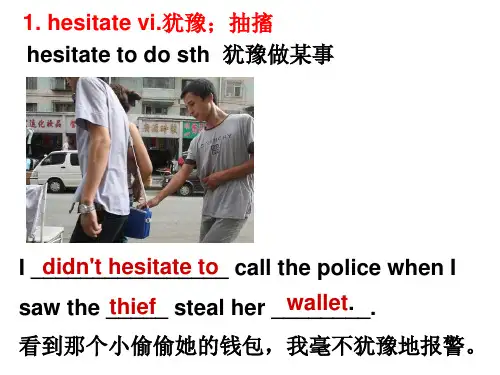
3.classify vt. 把......分类;把什么归类
classify ...into... by/ according to... 根据.......把.......分成
_G__e_n_e_ra_l_ly__s_p_e_a_k_in__g,, the books in the library_a_r_e_c_l_a_s_s_if_ie_d__in__to_ different kinds _b_y_/_a_c_c_o_r_d_i_n_g_t_o_.subjects.
hesitate about doing sth 对做.....犹豫不决
When I saw the exam result, _I h__e_s_it_a_te_d__a_b_o_u_t_t_e_ll_in_g__m__y_m__o_t_h_e_r _a_b_o_u_t_i_t..
当我看到考试结果的时候,我犹豫要不要告诉我妈妈。
They_c_o_n_d_e_m__n_e_d_ the reporter__f_o_r __ _m_a_k_i_n_g__w_r_o_n_g_r_e_m__a_rk_s__o_n_the event.
他们谴责这个记者对这个事件作出错误的评论。
sth condemns sb to ... .......使某人注定.......
Beethoven was so _b_r_il_li_a_n_t_ that he was _s_u_p_e_r_io_r_ __to__ other musicians at that time.
在那时候,贝多芬非常才华横溢,比其他音乐家要 优秀很多。
be senior to 比......资历深 be junior o 走过
高中英语(人教版选修8)教师用书:Unit 4 Section_Ⅱ Warming Up - Reading — Language Points(含答案)

Section_ⅡWarming Up & Reading — Language Points根据英文释义和首字母提示写出单词1.mistaken (adj.)be wrong about something that you thought you knew or saw 2.betray (vt.)to be disloyal to someone who trusts you so that they are harmed or upset3.condemn (vt.)to say very strongly that you do not approve of something or someone, especially because you think it is morally wrong4.acquaintance (n.)person whom one knows but who is not a close friend5.remark (n.) thing said or written as a comment; observation6.fortune (n.) chance, esp. regarded as a power affecting people’s lives; (good or bad) luck1.adaptation n.适应(性);改编本[教材原句] This play by George Bernard Shaw is an adaptation of a classic Greek story.乔治·伯纳德·萧的这个剧本改编自一个经典的希腊传说。
①Our company’s adaptation to shifting consumer tastes has been a great success.我们公司适应了顾客不断变化的口味,取得了很大的成功。
(完整版)人教版高中英语选修8各单元课文原文

选修8 Unit 1 A land of diversity-ReadingCALIFORNIACalifornia is the third largest state in the USA but has the largest population. It also has the distinction of being the most multicultural state in the USA, having attracted people from all over the world. The customs and languages of the immigrants live on in their new home. This diversity of culture is not surprising when you know the history of California.NATIVE AMERCANSExactly when the first people arrived in what we now know as California, no one really knows. However, it is likely that Native Americans were living in California at least fifteen thousand years ago. Scientists believe that these settlers crossed the Bering Strait in the Arctic to America by means of a land bridge which existed in prehistoric times. In the 16th century, after the arrival of the Europeans, the native people suffered greatly. Thousands were killed or forced into slavery. In addition, many died from the diseases brought by the Europeans. However, some survived these terrible times, and today there are more Native Americans living in California than in any other state.THE SPANISHIn the 18th century California was ruled by Spain. Spanish soldiers first arrived in South America in the early 16th century, when they fought against the native people and took their land. Two centuries later, the Spanish had settled in most parts of South America and along the northwest coast of what we now call the United States. Of the first Spanish to go to California, the majority were religious men, whose ministry was to teach the Catholic religion to the natives. In 1821, the people of Mexico gained their independence from Spain. California then became part of Mexico. In 1846 the United States declared war on Mexico, and after the war won by the USA, Mexico had to give California to the USA. However, there is still a strong Spanish influence in the state. That is why today over 40 of Californians speak Spanish as a first or second language.RUSSIANSIn the early 1800s, Russian hunters, who had originally gone to Alaska, began settling in California. Today there are about 25,000 Russian-Americans living in and around San Francisco.GOLD MINERSIn 1848, not long after the American-Mexican war, gold was discovered in California. The dream of becoming rich quickly attracted people from all over the world. The nearest, and therefore the first to arrive, were South Americans and people from the United States. Then adventurers from Europe and Asia soon followed. In fact, few achieved their dream of becoming rich. Some died or returned home, but most remained in California to make a life for themselves despite great hardship. They settled in the new towns or on farms. By the time California elected to become the thirty-first federal state of the USA in 1850, it was already a multicultural society.LATER A RRIVALSAlthough Chinese immigrants began to arrive during the Gold Rush Period, it was the building ofthe rail network from the west to the east coast that brought even larger numbers to California in the 1860s. Today, Chinese-Americans live in all parts of California, although a large percentage have chosen to stay in the "Chinatowns" of Los Angeles and San Francisco.Other immigrants such as Italians, mainly fishermen but also wine makers, arrived in California in the late 19th century. In 1911 immigrants from Denmark established a town of their own, which today still keeps up their Danish culture. By the 1920s the film industry was well established in Hollywood, California. The industry boom attracted Europeans including many Jewish people. Today California has the second largest Jewish population in the United States.Japanese farmers began arriving in California at the beginning of the 20th century, and since the 1980s a lot more have settled there. People from Africa have been living in California since the 1800s, when they moved north from Mexico. However, even more arrived between 1942 and 1945 to work in the ship and aircraft industries. MOST RECENT ARRIVALSIn more recent decades, California has become home to more people from Asia, including Koreans, Cambodians, Vietnamese and Laotians. Since its beginning in the 1970s, the computer industry has attracted Indians and Pakistanis to California.THE FUTUREPeople from different parts of the world, attracted by the climate and the lifestyle, still immigrate to California. It is believed that before long the mix of nationalities will be so great that there will be no distinct major racial or cultural groups, but simply a mixture of many races and cultures.GEORGE’S DIARY 12TH—14TH JUNEMonday 12th, JuneArrived early this morning by bus. Went straight to hotel to drop my luggage, shower and shave. Then went exploring. First thing was a ride on a cable car. From top of the hill got a spectacular view of San Francisco Bay and the city. Built in 1873, the cable car system was invented by Andrew Hallidie, who wanted to find a better form of transport than horse-drawn trams. Apparently he'd been shocked when he saw a terrible accident in which a tram's brakes failed, the conductor could not control the situation and the tram slipped down the hill dragging the horses with it.Had a late lunch at Fisherman's What. This is the district where Italian fishermen first came to San Francisco in the late 19th century and began the fishing industry. Now it's a tourist area with lots of shops, sea food restaurants and bakeries. It's also the place to catch the ferry to Angel Island and other places in the Bay.Did so much exploring at Fisherman's What. Am exhausted and don't feel like doing anything else. Early bed tonight!Tuesday 13th, JuneTeamed up with a couple from my hotel (Peter and Terri) and hired a car. Spent all day driving around the city. There's a fascinating drive marked out for tourists. It has blue and white signs with seagulls on them to show the way to go. It's a 79km round-trip that takes in all the famous tourist spots. Stopped many times to admire the view of the city from different angles and take photographs. Now have a really good idea of what the city's like.In evening, went to Chinatown with Peter and Terri. Chinese immigrants settled in this area in the 1850s. The fronts of the buildings are decorated to look like old buildings in southern China. Saw some interesting temples here, a number of markets and a great many restaurants. Also art galleries and a museum containing documents, photographs and all sorts of objects about the history of Chinese immigration, but it is closed in the evening. Will go back during the day. Had a delicious meal and then walked down the hill to our hotel.Wednesday 14th, JuneIn morning, took ferry to Angel Island from the port in San Francisco Bay. On the way had a good view of the Golden Gate Bridge. From 1882 to 1940 Angel Island was a famous immigration station where many Chinese people applied for right to live in USA. The cells in the station were very small, cold and damp; some did not even have light but the immigrants had nowhere else to go. Their miserable stay seemed to be punishment rather than justice and freedom to them. They wrote poems on the walls about their loneliness and mourned their former life in China. In 1940 the civil authorities reformed the system so that many more Chinese people were able to grasp the opportunity of settling in the USA. Made me very thoughtful and thankful for my life today.选修8 Unit 2 Cloning-ReadingCLONING: WHERE IS IT LEADING US?Cloning has always been with us and is here to stay. It is a way of making an exact copy of another animal or plant. It happens in plants when gardeners take cuttings from growing plants to make new ones. It also happens in animals when twins identical in sex and appearance are produced from the same original egg. The fact is that these are both examples of natural clones.Cloning has two major uses. Firstly, gardeners use it all the time to produce commercial quantities of plants. Secondly, it is valuable for research on new plant species and for medical research on animals. Cloning plants is straightforward while cloning animals is very complicated. It is a difficult task to undertake. Many attempts to clone mammals failed. But at last the determination and patience of the scientists paid off in 1996 with a breakthrough - the cloning of Dolly the sheep. The procedure works like this:On the one hand, the whole scientific world followed the progress of the first successful clone, Dolly the sheep. The fact that she seemed to develop normally was very encouraging. Then came the disturbing news that Dolly had become seriously ill. Cloning scientists were cast down to find that Dolly's illnesses were more appropriate to a much older animal. Altogether Dolly lived six and a half years, half the length of the life of the original sheep. Sadly the same arbitrary fate affected other species, such as cloned mice. The questions that concerned all scientists were: "Would this be a major difficulty for all cloned animals? Would it happen forever? Could it be solved if corrections were made in their research procedure?"On the other hand, Dolly's appearance raised a storm of objections and had a great impact on the media and public imagination. It became controversial. It suddenly opened everybody's eyes to the possibility of using cloning to cure serious illnesses and even to produce human beings.Although at present human egg cells and embryos needed for cloning research are difficult to obtain, newspapers wrote of evil leaders hoping to clone themselves to attain their ambitions. Religious leaders also raised moral questions. Governments became nervous and more conservative. Some began to reform their legal systems and forbade research into human cloning, but other countries like China and the UK, continued to accumulate evidence of the abundant medical aid that cloning could provide. However, scientists still wonder whether cloning will help or harm us and where it is leading us.THE RETURN OF THE DINOSAURS?The possibility of cloning fierce and extinct wild animals has alwaysexcited film makers. And they are not the only ones! The popularity of films such asJurassic Park, in which a scientist clones several kinds of extinct dinosaurs, proveshow the idea struck a mixture of fear and excitement into people's hearts. But in factwe are a long way from being able to clone extinct animals. Scientists are still experimenting with cloning mammals. This is because the cloning of mammals is stilla new science and its story only began seriously in the 1950s as this list shows:1950s cloning of frogs 1996 first clone of a mammal: Dolly the sheep1970s research using the embryos of mice 2000 cow gave birth toa bison1979 work on embryos of sheep and mice 2001 China's firstcloned twin calves1981 first experimental clones of mice 2002 first clonedcats1983 first experimental clones of cows 2005 first cloneddog…From time to time people suggest that extinct animals like dinosaurs, canpossibly be brought back to life through cloning. Unfortunately, with what we knownow, this is either impossible or unsuitable. There are many reasons.◎ The initial requirement is that you need perfect DNA (which gives information forhow cellsare to grow).◎ All efforts of cloning an animal will be in vain if there is not enough diversity inthe group to overcome illnesses. Diversity in a group meanshaving animals with their genes arranged in different ways. The advantage isthat if there is a new illness some of these animals may die,but others will survive and pass on the ability to resist that disease to the nextgeneration. The great drawback to cloning a group ofanimals is that they would all have the same arrangement of genes and so mightdie of the same illness. Then none of them would be left tocontinue the species.◎It would be unfair to clone any extinct animals if they were to live in a zoo. Asuitable habitat would be needed for them to lead a natural life.Based on what we know now, you cannot clone animals that have been extinct longer than 10,000 years. Actually, dinosaurs disappeared 65,000,000 years ago. So the chance of dinosaurs ever returning to the earth is merely a dream.选修8 Unit 3 Inventors and inventions-ReadingTHE PROBLEM OF THE SHRIKESWhen I called up my mother in the countryside on the telephone she was very upset. "There are some snakes in our courtyard," she told me. "Snakes come near the house now and then, and they seem to have made their home here, not far from the walnut tree. Can you get rid of them please?" I felt very proud. Here was a chance for .me to distinguish myself by inventing something merciful that would catch snakes but not harm them. I knew my parents would not like me to hurt these living creatures!The first thing I did was to see if there were any products that might help me, but there only seemed to be powders designed to kill snakes. A new approach was clearly needed. I set about researching the habits of snakes to find the easiest way to trap them. Luckily these reptiles are small and that made the solution easier.Prepared with some research findings, I decided on three possible approaches: firstly, removing their habitat; secondly, attracting them into a trap using male or female perfume or food; and thirdly cooling them so that they would become sleepy and could be easily caught. I decided to use the last one. I bought an ice-cream maker which was made of stainless steel. Between the outside and the inside walls of the bowl there is some jelly, which freezes when cooled. I put the bowl into the fridge and waited for 24 hours. At the same time I prepared some ice-cubes.The next morning I got up early before the sun was hot. I placed the frozen bowl over the snakes' habitat and the ice-cubes on top of the bowl to keep it cool. Finally I covered the whole thing with a large bucket. Then I waited. After two hours I removed the bucket and the bowl. The snakes were less active but they were still too fast for me. They abruptly disappeared into a convenient hole in the wall. So I had to adjust my plan.For the second attempt I froze the bowl and the ice-cubes again but placed them over the snakes' habitat in the evening, as the temperature was starting to cool. Then as before, I covered the bowl with the bucket and left everything overnight. Early the next morning I returned to see the result. This time with great caution I bent down to examine the snakes and I found them very sleepy. But once picked up, they tried to bite me. As they were poisonous snakes, I clearly needed to improve my design again.My third attempt repeated the second procedure. The next morning I carried in my hand a small net used for catching fish. This was in the expectation that the snakes would bite again. But monitored carefully, the snakes proved to be no trouble and all went according to plan. I collected the passive snakes and the next day we merrily released them all back into the wild.Pressed by my friends and relations, I decided to seize the opportunity to getrecognition formy successful idea by sending my invention to the patent office. Only after you have had thatrecognition can you say that you are truly an inventor. The criteria are so strict that it is difficult to get new ideas accepted unless they are truly novel. In addition, no invention will get a patent if it is:◎a discovery◎a scientific idea or mathematical model◎literature or art◎a game or a business◎a computer programme◎a new animal or plant varietyNor will you receive a patent until a search has been made to find out that your product reallyis different from everyone else's. There are a large number of patent examiners, too, whose only job is to examine whether your claim is valid or not. If it passes all the tests, your application for a patent will be published 18 months from the date you apply. So I have filled in the form and filed my patent application with the Patent Office. Now it's a matter of waiting and hoping. You'll know if I succeed by the size of my bank balance! Wish me luck!ALEXANDER GRAHAM BELLAlexander Graham Bell was born in 1847 in Scotland, but when he was young his family moved to Boston, USA. His mother was almost entirely deaf, so Alexander became interested in helping deaf people communicate and in deaf education. This interest led him to invent the microphone. He found that by pressing his lips against his mother's forehead, he could make his mother understand what he was saying.He believed that one should always be curious and his most famous saying was:"Leave the beaten track occasionally and dive into the woods. Every time you do you will be certain to find something that you have never seen before. Follow it up, explore all around it, and before you know it, you will have something worth thinking about to occupy your mind. All really big discoveries are the result of thought."It was this exploring around problems and his dynamic spirit that led to his most famous invention - the telephone in 1876. Bell never set out to invent the telephone and what he was trying to design was a multiple telegraph. This original telegraph sent a message over distances using Morse code (a series of dots tapped out along a wire in a particular order). But only one message could go at a time. Bell wanted to improve it so that it could send several messages at the same time. He designed a machine that would separate different sound waves and allow different conversations to be held at the same time. But he found the problem difficult to solve. One day as he was experimenting with one end of a straw joined to a deaf man's ear drum and the other to a piece of smoked glass, Bell noticed that when he spoke into the ear, the straw drew sound waves on the glass. Suddenly he had a flash of inspiration. If sound waves could be reproduced in a moving electrical current, they could be sent along a wire. In searching to improve the telegraph,Bell had invented the first telephone!Bell was fully aware of the importance of his invention and wrote to his father:"The day is coming when telegraph wires will be laid on to houses just like water or gas – and friends will talk to each other without leaving home."The patent was given in 1876, but it was not until five days later that Bell sent his first telephone message to his assistant Watson. The words have now become famous:"Mr Watson - come here - I want to see you."Alexander Graham Bell was not a man to rest and he interested himself in many other areas of invention. He experimented with helicopter designs and flying machines. While searching for a kite strong enough to carry a man into the air, Bell experimented putting triangles together and discovered the tetrahedron shape. Being very stable, it has proved invaluable in the design of bridges.Bell was an inventor all his life. He made his first invention at eleven and his last at seventy- five. Although he is most often associated with the invention of the telephone, he was indeed a continuing searcher after practical solutions to improve the quality of everybody's life.选修8 Unit 4 Pygmalion-ReadingPYGMALIONMAIN CHARACTERS:Eliza Doolittle (E): a poor flower girl who is ambitious to improve herself Professor Higgins (H): an expert in phonetics, convinced that the quality of aperson's English decides his/her position in societyColonel Pickering (CP): an officer in the army and later a friend of Higgins' who sets him a taskAct One FATEFUL MEETINGS11 :15 pm in London, England in 1914 outside a theatre. It is pouring with rain and cab whistles are blowing in all directions. A man is hiding from the rain listening to people's language and watching their reactions. While watching, he makes notes. Nearby a flower girl wearing dark garments and a woollen scarf is also sheltering from the rain. A gentleman (G) passes and hesitates for a moment.E: Come over’ere, cap’in, and buy me flowers off a poor girl.G: I'm sorry but I haven't any change.E: I can giv’ou change, cap’in.G: (surprised) For a pound? I'm afraid I've got nothing less.E: (hopefully) Oah! Oh, do buy a flower off me, Captain. Take this for three pence. (holds up some dead flowers)G: (uncomfortably) Now don't be troublesome, there's a good girl. (looks in his wallet and sounds more friendly) But, wait, here's some small change. Will that be of any use to you? It's raining heavily now, isn't it? (leaves)E: (disappointed at the outcome, but thinking it is better than nothing) Thank you, sir. (sees a man taking notes and feels worried) Hey! I ain’t done nothing wrong by speaking to that gentleman. I've a right to sell flowers, I have. I ain’t no thief. I'm an honest girl I am! (begins to cry)H: (kindly) There! There! Who's hurting you, you silly girl? What do you take me for? (gives her a handkerchief)E: I thought maybe you was a policeman in disguise.H: Do I look like a policeman?E: (still worried) Then why did 'ou take down my words for? How do I know whether 'ou took me down right? 'ou just show me what 'ou've wrote about me!H: Here you are. (hands over the paper covered in writing)E: What's that? That ain't proper writing. I can't read that. (pushes it back at him)H: I can. (reads imitating Eliza) "Come over' ere, cap'in, and buy me flowers off a poor girl." (in his own voice) There you are and you were bornin Lisson Grove if I'm not mistaken.E: (looking confused) What if I was? What's it to you?CP: (has been watching the girl and now speaks to Higgins) That's quite brilliant! How did you do that, may I ask?H: Simply phonetics studied and classified from people's own speech. That's my profession and also my hobby. You can place a man by just a few remarks. I can place any spoken conversation within six miles, and even within two streets in London sometimes.CP: Let me congratulate you! But is there an income to be made in that?H: Yes, indeed. Quite a good one. This is the age of the newly rich. People begin theirworking life in a poor neighbourhood of London with 80 pounds a year and end in a rich one with 100 thousand. But they betray themselves every time they open their mouths. Now once taught by me, she'd become an upper class lady ...CP: Is that so? Extraordinary!H: (rudely) Look at this girl with her terrible English: the English that will condemn her to the gutter to the end of her days. But, sir, (proudly) once educated to speak properly, that girl could pass herself off in three months as a duchess at an ambassador's garden party. Perhaps I could even find her a place as a lady's maid or a shop assistant, which requires better English.E: What's that you say? A shop assistant? Now that's sommat I want, that is!H: (ignores her) Can you believe that?CP: Of course! I study many Indian dialects myself and ...H: Do you indeed? Do you know Colonel Pickering?CP: Indeed I do, for that is me. Who are you?H: I'm Henry Higgins and I was going to India to meet you.CP: And I came to England to make your acquaintance!E: What about me? How'll you help me?H: Oh, take that. (carelessly throws a handful of money into her basket) We must have a celebration, my dear man. (leave together)E: (looking at the collected money in amazement) Well, I never. A whole pound! A fortune! That'll help me, indeed it will. Tomorrow I'll find you, Henry Higgins. Just you wait and see! All that talk of (imitates him) "authentic English" ... (in her own voice) I'll see whether you can get that for me ... (goes out)Act Two, Scene 1 MAKING THE BET It is 11am in Henry Higgins' house the next day. Henry Higgins and Colonel Pickering are sitting deep in conversation.H: Do you want to hear any more sounds?CP: No, thank you. I rather fancied myself because I can pronounce twenty-four distinct vowel sounds; but your one hundred and thirty beat me. I can't distinguish most of them.H: (laughing) Well, that comes with practice.There is a knock and Mrs Pearce (MP), the housekeeper, comes in with cookies, a teapot, some cream and two cups.MP: (hesitating) A young girl is asking to see you.H: A young girl! What does she want?MP: Well, she's quite a common kind of girl with dirty nails.I thought perhaps you wanted her to talk into your machines.H: Why? Has she got an interesting accent? We'll see.Show her in, Mrs Pearce. MP: (only half resigned to it) Very well, sir. (goes downstairs)H: This is a bit of luck. I'll show you how I make records on wax disks ...MP: (returning) This is the young girl, sir. (Eliza comes into the room shyly following Mrs Pearce. She is dirty and wearing a shabby dress. She curtsies to the two men.) H: (disappointed) Why! I've got this girl in my records. She's the one we saw the other day. She's no use at all. Take her away.CP: (gently to Eliza) What do you-want, young lady?E: (upset) I wanna be a lady in a flower shop 'stead o' selling flowers in the street. But they won't take me 'less I speak better. So here I am, ready to pay him. I'm not asking for any favours - and he treats me like dirt.H: How much?E: (happier) Now yer talking. A lady friend of mine gets French lessons for two shillings an hour from a real Frenchman. You wouldn't have the face to ask me for the same for teaching me as yer would for French. So I won't give yer more than a shilling.H: (ignoring Eliza and speaking to Pickering) If you think of how much money this girl has - why, it's the best offer I've had! (to Eliza) But if I teach you, I'll be worse than a father.CP: I say, Higgins. Do you remember what you said last night? I'll say you're the greatest teacher alive if you can pass her off as a lady. I'll be the referee for this little bet and pay for the lessons too ...E: (gratefully) Oh, yer real good, yer are. Thank you, Colonel.H: Oh, she is so deliciously low. (compromises) OK, I'll teach you. (to Mrs Pearce) But she'll need to be cleaned first. Take her away, Mrs Pearce. Wash her and burn her horrible clothes. We'll buy her new ones. What's your name, girl?E: I'm Eliza Doolittle and I'm clean. My clothes went to the laundry when I washed last week.MP: Well, Mr Higgins has a bathtub of his own and he has a bath every morning. If these two gentlemen teach you, you'll have to do the same. They won't like the smell of you otherwise.E: (sobbing) I can't. I dursn't. It ain't natural and it'd kill me. I've never had a bath in my life; not over my whole body, neither below my waist nor taking my vest off. I'd never have come if I'd known about this disgusting thing you want me to do ...H: Once more, take her away, Mrs Pearce, immediately. (Outside Eliza is still weeping with Mrs Pearce) You see the problem, Pickering. It'll be how to teach her grammar, not just pronunciation. She's in need of both.CP: And there's another problem, Higgins. What are we going to do once the experiment is over?H: (heartily) Throw her back.CP: But you cannot overlook that! She'll be changed and she has feelings too. We must be practical, mustn't we?。
新课标人教版选修八Book8 Unit4 Language points
8. 会谈结果是双方和解, 最后达成了协议. outcome The _________ of the conversation is a compromise _________________ reached by both sides. 9. 伊莱扎让人烧掉了那些令人作呕的衣服, 以 便能够开始她作为淑女的新生活. had those disgusting clothes burned Eliza ______________________________ so that she could begin a new life as a lady. 10. 不要把我的工作说成是你自己的, 这不公 平. pass my work off as your own. It Don’t __________________ isn’t fair.
never have come if I’d known about this disgusting thing you want to 4. I’d do to me. 我要是早知道你们想让我做这种可恶的事情,我绝 不会来— 主从复合句,句中含与过去事实相反的虚拟条件句。 条件句用了 had +过去分词 形式,主句用
3. What if I was? 如果我是又怎样呢? 此句为省略句。原句为: What should you do if I was born in…? What if…意思为“要是……又会怎样?”。用来征 求对方的意见或看法,也可用于提出建议。 What if the rumor is true? 如果传闻是真的,又怎么样呢? ________________________________________ What if it is true? 要是这是真的怎么办呢?
人教版高中英语选修八(Book 8 Unit 4)考点训练
人教版高中英语选修八(Book 8 Unit 4)Unit 4 Pygmalion假如你叫李华,你的加拿大笔友Jean来信,表示想学习中国画,但是对中国画不太了解,请你根据下面内容,给Jean回信,简单介绍中国画的有关知识。
1.中国传统绘画是我国文化遗产的重要组成部分,历史悠久,深受人们的喜爱。
2.传统国画的作画工具有:毛笔、墨、宣纸(Xuan paper)、颜料(pigment)。
3.中国传统绘画的重要特征是:诗、书(calligraphy)、画、印(seal)完美结合。
4.中国历史上有许多传统的国画家,如齐白石,擅长画虾;徐悲鸿,对画马颇有研究。
Dear Jean,I am very glad to learn from your letter that you like Chinese painting. The traditional Chinese painting,an important part of our country's cultural heritage,has a long history.It is very popular among people at home and abroad.What we need for painting are writingbrushes,Chinese ink,Xuan paper and pigments.Besides,an important feature of Chinese painting is that a painter should combine pictures,poems,calligraphy and seals perfectly. In fact,many painters are at the same time a calligrapher and a poet as well.In Chinese history,there are many famous traditional painters,including Qi Baishi and Xu Beihong.Qi Baishi was proficient in painting little shrimps while Xu Beihong was famous for his lively horses.Yours,Li Hua1.文章体裁:应用文——书信。
高中英语选修八Unit4单词表
/ʌn'kʌmfətəbli/
adv.不舒服地;不自在地
troublesome
/'trʌblsəm/
adj.带来麻烦的;使人心烦的
wallet
/'wɔlit/
n.皮夹;钱包
outcome
/'autkəm/
n.结果;效果
thief
/θi:f/
n.小偷;贼
handkerchief
whistle
/'wisl/
vi.吹口哨;发出汽笛声 n.口哨声;汽笛声
garment
/'gɑ:mənt/
n.衣服;服装
woolen
/'wulin/
adj.毛纺的;纯毛的
hesitate
/'heziteit/
vi.犹豫;踌躇
uncomfortable
/ʌn'kʌmfətəbl/
adj.不舒服的;不安的;不自在的
betray
/bi'trei/
vt.显露出;背叛
upper
/'ʌpə/
adj.较高的;级别较高的
extraordinary
/iks'trɔ:dinəri/
adj.不同寻常的;非凡的
condemn
/kən'dem/
vt.谴责;使...注定
properly
/'prɔpəli/
adv.适当地;恰当地
pass...off as...
/rɔb/
vt.抢劫;盗窃;剥夺
antique
/æn'ti:k/
adj.古时的;珍贵的 n.文物;古董
高中英语(人教版选修8)教师用书:Unit 4 Section_Ⅳ Grammar_-_Writing(含答案)
Section_ⅣGrammar_&_Writing过去分词作状语一、过去分词(短语)作状语过去分词作状语,修饰谓语动词,进一步说明谓语动词的动作和状态,即动作发生时的背景或状况,其逻辑主语则为句子的主语,其主语为过去分词动作的承受者。
过去分词作状语时,可单独使用,也可以在其前面加上适当的连词,可表示时间、原因、条件、伴随、方式等。
When finished,the paper should be turned in without delay.一完成,文件应立刻上交。
(时间状语)Given more attention, the trees will grow better.如果多给予些关注,这些树会长得更好。
(条件状语)Inspired by what he said, the girl student decided to work harder.在他的话的鼓励下,女学生决定更努力地学习。
(原因状语)He hurried to the hall, followed by two guards.他快步走向大厅,身后跟着两个卫兵。
(伴随状语)Asked many times, he still hasn’t said a word about the matter.虽然已被问了好几次,对这件事他仍只字未提。
(让步状语)二、过去分词(短语)作状语在句中的位置过去分词在句中作状语,可放在主句前作句首状语,后面用逗号与主句隔开;也可放在主句后面,前面用逗号与主句隔开。
过去分词(短语)作条件、原因及时间状语时,通常放在句首;作伴随、结果状语时,通常放在句末;作方式状语时,一般放在句末,有时也放在句首;作让步状语时,一般放在句首,有时也放在句末。
He stood there silently, moved to tears.=Moved to tears, he stood there silently.他静静地站在那里,被感动得热泪盈眶。