
英语词性转换规则大全
英语词性转换法则大全之五兆芳芳创作
(1)v.-n.动词转化为名词,
post-postage mail-mail
weigh-weight advise-advice
act-actor / actress-active
change-change-changeable
(3) v.-a.-ad.-n.动词转化成形容词,副词,名词
fill-full
need-necessary-necessarily
interest(v. / n.) interested /interesting
person personal ( 团体的; 私人的 )
fun funny
gentleman gentlemen human humans
possible possibly probable probably
(7)a. ad. n.形容词转化为副词,名词
true truly truth
lucky luckily luck
(8)原级 比较级 最初级 far farther / further farthest / furthest
little less least
一、名词变成形容词的办法
1. 在名词前面加-y可以酿成形容词(尤其是一些与天气有关的名词).例如:rain—rainy, cloud—cloudy, wind—windy,
snow—snowy, health—healthy, luck—lucky等.
注意:1)如果名词以重读闭音节结尾,且词尾只有一个子音字母,这时应双写词尾的子音字母再加-y.如:sun—sunny,
fun—funny等.
2)少数以不发音的e结尾的名词变成形容词时,应去掉e再加-y.例如:noise—noisy, ice—icy 等.
2. 一些抽象名词在词尾加-ful可以变成形容词.例如:care—careful, thank—thankful, help—helpful, use—useful,
beauty—beautiful等.
3. 一些暗示国度的名词可以在词尾加-ese, -ish或-n组成暗示国籍、语言的形容词.例如:China—Chinese, Japan—Japanese, England—English, America—American, India—Indian, Australia —Australian(注意Canada—Canadian).
4.在名词后加-ous变成形容词.例如:danger—dangerous等.
5. 在名词后加-ly变成形容词.例如:friend—friendly,
love—lovely等.
6.在名词后加-less组成含有否认意义的形容词.例如:care—careless(粗心的),use—useless(无用的),hope—hopeless(没希望的),home—homeless(无家可归的)等.
7. 一些以-ence结尾的名词,把ence改成ent酿成形容词.例如:difference—different, silence—silent等.
二、动词变成名词的办法
1.词形不变,词性改动.例如:work, study, water, plant等可以用作动词,也可以用作名词.
2. 一些动词在词尾加上-er或-or之后就酿成了暗示“某一类人”的名词.例如:work—worker, teach—teacher, sing—singer, jump—jumper, play—player, learn—learner,
visit—visitor, invent—inventor等.
注意:1)以不发音的e结尾的动词,在词尾加-r.例如:drive—driver, write—writer等.
2)以重读闭音节结尾,且末尾只有一个子音字母的动词,应双写末尾的子音字母,再加-er.例如:run—runner, win—winner, begin—beginner等.
3. 在动词词尾加-ing酿成名词(办法与动词变成现在分词的办法相同).例如: meet—meeting, build—building, wait—waiting, wash—washing, swim—swimming, shop—shopping,
begin—beginning等. 三、形容词变成副词的办法
一般在形容词的词尾加-ly可以酿成副词.例如:quick—quickly, slow—slowly, loud—loudly, sudden—suddenly
等.但是,以下几点值得注意:
1. 一些以“子音字母+y”结尾的形容词,要把y改成i再加-ly.例如:happy—happily, angry—angrily, lucky—luckily,
heavy—heavily, noisy—noisily 等.
2. 有些以-ble或-le结尾的形容词,去掉e加-y.例如:possible—possibly, terrible—terribly等.
3. 少数以e结尾的形容词,要去掉e再加-ly.例如:true—truly等.但绝大多数以e结尾的形容词仍然直接加-ly.例如:polite—politely, wide—widely等.
4. 以-l结尾的形容词变成副词时仍然要在词尾加-ly,而不是只加-y.除非是以-ll结尾的才在词尾只加-y.例如:usual—usually, careful—carefully, useful—usefully, full—fully等.
2023年初中英语语法考试:词性分类12种及词性转换七大规则
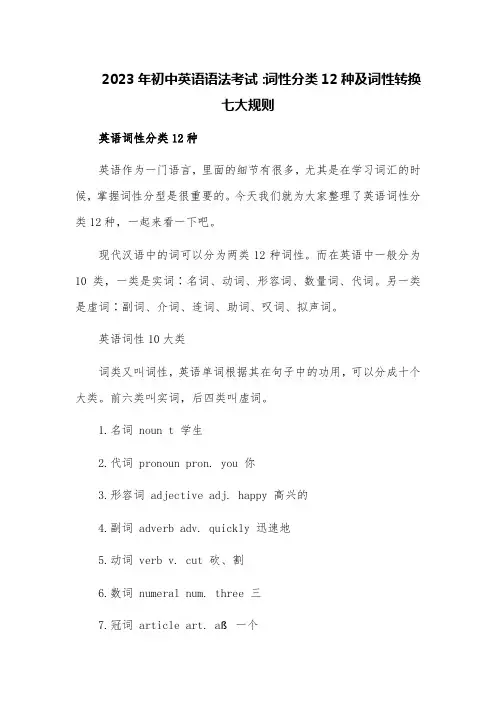
2023年初中英语语法考试:词性分类12种及词性转换七大规则
英语词性分类12种
英语作为一门语言,里面的细节有很多,尤其是在学习词汇的时候,掌握词性分型是很重要的。今天我们就为大家整理了英语词性分类12种,一起来看一下吧。
现代汉语中的词可以分为两类12种词性。而在英语中一般分为10类,一类是实词∶名词、动词、形容词、数量词、代词。另一类是虚词∶副词、介词、连词、助词、叹词、拟声词。
英语词性10大类
词类又叫词性,英语单词根据其在句子中的功用,可以分成十个大类。前六类叫实词,后四类叫虚词。
1.名词 noun t 学生
2.代词 pronoun pron. you 你
3.形容词 adjective adj. happy 高兴的
4.副词 adverb adv. quickly 迅速地
5.动词 verb v. cut 砍、割
6.数词 numeral num. three 三
7.冠词 article art. aß一个 8.介词 preposition prep. at 在...
9.连词 conjunction conj. and 和
10.感叹词 interjection interj. oh 哦
2 具体英语词性介绍及用法名词
在英语中有些名词可以加"'s"来表示所有关系,带这种词尾的名词形式称为该名词的所有格,如∶ a teacher's book。名词所有格的规则如下∶
1)单数名词词尾加"'s",复数名词词尾没有s,也要加"'s",如the boy's bag男孩的书包,men's room 男厕所。
2)若名词已有复数词尾-s ,只加"'",如∶ the workers' st∶
ers' struggle工人的斗争。
3)凡不能加"'s"的名词,都可以用"名词+of +名词"的结构来表示所有关系,如∶ the title oföthe song 歌的名字。
代词
代词pronoun简称pron是代替名词的一种词类。大多数代词具有名词和形容词的功能。英语中的代词,按其意义、特征及在句中的作用分为∶人称代词、物主代词、指示代词、反身代词、相互代词、疑问代词、关系代词、连接代词和不定代词九种。
英语词性转换
--
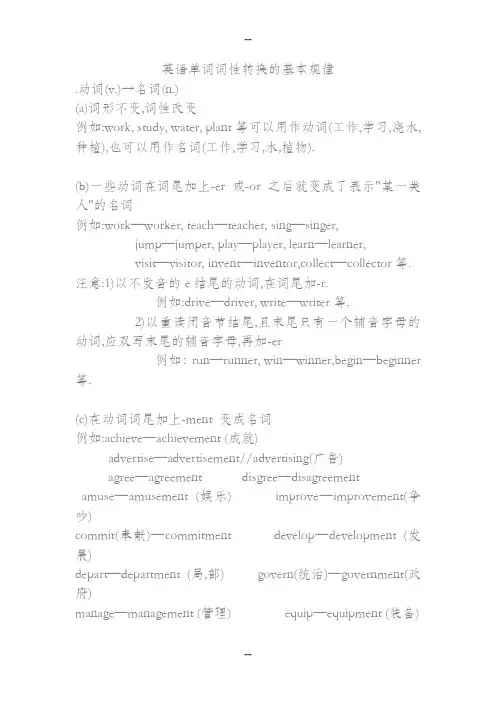
-- 英语单词词性转换的基本规律
.动词(v.)→名词(n.)
(a)词形不变,词性改变
例如:work, study, water, plant等可以用作动词(工作,学习,浇水,种植),也可以用作名词(工作,学习,水,植物).
(b)一些动词在词尾加上-er或-or之后就变成了表示"某一类人"的名词
例如:work—worker, teach—teacher, sing—singer,
jump—jumper, play—player, learn—learner,
visit—visitor, invent—inventor,collect—collector等.
注意:1)以不发音的e结尾的动词,在词尾加-r.
例如:drive—driver, write—writer等.
2)以重读闭音节结尾,且末尾只有一个辅音字母的动词,应双写末尾的辅音字母,再加-er
例如:run—runner, win—winner,begin—beginner等.
(c)在动词词尾加上-ment 变成名词
例如:achieve—achievement (成就)
advertise—advertisement//advertising(广告)
agree—agreement disgree—disagreement
amuse—amusement (娱乐) improve—improvement(争吵)
commit(奉献)—commitment develop—development (发展)
depart—department (局,部) govern(统治)—government(政府)
(完整版)英语词性转换大全
英语词性转换
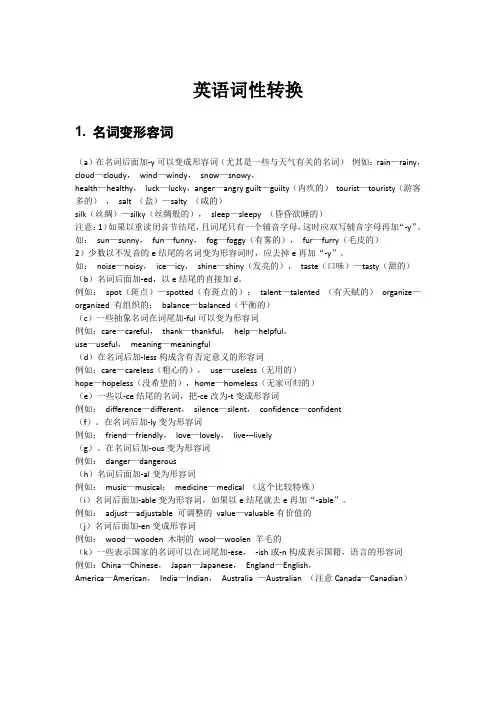
1. 名词变形容词
(a)在名词后面加-y可以变成形容词(尤其是一些与天气有关的名词) 例如:rain—rainy,
cloud—cloudy, wind—windy, snow—snowy,
health—healthy, luck—lucky,anger—angry guilt—guilty(内疚的) tourist—touristy(游客多的) , salt (盐)—salty (咸的)
silk(丝绸)—silky(丝绸般的), sleep—sleepy (昏昏欲睡的)
注意:1)如果以重读闭音节结尾,且词尾只有一个辅音字母,这时应双写辅音字母再加“-y”。
如: sun—sunny, fun—funny, fog—foggy(有雾的), fur—furry(毛皮的)
2)少数以不发音的e结尾的名词变为形容词时,应去掉e再加“-y”。
如: noise—noisy, ice—icy, shine—shiny(发亮的), taste(口味)—tasty(甜的)
(b)名词后面加-ed,以e结尾的直接加d。
例如: spot(斑点)—spotted(有斑点的); talent—talented (有天赋的) organize—organized 有组织的; balance—balanced(平衡的)
(c)一些抽象名词在词尾加-ful可以变为形容词
例如:care—careful, thank—thankful, help—helpful,
use—useful, meaning—meaningful
(d)在名词后加-less构成含有否定意义的形容词
例如:care—careless(粗心的), use—useless(无用的)
hope—hopeless(没希望的),home—homeless(无家可归的)
(e)一些以-ce结尾的名词,把-ce改为-t变成形容词
例如: difference—different, silence—silent, confidence—confident
人教版高中英语必修二 词性转换总结
新人教版 必修二 词性转换总结
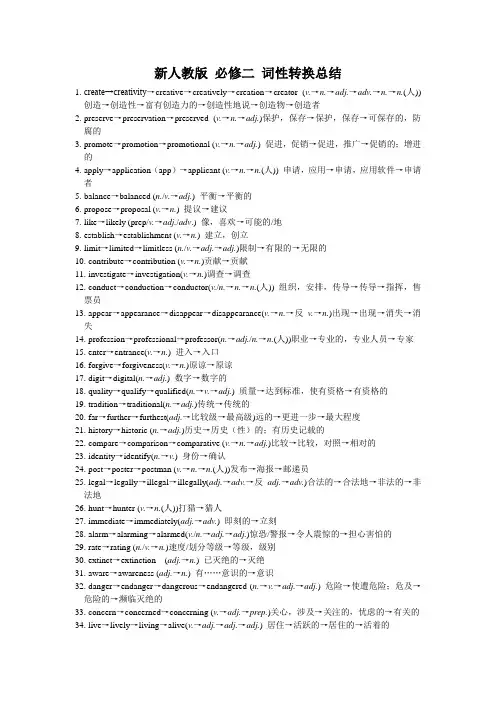
1. create→creativity→creative→creatively→creation→creator (v.→n.→adj.→adv.→n.→n.(人))
创造→创造性→富有创造力的→创造性地说→创造物→创造者
2. preserve→preservation→preserved (v.→n.→adj.)保护,保存→保护,保存→可保存的,防腐的
3. promote→promotion→promotional (v.→n.→adj.) 促进,促销→促进,推广→促销的;增进的
4. apply→application(app)→applicant (v.→n.→n.(人)) 申请,应用→申请,应用软件→申请者
5. balance→balanced (n./v.→adj.) 平衡→平衡的
6. propose→proposal (v.→n.) 提议→建议
7. like→likely (prep/v.→adj./adv.) 像,喜欢→可能的/地
8. establish→establishment (v.→n.) 建立,创立
9. limit→limited→limitless (n./v.→adj.→adj.)限制→有限的→无限的
10. contribute→contribution (v.→n.)贡献→贡献
11. investigate→investigation(v.→n.)调查→调查
12. conduct→conduction→conductor(v./n.→n.→n.(人)) 组织,安排,传导→传导→指挥,售票员
13. appear→appearance→disappear→disappearance(v.→n.→反v.→n.)出现→出现→消失→消失
14. profession→professional→professor(n.→adj./n.→n.(人))职业→专业的,专业人员→专家
英语单词词性转换
英语单词词性转换
一、动词v.→名词n.
1、词尾加上-er或-or之后就变成了表示"某一类人"的名词
例如:work—worker, teach—teacher, sing—singer,
jump—jumper, play—player, learn—learner,
visit—visitor, invent—inventor,collect—collector等.
注意:1以不发音的e结尾的动词,在词尾加-r.
例如:drive—driver, write—writer等.
2以辅音字母开头并以元音字母加辅音字母结尾的单词,应双写末尾的辅音字母再加er;
例如:run—runner, win—winner,begin—beginner等.
2.在动词词尾加上-ment 变成名词
例如:achieve—achievement 成就
advertise—advertisement
例如:argue—argument争论
3.在动词词尾加上-tion/sion变成名词
例如: attract—attraction; instruct—instruction;
invent—invention discuss—discussion;
express—expression educate—education;
graduate—graduation; operate—operation 去e再加"ion"
compete—competition; organize—organization 把e改成其他字母再加"tion"
decide—decision conclude—conclusion 把de改为s再加"ion"
英语单词词性转换的基本规律
英语单词词性转换的基本规律
.动词(v.)→名词(n.)
(a)词形不变,词性改变
例如:work, study, water, plant等可以用作动词(工作,学习,浇水,种植),也可以用作名词(工作,学习,水,植物).
(b)一些动词在词尾加上-er或-or之后就变成了表示"某一类人"的名词
例如:work—worker, teach—teacher, sing—singer,
jump—jumper, play—player, learn—learner,
visit—visitor, invent—inventor,collect—collector等.
注意:1)以不发音的e结尾的动词,在词尾加-r.
例如:drive—driver, write—writer等.
2)以重读闭音节结尾,且末尾只有一个辅音字母的动词,应双写末尾的辅音字母,再加-er
例如:run—runner, win—winner,begin—beginner等.
(c)在动词词尾加上-ment 变成名词
例如:achieve—achievement (成就)
advertise—advertisement//advertising(广告)
agree—agreement disgree—disagreement
amuse—amusement (娱乐) improve—improvement(争吵)
commit(奉献)—commitment develop—development (发展)
depart—department (局,部) govern(统治)—government(政府)
英语单词词性转换的基本规律 2
英语单词词性转换的基本规律
.动词(v.)→名词(n.)
(a)词形不变,词性改变
例如:work, study, water, plant等可以用作动词(工作,学习,浇水,种植),也可以用作名词(工作,学习,水,植物).
(b)一些动词在词尾加上-er或-or之后就变成了表示"某一类人"的名词
例如:work—worker, teach—teacher, sing—singer,
jump—jumper, play—player, learn—learner,
visit—visitor, invent—inventor, collect—collector等.
注意:1)以不发音的e结尾的动词,在词尾加-r.
例如:drive—driver, write—writer等.
2)以重读闭音节结尾,且末尾只有一个辅音字母的动词,应双写末尾的辅音字母,再加-er
例如:run—runner, win—winner, begin—beginner(新手,初学者)等.
(c)在动词词尾加上-ment 变成名词
例如:achieve—achievement (成就)
advertise—advertisement
例如:argue—argument(争论)
(d)在动词词尾加上-(t)ion/(s)ion变成名词
例如: (吸引)attract—attraction; (指导)instruct—instruction;
invent—invention discuss(讨论)—discussion; express(表达)—expression educate—education;
graduate—graduation; operate(操作,动手术)—operation (去e再加"ion")
英语词性转换大全
1. 名词变形容词
(a)在名词后面加-y可以变成形容词(尤其是一些与天气有关的名词) 例如:rain—rainy,
cloud—cloudy, wind—windy, snow—snowy,
health—healthy, luck—lucky,anger—angry guilt—guilty(内疚的) tourist—touristy(游客多的) , salt (盐)—salty (咸的)
silk(丝绸)—silky(丝绸般的), sleep—sleepy (昏昏欲睡的)
注意:1)如果以重读闭音节结尾,且词尾只有一个辅音字母,这时应双写辅音字母再加“-y”。
如: sun—sunny, fun—funny, fog—foggy(有雾的), fur—furry(毛皮的)
2)少数以不发音的e结尾的名词变为形容词时,应去掉e再加“-y”。
如: noise—noisy, ice—icy, shine—shiny(发亮的), taste(口味)—tasty(甜的)
(b)名词后面加-ed,以e结尾的直接加d。
例如: spot(斑点)—spotted(有斑点的); talent—talented (有天赋的) organize—organized 有组织的; balance—balanced(平衡的)
(c)一些抽象名词在词尾加-ful可以变为形容词
例如:care—careful, thank—thankful, help—helpful,
use—useful, meaning—meaningful
(d)在名词后加-less构成含有否定意义的形容词
例如:care—careless(粗心的), use—useless(无用的)
hope—hopeless(没希望的),home—homeless(无家可归的)
(e)一些以-ce结尾的名词,把-ce改为-t变成形容词
英语单词词根词缀和词性转换 英语单词词性转换的基本规律-英语词根
英语单词词性转换的基本规律
.动词(v.)→名词(n.)
(a)词形不变,词性改变
例如:work, study, water, plant等可以用作动词(工作,学习,浇水,种植),也可以用作名词(工作,学习,水,植物).
(b)一些动词在词尾加上-er或-or之后就变成了表示"某一类人"的名词
例如:work—worker, teach—teacher, sing—singer,
jump—jumper, play—player, learn—learner, visit—visitor, invent—inventor,collect—collector等.
注意:1)以不发音的e结尾的动词,在词尾加-r.
例如:drive—driver, write—writer等.
2)以重读闭音节结尾,且末尾只有一个辅音字母的动词,应双写末尾的辅音字母,再加-er
例如:run—runner, win—winner,begin—beginner等.
(c)在动词词尾加上-ment 变成名词
例如:achieve—achievement (成就)
advertise—advertisement//advertising(广告)
agree—agreement disgree—disagreement amuse—amusement (娱乐) improve—improvement(争吵)
commit(奉献)—commitment develop—development (发展)
depart—department (局,部) govern(统治)—government(政府)
manage—management (管理) equip—equipment (装备)
有些单词比较特殊,需把动词后的e去掉再加ment.
例如:argue—argument(争论)
(d)在动词词尾加上-(t)ion/(s)ion变成名词
[中考英语]词性转换规则及例子
词性转换规则
?动 词 变 名 词
1. V+ ment 结尾
Achieve—achievement 成就 advertise— advertisement/ advertising广告/广告业 agree— (in )agreement 同意 apart—apartment 公寓
amuse—amusement 娱乐 argue—argument 争吵
commit—commitment 奉献 comply—compliment 称赞,恭维 develop—development 发展 disagree—disagreement 分歧,争论 depart—department
局,部 experience—experiment 实验,试验 equip 配备—equipment 装备,器材 govern 统治—government 政府 manage—management 经营 管理
2(V+ ion 结尾
attract吸引—attraction 有吸引力的事或人;令人向往的地方
decide—decision 决定 conclude—conclusion 结论
describe—description描写,描绘 compete—competition 竞争,比赛
discuss—discussion 讨论 express表达—expression表达方式 educate—education教育 graduate—graduation毕业 operate 操作,动手术—operation
手术 organize—organization 组织,团体 instruct—instruction 指导, 介绍
invent—inventor / invention发明者 / 发明 permit —permission允许
inspire—inspiration灵感,鼓舞人心的(物) pollute—pollution 污染