
英语词性转换规则大全
英语词性转换规则大全
(1)v.-n.动词转化为名词,
post-postage mail-mail
weigh-weight advise-advice
(2)v.-n.-a.动词转化成名词-形容词
act-actor / actress-active
change-change-changeable
(3) v.-a.-ad.-n.动词转化成形容词,副词,名词
fill-full
need-necessary-necessarily
interest(v. / n.) interested /interesting
(4)n. a. n. a.名词转化为形容词
person personal ( 个人的; 私人的)
fun funny
(5)n. pl. n. pl.名词转化为名词复数
gentleman gentlemen human humans
(6)a. ad. a. ad.形容词转化为副词
possible possibly probable probably
(7)a. ad. n.形容词转化为副词,名词
true truly truth
lucky luckily luck
(8)原级比较级最高级
far farther / further farthest / furthest
little less least
一、名词变为形容词的方法
1. 在名词后面加-y可以变成形容词(尤其是一些与天气有关的名词)。
例如:rain—rainy, cloud—cloudy, wind—windy, snow—snowy, health—healthy, luck—lucky等。
注意:1)如果名词以重读闭音节结尾,且词尾只有一个辅音字母,这时应双写词尾的辅音字母再加-y。
如:sun—sunny, fun—funny等。
2)少数以不发音的e结尾的名词变为形容词时,应去掉e再加-y。
例如:noise—noisy, ice—icy 等。
2. 一些抽象名词在词尾加-ful可以变为形容词。
例如:care—careful, thank—thankful, help—helpful, use—useful, beauty—beautiful等。
3. 一些表示国家的名词可以在词尾加-ese, -ish或-n构成表示国籍、语言的形容词。
例如:China—Chinese, Japan—Japanese, England—English, America—American, India—Indian, Australia —Australian(注意Canada—Canadian)。
4.在名词后加-ous变为形容词。
例如:danger—dangerous等。
5. 在名词后加-ly变为形容词。
例如:friend—friendly, love—lovely等。
6.在名词后加-less构成含有否定意义的形容词。
例如:care—careless(粗心的),use—useless(无用的),hope—hopeless(没希望的),home—homeless(无家可归的)等。
7. 一些以-ence结尾的名词,把ence改为ent变成形容词。
例如:difference—different, silence—silent等。
二、动词变为名词的方法
1.词形不变,词性改变。
例如:work, study, water, plant等可以用作动词,也可以用作名词。
2. 一些动词在词尾加上-er或-or之后就变成了表示“某一类人”的名词。
例如:work—worker, teach—teacher, sing—singer, jump—jumper, play—player, learn—learner, visit—visitor, invent—inventor等。
注意:1)以不发音的e结尾的动词,在词尾加-r。
例如:drive—driver, write—writer等。
2)以重读闭音节结尾,且末尾只有一个辅音字母的动词,应双写末尾的辅音字母,再加-er。
例如:run—runner, win—winner,begin—beginner等。
3. 在动词词尾加-ing变成名词(方法与动词变为现在分词的方法相同)。
例如:meet—meeting, build—building, wait—waiting, wash—washing, swim—swimming, shop—shopping, begin—beginning等。
三、形容词变为副词的方法
一般在形容词的词尾加-ly可以变成副词。
例如:quick—quickly, slow—slowly, loud—loudly, sudden—suddenly 等。
但是,以下几点值得注意:
1. 一些以“辅音字母+y”结尾的形容词,要把y改为i再加-ly。
例如:happy—happily, angry—angrily, lucky—luckily, heavy—heavily, noisy—noisily 等。
2. 有些以-ble或-le结尾的形容词,去掉e加-y。
例如:possible—possibly, terrible—terribly 等。
3. 少数以e结尾的形容词,要去掉e再加-ly。
例如:true—truly等。
但绝大多数以e结尾
的形容词仍然直接加-ly。
例如:polite—politely, wide—widely等。
4. 以-l结尾的形容词变为副词时仍然要在词尾加-ly,而不是只加-y。
除非是以-ll结尾的才在词尾只加-y。
例如:usual—usually, careful—carefully, useful—usefully, full—fully等。
英语单词变形规则大全
英语单词变形规则大全一、名词复数变形规则。
1. 一般情况。
- 规则:在名词后加 -s。
- 例词:book[bʊk] - books[bʊks];pen[pen] - pens[pens]。
- 词性:名词(n.)2. 以s, x, ch, sh结尾的名词。
- 规则:加 -es。
- 例词:bus[bʌs] - buses[ˈbʌsɪz];box[bɒks] - boxes[ˈbɒksɪz];watch[wɒtʃ] - watches[ˈwɒtʃɪz];dish[dɪʃ] - dishes[ˈdɪʃɪz]。
- 词性:名词(n.)3. 以辅音字母 + y结尾的名词。
- 规则:把y变为i,再加 -es。
- 例词:city[ˈsɪti] - cities[ˈsɪtiz];baby[ˈbeɪbi] - babies[ˈbe ɪbɪz]。
- 词性:名词(n.)4. 以f或fe结尾的名词。
- 规则:把f或fe变为v,再加 -es。
- 例词:knife[naɪf] - knives[naɪvz];leaf[li:f] - leaves[li:vz]。
- 部分特例:roof[ru:f] - roofs[ru:fs](直接加 -s)。
5. 以o结尾的名词。
- 规则:- 有生命的加 -es,如:potato[pəˈteɪtəʊ] - potatoes[pəˈteɪtəʊz];tomato[təˈmɑ:təʊ] - tomatoes[təˈmɑ:təʊz]。
- 无生命的加 -s,如:photo[ˈfəʊtəʊ] - photos[ˈfəʊtəʊz];piano[piˈænəʊ] - pianos[piˈænəʊz]。
- 词性:名词(n.)二、动词第三人称单数变形规则(与名词复数变形规则有相似之处)1. 一般情况。
- 规则:在动词后加 -s。
- 例词:like[laɪk] - likes[laɪks];play[pleɪ] - plays[pleɪz]。
英语词性的分类及变换规则
英语词性的分类及变换规则英语词性的分类及变换规则词在不同的语境下,他所起的作用不样,也就是词性变化了。
英语单词有的可能词不变词性变了。
下面是店铺分享的词性分类和变换规则,希望能帮到大家!英语词性分类n .= 名词,noun的缩写v. = 动词,兼指及物动词和不及物动词,verb的缩写conj. = 连接词,conjunction的缩写s = 主词(主语)sc = 主词补语(有两种说法,一种表示主语补语=表语,一种表示一般表语属于主语补语)o = 受词 (宾语)oc = 受词补语(宾语补足语)vi. = 不及物动词,intransitive verb的缩写vt. = 及物动词,transitive verb的'缩写aux.v = 助动词,auxiliary的缩写adj. = 形容词,adjective的缩写adv. =副词,adverb的缩写art. = 冠词,article的缩写num. = 数词,numeral的缩写int. = 感叹词,interjection的缩写u. = 不可数名词,uncountable noun的缩写c. = 可数名词,countable noun的缩写plprep. = 介系词(介词);前置词,preposition的缩写pron .= 代名词(代词),pronoun的缩写. = 复数,plural的缩写英语词性变换规则一、动词变为名词的方法1.词形不变,词性改变。
例如:work, study, water, plant等可以用作动词,也可以用作名词。
2. 一些动词在词尾加上-er或-or之后就变成了表示“某一类人”的名词。
例如:work—worker, teach—teacher, sing—singer, jump—jumper, play—player, learn—learner, visit—visitor, invent—inventor等。
注意:1)以不发音的e结尾的动词,在词尾加-r。
英语词性转换归纳
英语词性转换归纳在英语学习中,词性转换是一个非常重要的知识点。
它不仅能够帮助我们更准确地理解单词的含义,还能让我们在写作和表达中更加灵活地运用词汇。
下面就来对英语中的词性转换进行一个归纳总结。
一、名词转换为动词很多名词都可以通过添加特定的后缀或改变词形来转换为动词。
例如,“hand”作为名词是“手”的意思,而“hand in”则是动词短语,表示“上交”。
“face”作为名词是“脸”,“face the problem”就是“面对问题”,此时“face”用作动词。
还有一些名词通过词形变化转换为动词,比如“water”,作名词是“水”,作动词表示“浇水”;“rain”,名词是“雨”,动词则是“下雨”。
二、动词转换为名词动词转换为名词的方式也多种多样。
常见的是在动词后加上“ion”“ment”“ance”“ence”等后缀。
例如,“decide”(决定)变成“decision”(决定);“develop”(发展)变成“development”(发展);“appear”(出现)变成“appearance”(出现;外表);“refer”(参考;提及)变成“reference”(参考;提及;参考书目)。
有的动词通过词形变化成为名词,比如“fly”(飞)变成“flight”(飞行;航班);“choose”(选择)变成“choice”(选择)。
三、形容词转换为动词形容词转换为动词相对较少,但也有一些常见的例子。
比如,“empty”,作形容词是“空的”,用作动词表示“使……空”。
“slow”作形容词是“慢的”,“slow down”则是“(使)减速”。
四、形容词转换为名词形容词转换为名词的情况比较常见。
可以在形容词后加上“ness”“ity”“th”等后缀。
例如,“happy”(快乐的)变成“happiness”(快乐);“able”(能够的)变成“ability”(能力);“wide”(宽的)变成“width”(宽度);“long”(长的)变成“length”(长度)。
(完整版)词性转换常见规律归纳
动词变名词1. v+ ment 结尾achieve---achievement 成就advertise---advertisement advertising agree—agreement argue---argument争吵announce --- announcement通知amuse--- amusement 娱乐2.V+ tion commit 奉献—commitment develop---development disgree—disagreement equip 装备---equipment 装备,器材govern 统治—government 政府manage---management经营管理settle--- settlement 定居admit 承认—admissioncompete—competition 竞争,比赛discuss—discussion 讨论educate ---- educationdecide --- decisiondescribe—description 描写,描绘organize --- organization imagine—imagination 想象力introduce—introduction 介绍instruct—instruction 指导,介绍invent—inventor / invention illustrate 阐明,举例说明3.V+ ance 结尾allow —allowance 允许appear—appearance 外貌,出现4.V+ ing 结尾bathe 洗澡---bathing end 结束ending 结尾,结局train 训练---training 5.V+ 其他beg(乞讨)—beggar 乞丐inspire---inspiration 灵感,鼓舞人心的pollute -- pollution 污染predict---prediction 预言pronounce ---pronunciation resolve 决心------- resolution 决心impress 给人印象—impression 印象permit 允许 - permissionsuggest-建议,暗示--suggestion solve 解决- s olution 解决方法perform --- performance 演出exist—existance 存在mean --- meaning 意义say ---- s aying 谚语结尾以t, te, de, 结尾的动词常去 E 或直接加ion attract吸引—attraction 有吸引力的事或人;令人向往的地方conclude—conclusion 结论--illustrationinvite —invitationsit--seat 座位employ--employer 雇主,老板believe—belief 信仰behave 行为,举止 -------- behavior know---knowledge fly —flight 飞行heat 加热---heat 热量hit 撞击 ------- h it 轰动一时的人或物,碰撞mix 混合mixture 混合物press 按,压—pressure 压力receive—receptionist 接待员serve—service 服务名词变形容词1 名词+y anger 生气angryhonest—honesty 诚实的hunger---hungry fog—foggy 有雾的fur furry 毛皮的guilt 罪恶---guilty 内疚的health---healthy luck---lucky cloud---cloudy wind—windy2. ------------------------ 名词+ ed balance –balanced 平衡的spot 斑点,地点 ---- spotted 有斑点的talent ---- talented 有天赋的organized 有组织的3.名词+ ful/less meaning—meaningful 有意义的care—careful/ careless 小心的;--employee 雇员succeed-- success tour 在 -- 旅游- tourist 游客pursue—pursuit 追求,从事propose—proposal 建议withdraw —withdrawal 取钱;收回;撤退survive—survival--survivor 幸存者arrive-- arrival 到达analyze—analysis 分析rain---rainy snow---snowy sun—sunny tourist touristy 游客多的business---busy salt 盐--- salty 咸的shine---shiny 发亮的silk 丝绸—silky 丝绸般的sleep---sleepy 昏昏欲睡的taste 口味,品味----------------- tasty 甜的distusted 厌恶的offended 生气的crowded 拥挤的polluted 被污染的pleased 高兴的粗心的help---helpful / helplesshome—homeless 无家可归的colour---colourful pain 疼痛---painful 痛苦的use---useless/ useful 4.名词+ able adjustable 可调整的comfort---comfortable 5. ---------------------- 名词+ ouscourage—courageous 勇敢的danger—dangerous mystery 神秘 ----------- mysterious 神秘的6. --------------- ce 变t confidence------------------ confidentdifference---different7. al 结尾Addition —additional 附加的,额外的Class—classical 经典的medicine 药medical 医学的music---musical nature---natural 自然的person---personal (私人的) nation—national 国家的8.名词+ ly friend—friendly live---lively 活跃的,有生气的love—lovely 可爱的10. 其他energy精力---energetic strategy—strategic 战略的fool 傻子—foolish 愚蠢的freedom 自由—free 空的,免费thank—thankful 充满感激的peace 和平-- peaceful 平静的,宁静的playful 顽皮的,爱玩耍的knowledge---knowledgeablesuit 一套- suitable 合适的dependence—dependent independence--independenteducation---educational 有教育意义的tradition --- t raditional 传统的origin 起源---original 新颖的;独创的grammar—grammatical 语法的globe—global 全球的9.+ en 结尾wood—wooden 木制的wool —woolen 羊毛的的height 高度—high illness 疾病--- ill love—loving 慈爱的death---deadpleasure---pleasant / pleased popularity 流行性—popular形容词变副词1.形容词+ ly bad—badly bright—brightly 明亮地casual—casually 随意地clear—clearly 清楚地complete—completely 完全correct---correctly 正确地final--finally fortunate—fortunately 幸运地general—generally 一般来讲loud—loudly particular 特殊的,独特的—particularly polite—politelyproper 合适的- ,恰当的---properlymain ----- mainly 主要地2. 以le 结尾的去 e + y comfortable---comfortably gentle—gently possible---possibly3. 辅音字母+ y 变ily easy—easily heavy—heavily happy--happily4. 特殊pride---proudscientist --- s cientific 科学的most 多数-- mostly 多半,大多数normal---normally 正常地quick—quickly quiet—quietly 轻轻地,安静地real—really recent 最近的------------- recently 最近;近来hard 难的;努力地---hardly 几乎不late 迟的—lately 最近;近来sad--sadlyslow---slowly special—specially 专门,特殊地specific---specifically 特定地,明确地strong—strongly 坚决地,强烈地sudden—suddenly 突然usual—usuallysimple ---- simply 仅仅;只;简单地terrible---terribly形容词变名词efficient 有效率的—efficiency 效率patient—patience/impatience true—truth high—height possible—possibility responsible—responsibility prosperous—prosperity 繁荣形容词变动词modern—modernize fast--fasten long—lengthen—length(n.) less--lessen strong—strengthen—strength(n.) large—enlargegood—well 好地true—trulywell 身体健康的,井名词变动词computer--computerize 名词---形容词—副词beauty 美,美人—beautiful —beautifully care—careful—carefully care—careless—carelessly difference---different---differently fortune—fortunate—fortunately/u nfortunately happiness—happy—happily hunger—hungry--hungrily health—healthy—healthily luck—lucky—luckily 方位的词名词—形容词East—easterndependen—t dependenc依赖性independent—independency 独立性wide—widthlong—length urgent—urgency 紧急accurate—accuracy 准确性social--socializeshort/shorten wide--widen noise—noisy—noisily pride—proud—proudly 骄傲地sadness—sad—sadly safety 安全;安全的地方—safe —safely silence—silent---silently 默默地success—successfu—l successfully truth—true—truly unluck—unlucky—unluckily wonder 奇迹—wonderful —wonderfullyWest—westernSouth—southern In the west of ChinaNorth---northern In the western part of China 四大洲名词 - 形容词Asia 亚洲–AsianAfrica 非洲-- AfricanEurope欧洲-- EuropeanAmerica 美洲- American既是形容词又是副词earlyget up early ;an early trainlate be late for class come late forschooldeep dive deep into the sea a holedeep largehigh jump high ;a high mountainhard a hard question; a hardstone work hard / study hardrain hardlongIt takes too longIt takes a long timefarjump farMy home is far from schoolstraight a straight linego straight along here。
英语单词词性转换
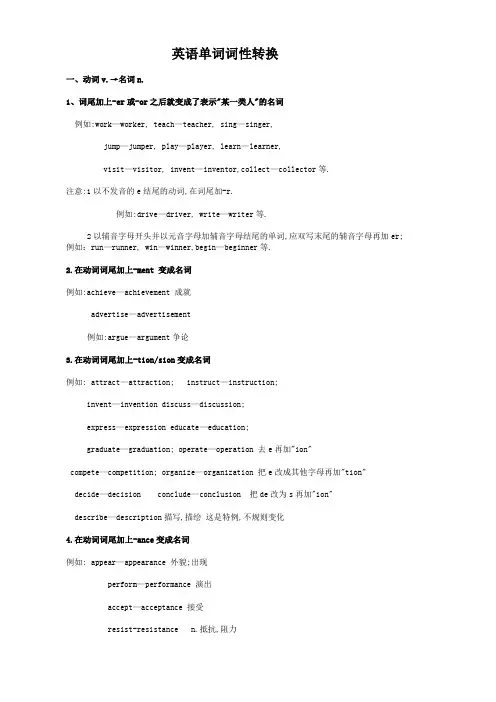
英语单词词性转换一、动词v.→名词n.1、词尾加上-er或-or之后就变成了表示"某一类人"的名词例如:work—worker, teach—teacher, sing—singer,jump—jumper, play—player, learn—learner,visit—visitor, invent—inventor,collect—collector等.注意:1以不发音的e结尾的动词,在词尾加-r.例如:drive—driver, write—writer等.2以辅音字母开头并以元音字母加辅音字母结尾的单词,应双写末尾的辅音字母再加er; 例如:run—runner, win—winner,begin—beginner等.2.在动词词尾加上-ment 变成名词例如:achieve—achievement 成就advertise—advertisement例如:argue—argument争论3.在动词词尾加上-tion/sion变成名词例如: attract—attraction; instruct—instruction;invent—invention discuss—discussion;express—expression educate—education;graduate—graduation; operate—operation 去e再加"ion"compete—competition; organize—organization 把e改成其他字母再加"tion"decide—decision conclude—conclusion 把de改为s再加"ion"describe—description描写,描绘这是特例,不规则变化4.在动词词尾加上-ance变成名词例如: appear—appearance 外貌;出现perform—performance 演出accept—acceptance 接受resist-resistance n.抵抗,阻力5.在动词词尾加-ing变成名词方法与动词变为现在分词的方法相同例如:meet—meeting build—building wait—waitingbathe—bathing say—saying谚语 mean—meaning注意:以辅音字母开头并以元音字母加辅音字母结尾的单词,应双写末尾的辅音字母再加-ing 如:swim—swimming shop—shopping begin—beginning二、动词v.→形容词adj.1.动词后面加able,以e结尾的动词则去e加able,表示具有此性质,特点或属性.例如: afford-affordable;love-lovable2.动词后面加ed,以e结尾的动词则直接加d,表示被动性的属性或特点.例如: scatter-scattered use-used3不规则的动词则必须记忆,记住其过去分词形式.规律不大,意义同b.三.名词n.→形容词adj.1.在名词后面加-y可以变成形容词尤其是一些与天气有关的名词例如: rain—rainy, cloud—cloudy, wind—windy, snow—snowy,health—healthy, luck—lucky,anger—angry guilt—guilty内疚的tourist—touristy游客多的 , salt 盐—salty 咸的silk丝绸—silky丝绸般的, sleep—sleepy 昏昏欲睡的注意:1如果以辅音字母开头并以元音字母加辅音字母结尾,这时应双写辅音字母再加"-y".如: sun—sunny, fun—funny, fog—foggy有雾的, fur—furry毛皮的2少数以不发音的e结尾的名词变为形容词时,应去掉e再加"-y".如: noise—noisy, ice—icy, shine—shiny发亮的, taste口味—tasty甜的2.名词后面加-ed,以e结尾的直接加d.例如: spot斑点—spotted有斑点的; talent—talented 有天赋的organize—organized 有组织的; balance—balanced平衡的3.一些抽象名词在词尾加-ful可以变为形容词例如:care—careful, thank—thankful, help—helpful,use—useful, meaning—meaningful4.在名词后加-less构成含有否定意义的形容词例如:care—careless粗心的, use—useless无用的hope—hopeless没希望的,home—homeless无家可归的5.一些以-ce结尾的名词,把-ce改为-t变成形容词例如: difference—different, silence—silent, confidence—confident 6.在名词后加-ly变为形容词例如: friend—friendly, love—lovely, live---lively7.在名词后加-ous变为形容词例如: danger—dangerous prosperous a 繁荣的pro 在前+sper 希望+ous 8.名词后面加-al变为形容词例如: music—musical; medicine—medical 这个比较特殊9名词后面加-able变为形容词,如果以e结尾就去e再加"-able".例如: adjust—adjustable 可调整的 value—valuable有价值的10.名词后面加-en变成形容词例如: wood—wooden 木制的 wool—woolen 羊毛的四.形容词adj.→副词adv.▲一般在形容词的词尾加-ly可以变成副词例如: quick—quickly, slow—slowly, loud—loudly, sudden—suddenly 等例如:possible—possibly, terrible—terribly。
词性转换规律

词性转换规律3)以辅音字母+y结尾的名词,变y为i,再加-es。
如:baby—babies;city—cities;4)以o结尾的名词,大部分加-s,少数加-es。
如:photo—photos;potato—potatoes;5)以f或fe结尾的名词,变f或fe为v,再加-es。
如:knife—knives;life—lives;6)以元音字母+y结尾的名词,直接加-s。
如:boy—boys;day—days。
2、不规则变化1)一些名词的单复数形式完全不同,需要记忆。
如:man—men;woman—women;child—children;tooth—teeth;foot—feet;2)一些名词的复数形式与单数形式相同。
如:sheep—sheep;deer—deer;fish—fish;3)一些名词的复数形式只有复数,没有单数。
如:scissors—scissors;pants—pants;4)一些名词的复数形式可以用-s或-es。
如:hero—heroes;potato—potatoes。
3、特殊情况1)有些名词的复数形式有两种,但含义不同。
如:brother—brothers(兄弟),brethren(同教会的);die—dies (模具),dice(骰子);2)有些名词的复数形式有两种,但用法不同。
如:XXX(衣服)在表示“一件衣服”时,是不可数名词,没有复数形式;但在表示“衣服”时,是可数名词,有复数形式。
To form XXX + y。
change y to i and add es。
For example。
baby es babies。
city es cities。
and family es families.To form the plural of words ending in f or fe。
change f or fe to ves。
For example。
XXX。
XXX。
(完整word版)英语词性转换规则大全,推荐文档
英语词性转换规则大全(1)v.-n.动词转化为名词,post-postage mail-mailweigh-weight advise-advice(2)v.-n.-a.动词转化成名词-形容词act-actor / actress-activechange-change-changeable(3) v.-a.-ad.-n.动词转化成形容词,副词,名词fill-fullneed-necessary-necessarilyinterest(v. / n.) interested /interesting(4)n. a. n. a.名词转化为形容词person personal ( 个人的; 私人的)fun funny(5)n. pl. n. pl.名词转化为名词复数gentleman gentlemen human humans(6)a. ad. a. ad.形容词转化为副词possible possibly probable probably(7)a. ad. n.形容词转化为副词,名词true truly truthlucky luckily luck(8)原级比较级最高级far farther / further farthest / furthestlittle less least一、名词变为形容词的方法1. 在名词后面加-y可以变成形容词(尤其是一些与天气有关的名词)。
例如:rain—rainy, cloud—cloudy, wind—windy, snow—snowy, health—healthy, luck—lucky等。
注意:1)如果名词以重读闭音节结尾,且词尾只有一个辅音字母,这时应双写词尾的辅音字母再加-y。
如:sun—sunny, fun—funny等。
2)少数以不发音的e结尾的名词变为形容词时,应去掉e再加-y。
例如:noise—noisy, ice—icy 等。
2. 一些抽象名词在词尾加-ful可以变为形容词。
(完整版)词性转换常见规律归纳
动词变名词1. v+ ment 结尾achieve---achievement 成就advertise---advertisement advertising agree—agreement argue---argument争吵announce --- announcement通知amuse--- amusement 娱乐2.V+ tion commit 奉献—commitment develop---development disgree—disagreement equip 装备---equipment 装备,器材govern 统治—government 政府manage---management经营管理settle--- settlement 定居admit 承认—admissioncompete—competition 竞争,比赛discuss—discussion 讨论educate ---- educationdecide --- decisiondescribe—description 描写,描绘organize --- organization imagine—imagination 想象力introduce—introduction 介绍instruct—instruction 指导,介绍invent—inventor / invention illustrate 阐明,举例说明3.V+ ance 结尾allow —allowance 允许appear—appearance 外貌,出现4.V+ ing 结尾bathe 洗澡---bathing end 结束ending 结尾,结局train 训练---training 5.V+ 其他beg(乞讨)—beggar 乞丐inspire---inspiration 灵感,鼓舞人心的pollute -- pollution 污染predict---prediction 预言pronounce ---pronunciation resolve 决心------- resolution 决心impress 给人印象—impression 印象permit 允许 - permissionsuggest-建议,暗示--suggestion solve 解决- s olution 解决方法perform --- performance 演出exist—existance 存在mean --- meaning 意义say ---- s aying 谚语结尾以t, te, de, 结尾的动词常去 E 或直接加ion attract吸引—attraction 有吸引力的事或人;令人向往的地方conclude—conclusion 结论--illustrationinvite —invitationsit--seat 座位employ--employer 雇主,老板believe—belief 信仰behave 行为,举止 -------- behavior know---knowledge fly —flight 飞行heat 加热---heat 热量hit 撞击 ------- h it 轰动一时的人或物,碰撞mix 混合mixture 混合物press 按,压—pressure 压力receive—receptionist 接待员serve—service 服务名词变形容词1 名词+y anger 生气angryhonest—honesty 诚实的hunger---hungry fog—foggy 有雾的fur furry 毛皮的guilt 罪恶---guilty 内疚的health---healthy luck---lucky cloud---cloudy wind—windy2. ------------------------ 名词+ ed balance –balanced 平衡的spot 斑点,地点 ---- spotted 有斑点的talent ---- talented 有天赋的organized 有组织的3.名词+ ful/less meaning—meaningful 有意义的care—careful/ careless 小心的;--employee 雇员succeed-- success tour 在 -- 旅游- tourist 游客pursue—pursuit 追求,从事propose—proposal 建议withdraw —withdrawal 取钱;收回;撤退survive—survival--survivor 幸存者arrive-- arrival 到达analyze—analysis 分析rain---rainy snow---snowy sun—sunny tourist touristy 游客多的business---busy salt 盐--- salty 咸的shine---shiny 发亮的silk 丝绸—silky 丝绸般的sleep---sleepy 昏昏欲睡的taste 口味,品味----------------- tasty 甜的distusted 厌恶的offended 生气的crowded 拥挤的polluted 被污染的pleased 高兴的粗心的help---helpful / helplesshome—homeless 无家可归的colour---colourful pain 疼痛---painful 痛苦的use---useless/ useful 4.名词+ able adjustable 可调整的comfort---comfortable 5. ---------------------- 名词+ ouscourage—courageous 勇敢的danger—dangerous mystery 神秘 ----------- mysterious 神秘的6. --------------- ce 变t confidence------------------ confidentdifference---different7. al 结尾Addition —additional 附加的,额外的Class—classical 经典的medicine 药medical 医学的music---musical nature---natural 自然的person---personal (私人的) nation—national 国家的8.名词+ ly friend—friendly live---lively 活跃的,有生气的love—lovely 可爱的10. 其他energy精力---energetic strategy—strategic 战略的fool 傻子—foolish 愚蠢的freedom 自由—free 空的,免费thank—thankful 充满感激的peace 和平-- peaceful 平静的,宁静的playful 顽皮的,爱玩耍的knowledge---knowledgeablesuit 一套- suitable 合适的dependence—dependent independence--independenteducation---educational 有教育意义的tradition --- t raditional 传统的origin 起源---original 新颖的;独创的grammar—grammatical 语法的globe—global 全球的9.+ en 结尾wood—wooden 木制的wool —woolen 羊毛的的height 高度—high illness 疾病--- ill love—loving 慈爱的death---deadpleasure---pleasant / pleased popularity 流行性—popular形容词变副词1.形容词+ ly bad—badly bright—brightly 明亮地casual—casually 随意地clear—clearly 清楚地complete—completely 完全correct---correctly 正确地final--finally fortunate—fortunately 幸运地general—generally 一般来讲loud—loudly particular 特殊的,独特的—particularly polite—politelyproper 合适的- ,恰当的---properlymain ----- mainly 主要地2. 以le 结尾的去 e + y comfortable---comfortably gentle—gently possible---possibly3. 辅音字母+ y 变ily easy—easily heavy—heavily happy--happily4. 特殊pride---proudscientist --- s cientific 科学的most 多数-- mostly 多半,大多数normal---normally 正常地quick—quickly quiet—quietly 轻轻地,安静地real—really recent 最近的------------- recently 最近;近来hard 难的;努力地---hardly 几乎不late 迟的—lately 最近;近来sad--sadlyslow---slowly special—specially 专门,特殊地specific---specifically 特定地,明确地strong—strongly 坚决地,强烈地sudden—suddenly 突然usual—usuallysimple ---- simply 仅仅;只;简单地terrible---terribly形容词变名词efficient 有效率的—efficiency 效率patient—patience/impatience true—truth high—height possible—possibility responsible—responsibility prosperous—prosperity 繁荣形容词变动词modern—modernize fast--fasten long—lengthen—length(n.) less--lessen strong—strengthen—strength(n.) large—enlargegood—well 好地true—trulywell 身体健康的,井名词变动词computer--computerize 名词---形容词—副词beauty 美,美人—beautiful —beautifully care—careful—carefully care—careless—carelessly difference---different---differently fortune—fortunate—fortunately/u nfortunately happiness—happy—happily hunger—hungry--hungrily health—healthy—healthily luck—lucky—luckily 方位的词名词—形容词East—easterndependen—t dependenc依赖性independent—independency 独立性wide—widthlong—length urgent—urgency 紧急accurate—accuracy 准确性social--socializeshort/shorten wide--widen noise—noisy—noisily pride—proud—proudly 骄傲地sadness—sad—sadly safety 安全;安全的地方—safe —safely silence—silent---silently 默默地success—successfu—l successfully truth—true—truly unluck—unlucky—unluckily wonder 奇迹—wonderful —wonderfullyWest—westernSouth—southern In the west of ChinaNorth---northern In the western part of China 四大洲名词 - 形容词Asia 亚洲–AsianAfrica 非洲-- AfricanEurope欧洲-- EuropeanAmerica 美洲- American既是形容词又是副词earlyget up early ;an early trainlate be late for class come late forschooldeep dive deep into the sea a holedeep largehigh jump high ;a high mountainhard a hard question; a hardstone work hard / study hardrain hardlongIt takes too longIt takes a long timefarjump farMy home is far from schoolstraight a straight linego straight along here。
英语单词词性转换的基本规律
英语单词词性转换的基本规律一词性变换的一般的规律1.动词(v.)→名词(n.)(a)词形不变,词性改变work, study, water, plant等可以用作动词(工作,学习,浇水,种植),也可以用作名词(工作,学习,水,植物).(b)一些动词在词尾加上-er或-or之后就变成了表示"某一类人"的名词例如:work—worker, teach—teacher, sing—singer, jump—jumper, play—player, learn—learner, visit—visitor, invent—inventor,collect—collector等.注意:1)以不发音的e结尾的动词,在词尾加-r.例如:drive—driver, write—writer等.2)以重读闭音节结尾,且末尾只有一个辅音字母的动词,应双写末尾的辅音字母,再加-er例如:run—runner, win—winner,begin—beginner等.(c)在动词词尾加上-ment 变成名词例如:achieve—achievement (成就) advertise—advertisement(广告) agree—agreement disagree—disagreementamuse—amusement (娱乐) improve—improvement(争吵)commit(奉献)—commitment develop—development (发展)depart—department (局,部) govern(统治)—government(政府)manage—management (管理) equip—equipment (装备)有些单词比较特殊,需把动词后的e去掉再加ment.例如:argue—argument(争论)(d)在动词词尾加上-(t)ion/(s)ion变成名词例如: attract—attraction; instruct—instruction;invent—invention discuss—discussion;express—expression educate—education;graduate—graduation; operate—operation (去e再加"ion")compete—competition; organize—organization (把e改成其他字母再加"tion") decide—decision conclude—conclusion (把de改为s再加"ion")describe—description描写,描绘(这是特例,不规则变化)(e)在动词词尾加上-ance变成名词例如: appear—appearance (外貌;出现) perform—performance (演出)accept—acceptance (接受)(f)在动词词尾加-ing变成名词(方法与动词变为现在分词的方法相同)例如: meet—meeting build—building wait—waitingbathe—bathing say—saying(谚语) mean—meaningend —ending train —training wash—washing注意:以重读闭音节结尾,且末尾只有一个辅音字母的动词,应双写末尾的辅音字母,再加-ing如:swim—swimming shop—shopping begin—beginning(g)其他一些比较特殊的变化例如: Beg(乞讨)—beggar(乞丐) behave(行为举止)—behaviorknow(知道)—knowledge(知识) fly—flight (飞行)heat (加热)—heat(热量) hit (撞击)—hit( 轰动一时的人或物,碰撞)mix (混合)—mixture(混合物) press(按,压)—pressure(压力)sit(坐)—seat (座位) succeed—success(成功)tour—tour(旅游)/ tourist (游客)2.动词(v.)→形容词(adj.)(a)动词后面加able,以e结尾的动词则去e加able,表示具有此性质,特点或属性.例如: afford-affordable;love-lovable(b)动词后面加ed,以e结尾的动词则直接加d,表示被动性的属性或特点.例如: scatter-scattered use-used(c)不规则的动词则必须记忆,记住其过去分词形式.规律不大,意义同(b).3.名词(n.)→形容词(adj.)(a)在名词后面加-y可以变成形容词(尤其是一些与天气有关的名词)例如: rain—rainy, cloud—cloudy, wind—windy, snow—snowy,health—healthy, luck—lucky,anger—angry guilt—guilty(内疚的)tourist—touristy(游客多的) , salt (盐)—salty (咸的)silk(丝绸)—silky(丝绸般的), sleep—sleepy (昏昏欲睡的)注意:1)如果以重读闭音节结尾,且词尾只有一个辅音字母,这时应双写辅音字母再加"-y". 如: sun —sunny, fun—funny, fog—foggy(有雾的), fur—furry(毛皮的)2)少数以不发音的e结尾的名词变为形容词时,应去掉e再加"-y".如: noise—noisy, ice—icy, shine—shiny(发亮的), taste(口味)—tasty(甜的)(b)名词后面加-ed,以e结尾的直接加d.例如: spot(斑点)—spotted(有斑点的); talent—talented (有天赋的)organize—organized 有组织的; balance—balanced(平衡的)(c)一些抽象名词在词尾加-ful可以变为形容词例如:care—careful, thank—thankful, help—helpful,use—useful, meaning—meaningful(d)在名词后加-less构成含有否定意义的形容词例如:care—careless(粗心的), use—useless(无用的)hope—hopeless(没希望的),home—homeless(无家可归的)(e)一些以-ce结尾的名词,把-ce改为-t变成形容词例如: difference—different, silence—silent, confidence—confident(f).在名词后加-ly变为形容词例如: friend—friendly, love—lovely, live---lively(g).在名词后加-ous变为形容词例如: danger—dangerous(h)名词后面加-al变为形容词例如: music—musical; medicine—medical (这个比较特殊)(i)名词后面加-able变为形容词,如果以e结尾就去e再加"-able".例如: adjust—adjustable 可调整的value—valuable有价值的(j)名词后面加-en变成形容词例如: wood—wooden 木制的wool—woolen 羊毛的(k)一些表示国家的名词可以在词尾加-ese, -ish或-n构成表示国籍,语言的形容词例如:China—Chinese, Japan—Japanese, England—English,America—American, India—Indian, Australia —Australian (注意Canada—Canadian)4.形容词(adj.)→副词(adv.)▲一般在形容词的词尾加-ly可以变成副词例如: quick—quickly, slow—slowly, loud—loudly, sudden—suddenly 等但是,以下几点值得注意:(a) 一些以"辅音字母+y"结尾的形容词,要把y改为i再加-ly例如: happy—happily, angry—angrily, lucky—luckily, heavy—heavily, noisy—noisily(b) 有些以-ble或-le结尾的形容词,去掉e加-y例如:possible—possibly, terrible—terribly(c)少数以e结尾的形容词,要去掉e再加-ly例如: true—truly但绝大多数以e结尾的形容词仍然直接加-ly 例如: polite—politely, wide—widely(d)以-l结尾的形容词变为副词时要在词尾加-ly,以-ll结尾的才在词尾只加-y.例如: usual—usually, careful—carefully, useful—usefullyfull—fully (以-ll结尾的才只加y)二. 派生:指由一个词根加上前缀和(或)后缀构成另一个词的构词形式。
词性转换规律
英语单词词性转换的基本规律一、动词变名词①词形不变,词性改变。
例如:work, study, water, plant等可以用作动词,也可以用作名词。
②一些动词在词尾加上-er或-or之后就变成了表示"某一类人"的名词。
注意:1)以不发音的e结尾的动词,在词尾加-r。
例如:drive—driver, write—writer等。
2)以重读闭音节结尾,且末尾只有一个辅音字母的动词,应双写末尾的辅音字母,再加-er。
例如:run—runner, win—winner,begin—beginner等。
work—worker teach—teacher sing—singer jump—jumper play—player learn—learner visit—visitor invent—inventorwait _ waiterfind _ finderthrill _ thrillerwrite _ writerdrive _ drivercome _ comerexplore _ explorerdance _ dancerrun _ runnerwin _ winnerrob _ robber③在动词词尾加ing变成名词注意:方法与动词变为现在分词的方法相同例如:meet—meeting, build—building, swim—swimming shop—shopping begin—beginning wash—washing draw ----drawing end ---ending begin ---beginning skate--- skating feel---- feeling say---saying, mean ----meaning, cross---- crossing surf ----surfing paint -----painting wait—waiting④在动词词尾加上ment 变成名词例如:achieve—achievement (成就) agree—agreement ⑤在词尾加ion 或去e加ion:decide _ decision donate _ donation describe _ description produce _ production celebrate _ celebration pronounce _ pronunciationdecorate _ decorationgraduate _ graduationfrustrate - frustrationpollute _ pollutioncontribute _ contributioncongratulate _congratulationeducate _ educationappreciate _ appreciation operate _ operation invite _ invitationdiscuss _ discussioninvent _ inventionattract _ attraction⑥其他一些比较特殊的变化know ---- knowledge please ---pleasure enjoy--- enjoyment practise--- practice die ---death succeed--- success weigh ---weight sit-- seatchange --chance enter --entrancefly --flightdiscover-- discovery appear-- appearance breathe-- breath二、名词变形容词①在名词后面加-y可以变成形容词(尤其是一些与天气有关的名词)例如: rain—rainy, cloud—cloudy, salt —salty sleep—sleepy注意:1)如果以重读闭音节结尾,且词尾只有一个辅音字母,这时应双写辅音字母再加"-y".如: sun—sunny, fun—funny, fog—foggy2)少数以不发音的e结尾的名词变为形容词时,应去掉e再加"-y".如: noise—noisy, ice—icy②名词后面加-ed,以e结尾的直接加d,表示被动性的属性或特点.talent—talented (有天赋的) use-usedplease - pleasedunite - unitedexcite - excitedclose - closedrelax - relaxed surprise - surprised, develop - developed interest - interested crowd - crowded pollute - polluted③一些抽象名词在词尾加-ful可以变为形容词use - useful care - careful, help - helpful, thank - thankful peace - peaceful, forget - forgetful, play - playful, succeed - successful, wonder - wonderful④在名词后加-less构成含有否定意义的形容词例如:care—careless, use—uselesshope—hopeless,home—homeless⑤一些以-ce结尾的名词,把-ce改为-t变成形容词例如: difference—different, silence—silent, confidence—confident ⑥在名词后加-ly变为形容词例如: friend—friendly, love—lovely, live---lively⑦在名词后加-ous变为形容词例如: danger—dangerous humor—humorous⑧名词后面加-al变为形容词例如: music—musical; medicine—medical (这个比较特殊) educate - educational ⑨名词后面加-able变为形容词,如果以e结尾就去e再加"-able".例如: adjust—adjustable 可调整的value—valuable有价值的know - knowledgeable, enjoy - enjoyabe, suit - suitableadjust - adjustable, comfort - comfortable⑩名词后面加-en变成形容词例如: wood—wooden 木制的wool—woolen 羊毛的speak - spoken, break - broken⑪一些表示国家的名词可以在词尾加-ese, -ish或-n构成表示国籍,语言的形容词例如:China—Chinese, England—English,America—American, Australia —Australian(注意Canada—Canadian)⑫其它:lose - lost,fool - foolish,live - lively / alive /living, sleep - sleepy / sleeping / asleep, wake - awake, taste - tastydie - dead,world - worldwide。