
2022年外研版七年级下Module11 Unit 2同步练习(附答案)
Module 11 Unit 2
Ⅰ. 根据句意及首字母提示完成单词
1. The capital(首都)of B________ is London.
2. It’s p________ to stand up when your teacher comes into the classroom.
3. There is one ring(指环)on each of his f________.
4. —What f________ language are you learning?
—English.
5. They live s________ in the forest.
Ⅱ. 用所给词的适当形式填空
1. Jenny hurt her two______(foot).
2. May I ask you some______(person)questions?
3. They don’t like others______(stand)in front of them.
4. We know the UK______(hold)the 2021 Olympics.
5. ______(be)careful! Here comes the bus.
Ⅲ. 单项填空
1. —How do Chinese people do when they meet new people?
—They often ________ when they meet new people.
A. point at each other
B. wave at each other
C. shake hands with each other
D. hug each other
2. —Someone helps you when you are in trouble. What should you say to them?
—I say “________〞 to them.
A. Hello B. Thanks C. Goodbye D. Not at all
3. —How do you say “No〞 with body language?
—I________.
A. shake hands B. shake head C. shake leg D. wave arm
4. Jack, can you help me ________ the chair to the other side?
A. nod B. move C. touch D. wave
5. —Don’t be late again, Mike!
—______
A. No, I don’t. B. Don’t worry.
C. Sorry, I won’t. D. I don’t know.
6. When you are in China, you can stand ______ to people.
A. close B. closed C. open D. opened
7. They came into the room______.
A. arm in arm B. arm with arm
C. arm to arm D. arms in arms
8. ______ is useful ______ us to know a foreign language.
A. It; of B. It; for
C. That; for D. That; of
9. —Why ______ you ______ the meeting?
—Because I forgot the time.
A. are; late for B. were; late to
C. are; late to D. were; late for
10. —Thank you for helping us. —______.
A. Not at all B. Yes, please
C. No, I don’t D. Thank you all the same
Ⅴ. 句型转换
1. To touch people’s head isn’t polite. (改为同义句)
________ _________ ________ _______ to touch people’s head.
2. You can’t move away when others talk to you. (改为祈使句)
________ _________ _______ when others talk to you.
3. Indians usually put their hands together and nod their heads when they meet. (对画线局部提问)
________ ________ Indians usually ________ when they meet?
4. Some people like doing the same things as others. (用not. . . at all改写句子)
Some people _______ _______doing the same things as others______ ________.
5. She often goes for a walk with her mother arm in arm. (对画线局部提问)
________ ________ she often ________ for a walk with her mother?
Ⅵ. 阅读理解
Americans like to look at the other person in the eyes when they are talking. If you don’t do so, it means you
are unhappy, or are not interested.
For Americans, thumbs up means yes, very good or well done; thumbs down means the opposite. To call a
waiter, people put one hand above the head. It is all right to point at things but not at people with the hand and
index finger. Americans shake their index finger at children when they scold them and touch them on the heads
when they admire them.
Learning body language is sometimes difficult. If you don’t know what to do, the best thing to do is smile.
根据短文内容, 判断正误(T/F)
( )1. In America, when people say no, they put their thumbs down.
( )2. When a waiter comes, the Americans put one hand above the head.
( )3. The most useful body language is smile.
( )4. It is difficult to learn how to smile.
( )5. Children will be afraid when their fathers put up the thumbs to them.
答案
Ⅰ. 1. Britain 2. polite 3. fingers 4. foreign 5. somewhere
Ⅱ. 1. feet 2. personal 3. to stand 4. held 5. Be
Ⅲ. 1~5. CBBBC 6~10. AABDA
Ⅴ. 1. It is not polite 2. Don’t move away
3. What do; do 4. don’t like; at all 5. How does; go
Ⅵ. 1~5. TFTFF
Module 5 Unit 1
I. 根据中文提示,完成句子。
1. I am going to buy for my mother on ________ (母亲) Day.
2. My brother likes eating ___________(草莓).
3. There’s a ____ (降价) on today.
4. Everything is half _____ (价格).
5. What ___ (别的) would you like?
II. 根据上下文,完成句子。
1. — ______ can I do ___ you?
—I’d like to buy a T-shirt for my son.
2. — ______ _____ does he like? — He likes white.
3. — _____ ____ do you like?
— Small.
4. — _____ _____ lemons are there on the table?
— There are seven lemons on the table.
。
1. My grandma likes buying things in the________(市场).
2. ________(草莓)are my favourite fruit.
3. —What size does your sister________(穿)?
—Small.
4. Please wait a m________. My father is coming soon.
5. Look at the lemons on the table! They look so f________.
参考答案
一、1. Mother’s 2. strawberries 3. sale 4. price 5. else
二、1. What,for 2. What color 3. What size 4. How many
七年级下册(外研版)英语单元检测卷附答案:Module 11 Body language
Module 11 Body language
Ⅰ.单项填空(共10小题;每小题1分,满分10分)
1.I put my bag ________ in my bedroom. But now I can't find it.
A.somewhere B.anywhere
C.everywhere D.nowhere
2.—Can I stand ________ people in the Middle East?
—Yes, you don't have to stand ________.
A.close to; far away B.close from; far from
C.far from; close to D.far away; close from
3.I want to get Helen's telephone number. That's ________ I want to call her.
A.because B.so C.why D.what
4.Don't ________ people when you ________ them in Britain.
A.touch; talk B.touch; talk to
C.touch; talk about D.touches; talk to
5.—________ do they usually touch the face when they meet?
—Twice, left and then right.
【同步练习卷】外研版英语七年级下册 Module 11 Unit 3
Unit 3 Language in use
一.选择题(共6小题)
1.We have classes _______ Monday to Friday.( )
A.in B.on C.from
2.Paul is from______. He is _________.( )
A.France; France B.French; France
C.French; French D.France; French
3.Tom,_______ the window,please.It is too cold outside(外面).( )
A.open B.doesn't open
C.close D.don't close
4.﹣Don't take pictures here,please.
﹣______.( )
A.No way. B.Sorry,I won't
C.Here you are D.It's a pleasure
5.China is famous ________ the Great Wall.( )
A.as B.for C.to D.of
6.﹣Don't be late next time,Mike.
﹣__________( )
A.No,I don't B.Don't worry
C.Sorry,I won't D.I don't know
二.填空题(共6小题)
7.In some places, it isn't (有礼貌的) to look at people when you talk.
8.﹣What's the date today?
﹣It's October 1st, (Mid﹣Autumn Day, National Day).
9.﹣What does your mother (like after, look like)?
外研版英语七年级下册:Module 11 Unit 2 Here are some ways to
NSE Module 11 Body language
Unit2 Here are some ways to welcome them.教学设计
作者姓名 学校
学科 英语 年级/班级
上课时间 课时名称 Module9 Body language
Unit2 Here are some ways to
welcome them.
Period 2 Writing
单元背景 本模块以身势语为话题,向学生介绍一些国家人们常用的身势语。第二单元的课文以“Body language around the world”为题,介绍了世界各地一些独特的身势语,试图以此作为一个导引,使学生开始关注身势语,意识到身势语是文化的一部分,认识到要尊重他国的文化就应该了解他们的身势语。从语言知识角度讲,本模块的重点是训练学生对祈使句的理解和运用。本单元的写作任务就是让学生运用祈使句列出班规。
课时设计说明 1、自主听读策略:学生通过自主听读课本材料,在完成课程标准要求的基础上训练听说能力,积累和丰富英语词汇及句式;
2、小组合作探究式学习策略:建立小组讨论、交流、合作的课堂氛围.
学习目标 1、语言目标:
1)复习重点词汇和短语personal, arm in arm, South American, hold, move,
polite wave to say goodbye, touch 等
2)重点句子
Don’t stand close to North Americans
Wave to say goodbye.
Be careful.
Give them more personal space.
Stand up when you answer a question in class.
Don’t be late for class.
Be polite to the teacher.
外研版英语七年级下册:Module 11 Unit 2 Here are some ways to 2
Teaching Plan
FLTRP: 7B Module11 Unit2 Body language around the world.
Reading
Analysis of the teaching material and students:
The topic of this module is body language, which is very interesting for students to learn
about different cultures around the world. In this unit, some foreign students are going to arrive at
Lingling’s class soon. In order to get on well with them, Lingling introduces different kinds of
body language in different countries and places when some body language and names of countries
and places are mentioned and imperative sentences are used with several new words and phrases.
However, the topic sentence of the passage in paragraph one: “Here are some ways to welcome
them. ” is apparently not in line with the content of paragraph five “waving to say goodbye.”
Thus, I add one more sentence “Do you know how to get on well with them?” in paragraph one to
七年级英语下册 Module 11 Body language练习外研版

1 / 8 Module 11 Body language
Unit 1 They touch noses!
短语互译 1.shake hands (with…)
2.nod one's head
3.three times
4.互相
句型在线 1.你知道新西兰的毛利人见面时做什么吗?
And Maori people
New Zealand do they meet?
2.那是因为不同国家的人们做法不同。
people
do different things in different
countries.
语音知识 /t∫/ /∫/ /pl/ /fr/ /br/
Ⅰ.汉译英
1.俄语教师
2.在学校
3.接待访客
4.在不同的国家
5.电影明星
Ⅱ.根据句意及首字母提示补全单词
1.Don't t the dog! It's dangerous.
2.In India, people put their hands t and n their heads when they
meet.
3.Our teacher came into our classroom, with a s on his face.
4. She s hands with her old friend yesterday.
外研版七年级下英语Module11 Unit1、2复习试卷
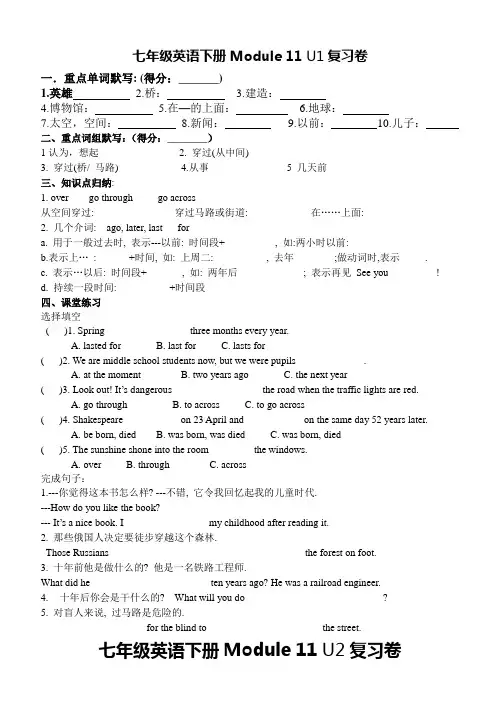
七年级英语下册Module 11 U1复习卷
一.重点单词默写: (得分:_______)
1.英雄 2.桥: 3.建造:
4.博物馆: 5.在—的上面: 6.地球:
7.太空,空间: 8.新闻: 9.以前: 10.儿子:
二、重点词组默写:(得分:________)
1认为,想起________________2. 穿过(从中间) _______________
3. 穿过(桥/ 马路) ____________4.从事_______________ 5 几天前_______________
三、知识点归纳:
1. over go through go across
从空间穿过: __________ 穿过马路或街道: __________ 在……上面: __________
2. 几个介词: ago, later, last for
a. 用于一般过去时, 表示---以前: 时间段+__________, 如:两小时以前:_____________
b.表示上… : ______+时间, 如: 上周二: __________, 去年________;做动词时,表示_____.
c. 表示…以后: 时间段+_______, 如: 两年后_____________; 表示再见 See you _________!
d. 持续一段时间: __________+时间段
四、课堂练习
选择填空
( )1. Spring ________________ three months every year.
A. lasted for B. last for C. lasts for
外研版英语七年级下册Module 11 Unit 2《Here are some ways to w
外研版英语七年级下册Module 11 Unit 2《Here are some ways to welcome them》教学设计
一. 教材分析
外研版英语七年级下册Module 11 Unit 2《Here are some ways to welcome
them》主要介绍了如何欢迎新同学。通过本节课的学习,学生能够掌握相关词汇和句型,并运用所学知识进行实际交流。教材内容丰富,实用性强,有利于提高学生的英语应用能力。
二. 学情分析
七年级的学生已经具备了一定的英语基础,能够听、说、读、写简单的英语句子。但部分学生对英语学习仍存在恐惧心理,缺乏自信心。因此,在教学过程中,教师需要关注学生的情感态度,鼓励他们积极参与课堂活动,提高他们的学习兴趣。
三. 教学目标
1. 知识目标:学生能够掌握表示欢迎的词汇和句型,如“Here are some
ways to welcome them.”, “How about…?”, “I think…is a good idea.”等。
2. 能力目标:学生能够用英语谈论如何欢迎新同学,并进行实际交流。
3. 情感目标:学生能够积极参与课堂活动,提高学习英语的自信心。
四. 教学重难点
1. 重点:表示欢迎的词汇和句型的运用。
2. 难点:如何运用所学知识进行实际交流。
五. 教学方法
1. 任务型教学法:通过完成具体任务,让学生在实践中学习和运用英语。
2. 情境教学法:创设真实的情境,让学生在实际环境中学习和运用英语。
3. 情感教学法:关注学生的情感态度,鼓励他们积极参与课堂活动。
六. 教学准备
1. 教材:外研版英语七年级下册Module 11 Unit 2《Here are some
ways to welcome them》。
2. 课件:教学课件,包括图片、视频等素材。
3. 练习册:配套练习册。 七. 教学过程
1. 导入(5分钟)
【同步练习卷】外研版英语七年级下册 Module 10 Unit 2
Unit 2 This morning we took
一.选择题(共7小题)
1.We should when we are waiting for the bus.( )
A.wait in line B.wait for line
C.wait on line D.jump in line
2.﹣Did you enjoy the concert last night?
﹣Very much. wonderful concert it was!( )
A.What a B.What C.How a D.How
3.﹣﹣What do you think of the 3 D film the Titanic last night?
﹣﹣It was____.I enjoyed it a lot.( )
A.boring B.wonderful C.strange D.terrible
4.﹣Don't step on the grass next time,Mike.﹣_____.( )
A.Yes,I do B.Don't worry
C.I don't know D.Sorry,I won't
5.﹣____ did Lucy go last week?
﹣She went to Dalian.( )
A.How B.Where C.When D.Which
6.﹣What are you going to do ____ holiday____ family?
﹣We are going to Australia.( )
A.in, with B.on, with C.with, on D.of, on
7.﹣Can you go to the supermarket with me?
﹣I'd love to. _____.( )
A.You can go alone
2020年外研版七年级英语下册Module 11 Body language模块检测题及答案
外研七年级英语下Module11模块检测卷
第一部分 听力(20分)
Ⅰ.听句子,选择与其内容相符的图片。每个句子读一遍。
A B C
D E F
1.______ 2.______ 3.______ 4.______ 5.______
Ⅱ.听句子,选择恰当的应答语。每个句子读两遍。
6. A. In the morning. B. Three times. C. Shake hands.
7. A. That’s funny. B. Where do they touch? C. Yes, we do.
8. A. Yes, we do. B No, he doesn’t. C. Yes, they do.
9. A. They are talking. B. In the park. C. Very old.
10. A. It doesn’t matter. B. Thank you. C. That’s a good idea.
Ⅲ.听长对话,选择最佳答案。每段对话读两遍。
听第一段长对话,回答第11-12小题。
11. What is the man doing?
A. Touching his eyes. B. Shaking his head. C. Crossing his arms.
12. How does the man feel?
A. Angry. B. Cold. C. Sad.
听第二段长对话,回答第13-15小题。
13. What’s the man doing in the picture?
外研版英语七年级下册:Module 11 Unit 2 Here are some ways to 3
学案
课题:M11 U2
学案编制人: 课型:阅读课
【学习目标】
1 本单元重点单词短语句型
2 正确使用祈使句,读懂关于各国身势语的文章
3 形成跨文化交际的意识,知道学习,尊重并理解异国文化。
【学习重点】
1能正确使用祈使句,让他人准确理解所表达的意思并照做。
2通过阅读,引导学生学会运用阅读的相关策略培养和提高他们的阅读理解能力.
【课前预习】
【学习过程】
Step I Pre-reading
Talk about body language in our daily life.Then revise the foreign
body language .
Step II While-reading
第一部分fast reading
(一) Let the students find out how many parts there are in the passage.
how many parts (部分)are there in the passage? (二) Read Part 1and find the answers.
1.Why did Wang Lingling write this passage?
Some _______ _________ are going to arrive , and she wants us to know some
________ to ________ them.
(三)Read Part2 (p2-p5) and finish three questions
1.How many aspects(方面)are mentioned when we meet foreigners?
What are they?
2.What's the type (体裁)of this passage?
A. narrative writing(记叙文)B. argumentation(议论文)