
英语人教版八年级下册Unit9 Section A 1a—2d
新目标英语八年级下Unit 9 Have you ever been to an musemant park?教学设计
一、教材内容及分析
本单元的目标是运用句型"Have you ever been to...?和I've never been to..’,谈论现在完成时态。
本单元的所有活动以“谈论过去的经历”为话题逐一展开。
本单元教学分为A,B两部分。
A部分使学生积极参加各项学习活动,B部分则巩固学习效果。
还应当与文化背景知识的学习与能力训练的有关练习结合起来,使学生能逐步地掌握知识. Section A la-2c首先以图片的形式呈现了本单元的重点语法现象现在完成时的用法,然后设计了听力活动、俩俩对话活动,从听说角度训练了本单元的核心句型,并在Grammar Focus中进行了归纳总结。
Section A 3a-4所设计的活动,则先通过一篇任务型阅读----你曾经去过迪斯尼乐园吗?让学生进一步熟悉这一新的语言现象,再通过两个俩俩结对活动,分别从半开放性的和完全开放性的话题入手,进一步发展学生的听、说技能。
Section B la-2b先通过对英语学习目的关注,呈现了听力活动中所要用到的词汇及句子。
然后,设计了两个听力活动,分别从两个层面,从宏观到细节,帮助学生掌握如何运用现在完成时谈论过去的经历,从而进一步学习现在完成时的意义、结构和用法.2c-4设计的活动,则通过说、读与写的活动,对学生运用各种时态谈论过去的经历进行了综合训练,旨在帮助学生创造性地运用现在完成时的能力。
Sell Check部分让学生通过活动1-3对自己的词汇运用能力及语言综合运用能力进行自我评价·
本单元的阅读材料向我们介绍了东南亚一个漂亮的岛国一新加坡·新加坡是个以旅游闻名的国家,素有“花园城市”的美称,它以干净优雅的环境、多样的饮食文化吸引着全世界旅游观光的人们。
又因为那里有众多的华人,所以新加坡也成为中国游客的热门选择.
二、学习者特征分析本单元学校的一般现在完成时,是在第六单元的基础上进行的,学生有了一点基础。
加之本单元谈论的是过去的经历,是学生很感兴趣的话题,故而只要用恰当的语句稍作引导,学生就会兴趣盎然,例如:“Did you go to Beijing ?Yes I did”我去过北京三次“I have been to Beijing for three times.”来谈论个人的经历。
三、教学目标
(一)知识 1. 掌握如何谈论过去的经历:一般过去时、现在完成时
2. 掌握如何谈论英语学习:tour guide, flight attendant
3. 掌握如何谈论曾经去过的地方:Have you ever been to …?Yes, I have been to …; No, I haven't. space museum, water park, amusement park, South America, European
4. 与本单元话题有关的其它词汇(参考课本词汇表)。
(二)能力能够询问和回答过去的经历。
(三)情感了解学英语的作用和重要性。
教学重点谈论过去的经历,现在完成时
教学难点用英语谈论自己的学习、生活经历。
四、教法选择、学法指导和资源准备
本单元主要是谈论自己的经历,学生本来就很感兴趣,根据《英语课标》和本单元教材内容,采用任务型语言教学途径,将教学目标设计成符合学生生活学习实际的任务链,尽量使学生在参与任务的过程中学习运用语言,形成语言能力,并使用多媒体辅助教学手段为学生学习营造较好的语言学习环境,提高学生学习语言的积极性。
通过任务型的教学途径,发展学生的综合语言运用能力,使语言学习的过程成为学生形成积极的情感态度、主动思维和大胆实践、形成自主学习能力的过程。
同时在教学中采用多媒体辅助教学、任务型教学模式,运用听说读写法,并以循序渐进的方式来进行教学。
教法选择:任务型教学法、情景视听法,交际法,整理法等。
学法指导:自主学习与合作学习相结合,听说读写相结合,知识学习与技能培养相结合。
教学媒体电脑、课件。
八年级-人教版-英语-上册-Unit 9 Section A (1a-2d)
Answer the questions according to the conversation.
3.What did Jeff and his cousin do last fall? They went bike riding together.
4.When is Sam leaving? He isn’t leaving until next Wednesday.
prepare for it. Jeff: That’s really too bad! Oh, but Sam isn’t leaving until next
Wednesday. Can you hang out with us on Monday night? Nick: Sure! Catch you on Monday!
L1bisten again and read after it.
Conversation 5
Anna: Hey, Paul. Can you come to my party on Saturday? Paul: Sure. It sounds great. When will it start? Anna: Around 6: 00 p.m. See you then. Paul: See you.
1.prepare for an exam 为考试做准备 (1) prepare for...表示“为……做准备”,相当于get ready for...。其 中,prepare用作不及物动词。
Unit 9 Can you come to my party?
(Period 1)
Section A (1a-2d)
Look and say
What do you usually do on weekends?
Unit9Haveyoueverbeentoamuseum_SectionA1a-2c课件人教版英语
Free talk Have you ever been to a/an_...? Yes, I have. /No, I haven’t.
have been to (去过),可 以与never[从没], ever [曾经], just[刚刚], once [一次], before[之前]连接。
ahsnmsciapsiawetutaruonscatrrecetmeymemrmzumeopusnuuoeastsuserepeumkuuammrmk
“我也是”结构: So+助动词/情态动词/be+主语(肯定) “So+助动词/be动词/情态动词+主语I.”=Me,too.
Drills --I have ever been to _a_s_c_i_en__ce__m__u_se_u_m___.
Have you ever been there?
回答1:Yes, __I_h_a_v_e___.
➢ 拓展:表示后者与前者情形相同,即“……也不……”时, 常用Me neither.或neither/nor引起的倒装句: Neither/Nor+助动词/系动词be/情态动词+主语.
时态上与前文保持一致,数要与其后的主语一致。
例:—I have never been to a water park.
Look at the map of the town. Listen and circle the places you hear.
2b Listen again and circle T for true or F for false.
Conversation 1
1. Tina went to the space museum last year. T/F
Unit9 Section A Gramm Focus课件2021-2022学年人教版英语八年级下册
she (2) _h_a_s__b_e_e_n_t_othe gym (健身房).
A: I (3)h_a_v_e__b_e_en__t_o the gym twice this week. It’s really tiring.
—Yes, I have been there once.
A. Have; gone B. Have; been
C. Do; go
D. Were; going
新疆乌鲁木齐中考
3.My friend’s new restaurant in Wanda Plaza (万达广 场) ______ two years ago, but I ______ there so far.
have been in+组织,表示加入某组织。 eg: He has been in the army for 3 years. 他参军三年了。
have been+adj./n.呈现……状态 eg: The shop has been open for 10 years. 这家店营业十年了。 We have been friends since we were 5. 我们从5岁起就一直是朋友。h
Language points
1. Well, I’ve already been there a couple of times, but I’m happy to go again.(教材P68 4a) a couple of 两个;一对;几个
a couple of 后跟可数名词复数。a couple of... 作主语时, 谓语动词用复数形式。 ➢ There are a couple of shoes in my bedroom, but they
人教版英语九年级全册Unit9 SectionA (1a-2d) 精品教案
Unit9 SectionA (1a-2d) 精品教案一、教学目标:1. 语言知识目标:1) 能掌握以下单词及短语:prefer, lyrics, Australian, electronic, suppose, smooth, spare, director, case, in the case, war2〕掌握I like /love/prefer music that…表达喜欢的音乐。
3〕掌握I like music that I can dance to. /I like musicians who play different kinds of music. 句型的用法。
3) 学习关系代词that/who引导的定语从句。
2. 情感态度价值观目标:1. 使学生学会谈论自己的喜好。
2. 通过表达个人喜好,提高学生欣赏美的水平。
3. 激发学生的学习兴趣和学习热情。
二、教学重难点1. 教学重点:1〕prefer, different kinds of sing along with的用法。
2〕句型:I like music that I can dance to.I like musicians who play different kinds of music.2. 教学难点:学习关系代词that/who引导的定语从句。
三、教学过程Ⅰ. Warming up师生问候。
Ⅱ. Lead-inSay What kind of books do you like? I like interesting books. I like books that are interesting. Write…that are interesting on the blackboard. Point to it and ask who can make another sentence with it. Write another phrase on the blackboard, …that is comfortable to …. Help the students to make sentences with it.Ⅲ. Presentation1. 教师播放学生较熟悉的带有歌词或歌手的图片的流行歌曲,激发学生的学习兴趣,同事师生对话,引出本单元的内容学习,为完成1a做铺垫。
人教版八年级英语下册教案Unit 9 Have you ever been to a museum.
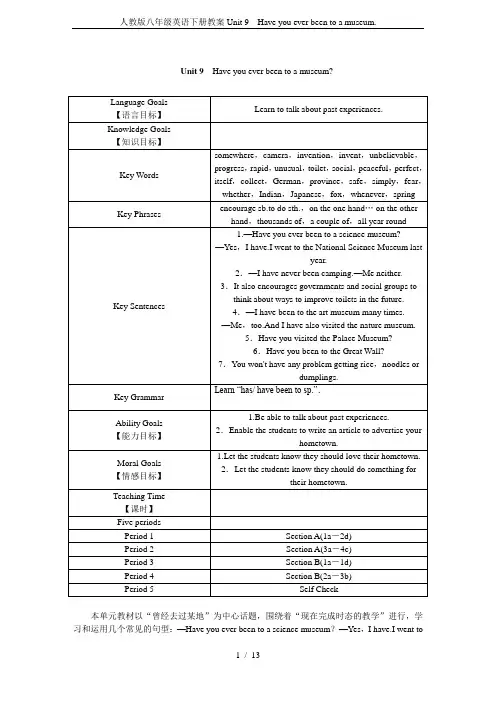
Unit 9Have you ever been to a museum?本单元教材以“曾经去过某地”为中心话题,围绕着“现在完成时态的教学”进行,学习和运用几个常见的句型:—Have you ever been to a science museum?—Yes,I have.I went tothe National Science Museum last year./—I have never been camping.—Me neither./It also encourages governments and social groups to think about ways to improve toilets in the future./—I have been to the art museum many times.—Me,too.And I have also visited the nature museum.等。
在学习过程中,学生在交流中,能促进师生之间的感情。
Section A主要学习几个常见的动词短语及句型Have you been to…?应掌握句型:—Have you ever been to a science museum?—Yes,I have.I went to the National Science Museum last year.等。
通过一篇短文介绍了学生们曾经去过的最有趣的博物馆,增加了学生的阅读量。
Section B安排了听、说、读、写的任务,通过短文“Singapore—A Place You Will Never Forget!”介绍了新加坡的一些情况。
教师在教学中应合理利用课本上的知识进行教学。
第一课时Section A(1a-2d)Teaching Key Points【教学重点】The vocabulary:amusement,somewhere,camera,invention,history/space/art museum,put up,have a good time,water/amusement parkTarget language:1.—Have you ever been to a science museum?—Yes,I have.I went to the National Science Museum last year.2.I have never been camping.3.It's a great way to spend a Saturday afternoon.Teaching Difficult Points【教学难点】Use the target language above to talk about past experiences.Teaching Aids【教学工具】an English book,a tape recorder and CAITeaching Steps【教学过程】★Step 1Preview and perception【预习感知】Ask the students to read the vocabulary and target language.Ⅰ.英译汉。
英语八年级下册第九单元1a到2d知识点

英语八年级下册第九单元1a到2d知识点本篇文章主要介绍英语八年级下册第九单元1a到2d知识点,涉及词汇、语法、听力和阅读理解等方面。
1. 词汇1a部分为词汇学习环节,主要涉及以下几个方面:1)爱好:例如swimming, watching TV, playing games等;2)活动:例如play basketball, go shopping, watch movies等;3)颜色:例如red, blue, green等;4)事物:例如book, computer, phone等。
2. 语法1a部分还涉及到了一些语法知识,主要包括以下几个方面:1)be动词的用法:例如I am a student. He is a doctor.;2)一般现在时的用法:例如I like swimming. She plays basketball every day.;3)频率副词的用法:例如always, often, sometimes, never等;4)现在进行时的用法:例如I am swimming. She is playing basketball.。
2a部分新增了一些语法知识:1)there is/are的用法:例如There is a book on the desk. There are two books in the bag.;2)数量词的用法:例如a, an, some, any, much, many等。
3. 听力2a和2b部分是听力环节,主要涉及以下几个方面:1)听句子选择正确的图片:例如听到“Mary is playing the guitar.”,选择正确的图片为Mary弹吉他;2)听对话选择正确的答案:例如听到“--What are you going to do this weekend? --I am going camping with my friends.”,选择正确的答案为周末我会和朋友去野营;3)听短文回答问题:例如听到一篇有关学生爱好的短文,回答问题“Tom likes playing basketball. True or false?”等。
人教版英语八年级下册-Unit 1 Section A (1a—2d)教案
Unit 1 What’s the matter?Section A (1a—2d)一、教学目标1. 能够熟练掌握本课重点词汇:matter, sore, stomachache, foot, neck, stomach, throat, fever, lie, rest, cough, X-ray, toothache, break, hurt,have a cold, have a stomachache, have a sore back, havea sore throat, lie down, cut oneself, take one’s temperature, have a fever, take breaks等。
2. 熟练运用本课重点句型:(1) —What’s the matter?—I have a…(2) —What should I do?—I think you should lie down and rest.3. 能够听懂谈论健康问题的对话,并能从中提取关键信息。
4. 能够使用“have+(a)+疾病”结构描述健康问题,并能就健康问题提出简单的建议。
5. 学会关心自己和他人,通过询问他人的健康情况并给予帮助,从而增进人与人之间的感情。
二、教学重点及难点重点:1. 能够听懂谈论健康问题的对话,并能从中提取关键信息。
2. 能够使用“have+(a)+疾病”结构描述健康问题,并能就健康问题提出简单的建议。
难点:能够使用“have+(a)+疾病”结构描述健康问题,并能就健康问题提出简单的建议。
三、教学过程四、板书设计Unit 1What’s the matter?第1课时Section A (1a—2d)Key words and phrases: matter, sore, stomachache, foot, neck, stomach, throat, fever, lie, rest, cough, X-ray, toothache, break, hurt,have a cold, have a stomachache, have a sore back, have a sore throat, lie down, cut oneself, take one’s temperature, have a fever, take breaksKey sentences:1. —What’s the matter?—I have a…2. —What should I do?—I think you should lie down and rest.。
人教版英语八年级下册Unit 1 SectionA (1a-2d)教案
Unit 1 What’s the matter?Section A (1a-2d)一、教学目标1. 听懂并掌握下列词汇及常用表达:matter, sore, stomachache, foot, neck, stomach, throat, fever, lie, rest, cough, X-ray, toothache, headache, break, hurthave a cold, have a stomachache, have a sore back, have a sore throat, lie down, cut oneself, take one’s temperature, have a fever, take breaks2. 听懂谈论健康问题的对话材料。
3. 能简单谈论健康问题,并使用“have + (a) + 病症”结构做出回答或表述。
What’s the matter with …?I have a …4.掌握听力技巧之利用生活常识听前预测。
5. 能够运用所学的语言简单地描述自己的健康状况并询问对方的身体健康状况。
6. 学会关心他人,通过询问他人的健康情况并能给予帮助,增进人与人之间的感情。
二、教学重点及难点重点:1. 掌握核心词汇及常用表达。
2. 能简单谈论健康问题,并使用“have + (a) + 病症”结构做出回答或表述。
难点:掌握听力技巧之利用生活常识听前预测。
三、教学准备1. 教学课件、词汇图片。
2. 学生课前预习。
四、教学过程Task 1(1a-1c)Step 1 Warming-upLook and sayT: Welcome to our new class. Today we’ll learn Unit 1. First you will see some pictures of body parts. You can look at the pictures and say the corresponding words.设计意图:复习已学的单词,为本单元“健康与急救”话题的学习奠定基础。
2014新人教版八年级英语下unit9sectionA 1a-2d
Talk something about the picture.
Sarah
Claudia
Listening 1 Choose the best answer.
2c Look at the map in 2a and make conversations about the places.
A: Have you ever been to the space museum? B: Yes, I have. How about you? 极好的 A: No, I haven’t. B: Oh, it’s fantastic. Let’s go tomorrow. A: OK. How are we going to get there? B: We can take the subway.
1. space museum 2. amusement park 3. water park 4. camera n.
1. 太空博物馆 2. 游乐场 3. 水上乐园 4. 照相机;摄影 机;摄像机
space museum
Have you ever been to a space museum?
He’s been watching TV all afternoon. 他一下午都在看电视。 We’ve been living like this ever since the birth of my little brother. 自打我小弟弟出生,我们就一直这样生 活。
1. 我去过北京两次。 I ______ have ______ been _____ to Beijing twice. 2. 大声读书是一种学习英语的好方法。 Reading aloud __ ____ ____ a good way ____ to to learn English. 3. 昨天他没有去那,我也没去。 He didn’t go there yesterday. _____ Me _________. neither
最新人教版八年级英语下册导学案(全册 共10个单元)
Unit 1 What’s the matter?第一课时 Section A(1a-2c)【学习目标】1.能听说读写重点单词和词组:matter, have a cold, stomachache, throat, fever, lie down, rest,X-ray, toothache, take one’s temperature,see a dentist等.2.句型:学会用What’s the matter? I have a cold. I have a stomachache. I have a sore throat. 等谈论身体情况。
3. 学习用should 给出建议【学习重难点】能询问并表述身体的种种不适以及对他人身体的种种不适给予适当的建议。
【学法指导】1、查词典,认读新单词,与画面中字母匹配,并在自己的身体上指认人体部位。
2、熟记目标词汇句型,听力更轻松。
【自学互助】1、把你所知道的身体部位的单词写下来,并写出其相应的中文意思。
eye 眼睛 ______ ______ ______ ______ ______ ____________ ______ ______ ______ ______ ______ ______ ____________ ______ ______ ______ ______ ______ ______ ______2、议一议:have a cold的意思是“感冒”,have 表示生…病,解释下列词组的意思。
have a sore throat _________ have a sore neck ___________have a fever __________ have a headache ____________have a stomachache ________ have a toothache __________3.通过互助学习后,我的疑惑是_____________________________________________________________________________【展示互导】谈论疾病,对症下药1.小组合作,看那个组准确说出常见的病痛;2.自由讨论给出治疗建议。