
2020秋人教版英语九年级上册精品教学课件Unit3_SectionB(2a-2d)
The topqiucesstieonnctoerrnecctley. iWseualssuo naeleldytotlheaern_h_ofw_irt_so_tb_e poolritetwhhee_n _wl_eaa_ss_kt_forsheenlp.tence
of each mpigaGhrtoadoedgprsepnaedapkohenrs.wcShhooamnmgteheethyteiamwreaeyspstehaeikytinsigpsetaoakloisrnohdoiifwfnewretenhltl setihtmeu_ya_itdiko_ndno_slwe. Teohaefchetxohptrheeesrpsiwoanerlsl.athIgteyirsuaaslpel h
It might seem more difficult to speak politely than directly. However, it is important to learn how to use the right language in different situations. This will help you communicate better with other people.
Conversation2:
Student: When is the school trip?
Teacher: ________________.
Requests
When is the school trip?
Excuse me, Mr West. Do you know when the school trip is?
2b
Could you please ...?
Para. 1
Tip:
When you visit a foreign country, it is important to know how to ask for help politely. For example, you may ask “Where are the restrooms?” or “Could you please tell me where the restrooms are?” These are similar requests for directions. Both are correct , but the first one sounds less polite. That is because it is a very direct question. It is not enough to just ask a
make request s
e question s
examples
Could you please tell me...?
Excuse me, Mr West. Do you know when the school trip is?
to whom teachers/old people/strangers...
Scanning Read
When you
ParCa o1ualdnCdyaocnhuoypoolseueatsfhiened.r.i.ag?hnteaxnaswmeprl.e?
visit a foreign country, it is important to know
how
to
ask for help politely. For example, you may ask “Where are the
Excuse me, do you know where the History Museum is?
I’m sorry to trouble you, could you please tell me how to get to the History Museum ? ......
Skimming Underline the topic sentence of each paragraph.
When is the school trip?
classmates
Excuse me, Mr West. Do you know when the school trip is?
teacher
GCoonovdesrpsaetaikoenr1s: change the way they speak in different sSitudaetinotn: sE.xTchuseeemxep,rMesrsWioensst.gDoooydouspkneoawkewrhsenutsheemscighohotl tdreippend on _is_?__w_h__o_m__t_h_e_y__a_r_e__s_p_e_a_k_i_n_g__to___or h__o_w__w_e__ll_t_h_e_y__k_n_o_w__e__a_c_h__o_t_h_e_r Teacher: _______________.
question. It is not enough to just ask a question correctly. We also
need to learn how to be polite when we ask for help.
sounAds less polite than
______
__d__ir_e_c_t___
question.
For example, you may ask “Where are the restrooms?” or “Could you please tell me where the restrooms are?” Both are correct(正确的), but the first one sounds less polite . That is because it is a very direct question. It is not enough to just ask a question correctly. We also need to learn how to be polite when we ask for help.
___w_h_o_m___th__e_dy_ira_e_rce_t_s_p_e__a_k_in__g_t_o____or _h_o_w__w__e_ll_t_h_e_y__k_n_o_w___e_a_c_h__o_t_h_e_r
to whom
questions
cpleaospsmleaytoeus k/ nfroiwenvdesr..y. well
Watch a video What polite questions can you hear?
Could you tell me ......? Excuse me, I wonder that you can help ...? Do you know how far it is...?
Can you find out the features(特点) of these sentences?
Discussion
What other ways does he have of making requests?
Where is the History Museum?
How can I get to the History Museum?
The ways
Could you tell me where the History Museum is?
2 “Excuse me, Mr. West. Do you know when the school trip is?”, this will sound much more
polite.
Para. 3
Para. 4
Usually polite questions are longer. They include expressions such as “Could you please ...?” or “May I ask ...?” It sounds more polite to say, “Peter, could you please tell me your e-mail address?” than “Peter, tell me your e-mail address.” Sometimes we even need to spend time leading in to a request. For example, we might first say to stranger, “Excuse me, I wonder if you can help me” or “I’m sorry to trouble you, but ...” before asking for help.
right to ask direct questions to your classmates because you know them well. However, if you
Para. say to your teacher, “When is the school trip?”, this might sound impolite. But if you say,
What should he do?
How does Mr Smith make requests (提出请求)?
How doDesidMYr.aSnmg iLthinmgahkeelrpeqMuer.sStsm(提ith出?请求)?
Why?
Because Mr.Smith is very polite(有礼貌的).
Para. 1
restrooms?” or “Could you please tell me where the restrooms are?” These are similar requests for directions. Both are correct , but the
(人教版)九年级上册英语unit3单元全套课件
使用说明:点击对应课时,就会跳 转到相应章节内容,方便使用。
Section A 1Leabharlann -1c➢ Objectives
To learn how to ask for information politely. To learn to follow directions. To learn the words:restroom, stamp, beside...
The girl wants to buy somes_ta_m__p_s . She asks the boy how to _g_et___ _t_h_e_re__. She can _g_o____ _p_a_s_t _ the bank and then _t_u_rn____ _r_ig_h_t__. The post office is on ther_ig_h_t___, next to the l_ib_r_a_r_y__.
人教版九年级英语上册单元全套课件
unit 3
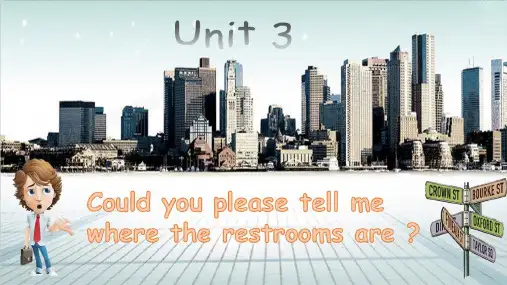
Could you please tell me where the restrooms are?
Section A 1a-1c
Section A 2a-2d
Section A 3a-3b Section A Grammar
Focus-4c
Section B 1a-1e Section B 2a-2d Section B 3a-Self
1a Where can you do the things below? Match each thing with a place in the picture. Many different answers are possible.
人教版英语9年级全册Unit3_SectionB(2a-Self_Check)教案
B
a, “could you please tell me where the restrooms are? ”
b. “When is the school trip?”
c, “Excuse me, I wonder if you can help me.” or “I am sorry to trouble you, but....”
【通过本单元的学习学生需掌握哪些综合技能】
1.在不同场合下礼貌的使用语言。
2.结合不同文化背景得体的使用语言。
教学目标
语言知识目标:
1.通过教师的情景式导入和与学生互动的问答形式,学习和巩固该话题下的词汇句型,激发调动学生的求知欲,熟练使用以下词汇、短语和句型:
单词:polite, politely, speaker, request, choice, direction, correct, direct, whom, address, faithfully
在最后的自我检测部分,巩固复习本单元学习的重点词汇和句型。
教学流程
(详见相应教学设计)
教学评价
写进行礼貌地询问的宾语从句,写作内容逐渐发展到使用wh-疑问词引导的宾语从句询问各种问题,写作话题由国内身边琐事发展到国外生活资讯;写作篇幅由句子过渡到语篇,学会独立写作咨询信;最后在具体语境中复习巩固本单元学习的重点词汇和句型。其中前两个环节是循序渐进的,教学中一定要务实第一个环节,为第二个环节奠定基础。
情感态度价值观目标:
通过对本部分的学习,使学生能够了解英语中的礼貌用语。
教学重难点
教学重点:
用wh-疑问词引导的宾语从句礼貌地询问各种问题。
人教版九年级英语全册Unit3SectionB2a~2d教学设计
针对以上学情,教师在教学过程中应关注个体差异,采取分层教学,提供有针对性的指导。同时,注重激发学生的学习兴趣,培养他们的自信心和团队精神,为学生的全面发展奠定基础。
三、教学重难点和教学设想
(一)教学重难点
1.重点:
-掌握本节课的核心词汇和短语,如:destiny, talent, confidence, opportunity等。
2.难点:
-对一般过去时和现在完成时的区别和运用进行深入理解。
-在实际语境中灵活运用目标词汇和句型进行表达。
-提高听力理解能力,特别是在处理语速较快、信息量较大的听力材料时。
-阅读理解中,对文章细节和隐含信息的捕捉以及推理判断能力的培养。
(二)教学设想
1.教学策略:
-采用任务型教学法,设计真实、有意义的任务,激发学生的兴趣和参与度。
5.培养阅读技巧,如快速阅读、细读、推理等,提高阅读理解能力。
(二)过程与方法
在本章节的教学过程中,学生将通过以下方式培养英语能力:
1.通过小组合作,进行课堂讨论,培养学生主动思考和合作交流的能力。
2.利用听力材料,进行听力训练,提高学生的听力技巧和注意力。
3.采用任务型教学法,设置各种真实语境,让学生在实际运用中掌握目标知识。
-帮助学生了解自己的优势和梦想,增强自信心。
3.教学过程:
-教师提出讨论问题,学生进行小组讨论。
-每个小组选派代表进行汇报,其他学生认真倾听,给予评价和反馈。
(四)课堂练习
1.教学活动设计:
-设计听力练习,让学生听懂并获取关键信息,如:人物的经历、梦想等。
-设计阅读练习,让学生运用阅读策略,理解文章深层含义,进行推理判断。
Unit3SectionB(1a-1e)课件人教版九年级英语全册

Section B (1a-1e)
Words Review
fascinating adj. 迷人的;极有吸引 力的
inexpensive adj. 不昂贵的 uncrowded adj. 不拥挤的;人少的 convenient adj. 便利的;方便的
F. uncrowded
Talk about the places in our city using the words above.
A: The Fine Arts Museum is really interesting.
B: Yes, and it’s beautiful, too.
Look at the picture and look through the conversations, then answer the questions .
e.g.Internet makes it convenient for us to get in touch with each other.
互联网使得我们相互联系便利了。
convenience是convenient的名词形式,既可作可数名词,意 为“便利的设施”,也可作不可数名词,意为“方便,便 利”。 ►The house has all the modern convenience.
Summary
What have we learnt today? Some adjectives : fascinating, inexpensive,
uncrowded, convenient … …
How to ask for information politely
人教版九年级英语全册Unit 3 Section B(2a-2d)课件
Could you please...?
Usually polite questions are
May I ask...?
Excuse me. I wonder if you can help me.
longer.
I’m sorry to trouble you, but ...
Longer questions can be more _p_o_l_it_e_ and we need to spend time _le_a_d_i_n_g__in_t_o_a__r_e_q_u_e_s_t before asking for help.
What’s the difference between their requests? Who is polite? Are their results the same?
Think about:
When do we need to make polite requests? How can we make polite requests?
• What’s the purpose(目的) of the writing? It will help you communicate better with other people.
Fill in the blanks according to the text.
1. When you visit a foreign 结构分析:本文是说明文,结构完整。 country, it is important to know
Q2: Are the two requests correct? Both are correct. Q3: Why is the request B better?
人教版英语九年级全册Unit3 SectionB(2a-2e)优质课教案
Unit3 SectionB(2a-2e)优质课教案requests?While ReadingSkimming:1. How many paragraphs are there in this passage?2. Please underline the topic sentence of each paragraph.Scanning:1. Read the first paragraph and choose the right answer.____sound less polite than ___. (A: Where are the restrooms? B: Could you please tell me where the restrooms are?)2. Guess the Chinese meaning of “direct”?3.引出思维导图:教师引导学生划分段落,画出每段的中心句。
教师引导学生抓关键信息,选择正确选项。
师引导学生猜出“direct”的意思。
教师引导学生理出思维导图的呈现过程。
学生根据阅读提示,划分段落,画出每段的中心句。
学生扫读第一自然段然后选择正确答案。
学生根据教师提示说出答案。
学生理清思维导图的思路。
Tip: The topicsentence isusually the______ orthe______sentence ofeach paragraph.Sometimes it isalso in the____ of theparagraph.目的是引出下面的思维导图。
Tip: Guess fromthe context.思维导图可以帮助学生理清文章思路和结构。
4. Read Para.2 and fill the table. Requests To whomWhen is theschool trip?Excuse me, MrWest. Do youknow when theschool trip is?5. Read Para.2 again and fill in the blanks: Good speakers change the way they speak in different situations. The expressions good speakers use might depend on ______or______.6.进一步完善思维导图:7. Watch a video What polite questions can you hear? 教师引导学生填表格。
人教版九年级英语课件:Unit3SectionB2
答案:1.要求;请求 2.方向;方位
5.address
3.谁;什么人
4.correct
6.polite(adj.)→__________(adv.)礼貌地;客气地 →__________(adj.)不礼貌的;粗鲁的 7.direct(adj.)→__________(adj.)间接的 8.speak(v.)→__________(n.)讲(某种语言)的人;发言者
2.It’simportanttoknow______alongwellwithothers. A.howgetB.howgetto C.howtogetD.togethow 3.Iwonder______youcancometomypartynextSunday.
A.ifB.whyC.thatD.where
式。
Weshould______________________________wetalkwhenwespe akwithdifferentpeopleindifferentsituations. 答案:3.wheretopark4.Both;are 5.changetheway
初中英语课件
金戈铁骑整理制作
(2)spend+时间/金钱+onsth.
【归纳拓展】如何表达“花费” (1)+spend+/+onsth./(in)doingsth. (2)+pay++forsth.
(3)sth.+cost++
(4)Ittakes+++todosth.
【巧学助记】spend/pay/cost/take的辨析技巧 一看主语,二看花费时间还是金钱,三看句式结构。
人教版英语九年级全一册-Unit 3 Section B (2a-2d)教案
九年级Unit 3 Could you please tell me where the restrooms are?Section B 2a-2d Could you please...?教学设计Teacher :Analysis: This unit is about asking for information politely. This reading passage is telling us where should we need to make polite requests and how. Students have learned how to say politely in Section A and they will keep learning how to make polite requests in the reading passage. They will be interested in talking rudely and politely and compare with different ways of speaking. So the teacher will design these kinds of activities for them to learn better.Objectives:1. Language skillsStudents will be able to make polite requests according to different situations and different people.Students will learn how to make polite requests.Students will be able to rewrite impolite requests.2. Language knowledgeStudents will be grasp these new words and sentence structures, politely, request, direction, correct, polite, direct, speaker, impolite, Could you please...? May I ask...? Excuse me, I wonder if you can help me. I’m sorry to trouble you, but...Students will be able to speak politely, gently and slowly when making request.3. AffectsStudents will be able to choose and use suitable language based on cultural knowledge, such as in a foreign country, in public places, at school and at home.4. Cultural awarenessStudents will be able to learn to ask politely and pay attention to the body language and remember to say thank you.Students will learn not to ask rude questions, such as age, salary or use rude gestures.5. Learning strategyStudents will be able to realize the wrong ways they are using in daily life and correct them. Students will be able to get information from the pictures given from the passage.Focuses:Students will be able to choose and use suitable language based on cultural knowledge, such as in a foreign country, in public places, at school and at home.Students will be able to rewrite impolite requests.Difficulties:Students will be able to learn to ask politely and pay attention to the body language and remember to say thank you.Students will be able to realize the wrong ways they are using in daily life and correct them. Students will be able to get information from the pictures given from the passage.Teaching process:So let’s take a look at the structure of the passage. First paragraph, the writer leads in the topic. ...Step 3 Close-readingT: So what examples does the writer give us to lead in the topic? Request 1 VS Request 2Topic: When we visit a foreign country, we need to ask for help_________ and _________.T: How can we speak politely? What does a good speaker do? What examples does the writer give us as good speakers?When is the school trip?Excuse me, Mr. West. Do you know when the school trip is?T: Whom do we usually say it to?Why?Tip 1: Good speakers change the way they speak depending on__________________ and ___________________.T: How can we make questions longer and more polite?Could you please...?May I ask...?Excuse me, I wonder if you can help me.I'm sorry to trouble you, but.......Tip 2: Longer questions can be more ______ and we need to spend time ___________________before asking for help.PracticeWhat are you going to say to them if you are thirsty? Can you talk about it with your partner?What does the writer tell us in the end?Why do we need to speak politely? 细读阶段,通过找作者给出的例子一步步带出话题和make polite requests 的两个方法。
人教版九年级上册英语授课课件 Unit 3 Section B (2a-2d)
_______________________________________________________
Thiswillhelpyoucommunicatebetterwithotherpeople.
课文呈现
1.
Direct questions
2.
Polite requests
1.Wherearetherestrooms? 1.Couldyoupleasetellme
wheretherestroomsare? 3.
2.Whenistheschooltrip?
2.Excuseme, Mr. West.
5. Excuse me, do you
B
know what time it
begins, please?
A
6. Let me know when
you're ready, OK?
B
7. Could you possibly tell
me the way to the
village school?
Thesearesimilarrequestsfordirections. ②
标题:线索式 “Could you please ...?”贯穿全文各个段落,是最具代 表性的礼貌用语,而且以疑问句为题目可以在一定程度上 引起读者的兴趣。
课文呈现
but之后才是作者要表达的重点:礼貌提问>正确提问。
Botharecorrect,
A
Place
athome
2. Do you know
新人教版九年级英语 unit3 unit 3 section B (2a-2b)-优质课件.ppt
• 13、志不立,天下无可成之事。2020/6/292020/6/292020/6/292020/6/296/29/2020
• 14、Thank you very much for taking me with you on that splendid outing to London. It was the first time that I had seen the Tower or any of the other famous sights. If I'd gone alone, I couldn't have seen nearly as much, because I wouldn't have known my way about.
• 17、一个人如果不到最高峰,他就没有片刻的安宁,他也就不会感到生命的恬静和光荣。2020/6/292020/6/292020/6/292020/6/29
谢谢观看Βιβλιοθήκη 2. usually polite questions are longer , they include expressions such as " could you please .../?
May I ask ....?
Fast Reading
Read the article and underline the topic sentence for each paragraph
4. I'm really sorry __(hear) that 5. Good __ (speak)of English know how to use proper
English .
• 9、春去春又回,新桃换旧符。在那桃花盛开的地方,在这醉人芬芳的季节,愿你生活像春天一样阳光,心情像桃花一样美丽,日子像桃子一样甜蜜。 2020/6/292020/6/29Monday, June 29, 2020