
Unit2辅导讲义牛津深圳版(广州沈阳通用)七年级英语上册
初一同步班上册Unit2辅导讲义
学员姓名:
授课时间:
授课教师:
本节课重难点: Unit 2重点单词+语法
教学内容
课前小测:
用所给词的适当形式填空。
1. She ______ (watch) TV every day.
2. I usually ______ (help) my mother clean the house.
2. Tom ______ (not go) to school by bus. He ______ (go) to school by bike every
day.
4. Kate often gets up at six, and ______ (brush) her teeth.
5. Jack ______ (study)at NO.8 Middle School.
6. I often ______ (finish) my homework at 8:30, but my brother often ______
(finish) his at 9:00.
7. The man ______ (clean) the house at 7:00 every morning. Now, it is 7:00. He
______ (clean) the house.
连词成句
1. what, usually, you do, on, do weekends?
________________________________________? 2. how often, your brother, does, take, a, shower?
_________________________________________?
3. I, nine , hours, sleep, every , night.
_____________________________________.
4. Betty, milk, drinks, every, morning.
____________________________________.
5. some, students, once, watch, TV, or, twice, a, week.
_______________________________________________.
同步知识讲解 Unit 2
Part 3:重点单词、句子
1、I love going to school.
I enjoy learning about different places in the world.
E.g. We love _______(take) a walk in the park after dinner.
learn about:___________
2、I always go to school on foot.
on foot:______________ Sarah goes to school on foot everyday.
by+交通工具 Sarah______ ______ _______ to school
everyday.(by bus)
3、I am seldom late. seldom:______________ never:______________
usually:______________ always:______________
4、Jack and I take part in the school band practice.
take part
in:_______________________________________________________
join:_____________________________________________________________
join
in:____________________________________________________________
’ll ____________social practice during the summer vacation.
2 e on,and _____________the ball game.
3.When did you _________the army?
5、I always have a good time at school.
have a good time:____________________=enjoy oneself
E.g. We ________________ on the Children’s Day.
写出其同义句:___________________________________________________
同步知识讲解 Unit 2【语法知识聚焦】
一般现在时:The Simple Present Tense
表示_________________________
He is twelve. 他十二岁。 They are at home.他们在家。
表示_________________________
I go to school at seven every day. He plays soccer on Sundays.
表示_________________________
She likes apples. They speak Japanese. She is medium build.
肯定式
I am a cleaner. You are right. He / She / It is here. We / You / They are
outgoing
否定式
I am not a… You are not… He / She / It is not… We / You / They are
not…
否定式和疑问式
We go to school at seven every day. We don’t go to school at seven.
Do you go to school at seven? Yes, we do.(No, we don’t.)
否定式和疑问式
He goes to school at seven every day. He doesn’t go to school at seven.
Does he go to school at seven? Yes, he does.(No, he doesn’t.)
一般现在时常和表示时间频度的副词连用。
如: often, usually, sometimes, always, never, hardly ever等。
1. I often read books in the evening
2. Do they usually go to school by bike?
3. He doesn’t like milk. He never drinks it.
4. Sometimes my mother gets back at five.
一般现在时常和以下时间表达法连用。
如: in the morning, in the afternoon, in the evening, at noon, at night,every
day,on Sunday(s), at seven 等。
Do they have math in the morning?
She sleeps nine hours every night.
It takes me two hours to do my homework every day.
They don’t have classes on Sundays.
动词第三人称单数的构成:
1、直接加slook—looks read—reads play—plays stop—stops
2. 在字母s, x,ch,sh,o后加es
miss—misses fix—fixes watch—watches wash—washes
go—goes dodoes 3. 辅音字母加y结尾的动词去y为i,再加es
carry – carries study – studies hurry – hurries cry – cries
have has
基本用法
1.表示经常性,习惯性的动作
1.我每天早上六点钟起床。
____________________________________________.
2.我每天晚上学习两小时。____________________________________________.
2.表示当前的状态,状况
1)护士在医院照看病人。____________________________________________.
2)他住在番禺。____________________________________________.
3.表示普遍真理,客观事实
1)水在一百摄氏度开。____________________________________________.
2)地球围绕着太阳转。____________________________________________.
难点:I will never tell her when she es back from tomorrow.
1.When I grow up, I’ll bee a nurse.
____________________________________________.
牛津深圳版(广州沈阳通用)八年级下册英语教案:Unit6
1 / 30 Module 3 Unit 6
Pets
This lesson is a period to learn the knowledge of pets. It tells students how to keep the
pets and some useful words and expressions related to the topic.By learning this
unit ,students can grasp some grammar to write something and train their basic ability.
【知识目标】
1.Get students to learn the useful words and expressions in this period.
chocolate,dolphin,click,reason,cute,feed,according to,sofa,noisy,nearly,stranger,common,choice;care for,have no choice but to do,head to
head。
2.Help students to learn about useful expressions..
【能力目标】
To read the passage and answer some questions about pets.
【情感目标】
1.Help them understand more about pets.
2.Develop students' sense of cooperative learning.
【教学重点】
How to train their reading ability step by step. 1. 教材分析
4. 教学重难2. 教学目标 2 / 30 【教学难点】
Unit3FamilylifeReading素材-牛津深圳版(广州沈阳通用)九年级英语上册备课资源(课文翻译+思维导图+课文解析+配套习题+单词短语)

9A Unit 3 Family life Reading 备课资源
★ 教材原文
Family life in cities
城市里的家庭生活
Paula interviewed two teenagers for a programme on family life. She asked them some questions.
Here are their answers.
Paula 采访了两位少年对家庭生活的计划。她问他们一些问题,以下是他们的答案:
Emily (aged 15)
Emily(15 岁)
1 Well, there are just three of us: my mum, my dad and me.
1. 嗯,目前我家只有三个人:我妈妈,我爸爸和我。
2 Have I got many possessions? Yes, I've got a lot of things: a big TV, a new computer and a
mobile phone.
2. 我有多少个人物品?是的,我有很多东西:一个大电视,一台新电脑和移动电话。
3 No, I'm not expected to do the housework.
3. 不,我从不想做家务。
4 We go out for dinner together sometimes, but my dad is often abroad on business, and my mum
works too. We usually just do our own personal things.
4. 我们有时一起出去吃晚饭,但是我爸是经常在国外出差,我妈妈也要上班,我们经常是各忙各的。
5 No, they don't usually set rules for me and since I'm a good daughter they never punish me.
8B Unit2 Grammar 知识点练习八年级英语牛津深圳版(广州沈阳通用)下册
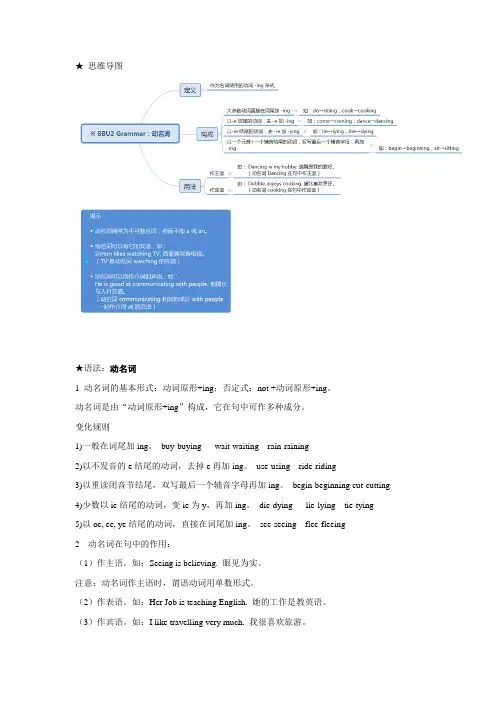
★ 思维导图
★语法:动名词
1 动名词的基本形式:动词原形+ing;否定式:not +动词原形+ing。
动名词是由“动词原形+ing”构成,它在句中可作多种成分。
变化规则
1)一般在词尾加ing。 buy-buying wait-waiting rain-raining
2)以不发音的e结尾的动词,去掉e再加ing。 use-using ride-riding
3)以重读闭音节结尾,双写最后一个辅音字母再加ing。 begin-beginning cut-cutting
4)少数以ie结尾的动词,变ie为y,再加ing。 die-dying lie-lying tie-tying
5)以oe, ee, ye结尾的动词,直接在词尾加ing。 see-seeing flee-fleeing
2 动名词在句中的作用:
(1)作主语。如:Seeing is believing. 眼见为实。
注意:动名词作主语时,谓语动词用单数形式。
(2)作表语。如:Her Job is teaching English. 她的工作是教英语。
(3)作宾语。如:I like travelling very much. 我很喜欢旅游。 (4)作定语。如:This is our reading room. 这是我们的阅览室。
3 习惯接动名词作宾语的动词有:enjoy, finish, imagine, keep, mind, practise等。如:
My sister enjoys playing tennis. 我姐姐喜欢打网球。
Do you mind opening the window? 你介意开窗吗?
4 动名词也可以在短语动词和介词后作宾语,习惯接动名词作宾语的短语有:be afraid of, be
busy, be good at, be interested in, be worth, feel like, how / what about, look forward to, pay
Unit2NumbersReading素材-辽宁省法库县东湖第二初级中学牛津深圳版(广州沈阳通用)八年级英语上册备课资源(课文翻译+思维导图+课文解析+配套习题+单词短语)
8A Unit 2 Reading 备课资源
★ 教材原文
The king and the rice
国王和米
A long time ago, there was a king in India. The king's favourite game was chess.
很久以前,印度有一个国王。国王最喜欢的游戏是国际象棋。
One day, a wise old man came to the palace and the king challenged him to a game.
一天,一个聪明的老人来到王宫,国王向他挑战了一场比赛。
The king promised the old man, “You can have any prize if you win the game.”
国王向老人承诺:“如果你赢了这场比赛,你可以获得任何奖金。”
The old man said, “If I win the game, I'd like one grain of rice for the first square of the chessboard,
老人说:“如果我赢了这场比赛,我想要棋盘上的第一格一粒米,
two for the second, four for the third, and then double the amount for each of the rest of the squares.”
第二格两粒米,第三格四粒米,余下的每个格都要加倍的数量。”
“Is that all?” asked the king. “Wouldn't you like gold or silver instead?”
“就这些吗?”国王问“你不喜欢金或银吗?“
“No, just rice,” replied the old man.
Unit3FamilylifeMorepractice素材-牛津深圳版(广州沈阳通用)九年级英语上册备课资源(课文翻译+思维导图+课文解析+配套习题+单词短语)
★ 教材原文
How to communicate with your parents
如何与你的家长交流
Many young people have trouble communicating with their parents.
许多年轻人在与父母交流时存在障碍。
However, there are some very useful tips to help solve this problem.
不过,这有一些非常实用的小技巧,对解决这个问题有帮助作用。
First, make a list of the things you and your parents disagree about most.
首先,列出一个你父母大致不会同意的事情清单。
With each of these things, try to find an answer acceptable to both you and your parents.
对每件事情,都尝试找到一个你和父母双方都能接受的方案。
It is no good for you to require everything to go your way.
它不会是完全符合你心意的(方案)。
You have to be ready to change a little if you want them to change.
如果你想要他们做出一些让步,你也必须准备好做出一些让步。
Second, talk to your parents when it is convenient for them.
其次,当他们方便的时候,和他们谈谈心。
Remember that your parents may have to work long hours and this can make them tired,
记住,你的父母长时间工作后,可能会有些累了,
Unit5EducationalexchangesCulturecorner素材-牛津深圳版(广州沈阳通用)八年级英语上册备课资源(课文翻译+思维导图+课文解析+配套习题+单词短语)

★ 教材原文
Culture shock
When we first visit another country, we may have a strange feeling. We call this feeling “culture shock”.
People have culture shock for different reasons. They may not know the language and local culture of
the country. They may also miss their families and friends. To deal with culture shock, you can:
Try and make new friends.
Try new things, like the local food.
Keep a diary. Write about all your new experiences.
Call your parents and friends and tell them about these new things.
文化冲突
当我们第一次访问另一个国家,我们可能有一种奇怪的感觉。我们称这种感觉叫“文化冲突”。
文化冲突的缘由不尽相同。他们可能是因为不了解这个国家的语言和当地文化。他们也可能是因为离开了他们的家人和朋友。为了应对这种文化冲突,您可以:
· 尝试结交新朋友。
· 尝试新事物,喜欢当地的食物。
· 随身携带一个日记本,记下所有的新体验。
· 打电话给你的父母和朋友,并告诉他们这些新事物。
★巩固提升
一、完形填空 阅读短文,然后从A、B、C、D中选出可以填入空白处的最佳选项。
Recently twenty students from Shenzhen went on a trip to Paris, ___1___ capital city of France. They
Unit 5 --6早读材料牛津深圳版(广州沈阳通用)八年级英语下册
8B Unit5 Save the endangered animals早读材料
I.短语
1. 出生时 at birth
2.在野生环境中 in the wild
3. 独自on one's own
4.几乎;接近 close to
5. 砍倒cut down
6.失去他们的家园 lose their homes
7.保护某人自己 protect oneself
8.超过more than
9.日日夜夜 day and night
10.生(孩子) give birth to
11.濒危动物 endangered animals
12.小档案fact file
13.黑白相间的 black and white
14.保持健康 stay healthy
15.和…一样as…as 16.剩下的;剩余的 the rest of
17.深山high up in the mountains
18.照顾;照料 take care of
19.亚洲象Asian elephant
20.蓝鲸blue whale
21.华南虎South China tiger
22.丹顶鹤red-crowned crane
23.对…表示出极大的爱show a great love for
24.自然保护区 nature reserve
25.失踪;走丢 go missing
26.纪念…in memory of
27掉落;跌落 fall into
28.日夜;夜以继日 day and night
29.喜欢做… enjoy doing
30.成群地 in large group
Ⅱ.同义词
1. population =the total number of animals or people 人口
2. at birth= when it was born出生
3. shoulder= the part of body between the arms and the neck.肩膀
Unit3FamilylifeListening素材-牛津深圳版(广州沈阳通用)九年级英语上册备课资源(课文翻译+思维导图+课文解析+配套习题+单词短语)
★ 教材原文
Number 1.
Girl: What’s that, Dad?
Dad: It’s our family tree. Look! There are your mother’s parents-Wendy and Kevin. And here are
my parents-Anthony and Karen.
Girl: You and Mum are below them.
Dad: That’s right. Here’s Mum and your aunt Susan. And this is my brother Peter and me.
Girl: And I’m at the bottom of the tree!
Dad: Yes, there you are. Your brother is next to you.
Girl: I see.
Question: What’s the name of the girl’s uncle?
Number 2
Boy: Mum, when are you and Dad going to see our school play?
Mum: Let me see the times. Hmm. I can’t make it on Thursday, because I’m going to work late.
Boy: And don’t forget that we’re going to take a trip to Beijing on Sunday.
Mum: I know. Sunday is no good either. Dad plays tennis on Friday, so we can only see the play on the next day. By the way. Let’s go to the earlier show. Then we can come home early.
Unit3ComputersReading素材-牛津深圳版(广州沈阳通用)八年级英语上册备课资源(课文翻译+思维导图+课文解析+配套习题+单词短语)
8A Unit 3 Reading 备课资源
★ 教材原文
Computer facts
电脑的事实
Smaller and better
更小而更好
In the 1940s, the first computers were bigger than cars.
在 20 世纪 40 年代,第一台电脑比汽车还要大。
Now computers are becoming smaller and better.
现在的电脑变得越来越小,而且越来越好了。
Some computers are tiny. You may be unaware of them.
有些电脑是微型的。你可能意识不到它们。
There is probably one inside your TV or washing machine.
可能在你的电视机或洗衣机内部就有一个。
You depend on computers more than you realize.
你所依赖的电脑比你更能干。
What can we do with computers?
我们可以用电脑做什么?
We can use computers to calculate.
我们可以用电脑来计算。
They can calculate at a faster speed than we can and almost never give wrong answers.
它们可以以比我们更快的速度计算而且几乎从来不会给你错误的答案。
We can also type and draw things with them.
我们还可以用它们来打字或绘画。
In addition, computers can do important jobs like operating railways and flying planes and
沪教牛津版九年英语上册Unit1 Wise men in history 综合练习(含答案)
Unit1 综合练习2024-2025学年沪教牛津版(广州深圳沈阳通用)九年级英语上册
一、单项选择
1.History story telling is a way of ________ the past and making sure
it’s not forgotten in the future.
A.remembering B.celebrating C.discovering D.correcting
2.After the company was bought, he ________ the manager.
A.seemed B.sounded C.remained D.got
3.—How do you feel about taking dancing classes
—To tell the _________, I’m not interested at all.
A.joke B.tale C.truth D.reason
4.— Do you know the sentence structure of “They painted
the
walls blue”
— Yes, it is ________.
A.S+V+DO+OC B.S+V+P C.S+V+IO+DO D.S+V+O
5.—Sue, I don’t know how to tell my parents my decision.
—You should tell them the truth, not a lie.
A.fact B.excuse C.method D.reason
6.When the shy girl was asked to answer the question, her
face
________ red.
A.seemed B.looked C.turned D.appeared