
牛津英语译林版九年级上册 短文强化训练 15
牛津英语译林版九年级上册 短文强化训练 15 教师版
一、完形填空
One day, a little boy was sitting in his grandmother’s kitchen. ___1___ he was watching the red fires in the wide open
fireplace, he was quietly wondering about the causes of things. Really, he was always ___2___ and always wanting to know.
“Grandma,” soon, he asked, “what makes the fire burn?” This was not the ___3___ time that he had puzzled his
grandmother with questions that she could not answer. So she went on with her preparations for supper and didn’t pay attention
to his ___4___ . Above the fire an old teakettle (烧水壶) was hanging. The water within it was beginning to bubble. A thin
cloud of steam was rising from the teakettle. Soon the lid (盖子) ___5___ to shake with a sound. The hot steam came out
quickly. Yet when the boy looked under the lid he could see ___6___ .
“Grandma, what is in it?” he asked. “Watt, my child, nothing but water,” answered the grandmother. “ But I know there is
something else. There must be something under the lid which lets ___7___ make a noise,” the boy said. The grandmother
laughed. “Oh, that is only steam,” she said. “ You can see it coming out of the teakettle and ___8___ the lid.”
“But you said there was nothing but water in the kettle. How did the steam get ___9___ the lid?”
“Why? My dear, it comes out of the hot water. The hot water makes it.”
The ___10___ was beginning to feel puzzled again. The boy lifted the lid and looked inside again. He could see nothing
but the bubbling water. The steam was not seen until it was fairly out of the teakettle. “How ___11___ !” he said, “The steam
must be very strong to lift the heavy lid. Grandma, how much water did you put into the kettle?” “About a quart (夸脱).” “Well,
if the steam from so little water is so ___12___ ”, why would not the steam from a great deal of water be a great deal stronger?
Why couldn’t it be made to lift a much greater ___13___ ? Why couldn’t it be made to turn wheels?” The grandmother made
___14___ reply. These questions were more puzzling, she thought. She went about her work ___15___ and the boy sat still in
his place and became interested in the teakettle. The boy was James Watt. Later, he invented the steam engine according to the
steam from a kettle.
(D)1. A. Although B. Because C. Unless D. While
(A)2. A. wondering B. receiving C. forgetting D. promising
(A)3. A. first B. second C. third D. fourth
(B)4. A. study B. question C. life D. food
(C)5. A. stopped B. refused C. began D. decided
(A)6. A. nothing B. something C. everything D. anything
(B)7. A. them B. it C. one D. those
(B)8. A. pulling down B. pushing up C. taking away D. putting out
(C)9. A. in B. on C. under D. over
(D)10. A. teacher B. friend C. grandfather D. grandmother
(A)11. A. strange B. dangerous C. difficult D. valuable
(B)12. A. weak B. strong C. dirty D. clean
(C)13. A. height B. sound C. weight D. power
(D)14. A. some B. any C. much D. no
(A)15. A. silently B. noisily C. angrily D. suddenly
二、阅读理解
A
Summer is almost here, which means it is time for swimming classes again at the Mangakino Community Pool.
Beginning time: Tuesday, May 3rd Swimming classes: 15
Lasting time: 10 hours each class Cost: $ 20 each class
Number of children in each class: 6
Notes:
◆Classes will increase in difficulty each week. The first week is for children up to six years old, The last week is for
advanced swimmers who want to improve their race skill.
◆Children can sign up for as many classes as they like, but they must pass the skill level test, For example, children
signing up for Level 4 must show their certificates for completing Level 3.
◆Children can’t sign up for a level they re not really for. Children who have never attended Community Pool classes must
show up on April 29th or 30th for a swimming skill test. Coaches will divide the children into different levels. Swimming classes are fun for all. Children learn new skills and make new friends. Parents get to meet other parents in the
community. Swimming, like bicycling, is a valuable skill that once learned, is never forgotten.
(C)1. How many swimming classes does the Mangakino Community Pool offer?
A.6. B. 10. C.15. D.20.
(C)2. Who can take the first week’s swimming class?
A. Advanced swimmers. B. Children who have paid 20 dollars.
C. Children up to 6 years old. D. Children who sign up on April 29th or 30th.
(A)3. The last paragraph wants to tell us ______ .
A. the advantages of attending swimming classes B. parents can attend the swimming classes
C. the advantages of bicycling D. how to make new friends
牛津英语译林版 单元测试 (Units 1-8,九年级上册)

(Units 1-8, 九年级上册)
听力部分(共20分)
一、听力(共20小题, 每小题1分, 计20分)
第一部分 听对话回答问题。
1. How is the weather now?
2. What does Stephen advise the woman to wear?
3. Where does Alex often spend his weekend?
4. How does the girl want to go to the supermarket?
5. What does Jimmy want to be in the future?
A. A surgeon. B. A writer. C. An artist.
6. Who is good at Physics?
A. Dale. B. Eric. C. Bob.
7. What is Betty having now?
A. Beef. B. Pancakes. C. Fish soup.
8. What kind of TV programme does Henry like best?
A. Comedies. B. Game shows. C. Documentaries.
9. What happened to a girl?
A. Her car was broken halfway. B. She was knocked down by a car. C. She drove too fast and got a ticket.
10. What is the book about?
A. Chinese kung fu. B. Chinese paintings. C. Chinese food.
第二部分听对话和短文回答问题。
牛津英语译林版 单元测试 (Unit 8,九年级上册)
(Unit 8, 九年级上册)
听力部分(共20分)
一、听力(共20小题, 每小题1分, 计20分)
第一部分 听对话回答问题。
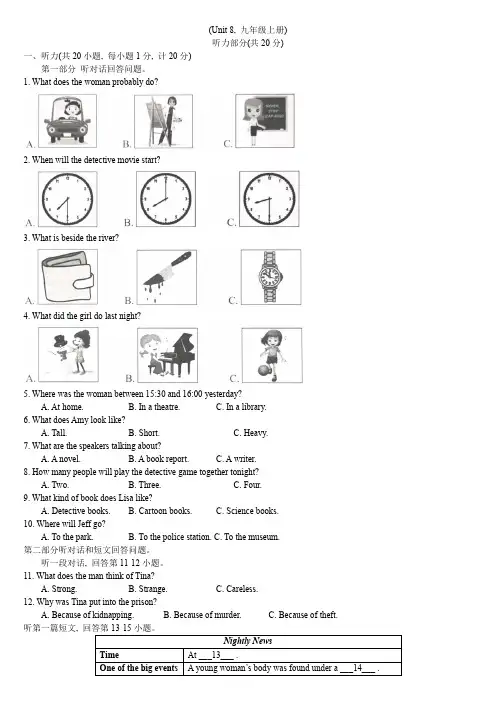
1. What does the woman probably do?
2. When will the detective movie start?
3. What is beside the river?
4. What did the girl do last night?
5. Where was the woman between 15:30 and 16:00 yesterday?
A. At home. B. In a theatre. C. In a library.
6. What does Amy look like?
A. Tall. B. Short. C. Heavy.
7. What are the speakers talking about?
A. A novel. B. A book report. C. A writer.
8. How many people will play the detective game together tonight?
A. Two. B. Three. C. Four.
9. What kind of book does Lisa like?
A. Detective books. B. Cartoon books. C. Science books.
10. Where will Jeff go?
A. To the park. B. To the police station. C. To the museum.
第二部分听对话和短文回答问题。
听一段对话, 回答第11-12小题。
11. What does the man think of Tina?
UNIT 5 (单元测试)含答案-2022年牛津译林版英语九年级上册

Unit 5 学情评估
英语九年级上册 HJ版
时间:120分钟 满分:120分
第一部分 (听力 共30分)
一、听对话, 选答案。(共15小题, 计20分)
第一节:
( )1. A. Because she is almost late.
B. Because there is much traffic.
C. Because it's dangerous here.
( )2. A. The boy.
B. The boy's mother.
C. The boy's father.
( )3. A. To the bank. B. To the post office. C. To the cinema.
( )4. A. A farmer. B. A doctor. C. A teacher.
( )5. A. On the bus. B. In the hospital. C. At the train station.
( )6. A. She is a doctor. B. She is a teacher. C. She is a reporter.
( )7. A. Through the radio. B. Through QQ. C. Through TV.
( )8. A. TV plays. B. Beijing Opera. C. Sports news.
( )9. A. A school. B. A new house. C. A radio station.
( )10. A. 16. B. 19. C. 22.
第二节:
听第11段对话, 回答11、12小题。
( )11. Where do they want to go?
A. To a mountain. B. To a hotel. C. To a beach.
Unit 4 Period 4 练习题 牛津译林版九年级英语上册
Unit 4 Period 4
Ⅰ.根据句意及汉语提示完成句子
1.There is no (记录) of how much I spend every month.
2.People in the city held a great party to celebrate their (胜利).
3.[2019·孝感] Come to the front with (勇气) and show your talent, Peter.
4.[2019·扬州邗江区二模] Every member of the club voted (反对) the project.
5.I will be with you in (精神) forever.
6.Everybody (钦佩) him for his fine sense of humour.
Ⅱ.用括号内所给单词的适当形式填空
7.Many children played games in the park, and some of them went into (hide) behind
the tree.
8.Some inventions that led to the colourful movies are on show, (include) cameras.
9.In the diary, we can write down our (think), feelings, hopes and so on.
10.—What are you doing?
—I am reading a book (write) by Mo Yan.
11.[2019·呼和浩特] During the World War Ⅱ, millions of (Germany) lost their lives.
牛津译林版英语九年级上册单元测试卷Unit 4 Growing up(word版,含答案解析)

第5页(共13 页) Unit 4 Growing up
一、单项选择(共15小题;共45分)
从下面各题所给选项中,选择最佳选项。
1. Huang Jiguang is a _____ hero of China. All Chinese people are proud of him.
A.national B.clever C.friendly
2. _____ hamburgers are junk food, many children like them.
A.If B.Unless C.Because D.Although
从下面选项中选出可以替换划线部分的最佳选项。
3. Nancy gave up her teaching career last week.
A.experiment B.support C.job
从下面各题所给选项中,选择最佳选项。
4. My brother often helps me to study my English _____ he is very busy.
A.although B.because C.when D.after
5. _____ Betty was young, she was very clever and could already speak four
languages.
A.If B.While C.Until D.Although
6. A _____ means a job or profession which someone does for a long period or
even all his life.
A.career B.guide C.journey
7. _____ the car is very old, it still runs well.
A.Because B.Unless C.Although D.Until
牛津译林版英语九年级上册 Unit 3 《Teenage problems.》 教学设计7

牛津译林版英语九年级上册 Unit 3 《Teenage problems.》 教学设计7
一. 教材分析
牛津译林版英语九年级上册Unit 3《Teenage problems》主要讨论了中学生在成长过程中所面临的各种问题,如学习压力、与父母沟通、朋友间的矛盾等。通过本节课的学习,学生能够掌握相关的词汇和表达方式,提高运用英语讨论问题的能力。本节课的教学设计分为七个部分,分别为导入、呈现、操练、巩固、拓展、小结和家庭作业。
二. 学情分析
九年级的学生已经具备了一定的英语基础,能够听、说、读、写一些简单的句子。但是,他们在运用英语进行深入讨论方面还存在一定的困难。因此,在教学过程中,需要关注学生的个体差异,充分调动他们的积极性,引导他们主动参与课堂活动。
三. 教学目标
1. 知识目标:学生能够掌握与青春期的烦恼相关的词汇和表达方式,如“learning pressure”、“communicate with parents”等。
2. 能力目标:学生能够运用所学的词汇和表达方式,就青少年面临的问题进行讨论和交流。
3. 情感目标:通过讨论和交流,学生能够认识到青春期烦恼的普遍性,学会理解和关爱他人。
四. 教学重难点
1. 重点:学生能够掌握与青春期的烦恼相关的词汇和表达方式。
2. 难点:学生能够在实际情境中运用所学的词汇和表达方式进行讨论和交流。
五. 教学方法
1. 任务型教学法:通过设置各种任务,引导学生主动参与课堂活动,提高他们的实际运用英语的能力。
2. 情境教学法:创设各种情境,让学生在真实的语境中学习英语,提高他们的学习兴趣。
3. 合作学习法:学生进行小组讨论和交流,培养他们的团队协作能力。
六. 教学准备 1. 准备相关的教学材料,如PPT、单词卡片等。
2. 设计各种任务和活动,确保课堂活动的顺利进行。
3. 准备一些与青春期烦恼相关的问题,用于引导学生进行讨论和思考。
牛津译林版英语九年级上册 Unit 3 《Teenage problems.》 说课稿9
牛津译林版英语九年级上册 Unit 3 《Teenage problems.》 说课稿9
一. 教材分析
《牛津译林版英语九年级上册》Unit 3的主题是“Teenage problems”,通过讨论青少年时期遇到的问题,引导学生关注自身成长过程中可能遇到的困难,并学会用英语进行表达和交流。本节课的内容贴近学生生活,有利于激发学生的学习兴趣,提高他们的语言运用能力。
本节课的主要内容包括:1. 学习青少年时期可能遇到的问题,如学业压力、与父母沟通、朋友间的矛盾等;2. 学会表达自己对于这些问题的看法和解决方法;3.
培养学生的合作意识和团队精神。
二. 学情分析
九年级的学生已经具备了一定的英语基础,能够听懂并运用简单的英语进行交流。但是,他们在表达复杂情感和观点方面还存在一定的困难。此外,由于年龄特点,学生对于青少年时期的问题有很强的共鸣,但同时也可能存在表达自己观点的胆怯心理。
三. 说教学目标
1. 知识目标:学生能够掌握本节课的生词和短语,理解文章内容,运用所学知识进行口头和书面表达。
2. 能力目标:学生能够用英语讨论青少年时期的问题,表达自己的观点和解决方法,提高语言运用能力。
3. 情感目标:学生能够认识到青少年时期的问题,学会用积极的态度面对和解决,培养良好的心理素质。
四. 说教学重难点
1. 重点:学生能够掌握本节课的生词和短语,理解文章内容,运用所学知识进行口头和书面表达。
2. 难点:学生能够用英语表达自己对于青少年时期问题的看法和解决方法,以及在讨论中运用所学知识。
五. 说教学方法与手段
1. 任务型教学法:通过设置各种任务,让学生在完成任务的过程中运用所学知识,提高语言运用能力。
2. 合作学习:学生进行小组讨论,培养学生的合作意识和团队精神。 3. 情感教学:引导学生关注自身成长过程中可能遇到的问题,帮助他们学会用积极的态度面对和解决。
4. 多媒体教学:利用多媒体课件,生动形象地展示教学内容,提高学生的学习兴趣。
牛津译林版英语九年级上册Unit3《Teenageproblems.》说课稿8
牛津译林版英语九年级上册 Unit 3 《Teenage problems.》 说课稿8
一. 教材分析
《牛津译林版英语九年级上册》Unit 3 《Teenage problems》主要讨论了青少年面临的一些普遍问题,如学习压力、与父母沟通、健康饮食和锻炼等。本节课通过阅读一篇关于青少年问题的文章,让学生了解并认识到青少年时期所面临的各种问题,并学会如何解决这些问题。教材内容丰富,贴近学生生活,有利于激发学生的学习兴趣,提高他们的英语阅读和表达能力。
二. 学情分析
九年级的学生已经具备了一定的英语基础,能够听、说、读、写一些简单的英语句子。然而,他们在阅读理解、词汇运用和写作方面还存在一定的困难。此外,由于年龄特点,学生可能对一些青少年问题有自己的看法和经历,这为课堂讨论提供了良好的基础。
三. 说教学目标
1. 知识目标:学生能够掌握本节课的生词和短语,理解文章的主旨大意,以及作者对待青少年问题的态度。
2. 能力目标:学生能够运用所学知识,进行阅读理解、词汇运用和写作练习。
3. 情感目标:学生能够认识到青少年时期所面临的各种问题,学会正确面对和解决这些问题,培养积极健康的心态。
四. 说教学重难点
1. 重点:学生能够熟练运用本节课的生词和短语,理解文章的主旨大意。
2. 难点:学生能够针对青少年问题,提出自己的观点和解决方案,并能够用英语进行表达。
五. 说教学方法与手段
本节课采用任务型教学法,通过自主学习、小组讨论、课堂展示等形式,激发学生的学习兴趣,提高他们的阅读理解和表达能力。同时,运用多媒体教学手段,如PPT、视频等,丰富教学内容,增强课堂氛围。
六. 说教学过程
1. 导入:教师通过提问,引导学生谈论青少年时期所面临的问题,激发学生的学习兴趣。 2. 阅读理解:学生阅读文章,回答相关问题,教师引导学生分析文章结构,理解作者观点。
3. 词汇学习:学生学习本节课的生词和短语,教师通过例句、游戏等方式,帮助学生巩固记忆。
牛津译林版九年级上册英语 9A Unit 8 单元测试题(含答案)
牛津译林版九年级上册英语 9A
Unit 8 单元测试题
(共100分)
一、选择填空(共15小题,每小题1分,满分15分)
从A、B、C、D四个选项中选出可以填入空白处的最佳选项。
( )1. I can’t find my watch, but it must be _____ in the room.
A. somewhere B. anywhere
C. nowhere D. everywhere
( )2. Both Millie’s parents think she is too young to _____.
A. dress B. be dressed
C. dress herself D. be dressed in
( )3. There is only one old book with a few pages _____ on his desk.
A. missed B. lost C. missing D. losing
( )4. —Can children under the age of 18 drive in our country?
—No. According to the law, they _____.
A. mustn’t B. may not C. needn’t D. shouldn’t
( )5. The fire started _____ between 9 and 10 last night.
A. sometimes B. some times
C. some time D. sometime
( )6. The strange man never spoke to anyone, so nobody knew _____ he did for a
2016年牛津译林版九年级上期中考试英语试题及答案
2016-2017学年第一学期期中测试
初三英语试卷
一、听力(共15小题;每小题1分,满分15分)
第一部分 听对话回答问题
本部分共有5小题,每小题你将听到一段对话,每段对话听两遍。
)1. How does Millie lear n about the world now?
()3. What time did the boy go home yesterday?
()4. Which colour does the girl like best?
A. Gree n. B. Yellow.
()5. Where is Jane now?
A. At school. B. At home.
第二部分听对话和短文答题 你将听到一段对话和两篇短文,各听两遍。 听一段对话,回答第6-7小题。
()6.What are they talki ng about?
A. Goi ng boati ng. B.Goi ng hiki ng. C.Climbi ng the
mou nta in.
()7.What does the boy advise the girl to do?
A .To take more exercise. B.To have a good rest. C.To stay at home. 听第一篇短文,回答第8-10小题。请根据内容从A、B、C三个选项中选择正确的选 项,完成信息记录表 to improve his English?
C.
C. Black. C. In hospital. )2.
Which suggestion for Daniel
听第二篇短文,回答第11至15小题
()11. What did the Smiths decide first?
A. Where to go. B. How to go. C. When to go.
()12. When did the Smiths decide to go traveli ng?