
五年级下册英语教案Unit6 In the kitchen Story time 译林版(三起)
Unit 6 In the kitchenPeriod 1一.教学内容:Story time二.教学目标:1.在情境中,能整体理解Story time的内容,并能听懂、会说、会读故事中出现的词汇:game, smell, meat, ready, vegetable, tomato, potato, yummy, look for.2.能听懂,会说,会读句型:Are you ...ing ...? Yes, I am./ No, I’m not. How’s ...?It’s yummy/nice....3.能在理解故事的基础上流利并有感情的朗读,并能选择一幅图进行表演。
4.能根据板书复述故事。
5.能从故事中感受父母对孩子的爱,并学习帮助父母做些简单的家务。
三.教学重点:1. 能听懂、会说、会读文中的词汇及句型。
2. 能以正确的语音语调朗读课文并正确的理解课文。
四.教学难点:1. 能在理解的基础上,正确运用现在进行时对课文进行复述。
2. 能体会文中的情感,学会主动帮父母做家务。
五.教学准备:PPT, 板书,表演道具六.教学过程:Step1 Warming up1.Sing a song: What are you doing?2.Play a game: Act and answer.Ss: What, what, what are you doing?S1: ...ing, ...ing, I’m ...ing ....Step2 Lead in1. Look and guessT: What are we doing now?S: We are having an English class.T: What about Liu Tao and his parents? What are they doing?Look, this is Mrs Liu. She is at home. What is she doing at home?We can guess like this: Mrs Liu, are you ...ing ...?Teach: Are you ...ing ...? (板书)S1: Mrs Liu, are you watching TV?Mrs Liu: No, I’m not.Teach: No, I’m not. (板书)S2: Are you washing clothes?Mrs Liu: Yes, I am.Teach: Yes, I am.(板书)同理问答Mr Liu, Liu Tao.Step3 Story time1. Reveal the titleT: Look, they are together now. Where are they? Can you guess?S: They are in the kitchen.Reveal the title: Unit 6 In the kitchen (板书)2. Watch and chooseT: What are they doing in the kitchen? Here are several sentences to choose.Let’s read first.Teach: a football game, look forWatch the cartoon and choose.Cooking dinner, Looking for things, Having dinner (板书)3.(picture1)Listen and underlineT: Listen, the clock is ringing. It’s six o’clock in the evening.What is Mrs Liu doing? What is Mr Liu doing? Let’s listen and underline.S: Mrs Liu is washing some vegetables.Teach: vegetableT: Now, you are Mrs Liu. What are you doing?S: I’m washing some vegetables.T: Why are you washing vegetables?S: Because I want to cook some tomato soup.Teach: a tomato, tomatoes, tomato soup, eggs with tomatoes.T: So Mrs Liu is washing some vegetables. (板书)Because she wants to cook some tomato soup.What about Mr Liu?S: He is cooking meat with potatoes.Teach: a potato, potatoes, meat, meat with potatoes.T: So Mr Liu is cooking meat with potatoes. (板书)T: I have another question. Does Liu Tao like eating meat? How do you know? S: Great! I can’t wait, Dad!指导朗读:Liu Tao is excited.T: What else does Liu Tao say?S: That smells nice, Mum. Are you cooking meat?Teach: smell (small)T: He thinks the meat smells nice.So these two sentences can also show Liu Tao likes eating meat.指导朗读:Liu Tao is full of expectation. 加上闻的动作4.Read pic1 after the tapeRead together5.(picture2)Listen and answerT: Mr and Mrs Liu are cooking dinner. What about Liu Tao? Is he cooking dinner? S: No, he is looking for things.T: What is he looking for? What does he find? Let’s listen.S: He is looking for some apple juice. He finds some orange juice.A learning tip: look for 意为寻找,强调过程;find 意为找到,强调结果。
6.Guess and sayT: What else are there in the fridge? You can use this sentence to guess.Teach: Is/ Are there any ...? (板书)7.(picture3)Read and findT: It’s six thirty. Dinner is ready. Here are the dishes.How’s the meat? How’s the soup?Teach: How’s ...?T: What does Liu Tao think of them? Can you find?Teach: It’s yummy/nice... I love it. 指导朗读T: What else can you say?S: It’s good/ great/...T: Liu Tao loves the meat. He says to his father, you’re a great cook!What does it mean?A.You are good at cooking.B. You are a cook, and you cook well.T: What does Mr Liu do? Do you remember?S: He’s a taxi driver.T: Yes. So A is right.8.Read pic2/3 after the tape.Read in roles.9.Let’s actT: You are good at reading. What about acting?Choose one picture to act.Step4 Consolidation1.T: It is seven o’clock now. Dinner is over. What is Liu Tao doing now?S: Are you ...ing ...?Liu Tao: Yes, I am. No, I’m not. I’m cleaning the table. I’m washing the dishes too. T: He is helping his parents. We should also help our parents. They do a lot of things for us. They read with us. They play with us and keep us safe. They help us with our homework. They cook nice dinner for us after a whole day work. When we are ill, they take good care of us. So what can we do for them?S: We can ...T: Yes, we can do some simple things for them. For example, wash some dishes, clean the house, do some massage for them when they are tired, or learn to cook breakfast or dinner for them. Remember love our parents, help our parents, we are family. (板书)2.T: Look it is eight o’clock. Liu Tao is in the study. He is writing a diary. Let’s help him, ok? Finish the paper.Check the answers.Step5 Homework1.Read and recite story time.2.Preview fun time and grammar time.3.Help parents do some housework.七.板书设计:八.教学后记:这节课经过了一个比较长的打造过程,一共修改了5次,最后呈现出的是一节流畅整体性强,采用随文教学,听说读写全面覆盖,符合五年级学生学习方式的教学有效性较强的课。
五年级下册unit6 in the kitchen 教学设计
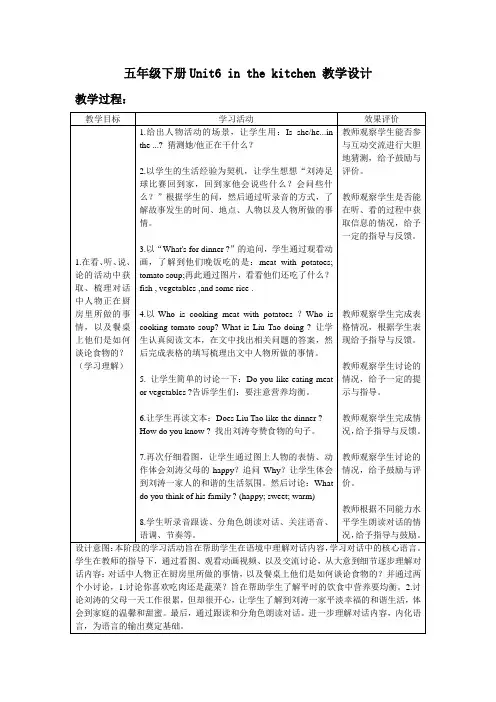
教师观察学生能否参与互动交流进行大胆地猜测,给予鼓励与评价。
教师观察学生是否能在听、看的过程中获取信息的情况,给予一定的指导与反馈。
教师观察学生完成表格情况,根据学生表现给予指导与反馈。
教师观察学生讨论的情况,给予一定的提示与指导。
教师观察学生完成情况,给予指导与反馈。
设计意图:本阶段学习活动引导学生在归纳和整理核心语言的基础上,通过角色扮演使每位学生能深入角色,运用语言理解意义。程度较好的学生还可以尝试使用连续话语介绍对话中人物在厨房里所做的事情以及表达对食物的喜爱。从学习理解过渡到应用实践,为后面的真实表达做好了准备。
3.讨论刘涛晚饭过后正在做什么?并说出理由。
教师观察学生运用所学语言交流的情况,给予鼓励与评价。
教师观察学生运用所学语言进行写作的情况,给予鼓励与评价。
设计意图:本阶段学习活动旨在帮助学生在迁移的语境中,创造性地运用所学语言,交流刘涛晚饭过后正在做的事情,学生从课本走向现实生活,在阐述晚饭后刘涛正在做的事情时,正是学生平时的一个写照,同时升华了主题:让学生能为辛劳的父母做一些力所能及的家务活。在学生交流过程中,发展学生的语用能力,初步形成对家务劳动意义和价值的理解。
教师观察学生讨论的
情况,给予鼓励与评价。
教师根据不同能力水平学生朗读对话的情况,给予指导与鼓励。
设计意图:本阶段的学习活动旨在帮助学生在语境中理解对话内容,学习对话中的核心语言。学生在教师的指导下,通过看图、观看动画视频、以及交流讨论,从大意到细节逐步理解对话内容:对话中人物正在厨房里所做的事情,以及餐桌上他们是如何谈论食物的?并通过两个小讨论,1.讨论你喜欢吃肉还是蔬菜?旨在帮助学生了解平时的饮食中营养要均衡。2.讨论刘涛的父母一天工作很累,但却很开心,让学生了解到刘涛一家平淡幸福的和谐生活,体会到家庭的温馨和甜蜜。最后,通过跟读和分角色朗读对话。进一步理解对话内容,内化语言,为语言的输出奠定基础。
译林版五下Unit 6 In the kitchen单元教案

Unit 6 In the kitchen 单元总备【单元教材分析】本单元的关键词是“吃饭”,这是一个同学们非常感兴趣的话题。
本单元围绕晚饭吃什么展开话题进行讨论,使用现在进行时的一般疑问句和there be结构的日常交际用语,对“having meals”这一话题进行讨论。
通过本单元的学习,帮助学生养成关爱父母,帮助他人的好习惯。
【单元教学目标】1.想知道对方正在做的事,“Are you/they...?”“Is he/she ...?”及其答句“Yes, I am/they are”“No, I’m not./they aren’t”和“Yes, he/she is.”“No, he/she isn’t.”2.掌握可数名词复数的变化规则。
3.培养学生乐于助人的良好习惯。
4.字母组合qu在单词中的读音。
【单元重、难点】1.听懂、会说、会读、会写句型Are yo…/ Is he/she…?及其肯定和否定回答。
2.能够掌握并运用现在进行时的一般疑问句及其肯定和否定回答。
【课时安排】4课时第1课时:Story time第2课时:Grammar time and Sound time第3课时:Cartoon time and Sound time第4课时:Culture time Checkout time and Ticking time12 Unit 6 In the kitchen 单元知识总汇【词汇】四会单词:1. vegetable 蔬菜2. tomato 西红柿,番茄3. potato 马铃薯,土豆4. look for 找,寻找5. love 喜欢, 喜爱6. bread 面包三会单词:1. game 运动,比赛2. smell ,闻起来3. meat (猪、牛、羊等的)肉4. I can ’t wait. 我等不及了5. ready 准备好6. yummy 好吃的,美味的7. win 获胜,赢 8. yeah 太好了,太棒了 9. angry 生气的,愤怒的10. spot 斑,点 11. catch 抓,抓住 12. drive …away 赶走【词组】1. come home from a football game 从一场足球赛上回到家2. cook dinner in the kitchen 在厨房做饭3. smell nice 味道很好4. cook meat 煮肉5. wash vegetables 洗菜6. cook tomato soup 做番茄汤7. cook meat with potatoes 做土豆烧肉8. I can ’t wait. 我等不及了。
(译林版)5B Unit 6 in the kitchen优秀说课稿

5B Unit 6 in the kitchen优秀说课稿我所执教的是译林版英语五年级下册unit 6 in the kitchen,第一课时,story time。
本单元的中心词是“吃饭”,这是同学们非常感兴趣的一个话题,并且贴近生活实际。
《英语课程标准》指出:激发和培养学生学习英语的兴趣,使学生树立自信心,养成良好的学习习惯和形成有效的学习策略,发展学生自主学习的能力和合作精神是小学英语教学的基本任务。
在认真分析教材的基础上,我针对学生实际,将本课时的教学目标及重,难点确定如下:1、能听懂、会读、会说单词:bread,meat,potato,tomato,vegetabl,look for,love2、能听懂、会读、会说Are you …ing?及回答,初步感知了解现在进行时的一般疑问句句3、能正确的理解课文,朗读课文并表演课文,在教师指导下根据板书复述课文4、能初步运用本课所学词汇或句型交流本课的教学重难点在于帮助学生正确理解课文,朗读并表演课文,在教师指导下根据板书复述课文,能初步运用本课所学词汇或句型交流。
在课前我准备了多媒体课件,音频,视频和人物卡通头像。
为了突破这堂课的重、难点,根据小学生好奇、好胜、好动、模仿力强、表现欲旺盛等生理和心理特点,我主要采取了以任务型教学模式为主,以活动,合作为主线,让学生在教师的指导下,通过感知、体验、实践、参与和合作感悟等多法并用的方式组织教学。
彻底改变传统的―授—受的教学模式,促进语言实际运用能力的提高。
因此,我设计如下教学过程:一、热身导入:通过自我介绍,让学生猜猜自己的名字,拉近与学生距离。
观看视频,提前渗透本课的重难点词汇和句型:meat with potatoes, tomato soup.和are you…二、课文呈现:1、让学生根据图片用what,where…提问,发散思维。
2、听录音,选择正确答案。
逐步走向文本的同时也训练了听力。
并通过问题where are they? They are in the kitchen. 揭示课题。
【英语教学设计】五年级下册-Unit 6《In the kitchen》课时1 Story time

英语教学设计五年级下册-Unit 6《In the kitchen》课时1 Story time 译林三起教学目标1.学生能够听懂故事并能够根据故事内容回答问题。
2.学生能够根据故事内容学会如何使用英语表达烹饪食品所需的材料和工具。
3.学生能够在课堂上进行交流并学习如何掌握时间。
教学准备1.教材:《英语译林》三年级下册 Unit 6《In the kitchen》课时1 Story time 部分。
2.教具:课件、卡片、图片等。
教学流程设计Step 1:Warm-up1.打招呼:Teacher: Good morning, boys and girls! How are you today?2.入门环节:Teacher: Let’s start with a game: I’ll say a word, and you say the first thing that comes to your mind. For example, I say “rice”, you could say “soup” or “porridge”. Are you ready?Step 2:Lead-in &Preview1.出示食材和厨具图片,突出板书:ingredients(食材)、kitchen tools (厨具)并对学生进行讲解。
2.提问: Teacher: What are they? Can you say them in English?Step 3: Listening1.结合图片讲解PPT,上屏煮面的图片。
2.上传音频,规范发音,播放故事。
3.让学生听完后回答问题。
a.What does Daming want to cook?b.What ingredients does he need to cook noodles?c.What kitchen tools does he need to use?Step 4:Drill1.教师给学生展示戴上围裙、洗手的图片。
五年级下册英语教案Unit 6 In the kitchen Story time译林版(三起)
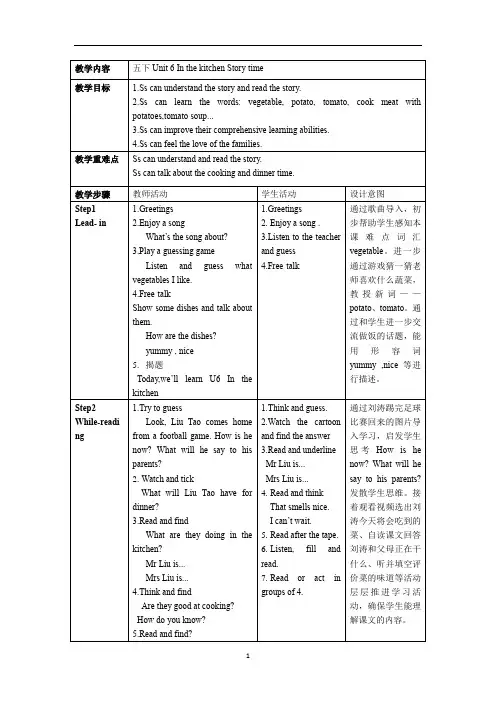
教学反思本单元Story time呈现的是刘涛参加完足球比赛回到家里,与爸爸妈妈在厨房里对话,以及吃晚饭时他和爸爸妈妈发生的对话的故事。
本篇故事以对话的形式呈现,语法上是对第五单元现在进行时的延续,在对话中运用了现在进行时的一般疑问句形式并进行回答;从话题上,本故事主要呈现了做饭和吃饭这两个场景,情境性强,学生可以从刘涛和父母的对话中感受到刘涛一家的其乐融融的家庭氛围。
在本课执教的过程中,我主要关注了以下几点:1.关注学生思维能力的培养在本节课中,我挖掘上下文和图片等信息,提出启发式问题,促进学生积极思考,提升其思维能力。
我根据刘涛参加完足球比赛回到家这样的一种状态,结合图片信息,提出问题:How is Liu Tao now? What will he say? 学生能较好地理解刘涛的状态,进行合理的表达,并自然过渡到故事的学习。
在学生理解故事内容后,提出评价性问题:How is Liu Tao’s family?启发学生思考评价,并帮助学生感受到家庭其乐融融的气氛。
2.关注语言知识在情境中的运用本节课以对话的形式展开,情景性强,与学生的生活实际也密切相关,因此,在输出环节,我引导学生进行对话创编,描述自己和家人做饭和用餐时的场景,在真实的情境中运用所学语言知识进行交流,也积极引导学生在文本对话内容的基础上再尝试丰富情境对话的内容,确保学生真正学会用英语来做事。
3.关注学生情感意识的提升本单元的单元话题是In the kitchen,在这则对话故事中所呈现的是刘涛和家人快乐的做饭和用餐时光,所以在这节课中,我积极引导学生去体会家人之间的爱,体会父母的付出,感恩父母的这种情感,在本节课的最后,我通过一个绘本故事,Jimmy和爸爸一起为妈妈做了一个菜这样的故事,引导学生感受到我们要试着向我们的家人表达我们的爱,去为我们的家人做一些自己力所能及的事。
在实际教学中,在培养学生发散思维和情感意识提升方便还存在一些可以改进之处,在文本学习和输出的过程中,可以进行追问,提出更多的启发学生思考的问题,如在问题:How is Liu Tao’s family?后可以继续问:If you were Liu Tao,what do you want to say to your parents? What can you do for your parents?通过这种启发式的问题,引导学生去换位思考,真正感知本课的主题意义,首先要学会向父母表达感谢,然后要尝试着去真正为父母做些什么来表达对父母的爱。
五年级下册英语教案Unit6 In the kitchen Story time译林版(三起) (2)

五下Unit 6 In the kitchen(Story time)【教学目标】1.知识目标:①能听懂、会说、会读和会拼写单词或短语vegetables,tomato,potato,look for, love.②能听懂、会说和会读单词或短语game,smell,meat,ready,yummy③能听懂、会说、会写并有感情的朗读句子Are you cooking meat?/No,I’m not.I’m washing some vegetables./How’s the meat/soup...?/It’s yummy/nice./I can’t wait!/I love it!2.能力目标:①能正确理解并流利朗读课文,并且回答关于课文的问题。
②让学生学习运用现在进行时的一般疑问方式以及回答方式。
3.情感目标:学会赞美。
【教学重点】①能听懂、会说、会读和会拼写单词或短语vegetables,tomato,potato,look for, love.②能听懂、会说和会读单词或短语game,smell,meat,ready,yummy③能正确理解并流利朗读课文,并且回答关于课文的问题【教学难点】①能听懂、会说、会读和会拼写单词或短语vegetables,tomato,potato,look for, love.②能听懂、会说和会读单词或短语game,smell,meat,ready,yummy③能正确理解并流利朗读课文,并且回答关于课文的问题。
【课堂活动】Step 1 Enjoy a songLet’s enjoy a song about vegetables. After listening, try to name some vegetables. Step 2 Lead in1.T: Do you know any vegetables?Ss try to say some vegetables.Learn: potato, tomato, vegetable情感教育:More vegetables, more healthy.2. T: Where can you see the vegetables?S: We can see them on the farm / in the supermarket / in the kitchen ...揭题:Unit6 In the kitchenStep3 Presentation1. Try to guessT: Look! Liu Tao is coming. How is Liu Tao? Why?S: He’s hot / tired / hungry ...Learn: a football match2. Try to orderT: What is Liu Tao going to do when he comes home. Look at these pictures and try to order.T: Let’s watch the cartoon and check out your answers.T: Liu Tao is hot. Why didn’t he just look for food in the fridge?S: Because ...Learn: That smells nice.3. Picture1: Listen and answerT: Look, Liu Tao’s parents are busy in the kitchen. What is Mr Liu doing?S: He’s cooking.T: What is he cooking? Look!S: He’s cooking...Learn: meat with potatoesT: What is Mrs Liu doing?S: She’s washing...T: Try to guess, what does she want to cook? Let’s listen and answer.Learn: tomato soup4. Picture2: Read and answerT: At this time, Liu Tao is looking for something in the fridge. There are many things in the fridge. What is he looking for? Try to guess.T: Read about Picture2, answer this question.S: He’s looking for some juice.T: Liu Tao is so hot. Why didn’t he look for something to eat in the fridge?S: Because...情感教育:Don't eat too much food before dinner.5. Picture3: Read and findT: Look, the dinner is ready. Does Liu Tao like his dinner? How do you know? Tip:图片可以帮助我们理解文本哦!T: What is Liu Tao saying? Guess!S: It’s nice / great ...T: Read about Picture3, underline the key sentences.Listen and repeat.情感教育:Don't forget to praise your parents, they'll be very happy.6. Listen and repeat.7. Let’s read.Work in four. You can read in parts. You can read together. You can read in roles. Step4.Consolidation1. Read and writeT: Now Liu Tao is recording. Read the text and then fill in the blanks in page 60. 2. Pair workT: Now Liu Tao’s friend Mike and Yang Ling are coming. Mike has some questions about it. Please work in pairs, one is Mike, one is Yang Ling.3. Make a new dialogueT: The next day is Sunday, Liu Tao is busy in the kitchen. He wants to cook for his parents. What will Liu Tao’s parents say? What will Liu Tao say?S: ...T: Work in three. Make a new dialogue.情感教育:Liu Tao is a good boy. I hope you are good children too.Step5 Homework1. Try to help your parents do one thing.2. Read the story after the tape.3. Finish the exercise.Blackboard designUnit6 In the kitchenMr Liu cook meat with potatoes yummyMrs Liu cook tomato soup niceLiu Tao look for some juice。
译林版(三起五年级下册英语Unit6 In the kitchen 教案
Unit6 In the kitchen教案(jiào àn)教学目标:1.学生理解故事主要内容并复述课文;2.学生初步会用现在进行时的一般疑问句进行提问和回答;3.学生会用“How is/are ...?”提问味道如何;4.学生对日常生活的观察更为细致深入、兴趣增强,能将英语学习与实际生活联系在一起,并养成关爱父母、帮助他人的好习惯。
教学重点:1.学生理解文章主要内容并表演课文;2.学生熟练运用现在进行时的一般疑问句提问并回答;3.学生可以用“How is/are ...?”提问情况教学难点:1.学生能正确区分可数名词单复数及不可数名词;2.学生熟练运用现在进行时的一般疑问句提问并回答;3.学生可以用“How is/are ...?”提问情况教材分析:本单元的话题是食物,内容涉及到可数名词和不可数名词的运用。
教师可以结合四年级上册Unit2 (Let’s make a fruit salad) 和Unit6 (At the snack bar) 中的食物类单词涉及教学活动,导入或操练可数名词和不可数名词。
本单元的新句型是现在进行时的一般疑问句及其回答,教师可以创设多种情境,鼓励学生反复操练,使学生在实际运用中掌握其用法。
另外,本单元再现了there be句型和表达赞美的习惯用语,在教学的过程中,教师可以和学生一起复习五年级上册Unit1 (Goldilocks and the three bears),Unit2 (A new student) 以及三年级上册Unit5(Look at me!)的相关句型和习惯用语,引导学生综合运用所学的知识。
教师可以在课前准备一些有关食物的精美图片,包括水果、蔬菜、肉类、主食和甜点等,在课上和学生一起分享,引起他们的学习兴趣。
在设计教学拓展和巩固活动时,教师可以引导学生将课文所学知识与实际生活联系在一起,创设新对话。
学情分析:学生在四年级时已经学过可数名词单复数及不可数名词,在五上第一二两单元也学过“There is/are ...”句型,已有较为多的基础,设计相关练习活动时已复习和巩固为主。
译林版(三起)五年级英语下册教案Unit 6 In the kitchen教案
Unit 6 In the kitchen教学设计1一、教学目标知识目标1.学生能听懂.会说单词drinking, eating, talking, playing.2.学生听懂并且会在实际情景灵活运用句型What’s she/he doing? ,She/He is…能力目标1.培养学生听说读的基本能力.2.培养学生运用英语的语言能力,发散思维能力和知识迁移能力.情感目标1.激发学生的学习兴趣,帮助他们养成良好的学习习惯。
2.培养学生的合作精神和竞争意识,二、教学重点和难点1.能听、认、读单词drinking, eating, talking, playing.2.能用句型“what’s she/he doing ?”询问他人正在做什么,并能用“she/he is…”回答他人正在做的事情。
3.单词drinking的发音三、教具准备:课件、单词卡片、相关图片、录音机、录音带。
四、教学过程:Step1: Warm upT: Boys and girls, let’s do an activity, ok?Ss: Ok.T: Now, I say you do.教师发指令,学生根据指令做动作:Listen to music, read a book, write a letter, play football, talk to you, do homework.T: Now, please look at me.(放录音听音乐)Ss: You are listening to music.T: Yes, I’m listening to music. Do you like listening to music?Ss: Yes.T: let’s sing song” I’m listening to music.”师生齐唱歌曲。
Step 2. 呈现单词T: Boys and girls, now please look at me ,(师做看书的动作)What am I doing?Ss: You are reading.老师依次做动作,学生猜答,复习单词reading, listening ,writing, playing, watching.T:(做喝水动作)What am I doing?Ss:喝水.T: Yes, I’m drinkin g.(出示单词卡片)Please look at the picture, read after me :drinking.学生分组读,分男女生读,开火车读,指名读.同法教单词eating, playing ,talking.Step3. 操练巩固单词T: Now, let’s play a game, ok?Ss: Ok.T: Ok, I say you do.老师发指令,学生依次做动作:Drinking, eating, talking, and playing.T发出drinking的指令后)What are you doing ?Ss: Drinking.(边做动作边回答)同法操练单词eating, talking, playing.Step4.呈现句型1.逐一出示drinking ,eating, talking, playing的图片并提问。
译林版英语五年级下册《Unit6Inthekitchen》教案
译林版英语五年级下册《Unit6Inthekitchen》教案教材版本本教案适用于译林版英语五年级下册《Unit6Inthekitchen》。
教学目标本课程将学生引入厨房话题,通过听、说、读、写等多种教学方式,让学生掌握以下内容:1.学生能够听懂和会说本单元出现的生词和短语,如:chop、grill、frying pan、cutting board、peppper、salt、etc;2.学生能够掌握本单元的句型,如:What are youdoing?/What’s he/she doing?/What are they doing?;3.学生能够通过小组合作活动,提高其团队合作能力和语言表达能力,共同完成有关厨房用品和烹饪方法的任务;4.学生能够通过练习,提高其英语阅读和写作能力。
教学重难点1.教学重点:生词、短语及句型的学习和练习。
2.教学难点:学生对一些烹饪方法和食物类别的理解,如炒、煮、烤、馅饼等。
教学内容1. Warming up通过展示食物和厨房用品图片,激发学生对教学主题的兴趣,引导学生谈论以下问题:•What food do you like to eat?•What do you like to do in the kitchen?•What kitchen appliances do you know?2. Listening and Speaking•Step 1: Listen to the conversation between Sarah and Ann播放录音,让学生跟着录音听,然后让学生回答一些与录音相关的问题,如:Q1: What is Sarah doing now? A1: She’s chopping vegetables.Q2: What does Ann want to do? A2: She wants to make a pizza.•Step 2: Pr Work现在,让学生两两分组,进行一些情景对话练习。
Unit6Inthekitchen(教案)译林版英语五年级下册
Ss work in pairs.
A/B: I’m … . I eat with … .
Ss discuss in pairs.
A/B: I eat with … .
Ss: chopsticks/ knife and fork/both
3.告诉你的父母和朋友关于中西餐具的区别。收集更多的餐桌礼仪。
板书设计:
Unit 6In the kitchen
… eat with chopsticks. qu /kw/
… eat with a knife and fork.
课后反思:
Learn: catch, drive away 6.order the mood of Bobby
创设用餐后吃水果的情境,回顾U5的Cartoon time,为本节课故事的延续作铺垫。
通过看动画回答问题,学习本课卡通的细节,并让学生想象好的瓢虫会对Bobby和坏瓢虫说些什么,为后期表演做铺垫。
指导学生揣摩Bobby的不同语
S: Sam’s ladybirds.
S: The good ladybird has seven stops. The bad ones have ten spots.
4.Ss work in four.
To Bobby : Don’t worry! …
To bad ladybirds : …
5.Read after the tape.
1.Ss look and say.
2.S: He is very sad.
Because there are so many pests and ladybirds in his garden.