
人教版九年级英语全一册 unit5 What are the shirts made of A1课件
2a
Listen and check (√) the main topic of Nick and Marcus’ conversation. ____ the science museum ____ the art and science fair ____ environmental protection ____ a model plane ____ a beautiful painting ____ grass and leaves
What’s the fork made of? It’s made of steel.
n. 钢;钢铁
These pigs like grass very much.
n. 草
a piece of leaf
Kolas like leaves.
n. 叶子
n. 叶子复数
1a
What are these things usually made of? Match them with the materials. More than one answer is possible. 1. 2. 3. 4. 5. 6. chopsticks window coin stamp fork blouse a. b. c. d. e. f. wood gold silver paper silk glass
What happens next?
The tea is packed and sent to many different countries and places around China.
It seems that many people all over the world drink Chinese tea.
be made of/be made from/be made in/be made into/be made up of 的区别
•be made of 表示“由……制成”,一般指能够看出原材料,或 发生的是物理变化。 Chair is made of wood. 椅子是木头做的。 This tablecloth is made of paper. 这张桌布是由纸做的。 This salad is made of apples and strawberries. 这种沙拉是由苹果 和草莓做的。
4. What is the painting made from? __________________________ Grass, leaves and flowers.
2c
Make conversations using the information in 2a and 2b. I saw a huge model What did you plane and a really see in the art beautiful painting. and science fair?
根据2d对话的内容完成下各句。 famous for tea both in 1.Chinese is _________ the past and now. As far as know , tea plants are 2. _________I grown on the side of mountains. leaves are ready, they 3. When the _______ are picked by hand and are sent for processing. then ________
A: What is the car made of? B: It’s made of gold. It was made in Germany.
A: What is the chair made of? B: It’s made of coins. It was made in Italy.
A: What is the bed made of? B: It’s made of grass. It was made in Britain.
1c
Practice the conversation in 1a. Then make conversations using the information in 1b. This ring looks nice. Is it made of silver?
Yes, and it was made in Thailand.
•be made into 的意思为"被制成为…"。 This piece of wood will be made into a small bench. 这块木头将要被制成一个小凳。 be made by 由…制作 This chair is made by my grandfather be made up of 由…构成、一般是多种构成。 Water was made up of oxygen and hydrogen. 水由氧气和氢构成。
What is the model plane made of? What is the painting made from?
The plane is made of wood and glass. The painting is made from grass, leaves and flowers.
This pair of chopsticks are made of bamboo.
n. 筷子
This coin is made of silver.
n. 硬币 n. 银 adj. 银色的
Is this blouse made of cotton?
n. 棉花
n. 女式衬 衣
No, it isn’t. It’s made of silk.
These shirts feel comfortable. Are they made of cotton?
Yes, and they were made in America.
The chopsticks look nice. Are they made of silver?
No, they’re made of steel, and they were made in Korea.
How is tea produced?
Well, as far as I know, tea plants are grown on the sides of mountains. When the leaves are ready, they are picked by hand and then are sent for processing.
朗读2d的对话并理解大意,判断句子正误 1.(T)China is famous for tea both in the past and now. 2.(F)Tea is produced only in Anxi and Hangzhou 3.( F)It seems that Chinese tea is drunk all over China. 4. ( T ) People say that tea is good for health.
2d
Role-play the conversation. China is famous for tea, ri.
Where is tea produced in China?
Well, in many different areas. For example, Anxi and Hangzhou are widely known for their tea.
2d Listen and answer the questions.
1.What are they talking about? They are talking about Chinese tea. 2.What places are mentioned in their talk? An xi and Hangzhou. 3.Why do people drink tea according to Liu Jun? Because tea is good for both health and business.
A: What is the dress made of? B: It’s made of newspaper. It was made in France.
A: What is the pillow made of? B: It’s made of wood. It was made in China.
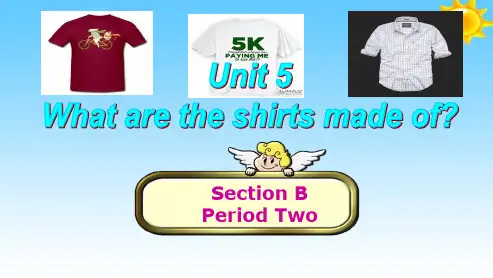
Unit 5 What are the shirts made of? Section A
1a-2d
1. Who invented paper first? Cai Lun invented it in Han Dynasty.
2. What was paper made of then? It was mainly made of bamboo.
What’s the gold medal made of? It’s made of gold.
Is this table made of wood?
No, it isn't. It’s made of glass.
Is butter made of meat?
No, it isn’t. It’s made from cream.
2b Listen again. Write short answers
to the questions. 1. Where is the art and science fair? _________________________ Outside the science museum. 2. Do Nick and Marcus have to pay to go? No, they don’t. _________________________ 3. What is the model plane made of? Used wood and glass. _________________________
人教版九年级英语全一册Unit-5-What-are-the-shirts-made-of?短语、语

人教版九年级英语全一册U n i t-5-W h a t-a r e-t h e-s h i r t s-m a d e-o f?短语、语法知识点汇总。
-CAL-FENGHAI.-(YICAI)-Company One1一、必背短语【教材内容解析】Section A1.glass (P. 33)glass此处用作不可数名词,表示“玻璃”,也可以用作可数名词,表示“玻璃杯”。
You can break glass easily.He drank two glasses of milk this morning.2. --Is it made of silver?--Yes, it was made in Thailand. (P. 33)be made of 意为“由……制成”,强调看得出原材料。
The house is made of stone.【拓展】1. be made from“由……制成”,从成品看不出原材料。
The wine is made from grapes.2.be made in “在某地制造”。
The car is made in China.3.be made up of “由……组成,由……构成”。
The park is made up of a man-made lake and a hill.4.be made into “被制成”。
His novel was made into a film.3.China is famous for tea, right4.(P. 34)5.famous表示“出名的、著名的”,相当于known,常用的结构为:be famous for“因……而出名”;be famous as“作为……而出名”。
The writer is famous for his novels.The professor is famous as an expert in cancer.6.Where is tea produced in China7.(P. 34)8.produce此处用作及物动词,表示“生产、制造”。
人教版九年级英语全一册Unit_5_What_are_the_shirts_made_of?_Section_B2ppt课件
lion dance
new year paintings
embroidery
Dunhuang Murals
To learn to use new words and expressions To learn to talk about traditional art
Before you read Look at the title and the pictures on page 38. Then answer the questions. 1.What does the passage may talk about? 1.It may talk about some Chinese traditional art.
4C.hHinoewsedhoipsteooRrpyel.aedustehpeappaersscaugtteinaggsadinurainngdthaensSwpreirng Festivals? 54.. WDuhraitnagrtehtethhSepesrtqienupgsesFftoeirsotmnivsaa.klsi,ntghcelya’yreaprtupt ioencews?indows, doors and
Clay Figurines Zhang sky lantern
Beijing Opera
shadow figures Chinese martial arts
cloisonne
paper cutting
Do you know any folk or traditional arts in your hometown?
6w.aWllshaicshsyamrtbforlsmofdwo iysohuesthfoinrkgoisodthleumckoastnidntaehreasptpinygn?eWwhyye?ar.
PEP人教版九年级英语全一册unit5_what_are_the_shirts_made_of单词解析及拓展ppt课件
France
Country/continent Africa America Asia Australia Britain Canada China England
people African
Language/adjective African English/American Asian English/Australian English/British English /French/Canadian Chinese English
produce
widely
adv. 广泛地;普遍地 •比较级: more widely 最高级: most widely •英语在世界上被广泛应用。 •English is widely used in the world. •我们在很多问题上分歧很大。 •We were widely different on many questions. •Wide表示空间宽度 •He opened the door wide.他把门开
process
• v. 加工;处理 n. 过程 •How fast does the computer process the data? •这台计算机处理数据有多快? •在那家商店可买到加工过的食品. •Process foods are available in that store. •It'll be two years before the process is complete. •这个过程需要两年才能完成。
silver
glass
cotton
• n.棉;棉花
steel
n. 刚;钢铁
fair
environmental
grass
人教版九年级英语全一册第五单元unit-5-What are the shirts made of -课件

Unit 5
What are the shirts made of?
Section A 1a-1c
➢ Objectives
1. To learn to understand and use the passive voice(present tense) be + v (ed).
What are these things usually made of?
It is made of … / They are made of …
1a What are these things usually made of ?Match them with the materials. More than one answer is possible.
wood
cotton
What are these things? Say the names in English.
silver
steel
What are these things? Say the names in English.
glass
gold bars
What are these things? Say the names in English.
Yes, and it was made in Thailand.
1c Practice the conversation in 1a. Then make conversations using the information in 1b.
This ring looks nice. Is it made of silver?
Hmm…yes, I think it’s quite pretty. Is it made of silver?
新2024秋季人教版九年级英语全一册Unit5whataretheshirtsmadeof?听课记录
听课记录:新2024秋季人教版九年级英语全一册Unit 5 "What are the shirts made of?"教学目标(核心素养)1.1 知识与技能:学生能够识别并描述不同材料的名称及特性;掌握并使用“bemade of/from”等句型询问和回答物品的制作材料。
1.2 思维能力与情感态度:通过对比分析不同材料的特点,培养学生的观察力和分析能力;激发学生对环保材料的兴趣,培养可持续发展的意识。
导入教师行为:•手持几件不同材质的衣服(如棉质T恤、丝绸围巾、聚酯纤维外套),让学生观察并猜测它们的材质。
•提问:“How can you tell what these clothes are made of?” 引导学生思考并讨论。
学生活动:•仔细观察教师手中的衣服,积极猜测并讨论它们的材质。
•分享自己的观察结果和猜测依据。
过程点评:•通过实物展示和猜测活动,迅速吸引了学生的注意力,激发了他们的好奇心和探究欲。
同时,也为学生后续学习“be made of/from”等句型做了铺垫。
教学过程教师行为:•展示并讲解本单元的重点词汇和句型,如“cotton, silk, polyester, be made of, be made from”等。
•引导学生阅读课文,找出描述衣物材质的句子,并尝试用自己的话复述。
•组织小组讨论,让学生分享自己日常生活中接触到的不同材质物品,并讨论它们的优缺点。
•播放一段关于环保材料的短片,引导学生思考环保材料的重要性,并讨论如何在日常生活中选择环保材料。
学生活动:•认真听讲,做好笔记,掌握重点词汇和句型。
•仔细阅读课文,找出并标记描述衣物材质的句子,尝试复述。
•在小组讨论中积极发言,分享自己的经历和见解。
•观看短片,思考并讨论环保材料的意义和选择方法。
过程点评:•教学过程层次清晰,由浅入深,逐步引导学生掌握重点知识。
小组讨论和短片观看环节增加了学生的参与度和互动性,促进了他们对知识点的深入理解和应用。
人教版九年级英语全一册Unit_5_what_are_the_shirts_made_ofppt课件
avoid避免,躲避
•avoid doing sth避免做……
• He realized that Americans can hardly avoid buying products made in china.
• 他意识到美国人不可避免买到中国制造的产品。
• sb realize that ....某人意识到,后面接宾语从句 • hardly几乎不能 • avoid doing sth避免做……
( ) 2 English ____ in Canada. A. speaks B. are spoken C. is speaking D. is spoken
( ) 3 This English song___ by the girls after class. B. often sang
C. is often sang D. is often sung
• sb realize that ....某人意识到,后面接宾语从句 • hardly几乎不能 • avoid doing sth避免做……
kang Jian thinks it's great that China is so good at makin these everyday things.
3.the most common things
4.from paper to clay to bamboo
最常见
5.turn into 6.objectsof beauty
从纸到 陶土
美
编后语
• 常常可见到这样的同学,他们在下课前几分钟就开始看表、收拾课本文具,下课铃一响,就迫不及待地“逃离”教室。实际上,每节课刚下课时的几分 钟是我们对上课内容查漏补缺的好时机。善于学习的同学往往懂得抓好课后的“黄金两分钟”。那么,课后的“黄金时间”可以用来做什么呢?
人教版初中英语九年级全册unit5Whataretheshirtsmadeof优秀教学案例
(三)学生小组讨论
1.布置任务:分组讨论并完成一个关于环保的短剧,要求运用本节课所学知识。
2.学生分组,每组成员分工合作,共同完成任务。
3.引导学生围绕环保主题,运用所学语言知识进行角色扮演和对话练习。
4.给予学生必要的帮助和指导,确保他们能够顺利完成任务。
(四)反思与评价
1.组织学生进行课堂反思,引导学生总结所学知识和技能。
2.鼓励学生分享自己的学习心得和体会,培养他们的自我评价能力。
3.通过学生互评和教师评价,对学生的语言运用和合作能力进行综合评价。
4.关注学生的个体差异,给予不同水平的学生个性化的关注和指导,促进他们的全面发展。
四、教学内容与过程
(二)讲授新知
1.通过PPT展示一般现在时的被动语态结构,如“The shirts are made of cotton.”。
2.讲解一般疑问句及其回答,如“What are these shirts made of?”,“They are made of cotton.”。
3.举例说明衣物材质的多样性,如棉、丝、毛、合成纤维等,并引导学生进行实际操作,练习表达。
4.设计环保主题的短剧,让学生在角色扮演中运用所学知识,提高交际能力。
(二)问题导向
1.针对衣物材质和环保话题,设计一系列问题,引导学生进行思考和讨论。
2.通过提问,激发学生对环保问题的关注,培养学生独立思考和解决问题的能力。
3.引导学生从不同角度分析问题,如生产、消费和回收等,全面了解衣物材质对环境的影响。
针对本节课的内容,我设计了一系列实用的教学活动。首先,通过展示不同材质的衣物及其生产过程,让学生了解各种材料对环境的影响,从而引出本节课的主题。接着,采用任务型教学法,让学生分组讨论并完成一个关于环保的短剧,旨在培养他们的合作意识和创新精神。在课堂总结环节,组织学生进行反思,探讨如何在日常购物中践行环保理念,将学习成果运用到实际生活中。
人教版英语九年级全一册Unit5听力原文及翻译
⼈教版英语九年级全⼀册Unit5听⼒原⽂及翻译Unit 5 What are the shirts made of?Section A, 1bSusan:Hi, Anita. I bought three shirts for 29 dollars yesterday!你好,安妮塔。
我昨天花了29美⾦买了三件衬衫。
Anita:Oh, really? What are they made of though? Sometimes the cheap ones are made of materials that don’t feel very good.哦,是吗?那它们是⽤什么做的?有时候便宜的衬衫是⽤质感不好的材料做的。
Susan:A hundred percent cotton. They’re nice and soft, and they were made in America.百分百纯棉。
漂亮⽽且软乎,是美国制造。
Anita:Oh, OK. By the way, where did you buy those chopsticks? They’re really cool!哦,好的。
顺便问⼀下,你在哪⼉买的那些筷⼦?真的很酷!Susan:Oh, I got them in Korea. They’re nice, aren’t they?哦,我在韩国买的。
它们很漂亮,是吧?Anita:Yeah. Chopsticks are usually made of wood. I’ve never seen steel ones before.是的。
筷⼦通常⽤⽊头做的。
我还从没见钢制的。
Susan:Oh, steel chopsticks are popular in Korea. Hey, do you think this ring looks OK?哦,钢制的筷⼦在韩国很受欢迎。
看,你觉得这个戒指好看吗?Anita:Hmm…yes, I think it’s quite pretty. Is it made of silver?嗯,是的,我觉得它很漂亮。
人教版九年级英语全册Unit5Whataretheshirtsmadeof单元整体教学设计
3.听力:学生能够听懂并理解关于物品制作材料及环保话题的对话和短文,提高听力技巧和信息捕捉能力。
4.口语:学生能够就物品的制作材料进行交流,并能就环保话题展开讨论,提高口语表达能力和沟通技巧。
5.阅读与写作:学生能够阅读并理解关于物品制作及环保的文章,学会运用被动语态进行写作,提高阅读和写作能力。
3.引入一般现在时的被动语态,通过例句展示、讲解,让学生感知被动语态的结构,并学会在实际语境中运用。
4.教师选取一段关于物品制作材料的听力材料,引导学生边听边练习被动语态,提高听力理解能力。
(三)学生小组讨论
1.教师将学生分成小组,每组挑选一个物品,讨论并回答以下问题:“What is it made of? How is it made?”
2.语法方面:学生对一般现在时的被动语态掌握程度不一,部分学生可能在句子结构、时态运用上存在困难。
3.情感态度:学生对环保话题感兴趣,但可能缺乏实际生活中的实践经验,需要引导他们将所学知识运用到实际中。
4.学习策略:学生在合作学习、自主学习方面有待提高,需培养他们主动参与课堂、积极思考的习惯。
5.文化意识:学生对世界各国文化有一定了解,但需要进一步拓宽视野,增强跨文化交际能力。
4.观察日记:鼓励学生持续观察并记录一周内自己或家人在购物时选择环保材料的情况,如购买衣物、餐具等。要求学生思考并记录选择环保材料的原因和感受。
5.小组项目:小组合作设计一个环保宣传海报,内容包括环保口号、本节课学习的词汇和短语、被动语态的例句等。要求设计新颖,富有创意,能够吸引他人关注环保问题。
6.口语练习:学生与家长或朋友进行对话,讨论以下问题:“What is the most environmentally friendly material you know? Why?”并尝试使用一般现在时的被动语态进行回答。
人教版英语九年级全一册Unit5Whataretheshirtsmadeof.SectionB含答案
姓名:班级Unit 5 What are the shirts made of?Section B本课重点掌握一般现在时态的被动语态。
学会be made of和be made in的用法本课难点一般现在时态的被动语态常考句型It is made of/by/in/from…一、单项选择1.We see some________ rising into the air at the opening of our new library.A.balloons B.balloon C.balloones【答案】A【详解】句意:在我们新图书馆的开馆仪式上,我们看到一些气球升到空中。
考查名词复数。
balloon可数名词,此前有some修饰,使用名词复数,balloon的复数是balloons,故选A。
2.Chinese shadow puppetry(皮影戏) brings our traditional stories ________ on stage.A.likely B.lively C.lonely【答案】B【详解】句意:中国皮影戏把我们的传统故事生动地展现在舞台上。
考查副词用法。
likely很可能,副词;lively生动地,副词;lonely孤独的,形容词。
结合语境及常识可知,这里是指把我们的传统故事生动地展现在了舞台上,所以应用副词lively修饰动词,故选B。
3.—What do you think of science?—I find ________ hard to understand.A.that B.this C.its D.it【答案】D【详解】句意:——你觉得科学怎么样?——我发现它很难理解。
考查代词辨析。
that那个;this这个;its它的;it它。
答句中I是主语,find是谓语,后接宾语,此处可以使用it充当形式宾语,动词不定式“to understand”作真正宾语。