
《教师言语表达》书面测试卷2024
12、深以刻薄为戒,每事当从忠厚
——薜渲
《教师言语表达》书面测试卷(样卷A卷)
(校本研修用)共50分
学校姓名分数
一、判断题 10分
1.语言是人类最重要的交际工具,同一民族的人民往往使用同一种语言()
2.所有的书面语言和口头语言都要求讲究修辞
()
3.朗读是语文学习的一种能力和手段,不需要有什么目的
()
4."以北京语音为标准音"是指北京语音系统,并不是说所有北京话的语音成分都是标准的
()
5."幸福像花儿一样"
这句话中有双音节词两个,单音节词三个
()
6.教师言语表达包括教学用语与教育用语
()
7.否定句就是表达否定的意思
()
8.朗诵和朗读都是一种语言表达的艺术表演形式
()
9.从某种程度上说,一个好题目的确定,就是演讲成功的一半
()
10.批评是重要的教育手段,但我们提倡把批评当要求提出来
()
二、选择题(多选)10分
1.教师言语表达需要有以下基础:()
A.思想道德基础 B.普通话基础 C.朗读基础
D.修辞学基础 E.逻辑学基础
2.课堂教学口语主要包括:()
A.导入语 B.提问语 C.讲述语
D.反问语 E.总结语 F.安慰语
() 3.语文新课标规定要使学生获得基本的语文素养......使他们具有适应实际需要:
A.识字写字能力 B.阅读能力 C.语法能力
D.写作能力 E.口语交际能力 F.演讲能力
4.在语文教学中尤其重视培养学生:()
A.语感 B.语速 C.语气 D.整体把握能力
5.地震发生后大量安慰的语言涌向幸存者,你会选择哪些话?
()
A.你很幸运 B.你要坚强、挺住 C.你已很坚强,我为你高兴
D.我很难过 E.一切都会好起来 F.你已尽力了
三、选择题(单选)5分
1."君子之交淡若水,小人之交甘若醴",用到的主要修辞手法是:()
A.比喻、排比、夸张 B.比拟、对偶、夸张
C.对偶、夸张、比喻
2.教师并不是所有问题都能回答,当回答不出时应选择:()
A.委婉表示老师还要去了解真相 B.东拉西扯转移话题
C.请其他同学代为回答
3.口语多用:()
A.长句 B.短句 C.紧缩句
4.所有语言运用策略中最重要的策略是:()
A.得体策略 B.幽默策略 C.谦虚策略
5.老师讲《口技》一课,一学生在下面学狗叫,老师表扬他学得像,然后引导学生继续学习课文,这种应变能力属:()
A.启发式应变 B.借题发挥样式应变 C.将错就错式应变
四、简答题 10分
1.说明语言和言语的区别
2.简述规范修辞和艺术修辞的区别
五、本材料分析题 15分
小勇在课堂上专心看书,冷不丁被后桌的小方抽去了凳子,小勇一屁股掉在地上,全班同学哄笑
小勇不仅身体疼,更感觉自尊受伤,王老师见状连忙过去扶小勇并严厉批评小方,没想到小方不以为然还嘲讽小勇无能,责怪老师没情调,眼看一场激烈的硬碰硬冲突要发生
请你尝试以王老师的身份用言语智慧化解这一矛盾,达到批评教育小方与同学,友爱鼓励小勇的目的
宁波中小学教师培训中心制
2008年6月1
12、深以刻薄为戒,每事当从忠厚
——薜渲。
初中数学教师资格考试学科知识与教学能力2024年下半年自测试卷及解答
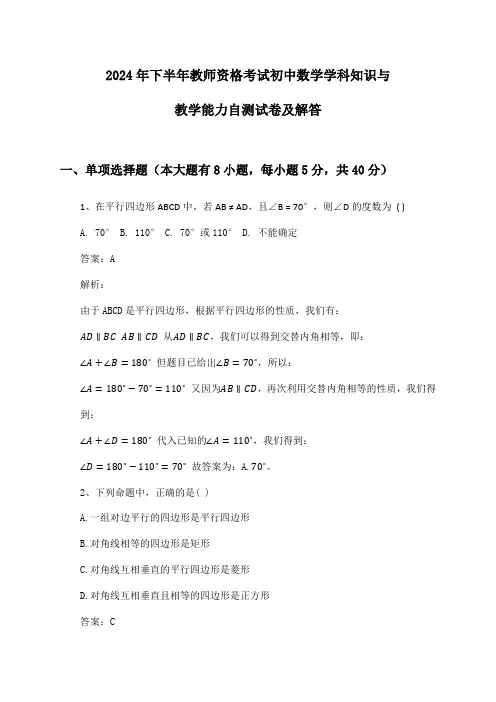
2024年下半年教师资格考试初中数学学科知识与教学能力自测试卷及解答一、单项选择题(本大题有8小题,每小题5分,共40分)1、在平行四边形ABCD中,若AB ≠ AD,且∠B = 70°,则∠D的度数为( )A. 70°B. 110°C. 70°或110°D. 不能确定答案:A解析:由于ABCD是平行四边形,根据平行四边形的性质,我们有:AD∥BC AB∥CD从AD∥BC,我们可以得到交替内角相等,即:∠A+∠B=180∘但题目已给出∠B=70∘,所以:∠A=180∘−70∘=110∘又因为AB∥CD,再次利用交替内角相等的性质,我们得到:∠A+∠D=180∘代入已知的∠A=110∘,我们得到:∠D=180∘−110∘=70∘故答案为:A.70∘。
2、下列命题中,正确的是( )A.一组对边平行的四边形是平行四边形B.对角线相等的四边形是矩形C.对角线互相垂直的平行四边形是菱形D.对角线互相垂直且相等的四边形是正方形答案:C解析:A. 一组对边平行的四边形可能是梯形,不一定是平行四边形,故A错误;B. 对角线相等的平行四边形才是矩形,仅仅对角线相等不能确定四边形是矩形,故B错误;C. 对角线互相垂直的平行四边形,其四边必然相等(由平行四边形的性质和对角线垂直的性质共同推出),即该平行四边形是菱形,故C正确;D. 对角线互相垂直且相等的平行四边形才是正方形,仅仅对角线互相垂直且相等不能确定四边形是正方形,故D错误。
故答案为:C。
3、若关于x的分式方程xx−1=2x−1+1有增根,则增根是 ____.答案:x=1解析:首先,我们考虑方程的最简公分母,即x−1。
若方程有增根,则增根应使最简公分母为0,即x−1=0,解得x=1。
故答案为:x=1。
4、已知点 P (x, 3) 在直线 y = 2x + 1 上,则点 P 的坐标是 ( )A. (1,3)B. (-1,3)C. (2,3)D. (3,2)答案:A解析:已知点P(x,3)在直线y=2x+1上,那么其坐标应满足该直线的方程。
2024年教师资格考试高级中学学科知识与教学能力语文自测试题与参考答案

2024年教师资格考试高级中学语文学科知识与教学能力自测试题与参考答案一、单项选择题(本大题有25小题,每小题2分,共50分)1、在《离骚》中,“吾令羲和弭节兮,望崦嵫而勿迫”中的“羲和”指的是:A、太阳神B、月亮神C、风神D、雨神答案:A解析:《离骚》是中国古代伟大的浪漫主义诗人屈原创作的一首长篇抒情诗。
诗中的“羲和”是指太阳神,这里用来形容屈原希望时间能够放慢脚步,以便他能更好地思考人生哲理。
因此,正确答案为A。
2、以下哪位古代作家被誉为“诗仙”?A、杜甫B、李白C、白居易D、王之涣答案:B解析:李白是唐代伟大的浪漫主义诗人,其诗歌豪放、奔放,充满想象力,被誉为“诗仙”。
杜甫被誉为“诗圣”,白居易被誉为“诗魔”,王之涣则以《登鹳雀楼》等诗作闻名。
因此,正确答案为B。
3、下列关于《红楼梦》中“金陵十二钗”的表述,错误的是:A、林黛玉是金陵十二钗正册之首,才华横溢,性情真率B、薛宝钗是金陵十二钗中唯一与贾宝玉成婚的女子,端庄贤淑C、王熙凤是金陵十二钗副册中的人物,精明强干,心狠手辣D、贾元春是金陵十二钗正册之一,身份尊贵,因贤孝才德被选入宫中答案:C解析:《红楼梦》中的“金陵十二钗”是书中最重要的女性角色集合,分为正册、副册、又副册。
林黛玉、薛宝钗、贾元春等人均位列正册,而王熙凤实际上并非副册中的人物,而是正册中的第九位,以她的精明强干、心狠手辣而著称。
因此,选项C中的“王熙凤是金陵十二钗副册中的人物”表述错误。
4、在《论语》中,孔子强调“学而时习之,不亦说乎?”这句话所体现的教育思想是:A、重视道德教育B、提倡独立思考C、强调实践应用D、追求知识广博答案:C解析:孔子在《论语》中的这句话“学而时习之,不亦说乎?”意思是学习并时常复习,不是很快乐吗?这里的“习”字,不仅指复习已学过的知识,还包括将所学知识应用于实践,即强调知识的实践应用。
因此,这句话所体现的教育思想是强调实践应用,选项C正确。
选项A“重视道德教育”虽然也是孔子的教育思想之一,但与此句话无直接关联;选项B“提倡独立思考”在《论语》中也有所体现,但并非此句话的重点;选项D“追求知识广博”则与这句话无关。
初级中学语文教师资格考试学科知识与教学能力试卷与参考答案(2024年)
2024年教师资格考试初级中学语文学科知识与教学能力自测试卷(答案在后面)一、单项选择题(本大题有25小题,每小题2分,共50分)1、在以下词语中,不属于近义词的一组是:A. 诚恳、诚挚B. 谦虚、谦逊C. 欣慰、喜悦D. 严酷、残酷2、在下列句子中,没有语病的是:A. 通过这次活动,使我深刻认识到团队协作的重要性。
B. 随着科技的发展,我们生活的环境越来越美好,但同时也带来了不少问题。
C. 他的成绩提高得很快,这主要得益于他的勤奋和老师的悉心指导。
D. 我昨天去图书馆借了一本关于文学的小说,今天已经看完了。
3、在古代汉语中,“之”字的用法多样,下面哪一项中的“之”字作为宾语前置的标志使用?A. 蚓无爪牙之利B. 何陋之有C. 吾欲之南海D. 公输子之意不过欲杀臣4、下列句子中,哪一个使用了通假字?A. 沛公不胜杯杓B. 风吹草低见牛羊C. 学而不思则罔D. 然后知松柏之后凋也5、在下列哪项中,“之”字用作结构助词?A. 赵王与秦王会论池B. 然后秦王不怿C. 惜其不遭时D. 乃以八月十三日,北去6、下列哪一项不属于《论语》中的经典名句?A. 学而时习之,不亦说乎B. 温故而知新,可以为师矣C. 己所不欲,勿施于人D. 知之者不如好之者,好之者不如乐之者7、下列哪一项不是《红楼梦》的主要人物?A. 贾宝玉B. 林黛玉C. 薛宝钗D. 王熙凤E. 刘姥姥8、在教学过程中,教师使用多媒体课件展示诗歌,这种教学方法属于:A. 讲授法B. 演示法C. 练习法D. 实验法9、在语文教学中,教师应如何处理教材与学生的关系?A. 以教材为中心,严格按照教材内容教学B. 以学生为中心,根据学生的兴趣和需要调整教材内容C. 教师和学生共同决定教材内容和教学方式D. 教材内容为参考,以学生的实际需求为教学目标 10、以下哪个教学策略不利于培养学生的创新思维?A. 小组合作学习B. 问题解决学习C. 启发式教学D. 机械重复练习11、下列选项中,哪一项不属于中国古代四大名著?A. 《红楼梦》B. 《水浒传》C. 《西游记》D. 《三国志》12、在语文教学过程中,教师使用情境教学法的主要目的是什么?A. 增加课堂的趣味性B. 提高学生的记忆效率C. 加强学生对文本的理解D. 促进学生的情感体验13、在语文教学中,以下哪项不属于语文教学目标的内容?A. 培养学生的阅读理解能力B. 培养学生的写作技巧C. 增强学生的语言表达能力D. 培养学生的科学素养14、在初中语文教学中,以下哪种教学方法最有利于培养学生的创造性思维?A. 讲授法B. 案例分析法C. 小组讨论法D. 角色扮演法15、下列选项中,哪一项是正确的古汉语词汇解释?A. “不亦说乎”中的“说”通“悦”,意为高兴。
《教师言语表达》书面测试卷1084

8、书籍是青年人不可分离的生活伴侣和导师——高尔基《教师言语表达》书面测试卷(样卷A卷)(校本研修用)共50分学校姓名分数一、判断题 10分1.语言是人类最重要的交际工具,同一民族的人民往往使用同一种语言()2.所有的书面语言和口头语言都要求讲究修辞()3.朗读是语文学习的一种能力和手段,不需要有什么目的()4."以北京语音为标准音"是指北京语音系统,并不是说所有北京话的语音成分都是标准的()5."幸福像花儿一样"这句话中有双音节词两个,单音节词三个()6.教师言语表达包括教学用语与教育用语()7.否定句就是表达否定的意思()8.朗诵和朗读都是一种语言表达的艺术表演形式()9.从某种程度上说,一个好题目的确定,就是演讲成功的一半()10.批评是重要的教育手段,但我们提倡把批评当要求提出来()二、选择题(多选)10分1.教师言语表达需要有以下基础:()A.思想道德基础 B.普通话基础 C.朗读基础D.修辞学基础 E.逻辑学基础2.课堂教学口语主要包括:()A.导入语 B.提问语 C.讲述语D.反问语 E.总结语 F.安慰语3.语文新课标规定要使学生获得基本的语文素养......使他们具有适应实际需要:() A.识字写字能力 B.阅读能力 C.语法能力D.写作能力 E.口语交际能力 F.演讲能力4.在语文教学中尤其重视培养学生:()A.语感 B.语速 C.语气 D.整体把握能力5.地震发生后大量安慰的语言涌向幸存者,你会选择哪些话?()A.你很幸运 B.你要坚强、挺住 C.你已很坚强,我为你高兴D.我很难过 E.一切都会好起来 F.你已尽力了三、选择题(单选)5分1."君子之交淡若水,小人之交甘若醴",用到的主要修辞手法是:()A.比喻、排比、夸张 B.比拟、对偶、夸张C.对偶、夸张、比喻2.教师并不是所有问题都能回答,当回答不出时应选择:()A.委婉表示老师还要去了解真相 B.东拉西扯转移话题C.请其他同学代为回答3.口语多用:()A.长句 B.短句 C.紧缩句4.所有语言运用策略中最重要的策略是:()A.得体策略 B.幽默策略 C.谦虚策略5.老师讲《口技》一课,一学生在下面学狗叫,老师表扬他学得像,然后引导学生继续学习课文,这种应变能力属:()A.启发式应变 B.借题发挥样式应变 C.将错就错式应变四、简答题 10分1.说明语言和言语的区别2.简述规范修辞和艺术修辞的区别五、本材料分析题 15分小勇在课堂上专心看书,冷不丁被后桌的小方抽去了凳子,小勇一屁股掉在地上,全班同学哄笑小勇不仅身体疼,更感觉自尊受伤,王老师见状连忙过去扶小勇并严厉批评小方,没想到小方不以为然还嘲讽小勇无能,责怪老师没情调,眼看一场激烈的硬碰硬冲突要发生请你尝试以王老师的身份用言语智慧化解这一矛盾,达到批评教育小方与同学,友爱鼓励小勇的目的宁波中小学教师培训中心制2008年6月18、书籍是青年人不可分离的生活伴侣和导师——高尔基。
2024年教师资格考试高级中学学科知识与教学能力英语模拟试卷与参考答案
2024年教师资格考试高级中学英语学科知识与教学能力模拟试卷与参考答案一、单项选择题(本大题有30小题,每小题2分,共60分)1、题干:The teacher’s ability to foster critical thinking in students is particularly important in the discipline of ________.A. MathematicsB. HistoryC. EnglishD. Science答案:C解析:The correct answer is C. English. The question emphasizes the importance of fostering critical thinking, which is a key aspect of language arts education. English as a discipline often emphasizes critical thinking skills, such as analyzing texts and interpreting literature, which makes it the most relevant option among the choices provided.2、题干:Which of the following is NOT a common instructional strategy used to promote student engagement in an English class?A. Group discussionsB. Project-based learningC. Teacher-centered lecturesD. Socratic seminars答案:C解析:The correct answer is C. Teacher-centered lectures. The question asks for the instructional strategy that is NOT common for promoting student engagement. Group discussions (A), project-based learning (B), and Socratic seminars (D) are all known to increase student participation and engagement.Teacher-centered lectures (C), on the other hand, are more traditional and may not encourage active student involvement as much as the other strategies.3、The se ntence “She has a bright smile” can be paraphrased as:A. She has a cheerful expression.B. She has a dim smile.C. She has a bright thought.D. She has a dark smile.Answer: AExplanation: The phrase “a bright smile” implies a pleasant and friendly expres sion, which can be accurately paraphrased as “a cheerful expression.” The other options either change the meaning or are not close synonyms of the original phrase.4、Which of the following sentences is an example of a declarative sentence?A. “Where is my pen?”B. “I will be there tomorrow.”C. “Don’t you think she’s talented?”D. “Can you help me with this?”Answer: BExplanation: A declarative sentence makes a statement or declares a fact. “I will be there tomorrow” is a clear statement of future intentio n, making it a declarative sentence. The other options are questions (A and D) or a tag question (C), which are not declarative sentences.5、The teacher’s role in the classroom is crucial for student learning. Which of the following statements best describes the role of a teacher in fostering student engagement?A)The teacher should act as a passive facilitator, allowing students to guide their ownlearning.B)The teacher should dominate the class, ensuring that all students follow the samecurriculum.C)The teacher should create a supportive and interactive environment that encouragesstudent participation.D)The teacher should primarily focus on correcting student mistakes to improve theirperformance.Answer: C) The teacher should create a supportive and interactive environment that encourages student participation.Explanation: A supportive and interactive classroom environment is essential for student engagement. This approach allows students to actively participate in their learning, which can lead to better understanding and retention of the material.6、When designing a lesson plan for a unit on environmental conservation, which of the following teaching strategies would be most effective in promoting critical thinking and understanding among students?A)Presenting a lecture and providing a list of facts about different environmental issues.B)Using multimedia presentations to showcase images and videos related toenvironmental conservation.C)Facilitating a debate or discussion on the causes and solutions to environmentalproblems.D)Assigning a research project where students investigate a specific environmentalissue.Answer: C) Facilitating a debate or discussion on the causes and solutions to environmental problems.Explanation: A debate or discussion encourages students to think critically about the topic, analyze different perspectives, and develop arguments. This interactive approach can enhance their understanding and appreciation of the complexities involved in environmental conservation.7、The following sentence is a fragment. Which of the following words can be added to make it a complete sentence?A. The students enjoyed the movie, but they _______.B. The students were enjoying the movie _______.C. The students enjoyed the movie _______.D. The students were enjoying the movie, and they _______.Answer: BExplanation: The sentence “The students were enjoying the movie” is a complete sentence on its own. The word “but” can be added to show contrast with the following clause, making it a compound sentence. The other options do not make the sentence grammatically correct or complete.8、Which of the following sentence structures is most appropriate for describing a sequence of events?A. It is important that we should do this, because it will help us learn.B. The first step is to collect the necessary information, the second step is to analyze it, and the final step is to make a decision.C. Although we tried, we were unable to reach the destination on time.D. If we do not act now, the situation will become worse.Answer: BExplanation: The structure “The first step is to collect the necessary information, the second step is to analyze it, and the final step is to make a decision” effectively describes a sequence of events, with each step clearly identified. The other options do not present a clear sequence of events.9、The sentence “The students were all engaged in their activities when the bell rang.” is an example of which tense structure?A. Simple PresentB. Simple PastC. Present ContinuousD. Past ContinuousAnswer: C. Present ContinuousExplanation: The sentence describes an action that was ongoing at the moment the bell rang. The present continuous tense is used to talk about actions happening at the moment of speaking, which fits the context of the sentence.10、In the following sentence, “She has finished her homework and is now preparing for the exam,” which part of speech is underlined?A. has finishedB. herC. nowD. preparingAnswer: D. preparingExplanation: The underlined word “preparing” is a gerund, which is a verb form that functions as a noun. Gerunds are often used as subjects, objects, or complements in sentences. In this case, “preparing” is the gerund that functions as the subject of the second clause.11.The teacher, who has been teaching for five years, is highly respected by his students for his_______teaching style.A. creativeB. strictC. humorousD. traditionalAnswer: AExplanation: The question is asking about the teacher’s teaching style that is highly respected by his students. “Creative” is the most appropriate choice to describe a style that is likely to be respected, as it implies innovation and engagement in the teaching process.12.In order to enhance the students’ reading comprehension, the teacher uses a variety of_______techniques in her English class.A. readingB. questioningC. listeningD. writingAnswer: BExplanation: The question is inquiring about the techniques used to improve reading comprehension in an English class. “Questioning” techniques, such as Socratic questioning or guided inquiry, are specifically designed to enhance comprehension and critical thinking skills, making it the most suitable answer among the options provided.13、What is the most appropriate tense to use when describing a routine activity that occurs on a daily basis?A. Present simpleB. Present perfectC. Past simpleD. Future simpleAnswer: A. Present simpleExplanation: The present simple tense is used to describe habits, regular routines, and general truths. It is the correct tense to use when referring to daily activities that are habits or routines.14、Which of the following sentences uses the correct form of the passive voice?A. The students are given by the teacher.B. The teacher gives the students.C. The students are given to by the teacher.D. The students are given from the teacher.Answer: C. The students are given to by the teacher.Explanation: The passive voice is formed by using the past participle of the verb after “be” followed by the subject. In this case, “given” is the past participle of “give.” The correct construction uses “given to by” to indicate that the students are the recipients of the action.15.The teacher is discussing the importance of reading aloud with the students. Which of the following statements is the most appropriate to use in this context?A)“Reading silently is better because it helps you concentrate better.”B)“Reading aloud is unnecessary; it only slows down the reading process.”C)“Reading aloud is beneficial because it enhances comprehension and pronunciation.”D)“We should only read aloud in class when we have time.”Answer: CExplanation: The correct answer is C because it highlights the positive aspects of reading aloud, such as improving comprehension and pronunciation. The other options either dismiss the importance of reading aloud or suggest it is unnecessary, which are not appropriate responses in the context of discussing its benefits.16.In a lesson on Shakespeare’s “Romeo and Juliet,” the teacher wants to engage students in a debate about the theme of fate versus free will. Which activity would best facilitate this discussion?A)Assigning students to write a short essay on the theme.B)Organizing a group discussion with prepared questions.C)Playing a scene from the movie adaptation of the play.D)Giving students a multiple-choice quiz about the characters.Answer: BExplanation: The correct answer is B because it encourages active participation and discussion among the students, which is ideal for exploring complex themes like fate versus free will. The other options either focus on individual writing or passive consumption, which may not foster the kind of interactive and critical thinking required for this type of discussion.17.The sentence “She is as tall as her father” is an example of which sentence structure?A. ComparisonB. ConditionalC. FutureD. PastAnswer: AExplanation: The sentence “She is as tall as her father” is using the comparison structure to show that two things (her height and her father’s height) are equal.18.Which of the following sentence is correct in terms of verb tense and subject-verb agreement?A. The dog run in the park every morning.B. The dogs are runs in the park every morning.C. The dog runs in the park every morning.D. The dogs is runs in the park every morning.Answer: CExplanation: The correct sentence is “The dog runs in the park every morning.” It uses the present simple tense correctly with the subject “dog,” which is singular, and agrees with the singular verb “runs.” The other options have incorrect verb tenses or subject-verb agreement errors.19.The teacher is using a teaching strategy to encourage student participation. Which of the following is the most appropriate strategy for discussing a complex historical event?A)Presenting a detailed timeline of the event.B)Asking students to write a brief summary of the event.C)Pairing students to debate the causes and effects of the event.D)Showing a documentary about the event.Answer: C) Pairing students to debate the causes and effects of the event.Explanation: Pairing students to debate a complex historical event encourages critical thinking and collaborative learning. It allows students to engage with the material from different perspectives, fostering a deeper understanding of the event.20.In the context of English language teaching, which of the following activities is most effective for improving students’ listening skills?A)Reading aloud a passage of text and asking students to retell it.B)Listening to a short story and then summarizing the main points.C)Watching a video clip and discussing the characters’ motivations.D)Listening to a dialogue and then analyzing the pronunciation of the speakers.Answer: B) Listening to a short story and then summarizing the main points.Explanation: Listening to a short story and summarizing the main points helps students practice active listening skills, identify key information, and improve their ability to process and recall spoken language. It also encourages them to engage with the content on a deeper level.21.The sentence “He has lived here for ten years, but he doesn’t feel at home yet.” demonstrates which of the following sentence structures?A)SimpleB)ComplexC)CompoundD)Complex-complexAnswer: B) ComplexExplanation: This sentence is a complex sentence because it has one mainclause (“He doesn’t feel at home yet”) and one or more dependent clauses that provide additional information. The dependent clause “He has lived here for ten years” adds extra informa tion about the main clause.22.Which of the following phrases is an example of a gerund phrase?A)To eating ice creamB)Eating ice creamC)Eat ice creamD)Eating ice-creamAnswer: B) Eating ice creamExplanation: A gerund phrase is a phrase that functions as a noun and consists of a gerund (a verb form that ends in -ing and functions as a noun). In this case, “Eating ice cream” is a gerund phrase that can act as a subject, object, or complement in a sentence. The other options do not fit the definition of a gerund phrase.23.What is the main purpose of using cooperative learning in the English classroom?A)To ensure that all students have the same level of English proficiency.B)To encourage students to work independently and develop their own learningstrategies.C)To promote interaction and collaboration among students.D)To test students’ ability to work under time pressure.Answer: CExplanation: The main purpose of using cooperative learning in the English classroom is topromote interaction and collaboration among students. This approach helps students develop their communication skills, critical thinking, and teamwork abilities.24.Which of the following activities is most suitable for assessing students’ understanding of a literary text in an English class?A) A written test that covers all the details of the text.B) A group discussion where students present their own interpretations of the text.C)An individual project that requires students to create a visual representation of thetext.D) A multiple-choice quiz that tests students’ recall of the main events.Answer: BExplanation: A group discussion where students present their own interpretations of the textis the most suitable activity for assessing students’ understanding of a literary text. This method encourages critical thinking, creativity, and the ability to articulate thoughts and ideas. It also promotes peer learning and collaboration.25.The following sentence is a direct quote. Which one of the following punctuation marks is correctly used at the end of the quote?A)Period (.)B)Question mark (?)C)Exclamation mark (!)D)Semicolon (;)Answer: A) Period (.)Explanation: When a direct quote is used within a sentence, it is always followed by a period. The period signifies the end of the quote.26.In the following sentence, “They had been working on the project for months, and it was finally completed,” the comma after “months” is used to:A)Separate a list of itemsB)Introduce a non-restrictive relative clauseC)Indicate a pause in the sentenceD)Separate independent clausesAnswer: B) Introduce a non-restrictive relative clause.Explanation: The comma after “months” i s used to introduce anon-restrictive relative clause, which provides additional information about the subject but is not essential to the main idea of the sentence. The clause “and it was finally completed” adds detail to the time frame of the project.27.The following sentence contains an error in verb tense usage. Which one is it?A. The students will be working on their projects until the end of the month.B. The students worked on their projects last week.C. The students are working on their projects at the moment.D. The students will have worked on their projects by the end of the month.Answer: BExplanation: The sentence that contains an error in verb tense usage is B. The correct tense should be present continuous for the ongoing action, but “worked” is in the past simple tense, which does not fit with the present continuous tense of “are working” in the other parts of the sentence.28.Choose the word that best fits the blank in the following sentence:The teacher_______to the students that the exam would be postponed due to bad weather.A. mentionedB. suggestedC. notifiedD. impliedAnswer: CExplanation: The correct word to fill in the blank is “notified.” The teacher is informing the students of an important change, which is best described by “notified,” meaning to inform formally. “Mentioned” could also be correct, but “notified” is more formal and appropriate for official announcements. “Suggested” and “implied” do not fit the context of formally informing students of a change.29、Which of the following is NOT a component of communicative language teaching (CLT)?A) Focus on accuracyB) Emphasis on using the language for real communicationC) Grammar translation as the main activityD) Task-based learning activitiesAnswer: C) Grammar translation as the main activityExplanation: Communicative Language Teaching (CLT) emphasizes the use of language for real communication and often incorporates task-based learningactivities. While focus on accuracy is also important, CLT moves away from the traditional grammar-translation method, which focuses more on the analysis and translation of written texts rather than the ability to communicate effectively in the target language.30、In the context of second language acquisition, what does the term “comprehensible input” refer to?A) Input that is slightly above the learner’s current level of competenceB) Input that is slightly below the learner’s current level of competenceC) Input that matches exactly the learner’s current level of competenceD) Any form of input regardless of the learner’s level of competenceAnswer: A) Input that is slightly above the learner’s current level of competenceExplanation: The concept of “comprehensible input,” developed by Stephen Krashen, suggests that learners acquire language best when they receive input that is just beyond their current linguistic capabilities, known as i+1, where “i” represents the learner’s current language level and “+1” is the next level of language complexity. This type of input challenges learners without overwhelming them, facilitating language acquisition effectively.二、简答题(20分)Question:In your opinion, what are the key factors that contribute to successful language learning inhigh school students? Explain how you would incorporate these factors into your teaching practice.Answer:The key factors that contribute to successful language learning in high school students include:1.Motivation: Motivation plays a crucial role in language learning. High school students need to be intrinsically motivated to learn the language, as well as extrinsically motivated by the goals and expectations set by their teachers and parents. As a teacher, I would create a positive learning environment by using engaging materials, encouraging students to set personal goals, and recognizing their achievements.2.Interaction: Interaction among students and with the teacher is essential for language learning. By incorporating activities such as group discussions, role-playing, and pair work, I would encourage students to communicate in English and practice their speaking and listening skills.3.Authentic materials: Using authentic materials such as newspapers, films, and songs can help students connect the language they learn in the classroom to real-life situations. I would integrate these materials into my lessons to provide students with practical language use.4.Effective assessment: Regular and varied assessment methods can help students monitor their progress and identify areas for improvement. As a teacher, I would use formative and summative assessments to track student performance and adapt my teaching strategies accordingly.5.Collaborative learning: Encouraging students to collaborate and worktogether can enhance their language skills and foster a sense of community in the classroom. I would incorporate group projects, peer tutoring, and cooperative learning activities to promote collaboration among students.6.Individual differences: Recognizing and addressing individual differences among students is crucial for successful language learning. I would differentiate my instruction by using varied teaching methods, providing additional support for struggling students, and challenging advanced learners.Incorporating these factors into my teaching practice would involve: •Creating a motivating and supportive learning environment•Incorporating interactive and collaborative activities•Utilizing authentic materials•Employing various assessment methods•Differentiating instruction to meet individual student needs•Continuously reflecting on and improving my teaching strategiesBy focusing on these key factors, I believe that high school students can achieve successful language learning and develop their English language skills.三、教学情境分析题(30分)III.Teaching Situation Analysis (30 points)Question 1:You are a high school English teacher preparing to teach a unit on American literature. Your students come from diverse backgrounds and have varying levelsof English proficiency. You notice that some students are particularly interested in contemporary issues, while others prefer classic literature. Considering these factors, design a lesson plan for a 45-minute class session that incorporates both traditional and modern elements of American literature. The lesson should aim to engage all students and foster critical thinking about the relevance of literature today. Include:•Objectives•Materials needed•Activities and procedures•Assessment methodsAnswer:Lesson Plan: Bridging Past and Present Through American LiteratureObjectives:1.Students will explore themes common to both classical and contemporary American literature.2.Students will analyze how different literary works reflect societal changes over time.3.Students will engage in a group discussion to compare and contrast two texts: one classical and one contemporary.Materials Needed:1.Excerpts from “The Great Gatsby” by F. Scott Fitzgerald (classical text).2.A short story or poem from a contemporary author such as “Interpreter of Maladies” by Jhumpa Lahiri.3.Handouts with guiding questions for each text.4.Access to online resources for additional research if available.Activities and Procedures:1.Introduction (5 minutes): Briefly introduce the authors and provide historical context for their works.2.Reading and Individual Analysis (20 minutes): Distribute the excerpts and handouts. Instruct students to read the texts silently and answer the guiding questions individually.3.Group Discussion (15 minutes): Organize students into small groups to share their insights and discuss the similarities and differences between the texts. Encourage them to consider how each work reflects its respective era.4.Whole-Class Sharing (5 minutes): Invite each group to present key points from their discussion to the class.Assessment Methods:1.Participation in group discussions will be observed and noted.2.Students’ written response s to the guiding questions will be collected and evaluated for comprehension and critical analysis.3.Group presentations will be assessed based on clarity, engagement, and depth of analysis.Analysis:This lesson plan addresses the diverse interests and English proficiency levels of the students by combining classical and contemporary literature. It allows for differentiated instruction, as students can choose which text theyfeel more comfortable with initially, yet still exposes them to both. The guiding questions facilitate deeper understanding and encourage students to make connections between the texts and the world around them, thereby enhancing their critical thinking skills. The combination of individual work, group discussion, and whole-class sharing ensures multiple opportunities for engagement and learning, catering to different learning styles and preferences within the classroom.四、教学设计题(40分)Question:Design a 45-minute lesson plan for an Advanced High School English class on the topic of “Global Warming and Its Impact on the Environment”. The lesson should include activities that encourage critical thinking, group discussion, and a creative project. Students are expected to be able to identify the causes of global warming, discuss its effects, and propose potential solutions.Answer:Lesson Title: “The Perils of Climate Change: Causes, Effects, and Solutions”Objective:By the end of this lesson, students will be able to:1.Identify the main causes of global warming.2.Discuss the effects of global warming on the environment.3.Propose potential solutions to mitigate the impact of global warming.Materials:1.Projector and screen2.Handouts with facts about global warming3.Whiteboard and markers4.Chart paper5.Pencils and colored markersLesson Outline:I. Introduction (10 minutes)1.Begin with a short video clip on global warming to spark students’ interest.2.Ask students to write down three things they learned from the video.3.Facilitate a class discussion on what global warming is and its importance.II.Group Work - Causes of Global Warming (15 minutes)1.Divide the class into small groups of four.2.Distribute handouts with facts about the causes of global warming.3.Instruct each group to identify at least three causes and explain their impact.4.Each group will create a poster highlighting their findings.5.Allow groups to present their posters to the class.III.Class Discussion - Effects of Global Warming (15 minutes)1.Discuss the effects of global warming on the environment, such as rising sea levels, extreme weather events, and loss of biodiversity.2.Facilitate a class discussion, encouraging students to share their opinions and experiences.3.Summarize the key points on the whiteboard.IV.Creative Project - Potential Solutions (5 minutes)1.Instruct students to work in pairs to brainstorm potential solutions to mitigate the impact of global warming.2.Give each pair 5 minutes to present their ideas to the class.V. Conclusion (5 minutes)1.Summarize the main points discussed in the lesson.2.Encourage students to continue exploring the topic outside the classroom.Explanation:The lesson plan is designed to engage students in an interactive and thought-provoking way. By using a combination of videos, group work, and class discussions, students will be able to gain a deeper understanding of the causes, effects, and potential solutions to global warming. The creative project allows students to apply their knowledge and come up with innovative ideas to tackle this pressing issue.。
教师资格考试高中英语学科知识与教学能力试卷与参考答案(2024年)
2024年教师资格考试高中英语学科知识与教学能力模拟试卷与参考答案一、单项选择题(本大题有30小题,每小题2分,共60分)1、In the following sentence, the word “that” is used as a relative pronoun. Which sentence best illustrates the use of “that” in this context?A. The book that you gave me is very interesting.B. She told me the story that she had just read.C. The students that were late were given extra homework.D. I don’t remember the name of the person that I met yesterday.答案:A解析:选项A中的”that”引导一个定语从句,修饰先行词”book”,并在从句中作宾语,省略了”which”或”whom”。
其他选项中的”that”要么引导非限制性定语从句(B选项),要么在从句中作主语或宾语,但没有省略”that”。
2、Which of the following sentences is correctly punctuated?A. The teacher said, “Let’s start the class now.”B. She asked, “Where are you going?”C. He replied: “I’m going to the library.”D. The student: “I have finished my homework.” The teacher: “Good job!”答案:B解析:选项B中的句子正确地使用了问号,因为它是直接引语,而直接引语中的句子如果是疑问句,则必须以问号结尾。
2020年智慧树知道网课《教师语言(山东联盟—山东师范大学)》课后章节测试满分答案
第一章测试【判断题】(10分)教师语言要求教师在有限的教学时间里,尽可能少地增加语言信息量,同时传达信息的语言还要有准确性和生动性。
A.对B.错参考答案B2【判断题】(10分)即兴口语时而是流动的,时而处于静止状态A.错B.对参考答案3A【判断题】(10分)3语言通过信号来传递,信号会因发送而立即消失;文字通过符号来流传,符号能永久留存,并一代又一代地积累起来。
A.错© B.对参考答案B4【判断题】(10分)语音和书面语相似,可以准备和保存。
A.错B.对参考答案A5【单选题】(10分)以下哪些选项不属于沟通原则中的内容?r AA.对对方频道的激发与引导B.认识到频道的发生与存在C.双方频道的契合和打通口 D.对他人频道的发现和改变参考答案D6【单选题】(10分)以下选项哪些属于教师语言?A.不带有书面色彩B.无准备的边想边说C.大众传播的言语行为D.表达内容无规定性参考答案C7【单选题】(10分)以下选项哪个不属于教师语言的特征?A.情境性B.抽象性具象性D.维性参考答案B8【多选题】(10分)以下哪些词汇具有语言的具象性特征?A.香喷喷B.嘻嘻哈哈C.热锅上的蚂蚁D.慌里慌张E.豆腐渣工程参考答案ABCE9【多选题】(10分)以下选项中哪些属于教师语言?A.强调信息的含量和密度B.表达对象的公众性C.大众传播的言语行为D.人际交往的言语行为E.不强调信息的含量和密度表达对象的选择性参考答案BCE10【多选题】(10分)关于语言工具和文字工具,哪些选项属于语言工具的特征?A.可流传不可准备可记录厂D.不可在空间中展开参考答案BD第二章测试i【判断题】(io分)在教师语言的即兴生成环节中,转换是指词语之间的相互替换或改变。
A.对B.错参考答案B2【判断题】(10分)转换和增补是言语生成的基础环节,没有他们就不可能有后面的两个环节A.错B.对参考答案A3【判断题】(10分)把信息扁平化就是把粗略的信息归拢凝炼,并且突出它的精髓A.错B.对参考答案B4【单选题】(10分)以下哪项不是教师语言的即兴生成环节?A.调取B.转换组接D.修改参考答案D5【单选题】(10分)()具有独特而又真实的特点,是有创造性的语言材料。
2024年教师资格考试中学综合素质试卷与参考答案
2024年教师资格考试中学综合素质自测试卷(答案在后面)一、单项选择题(本大题有29小题,每小题2分,共58分)1、根据《中华人民共和国教师法》的规定,教师应当履行下列哪项职责?A、对学生进行思想品德教育,关心、爱护全体学生B、传授学科知识,培养学生的专业技能C、组织教育教学活动,开展教育教学改革D、完成教育教学工作任务,参与学校管理工作2、在班级管理中,教师与学生之间的互动关系应遵循以下哪种原则?A、权威原则B、民主原则C、专制原则D、放任原则3、在教育教学活动中,教师应具备的基本素质不包括以下哪项?A、扎实的专业知识B、良好的心理素质C、丰富的实践技能D、熟练掌握财务会计知识4、下列关于教师职业道德规范的说法,不正确的是?A、关爱学生是教师职业道德的灵魂B、爱岗敬业是教师职业道德的核心C、为人师表是教师职业道德的内在要求D、教书育人是教师职业道德的基本要求5、以下关于教师职业道德规范中“关爱学生”的理解,不正确的是()A. 关爱学生是教师职业道德的核心B. 关爱学生要求教师关心学生身心健康C. 关爱学生要求教师尊重学生人格尊严D. 关爱学生要求教师对学生宽容无度6、在教育教学活动中,教师应该遵循的基本原则是()A. 教育与教学相结合B. 理论与实践相结合C. 教师主导与学生主体相结合D. 德育与智育相结合7、在教育活动中,教师与学生之间的交往方式最符合以下哪种理念?A. 指导者与执行者B. 传授者与接受者C. 伙伴与伙伴D. 监督者与被监督者8、在教学中,教师通过展示实物、播放多媒体等方式帮助学生理解抽象概念,这种教学策略属于以下哪一类?A. 案例分析法B. 启发式教学法C. 直观教学法D. 讨论法9、在以下教育活动中,不属于教师职业道德规范要求的是:A. 关爱学生B. 爱岗敬业C. 教书育人D. 好为人师 10、在班级管理中,班主任对学生的批评教育要讲究方法,以下哪一项不是班主任批评教育学生时应该注意的原则?A. 以学生为本B. 客观公正C. 严慈相济D. 简单粗暴11、在教育过程中,教师与学生之间最基本的关系是:A. 管理与被管理的关系B. 教育与被教育的关系C. 领导与被领导的关系D. 主体与客体的关系12、根据《中华人民共和国未成年人保护法》,对违法犯罪的未成年人,实行教育、感化、挽救的方针,坚持的原则是:A. 教育为主,惩罚为辅B. 惩罚为主,教育为辅C. 教育与惩罚并重D. 依法从轻处罚13、在教育教学过程中,教师与学生之间应该建立怎样的关系?A. 上下级关系B. 同伴关系C. 管理与被管理关系D. 指导与被指导关系14、教师职业道德规范要求教师做到“关爱学生”,以下哪项行为体现了这一要求?A. 对学生进行严厉的批评B. 尽量满足学生的合理需求C. 对学生进行歧视D. 对学生进行欺骗15、在教学过程中,教师为了激发学生的学习兴趣,常采用的教学方法不包括以下哪一项?A. 讲授法B. 情境教学法C. 游戏化学习D. 机械记忆法16、《中华人民共和国教育法》规定,国家实行九年义务教育制度。
教师资格考试中学教育知识与能力2024年下半年测试试题与参考答案
2024年下半年教师资格考试中学教育知识与能力测试试题与参考答案一、单项选择题(本大题有21小题,每小题2分,共42分)1、下列选项中,不属于教师职业道德范畴的是()。
A. 教师义务B. 教师良心C. 教师能力D. 教师荣誉答案:C解析:本题考查教师职业道德范畴的相关知识。
选项A,教师义务是指教师依据教育法律、法规、职业规范和教育规律,在从事教育教学活动中必须履行的责任和行为规范。
它是教师职业道德的重要组成部分,故A选项属于教师职业道德范畴。
选项B,教师良心是指教师在教育教学活动中,对自己履行教师职业道德义务所负的道德责任感和自我评价能力。
是教师职业道德的范畴之一,因此B选项不符合题意。
选项C,教师能力是教师从事教育教学活动,完成教书育人任务的能动力量。
教师能力的高低,直接影响着教育任务的完成和教育质量的好坏。
它不属于教师职业道德的范畴,而是教师专业素养的一部分,所以C选项正确。
选项D,教师荣誉是指社会对教师的道德行为的价值所做出的公认的客观评价和教师对自己行为的价值的自我意识。
教师荣誉是教师道德行为的客观评价和主观认识的统一,是教师道德行为被社会所肯定而产生的积极结果,是教师道德追求的目标,故D选项属于教师职业道德范畴。
2、下列选项中,不属于中学生物教学原则的是()。
A. 直观性原则B. 启发性原则C. 科学性原则D. 巩固性原则答案:C解析:本题主要考察的是中学生物教学原则的相关知识。
选项A,直观性原则是指在教学中要通过学生观察所学事物或教师语言的形象描述,引导学生形成所学事物、过程的清晰表象,丰富他们的感性知识,从而使他们能够正确理解书本知识和发展认识能力。
这是中学生物教学中常用的一个原则,故A选项不符合题意。
选项B,启发性原则是指在教学中教师要承认学生是学习的主体,注意调动他们的学习主动性,引导他们独立思考,积极探索,生动活泼地学习,自觉地掌握科学知识和提高分析问题和解决问题的能力。
这也是中学生物教学中的一个重要原则,所以B选项错误。
教师资格考试高中英语学科知识与教学能力试卷与参考答案(2024年)
2024年教师资格考试高中英语学科知识与教学能力模拟试卷与参考答案一、单项选择题(本大题有30小题,每小题2分,共60分)1、The sentence “They have been working on the project for three weeks now.” is an example of a(n)__________sentence.A. simpleB. compoundC. complexD. compound-complex答案:C解析:This sentence contains a main clause (“They have been working on the project”) and one or more subordinate clauses (“for three weeks now”). This structure is characteristic of a complex sentence.2、In the following dialogue, which sentence is a question?A. “I think we should start the meeting now.”B. “Where are we going for lunch?”C. “We should all bring our laptops to the meeting.”D. “Please make sure the presentation is ready by tomorrow.”答案:B解析:The sentence “Where are we going for lunch?” is asking for information about the location of the lunch, which makes it a question. The other sentences are statements.3、The following sentence is a sentence error. Which one is it?A. He isn’t working as a teacher because he doesn’t like teaching.B. She was able to finish the project on time because she worked hard.C. They don’t know what to do, so they’re asking for advice.D. We went to the beach on the weekend, but it rained all day.Answer: DExplanation: The correct sentence should be “We went to the beach on the weekend, but it rained all day.” The phrase “all day” should be followed by “and,” making the correct sentence “We went to the beach on the weekend, and it rained all day.”4、Choose the correct word form to complete the following sentence.The student’s performance in the class (improve/improving) over the past few months.Answer: has improvedExplanation: The correct answer is “has improved” because the sentence is referring to a change that has taken place over a period of time, which is indicated by “over the past few months.” The present perfect tense is used to describe past actions that have a present result.5、The following sentence contains a grammatical error. Which underlinedword should be corrected?A. I have always admired herB. I admire her alwaysC. Always, I admire herD. I admire her alwaysAnswer: CExplanation: The correct placement of the adverb “always” should be after the subject “I” and before the verb “admire” to modify the verb, not the subject. Therefore, option C is the correct answer.6、In the sentence “She spent a fortune on her new car,” “fortune” is a(n)__________word.A. abstractB. concreteC. countableD. uncountableAnswer: AExplanation: “Fortune” in this context is a noun referring to a large amount of money, which is an abstract concept. Abstract words are ideas, concepts, or qualities that cannot be perceived by the senses. Therefore, the correct answer is A.7、The following sentence is an example of which tense structure?A)Present perfect continuousB)Present perfect simpleC)Present perfect continuous with “already”D)Present perfect simple with “for”Answer: B) Present perfect simpleExplanation: The sentence “He has finished his homework” is an example of the present perfect simple tense. It is used to describe an action that started in the past and is completed at an unspecified time before now.8、In the following dialogue, what is the most suitable response to the question “How do you usually spend your weekends?”?A)“I usually go shopping on Saturdays and visit my friends on Sundays.”B)“I often watch movies on weekends and then go out for dinner with my family.”C)“I usually spend my weekends at home, either reading books or cooking.”D)“On weekends, I usually attend workshops or take part in community activities.”Answer: A) “I usually go shopping on Saturdays and visit my friends on Sundays.”Explanation: The question “How do you usually spend your weekends?” is asking about a regular pattern of behavior. Answer A provides a clear and consistent pattern of weekend activities, which is appropriate for the question. The other options either do not give a clear pattern or do not address the question directly.9.The teacher is using a realia (real object) to illustrate the use of the present perfect tense in a lesson. Which of the following realia would be most appropriate to demonstrate the concept of “has/have + past participle”?A) A calendar showing the date of a school eventB) A map of the school groundsC) A collection of textbooksD) A clock showing the current timeAnswer: A) A calendar showing the date of a school eventExplanation: The present perfect tense is used to describe actions that have a present result, often with a past cause. Using a calendar to show the date of a school event can illustrate this concept, as it represents an action that started in the past and has a present outcome (e.g., “The school play has already been performed”). The other options do not directly relate to the present perfect tense in the same way.10.In a lesson on cause and effect, the teacher wants to encourage students to use a variety of sentence structures. Which of the following sentence structures would best demonstrate the difference between a cause and an effect?A)Simple present tense: “The weather is sunny.”B)Simple past tense: “The sun shone yesterday.”C)Present perfect tense: “The flowers have bloomed.”D)Future perfect tense: “The flowers will have bloomed by the time the sun sets.”Answer: C) Present perfect tense: “The flowers have bloomed.”Explanation: The present perfect tense is often used to describe an effect that has occurred as a result of a cause that started in the past. In this case, “The flowers have bloomed” suggests that there was a cause (such as the ar rival of spring) that led to the effect (the blooming of the flowers). The other options do not explicitly demonstrate cause and effect relationships. The simple present tense (A) and simple past tense (B) are used for actions without a specific timereference, while the future perfect tense (D) is used to describe an action that will be completed at some point in the future.11.The following sentence is an example of which of the following sentence structure?A)SimpleB)CompoundC)ComplexD)Compound-ComplexAnswer: C) ComplexExplanation: A complex sentence contains at least one independent clause and at least one dependent clause. The sentence “Although he studied hard, he still failed the exam” contains an independent clause (“he still failed the exam”) and a dependent clause (“Although he studied hard”).12.What is the main purpose of the following sentence in the context of teaching English?“The weather today is perfect for a picnic.”A)To provide weather informationB)To encourage students to engage in outdoor activitiesC)To set the scene for a storyD)To explain the importance of weather forecastingAnswer: B) To encourage students to engage in outdoor activitiesExplanation: The sentence is used to create a positive atmosphere and encourage students to think about outdoor activities, which is useful for alesson that focuses on vocabulary related to weather or outdoor activities.13.The teacher is demonstrating a new grammar point to the students. Which of the following is the best way to ensure the students understand the concept?A)Explain the grammar point using only the target language.B)Provide a detailed translation into the students’ first language.C)Use a simple, everyday example in the target language.D)Ask the students to translate the new grammar point into their first language.Answer: CExplanation: Using a simple, everyday example in the target language helps students to connect the new grammar point with their own experiences and understand it in a more practical context. This approach reduces the potential confusion that can arise from translating directly into their first language and allows for the development of language proficiency.14.In a lesson on American culture, the teacher wants to engage the students in a discussion about famous American authors. Which activity would be most appropriate for this purpose?A) A multiple-choice quiz about the authors.B) A role-play activity where students create their own dialogue between two of theauthors.C) A solo presentation by each student on one of the authors.D) A lecture about the authors’ biographical information.Answer: BExplanation: A role-play activity where students create their own dialoguebetween two of the authors is the most engaging and interactive choice. This allows students to practice speaking and listening skills, develop their creativity, and deepen their understanding of the authors’ works and personalities. The other options are less interactive and may not promote the same level of engagement and language skills development.15.Which of the following sentence structures is commonly used to express future actions?A. Present perfect tenseB. Future perfect tenseC. Simple future tenseD. Present perfect continuous tenseAnswer: CExplanation: The simple future tense is commonly used to express future actions. It is formed by using the base form of the verb followed by “will” or “shall.”16.In the sentence “The students are discussing the topic in the classroom,” which word functions as the main verb?A. DiscussingB. TopicC. ClassroomD. StudentsAnswer: AExplanation: In this sentence, “discussing” is the main verb because it is the action that the subject (“students”) is performing. The other words in the sentence, “topic” and “classroom,” are nouns that provide additional context, and “students” is the subject of the verb.17.In the following sentence, the word “enlightened” is used as an adjective. Which of the foll owing is the correct definition of “enlightened”?A. Educated and well-informed.B. Ignorant and uneducated.C. Lazy and unmotivated.D. Crazy and unpredictable.Answer: AExplanation: The word “enlightened” means educated and well-informed. It refers to someone who has a deep understanding of a subject or a wide range of knowledge.18.Choose the word that does not belong in the following list:A. GrammarB. VocabularyC. SyntaxD. TechnologyAnswer: DExplanation: Grammar, vocabulary, and syntax are all related to the study of language and how it is used. Technology, on the other hand, refers to theapplication of scientific knowledge for practical purposes, and it is not directly related to the study of language.19、Which of the following is NOT a characteristic of effective language teaching in high school English classes?A) Student-centered learningB) Over-emphasis on grammar rulesC) Authentic language materialsD) Encouragement of communicationAnswer: BExplanation: Effective language teaching in high school English classes emphasizes student-centered learning, where students are actively engaged in the learning process. It utilizes authentic language materials that reflect real-life communication and encourages students to communicate in English. Over-emphasis on grammar rules, without proper context and communication practice, is not considered an effective teaching strategy as it often leads to rote memorization rather than actual language use.20、In designing an English language arts lesson for high school students, which of the following is an essential element to incorporate?A) Sole reliance on textbooksB) Integration of technology and multimediaC) Limited exposure to different cultural perspectivesD) Heavy emphasis on standardized test preparationAnswer: BExplanation: When designing an English language arts lesson for high school students, it is essential to incorporate various elements that enhance learning and engagement. Integration of technology and multimedia can greatly enrich the learning experience by providing students with access to a wide range of resources, interactive tools, and authentic language samples. Relying solely on textbooks or limiting exposure to different cultural perspectives can limit students’ learning. Similarly, while standardized test preparation is important, it should not be the sole focus of instruction as it often prioritizes rote memorization over critical thinking and communication skills.21、Which of the following is an example of a modal verb that expresses ability?A)CanB)MustC)ShouldD)WouldAnswer: A) CanExplanation: Modal verbs are auxiliary verbs that express necessity, possibility, permission, or ability. In this case, “can” is used to express ability, such as in the sentence “She can speak three languages.” “Must” is used for strong obligation, “should” for advice or recommendation, and “would” for hypothetical situations or polite requests.22、When teaching reading comprehension, which of the following strategieswould best help students understand the main idea of a text?A)Asking students to memorize new vocabulary from the text.B)Encouraging students to focus on the details of each paragraph.C)Guiding students to identify the topic sentence and supporting details.D)Having students read the text aloud to practice pronunciation.Answer: C) Guiding students to identify the topic sentence and supporting details.Explanation: Identifying the topic sentence, which often states the main idea, and its supporting details, is a key strategy in comprehending the central theme of a text. This approach helps students to see the structure of the text and to distinguish between the main points and the finer details. Memorizing vocabulary (A), focusing on details (B), and practicing pronunciation (D) are all useful activities but do not directly aid in understanding the main idea of the text.These types of questions test the candidate’s knowledge of English grammar and pedagogical strategies for effective teaching.23、In the following sentence, which verb tense is used to express an action that began in the past and continues to the present?A. Present PerfectB. Simple PresentC. Present Perfect ContinuousD. Past ContinuousAnswer: C. Present Perfect ContinuousExplanation: The correct answer is C because the Present Perfect Continuoustense is used to describe actions that started in the past, continue up to the present, and may continue into the future. For example, “I have been teaching English for ten years.”24、Which of the following sentence structures is used to express a condition that is true in the present?A. If + past tense, would + verbB. If + past perfect, would + have + past participleC. If + present tense, would + verbD. If + present perfect, would + have + past participleAnswer: C. If + present tense, would + verbExplanation: The correct answer is C because the “If + present tense” structure is used to express a condition that is true in the present. This structure is used to talk about real a nd possible situations. For example, “If it rains, we will cancel the game.”25、Which of the following is NOT a strategy for teaching vocabulary in high school English classes?A) Using context clues to infer word meaningsB) Memorizing vocabulary lists without contextC) Encouraging students to use new words in their own sentencesD) Utilizing word associations and synonymsAnswer: BExplanation: Option B, “Memorizing vocabulary lists without context,” isgenerally not considered an effective strategy for teaching vocabulary in high school English classes. Memorizing words without understanding their use in context can lead to a shallow understanding of their meaning and how to appropriately use them in communication. Effective vocabulary instruction often involves using context clues, encouraging students to apply new words in their own sentences, and utilizing word associations and synonyms to deepen their understanding.26、In a lesson aimed at improving students’ listening comprehension, which of the following activities would be most beneficial?A) Having students read a passage silently and answer comprehension questionsB) Playing a recording of a conversation and asking students to summarize the main pointsC) Asking students to write an essay on a given topicD) Providing students with a list of vocabulary words to memorizeAnswer: BExplanation: Option B, “Playing a recording of a conversation and asking students to summarize the main points,” is the most beneficial activity in a lesson aimed at impro ving students’ listening comprehension. This activity directly addresses the skill of listening by engaging students in the process of actively listening to a recording and then analyzing and summarizing the information they heard. In contrast, option A focuses on reading comprehension, option C on writing skills, and option D on vocabulary memorization, all of whichare important but less directly related to improving listening comprehension.27、Which of the following sentences uses the subjunctive mood correctly?A)If he were here, he would help us.B)If she was younger, she could join the team.C)If they had known, they would have come.D)If I was rich, I would travel the world.Answer: A) If he were here, he would help us.Explanation: The correct form of the subjunctive mood is used in option A, where “were” is used instead of “was” for the present unreal condition. Options B and D should use “were” instead of “was,” and C is actually in the past perfect subjunctive which is correct but does not match the present hypothetical context of the question.28、Choose the correct form of the verb that agrees with the subject in the following sentence:“Either the judge or the defendants_______to appear in court tomorrow.”A)hasB)haveC)is havingD)are havingAnswer: A) hasExplanation: When the subject consists of two or more nouns connected by “or” or “either…or,” the verb agrees with the subject nearest to it. Here, “the defendants” is nearer but the singular “the judge” determines the ve rbform. Therefore, the singular form “has” is correct as “the judge” is singular.29.The teacher is about to introduce a new topic in the English class. Which of the following phrases would best signal the introduction of a new topic?A. “Let’s continue where we left off.”B. “Today, we are going to explore a new topic.”C. “Now, we need to wrap up our discussion.”D. “We’ll take a quick break before we move on.”Answer: BExplanation: The phrase “Today, we are going to explore a new topic.” clearly signals that the teacher is introducing a new topic in the lesson.30.In the context of teaching high school English, which of the following is the most effective way to encourage student participation in group discussions?A. Assigning each student a specific role in the group to avoid free-riding.B. Allowing students to choose their own topics for discussion.C. Providing detailed guidelines for the discussion, including the objectives and time limits.D. Allowing students to raise their hand to speak, but not interrupting others.Answer: CExplanation: Providing detailed guidelines for the discussion, includingthe objectives and time limits, can help ensure that students are prepared and engaged in the group discussions, leading to more effective participation.二、简答题(20分)II.Short-Answer QuestionsQuestion 2:Explain the importance of integrating technology into English language teaching (ELT) in the context of senior high school education, and provide an example of a technological tool that can be effectively used to enhance students’ reading comprehension skills.Answer:The integration of technology into English language teaching in senior high schools is paramount for several reasons. Firstly, it fosters a more engaging and interactive learning environment, which is crucial for maintaining students’ interest and motivation. By leveraging multimedia resources, teachers can present lessons in diverse and dynamic ways, making them more appealing to students who may have different learning styles and preferences.Secondly, technology enables personalized learning. With tools such as learning management systems (LMS) and intelligent tutoring systems, teachers can tailor instruction to meet the individual needs and abilities of each student. This ensures that students at all levels are challenged appropriately and receive the support they require to progress.Thirdly, technology expands access to authentic materials and culturalcontexts. By utilizing online resources and digital libraries, students can access a vast array of current and culturally relevant texts, videos, and podcasts. This exposure not only enriches their linguistic knowledge but also fosters cultural awareness and global citizenship.An example of a technological tool that can effectively enhance students’ reading comprehension skills is the use of interactive e-books or digital reading platforms. These platforms often include features such as highlighting, annotating, and embedded dictionaries, which allow students to actively engage with the text and deepen their understanding. Additionally, many digital reading tools incorporate multimedia elements, such as videos or audio recordings, that can provide context and clarify difficult concepts. Furthermore, some platforms offer comprehension quizzes or interactive questions that encourage students to reflect on and apply what they have read. By using these tools, teachers can create engaging reading experiences that foster critical thinking, vocabulary development, and overall comprehension skills.Analysis:This answer comprehensively outlines the importance of integrating technology into English language teaching in senior high schools. It begins by highlighting the role of technology in creating an engaging and interactive learning environment, which is essential for maintaining student interest and motivation. The answer then emphasizes the benefits of personalized learning, explaining how technology can help teachers tailor instruction to meet theunique needs of each student. Furthermore, the answer discusses the expansion of access to authentic materials and cultural contexts, which is crucial for developing linguistic knowledge and cultural awareness.The example provided—interactive e-books or digital reading platforms—is relevant and specific, demonstrating how technology can enhance students’ reading comprehension skills. The answer explains how these tools enable active engagement with the text, provide context and clarification, and incorporate multimedia elements to enrich the reading experience. Additionally, the inclusion of comprehension quizzes or interactive questions underscores the importance of reflection and application in developing reading comprehension skills. Overall, this answer provides a clear and compelling rationale for the integration of technology in ELT, supported by a relevant and practical example.三、教学情境分析题(30分)III.Teaching Situation Analysis (15 points)Scenario:You are teaching a high school English class and have just finished a unit on Shakespeare’s Romeo and Juliet. You notice that while some students have grasped the themes and language of the play quite well, others are still struggling with understanding the context and the archaic language used by Shakespeare. Your next class period is dedicated to reviewing the play and ensuring all students have a good grasp of its content before moving on to thenext topic.Question:Design a 30-minute lesson plan that includes activities to help students who are struggling with understanding Romeo and Juliet. The activities should aim to improve their comprehension of the text and engage them through interactive methods. Your lesson plan should include:•Objectives for the lesson.• A brief description of the activities you would use.•How you will assess whether the students have understood the material better after the activities.•Consideration for differentiation to meet the needs of all learners.Answer and Analysis:Objectives:1.Students will demonstrate a better understanding of the themes and language in Romeo and Juliet by participating in group discussions and role-playing activities.2.Students will identify key quotes from the play and explain their significance within the context of the story.3.Students will engage with the text in a more personal way, enhancing their comprehension and appreciation of Shakespearean literature.Activities Description:1.Quote Cards Game (10 minutes) - Distribute index cards with significant quotes from Romeo and Juliet to pairs of students. Each pair must read the quote aloud and discuss its meaning and relevance to the plot or character development. They will then present theirinterpretation to the class.2.Role-Playing Scene (15 minutes) - Assign scenes from the play to groups of four students. Each group will prepare a modernized version of the scene where they translate the archaic language into contemporary speech. They will perform their scene for the class, followed by a short discussion about the translation choices made and how these affect the interpretation of the original text.Assessment Method:•Observe participation during the Quote Cards Game and Role-Playing Scene.•Evaluate the quality of the presentations and the depth of the subsequent discussions.•Conduct a short quiz at the end of the activity where students match modern translations of quotes to their original Shakespearean versions.Differentiation Considerations:•For students who need additional support, provide them with a list of vocabulary words and their meanings beforehand.•Pair advanced students with those who are struggling to facilitate peer learning.•Allow students to choose between presenting a scene or creating a visual representation of a key moment from the play as an alternative assessment method.This lesson plan aims to make the challenging text more accessible to students through active engagement and modernization, while also providing opportunities for formative assessment and differentiation based on individual student needs.This scenario and the corresponding lesson plan illustrate a practical approach to addressing diverse student needs when teaching complex literary works such as Romeo and Juliet.四、教学设计题(40分)Question:Design a 40-minute lesson plan for a high school English class, focusing on the theme of “Cultural Differences.” The class consists of 30 students, and you have access to a whiteboard, a projector, and a computer with internet access. Your objective is to help students understand the concept of cultural differences, recognize common stereotypes, and develop critical thinking skills to analyze these stereotypes.Answer:Lesson Title: Understanding Cultural Differences: Beyond Stereotypes Objective:By the end of this lesson, students will be able to:1.Define and recognize cultural differences.2.Identify common stereotypes related to cultural differences.3.Analyze and critically evaluate stereotypes.4.Discuss the importance of understanding cultural differences in building respectful relationships.Materials:•Projector and computer with internet access•Whiteboard and markers•Handouts with a list of cultural stereotypes•Group activity materials (e.g., paper, pens, sticky notes)Lesson Outline:1.Introduction (10 minutes)•Begin with a brief discussion about what cultural differences are and why they are important to understand.•Ask students to share their own experiences with cultural differences and stereotypes.2.Presentation (15 minutes)•Use the projector to display a PowerPoint presentation that covers the following topics:•Definition of cultural differences•Common stereotypes related to cultural differences (e.g., food preferences, communication styles, values)•The impact of stereotypes on personal and societal relationships3.Group Activity (10 minutes)•Divide the class into groups of four or five students.•Provide each group with a list of cultural stereotypes and sticky notes. •Instruct students to discuss the stereotypes, identify which ones are true and which ones are false, and explain their reasoning.•Each group will create a poster summarizing their findings and present it to the class.4.Class Discussion (5 minutes)。