
情态动词用法导学案
Modal verbs(情态动词的用法)————课堂导学案一、Lead inWatch a video, then answer a question.---How does Mr. Bean like the man? --- _____________________二、教学过程Step 1: 复习情态动词用法一 5 tasks1.动词的种类:_________________ __________________________________ _________________2.情态动词的定义:___________________________________________________3.已经学过的情态动词:4-3-2①能、会____________ 也许,可能___________应该______________ 将会_________________②必须___________ 需要________________ 敢_______________③不得不_________ 最好_____________________4 情态动词的语法特征:①后接动词____________He can speak English.②无_____和______ 的变化They can speak English?③构成否定句时,在其后加______ 构成疑问句时,将其_____He can’t speak English Can he speak English?注意:have to 不遵循以上②、③规则,其有_____ _____的变化,疑问句也要借_____来完成。
如:They have to go home . She has to go home.They don’t have to go home. She doesn’t have to go home.Do they have to go home? Does she have to go home?④情态动词的肯定回答, 用开头的词来回答.--- May I go now? ---Yes, you may.⑤情态动词疑问句的否定回答,通常用相应的否定形式.---Can she swim?---No, she can’t.但may 和must 的一般疑问句的否定回答,分别用____________ ; _____________5. Have a try(小试牛刀)( )1. ---Must we clean the classroom before breakfast? ---No, you _____.A. can’tB. may notC. mustn’tD. needn’t( )2. ---Can you tell us the story in English? ---No, I_____.A. needn’tB. don’tC. won’tD. can’t( )3.---May I take the books out of the room?--- No, you ___.A. may notB. mustn’tC. needn’tD. don’t( )4. You _____ go there at once.A. hav en’t toB. doesn’t have to B. don’t have to D. not have toStep 2 情态动词表推(猜)测,4 tasks。
1. He plays basketball every day, so he must be very strong now.2. must /have tomust 表________________________2. He looks handsome, he may/might/could be an actor in the future.may/might /could表___________________表示“可能性”,三者之间区别不大may 的可能性稍大。
3. can’t / can①He is riding a bike outside, so he can’t be at home.can’t 表_______________②Can he be a little clever?can 表________________________4 活学活用()1. Peter ____ come with us tonig ht, but he isn’t very sure yet.A. mustB. mayC. canD. will()2. I thought you ____ like something to read, so I have brought you some books.A. mayB. mightC. canD. must()3.---___the man there be our math teacher ? ---He ___be, but I’m not sure.A. May, can’tB. Can, can’tC. Can, mayD. May, mustn’t()4.-What’s the time now?- It’s seven. It’s still early. You____ worry about the time.A. can’tB. needn’tC. mustn'tD. may not()5.--I’m sorry I didn't win the game. --Well, that’s OK. You___ win every time.A. mustn’tB. maynotC. can’tD. shouldn'tStep 3 Exercises 2 tasks 一、Best choice()1. ---Who is the man over there? Is It Mr Li?--- No, it_________ be him. Mr. Li is much taller. (河北)A. mustn’tB. may notC. can’tD. needn’t.()2. __ I read the newspaper on your desk? I’d like to read today’s SARS n ews.(北京)A. DoB. MustC. MayD. Need()3. ---_________ I take the new magazine(杂志home from the reading-room?---No, you______.(山东)A. Can, needn’tB. May; mustn’tC. May; may notD. Must; mustn’t()4. ---Where is Jack, please? (杭州)---He ________ be in the reading room.A. CanB. needC. wouldD. must()5.(福建厦门)Sandra didn’t come to school today. I think she _________ be ill.A. shallB. canC. mustD. should()6. --- Would you like to go out for a walk with us?--- I’d love to. But my mother is ill. I_______ look after her.(湖南)A. have toB. couldC. mayD. need()7. This key ____be Peter’s. His is still in the lock.A. may notB. can’tC. mustn’tD. needn’t()8. It____ rain this afternoon, but I’m not sure.A. willB. canC. mustD. may()9. ---___ he be your best friend? --- No, he is much taller.A. ShallB. CanC. NeedD. Should()10. Henry ___be at home because he phoned me from the farm just now.A. mu stn’tB. may notC. can’tD. needn’t二、用must, could, might, can’t 填空。
1. ---Look! That woman looks like our English teacher.---It _____________be her. She has gone to Shenzhen.2. –Whose pen is this? ---It __________be Jack’s. He did his homework here just now.3. He likes reading. Now he ___________be reading in the library.4. –Is that boy Wang Hai?--It _____________be him. He’s much taller.5. The basketball ___________be Li Dong’s. He often plays basketball.三、Summary四、homework 1.Finish a paper of modal verbs 2.Preview Section A.。
情态动词教案范文

情态动词教案范文题目:情态动词学习年级:初中课时:1课时教学目标:1.学生能够理解情态动词的概念和用法。
2.学生能够正确使用情态动词表达自己的意愿、建议和推测。
教学重点:1.情态动词的用法。
2.情态动词的否定和疑问形式。
教学难点:1.在句子中正确使用情态动词表达意愿、建议和推测。
2.情态动词的否定和疑问形式的变化。
教学准备:1.教师准备幻灯片或板书。
2.学生准备笔记或笔记本。
教学过程步骤一:导入新课(5分钟)教师向学生提问,询问学生是否知道情态动词是什么以及它们在句子中有什么作用。
鼓励学生参与讨论,并帮助他们理解情态动词的概念。
步骤二:讲解情态动词的用法(10分钟)教师通过幻灯片或板书向学生介绍情态动词的用法和常见情态动词的意义。
解释情态动词用于表达意愿、建议和推测的特点,并给出一些例句来说明这些用法。
步骤三:练习情态动词的使用(20分钟)教师提供几个情态动词的句子,让学生根据上一步的讲解,用适当的情态动词填充句子中的空白。
学生可以一起讨论并给出答案。
步骤四:练习情态动词的否定和疑问形式(15分钟)教师讲解情态动词的否定和疑问形式的变化规则,并给出相应的例句。
然后,让学生尝试改写给定的句子,并考虑情态动词的否定和疑问形式。
步骤五:总结和小结(5分钟)教师对本节课的教学内容进行总结,并强调情态动词的用法和变化规则。
然后,教师给学生一些练习题,鼓励他们在课下进一步巩固所学知识。
步骤六:作业布置(5分钟)教师布置适当的作业,让学生在课后继续练习情态动词的用法和变化。
可以是填空题、选择题或书面练习。
教学延伸:1.调整教学内容的难易程度,根据学生的理解程度进行相应变化。
2.鼓励学生将所学的情态动词用于实际场景和对话中,提高其语言运用能力。
情态动词导学案
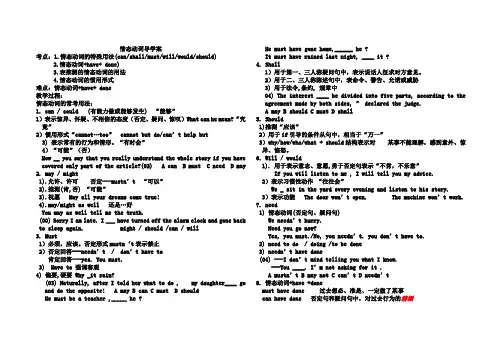
情态动词导学案考点:1.情态动词的特殊用法(can/shall/must/will/would/should)2.情态动词+have+ done)3.表推测的情态动词的用法4.情态动词的惯用形式难点:情态动词+have+ done教学过程:情态动词的常考用法:1.can / could (有能力做或能够发生) “能够”1)表示惊异、怀疑、不相信的态度(否定、疑问、惊叹)What can he mean?“究竟”2)惯用形式“cannot…too” cannot but do/can’t help but3) 表示常有的行为和情形。
“有时会”4)“可能”(否)How __ you say that you really understand the whole story if you have covered only part of the article?(02) A can B must C need D may 2. may / might1).允许、许可否定---mustn’t“可以”2).推测(肯,否) “可能”3).祝愿 May all your dreams come true!4).may/might as well 还是…好You may as well tell me the truth.(00) Sorry I am late. I ___ have turned off the alarm clock and gone back to sleep again. might / should /can / will3. Must1)必须,应该。
否定形式mustn‘t表示禁止2)否定回答---needn’t / don’t have to肯定回答---yes. You must.3) Have to 强调客观4) 偏要,硬要 Why _it rain?(03) Naturally, after I told her what to do , my daughter____ goand do the opposite! A may B can C must D shouldHe must be a teacher ,_____ he ? He must have gone home,______ he ?It must have rained last night, ____ it ?4. Shall1)用于第一、三人称疑问句中,表示说话人征求对方意见。
英语情态动词用法导学案
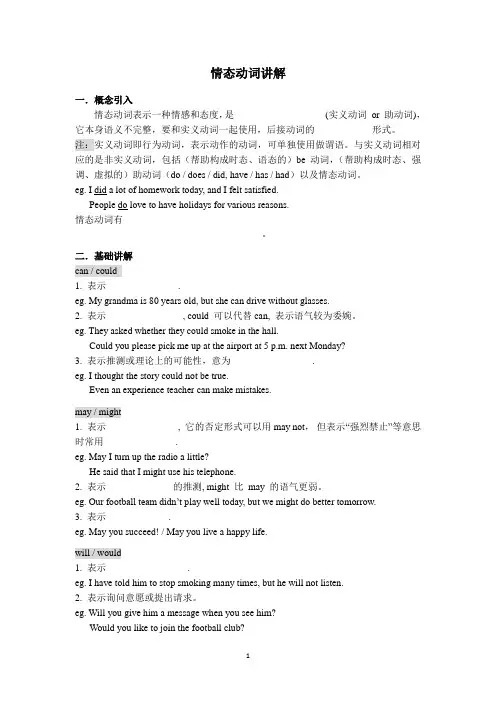
情态动词讲解一.概念引入情态动词表示一种情感和态度,是___________________(实义动词or 助动词),它本身语义不完整,要和实义动词一起使用,后接动词的____________形式。
注:实义动词即行为动词,表示动作的动词,可单独使用做谓语。
与实义动词相对应的是非实义动词,包括(帮助构成时态、语态的)be动词,(帮助构成时态、强调、虚拟的)助动词(do / does / did, have / has / had)以及情态动词。
eg. I did a lot of homework today, and I felt satisfied.People do love to have holidays for various reasons.情态动词有_________________________________________________________________________________________________。
二.基础讲解can / could1. 表示_______________.eg. My grandma is 80 years old, but she can drive without glasses.2. 表示________________, could 可以代替can, 表示语气较为委婉。
eg. They asked whether they could smoke in the hall.Could you please pick me up at the airport at 5 p.m. next Monday?3. 表示推测或理论上的可能性,意为_________________.eg. I thought the story could not be true.Even an experience teacher can make mistakes.may / might1. 表示_______________, 它的否定形式可以用may not,但表示“强烈禁止”等意思时常用_______________.eg. May I turn up the radio a little?He said that I might use his telephone.2. 表示______________的推测, might 比may 的语气更弱。
高一英语教案-高一英语必修3第2单元导学案情态动词II

高一英语必修3第2单元导学案情态动词(II)导学案4情态动词(ii)一、ought to 应该,应当其否定“ought not to” 或“oughtn’t to” (1) 用于第一人称,表有责任或有必要做某事。
we ought to be more careful with our homework. (2)用于二、三人称,表建议或劝告。
you ought tofollow your teacher’s advice. she ought not to go alone. (3) ought to+have done: 本该……i’m sorry.i ought to have told you this morning.对不起,我本该今天早上告诉你的。
二、have to / don’t have to / mustn’t (1) haveto = have got to 必须,不得不(有人称和数、时态的变化)he has to work on the farm all day . 他不得不在农场工作一整天。
(2)don’t have to 不必……you don’t have to buy a computer. (3)mustn’t禁止,不许you mustn’t sleep in class!三、need 需要,必要(既可以作情态动词,也可以作实义动词,但用法不同)(1)作为情态动词,need 通常用于否定句和疑问句①you needn’t buy the book.. ②――need he do his homework first?――yes ,he must! (no ,he needn’t) (2) need 作为实义动词时,通常用法是: sb/sth need to do (表主动) we need to tell himthe truth. sb/sth need doing /to be done(表被。
九年级英语教学设计导学案(情态动词)

t; can 14.—The book report is very important. You ________ write it carefully. —But I ________ hand it in now. A.must; must B.have to; must C.must; have to D.have to; have to 15.It is 11:00 p.m now. Peter hasn't come back yet. His mother ______ be very mad
三、加强思维
6.I’ve bought a nice necklace for Jo’s birthday. She _____like it, but I’m not sure. A.can B.may be C.might D.must 7.The designer has tried every possible way to make the robot light, so you _____
导学设计
9.—Can we walk across the road now?
—No, we. We have to wait until the light turns green.
A.couldn’t B.needn’t C.shoul heard about the temperature of the earth will rise to 59℃ in 2020?
at him. A.may
B.can
C.must
D.need
1-5:BDCAA 6-10:CDADB 11-15:BCDCC
2/3
导学设计
3/3
初中情态动词教案
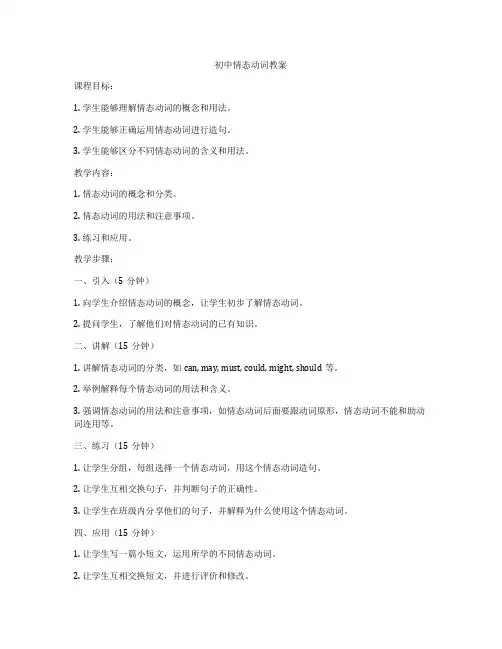
初中情态动词教案课程目标:1. 学生能够理解情态动词的概念和用法。
2. 学生能够正确运用情态动词进行造句。
3. 学生能够区分不同情态动词的含义和用法。
教学内容:1. 情态动词的概念和分类。
2. 情态动词的用法和注意事项。
3. 练习和应用。
教学步骤:一、引入(5分钟)1. 向学生介绍情态动词的概念,让学生初步了解情态动词。
2. 提问学生,了解他们对情态动词的已有知识。
二、讲解(15分钟)1. 讲解情态动词的分类,如can, may, must, could, might, should等。
2. 举例解释每个情态动词的用法和含义。
3. 强调情态动词的用法和注意事项,如情态动词后面要跟动词原形,情态动词不能和助动词连用等。
三、练习(15分钟)1. 让学生分组,每组选择一个情态动词,用这个情态动词造句。
2. 让学生互相交换句子,并判断句子的正确性。
3. 让学生在班级内分享他们的句子,并解释为什么使用这个情态动词。
四、应用(15分钟)1. 让学生写一篇小短文,运用所学的不同情态动词。
2. 让学生互相交换短文,并进行评价和修改。
3. 让学生在班级内分享他们的短文,并解释他们为什么选择使用这些情态动词。
五、总结(5分钟)1. 对本节课的内容进行总结,让学生巩固所学知识。
2. 回答学生的疑问,并进行解答。
教学评价:1. 观察学生在练习中的表现,了解他们对于情态动词的掌握程度。
2. 评价学生在应用环节的短文,了解他们能否正确运用情态动词。
3. 收集学生的反馈意见,了解他们对情态动词的理解和运用情况。
教学反思:本节课通过讲解、练习和应用等环节,让学生掌握了情态动词的概念和用法。
在教学过程中,要注意让学生充分理解和掌握情态动词的用法,并能够正确运用情态动词进行造句。
同时,要注重学生的实际应用能力的培养,让他们能够在实际情境中灵活运用情态动词。
初中情态动词的教案
初中情态动词的教案一、教学目标:1. 让学生掌握常见的情态动词,如can, may, must, could, might, should等。
2. 使学生能够正确运用情态动词提问和回答,表达可能性、允许、建议、能力等意义。
3. 培养学生运用情态动词进行交际的能力,提高学生的英语口语水平。
二、教学内容:1. 情态动词的定义和用法。
2. 情态动词的提问和回答方式。
3. 情态动词在实际语境中的应用。
三、教学过程:1. 导入:通过一幅图片或情景,引导学生思考情态动词的用法。
2. 讲解:讲解情态动词的定义和用法,举例说明。
3. 练习:让学生进行情态动词的提问和回答练习,巩固所学知识。
4. 应用:创设实际语境,让学生运用情态动词进行交际。
5. 总结:对本节课的内容进行总结,强调情态动词的重要性和用法。
四、教学方法:1. 情境教学法:通过创设实际语境,让学生在情境中学习情态动词的用法。
2. 互动教学法:引导学生进行提问和回答练习,提高学生的口语表达能力。
3. 交际教学法:鼓励学生在实际交际中运用情态动词,提高学生的交际能力。
五、教学评价:1. 课堂参与度:观察学生在课堂上的积极参与情况和表现。
2. 练习正确性:检查学生在练习中的答案是否正确。
3. 实际应用:评价学生在实际语境中运用情态动词的能力。
4. 口语表达:评估学生在口语交际中的表现,如提问、回答等。
六、教学资源:1. 图片或情景:用于导入和创设实际语境。
2. 练习题:用于巩固所学知识,提高学生的应用能力。
3. 录音机或音响:用于播放录音,提高学生的听力水平。
4. 教学课件:用于辅助讲解和展示教学内容。
七、教学步骤:1. 导入:展示一幅图片或情景,引导学生思考情态动词的用法。
2. 讲解:讲解情态动词的定义和用法,举例说明。
3. 练习:让学生进行情态动词的提问和回答练习。
4. 应用:创设实际语境,让学生运用情态动词进行交际。
5. 总结:对本节课的内容进行总结,强调情态动词的重要性和用法。
语法运用教案情态动词的用法
语法运用教案情态动词的用法教案:语法运用――情态动词的用法一、引言情态动词在英语中扮演着重要的角色,能够表达说话人对某种行动或情况的评价、推测、建议、义务以及可能性等。
本教案旨在帮助学生掌握几种常见的情态动词,并能够正确运用于实际的语境中。
二、目标1. 学会情态动词的基本定义和用法。
2. 掌握can、could、may、might、must、shall、should、will、would的用法。
3. 能够正确运用情态动词表达推测、建议、能力、义务、可能性等。
三、导入1. 通过给出一些日常生活中的场景,让学生用情态动词表达自己的推测、建议或可能性。
2. 引导学生思考,情态动词与其他动词的区别是什么,为什么我们需要情态动词。
四、情态动词的基本概念和用法1. 情态动词是一类辅助动词,不可以单独作谓语,需要与动词原形一起构成句子。
2. 情态动词可以表示说话人对某种行动或情况的态度、推测、建议、能力、义务或可能性。
3. 情态动词不具有人称和数的变化。
4. 情态动词后接动词原形,且不需要加to。
五、各种情态动词的用法1. Can/Coulda. 表示能力或可能性。
- She can swim. (她会游泳。
)- Could you help me with this problem? (你可以帮我解决这个问题吗?)b. 表示请求或邀请。
- Can you give me a hand? (你能帮个忙吗?)- Could you join us for dinner? (你能和我们一起吃饭吗?)2. May/Mighta. 表示推测或可能性。
- It may rain later. (今天可能会下雨。
)- He might be at home. (他可能在家。
)b. 表示请求或允许。
- May I borrow your pen? (我能借用你的钢笔吗?)- You may go now. (你可以走了。
)3. Musta. 表示推测或确定。
2019高考英语情态动词导学案.docx
情态动词李仕才课程目标一、学习目标1.情态动词的基本用法。
2.情态动词+have done的用法。
二、重点、难点重点:情态动词的基本用法。
难点:情态动词+have done的用法。
三、考情分析上述语法是高考的重点语法,历年考题中占有重要的地位,并且是高考试题的难点。
一般在单选中能占1-2分;我们学习时应特别注意上述语法的学习及做题技巧,并认真研究近几年的高考题。
知识梳理一、情态动词的基本用法考点1 can和could的基本用法【用法】1.can和could都可以表示能力;许可、建议、请求以及推测;2.在疑问句和否定句中表示“怀疑,猜测”或“可能性”;3.如果要表示委婉的语气,"J用could代替can,这时could不再是can的过去式。
【例句】—Can she be in the computer center?或许她是在计算机中心?—No, she can, t be in it.不,她不可能在里面。
Could I borrow your bicycle?我能借你的自行车用用吗?【考题链接】1.You don' t have to know the name of the author to find a book・ You __________ find the book by the title.A. must «B. needC. canD. would答案:C解题思路:句意:你没有必要一定通过作者的姓名来找到一本书。
你可以根据这本书的标题(书名)來找到这本书。
must “必须,一定” :need “需要” ;can “可以,能够”: would "将会”,表过去的将來。
根据句意,只有C项符合题意。
2.—Could I speak to Mr. White?—I' m afraid he ________________ answer your call now. He is holding a meeting.A. can" tB. needn' tC. mustn' tD. shouldn" t答案:A解题思路:考查情态动词。
情态动词导学案-高三英语一轮语法复习
一轮英语语法之八:情态动词【预习案】1.情态动词的特性1)不能单独充当谓语,后接______________。
2)无_________________形式。
3)部分情态动词无过去式。
4)可用作助动词。
2.3.常见用法:1)用于请求与询问①May/Might/Could/Can I...?②Would you (please)…/Would you mind…?③Must/Need I…?④Shall I/we/he…?2)表推测①It can be very warm in this area.②It's 9:30 .I think she ___________ be in her office.③That restaurant ____________ be very good. It’s always empty.(2)时间观念①+do/be 对现在情况的推测②+be doing 对现在正在进行的动作的推测③+have done 对过去发生的事情的推测填空:①I can’t find my ticket, I think I must __________(lose) it.②Judging by her clothes, she must ___________ very rich.3)虚语气中的运用①should (not) have done sth. 本应该做某事却没做/本不该做某事却做了②could/might have done sth.③needn’t have done sth.1)特殊的情态动词2)固定搭配①may/might as well ______________________②would rather do…, would prefer/like to do…③can’t …too…/enough __________________________④can’t help/resist doing sth. ______________________⑤can’t but do sth.⑥can’t wait to do ________________⑦before sb can… _____________________⑧I dare say. ___________________⑨do all/what/everything sb can to do sth _________________________【当堂训练】1.选择题1)(2017北京卷)Samuel, the tallest boy in our class, ____ easily reach the books on the top shelf.A.mustB.shouldC.canD.need2)(2017天津卷2)My room is a mess, but I __________clean it before I go out tonight. I can doit in the morning.A. daren’tB.shouldn’tC.needn’tD.mustn’t3)【2016·北京】I love the weekend,because I________get up early on Saturdays and Sundays.A.needn’tB.mustn’tC.wouldn’tD.shouldn’t4)【2016•浙江】George _________ too far . His coffee is still warm .A. must have goneB. might have goneC. can't have goneD. needn't have gone5)【2014·陕西卷】My book,The House of Hales,is missing.Who________have taken it?A.needB.mustC.shouldD.could6)【2021年天津卷第一次】It used to be that you ______ drive for miles here without seeinganother person, but now there are houses and people everywhere.A.need B.should C.could D.must7)【2021年天津卷第二次】I honestly don't think I'm going to be admitted.Wel1, you never know! You________ a better impression than you think.A. may have madeB. should have madeC. couldn’t have madeD. needn't have made8)【2020·天津】Jim says we ______ stay in his house as long as we leave it clean and tidy .A.must B.can C.need D.should9)【2020·天津】You ____________ have scolded him for his poor performance. After all, he haddone his best.A.must B.should C.mustn’t D.shouldn't2.填空:1)When I was a child, I ________ watch TV whenever I wanted to.2)The police haven’t found the lost child, but they’re doing all they _________.3)If you don’t want to go swimming, you ________ as well stay at home.4)I like the author so much that I __________ wait to read his new book.5)You __________ be too careful when crossing the street.6)The poor postman was fired before he _________ account for his fault.7)It is usually warm in my hometown in March,but it ________be rather cold sometimes.8)If you ________go,at least wait until the storm is over.3.单句改错:1)Some classmates suggest we can go to places of interest nearby.2)We can chose between staying at home and taking a trip.3)Do I need leave my telephone number and address?4)I mustn't use a clock to wake me up because at six o'clock each morning the train es by myhouse.5)But in fact, Gorka can quite shy, even around the people he has known for a while.6)As for the consumers, they had better have their own judgment and not were puzzled by ads.7)He may have given you more help, even though he was very busy.【巩固练习】1.选择1)【2015·北京】—Can’t you stay a little longer?—It’s getting late.I really_____go now,My daughter is home alone.A.mayB.canC.mustD.dare2)【2015·重庆】You____be Carol.You haven’t changed a bit after all these years.A.mustB.canC.willD.shall3)【2015·浙江】It was so noisy that we__________ hear ourselves speak.A.couldn’tB.shouldn’tC.mustn’t D needn’t4)【2015•天津】I ______ have worried before I came to the new school, for my classmates here arevery friendly to me.A.mightn’tB.mustn’tC.needn’tD.couldn’t5)【2015·四川】You_____be careful with the camera.It costs!A.mustB.mayC.canD.will6)【2015·陕西】You __________ feel all the training a waste of time, but I’m a hundred percentsure later you’ll be grateful you did it.A. shouldB. needC. shallD. may7)【2015·福建】—Sorry,Mum!I failed the job interview again.—Oh,it's too bad.You________ have made full preparations.A. mustB.canC.wouldD.should8)【2018年北京卷】In today’s information age, the loss of data _________ cause serious problemsfor a pany.A. needB. shouldC. canD. must9)【2018年江苏卷】It’s strange that he_______ have taken the books without the owner’s permission.A. wouldB. shouldC. couldD. might10)【2018年天津卷】I can't find my purse. I___________ it in the supermarket yesterday, but I'mnot sure.A. should leaveB. must have leftC. might leaveD. could have left2.改错1)We must found ways to protect our environment.2)I dare not to face the danger bravely.3)You shouldn't have bought so much food, because I have prepared everything we need for thepicnic.4)You had better not to e here tomorrow.5)You mustn’t do the exercise if you don’t want to.3.填空1)—No one ________be pared with Yao Ming in playing basketball.—Oh,you are really his big fan.2)It ________be the postman at the door. It's only six o'clock.3)I ________worry about my weekend—I always have my plans ready before it es.Just be patient.4)You ________expect the world to change so soon.5)—May I take this book out of the reading room?—No,you ________.You read it in here.6)You ________park here!It's an emergency exit.7)—I don't really like James. Why did you invite him?—Don't worry. He ________not e. He said he wasn't certain what his plans were.8)—I left my handbag on the train,but luckily someone gave it to a railway official.—How unbelievable to get it back!I mean,someone ________ have stolen it.9)It ________have been Tom that parked the car here,as he is the only one with a car.10)What do you mean,there are only ten tickets?There ________ be twelve.。