
英语语法之名词性从句 定语从句 状语从句
精锐教育学科教师辅导讲义讲义编号_11gz2yy006515学员编号:gz2wql511 年级:高三课时数及课时进度:11(36/81)学员姓名:郑嘉裕辅导科目:英语学科教师:陈桂冰学科组长/带头人签名及日期白梅2011/4/5课题语法专题复习之名词性从句+定语从句+状语从句授课时间:2011-04-10 备课时间:2011-04-8教学目标对于名词性从句+定语从句+状语从句的重点难点知识的牢固掌握及灵活运用重点、难点名词性从句+定语从句+状语从句的重点难点的解析及运用考点及考试要求对于语法知识点的综合考查教学内容Part I 上一节课的复习效果检查Part II Review Grammar 专题名词性从句I、重点难点解析名词性从句是历年高考的重点和难点也是热点。
名词性从句相当于名词,可分别作主句的主语、宾语、表语和同位语。
因此,名词性从句可分为主语从句、表语从句、宾语从句和同位从句(见下表)。
主语从句做主语,用that,whether,what(=the thing that)等连接词(原疑问词)引导宾语从句做宾语,用that(可省略),if,whether(or not),what(=the thing which)等连接词(原疑问词)引导表语从句用that(一般不省略),whether,what(=the thing which)等连接词(原疑问词)引导同位语从句用that(常用在news,thought,idea等词后),whether等连接词(原疑问词)引导一、主语从句主语从句是在复合句中充当主语的从句,通常放在主句谓语动词之前或由形式主语it代替,而本身放在句子末尾。
如:Who will go is not important.It doesn’t matter so mu ch whether you will come or not.That he suddenly fell ill last week made us surprised.1. It 作形式主语和it引导强调句的比较It 作形式主语代替主语从句,主要是为了平衡句子结构,主语从句的连接词没有变化。
而it引导的强调句则是对句子某一部分进行强调,无论强调的是什么成分,都可用连词that。
被强调部分指人是也可用who/whom。
例如:It is a pity that you didn’t go to see the film.(主语从句)It doesn’t interest me whether you succeed or not. (主语从句)It is in the morning that the murder took place.(强调句)It is John that broke the window. (强调句)2. 用it 作形式主语的结构:句型例子1 It is +名词+从句It is a fact that … 事实是… / It is an honor that …非常荣幸It is common knowledge that …是常识2 It is +形容词+从句It is natural that… 很自然…/ It is strange that… 奇怪的是…3 It is +不及物动词+从句It seems that… 似乎…/ It happened that… 碰巧…It appears that… 似乎…4 It +过去分词+从句It is reported that… 据报道…/ It has been proved that…已证实…It is said that… 据说…3. 主语从句不可位于句首的五种情况:情况说明例句1 if 引导的主语从句不可居于复合句句首。
If he will come or not is unknown (误). Whether he will come or not is unknown (正)2 It is said /reported…结构中的主语从句不可提前It is said that Jiang will visit our school. (正)Jiang will visit our school next week is said. (误)3 It happens/occurs…结构中的主语从句不可提前It occurred to him that he failed in the examination. (正)That he failed in the examination occurred to him. (误)4 It doesn’t matter how/whether …结构中的主语从句不可提前It doesn’t matter whether he is wrong or not. (正)Whether he is wrong or not doesn’t matter. (误)5 含主语从句的复合句是疑问句时,主语从句不可提前Is it likely that it will rain in the evening? (正)Is that will rain in the evening likely? (误)二.宾语从句宾语从句就是在复合句中作宾语的名词性从句,通常放在主句谓语动词(及物动词) 或介词之后。
情况说明例句1 作动词宾语由that引导的宾语从句(that 通常可以省略)I heard (that) he joined the army.由what, whether (if),when, where 等引导的宾语从句She did not know what had happened.I wonder whether you can change this note for me.动词+间接宾语+宾语从句She told me that she would accept my invit tion.2 作介词的宾语Our success depends upon how well we can cooperate withone another.3 作形容词的宾语I am afraid (that) I’ve made a mistake.4 it 可以作为形式宾语We heard it that she would get married next month.5 否定的转移(若主句谓语动词为think, consider,suppose, believe, expect, fancy, guess, imagine等,其后的宾语从句若含有否定意义,一般要把否定转移到主句谓语上,从句谓语用肯定式)I don’t think this dress fits you well. 我认为这件衣服不适合你穿。
注意:that 引导的从句常跟在下列形容词后作宾语:anxious, aware, certain, confident, convinced, determined, glad, proud, surprised, worried, sorry, thankful, ashamed, disappointed, annoyed, pleased, hurt, satisfied, content 等。
也可以将此类词后的that 从句的看作原因状语从句。
三.表语从句表语从句在复合句中作表语的名词性从句,放在系动词之后,一般结构是“主语+连系动词+表语从句”。
可以接表语从句的连系动词有be, look, remain, seem等。
引导表语从句的that常可省略。
另外,常用的还有the reason is that… 和It is because 等结构。
例如:1) The question is whether we can make good preparation in such a short time.2) This is why we can’t get the suppor t of the people.3) But the fact remains that we are behind the other classes.4) The reason he is late for school is that he missed the early bus.四.同位语从句同位语从句就是在复合句中作名词的同位语的名词性从句。
情况说明例句1 同位语从句的功能(一般由that引导)对于名词进一步解释,The king’s decision that the prisoner would be set freesurprised all the people.说明名词的具体内容,The order that all the soldiers should stay still is given bythe ge eral.2 同位语从句在句子中的位置有时可以不紧跟在它所说明的名词后面,被别的词隔开He got the news from Mary that the sports meeting was putoff.五.whether, if引导名词性从句的区别:情况说明例句1 在句首引导主语从句时,只能用whether Whether we will go camping tomorrow depends on theweather.2 if不能引导表语从句What he doctor really doubt is whether my mother willrecover from the serious disease soon.3 if 不能引导介词后的宾语从句Everything depends on whether we can make a plan that theywill agree to.4 如果宾语从句是否定句只能用if I asked Pav e if he hadn’t decided what he would say at hemeeting.5 discuss 后的宾语从句只能用whether引导We discussed whether the medicine will cause side effect.注意:doubt 作“怀疑”解,后接宾语从句时,如主句是肯定的,宾语从句用whether 或if 引导;如主句是否定,宾语从句只能用that 引导。
(1) I doubt whether/ if he is fit for the job.(2) I don’t doubt that he can do it very well.II、实战演练用适当的连词填空:1. I can’t decide ____________ dictionary I should buy.2. That’s ____________ he refused my invitation.3. I am very interested in ____________ he has improved his pronunciation in such a short time.4. ____________ we need is more time.5. The fact ____________ she had not said anything at the meeting surprised everybody.6. ____________ and ____________ they will meet has not been decided yet.7. Please tell me ____________ you are waiting for.8. Is that ____________ you are looking for?9. Would you please tell me ____________ the nearest post office is?10. I don’t know ____________ he will agree to the plan or not.11.______ is done cannot be undone.12.Take care ______ you don’t make mistakes in the coming exam.13.To his surprise, the umbrella was not ______ he had put.14.______ we can’t get seems better than ______ we have.15.______ we’ll go camping tomorrow depends on the weather.16.______ they are most interested in is ______ they can produce more and better cars.17.It doesn’t matter ______I rest or not.18. ______I have will be yours sooner or later.19.I think it is ______ you’re eating too much.20.Can you make sure ______ Alice has put the gold necklace?21.——Do you remember ______ he came?——Yes, I do. He came by train.22.Mother asked me ______ was wrong with me.23______they have won the game made us excited.24. ______he says in his report is a very interesting question.25.That is he failed to arrive on time.专题二定语从句I、重点难点解析定语从句是英语语法中的重点。
高考英语三大从句(名词性从句、定语从句、状语从句)讲解+练习(附答案)
高考英语三大从句讲解+练习(附答案)【名词性从句】名词性从句相当于名词,可分别作主句的主语、表语、宾语和同位语。
因此,名词性从句成分为主语从句、表语从句、宾语从句和同位从句。
(一)引导名词性从句的连接词1、连接代词:who, whose, whom, what, which。
有词义,在从句中担任成分,如主语、表语、宾语、或定语等。
2、连接副词:when, where, why, how。
有词义,在从句中担任成分,作状语。
3、连接词:that, whether, if, as if。
that 无词义,在从句中不担任成分,有时可省略;if (whether), as if虽有词义,但在从句中不担任成分。
1. 主语从句作句子主语的从句叫主语从句。
主语从句通常由从属连词that,whether,if和连接代词what,who,which,whatever,whoever以及连接副词how,when,where,why等词引导。
that在句中无词义,只起连接作用;连接代词和连接副词在句中既保留自己的疑问含义、又起连接作用,在从句中充当从句的成分。
例如:What he wants to tell us is not clear. 他要跟我们说什么,还不清楚。
It is known to us how he became a writer. 我们都知道他是如何成为一名作家的。
Where the English evening will be held has not yet been announced.英语晚会将在哪里举行,还没有宣布。
有时为避免句子头重脚轻,常用形式主语it代替主语从句作形式主语放于句首,而把主语从句置于句末。
主语从句后的谓语动词一般用单数形式。
常用句型如下:(1)It + be + 名词+ that从句(2)It + be + 形容词+ that从句(3)It + be + 动词的过去分词+ that从句(4)It + 不及物动词+ that 从句另注意在主语从句中用来表示惊奇、不相信、惋惜、理应如此等语气时,谓语动词要用虚拟语气“(should) +do”,常用的句型有:It is necessary (important, natural, strange, etc.) that …It is a pity (a shame, no wonder, etc.) that…It is suggested (requested, proposed, desired, etc.) that…注意:连词that, whether在从句中不担任句子成分,只起连接作用,不能省略。
英语语法中的从句
英语语法中的从句有:名词性从句(主语从句、表语从句、宾语从句同位语从句)、形容词性从句(定语从句)、副词性从句(状语从句)。
英语从句的重点是,熟悉连接从句的连词、关系词的各种含义以及用法。
1.名词性从句英语语法中的名词性从句,在句子中起名词或者名词词组作用。
在英语复合句中充当主语、宾语、表语、同位语、介词宾语等。
因此,自然就有主语从句、宾语从句、表语从句和同位语从句。
1.同位语从句说明前一个名词具体内容的从句,一般位于被说明的名语之后,在含义上它与被说明的名词相等。
?引导同位语从句的连词,最常见的是that,其次还有whether,what, which, who, when, where, why, how 等词。
1.由that引导The fact that everyone loves money is common sense.人人爱钱是常识。
注意:此句的the fact=that everyone loves money说明同位语从句的名词,只是表达“语言、想法、事实”等少数抽象名词,大多数句词不能也不需要接同位语从句,常见的有:idea想法thought想法question问题fact事实belief信念answer回答reply回复rumor谣言news消息order命令hope希望promise诺言suggestion建议doubt怀疑saying格言I like the idea that we hold an evening party.我喜欢开晚会这个想法。
Do you remember your promise that you treat us to hamburgers?你还记得你请我们吃汉堡包的承诺吗?The hope that every family owns a car will come true.每家有小车的希望会实现的。
注意:引导同位语从句的连词that通常不省略,但在非正式文体中也可以省去。
理解4种词性,轻松驾驭3大从句:名词性从句、定语从句、状语从句
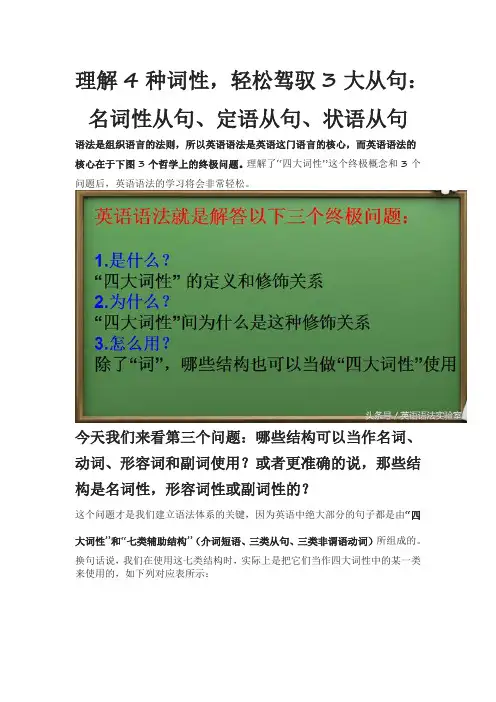
理解4种词性,轻松驾驭3大从句:名词性从句、定语从句、状语从句语法是组织语言的法则,所以英语语法是英语这门语言的核心,而英语语法的核心在于下图3个哲学上的终极问题。
理解了“四大词性”这个终极概念和3个问题后,英语语法的学习将会非常轻松。
今天我们来看第三个问题:哪些结构可以当作名词、动词、形容词和副词使用?或者更准确的说,那些结构是名词性,形容词性或副词性的?这个问题才是我们建立语法体系的关键,因为英语中绝大部分的句子都是由“四大词性”和“七类辅助结构”(介词短语、三类从句、三类非谓语动词)所组成的。
换句话说,我们在使用这七类结构时,实际上是把它们当作四大词性中的某一类来使用的,如下列对应表所示:注:只有谓语动词才具有动词词性,其他任何结构包括非谓语动词都无法替代。
所以不再列出。
从上表可以看出,从句分为名词从句、定语从句、状语从句三个大类,正好分别对应了名词、形容词、副词这三大词性。
所以,我们也可以这样理解这三类从句:1.名词性从句:可以当作名词使用的从句。
顾名思义,就是把一个完整的句子当做名词来用,在另一个句子(主句)中充当成分,而名词常做四种成分:主语,宾语,表语,同位语。
所以便有了四种名词性从句:主语从句,宾语从句,表语从句和同位语从句。
例句回顾:①That English is important is known to all.(主语从句)注:避免头重脚轻It is known to all that English is important. (It作形式主语)② We all know that English is important.(宾语从句)③ What we all know is that English is important.(表语从句)④ What is known to all is the fact that English is important.(同位语从句)2.定语从句:可以当作形容词使用的从句。
大学英语语法应用教程-从句(Clause)
从句(Clause)
If two numbers are to be added, it does not matter in which order they are added. 若要把两个数加起来,那么按哪种顺序相加是没有关系的。(需要注意的是,连接代词which并没有位于主语从句句首, 因为它在从句中作介词in的介词宾语和order的定语。而且,不要把由which引导的主语从句误认为是介词宾语从句。) It follows from Maxwell’s hypothesis that whenever there netic field is produced. 由麦克斯韦假设可知,每当电场发生变化时就产生磁场。 (it follows that … 意为“由此得知……;因此”。) It happened that she was out when he called.( = She happened to be out when … ) 他打电话时,她恰巧不在家。(It happens that可译成“碰巧,恰巧;发生”。)
从句(Clause)
3) 表语从句 主要位于系动词be之后的表语从句最为常见,当然,也可用seem, sound等。例如: The present conception of the general structure of the atom is that it consists of a kind of solar system. 现在对 原子的一般结构的看法是:它是由一种太阳系构成的。 All indications are that the need for skilled people in the field of electronics will grow in this new decade. 所有 的迹象表明,在这新的十年中对电子学领域熟练人员的需求量将会增长。 That is how a computer works. 这就是计算机的工作原理。 (本句中的that应译为“这”;how从句一般可译成“……的原理,……是如何……”) Predictions are that electronics will continue to grow at a rapid rate for some time to come. 预测表明,在未来 一段时期内电子学将会继续高速发展。 (That is why … 要译成“这就是……的理由;这就是为什么……;因此……”。) My plan is that we will finish the project by the end of the year. 我的计划是我们年底结束这个项目。 The conclusion of the discussion is that the proposal cannot be accepted. 讨论的结果是这个提议不能被接受。 在个别情况下,状语从句也可充当表语从句(特别是句型this is because … )。如: This is because you has been absent all the term. 这是因为你整个一学期缺勤的缘故。
语法讲座之九名词性从句和定语从句和状语从句

语法讲座之九:名词性从句和定语从句和状语从句一、名词性从句名词性从句指主语从句、宾语从句、表语从句和同位语从句。
(一)主语从句1.主语从句的引导词:wh- / that 。
例如:That he will accept the offer seems unlikely.That he always studies hard is known to us.What they are after is profit.Who will go with you hasn’t been decided yet.2. 如果主语太长或为了保持句子的平行,绝大部分主语从句用it作形式主语,将真正的主语从句放在后面。
例如:①It is + 形容词+that②It is + 名词+that③It is + 动词+thatIt is likely that it is going to rain. ①It is no use that you go there in person. ②It is known that football is played all over the world. ③(二) 宾语从句宾语从句的引导词:wh- / that 。
例如:We must find out who did all this.He told me (that) he could do it for me.He has made it clear that the meeting will not be postponed.注意:if 和whether在引导宾语从句时的特殊用法①whether or not / whether…or not 连用是固定搭配,这时,whether 不能用if来替换。
②如果宾语从句是否定句时,只能用if而不能用whether来引导。
例如:I don’t care if it doesn’t rain.I don’t care if the factory doesn’t have my pay raised.(三) 表语从句表语从句的引导词:wh- / that 。
主要名词性从句定语从句,宾语从句,状语从句……
宾语从句宾语从句的概念:在复合句中,用来充当宾语的句子叫作宾语从句。
在谓语动词、介词、动词不定式等后面都可以接宾语从句,要想真正掌握宾语从句的用法,必须把握三个关键点:引导词、语序、时态。
考生在做此类试题时,首先从语序着手,宾语从句的语序应该为陈述句语序;再从时态考虑,一般情况下,宾语从句的时态要和主句的时态保持一致,但是,如果有明显的时间状语,要以时间状语来判断时态;最后,再根据答语来判断疑问词,问内容用what、问时间用when/what time、问地点用where、问原因用why、问方式用how 等例:—Could you tell me _____?—Last week.A. how he returned to BeijingB. when he left for BeijingC. when did he leave for Beijing【方法点拨】第①步:宾语从句的语序应该为陈述句语序,观察选项,可直接排除C项;第②步:根据答句中的时间状语“Last week”可知时态为一般过去时,且引导词为询问时间的when,故选B。
定语从句定语从句的概念:在复合句中作定语,修饰主句中某一名词或代词的从句,叫作定语从句。
被定语从句所修饰的词叫先行词,通常位于定语从句之前。
定语从句的关系词:引导定语从句的关系词包括关系代词that, which, who, whom, whose和关系副词when, where, why。
关系代词或关系副词位于先行词和定语从句之间,它既起连接作用,又充当从句中的一个成分。
考生在解答该类试题的时候,首先分析语境,可以把先行词还原到从句中,确定先行词在句子中所作的成分;其次在选择关系词时,要确定先行词是指人还是指物。
指人就从that、who、whose和whom 中选择;如果指物,就从that和which中选择。
如果先行词表地点,且在句中作状语则用where。
例:I still remember the college ____ I visited in London many years ago.A. whatB. whoC. that【方法点拨】第①步:分析语境“我仍然记得许多年前在伦敦参观的大学。
三大从句语法讲解
三大从句语法讲解从句:在复合句具有主谓部分但不能独立成句的句子。
主句:除掉从句,就是主句在英语中,主要有三大从句:名词性从句(包括主语从句,宾语从句,表语从句,同位语从句)形容词性从句(即定语从句)副词性从句(即状语从句:包括时间、条件、结果、目的、原因、让步、地点、方式等)三大从句快速判断方法:1.主句不完整,从句不完整→名词性从句(连接代词)2.主句不完整,从句完整→名词性从句(连词、连接副词)3.主句完整,从句不完整→定语从句(关系代词)4.主句完整,从句完整→定语从句(关系副词)、同位语从句、状语从句名词性从句主语从句:(用句子代替名词来做主语)比如汉语中:①你通过我的方法学好了英语【主语】是我的荣幸。
②你要不要学英语【主语】是你自己的事。
③你想要的学习效果【主语】还必须靠你自己实现。
④你什么时候开始学英语【主语】是很重要的一件事。
基本:三类主语从句的连词(1)从属连词引导的主语从句(that / whether / if)that引导的主语从句:引导词that无含义/在句中不做成分/不可以省。
That 引导主语从句通常用it 作形式主语。
例如:That you will win the medal seems unlikely.(你要赢得这样比赛看起来不可能。
)That she survived the accident is a miracle.(她能在这场事故中幸存真是个奇迹。
)这个就同我们汉语例子中的①句一样,只不过英语中更加重视句子结构,所以把that放在前头,告诉你这个that后面跟的句子(和里面的主谓宾)不影响主句。
whether 引导的主语从句: whether有含义(是否)/在句中不做成分/不可以省。
注意:引导主语从句,不能用if不能在开头,只能用whether.Whether we will hold a party in the open air tomorrow depends on the weather.(我们明天会不会在户外举办聚会取决于天气。
高考语法之定语从句和状语从句
高考语法之定语从句和状语从句复合句:名词性从句定语从句状语从句复合句是由一个主句加一个或几个从句构成的句子。
从句只用作句子的一个成分,不能独立。
根据从句在句子中的作用,可分为名词性从句、形容词性从句(定语从句)和副词性从句(状语从句)三类。
(一)名词性从句复合句中起名词作用的从句叫名词性从句。
名词性从句可分为主语从句、表语从句、同位语从句和宾语从句。
其关联词有:连接词that,whether;连接代, what, whatever, which, whichever, who, whom, whose,whoever, whomever;连接副词 when, where, how, why 等。
1. 主语从句及形式主语在句子中充当主语的从句称为主语从句,位于句首主语的位置。
当主语从句位于句首时,引导从句的连接词一律不能省略,其谓语动词通常用早�d。
引导主语从句的连接词分以下三种:1) that, whether引导主语从句,只起连接作用,在句中不充当成分。
连接词that 在句子中没有词义,但不能省略。
that, whether引导的主语从句谓语及其他 That we are losing high-level scientists astonishes us. That she won the game made a tremendous stir in our country Whether one can succeed dependson how hard he works. Whether it will do us harm or good remains to be seen. Just because he is over sixty doesn’t mean he must retire. 说明:在传统英语中,because是不能引导主语从句的,但在非正式文体中,特别在现代英语中,已很常见。
初中英语语法-英语从句总结
初中英语语法总结(从句)英语从句三大类型按一般说法,可分为三大类14种从句。
一,名词性从句1主语从句Whether it’s right or not remains to be seen。
2宾语从句I wonder whether it's right or not.3同位语从句This is a question whether it's right or not. 4表语从句The question is whether it's right or not。
二,定语从句1限定性定语从句She is the student who can speak English well。
2非限定性定语从句She is the student, who can speak English well。
三,状语从句1时间状语从句The fact will come out when he comes here。
2地点状语从句You can go wherever you like。
3原因状语从句Pay more attention to your lessons because you are astudent。
4方式状语从句He walks as if he were a king.5目的状语从句She went to Japan so that she could learn Japanese well. 6结果状语从句She went to Japan so that she learned Japanese well.7条件状语从句I will understand it if he tells me.8让步状语从句He knows a lot though he is little.1.定语从句There are some old books in the box.The boy dressed in blue is from America。
英语三大从句语法讲解
英语三大从句在英语中,主要有三大从句,即名词性从句包括主语从句,宾语从句,表语从句,同位语从句、形容词性从句即定语从句、副词性从句即状语从句,包括时间、条件、结果、目的、原因、让步、地点、方式等;定语从句一、关系代词引导的定语从句关系代词代替前面的先行词,并且在定语从句中充当句子成分,可以作主语、宾语、定语等;常见的关系代词有:who, that, which;它们的主格、宾格和所有格如下表所示:一关系代词who, whom和 whose的用法who代替人,是主格,在定语从句中作主语;An architect is a person who designs buildings. 建筑师是设计房屋的人;whom代替人,是宾格,在定语从句作宾语,在非正式英语常可省略;Do you know the gentleman whom we met in the school library yesterday 昨天我们在学校图书馆里遇到的那位先生你认识吗whose一般代替人,有时亦可代替物,是所有格,在定语从句作定语; The girl student whose father is a senior engineer used to study abroad. 其父是一位高级工程师的那个女学生过去在国外留学;Do you know the name of the hotel whose window we can see here 我们这儿能看到窗户的那个宾馆叫什么名字,你知道吗关系代词whose指代先行词hotel,正式用法应该用of which;whose window=the window of which,意思是:the window of the hotel; 二关系代词which的用法which代替物,在定语从句作主语或宾语,作宾语时还可省略;I do not like stories which have unhappy endings.我不喜欢有不幸结局的小说;which可以换成that三关系代词that的用法that既可指人又可指物,在当代英语中大多指物,在定语从句作主语或宾语,作宾语时还可省略;:Is she the girl that sells newspapers她是卖报纸的那个女孩吗that可以换成whoWhere is the ice-cream that was in the fridge放在冰箱的冰激凌哪儿去了that可以换成whichIs this the book that you want to buy这是你要买的那本书吗 that可以换成which,在定语从句作宾语,还可以省略二、关系副词引导的定语从句常用的关系副词只有三个:when, where, why,在定语从句中充当时间、地点和原因状语;一关系副词when的用法关系副词when代替的先行词表示的是时间,when在定语从句作时间状语;In Beijing July and August are the months when it rains very often.北京的七月和八月是常下雨的月份;when先行词是months二关系副词where的用法关系副词where代替的先行词表示的是地点,where在定语从句作地点状语;During the Spring Festival I went back to the town where I was brought up.春节期间,我回到了生我养我的家乡;where的先行词是town三关系副词why的用法关系副词why代替的先行词表示的是原因,why在定语从句作原因状语;The reason why I am phoning you is to ask you whether you have got my email.我打电话给你的原因是想问问你是否收到了我的电子邮件;why先行词是reason, 当代英语里why可以用that替代,这时关系代词that 就变成了表示原因的关系副词,还可以将why省略三、特殊关系代词as引导的定语从句一在固定搭配as…as, so…as, such…as, the same…as中,as引导定语从句You may take as many books as you want.你想要拿多少书就拿多少;第一个as是副词,修饰many的;第二个as才是关系代词,代替先行词books,在定语从句中作宾语二独立于主句之外,as引导定语从句As we know/ As is known to us, the earth turns around the sun. 正如我们所知,地球围绕太阳旋转;As we know和 As is known to us均为定语从句,as分别作宾语和主语,替代后面的主句;Taiwan is, as you know, an inseparable part of China.你知道,台湾是中国不可分割的一部分;关系代词as指代整个主句,在定语从句中作宾语;四、关系代词who, which与that的区别一关系代词who与that的区别1. 当关系代词用作主语时,多用主格who;He who loses hope loses all.失去希望的人就失去一切;先行词为代词he, they, any, all, one 等时,多用whoI met Alice, who told me that she was learning Chinese.我遇见艾丽斯,她告诉我她在学汉语;在非限制性定语从句中,用who 2. 当关系代词用作介词后的宾语时,用宾格whom,不用that;The man to whom our headmaster talked just now is our English teacher.我们校长刚才与他谈话的那个人是我们的英语老师;介词与关系代词紧密相连时,只能用宾格whom,不可用主格who注意:介词与关系代词不是紧密相连时,或者说介词放在句子后面时,这时可以用主格who,也可用that,还可以省略关系代词;因此,上面的这句话还可以有如下四种说法:1 The man whom our headmaster talked to just now is our English teacher.2 The man who our headmaster talked to just now is our English teacher.3 The man that our headmaster talked to just now is our English teacher.4 The man our headmaster talked to just now is our English teacher.3. 当关系代词泛指人时,多用that;He is a man that is never afraid of failure.他是个从不怕失败的人;that用来泛指人4. 当关系代词出现在who开头的疑问句时,应用that;例如:Who is the girl that is talking to Tom in English用英语同汤姆交谈的那个女孩是谁避免重复使用who,以免造成误解或语义含混不清二关系代词which与that的区别1. 当先行词为all, much, little以及不定代词anything, something, everything等时,关系代词多用that;All that glitters is not gold. 闪闪发光物,未必尽黄金;She told me everything that she knew. 她把她所知道的一切都告诉了我;2. 当先行词的前面有形容词最高级、序数词或限定词the only, the very, all, every, any, no等时,关系代词一般都用that;This is the best novel that I have ever read. 这是我读过的最好的一部小说;He is the only person that has been invited to the ball. 他是惟一应邀参加舞会的人;3. 当关系代词出现在which开头的疑问句时,应用that;Which was the hotel that was recommended to the foreign guest 哪一个是推荐给外宾的宾馆这里使用that很明显是为了避免重复which4. 在非限制性定语从句中,关系代词一般只用which;Beijing, which is the capital of the People’s Republic of China, will host the 2008 Olympic Games. 北京是中华人民共和国的首都,将主办2008年奥运会;5. 介词后的关系代词用which,而不用that;She has collected 600 stamps, 60% of which are German stamps. 她收集了600张邮票,其中60%是德国邮票;五、定语从句的位置如前所述,定语从句一般总是直接置于所修饰的名词或代词之后;有时候,定语从句与先行词之间插入了其他的短语,这样它们被分隔了,这种情况下的定语从句被称作隔离定语从句;There was a girl upstairs who was shouting and crying, obviously mad.楼上有一个女孩,大喊大叫;很明显,她疯了;定语从句who was shouting and crying修饰the girl,被upstairs所隔开A new master will come tomorrow who will teach you German. 明天要来一位新老师教你们德语了;定语从句置于句末以示强调名词性从句宾语从句一、引导词1由that 引导的陈述句性的宾语从句,在很多动词如say, think, wish , hope, see, believe, agree, expect, hear , feel等动词后;连词that只起连接作用,在从句中不做句子的成分,也无词汇意义,在口语中常被省略;如:I told him that he was wrong.在think, believe, suppose, expect等动词引起的宾语从句中,有时谓语尽管是否定意义,却不用否定形式,而将think 等动词变为否定形式;见语法:否定转移如:I don’t think you are right. 我认为你做的不对在许多带有复合宾语的句子中,that引导的宾语从句经常移到句子的后面,而用it做形式宾语;We think it wrong that he told a lie to everyone 我认为他向每一个人撒谎是错误的2 由连词if、 whether 引导的表示“是否…”的宾语从句; Whether, if 在从句中不做句子的成分,一般情况下,whether和if 可以替换;I don’t know if/whether he will come tomorrow.在介词后面的宾语从句中不用if引导Everything depends on whether we have enough money.宾语从句中有or not时不用if引导.I don’t know whether the movie star will come or not.和不定式连用作宾语时不用if引导Whether to go there or not hasn’t been decided.3由wh-引导的宾语从句;连接代词who, whom, whose, what, which 和连接副词when, where, why, how 等连接的宾语从句,它们在句中即有连接从句的作用,又在句中充当句子的成分;Do you know which film they are talking about which做定语I don’t know where he lives. where 做地点状语二、宾语从句的语序,宾语从句的语序必须是陈述语序,既连接词+主语+谓语+其他成分 I believe that they will come soon.特例:有下列常见的问句,作为从句出现,是“不改变语句顺序”的;1. What's the matter2. What's wrong3. What's up4. What's the problem5. What's your trouble三、宾语从句的时态;宾语从句的时态受主句的限制,即:主句是一般现在时态,从句根据实际情况而定;主句是一般过去时态,从句用相应的过去的时态;如果从句的动作发生在主句之前,则从句要用过去完成时态;1 She says that she is a student.→ She said that she was a student.2She says that she will fly to Japan in a week. → She said that she would fly to Japan in a week.3She says that she has finished her homewor k already. → She said that she had finished her homework already.1如果宾语从句说的是客观真理、自然现象或事实时,这时宾语从句要用一般现在时态;The teacher said that the earth goes round the sun.2Could you tell me…是用来征询对方的意见,语气委婉,并不表示过去;Could you tell me when we will visit the History Museum注意事项:3由陈述句变成宾语从句时,要注意人称的变化;She said: “I have been to England before.” → She said that she had been to England before.She asked me: “Do you like maths” → She asked me if I liked maths.4宾语从句与简单句的交换;由连接代词和连接副词引导的宾语从句,如果宾语从句的主语和主句的主语是同一个人时,可以用“疑问词+不定式”做宾语的简单句结构;I don’t know what I should do next. → I don’t know what to do next.DO SOME EXERCISES:1.Can you see AA. what he’s readingB. what is he readingC. what does he readD. he reads what2. Does Jack come from Japan Do you know合并成一个句子Do you know ___that__Jack __come___from Japan3._What did your son say in the letter_He told me that he_D__ the Disney the next day.A. will visitB. has visitedC. is going to visitD. would visit4. He didn’t know___A____A. what’s the matterB. what the matter isC. what was the matterD. what the matter was5. Somebody called you just now, but I didn’t know__D__A. who were theyB. who they wereC. who was itD. who it was6. I want to know___D__A. what is his n ameB. what’s his nameC. that his name isD. what his name is7. ---Could you tell me __C__she is looking for---Her cousin, Susan.A. thatB. whose C .who D. which8. ---What are you searching the Internet for---I’m trying to find out____.A. What is the difference between SARS and BIRDFLUB. How many persons have died in IraqC. How to protect our environmentD. Why is our Chinese team be able to beat Korea同位语从句一一般来说,在主从复合句中,用作同位语的从句叫同位语从句;它通常跟在某些名词之后,用以说明或解释该名词表示的具体内容;可以跟同位语从句的名词通常有:advice, decision, fact, hope, idea, information, message, news, promise, proposal, reply, report, suggestion, word消息,problem, question, doubt, thought等; eg: They were delighted at the news that their team had won.当听到他们队获胜的消息时,他们欣喜若狂;有时同位语从句可以不紧跟在被说明的名词后面,而被别的词隔开; 如:The thought came to him that Tom might have returned the book. 他突然想起汤姆可能已经还了书了;二引导词1. The news that Mr. Li will be our new English teacher is true.2. He hasn’t made the decision whether he will go there.3. The question who should do the work is being discussed at the meeting.4. I have no idea what the boy is doing in the next room now.5. We haven’t yet settled the question where we are going to spend our summer vacation this year.6. I have no idea how I can get to the railway station.7. I have no idea when he will be back.小结:① that引导同位语从句时无词义,也不充当任何成分,但通常不可以省略,如句1;② whether引导同位语从句时意为“是否”,通常不能用if来代替, 如句2;③ 连接代词who, what等可以引导同位语从句,如句3, 4;④ 连接副词where, how, when等可以引导同位语从句, 如句5,6,7;三 that 引导的同位语从句和定语从句① 意义不同:同位语从句用来进一步说明前面名词的内容;而定语从句用来修饰、限定前面的先行词;试比较:1. The news that our team has won the final match isencouraging.2. The news that you told us is really encouraging.② that的功能不同:that引导同位语从句时是一个纯连词,不充当任何成分;而引导定语从句时,不仅起连接作用,而且还指代先行词并在从句中充当主语、宾语等成分;试比较:1. Dad made a promise that he would buy me a CD player ifI passed the English test.2. Dad made a promise that excited all his children.③ 可否省略:that在引导同位语从句时,通常不可省略;在引导定语从句时,若在从句中作宾语,通常可以省略,若作主语则不可以省略;DO SOME EXERCISES:I. 请用适当的词填空,使下列句子意思完整;1. They expressed the hope _that_ they would come over toChina soon.2. The fact ___that____ he didn’t see Tom this morning istrue.3. Word has come __where_____ some American guests will cometo our college for a visit next week.4. He can’t answer the question ___how____ he got the moneyfrom his home yesterday.5. Do you have any idea __what___ is actually going on inthe classroom6. The problem _______ we should have the meeting in the hallnow must be decided at once.II. 下列各句中均有一处错误,请改正;1. Our team has won the game, that made us very happy.2. I’ve come with a message from Mr Wang how he won’t beable to see you this afternoon.3. He must answer the question if he agrees with what shesaid or not.4. I’ve read the book where you gave me the day beforeyesterday. 5. One of the men held the opinion when what the book said was right.表语从句表语从句只能置于主句之后,而主句的动词只能是连系动词;名词性从句在be等系动词后作表语时被称为表语从句The problem is how we can get the things we need.问题是我们怎样能弄到我们需要的东西;how 在表语从句中充当方式状语The scissors are not what I need. 这把剪刀不是我所需要的;what 在表语从句中充当宾语What I told him was that I would find him a good play. 我告诉他的是我会给他找个好剧本;what在主语从句中作直接宾语, that 作为表语从句的引导词在该表语从句中不充当句子成分, 不能省略That is what I want to tell you.那就是我想要对你讲的;what在表语从句中充当直接宾语That is why she failed to pass the exam. 那就是她考试不及格的原因;why 在表语从句中充当原因状语“That is why...”是常用句型, 意为“这就是……的原因/因此……”, 其中why引导的名词性从句在句中作表语, 该句型通常用于针对前面已经说明过的原因进行总结下面是两个与“That is why...”形式相似的结构, 它们与“That is why...”结构之间的关系要能够辨析清楚:1“That is why...”与“That is the reason why...”同义, 只不过从语法结构上讲, “That is the reason why...”中why引导的是—个定语从句, 将其中的the reason去掉则与“That is why...”结构一样 That is the reason why I cannot agree.2“That is because...”句型中从属连词because引导的名词性从句在此作表语, 这也是个常用句型, 意为“这就是为什么……/因为……”;“That is because...”与“That is why...”之间的不同在于“That is because...”指原因或理由, “That is why...”则指由于各种原因所造成的后果He did not see the film last night. That is because he had to help his little sister with her homework.昨天晚上他没有去看电影, 那是因为他得帮助他的妹妹做作业;第一句话说明结果, 第二句话说明原因He had seen the film before. That is why he did not seeit last night.他以前曾看过那部电影, 因此他昨天晚上没有去看;第一句话说明原因, 第二句话说明结果考题1The traditional view is ____ we sleep because our brain is “programmed” to make us do so. 2007上海A. whenB. whyC. whetherD. that考题2You are saying that everyone should be equal, and this is ____ I disagree. 2004A. whyB. whereC. whatD. how考题3— I drove to Zhuhai for the air show last week.— Is that ____ you had a few days off 1999A. whyB. whenC. whatD. where考题4____ made the school proud was ____ more than 90% of the students had been admitted to key universities. 2003上海春A. What; becauseB. What; thatC. That; whatD. That; because考题5—Are you still thinking about yesterday’s game—Oh, that’s ____. 2003北京春A. what makes me feel excitedB. whatever I feel excited aboutC. how I feel about itD. when I feel excited 表语从句与宾语从句的关系宾语从句和表语从句都属于名词性从句;其作用跟名词在句中的作用相同;故充当宾语的句子叫宾语从句,充当表语的句子叫表语从句;宾语从句1对于宾语从句要掌握以下三点①语序: 从句的语序必须是陈述句语序, 即“主语 + 谓语”这种形式;②时态: 当主句是一般现在时或一般将来时的时候, 从句可以是任何时态, 而当主句是一般过去时的时候, 从句时态必须是过去时范围的时态, 即一般过去时, 过去进行时, 过去完成时, 过去将来时;③连接词: 当从句意思完整, 主句意思肯定时, 连接词用that, 且可以省去当从句意思完整, 主句意思不确定或含否定含意时, 常用if或whether是否当从句意思不完整时, 连接词则是代替不完整部分的特殊疑问词;表语从句在句子中起表语作用的从句叫做表语从句,位于主句系动词的后面;表语从句的引导词和主语从句的引导词相同;也是名词性从句的一种;What the police want to know is when you entered the room.警察想知道的是你什么时候进的房间;The trouble is that we are short of funds困难是我们缺乏资金; This is what we should do这是我们应当做的;That is why I want you to work there那就是我要你在那儿工作的原因;His first question was whether Mr. Smith had arrived yet他的第一个问题是史密斯先生到了没有; 从句中的疑问句用正常语序,即陈述语序;as if, as though, because也可用来引导表语从句;She seems as if she had done a great thing她看起来好像做了一件大事;It is because you eat too much那是因为你吃得太多了;状语从句一状语从句的种类1.时间状语从句2.地点状语从句;3.原因状语从句;4.条件状语从句;5.目的状语从句;6.让步状语从句;7比较状语从句;8.程度状语从句;9.方式状语从句;10.结果状语从句;二状语从句的时态一般情况下,时间和条件状语从句的谓语动词一般用“一般现在时”表示“一般将来时”,用“现在完成时”表示“将来完成时”;1时间状语从句1.由when, while, as引导的时间状语从句;when, while和as的区别:when引导的从句的谓语动词可以是延续性的动词,又可以是瞬时动词;并且when有时表示“就在那时”; While引导的从句的谓语动作必须是延续性的,并强调主句和从句的动作同时发生或者相对应;并且while有时还可以表示对比;While my wife was reading the newspaper, I was watching TV. As表示“一边……一边”,as引导的动作是延续性的动作,一般用于主句和从句动作同时发生;as也可以强调“一先一后;As we was going out, it began to snow.当我们出门时,开始下雪了;as强调句中两个动作紧接着先后发生,而不强调开始下雪的特定时间2.由before和after引导的时间状语从句;before引导的从句不再用否定式的谓语,并且当before引导的从句位于主句之后,有时译成“就,才”; 时态:当主句用将来时,从句总是用现在时;如果before引导的从句谓语用的是过去时,则主句动词多用过去完成时,这样以便体现动作发生的先后;After表示主句动作发生在从句动作之后;主句和从句的动作的时间关系正好与before引导的从句相反;3.由till或until引导的时间状语从句;till和until一般情况下两者可以互换,但是在强调句型中多用until;并且要注意的是:如果主句中的谓语动词是瞬时动词时,必须用否定形式;如果主句中的谓语动词是延续性动词时,用肯定或否定形式都可以,但表达的意思不同;4.由since引导的时间状语从句;since引导的从句的谓语动词可以是延续性的动词,又可以是瞬时动词;一般情况下,从句谓语动词用一般过去时,而主句的谓语动词用现在完成时;但在It is +时间+since从句的句型中,主句多用一般现在时;5.由as soon as, immediately, directly, instantly, the moment, the instant, the minute, 等引导的时间状语从句;这些连词都表示“一……就”;hardlyscarcely, rarely…when / before, no sooner…than 相当于as soon as之意;主句用过去完成时,从句用一般过去时;当hardly, scarcely, rarely和no sooner位于句首时,主句应用倒装语序;6.由by the time引导的时间状语从句;时态的变化:在一般情况下,如果从句的谓语动词用一般过去时,主句的谓语动词用过去完成时;如果从句的谓语动词用一般现在时,主句的谓语动词用将来完成时;7.由each time, every time和whenever引导的时间状语从句;8.由as long as和so long as引导的时间状语从句;这两个连词表示“只要;和…一样长”;2地点状语从句地点状语从句一般由连接副词where, wherever等引导,已经形成了固定的句型,:句型1:Where+地点从句,there+主句;此句型通常译成“哪里……哪里就……”;主句在从句后面时,there 可用可不用;如果主句在从句的前面时,一般都不用there;句型2:Anywhere/ wherever+地点从句,+主句;状语从句是句子的状语由一个从句充当,来修饰主句中的动词,形容词或副词等;状语从句都由从属连词引导,与主句连接,放在句末时,一般不在前面加逗号;3原因状语从句: because, since, as和for都表示原因;because 语势最强,回答why提出的问题,用来说明人所不知的原因;当能够很明显的看出原因或人们已知原因,就用as或since;由because引导的从句如果放在句末,且前面有逗号,则可以用for来代替;但如果不是说明直接原因,而是多种情况加以推断,就只能用for;4目的状语从句:表示目的状语的从句可以由in order that, so that,等词引导;5结果状语从句:结果状语从句常由so...that 或 such...that引导,首先要了解so和such后面分别跟什么词;such是形容词,修饰名词或名词词组,so是副词,只能修饰形容词或副词;so 还可与表示数量的形容词many, few, much, little连用,形成固定搭配;The box is so heavy that I can't carry it.6让步状语从句:是由though, although 引导的状语从句;。