
英语状语有哪些种类,英语状语的分类_状语从句 英语语法.doc
英语状语有哪些种类,英语状语的分类_状语从句英语中的状语按其用途,可以分为时间状语、地点状语、方面状语、原因状语、结果状语、目的状语、条件状语、让步状语、程度状语、方式状语、伴随状语等11种。
一、时间状语
She is to be married next month. 她预定在下个月结婚。
I’ll meet you at 4 o’clock. 我将在4点钟和你见面。
A lot of students missed my lecture yesterday. 昨天许多学生误了我的课。
二、地点状语
He lives over the mountain. 他住在山的那一边。
I first met him in Paris. 我初次见到他是在巴黎。
The children are swimming in the river. 孩子们正在河里游泳。
注:地点状语除表位置外,还可以表出发去向距离等。
如:
Are you glad to be going back to school? 返回学校你感到高兴吗?
They lived many miles from the town. 他们住的地方离镇子好几英里远。
三、方面状语
She is very weak in physics. 她物理很不行。
China is very rich in natural resources. 中国自然资源丰富。
This is better in every way than that. 这个在哪一方面都比那个要好。
The bridge is 2500 meters in length and 150 meters in height. 这座桥长2500米,高150米。
四、原因状语
He was surprised at what she said. 听到她说的话,他很吃惊。
He succeeded by hard work. 他由于努力工作而成功。
He was sent to prison for robbery. 他因为抢劫而坐牢。
Last week she fell ill from cold. 上星期她着凉生病了。
We’re proud of our motherland. 我们为祖国感到骄傲。
五、结果状语
He talked his wife into buying a car. 他说服他妻子买一辆小汽车。
The box is too heavy for me to lift. 这个箱子太重了,我提不动。
It rained heavily, causing severe flooding in that country. 大雨滂沱,造成了那个国家洪水泛滥。
He went to Africa in 1963, never to come back. 他在1963年到非洲,然后就再也没回来过了。
六、目的状语
They went out for a walk. 他们出去散步了。
He saves on behalf of his son. 他为儿子存钱。
He stood aside for her to pass. 他靠边站让她过去。
He cupped his ear to hear better. 他的手捂着耳朵,以便听得更清楚。
He went to the south in search of a better life. 他去南方寻求更好的
生活。
I went to France not to study French, but to study architecture. 我去法国不是为了学法语,而是为了学建筑。
七、条件状语
Can you see without your glasses? 你不戴眼镜能看得清东西吗?
United, we stand;divided, we fall. 团结则存,分裂则亡。
With more money I would be able to buy it. 钱多一点的话,我就买得起。
To look at him you could hardly help laughing. 看到他你就会忍不住笑起来。
We must be losing at least a third of our staff under new technology. 在新的技术条件下,我们必定要解雇至少三分之一的员工。
Weather permitting, we’ll have the match tomorrow. 天气允许的话,我们将于明天进行比赛。
八、让步状语
For all his money, he’s a very lonely man. 他虽然富有,可是非常寂寞。
Carol went to work in spite of feeling ill. 卡洛尔尽管感到不舒服仍去上了班。
With all his efforts, he lost the match. 虽然尽了全力,他还是输了那场比赛。
You couldn’t do that to save your life. 你即使为了救自己的命也不
能那样做。
Laughed at by everybody, he had my sympathy. 人人都嘲笑他,但我却同情他。
Knowing all this, they made me pay for the damage. 他们尽管了解这一切,还是要我赔偿损失。
九、程度状语
I don’t like coffee very much. 我不太喜欢咖啡。
To a great extent, it is not fair. 在很大程度上,这是不公平的。
The system which is used in this school is very successful. 这个学校所施行的制度是非常成功的。
十、方式状语
We came on the bus. 我们坐公共汽车来的。
You must pay the bill in cash. 你必须用现金付账。
I watched the game on television. 我在电视上收看了那场比赛。
We see with our eyes, and hear with our ears. 我们用眼睛看,用耳朵听。
I heard of the job through a newspaper advertisement. 我从报上的广告中知道了这个工作。
十一、伴随状语
I slept with the window open. 我开着窗睡觉。
She said good-bye with tears in her eyes. 她含着泪水说再见。
He ran up to her breathing heavily. 他气喘吁吁地跑到她跟前。
He rushed into the room, his face covered with sweat. 他满脸是汗跑进屋来。
英语中状语从句用法及例句总结(完整)
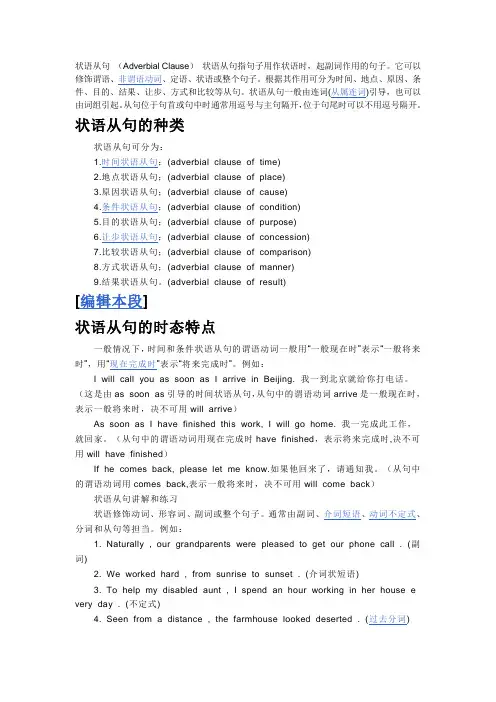
状语从句(Adverbial Clause)状语从句指句子用作状语时,起副词作用的句子。
它可以修饰谓语、非谓语动词、定语、状语或整个句子。
根据其作用可分为时间、地点、原因、条件、目的、结果、让步、方式和比较等从句。
状语从句一般由连词(从属连词)引导,也可以由词组引起。
从句位于句首或句中时通常用逗号与主句隔开,位于句尾时可以不用逗号隔开。
状语从句的种类状语从句可分为:1.时间状语从句;(adverbial clause of time)2.地点状语从句;(adverbial clause of place)3.原因状语从句;(adverbial clause of cause)4.条件状语从句;(adverbial clause of condition)5.目的状语从句;(adverbial clause of purpose)6.让步状语从句;(adverbial clause of concession)7.比较状语从句;(adverbial clause of comparison)8.方式状语从句;(adverbial clause of manner)9.结果状语从句。
(adverbial clause of result)[编辑本段]状语从句的时态特点一般情况下,时间和条件状语从句的谓语动词一般用“一般现在时”表示“一般将来时”,用“现在完成时”表示“将来完成时”。
例如:I will call you as soon as I arrive in Beijing. 我一到北京就给你打电话。
(这是由as soon as引导的时间状语从句,从句中的谓语动词arrive是一般现在时,表示一般将来时,决不可用will arrive)As soon as I have finished this work, I will go home. 我一完成此工作,就回家。
(从句中的谓语动词用现在完成时have finished,表示将来完成时,决不可用will have finished)If he comes back, please let me know.如果他回来了,请通知我。
英语里的状语
英语里的状语英语里的状语是句子中的某个成分用来修饰动词、形容词或副词,表示动作发生的时间、地点、原因、目的、结果等。
状语通常由副词、介词短语、不定式、分词和从句等构成。
下面我们来详细了解一下状语的分类和用法。
一、状语的分类根据用途,状语可分为多种类型,包括时间状语、地点状语、条件状语、原因状语、目的状语、结果状语等。
时间状语时间状语表示动作发生的时间,通常由介词短语、副词或从句等构成。
例如:I will meet you tomorrow.(介词短语)Please wait a moment.(副词)When I grow up,I want to be a doctor.(从句)地点状语地点状语表示动作发生的地点,通常由介词短语或副词构成。
例如:I saw him in the park yesterday.(介词短语)She is happy to live in a big city.(副词)条件状语条件状语表示动作发生的条件,通常由从句或介词短语构成。
例如:If it rains,we will stay at home.(从句)The offer is valid for 30 days.(介词短语)原因状语原因状语表示动作发生的原因,通常由介词短语或从句等构成。
例如:She is sad because her friend is leaving.(介词短语)The plane was delayed due to bad weather.(介词短语)He cried because he was happy.(从句)目的状语目的状语表示动作发生的目的,通常由介词短语或不定式构成。
例如:She studied hard to get a good grade.(不定式)They traveled to Europe for vacation.(介词短语)结果状语结果状语表示动作发生的结果,通常由副词、介词短语或从句等构成。
英语中的九种状语从句
5、条件状语从句的引导词有if, if only(如果…… 就好了,但愿), unless, in case, as/so long as, provided that, providing that, suppose that, supposing that, on condition that , when。
(1)___the days went on, the weather got worse.
A. With
B. Since
C. While D. As
(2) ____the satellite launch drawing near,the research workers put their hearts to the test and always stayed up late.
状语从句
状语从句 (Adverbial Clause) 是指句子用作状 语,根据其作用可分为一下九种:
1. 时间状语从句 1) 引导词 ( 1 ) 表 示 “ 当 …… 时 候 ” : when, while, as,
whenever When I went into the room, he was at work.当我进屋
Even if I have to walk all the way I’ll get there. 即使我 得一路走着去,我也要走到那里。
• as引导的让步状语从句的结构是:名词(形 容词、副词、动词)+ as +主谓。如:
Child as he was, he knew what was the right thing to do. 尽管是个孩子,他知道要做的正确的事情 是什么。
状语从句的种类及其在句子中的位置
状语从句的种类及其在句子中的位置状语从句是英语中常见的从句类型之一。
它在句子中用来修饰动词、形容词、副词等,起到更加具体和详细的说明和补充的作用。
本文将介绍状语从句的种类及其在句子中的位置。
一、状语从句的种类1. 时间状语从句时间状语从句用来表示动作或事件发生的时间、顺序、频率等。
常见的引导词有when(当...时候)、while(当...的时候)、as(当...时候)等。
例如:- I will go to bed when I finish the report.(我完成报告时,就去睡觉。
)- While she was cooking, her phone rang.(她在煮饭时,手机响了。
)- As I was leaving, it started to rain.(当我离开时,开始下雨了。
)2. 地点状语从句地点状语从句用来表示动作或事件发生的地点。
常见的引导词有where(在哪里)、wherever(无论在哪里)等。
例如:- He will meet you where we first met.(他会在我们初次见面的地方和你见面。
)- Wherever you go, I will follow.(无论你去哪里,我都会跟随。
)原因状语从句用来表示动作或事件发生的原因。
常见的引导词有because(因为)、since(因为)、as(因为)等。
例如:- He didn't come to the party because he was sick.(他因为生病所以没有来参加派对。
)- Since it's raining, we should stay at home.(因为下雨了,我们应该待在家里。
)4. 目的状语从句目的状语从句用来表示动作或事件的目的。
常见的引导词有so that (以便)、in order that(为了)等。
例如:- I study hard so that I can pass the exam.(我努力学习,以便能通过考试。
十大状语从句类型

十大状语从句类型
十大状语从句类型:
1. 时间状语从句
当我们谈到时间时,常常使用时间状语从句来表达具体的时间点或时间段。
例如:当我到达学校时,已经下午三点了。
2. 原因状语从句
我们常常使用原因状语从句来解释一个事件或行为的原因。
例如:我没去参加聚会,是因为我生病了。
3. 条件状语从句
条件状语从句常常用来表达一个条件对结果的影响。
例如:如果明天下雨,我们就不出去玩了。
4. 目的状语从句
目的状语从句用来说明一个行为或动作的目的。
例如:我学习英语,是为了能够和外国人交流。
5. 结果状语从句
结果状语从句用来说明某个行动或情况所导致的结果。
例如:她很努力学习,结果考试取得了好成绩。
6. 让步状语从句
让步状语从句用来表示一个与主句相反的情况或条件。
例如:尽管
下雨了,但他还是出去跑步了。
7. 比较状语从句
比较状语从句用来表示两个或多个事物之间的比较。
例如:他比我更高大。
8. 方式状语从句
方式状语从句用来说明某个行动或动作的方式。
例如:他悄悄地走进房间。
9. 地点状语从句
地点状语从句用来说明某个行动或动作发生的地点。
例如:我们在公园里见面。
10. 比较状语从句
比较状语从句用来表示两个或多个事物之间的比较。
例如:她比我更聪明。
这是十大常见的状语从句类型,通过使用不同类型的状语从句,我们可以更加准确地表达我们的意思,使语言更加丰富多样。
同时,了解这些状语从句的用法也能够帮助我们更好地理解和使用复杂句子。
高中英语知识点归纳状语的分类及常见表达方式
高中英语知识点归纳状语的分类及常见表达方式状语是英语中常见的修饰成分,它可以修饰动词、形容词、副词等,用来说明动作或状态的程度、方式、原因、时间、地点等等。
本文将对状语进行分类,并介绍常见的表达方式。
一、时间状语1. 定义:用来表达动作发生的时间。
2. 表达方式:(1)now,then,today,tomorrow,yesterday等词汇。
(2)表示频率的副词,如often,sometimes,always,usually等。
(3)时间状语从句,如when,as soon as,before,after等。
二、地点状语1. 定义:用来表达动作发生的地点。
2. 表达方式:(1)表示具体地点的名词,如kitchen,park,school等。
(2)表示方向的副词,如up,down,here,there等。
(3)地点状语从句,如where,everywhere,anywhere等。
三、方式状语1. 定义:用来表达动作发生的方式或方法。
2. 表达方式:(1)表示方式的副词,如quickly,carefully,quietly等。
(2)表示方式的介词短语,如by car,on foot等。
(3)方式状语从句,如as if,as though等。
四、程度状语1. 定义:用来表达动作或状态的程度。
2. 表达方式:(1)表示程度的副词,如very,extremely,quite等。
(2)表示程度的介词短语,如to some extent,to a certain degree等。
五、原因状语1. 定义:用来表达动作发生的原因。
2. 表达方式:(1)表示原因的连词,如because,since,as等。
(2)表示原因的副词,如therefore,thus,so等。
(3)原因状语从句,如because of,due to等。
六、条件状语1. 定义:用来表达动作发生的条件。
2. 表达方式:(1)表示条件的连词,如if,unless,whether等。
英语语法:状语从句八大类型的区分以及知识点讲解
英语语法:状语从句八大类型的区分以及知识点讲解NO.1 副词作状语(1)句子副词:句子副词用于修饰句子(而不是修饰某个单个的词),反映说话人的观点和看法。
如actually, apparently, certainly, clearly,definitely, evidently, fortunately, frankly, honestly, luckily, obviously, perhaps, possibly, probably, surely, undoubtedly, unexpectedly 等。
作用以及位置:句子副词通常位于句首(或分句句首)。
Eg:Obviously he can't tell the difference between them. 显然他无法区别两者的不同。
I arrived late but luckily the meeting had been delayed. 我迟到了,幸而会议推迟了。
但有些句子副词也可以出现句中。
eg:He smiled nastily. He evidently knew something I didn't. 他发出狞笑,他显然知道一些我所不知道的事。
有的句子也可用作其他种类的副词,不过这往往会导致位置和语义的变化:Clearly he didn't say so. 显然他没有这样说。
(句子副词)He didn't say so clearly. 他说得没有那么清楚。
(方式副词)(2)起连词作用的副词连接副词就是连接词,如besides,meanwhile,then, therefore, thus, However,Otherwise, so, yet 等。
作用以及位置:常放在两个句子中间,前面为逗号,后面放连接词,从句之前。
注意:so 也可放在形容词之前做修饰,yet 可放句尾或从句之前。
(完整版)状语从句(9种全)
状语从句在复合句中作状语的从句叫状语从句。
状语从句有时间、地点、原因、目的、结果、条件、方式、比较、让步等种类。
一、时间状语从句引导时间状语从句的连接词有: when, as, while, after, before, since, ever since, as soon as, once, till, until, whenever, no sooner…than, hardly/scarcely...when, themoment/minute/instant/second, every time, each time, any time, the first time, next time, last time, all the time, by the time, directly, immediately, instantly等。
1.表示“一···就···”的句型1) as soon as/onceAs soon as he arrives, I'll call you.他一到,我就给你打电话。
(as soon as 侧重时间或动作先后衔接紧,而once侧重条件,表示“一旦...”)2) on doing sth/on one's + n.作时间状语On arriving at the station, the thief was arrested.一到达车站,这个小偷就被逮捕了。
On his arrival in Paris, he was recognized as a noble and thrown into prison. 他一到达巴黎,就被认出是一个贵族,并被投入监狱。
3) no sooner ...than , hardly/scarcely...when它们表“一…就”。
结构中的否定词放在句首时,主句要倒装。
完整版)状语从句(9种全)
完整版)状语从句(9种全)状语从句在复合句中起到修饰主句的作用,分为时间、地点、原因、目的、结果、条件、方式、比较、让步等种类。
1.时间状语从句时间状语从句的连接词包括when。
as。
while。
after。
before。
since。
ever since。
as soon as。
once。
till。
until。
whenever。
no sooner…than。
hardly/scarcely。
when。
the moment/minute/instant/second。
every time。
each time。
any time。
the first time。
next time。
last time。
all the time。
by the time。
directly。
immediately。
instantly等。
例如,“一···就···”的句型可以用as soon as或once引导,其中as soon as侧重时间或动作先后衔接紧,而once侧重条件,表示“一旦。
”;on doing sth/on one's + n.作时间状语,例如On arriving at the n。
the thief was arrested.意为“一到达车站,这个小偷就被逮捕了。
”2.地点状语从句地点状语从句的连接词包括where。
wherever。
anywhere。
everywhere等。
例如,I'll go wherever you go.意为“你去哪儿,我就跟你去哪儿。
”3.原因状语从句原因状语从句的连接词包括because。
since。
as。
now that。
seeing that。
considering that等。
例如,Since it's raining。
we'll stay indoors.意为“因为下雨,我们将待在室内。
英语状语从句的九种类型
英语状语从句的九种类型状语从句是英语语法中一个非常重要的部分。
它可以用来修饰主句的动词,形容词,副词等,从而使句子更加完整,更加准确。
在状语从句中,最常见的就是状语从句。
状语从句可以分为九种类型,分别是时间状语从句,条件状语从句,原因状语从句,目的状语从句,结果状语从句,让步状语从句,方式状语从句,比较状语从句和地点状语从句。
下面我们将对这九种类型进行详细的介绍。
一、时间状语从句时间状语从句用来表示主句中所描述的动作发生的时间,包括过去、现在和将来。
时间状语从句通常由时间连词引导,如when、while、as soon as、before、after、since、until、till等等。
例如:I will call you as soon as I arrive in Beijing.(我到北京后会立即给你打电话。
)He had finished his homework before he went to bed.(他睡觉前已经完成了作业。
)二、条件状语从句条件状语从句用来表示主句中的动作发生的条件或假设。
条件状语从句通常由if、unless、provided that、in case等引导。
例如: If it rains tomorrow, we will stay at home.(如果明天下雨,我们会呆在家里。
)Unless you study hard, you won't pass the exam.(除非你努力学习,否则你不会通过考试。
)三、原因状语从句原因状语从句用来表示主句中的动作发生的原因。
原因状语从句通常由because、since等引导。
例如:He didn't come to the party because he was sick.(他因为生病没有来参加聚会。
)Since it's raining outside, we can't go for a walk.(因为外面下雨,我们不能去散步。