
leadership style
Adapted from “The Wall Street Journal Guide to Management” by Alan Murray, published by Harper Business.
Leadership is less about your needs, and more about the needs of the people and the organization you are leading. Leadership styles are not something to be tried on like so many suits, to see which fits. Rather, they should be adapted to the particular demands of the situation, the particular requirements of the people involved and the particular challenges facing the organization.
In the book “Primal Leadership,” Daniel Goleman, who popularized the notion of “Emotional Intelligence,” describes six different styles of leadership. The most effective leaders can move among these styles, adopting the one that meets the needs of the moment. They can all
beco me part of the leader’s repertoire.
Visionary. This style is most appropriate when an organization needs a new direction. Its goal is to move people towards a new set of shared dreams. “Visionary leaders articulate where a group is going, but not how it will get there – setting people free to innovate, experiment, take calculated risks,” write Mr. Goleman and his coauthors.
Coaching. This one-on-one style focuses on developing individuals, showing them how to improve their performance, and helping to connect their goals to the goals of the organization. Coaching works best, Mr. Goleman writes, “with employees who show initiative and want more professional development.” But it can backfire if it’s perceived as “micromanaging” an employee, and undermines his or her self-confidence.
Affiliative. This style emphasizes the importance of team work, and creates harmony in a group by connecting people to each other. Mr. Goleman argues this approach is particularly valuable “when trying to heighten team harmony, incre ase morale, improve communication or repair broken trust in an organization.” But he warns against using it alone, since its emphasis on group praise can allow poor performance to go uncorrected. “Employees may perceive,” he writes, “that mediocrity is tolerated.”
Democratic. This style draws on people’s knowledge and skills, and creates a group commitment to the resulting goals. It works best when the direction the organization should take is unclear, and the leader needs to tap the collective wisdom of the group. Mr. Goleman warns that this consensus-building approach can be disastrous in times of crisis, when urgent events demand quick decisions.
Pacesetting. In this style, the leader sets high standards for performance. He or she is “obsessive about doing things better and faster, and asks the same of everyone.” But Mr. Goleman warns this style should be used sparingly, because it can undercut morale and make people feel as if they are failing. “Our data shows that, more often than not, pacesetting poison s the climate,” he writes.
Commanding. This is classic model of “military” style leadership – probably the most often used, but the least often effective. Because it rarely involves praise and frequently employs criticism, it undercuts morale and job satisfaction. Mr. Goleman argues it is only effective in a crisis, when an urgent turnaround is needed. Even the modern military has come to recognize its limited usefulness.
四种领导风格具体如下:
①支持型领导(Supportive leadship):他们员工福利和个人需求极为关心。
其领导行为是开放的、友善的和平易近人的,领导者能够创造一种团队氛围,对下属平等相待。
②指导型领导(Directive leadship):他们非常精确详细地告诉下属他希望下属做什么。
其领导行为包括制定计划、指定工作进度表、建立绩效目标和作业标准以及严肃规章制度。
③参与型领导(Participative leadship):他们能够与下属一起进行决策。
其领导行为包括向下属征询意见和建议,鼓励下属参与决策,鼓励集体决策和书面建议。
④成就导向型领导(Achievement-oriented leadship):他们能够为下属确立清晰明确的具有挑战性的目标。
其领导行为的特点是强调超越目前水平的、高质量的绩效和成就。
这种类型的领导者同样也对下属充满信任,并帮助他们了解如何去实现目标。
leadership-styles-tactics-
They don’t forget bad experiences and have contradictory view
Motivational Skills
• How do one ensures high level of enthusiasm and commitment during bad times?????????................
Leadership Styles & Tactics
By Nisha Hariyani
• After the september 11, 2001 terrorist attacks, entire airline industry in US faced devasting lossess. • South west airlines did not go for layoffs. But also posted profits in the same year. • How????????????????
Points to Learn
• • • • Persuasion skills Motivational skills Conflict resolution skills Leadership tactics
Persuasion skills
• Consider a situation where a company has to take an important decision about funding a lucrative yet risky project. …..!!!!!!!!!!!!!!!!!!!!! • Learn how to persuade by analyzing whom to persuade
leadership领导力 ppt课件
leadership领导力 ppt课件
6
1.Tannenbaum and Schmidt continuum 2.Rensis Likert Support Relation Theory 3.Chris Argyris Immature – Mature continuum 4. Blake and Mouton Managerial Grid 5.John Adair Action Centred Leadership
2. Autocratic 2 (A2) – you ask team members for specific information and once you have it, you make the decision. Here you don't necessarily tell them what the information is needed for. .
2021/3/26
leadership领导力 ppt课件
27
管理者的两种类型:
1. 任务导向型:task oriented 2. 人员导向型:relationship oriented
衡量管理情况的三个维度:
1.Position and authority 领导者的权利和地位 2.Objective structure 任务结构
Contigency Theory
三选一
2021/3/26
leadership领导力 ppt课件
26
1.Fiedler’s Contingency Theory 菲德勒的权变管理思想
中心思想:不同管理(situation)情况适用 不同领导风格(leadership behaviour)—— 把人放进情况里
【管理英文】为自己选择最佳的领导风格

【管理英文】为自己选择最佳的领导风格How does a leader act? You may have an idea, but there are many different types of leadership, so when you are ready to lead, you don’t have to look like the other leaders you know. You can look like you. You can pick the best types of leadership that work for you. That’s a big relief when you already have a ton on your plate in your new leadership role.领导是怎么做的?也许你是有主意的,但是有许多不同类型的领导类型,所以,在你准备领导时,你不需要看起来像你所认识的其他领导者一样。
你可以让自己的领导类型像你自己。
你可以选择最适合自己的领导类型。
在你的新的领导角色层面已经有很多的事情要做时,这会让你感到很轻松。
Daniel Goleman’s 'Harvard Business Review Study, Leadership That Gets Results' identified six types of leadership styles. Here they are:丹尼尔·戈尔曼博士在“哈佛商业评论研究,领导取得成果“一文中将领导风格分为以下六种风格:1The pacesetting leader: This leader says “Do as I do, now.” Many people think this is what a leader looks like. The downside is that if you’re always doing what the boss says, there isn’t much room for your innovation.领头型领导:这种类型的领导者会说:“现在,照我说的做。
9 THEORIES OF LEADERSHIP STYLE

THEORIES OF LEADERSHIP STYLEby John Ball03 Sep 2005Fundamental to the management of people is an understanding of the importance of leadership. Managers must lead, and as such must accept responsibility for the activities and successes of their departments. All leaders must exercise authority, but leadership style will vary. It is generally accepted that a leader's style will affect the motivation, efficiency, and effectiveness of their employees.The main leadership theories present two basic approaches - task-centred and employee-centred. Tannenbaum and Schmidt suggest that leadership style is a continuum, and that the appropriate style depends on the characteristics of the leader, the subordinates, and of the situation.In a more contemporary approach, known as 'action-centred leadership', John Adair suggests that there are three basic needs that result in differing leadership styles: the needs of the task, the needs of the group, and the needs of the individual. Feidler, on the other hand, takes a more psychological approach to defining leadership.As these approaches to leadership vary, it is interesting to explore the differences. Tannenbaum and Schmidt's continuum-based theory suggests a range of styles ranging from autocratic to democratic, although not suggesting that any one style within the continuum is right or wrong.At one end of the continuum is the dictatorial style - the manager makes decisions and enforces them (the so-called tells approach) or, in a slightly gentler way, 'sells' their decision (the tells and sells approach).Further along the continuum, is the autocratic style, where the manager suggests ideas and asks for comments (the tells and talks approach), or the manager presents outline ideas, seeks comments and amends the ideas accordingly (the consults approach).The next step in the continuum is the democratic approach. Here the manager presents a problem, again seeks ideas and makes a decision (the involves approach), or allows employees to discuss the issue and make a decision (the delegates approach).Finally, the continuum ends with the laissez-faire approach. Here the manager allows employees to act in whichever way they wish, within specified limits (the abdicates approach).However, Tannenbaum and Schmidt's continuum is not a static model. It recognises that appropriate style depends on both the leader's personality, values and natural style, and the employees' knowledge, experience and attitude.Furthermore, the range of situations which present themselves to a leader depend on factors such as the culture of the organisation, time pressure, the amount of authority and the amount of responsibility the leader has. This last factor is dependent - as is so often the case - upon the organisation's general environment.A more contemporary approach is to regard leadership as comprising a number of different skills (action-centred leadership), a theory associated with the writer John Adair.This idea recognises that leadership style is determined by three interrelated variables: the needs of the task, the needs of the group, and the needs of the individual.The leader needs to balance the relative importance of all three, with emphasis given to identifying and acting upon the immediate priority.'Task needs' refer to the setting of objectives for the department, planning and initiating the task, allocating responsibilities, setting and verifying performance standards, and establishing a control system.'Group needs' require team building so that mutual support and understanding is achieved, standards established, training provided and most importantly, communication and information channels opened.'Individual needs' recognise the development and nurturing of individual achievement, of motivation, the encouragement of creativity, delegation of authority to encourage group support, and attention to any problems or issues.In contrast, a different, more psychological approach to leadership, described by the writer Feidler, suggests a relationship between leadership styles and departmental effectiveness and success. He distinguishes between two types of leader - those who are psychologically close and those who are psychologically distant.Psychologically close managers prefer informal relationships, are sometimes over concerned with human relations, and favour informal rather than formal contacts. This is sometimes called 'relationship oriented'.Psychologically distant managers prefer formal relationships. They tend to be reserved in their personal relationships even though they often have good interpersonal skills. This approach is sometimes called 'task oriented'.It is, of course, vital to recognise that no leadership style is correct, and that style is always dependent upon the particular situation, and the nature and culture of the organisation.John Ball is former examiner for Paper 1.3。
leadership-style(ppt文档)

Situational Leadership
由KEN BLANCHARD 和PAUL HERSY博士开发. 适用于各种不同文化背景 助你成为更有效的领导者 构筑强有力的领导班子
管理中最重要的因素
人的因素 高科技,高温情
S2 教练型 S3 支持型 S4 放手型
对不同的人采取不同的方式
在不同情况下对同一个人采取 不同的方式
情形领导者的技巧
情形领导的3个技巧
1、 Flexibility 灵活性
2、 Diagnosis 诊断
3、 Contracting for Leadership 确定领导方式
高度的灵活性
能够运用四种领导方式
低度灵活性
依赖一种或两种领导方式
灵活性很重要
高效的领导者绝不会仅仅依赖一种领导方式 高效领导者能够根据情形自如运用1种以上领
情形领导模式
根据: 员工 工作 情形 的不同采取不同的领导方式,强调的是领 导者的灵活性。
情形领导的3个技能
1、 Flexibility 灵活性
2、 Diagnosis 诊断
3、 Contracting for Leadership 确定领导方式
4只轮胎
精神
情感
大脑
身体
你在的时候怎么样并不重要, 重要的是你不在的时候怎么样!
离合器:支持 (换挡)
配合: 灵活使用
发展水平
发展水平
态度
能力
具体工作知识和能力 转换技能
动力
信心
发展水平是指
能力
具体工作知识和技能 转换能力
热情
动力 信心
流利说商务英语 Level 6 Unit 2 Part 4(一)Leadership Styles - 副本
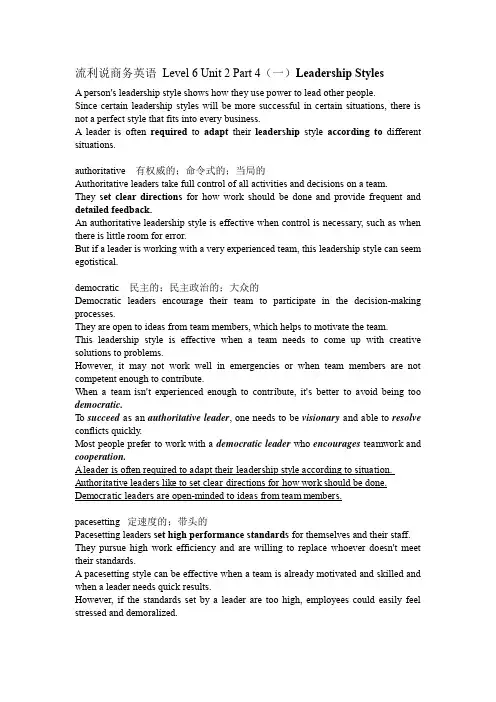
流利说商务英语Level 6 Unit 2 Part 4(一)Leadership StylesA person's leadership style shows how they use power to lead other people.Since certain leadership styles will be more successful in certain situations, there is not a perfect style that fits into every business.A leader is often required to adapt their leadership style according to different situations.authoritative 有权威的;命令式的;当局的Authoritative leaders take full control of all activities and decisions on a team.They set clear directions for how work should be done and provide frequent and detailed feedback.An authoritative leadership style is effective when control is necessary, such as when there is little room for error.But if a leader is working with a very experienced team, this leadership style can seem egotistical.democratic 民主的;民主政治的;大众的Democratic leaders encourage their team to participate in the decision-making processes.They are open to ideas from team members, which helps to motivate the team.This leadership style is effective when a team needs to come up with creative solutions to problems.However, it may not work well in emergencies or when team members are not competent enough to contribute.When a team isn't experienced enough to contribute, it's better to avoid being too democratic.To succeed as an authoritative leader, one needs to be visionary and able to resolve conflicts quickly.Most people prefer to work with a democratic leader who encourages teamwork and cooperation.A leader is often required to adapt their leadership style according to situation. Authoritative leaders like to set clear directions for how work should be done. Democratic leaders are open-minded to ideas from team members.pacesetting 定速度的;带头的Pacesetting leaders set high performance standards for themselves and their staff. They pursue high work efficiency and are willing to replace whoever doesn't meet their standards.A pacesetting style can be effective when a team is already motivated and skilled and when a leader needs quick results.However, if the standards set by a leader are too high, employees could easily feel stressed and demoralized.affiliative 有亲和力的Affiliative leaders regularly encourage their team and like to nurture a sense of belonging in an organization.They help strengthen emotional bonds among team members, which creates a positive atmosphere.Therefore, an affiliative style is effective when team morale is low and needs to be improved.However, a leader should not always use this style because it can create a culture where poor performance will be tolerated.What kind of leaders tend to closely supervise their employees' work? Authoritative What kind of leadership style is the most effective when there's a need of quick results? DemocraticA pacesetting leader puts heavy pressure on team members, which may even affect their physical health.Affiliative leaders like to seek an amicable resolution to tense or difficult situations. Pacesetting leaders are willing to replace whoever doesn't meet their standards.。
leadership style解读
Blake and Mouton’s 管理图表
9
x
轻视工作 重视人 重视工作 重视人
对人的重视
轻视工作 轻视人
重视工作 轻视人
0
9
对工作的重视
4种领导方式
高 高度支持 低度指令 高度支持 高度指令
支持型行为
S3 S2 S4
低度支持 低度指令 低度支持 高度指令 高
S1
低
指令型行为
高度指令型的领导方式
情形领导模式
根据: 员工 工作 情形 的不同采取不同的领导方式,强调的是领 导者的灵活性。
情形领导的3个技能
1、 Flexibility 灵活性 2、 Diagnosis 诊断 3、 Contracting for Leadership 确定领导方式
4只轮胎
精神
情感
大脑
身体
你在的时候怎么样并不重要, 重要的是你不在的时候怎么样!
教 练 型
S4
放 手 型
S1
指 令 型
高
低
发展水平和领导方式
D4
D3
D2
D1
员工发展水平
发展水平
D1 “热情高涨的初学者 (意识不到自己能力弱) D2 “幻想破灭的观望者” (知道自己有能力) “懒于奉献的抵触者” (知道自己有能力) 完美工作表现者 (意识不到自己能力强)
采用领导方式
S1 指令型
Situational LEADERSHIP 情形领 导 方 式
Situational Leadership
由KEN BLANCHARD 和PAUL HERSY博士开发. 适用于各种不同文化背景
助你成为更有效的领导者
构筑强有力的领导班子
领导风格的选择中文
论企业管理者领导风格(leadership styles)的选择Abstract: Based on the comparisons of the advantages and s disadvantage of the two main leadership styles - democratic style and authoritarian style, which highlights that each leadership style has its weakness and strength and cannot be generalized as bad or good. Managers need to consider the impact from the leaders, their subordinates and the environment in the particular situation when they choose the leadership style. And no matter which leadership style the managers may choose, it would be the best as long as it’s appropriate.Keywords:Corporate managers; leadership stylesPeople often ask this question: "What kind of leadership style is the best one?" The subconscious of this question hopes to find the best leadership style and master the complex management practices. To be a wise leader, the actual situation is far more complicated..d能给领导风格简单排序,分出优劣,各种领导风格都有其所长、所短。
Leadership style
1.Authoritarian(专制型的) 1.Authoritarian(专制型的) 专制型的 2.Participative(参与性的 参与性的) 2.Participative(参与性的) 3.Delegative(授权性的 授权性的) 3.Delegative(授权性的)
Good leaders use all three styles, with one of them normally dominant. Bad leaders tend to stick with one style
Participative (democratic)
Keywords:Let's work together to solve this. . . This style involves the leader including employees in the decision making process (determining what to do and how to do it). It is a sign of strength that your employees will respect. This is normally used when you both have some information. Note that a leader is not expected to know everything. Using this style is of mutual benefit .
Unbelievable Difficulties
Franklin Roosevelt has come across with unbelievable difficulties in the proceeding of New Deal. The policy was rejected by the entrepreneurs . entrepreneurs[ˈ ɔntrəprəˈ ə:s]企业家 n
Leadership Styles
Lea ders hip Style sLeadership style is the manner and approach of providing direction, implementing plans, and motivating people. There are normally three styles of leadership (U.S. Army Handbook, 1973) :o Authoritarian or autocratico Participative or democratico Delegative or Free ReignAlthough good leaders use all three styles, with one of them normally dominate, bad leaders tend to stick with one style.A u t h o r i t a r i a n(a u t o c r a t i c)专治管理:This style is used when the leader tells her employees what she wants done and how she wants it done, without getting the advice of her followers. Some of the appropriate conditions to use it is when you have all the information to solve the problem, you are short on time, and your employees are well motivated.没有提前询问成员的意见,当管理者只是告诉成员他们应该怎么做、如何做。
当我们有绝对的信息处理问题、紧急情况下、或者你的成员工作意愿较高时。