
小学英语外研版(三起)四年级下册Module+6+Unit+2+Was+it+a+big+city+then+教案
小学英语外研版(三起)四年级下册
Module 6 Unit 2 Was it a big city then?
教案
教学目标:
使学生能听、说、认识、口头运用单词:tanks, sun, lesson…能理解并口头运用:Was it fat? Was it short?
情感目标:
通过本课的学习,激发学生学习兴趣和动力。
教学重点:
1、认识新单词三会(会说、会听、会读):
thanks 感谢sun 阳光lesson 一节课
2、掌握新句子:两会(会听、会说):
Was it fat? 它胖吗?
Was it short? 它短吗?
教学难点:
理解并口头运用:Was it…?知道如何做简要的介绍。
教学流程:
Class opening
1、Greeting: Hello! /Hi!
New Concepts
1、利用图片引出对话,并对其进行介绍:Was it…? (说出图片),教师可以重复这句话,使学生理解它,如果学生不能明白,教师就多举几个例子,例如:
在学生理解句子的含义后教师试着让学生造句:Was it…? 反复进行几组后就要放手让学生自己来练习了。
教授单词和句子同上述方法。
设计意图:根据年龄特点,用创设情景的方法,直观的将所学内容展示给学生,生动活泼,使学生容易接受新知。
激发学生的学习兴趣。
2、Listen to the tape, and read after it.
设计意图:让学生在模仿练习进一步熟练课文内容,并同时进行听力训练。
3、Play a game.
Memory name。
游戏规则:让几名自告奋勇的学生面对全班站在教室的前面,教师站在这一排学生得一端拿着卡片提问。
设计意图:通过游戏使学生能有亲身体验,并激发他们的学习兴趣,在游戏中轻松愉悦地获得新知。
4、Make a dialogue in groups.
设计意图:使学生在活动中发散思维,并培养他们的合作创新精神,能够运用所学知识进行简单的口语交流,培养自主学习能力。
家庭作业:
根据课文所学内容编对话并熟读课文和单词。
四年级下册英语教案 Module 6 Unit 2 Was it a big city then 外研社(三起)
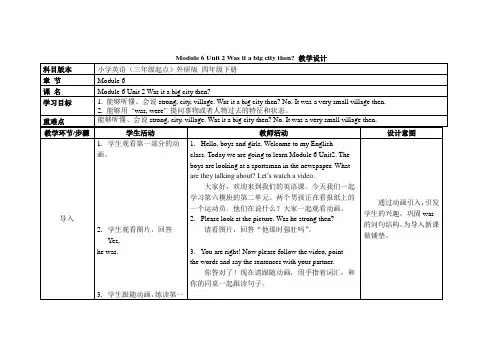
3.逐句听原音,找出问题的答案,分别是:
Shenzhen is a big city now.
No. it was a very small village then.
4.跟读句子。
1.Now please look at this picture. They areour friendsLinglingandAmy. What are they doing?
同学们,还记得可以使用哪些词描述人物或者动物的外貌特征吗?比如说fat, thin, tall, short, young, old, cute and naughty.现在请你看看这些图片里的人物或者动物,他们都长什么样子呢。
2.Great! Everybody,now make new dialogues with your partner according to the pictures.
通过情景展现,学生学说city, village等词汇;学着提问事物过去的性质和状态“Was it a big city then?”,并学会回答。
分步训练
1.练习本课第三部分,学生能够根据图片所提示的信息,说出对应的外貌描述词:
thin, short, naughty, young.
2.两两一组,创编对话。
请看图片认真听。深圳现在什么样子?
Whatwas Shenzhen likethen?Was it a big city? Please listen.
深圳过去什么样子?也是一个大城市吗?请听录音。
4.Great! Now let’s repeat the sentences together.
很棒!现在我们来跟读一下这些句子吧!
四年级下册英语教案Module 6 Unit 2 Was it a big city then∣外研版(三起)
Module 6 Unit 2 Was it a big city then? (教案)其实,任何一门学科都离不开死记硬背,关键是记忆有技巧,“死记”之后会“活用”。
不记住那些基础知识,怎么会向高层次进军?尤其是语文学科涉猎的范围很广,要真正提高学生的写作水平,单靠分析文章的写作技巧是远远不够的,必须从基础知识抓起,每天挤一点时间让学生“死记”名篇佳句、名言警句,以及丰富的词语、新颖的材料等。
这样,就会在有限的时间、空间里给学生的脑海里注入无限的内容。
日积月累,积少成多,从而收到水滴石穿,绳锯木断的功效。
外研社(三起)-四年级英语下册要练说,先练胆。
说话胆小是幼儿语言发展的障碍。
不少幼儿当众说话时显得胆怯:有的结巴重复,面红耳赤;有的声音极低,自讲自听;有的低头不语,扯衣服,扭身子。
总之,说话时外部表现不自然。
我抓住练胆这个关键,面向全体,偏向差生。
一是和幼儿建立和谐的语言交流关系。
每当和幼儿讲话时,我总是笑脸相迎,声音亲切,动作亲昵,消除幼儿畏惧心理,让他能主动的、无拘无束地和我交谈。
二是注重培养幼儿敢于当众说话的习惯。
或在课堂教学中,改变过去老师讲学生听的传统的教学模式,取消了先举手后发言的约束,多采取自由讨论和谈话的形式,给每个幼儿较多的当众说话的机会,培养幼儿爱说话敢说话的兴趣,对一些说话有困难的幼儿,我总是认真地耐心地听,热情地帮助和鼓励他把话说完、说好,增强其说话的勇气和把话说好的信心。
三是要提明确的说话要求,在说话训练中不断提高,我要求每个幼儿在说话时要仪态大方,口齿清楚,声音响亮,学会用眼神。
对说得好的幼儿,即使是某一方面,我都抓住教育,提出表扬,并要其他幼儿模仿。
长期坚持,不断训练,幼儿说话胆量也在不断提高。
【教学目标】“教书先生”恐怕是市井百姓最为熟悉的一种称呼,从最初的门馆、私塾到晚清的学堂,“教书先生”那一行当怎么说也算是让国人景仰甚或敬畏的一种社会职业。
只是更早的“先生”概念并非源于教书,最初出现的“先生”一词也并非有传授知识那般的含义。
外研社(三起)四年级下册英语 Module 6 Unit2 Was it a big city then 课件

1 熟记本节课所学的句型、短语和单词,必须会 听、说、读、写。 2 将Listen and say 的对话朗读流利。 3 完成配套的课后作业。
2. —Is it Shanghai?
—Yes,
A. it was
B
.
B. it is C. it were
3. —Was it a dirty place ?
—Yes, A .
A. it was
B. it is
C. it were
4. —
C
you seven years old then?
—Yes,I ______.
考向: 问句是一个由was 开头的一般过去时态的一般疑问 句,用来确认某人、某物或某地过去的特征。 句型结构: Was / Were + 主语+ 表示特的形容词+ 其他?
肯定回答: Yes,主语+was/were. 否定回答: No,主语+wasn’t/weren’t. 例句: —Was he naughty then? 他那时淘气吗?
Do you know these pictures belong
to which city?
Oh,he’s strong. Was he strong then? Yes,he was.
知识点 1
—Was he strong then? 那时他是强壮的吗?
—Yes,he was. 是的,他是。
The street was old then. It is new now.
Yes,it is.
Is it Beijing?
一、单项选择。
1. — B he old then? . B. Was;wasn’t
四年级下册英语教案:Module6Unit2Wasitabigcitythen∣外研版(三起)
Module 6 Unit 2 Was it a big city then? ( 教课设计 )【教课目的】1.语言目标:(1)学生能听、说、认读词汇: village, fat, thin, slow, fast, win 等。
(2)学生能运用句型: Was it a big city then? Was he strong then? Was it fat? Yes, it was. No, it wasn’t.等。
2.技术目标:(1)学生能在插图的帮助下理解故事的主要内容,朗诵人物的对话。
(2)学生能依据实质状况运用本课时的句型描绘过去的事情与此刻的事情。
3.感情目标:培育学生依据事情的特点进行合理判断的能力。
【教课要点】1.学生能听、说、认读本单元的要点词汇。
2.学生能运用本课时的句型描绘过去的事情与此刻的事情。
【教课难点】学生能在情境中正确划分一般过去时和一般此刻时。
【教课准备】PPT、图片、卡片、人物头饰等。
【教课流程】Step 1 Warming up and Revision1.Greetings. (师生间进行简单的问候。
)T:Good morning, boys and girls!Ss: Good morning, Teacher!T:How are you today?S1: I am fine.用相同的方式问候几个学生。
2. Revision教师利用PPT 体现文本,学生齐读文本,复习上一节课学习的内容。
Step 2 Presentation and Practice一、 Listen, point and say.1. 教师出示该部分图片,发问Q1: What can you see in the picture?学生看图回答: I can see ...2.教师让学生猜猜: What is the man like? 而后播放录音。
学生依据录音回答: He is strong.3.教师发问: Was he strong then? 而后播放录音。
外研版英语四年级下册Module 6 Unit 2 Was it a big city then课件
A. Yes
B. Yes, it is
C. No
选答语
D ( ) 1. Is Hong Kong a big city now? E( ) 2. Was Shenzhen a small village then? B( ) 3. Is the girl thin now? C( ) 4. Was your grandma fat then? A ( ) 5. Where is Lingling?
B ( ) 1.-_____? -Very well, thank you. And you?
A. How old are you B. How are you C. How do you do
C ( ) 2. –Were you _____ school yesterday?.
A. in
B. to
C. at
A ( ) 3. The street ____ old then. It _____ new now.
A. was, is B. is, was C. was, was
C( ) 4.-Was it a big city then?-____. It was a very small village.
Is it Beijing?
Summing up.
重点单词:was, big city, small village, then, now, fat, tall, naughty, young 重点短语:at school, at, home 重点句型:-Was it a big city then?
Where在此作副词,意为“在哪里”,询问地点。 例如:-Where is Li Ming?
-He is on the playground.
外研英语四年级下优质教案:Module6 Unit2 Was it a big city then
Unit2 Was it a big city then? 教学目标:1、掌握重点词汇:village2、学习重点句型:Was it a big city then?Yes, it was. /No, it wasn’t.3、能够运用由Was 引导的一般疑问句及其回答。
教学重点:1、掌握重点词汇:village2、学习重点句型:Was it a big city then?Yes, it was. /No, it wasn’t.教学难点:能够运用由Was 引导的一般疑问句及其回答。
教学准备:多媒体、图片、单词卡教学过程:1. Greeting2. ReviewStep 2: Presentation1. New wordShow a picture of my hometown.T: Look! It’s a small village.(讲授village)2. New sentencesLook at this picture about Shenzhen.T: Is it a big city?S: Yes, it is.T: Now let me guess, was it a big city then? Look at another picture about Shenzhen. (展示出一张过去深圳的照片)S: No, it wasn’t.询问第三人称单数过去怎么样句型:Was +第三人称单数(it/he/she...)+形容词?回答:Yes, it/he/she... was.No, it/he/she... wasn’t.Step 3: Teacher-student interaction1、设计一个游戏环节,Let me guess.可以让学生互相猜一猜自己过去拥有的物品或者家里曾经养过的动物。
2、学唱歌曲<I was fat>。
Step 4: Homework1、将本课重点句型抄写三遍。
外研版(三起)-英语-四年级下册--Moudle6 Unit 2教材同步讲解
Unit 2 Was it a big city then?(第二单元当时它是一座大城市吗?)(教材35~37页)1.Listen,point and say.听一听,指一指,说一说。
(教材第35页)课文英汉互译2.Listen and say.听一听,说一说。
(教材第35页)课文英汉互译朗读参考新词速记village/vilidʒ/n.(名词)乡村,村子短语:in a village在一个村子里例句:It is a small village.它是一个小村子。
即学即用根据汉语提示完成句子There are many trees in the ______ (村子).答案速查:village重难点精析辨析village,town与cityShenzhen is a big city now.深圳现在是一座大城市。
词语辨析village指小的村子、村庄。
例如:There are some small houses in the village.在这个村子里有一些小房子。
town意为“城镇”,比village“村庄”大,但称不上是city。
town一般和country( side)“乡下”相对应。
例如:There is a hospital near the town.在这个城镇附近有家医院。
city指较大的、较重要的城市,但在美国,city用得较广,市镇也称为city。
例如:I like the city. It's very beautiful.我喜欢这座城市。
它很美丽。
即学即用Beijing is a big ______.A. villageB. townC. city答案速查:C3.Point,ask and answer.指一指,问一问,答一答。
(教材第36页)课文英汉互译操作练习4.Listen and say.Then sing.听一听,说一说。
然后唱一唱。
(教材第36页)课文英汉互译5.Ask and answer.问一问,答一答。
四年级下册英语教案Module6Unit2Wasitabigcitythen外研社(三起)
教案Module 6 Unit 2 Was it a big city then 外研社(三起)教学内容:本节课为四年级下册英语Module 6 Unit 2,主题为“Was it a big city then”。
教学内容主要围绕过去时态的疑问句,询问过去某个时间点的城市规模,以及与之相关的回答。
本节课的重点是让学生掌握过去时态的疑问句结构,并能运用所学句型进行询问和回答。
教学目标:1. 让学生掌握过去时态的疑问句结构,并能运用所学句型进行询问和回答。
2. 培养学生的听说能力和合作能力,提高学生的英语交流水平。
3. 培养学生对历史文化的兴趣,拓宽学生的国际视野。
教学难点:1. 过去时态的疑问句结构及其用法。
2. 询问和回答关于过去城市规模的问题。
教具学具准备:1. 多媒体设备,用于播放课件和视频。
2. 教学卡片,用于展示句型和关键词。
3. 学生用书和练习册,用于课堂练习和课后作业。
教学过程:1. 导入a. 老师出示一张现代城市的图片,引导学生描述现代城市的特征。
b. 老师出示一张过去城市的图片,引导学生描述过去城市的特征。
2. 新课展示a. 老师出示句型卡片,引导学生学习过去时态的疑问句结构。
b. 老师播放课件,展示句型的运用实例,引导学生理解句型的用法。
3. 操练a. 学生分组,进行角色扮演,运用所学句型进行询问和回答。
b. 老师巡回指导,纠正学生的发音和语法错误。
4. 巩固a. 老师出示练习题,学生独立完成。
b. 老师公布答案,学生核对并改正错误。
5. 作业布置a. 学生完成练习册上的相关练习。
b. 学生预习下一节课的内容。
板书设计:1. Module 6 Unit 2 Was it a big city then2. 句型:Was it a big city then? Yes, it was./ No, it wasn't.3. 重点词汇:big city, then, was, weren't作业设计:1. 完成练习册上的相关练习。
四年级下册英语教案Module6Unit2 Was it a city then外研版(三起)
Module 6 Unit 2 Was it a big city then?一.教学目标1.能够听,说,认读下列单词:village,was,strong,then,where2.能够使用“Was it a/an +表示事物特征的形容词+事物名称(+其他)”句型来询问某个事物过去是否具有某种特征,并能使用“Yes,it was./No, it wasn’t.”来回答。
3.情感目标:了解我们生活的城市,知道它过去的状况和现在的变化。
二.教学重点1.教授单词:village,strong2.如何使用句型“Was it a/an +表示事物特征的形容词+事物名称(+其他)”3.Be动词的使用:am/ is(was), are(were)三.教学难点1.询问某事物过去的的状态,必须用“Was...”来引导,这样的一般疑问句,回答为“Yes,it was./No, it wasn’t.”四.教学过程Step1: Greeting and Warm upT:Good morning,boys and girls! Nice to see you again. Let’s sing a song.Please turn to page 36 and look at Activity 4.I was fat,but now I’m thin.......T:Great! I’ll divide you into four groups:Group 1,Group2, Group3, Group4. If you did a good job, I’ll give you one star .(在课堂中加入竞争机制,有效管理课堂,并能调动学生参与的积极性)Step2:Lead-inT:Please look at the picture(出示一张南充以前的照片).What’s this?Do you know?S:.....T:It was Nanchong many years ago.Was it a big city then?(用肢体动作做出很大的样子)S:No!T:Good job! No, it wasn’t.Step3:PresentationT:Today,we’re going to learn Module6 Unit2 Was it a big city then? (黑板上板书标题Module6 Unit2 Was it a big city then?)Read after me:Was it a big city then?Was it a big city then?(一边打节拍一边教读)S:Was it a big city then?T:Group1.Was it a big city then?Group1:Was it a big city then?T:One star for you!Group2, ready go!Group2:Was it a big city then?T:Nice job!Two stars for you.T:Please turn to page 35 and look at Activity Two. Let’s listen to the tape and circle the new words.(播放课文音频,让学生跟读,圈出新单词)T:Time’s up!Can you spell the new words?S1:V-I-L-L-A-G-ES2:W-H-E-R-E.....(老师板书新单词在黑板上)T:(出示乡村的照片)Village!Village!(自己教读或者播放音频让学生跟读) S:Village!Village!T:This group, please read it one by one!S1:Village!Village!S2:Village!Village!....T:Who can be a little teacher?S3:Let me try!Village!Village!S:Village!Village!(Use the same way to teach other new words.)T:Well, let’s watch the video and answer these questions:1.Where is he?2.Was Shenzhen a big city then?(播放课文视频,然后小组讨论,勾画答案)T:Stop here!Who wants to try? Where is he?S1:Let me try!He is in Shenzhen.T:Yes or no?S:Yes!T:Big hands for her.And, was Shenzhen a big city then?S2:No,it wasn’t. It was a small village!T:Great!Thank you!Let’s read the passage together.Step4:PracticeT:(出示一只很瘦猫咪的照片)Was it fat then?(做出很胖的动作)S:No.It was thin.T:We can say:No, it wasn’t.Anther question:Was it thin then?S:Yes.T:We can say “Yes, it was.”(黑板上板书重点句型:Was it....? Yes, it was. No, it wasn’t.)T:(出示一个矮个子女孩的照片)Was she tall then?Who wants to try?S1:Let me try. No,she was.T:Big hands for him.Was she short?S2:Yes, she was.(按照这个方法,多做几次练习,让学生学会如何询问和作答)Step5:SummaryT:Today, we have learnt how to ask something with the sentences structure:Was it a/an big/small/fat/thin..+n then?We can answer it:Yes, he/she/it was. No, he/she/it wasn’t.Step6:Homework1.Finish Activity Three.2.Read the passage for ten minutes.3.Write the new words eight times.。
外研版四年级下册英语Module 6 Unit 2-Was it a big city then?Period 1课件
Module 6 Unit 2
Was it a big city then?
那时它是一座大城市吗?
Period 1
Let's chant
Were you at......yesterday? 昨天你在...吗?
肯定:Yes,I was. 否定:No,I wasn’t.
Were you at……? Yes,I was. No, I wasn't.
Listen and say
Listen and answer questions
Where is Lingling’s grandpa? Was Shenzhen a big city then? How about now?
a small village 村庄
1.有表情地朗读,并注意 模仿语音语调。
Yes,he was.
1.有表情地朗读,并注意
模仿语音语调。 2.注意指读哦!
Lingling 正在向Amy 介绍深圳过去与现在的 不同的。 我们来学习学习吧!
Listen and answer questions
Where is Lingling’s grandpa? Was Shenzhen a big city then? How about now?
Let's learn
What are they doing?
They are talking about a man
Listen and answer questions
Was he strong then?
Listen and answer questions
Was he strong then?