
人教版高中英语必修三Unit1Festivalaroundtheworld
China some Western countries
Japan
True or False:
1. The ancient people needn’t worry about their food.
( F)
2. Halloween used to be a festival intended to honor the dead. ( T )
3. Qu Yuan was a great poet who people honor a lot in China. ( T )
4. Mid-autumn Festival is held to celebrate the end of autumn. ( F )
5. Easter celebrates the birth of Jesus.
高中英语课件
madeofcanruohanxing
Unit 5 Festivals around the world
Warming Up & Reading
Step 1 Warming up
Game Time
Let’s guess what the festivals they are!
January 1st of the lunar month
Harvest and Thanksgiving festivals are happy events because the food is g__a_th_e_r_e_d__ for the winter and because a season of a_g_ri_c_u_l_tu_r_a_l work is over, which Mid -autumn festival belongs to. And the most energetic and important festivals are the ones that look forward to the end of winter and to the c_o_m_i_n_g_ of spring, such as the l_u_n_a_r__ New Year, at which people have a very good time.
Harvest/Thanksgiving festivals European and other countries
Mid-autumn festivals
China and Japan
Spring Festivals
Spring Festival Easter and related holidays
Step 2 Pre-reading
Skim the reading passage and fill in the chart on Page3.
Kinds of Festivals
Names of Festivals
Countries
Festivals of the Dead
Festivals to Honour People
1. We eat dumplings with our family. 2. Pay New Year’s call. 3. Give the children gift money in red paper. 4. Dragon dances. 5. Put on new clothes. 6. Put up the Spring Festival couplets. 7. Take photos.
Obon Day of the Dead
Halloween
Dragon Bout Festival Columbus Day
Festival to honour Gandhi
Japan Mexico some Western countries
China USA India
Harvest Festivalhe text by filling the following blanks:
There are all kinds of festivals and c_e_le_b_r_a_t_io_n_s_ around the world, which are held for different reasons. The a_n_c_i_en__t _ _f_e_s_ti_v_a_ls__ were mainly held at three times a year--- the end of the cold weather, planting in spring and harvest in autumn.Some festivals are held to h_o_n_o_r_ the dead or satisfy the a_n_c_e_st_e_r_s in case they might d_o__ _h_a_r_m___, while other festivals are held to honor famous people, such as D_r_a_g_o_n__ _b_o_a_t__ __F_e_st_i_v_a_l _and Columbus Day.
Water-sprinkling Festival
Do you know some foreign festivals? Christmas
Halloween
Easter
Valentine’s Day
Cherry Blossom Festival
Discuss with your partner what we do in Spring Festival.
Homework:
• Read the text further and finish comprehending exercises and language exercises after it.
• Write down your new festival.
Game Time
January 15th of the lunar month
September 9th of the lunar month
October 1st
September 10th
April 1st
May 5th of the lunar month
May 1st
Around April 4th to 6th
February 14th
August 15th of the lunar month
July 7th of the lunar month
Qiqiao?Festival
Dragon Bo?at Festival
Tomb Swe?eping Day
Mid-autu?mn Day
Lantern?Festival
人教版高中英语必修三Unit1Festivalsaroundtheworld
人教版必修三Unit 1 Festivals around the world智慧课堂中“节日”话题的词汇教学设计Lesson Plan●教材分析Teaching material analysis:本节词汇复习课紧扣人教版必修3,Unit1 “节日”话题——“Festivals around the world”,利用自选课外篇章An interesting festival学习和复习有关节日和民俗的词汇和表达,如origin, take place, reunion, religious,take place等。
引导学生发现英语词汇中的词缀,以此帮助了解不同的词性构成法,并有意识地应用该方法扩大词汇量。
利用本校引进的“慧学云”智能授课交互系统进行针对性的训练。
最后,鼓励学生利用所学词汇和表达,创设任务情景,请学生分享/创造重要/有趣的节日。
本课坚持“词不离句,句不离篇”的词汇学习原则,把词汇放到具体的语境中学习,并通过不同方式进行训练,让学生理解、记忆、复习与巩固与节日相关的词汇和表达。
同时,教会学生如何通过前缀和后缀进行词汇学习和拓展。
本课结合布鲁姆的认知目标分类,在教学中注重记忆、理解、应用、分析/评价、创造层层递进的教学环节,实现教学目标。
●学情分析Students analysis:高一(12)班是年级的重点班,同学对英语学习的热情较高,大部分同学在课堂上专注学习,但是课后未能有效运用所学的词汇和表达。
同时,他们对于单词的记忆方法不够科学,大部分限于拼读和生硬的记忆背诵。
此外,学生初步具有利用多媒体技术进行学习和动手实践的能力,具备一定的小组合作精神。
●教学目标Teaching aims:1. 语言知识和技能方面:1) 通过学习,学生能够对了解和掌握与“节日”话题相关的词汇和表达;2)学生能学以致用,应用所学词汇介绍中西方一些重要节日和民俗;3)学生能根据词缀构词法改善词汇学习和记忆单词的方法。
Unit 1 Festivals around the World 教学设计(英语人教版高中必修3)

Unit 1 Festivals around the WorldThe reading passage entitled FESTIV ALS AND CELEBRATIONS briefly describes the origins of different festivals, and then introduces four kinds that are celebrated in most parts of the world. It is important for students to appreciate the values of festivals and learn to attach importance to their culture. Through comparison and contrast, students will be able to evaluate their own culture aswell as exotic culture, keep uptheir own advantages and learn from others, thus cultivating an international outlook.1. Knowledge Objectives:(1)Students know the origins of different festivals.(2)Students learn about history and basic knowledge of festivals both at home and abroad.2. Skill Objectives:(1) Students can practice their reading ability and learn different reading skills.(2) Students can express ideas about festivals and how people celebrate these different festivals.3. Emotional Attitude and Values:(1) Students can get familiar with the origins of festivals both at home and abroad.(2) Students can develop love for their own national culture and customs.(3) Students also can develop the sense of gratitude.4. Learning Strategies:Students can use reading skills to collect and analyze the significant information in the text. They can also work with their partners or work in groups to practice.5. Cross-culture Awareness:Students will cultivate an international outlook through comparison and contrast.Teaching Important Points:1. Students learn more about history and basic knowledge of festivals.2. Students learn different reading skills.Teaching Difficult Points:1. Students enhance their reading ability.2. Students can talk about festivals and celebrations.3. Students will fully understand and keep up the values of festivals.Teaching MethodsElicitation, discussion, listening, group workTeaching AidsA computer, a blackboardStep1 Warming upPlay a guessing game. Try to guess what festival it is.Step2 Fast Reading1.Choose the right main idea for each part.Part1. (Para.1) ___________Part2. (Para.2-5) ___________Part3. (Para.6) ___________A. Different kinds of festivals around the worldB. The reasons why people celebrate the festivalsC. The origins of the festivals2. Fill in the blanksTo day’s festivals have many________:some ________,some ________,some ____________________________.Match the origins with the examples.Step3 Careful Reading1. Festivals of the DeadComplete the table.2. Festivals to Honor PeopleWho are mentioned in this part?3. Harvest Festivals & Spring FestivalsDo a True or False.Only China has mid-autumn festival.Spring festivals are the ones that look forward to the end of winter and to the coming of spring. There are dragon boat race and carnivals at the Spring Festivals in China.4. The Last ParagraphWhy do people celebrate festivals?Step4 ConsolidationThere are all kinds of festivals and ___________ (celebrate) around the world. Some festivals are held to ________ the dead or satisfy the _________(ancestor) in case they might return either to help or to do _______, while other festivals are _______ ( hold ) to honor famous people. Harvest and Thanksgiving festivals are happy events because the food is _________ (gather) for the winter and the __________ (agriculture) work is over. And the most __________ (energy) and important festivals are the ones that look ________ to the end of winter and to the ________ (come) of spring.Step5Language points1.Festivals are meant to celebrate important times of year. mean: 1) 打算,意欲mean+ n/ pron/ to soHe means what he says.He means to cause trouble.2) be meant for“打算给予;打算作……用”。
【教育资料】人教版高中英语必修三:Unit1-Festivals-around-the-world-
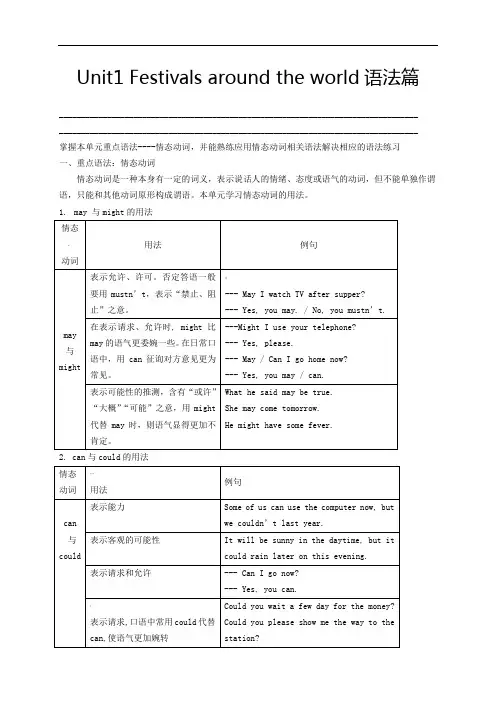
Unit1 Festivals around the world语法篇____________________________________________________________________________________________________________________________________________________________________掌握本单元重点语法----情态动词,并能熟练应用情态动词相关语法解决相应的语法练习一、重点语法:情态动词情态动词是一种本身有一定的词义,表示说话人的情绪、态度或语气的动词,但不能单独作谓语,只能和其他动词原形构成谓语。
本单元学习情态动词的用法。
1.may 与might的用法2. can与could的用法…3. will与would的用法4.shall与should的用法5. must, may (might) 和can表示“推测”的用法6.should与ought to用法;7.need与dare用法ed to与would用法例1.(2019北京卷27.)________ I have a word with you? It won’t take long.A. CanB. MustC. ShallD. Should解析:本题考察的是情态动词基本意义辨析。
can能够,可能;must必须,一定;非得;shall将要;:should应该;句意:我可以和你谈谈吗?不会花很多时间的。
根据句意可知本题使用Can I…?表示询问对方是否允许。
如:Can I use your dictionary? 我可以使用你的字典吗?答案:A。
例2.(2019大纲卷)30. Although you _____ find bargains in London, it’s not generally a cheapplace to shop.A. shouldB. needC. mustD. can解析:should应该,竟然;need需要;must必须,一定;非得,偏偏;can能够,可能,有时会…;根据句意“尽管你有时可能会在伦敦找到便宜货,但总得说来那不是一个购物的便宜的地方。
人教版高一英语必修三Unit1Festivals around the world教案设计

二.教学目标 1. Students can talk about the types and origins of different festivals. 2. Students can talk about their favorite festivals.
三.教学重难点 The important points: 1. Students can summarize the main idea and find out detailed information by scanning and skimming. 2. Students can learn more about different types of festivals. The difficult points: 1. Students can use their own words to introduce their favorite festivals.
人教版高一英语必修三 Unit1Festivals around the world 教案设计
教学设计
课文标题: 单元名称: 教材版本: 授课年级:
Festivals And Celebrations Unit 1 Festivals around the world New Senior English for China Student’s Book3 Grade Two
Step2.Reading
. Ask the students to find out the subtitles, fill in
the blanks and analysis the text.
Students can find
out the subtitles
人教版高中英语必修3 unit1 Festivals around the world 课件

Mexico
Halloween
western countries
Dragon Boat Festival
China
Festivals to Honor People
Columbus Day
USA
Festival to Honor Gandhi
India
Harvest Festivals
Thanksgiving
Unit 1 Festivals around the world
Spring Festival Christmas
Unit 1 Festivals around the world
Tibetan New Year
Unit 1 Festivals around the world
Task 1
Scanning
Easter and some western
carnivals
countries
Cherry Blossom Japan Festival
Kinds of Festivals
Names of Festivals
Countries
Obon
Japan
Festivals of the Dead
Day of the Dead
A. 生病 B. 发疯
C. 受伤 D. 挨饿
2.Which one is used to honour someone?
A. Spring Festival
B. Thanksgiving
C. Dragon Boat Festival
D. Mid-autumn Day
3. Which of the following is not mentioned?
人教版高中英语必修三 Unit 1 Festivals around the world Rea教案

Festival around the world------(必修3 unit 1 人教新课标)课型:阅读课新授课课时:40mins一,教材分析和教材重组(一)教材分析本单元以节日为话题,介绍了世界各地的一些节日、含义、由来和民俗。
通过本单元的学习,可以帮助学生更多地了解节日、体味文化;同时又能教育学生理解、尊重不同的文化和习俗。
通过本单元的语言技能训练,要求学生学会使用请求以及感谢的表达法。
1. Warming Up 要求学生以小组活动的形式列出中国的节日和这些节日的时间、庆祝的内容以及节日里人们的所作所为。
激发学生的阅读兴趣,为本单元Reading部分的世界节日做好铺垫。
2. Reading 由五篇小短文组成,分别介绍古代节日、亡灵节、纪念名人的节日、丰收节和春天的节日等,使学生了解节日的由来及其存在的意义。
最古老的节日主要庆祝冬天的结束,春天的播种,秋天的收获等。
鬼节是为祭奠亡灵,取悦祖先而举行的节日,例如日本的盂兰盆节(Obon),墨西哥的亡灵节,万圣节(Halloween)等。
纪念名人的节日有中国的端午节,美国的哥伦布日,印度的甘地纪念日。
春天的节日包括中国的春节,西方的狂欢节、复活节,日本的樱花节。
3. Comprehending 第一部分提出的5个问题让学生对所读文章有一个浅层理解。
第二部分要求学生结合所读文章和自己的想法讨论自己最喜欢的节日,教师则呈现一些有用的短语。
(二)教材重组1.将Warming Up,Reading与Comprehending整合在一起上一节“阅读课”。
(三)教学目标:知识与技能:1, Get students to learn new words and expressions in this unit;2, Let students learn to make phone call and invitations and thanks;3, Learn different culture and respect them.4, Develop students’ listening, speaking reading and writing skills.情感目标1, Stimulate students’ love for their own national culture and custom;2, Develop students’ sense of cooperative learning.(四)学情分析:Many students are very familiar with Chinese traditional festivals. They can list many different festivals of our country and foreign countries. According their own experience, I will list many kin ds of different festivals and tell them how to speak them in English.(五)教学重难点教学重点:1, have students learn some useful new words and expression about festivals2, let students learn some reading skills.教学难点:1, let them master the using skill of reading.2, let students learn to write and describe different festivals especially their favorite festival.Part 1: Teaching Design(第一部分:教学设计)Period 1: FESTIVALS AND CELEBRATIONSAims:To help students develop their reading abilityTo help students learn about festivalsProcedures:I. Warming upWarming up by discussingGood morning, class. Today we are going to read about FESTIVALS AND CELEBRATIONS. But first, what kind of festival did we just celebrate? I’d like to hav e you work in groups and list some Chinese festivals that you know. When do they take place? What do they celebrate? And what do people do at that time?Warming up by watchingHi, every one. Nowadays, foreign festivals are more and more popular in China. Can you list some? Look at the photos and let’s see some pictures and guess.Some Western FestivalsValentine’s Day , February 14 情人节April Fool’s Day, April 1 愚人节Mother’s Day 母亲节Father’s Day 父亲节Halloween , October 31 万圣节Easter 复活节Thanksgiving Day 感恩节Labor’s Day 劳动节Christmas Day, December 25 圣诞节II. Pre-reading1. Imagining and sharingHello! Now you can celebrate everyday!Everyday is a holiday. Imagine somewhere someone is celebrating right now. Our world is filled with mystical celebrations and powerful memories. Come and tell the class what holiday it is today.2. Talking and sharingWork in groups of four. Tell your group mates what festivals or celebrations you enjoy in your city or town.However, how do people around the world celebrate their festivals?III. Reading1.Fast readingSkim the reading passage and then fill in the following chart.Festivals Names of Festival CountriesFestivals of theDead2. Careful ReadingNext you are to read and tell your classmates the five sentences true or false.▪The ancient people needn’t worry about their food.▪People celebrate Halloween with a different purpose from the past.▪Gandhi was a great leader who Indian people honor a lot.▪China and Japan share the same custom of celebrating Mid-Autumn Festival.▪Easter just celebrates the rebirth of Jesus.3. ComprehensionUse the information from the passage to answer the questions.1.What are festivals of the dead usually for?2.What makes autumn festivals happy events?3.What do people usually do at spring festivals?4.What is one important reason to have festivals and celebrations?pare the festivals of the dead in Mexico, Japan and China. What things aresimilar? What things are different?IV. DiscussingMy favourite festival◆What is your favourite festival? Why?◆When is it?◆What is the festival about?◆How long can we have it for holiday?◆What do we usually do in the festival?Suggested expressions:I like … festival best. It is celebrated on …. to remember/ in memory of …. It usually lasts … days. People do ….V. Homework1.Listen to your tape and read the text again.2.Try to retell the text with only a few sentences.3.Finish exercises on Page4.。
人教版高中英语必修三Unit1Festivalsaroundtheworld课文知识点解析
happy memories of his stay in London
对在伦敦幸福的记忆
8.lead the ancestors back to earth
把祖先带回到地球
lead sb. to...把某人带到……
e.g. He led us to his home.
plenty n./pron. 足够;大量
e.g. years of peace and plenty 太平丰收年
There is plenty of room in my bag.
我包里还很空。
6.Some festivals are held to honor the dead,or satisfy and please the ancestors,who could return either to help or do harm.
一些人可能因为他们的动物,花,果实和蔬菜而赢得奖品。
award[C] n. 评价 报酬 奖品
e.g.He has won the best actor award.
他已经获得了最佳男演员奖。
19.In China and Japan there are mid-autumn festivals,when people admire the moon and give gifts of mooncakes.
People mean festivals to celebrate important events.
(1)mean vt. mean sb. or sth. to do sth.=intend sb. or sth. to do sth.
新人教版必修三-Unit-1-Festival-around-the-world[教案]
第一单元Reading Festivals and celebrations 教案1. 教学设计理念语言的学习离不开文化,英语教学从某种程度上来讲就是文化教学,对英语文化的了解和理解有利于加深本国文化的学习,培养爱国主义精神,也有利于提高人文素养。
因此传授文化知识、培养文化意识和世界意识,是英语教学中一个非常重要的任务。
①运用任务型语言教学模式,训练培养学生对语言的综合运用能力.②课堂以学生为主体,以任务为主线,重视体验参与,教师起到“设计者、研究者、促进者、协调者”的作用.③在教学中,突出交际性,注重读写的实用性,要进行情感和策略调整,以形成积极的学习态度,促进语言实际运用能力的提高.④正视个体差异,倡导过程激励,以多层次、多角度、多主体的结果与过程并重的评价方式激励学生进步.2. 教材分析本单元以节日为话题,介绍古今中外节日的种类、由来、意义以及人们的活动和习俗,旨在通过对世界各地的节日名称、由来及庆祝方式的讨论和学习,让学生在多样的东西方节日、文化中进行比较,并发现节日文化的共性、多样性和民族独特性,从而增进对多种文化节日的理解,进而拓展社会文化背景、增加跨国文化知识.3. 教学目标①帮助学生了解世界各地的节日.②了解节日的分类并进而理解节日庆祝的意义.③通过阅读材料继续训练学生略读,细读,猜测词义,归纳等阅读技巧.4. 重难点①理解节日的起源及意义,增强文化保护意识②通过学生对多样的东西方节日、文化所进行的比较,发现节日文化的共性、多样性和民族独特性,从而增进对多种文化节日的理解。
5. 教学步骤Unit 1 Festivals around the worldLearning aims : 1.learn about festivals around the world.2. learn about the kinds of festivals and the reason for celebrating them.3. train reading skills such as skimming and summarizing.Difficult points : the reason for peopke’s celebrating festivalsStep 1 Warming up1.What other traditional festivals in China do you know ?______________________________________________________________2.What festivals of foreign countries do you know?______________________________________________________________ Step 2 ReadingII.Careful reading2). Festivals to Honour People (Match the person with the festival.)1. Qu Y uan a. the Dragon Boat Festival2. Christopher Columbus b. an Indian national festival on Oct. 23. Mohandas Gandhi c. Columbus Day3). Harvest Festivals (Choose the best answer.)Many activities can be held in harvest festivals EXCEPT that people ___.A. get together to have mealsB. decorate houses to admire the moonC. win awards for their farm produceD. enjoy mooncakesTask 2 True or False1. The ancient people needn’t worry about their food.2. Halloween used to be a festival to honor the dead.3. Qu Y uan was a great poet who people honor a lot in China.4. Mid-autumn Festival is held to celebrate the end of autumn.5. Easter celebrates the birth of Jesus.Task 3 Answer the questions1.What are festivals of the dead usually for?2. What makes autumn festivals happy events?3. What do people usually do at spring festivals?4. What is one important reason to have festivals and celebrations?III. Free talkingWhat do most festivals seem to have in common ?Step 3 Discussing◆What is your favourite festival? Why?◆When is it? What is the festival about?◆How long can we have for holiday? What do we usually do in the festival? Step 4HomeworkWrite a short passage about your favorite festival。
人教版高中英语必修三《Unit 1 Festivals around the world》 reading课件(课文重点词句讲解)
7. The festival of Halloween had its origin as an event in memory of the dead. 万圣节前夕的盛会也是源自纪念亡 者的祭事。 origin n. 起源;源头 the origins of the life on earth 地球上生命的起源。
讨论它们(中国节日)什么时间进行, 庆祝的是什么事件,并说出人们在那天 所做的一件事。
take place 发生;举行
① The performance didn’t take place after all.
演出终于没有进行。
② Was there anybody passing by when the accident took place?
4). mean 后接名词、副词或从句 mean 后接名词或副词,意为“表
示;打算;存心”等意思;后接that 从句,意为“表示……”。
5). be meant for 该短语的意思是“打算给予;打算
作……用”。
In some parts of London, missing a
bus means _____ for another hour.
= You can see animals of different kinds in the zoo. 你在动物园可以看见不同种类的动物。
Practice (用动词的适当形式填空)
① Books of this kind _s_e_ll_ (sell) well in the bookstore. ② This kind of books _s_el_ls_ (sell) well in the bookstore. ①句中谓语动词的单复数由“books”确 定。②句中的谓语动词由“kind”确定。
高一英语人教版必修3 unit 1Festivals around the world
Brainstorming
How many festivals do you know in China?
In China
The Spring Festival
The Double Ninth Festival
Spring Festivals: Fill in the blanks.
Festivals Spring Festival Carnivals
Activities Eating good foods; giving children
_lu_c_k_y_ money; _d_r_a_g_o_n__ _d_a_n_c_e_s__ and
To honor Ganhdi who helped gain Indian’s independence from Britain.
4. How do Europeans celebrate Thanksgiving festivals?
Decorate churches and town halls with flowers and fruits; people get together to have meals.
Festivals Activities
Obon
The Day Halloween
of the Dead
Cleaning Eating
Children
_g_r_a_v_e_s; cakes with _d_r_es_s__u_p
lighting _b_o_n__e_s on _i_n_c_en__se_ them; and lamps; offering