
(完整word版)英国文学(刘炳善版)作家作品一览表
The Great Tragedies:The Tragedy of Hamlet哈姆雷特/王子复仇记; Othello奥塞罗King Lear李尔王; The Tragedy of Macbeth麦克白;
Christopher Marlowe克里斯托夫。马洛
Tamburlaine铁木耳大帝Dr.Faustus浮士德的悲剧The Jew of Malta马耳他的犹太人The Passionate Shepherd多情的牧羊人致情人
William Shakespeare莎士比亚1564-1616
The Tempest暴风风雨;The Two Gentlemen of Veronaz维罗纳二绅士;The Mercy Wives of Windsor温莎的风流妇人;Measure for Measure恶有恶报;The Comedy of Errors错中错;Much Ado about Nothing无事自扰;Love’s Labour’s Lost空爱一场;A Midsummer Night’s Dream仲夏夜之梦;The Merchant of Venice威尼斯商人;As You Like It如愿;The Taming of the Shrew驯悍记;All’s Well That Ends Well皆大欢喜;Twelfth Night第十二夜;The Winter’s Tale冬天的故事;The Life and Death of King John/Richard the Second/Henry the Fifth/Richard the Third约翰王/理查二世/亨利五世/理查三世;The First/Second Part of King Henry the Fourth亨利四世(上、下);The First/Second/Third Part of King Henry the Sixth亨利六世(上、中、下);The Life of King Henry the Eighth亨利八世;Troilus and Cressida脱爱勒斯与克莱西达;The Tragedy of Coriolanus考利欧雷诺斯;Titus Andronicus泰特斯·安庄尼克斯;Romeo and Julet罗密欧与朱丽叶;Timon of Athens雅典的泰门;The Life and Death of Julius Caesar;朱利阿斯·凯撒;The Tragedy of Macbeth麦克白;The Tragedy of Hamlet哈姆雷特/王子复仇记;King Lear李尔王;Othello奥塞罗;Antony and Cleopatra安东尼与克利欧佩特拉;Cymbeline辛白林;Pericles波里克利斯;Venus and Adonis维诺斯·阿都尼斯;Lucrece露克利斯;The Sonnets十四行诗
Part 2. The English renaissance
Thomas More托马斯。莫尔
Utopia乌托帮
Philip Sidney菲力普。锡德尼
Astrophel and Stella Apology for Poetry诗辩
Edmond Spenser埃德蒙。斯宾塞
The Faerie Queene仙后The Shepherds’s Calender牧羊人日历
L‘Allegro欢乐的人;Il Penseroso沉思的人;Comus科马斯;Lycidas列西达斯;Areopagitica论出版自由;Pro Populo Anglicano Defense为英国人民声辩; Pro Populo Anglicano Defense Secunda再为英国人民声辩;Paradise Lost失乐园;Paradise Regained复乐园;Samson Agonistes力士参孙
Piers the Plowman耕者皮尔斯
Geoffrey Chaucer杰佛利·乔叟1340-1400
长诗:The House of Fame声誉之堂;Troilus and Criseyde特罗勒斯与克丽西德
小说:Canterbury Tales坎特伯雷故事集----英国文学史上现实主义第一部杰作
(他是最早有人文主义思想的作家,现实主义文学的奠基人)
his contribution to English poetry: introduced fromfrancethe rhymed couplet of 5 accents in iambic meter (the heroic couplet), is the first great poet who wrote in the English language. Who making the dialect ofLondonthe standard for the modern English speech.
英国文学
Part 1. Old and medieval
Beowulf贝尔武甫(the national epic of the English people) stricking feature: alliteration, metaphors and understatements.
William Langland威廉。兰格伦
The Later Comedies(romances):Pericles波里克利斯; Cymbeline辛白林; The Winter’s Tale冬天的故事; Theห้องสมุดไป่ตู้Tempest暴风风雨;
Part 3. The English Bourgeois revolution period
John Milton约翰·弥尔顿1608-1674
Francis Bacon培根1561-1626
Advancement of Learning学术的进展;Novum Organum新工具;New Atlantic新大西岛;Essays论文集(Of Studies论学习;Of Wisdom for a Man’s Self)
The founder of English materialist philosophy
英国文学史刘炳善版

Christopher Marlowe克里斯托夫。马洛
Tamburlaine铁木耳大帝Dr.Faustus浮士德的悲剧The Jew of Malta马耳他的犹太人The Passionate Shepherd多情的牧羊人致情人
William Shakespeare莎士比亚1564-1616
The Tempest暴风风雨;The Two Gentlemen of Veronaz维罗纳二绅士;The Mercy Wives of Windsor温莎的风流妇人;Measure for Measure恶有恶报;The Comedy of Errors错中错;Much Ado about Nothing无事自扰;Love’s Labour’s Lost空爱一场;A Midsummer Night’s Dream仲夏夜之梦;The Merchant of Venice威尼斯商人;As You Like It如愿;The Taming of the Shrew驯悍记;All’s Well That Ends Well皆大欢喜;Twelfth Night第十二夜;The Winter’s Tale冬天的故事;The Life and Death of King John/Richard the Second/Henry the Fifth/Richard the Third约翰王/理查二世/亨利五世/理查三世;The First/Second Part of King Henry the Fourth亨利四世(上、下);The First/Second/Third Part of King Henry the Sixth亨利六世(上、中、下);The Life of King Henry the Eighth亨利八世;Troilus and Cressida脱爱勒斯与克莱西达;The Tragedy of Coriolanus考利欧雷诺斯;Titus Andronicus泰特斯·安庄尼克斯;Romeo and Julet罗密欧与朱丽叶;Timon of Athens雅典的泰门;The Life and Death of Julius Caesar;朱利阿斯·凯撒;The Tragedy of Macbeth麦克白;The Tragedy of Hamlet哈姆雷特/王子复仇记;King Lear李尔王;Othello奥塞罗;Antony and Cleopatra安东尼与克利欧佩特拉;Cymbeline辛白林;Pericles波里克利斯;Venus and Adonis维诺斯·阿都尼斯;Lucrece露克利斯;The Sonnets十四行诗
刘炳善《英国文学简史》完整版笔记(免费)

刘炳善《英国文学简史》完整版笔记(免费)英国文学简史完全版A Concise History of British LiteratureChapter 1 English Literature of Anglo-Saxon PeriodI. Introduction1. The historical background(1)Before the Germanic invasion(2)During the Germanic invasiona. immigration;b. Christianity;c. heptarchy.d. social classes structure: hide-hundred; eoldermen (lord)– thane - middle class (freemen)- lower class (slave or bondmen: theow);e. social organization: clan or tribes.f. military Organization;g. Church function: spirit, civil service, education;h. economy: coins, trade, slavery;i. feasts and festival: Halloween, Easter; j. legal system.2. The Overview of the culture(1)The mixture of pagan and Christian spirit.(2)Literature: a. Poetry: two types; b. prose: two figures.II. Beowulf.1. A general introduction.2. The content.3. The literary features.(1)the use of alliteration(2)the use of metaphors and understatements(3)the mixture of pagan and Christian elementsIII. The Old English Prose1. What is prose?2.figures(1)The Venerable Bede(2)Alfred the GreatChapter 2 English Literature of the Late Medieval Ages I.Introduction 1. The Historical Background.(1)The year 1066: Norman Conquest.(2)The social situations soon after the conquest.A. Norman nobles and serfs;B. restoration of the church.(3)The 11th century.A. the crusade and knights.B. dominance of French and Latin;(4)The 12th century.A. the centralized government;B. kings and the church (Henry II and Thomas);(5)The 13th century.A. The legend of Robin Hood;B. Magna Carta (1215);C. the beginning of the ParliamentD. English and Latin: official languages (the end)(6)The 14th century.a. the House of Lords and the House of Commons—conflict between the Parliament and Kings;b. the rise of towns.c. the change of Church.d. the role of women.e. the Hundred Years' War—starting.f. the development of the trade: London.g. the Black Death.h. the Peasants' Revolt—1381.i. The translation of Bible by Wycliffe.(7)The 15th century.a. The Peasants Revolt (1453)b. The War of Roses between Lancaster and Yorks.c. the printing-press—William Caxton.d. the starting of Tudor Monarchy(1485)2. The Overview of Literature.(1)the stories from the Celtic lands of Wales and Brittany—great myths of the Middle Ages.(2)Geoffrye of Monmouth—Historia Regum Britanniae—King Authur.(3)Wace—Le Roman de Brut.(4)The romance.(5)the second half of the 14th century: Langland, Gawin poet, Chaucer.II. Sir Gawin and Green Knight.1. A general introduction.2. The plot.III. William Langland.1. Life2. Piers the PlowmanIV. Chaucer1. Life2. Literary Career: three periods(1)French period(2)Italian period(3)master period3. The Canterbury TalesA. The Framework;B. The General Prologue;C. The Tale Proper.4. His Contribution.(1)He introduced from France the rhymed stanza of various types. (2)He is the first great poet who wrote in the current English language. (3)The spoken English of the time consisted of several dialects, and Chaucer did much in making the dialect of London the standard for the modern English speech.V. Popular Ballads.VI. Thomas Malory and English ProseVII. The beginning of English Drama.1. Miracle Plays.Miracle play or mystery play is a form of medieval drama that came from dramatization of the liturgy of the Roman Catholic Church. It developed from the 10th to the 16th century, reaching its height in the 15th century. The simple lyric character of the early texts was enlarged by the addition of dialogue and dramatic action. Eventually the performance was moved to the churchyard and the marketplace.2. Morality Plays.A morality play is a play enforcing a moral truth or lesson by means of the speech and action of characters which are personified abstractions –figures representing vices and virtues, qualities of the human mind, or abstract conceptions in general.3. Interlude.The interlude, which grew out of the morality, was intended, as its name implies, to be used more as filler than as the main part of an entertainment. As its best it was short, witty, simple in plot, suited for the diversion of guests at a banquet, or for the relaxation of the audience between the divisions of a serious play. It was essentially an indoors performance, and generally of an aristocratic nature.Chapter 3 English Literature in the Renaissance I.A Historical BackgroundII. The Overview of the Literature (1485-1660)Printing press—readership—growth of middle class—trade-education for laypeople-centralization of power-intellectual life-exploration-new impetus and direction of literature.Humanism-study of the literature of classical antiquity and reformed education.Literary style-modeled on the ancients.The effect of humanism-the dissemination of the cultivated, clear, and sensible attitude of its classically educated adherents.1. poetryThe first tendency by Sidney and Spenser: ornate, florid, highly figuredstyle.The second tendency by Donne: metaphysical style—complexity and ingenuity.The third tendency by Johnson: reaction——Classically pure and restrained style.The fourth tendency by Milton: central Christian and Biblical tradition.2. Dramaa. the native tradition and classical examples.b. the drama stands highest in popular estimation: Marlowe –Shakespeare – Jonson.3. Prosea. translation of Bible;b. More;c. Bacon.II. English poetry.1. Sir Thomas Wyatt and Henry Howard (courtly makers)(1)Wyatt: introducing sonnets.(2)Howard: introducing sonnets and writing the first blank verse. 2. Sir Philip Sidney—poet, critic, prose writer(1)Life:a. English gentleman;b. brilliant and fascinating personality;c. courtier.(2)worksa. Arcadia: pastoral romance;b. Astrophel and Stella (108): sonnet sequence to Penelope Dvereux—platonic devotion.Petrarchan conceits and original feelings-moving to creativeness—building of a narrative story; theme-love originality-act of writing.c. Defense of Poesy: an apology for imaginative literature—beginning of literary criticism.3. Edmund Spenser(1)life: Cambridge - Sidney's friend - “Areopagus” –Ireland - Westminster Abbey.(2)worksa. The Shepherds Calendar: the budding of English poetry in Renaissance.b. Amoretti and Epithalamion: sonnet sequencec. Faerie Queen:l The general end——A romantic and allegorical epic—steps to virtue.l 12 books and 12 virtues: Holiness, temperance, justice and courtesy.l Two-level function: part of the story and part of allegory (symbolic meaning)l Many allusions to classical writers.L Themes: puritanism, nationalism, humanism and Renaissance Neoclassicism—a Christian humanist.(3)Spenserian Stanza.III. English Prose1. Thomas More(1)Life: “Renaissance man”, scholar, statesman, theorist, prose writer, diplomat, patron of artsa. learned Greek at Canterbury College, Oxford;b. studies law at Lincoln Inn;c. Lord Chancellor;d. beheaded.(2)Utopia: the first English science fiction.Written in Latin, two parts, the second—place of nowhere.A philosophical mariner (Raphael Hythloday)tells his voyages in which he discovers a land-Utopia.a. The part one is organized as dialogue with mariner depicting his philosophy.b. The part two is a description of the island kingdom where gold and silver are worn by criminal, religious freedom is total and no one owns anything.c. the nature of the book: attacking the chief political and social evils ofhis time.d. the book and the Republic: an attempt to describe the Republic in a new way, but it possesses an modern character and the resemblance is in externals.e. it played a key role in the Humanist awakening of the 16th century which moved away from the Medieval otherworldliness towards Renaissance secularism.f. the Utopia(3)the significance.a. it was the first champion of national ideas and national languages; it created a national prose, equally adapted to handling scientific and artistic material.b. a elegant Latin scholar and the father of English prose: he composed works in English, translated from Latin into English biography, wrote History of Richard III.2. Francis Bacon: writer, philosopher and statesman(1)life: Cambridge - humanism in Paris – knighted - Lord Chancellor – bribery - focusing on philosophy and literature.(2)philosophical ideas: advancement of science—people: servants and interpreters of nature—method: a child before nature—facts and observations: experimental.(3)“Essays”: 57.a. he was a master of numerous and varied styles.b. his method is to weigh and balance maters, indicating the ideal course of action and the practical one, pointing out the advantages and disadvantages of each, but leaving the reader to make the final decisions. (arguments)IV. English Drama1. A general survey.(1)Everyman marks the beginning of modern drama.(2)two influences.a. the classics: classical in form and English in content;b. native or popular drama.(3)the University Wits.2. Christopher Marlowe: greatest playwright before Shakespeare and most gifted of the Wits.(1)Life: first interested in classical poetry—then in drama.(2)Major worksa. Tamburlaine;b. The Jew of Malta;c. The Tragical History of Doctor Faustus.(3)The significance of his plays.V. William Shakespeare1. Life(1)1564, Stratford-on-Avon;(2)Grammar School;(3)Queen visit to Castle;(4)marriage to Anne Hathaway;(5)London, the Globe Theatre: small part and proprietor; (6)the 1st Folio, Quarto;(7)Retired, son—Hamlet; H. 1616.2. Dramatic career3. Major plays-men-centered.(1)Romeo and Juliet——tragic love and fate(2)The Merchant of Venice.Good over evil.Anti-Semitism.(3)Henry IV.National unity.Falstaff.(4)Julius CaesarRepublicanism vs. dictatorship.(5)HamletRevengeGood/evil.(6)OthelloDiabolic characterjealousygap between appearance and reality.(7)King LearFilial ingratitude(8)MacbethAmbition vs. fate.(9)Antony and Cleopatra.Passion vs. reason(10)The TempestReconciliation; reality and illusion.3. Non-dramatic poetry(1)Venus and Adonis; The Rape of Lucrece.(2)Sonnets:a. theme: fair, true, kind.b. two major parts: a handsome young man of noble birth; a lady in dark complexion.c. the form: three quatrains and a couplet.d. the rhyme scheme: abab, cdcd, efef, gg.VI. Ben Jonson1. life: poet, dramatist, a Latin and Greek scholar, the “literary king” (Sons of Ben)2.contribution:(1)the idea of “humor”.(2)an advocate of classical drama and a forerunner of classicism in English literature.3. Major plays(1)Everyone in His Humor—“humor”; three unities.(2)Volpone the FoxChapter 4 English Literature of the 17th Century I.A Historical BackgroundII. The Overview of the Literature (1640-1688)1. The revolution period(1)The metaphysical poets;(2)The Cavalier poets.(3)Milton: the literary and philosophical heritage of the Renaissance merged with Protestant political and moral conviction2. The restoration period.(1)The restoration of Charles II ushered in a literature characterized by reason, moderation, good taste, deft management, and simplicity. (school of Ben Jonson)(2)The ideals of impartial investigation and scientific experimentation promoted by the newly founded Royal Society of London for Improving Natural Knowledge (1662)were influentialin the development of clear and simple prose as an instrument of rational communication.(3)The great philosophical and political treatises of the time emphasize rationalism.(4)The restoration drama.(5)The Age of Dryden.III. John Milton1. Life: educated at Cambridge—visiting the continent—involved into the revolution—persecuted—writing epics.2. Literary career.(1)The 1st period was up to 1641, during which time he is to be seen chiefly as a son of the humanists and Elizabethans, although his Puritanism is not absent. L'Allegre and IL Pens eroso (1632)are his early masterpieces, in which we find Milton a true offspring of the Renaissance, a scholar of exquisite taste and rare culture. Next came Comus, a masque. The greatest of early creations was Lycidas, a pastoral elegy on the death of a college mate, Edward King.(2)The second period is from 1641 to 1654, when the Puritan was in such complete ascendancy that he wrote almost no poetry. In 1641, he began a long period of pamphleteering for the puritan cause. For some 15 years, the Puritan in him alone ruled his writing. He sacrificed his poetic ambition to the call of the liberty for whichPuritans were fighting.(3)The third period is from 1655 to 1671, when humanist and Puritan have been fused into an exalted entity. This period is the greatest in his literary life, epics and some famous sonnets. The three long poems are the fruit of the long contest within Milton of Renaissance tradition and his Puritan faith. They form the greatest accomplishments of any English poet except Shakespeare. In Milton alone, it would seem, Puritanism could not extinguish the lover of beauty. In these works we find humanism and Puritanism merged in magnificence.3. Major Works(1)Paradise Losta. the plot.b. characters.c. theme: justify the ways of God to man.(2)Paradise Regained.(3)Samson Agonistes.4. Features of Milton's works.(1)Milton is one of the very few truly great English writers who is also a prominent figure in politics, and who is both a great poet and an important prose writer. The two most essential things to be remembered about him are his Puritanism and his republicanism.(2)Milton wrote many different types of poetry. He is especially a great master of blank verse. He learned much from Shakespeare and first used blank verse in non-dramatic works.(3)Milton is a great stylist. He is famous for his grand style noted for its dignity and polish, which is the result of his life-long classical and biblical study.(4)Milton has always been admired for his sublimity of thought and majesty of expression.IV.John Bunyan1. Life:(1)puritan age;(2)poor family;(3)parliamentary army;(4)Baptist society, preacher;(5)prison, writing the book.2. The Pilgrim Progress(1)The allegory in dream form.(2)the plot.(3)the theme.V. Metaphysical Poets and Cavalier Poets.1. Metaphysical PoetsThe term “metaphysical poetry” is commonly used to designate theworks of the 17th century writers who wrote under the influence of John Donne. Pressured by the harsh, uncomfortable and curious age, the metaphysical poets sought to shatter myths and replace them with new philosophies, new sciences, new words and new poetry. They tried to break away from the conventional fashion of Elizabethan love poetry, and favoured in poetry for a more colloquial language and tone, a tightness of expression and the single-minded working out of a theme or argument.2. Cavalier PoetsThe other group prevailing in this period was that of Cavalier poets. They were often courtiers who stood on the side of the king, and called themselves “sons” of Ben Jonson. The Cavalier poets wrote light poetry, polished and elegant, amorous and gay, but often superficial. Most of their verses were short songs, pretty madrigals, love fancies characterized by lightness of heart and of morals. Cavalier poems have the limpidity of the Elizabethan lyric without its imaginative flights. They are lighter and neater but less fresh than the Elizabethan's.VI. John Dryden.1. Life:(1)the representative of classicism in the Restoration.(2)poet, dramatist, critic, prose writer, satirist.(3)changeable in attitude.(4)Literary career—four decades.(5)Poet Laureate2. His influences.(1)He established the heroic couplet as the fashion for satiric, didactic, and descriptive poetry.(2)He developed a direct and concise prose style.(3)He developed the art of literary criticism in his essays and in the numerous prefaces to his poems.Chapter 5 English Literature of the 18th CenturyI. Introduction1. The Historical Background.2. The literary overview.(1)The Enlightenment.(2)The rise of English novels.When the literary historian seeks to assign to each age its favourite form of literature, he finds no difficulty in dealing with our own time. As the Middle Ages delighted in long romantic narrative poems, the Elizabethans in drama, the Englishman of the reigns of Anne and the early Georges in didactic and satirical verse, so the public of our day is enamored of the novel. Almost all types of literary production continue to appear, but whether we judge from the lists of publishers,the statistics of public libraries, or general conversation, we find abundant evidence of the enormous preponderance of this kind of literary entertainment in popular favor.(3)Neo-classicism: a revival in the seventeenth and eighteenth centuries of classical standards of order, balance, and harmony in literature. John Dryden and Alexander Pope were major exponents of the neo-classical school.(4)Satiric literature.(5)SentimentalismII. Neo-classicism. (a general description)1. Alexander Pope(1)Life:a. Catholic family;b. ill health;c. taught himself by reading and translating;d. friend of Addison, Steele and Swift.(2)three groups of poems:e. An Essay on Criticism (manifesto of neo-classicism);f. The Rape of Lock;g. Translation of two epics.(3)His contribution:h. the heroic couplet—finish, elegance, wit, pointedness;i. satire.(4)weakness: lack of imagination.2. Addison and Steele(1)Richard Steele: poet, playwright, essayist, publisher of newspaper.(2)Joseph Addison: studies at Oxford, secretary of state, created a literary periodical “Spectator” (with Steele, 1711)(3)Spectator Club.(4)The significance of their essays.a. Their writings in “The Tatler”, and “The Spectator” provide a new code of social morality for the rising bourgeoisie.b. They give a true picture of the social life of England in the 18th century.c. In their hands, the English essay completely established itself as a literary genre. Using it as a form of character sketching and story telling, they ushered in the dawn of the modern novel.3. Samuel Johnson—poet, critic, essayist, lexicographer, editor.(1)Life:a. studies at Oxford;b. made a living by writing and translating;c. the great cham of literature.(2)works: poem (The Vanity of Human Wishes, London);criticism (The Lives of great Poets); preface.(3)The champion of neoclassical ideas.III. Literature of Satire: Jonathan Swift.1. Life:(1)born in Ireland;(2)studies at Trinity College;(3)worked as a secretary;(4)the chief editor of The Examiner;(5)the Dean of St. Patrick's in Dublin.2. Works: The Battle of Books, A Tale of a Tub, A Modest Proposal, Gulliver's Travels.3. Gulliver's Travels.Part I. Satire—the Whig and the Tories, Anglican Church and Catholic Church.Part II. Satire—the legal system; condemnation of war.Part III. Satire—ridiculous scientific experiment.Part IV. Satire—mankind.IV. English Novels of Realistic tradition.1. The Rise of novels.(1)Early forms: folk tale –fables –myths –epic –poetry –romances – fabliaux – novella - imaginative nature of their material. (imaginative narrative)(2)The rise of the novela. picaresque novel in Spain and England (16th century): Of or relating to a genre of prose fiction that originated in Spain and depicts in realistic detail the adventures of a roguish hero, often with satiric or humorous effects.b. Sidney: Arcadia.c. Addison and Steele: The Spectator.(plot and characterization and realism)(3)novel and drama (17the century)2. Daniel Defoe—novelist, poet, pamphleteer, publisher, merchant, journalist.)(1)Life:a. business career;b. writing career;c. interested in politics.(2)Robinson Crusoe.a. the story.b. the significance of the character.c. the features of his novels.d. the style of language.3. Henry Fielding—novelist.(1)Life:a. unsuccessful dramatic career;b. legal career; writing career.(2)works.(3)Tom Jones.a. the plot;b. characters: Tom, Blifil, Sophia;c. significance.(4)the theory of realism.(5)the style of language.V. Writers of Sentimentalism.1. Introduction2. Samuel Richardson—novelist, moralist (One who is unduly concerned with the morals of others.)(1)Life:a. printer book seller;b. letter writer.(2)Pamela, Virtue Rewarded.a. the storyb. the significancePamela was a new thing in these ways:a)It discarded the “improbable and marvelous” accomplishments of the former heroic romances, and pictured the life and love ofordinary people.b)Its intension was to afford not merely entertainment but also moral instruction.c)It described not only the sayings and doings of characters but their also their secret thoughts and feelings. It was, in fact, the first English psycho-analytical novel.3. Oliver Goldsmith—poet and novelist.A. Life:a. born in Ireland;b. a singer and tale-teller, a life of vagabondage;c. bookseller;d. the Literary Club;e. a miserable life;f. the most lovable character in English literature.B. The Vicar of Wakefield.a. story;b. the signicance.VI. English Drama of the 18th century1. The decline of the drama2. Richard Brinsley SheridenA. life.B. works: Rivals, The School for Scandals.C. significance of his plays.a. The Rivals and The School for Scandal are generally regarded as important links between the masterpieces of Shakespeare and those of Bernard Shaw, and as true classics in English comedy.b. In his plays, morality is the constant theme. He is much concerned with the current moral issues and lashes harshly at the social vices of the day.c. Sheridan's greatness also lies in his theatrical art. He seems to have inherited from his parents a natural ability and inborn knowledge about the theatre. His plays are the product of a dramatic genius as well as of a well-versed theatrical man.d. His plots are well-organized, his characters, either major or minor, are all sharply drawn, and his manipulation of such devices as disguise, mistaken identity and dramatic irony is masterly. Witty dialogues and neat and decent language also make a characteristic of his plays.Chapter 6 English Literature of the Romantic AgeI. Introduction1. Historical Background2. Literary Overview: RomanticismCharacteristics of Romanticism:(1)The spontaneous overflow of powerful feelings(2)The creation of a world of imagination(3)The return to nature for material(4)Sympathy with the humble and glorification of the commonplace(5)Emphasis upon the expression of individual genius(6)The return to Milton and the Elizabethans for literary models (7)The interest in old stories and medieval romances(8) A sense of melancholy and loneliness(9)The rebellious spiritII. Pre-Romantics1. Robert Burns(1)Life: French Revolution(2)Features of poetrya. Burns is chiefly remembered for his songs written in the Scottish dialect.b. His poems are usually devoid of artificial ornament and have a great charm of simplicity.c. His poems are especially appreciated for their musical effect.d. His political and satirical poems are noted for his passionate love for freedom and fiery sentiments of hatred against tyranny.(3)Significance of his poetryHis poetry marks an epoch in the history of English literature. Theysuggested that the spirit of the Romantic revival was embodied in this obscure ploughman. Love, humor, pathos, the response to nature – all the poetic qualities that touch the human heart are in his poems, which marked the sunrise of another day – the day of Romanticism.2. William Blake(1)life: French Revolution(2)works.l Songs of Innocencel Songs of Experience(3)featuresa. sympathy with the French Revolutionb. hatred for 18th century conformity and social institutionc. attitude of revolt against authorityd. strong protest against restrictive codes(4)his influenceBlake is often regarded as a symbolist and mystic, and he has exerted a great influence on twentieth century writers. His peculiarities of thought and imaginative vision have in many ways proved far more congenial to the 20th century than they were to the 19th.III. Romantic Poets of the first generation1. Introduction2. William Wordsworth: representative poet, chief spokesman ofRomantic poetry(1)Life:a. love nature;b. Cambridge;c. tour to France;d. French revolution;e. Dorathy;f. The Lake District;g. friend of Coleridge;h. conservative after revolution.(2)works:a. the Lyrical Ballads (preface): significanceb. The Prelude: a biographical poem.c. the other poems(3)Features of his poems.a. ThemeA constant theme of his poetry was the growth of the human spirit through the natural description with expressions of inward states of mind.b. characteristics of style.His poems are characterized by a sympathy with the poor, simple peasants, and a passionate love of nature.3. Samuel Taylor Coleridge: poet and critic(1)Life:a. Cambridge;b. friend with Southey and Wordsworth;c. taking opium.(2)works.l The fall of Robespierrel The Rime of the Ancient Marinerl Kubla Khanl Biographia Literaria(3)Biographia Literaria.(4)His criticismHe was one of the first critics to give close critical attention to language. In both poetry and criticism, his work is outstanding, but it is typical of him that his critical work is very scattered and disorganized.IV. Romantic Poets of the Second Generation.1. Introduction2. George Gordon Byron(1)Life:a. Cambridge, published poems and reviews;b. a tour of Europe and the East;c. left England;d. friend with Shelley;e. worked in Greece: national hero;f. radical and sympathetic with French Revolution.(2)Works.l Don Juanl When We Two Partedl She Walks in Beauty(3)Byronic Hero.Byron introduced into English poetry a new style of character, which as often been referred to as “Byronic Hero” of “satanic spirit”. People imagined that they saw something of Byron himself in these strange figures of rebels, pirates, and desperate adventurers.(4)Poetic style: loose, fluent and vivid3. Percy Bysshe Shelley: poet and critic(1)Life:a. aristocratic family;b. rebellious heart;c. Oxford;d. Irish national liberation Movement;e. disciple of William Godwin;f. marriage with Harriet, and Marry;g. left England and wandered in EUrope, died in Italy;h. radical and sympathetic with the French revolution;i. Friend with Byron(2)works: two types – violent reformer and wanderer (3)Characteristics of poems.a. pursuit of a better society;b. radian beauty;c. superb artistry: imagination.(4)Defense of Poetry.4. John Keats.(1)Life:a. from a poor family;b. Cockney School;c. friend with Byron and Shelley;d. attacked by the conservatives and died in Italy.(2)works.(3)Characteristics of poemsa. loved beauty;b. seeking refuge in an idealistic world of illusions and dreams. V. Novelists of the Romantic Age.1. Water Scott. Novelist and poet(1)Life:。
英国文学简史期末考试复习要点-刘炳善版
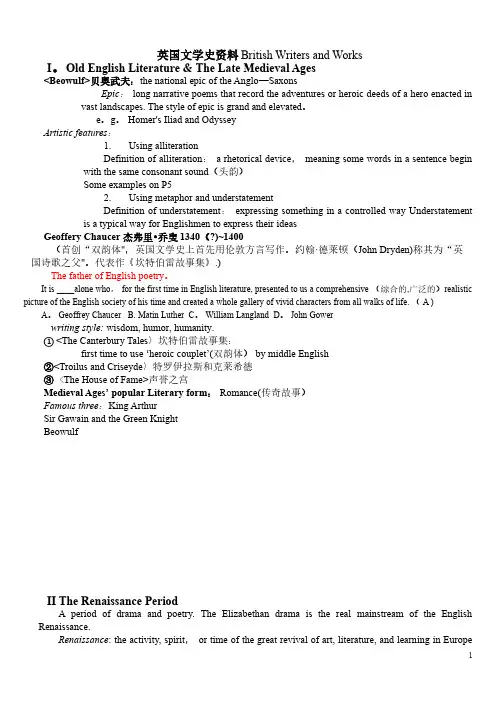
英国文学史资料British Writers and WorksI。
Old English Literature & The Late Medieval Ages<Beowulf>贝奥武夫:the national epic of the Anglo—SaxonsEpic: long narrative poems that record the adventures or heroic deeds of a hero enacted in vast landscapes. The style of epic is grand and elevated。
e。
g。
Homer's Iliad and OdysseyArtistic features:ing alliterationDefinition of alliteration: a rhetorical device, meaning some words in a sentence begin with the same consonant sound(头韵)Some examples on P5ing metaphor and understatementDefinition of understatement: expressing something in a controlled way Understatement is a typical way for Englishmen to express their ideasGeoffery Chaucer 杰弗里•乔叟1340(?)~1400(首创“双韵体",英国文学史上首先用伦敦方言写作。
约翰·德莱顿(John Dryden)称其为“英国诗歌之父"。
代表作《坎特伯雷故事集》.)The father of English poetry。
《英国文学简史》刘炳善中文版.doc

《英国文学简史》刘炳善中文版《英国文学简史》刘炳善中文版2010-09-09 21:00第一部分:早期和中世纪英国文学第一章:英国的组成1、大不列颠人(英国人)在开始学习英国文学史之前,了解一下英国这个民族是很必要的。
英国这个民族是一个混血族。
早期居住在这个岛上的居民是凯尔特人的一个部落,我们现在称它为大不列颠人。
大不列颠人把这个岛屿命名为大不列颠岛,凯尔特人是其原始居民。
他们分为几十个小部落,每个部落都以小屋群居为主。
"最古老的凯尔特人法律今天归结起来显示出氏族任然充满着生命力"。
英国人曾生活在部落社会。
2、罗马人的占领在公元前55年,大不列颠岛被罗马征服者凯撒入侵,而这是的凯撒刚刚占领了高卢。
但是罗马人刚登上大不列颠岛海岸时,就遭到了在首领领导下的大不列颠人的狮子般疯狂的反击,随着罗马将领来来往往的这个世纪,直到公元78年英国从被于罗马帝国完全征服过。
伴随着罗马人的侵略占领,罗马式的生活方式也开始融入英国。
罗马式剧院和澡堂很快的在城镇中兴起。
而这些高雅的文明只不过是罗马侵略者的娱乐享受方式罢了,大不列颠人民却像奴隶一样被压迫着。
罗马人的占领持续了将近400年,在这期间,罗马人因其军事目的在岛上修建了后来被称之为罗马路的纵横交错的公路,这些公路在后期发展中起到了很大的作用。
沿着这些公路开始建立起大量的城镇,伦敦就是其中之一,开始成为重要的贸易中心城市。
罗马的占领也带来了基督教文化。
但是在15世纪初期,罗马帝国处于逐渐的衰落阶段。
公元410年,所有罗马军队撤回欧洲大陆再也没有返回。
因此,也标志这罗马人占领的结束。
3、英国人的占领同时,大不列颠也被成群的海盗给侵略着。
他们是来自北欧的三个部落:盎格鲁人,撒克逊人和朱特人民族。
这三个部落在大不列颠海岸登路,把大不列颠人民赶到西部和北部,然后自己定居下来。
朱特人占领了岛屿东南部的肯特。
撒克逊人占领了岛屿南部地区,并建立起像韦塞克斯,埃塞克斯和东萨塞克斯这样的小王国。
《英国文学简史》刘炳善中文版
《英国文学简史》刘炳善中文版《英国文学简史》刘炳善中文版2010-09-09 21:00第一部分:早期和中世纪英国文学第一章:英国的组成1、大不列颠人(英国人)在开始学习英国文学史之前,了解一下英国这个民族是很必要的。
英国这个民族是一个混血族。
早期居住在这个岛上的居民是凯尔特人的一个部落,我们现在称它为大不列颠人。
大不列颠人把这个岛屿命名为大不列颠岛,凯尔特人是其原始居民。
他们分为几十个小部落,每个部落都以小屋群居为主。
"最古老的凯尔特人法律今天归结起来显示出氏族任然充满着生命力"。
英国人曾生活在部落社会。
2、罗马人的占领在公元前55年,大不列颠岛被罗马征服者凯撒入侵,而这是的凯撒刚刚占领了高卢。
但是罗马人刚登上大不列颠岛海岸时,就遭到了在首领领导下的大不列颠人的狮子般疯狂的反击,随着罗马将领来来往往的这个世纪,直到公元78年英国从被于罗马帝国完全征服过。
伴随着罗马人的侵略占领,罗马式的生活方式也开始融入英国。
罗马式剧院和澡堂很快的在城镇中兴起。
而这些高雅的文明只不过是罗马侵略者的娱乐享受方式罢了,大不列颠人民却像奴隶一样被压迫着。
罗马人的占领持续了将近400年,在这期间,罗马人因其军事目的在岛上修建了后来被称之为罗马路的纵横交错的公路,这些公路在后期发展中起到了很大的作用。
沿着这些公路开始建立起大量的城镇,伦敦就是其中之一,开始成为重要的贸易中心城市。
罗马的占领也带来了基督教文化。
但是在15世纪初期,罗马帝国处于逐渐的衰落阶段。
公元410年,所有罗马军队撤回欧洲大陆再也没有返回。
因此,也标志这罗马人占领的结束。
3、英国人的占领同时,大不列颠也被成群的海盗给侵略着。
他们是来自北欧的三个部落:盎格鲁人,撒克逊人和朱特人民族。
这三个部落在大不列颠海岸登路,把大不列颠人民赶到西部和北部,然后自己定居下来。
朱特人占领了岛屿东南部的肯特。
撒克逊人占领了岛屿南部地区,并建立起像韦塞克斯,埃塞克斯和东萨塞克斯这样的小王国。
英国文学复习要点(教材刘炳善《英国文学简史》

英国文学复习要点(教材刘炳善《英国文学简史》英国文学复习要点(教材刘炳善《英国文学简史》)Part One: Early and Medieval 1. Beowulf: national epic of the English people; Denmark story; alliteration, metaphors and understatements.*2. Romance (名词解释)(1).The basic material of medieval romance is knightly activity and adventure; we might best define medieval romance as a story of adventure--fictitious, frequently marvelous or supernatural--in verse or prose.(2).A long composition describing the life and adventures ofa noble hero. The central character was the knight, a man of noble birth skilled in the use of weapons who was very devoted to the king or to the church.(3).One who wanted to be a knight should serve patiently until he was admitted to the knighthood with solemn ceremony and the swearing of oaths.The Nature of the Romance:(4). The Nature of the Romance:Themes: Loyalty to the king and the lord, which was the corner-stone of feudal morality.The audience was of noble people from the court or the castle.The Romance had nothing to do with the common people.The Romance were written for the noble, of the noble and in most cases by the poets patronized by the noble.*3. Piers the Plowman. Over 7000 lines, written by William Langland.*4. Ballad民谣(名词解释)1.A short narrative poem with stanzas of two or four lines and usually a refrain. The story, folklore popular legends. straightforward verse, s with graphic simplicity and force. suitable for singing generally written in ballad meter, with the last words of the second and fourth lines rhyming.2.the subjects of Ballad:(1) the struggle of young lovers who are fight against the feudalism(2) the conflict between love and wealth(3) the cruelty of jealousy(4) the criticism of the civil war(5) the matters of class struggles. 5. Character of Robin Hood1.Robin Hood--- A legendary English hero of many ballads, who robbed the rich to give to the poor; a popular model of courage, generosity and justice.2. strong, brave, clever, tender-hearted, affectionate. Hatred to the cruel oppressors, love for the poor and the downtrodden *6. Geoffrey Chaucer桥搜: founder of English poetry; The Canterbury Tales (main contents; 124 stories planned, only 24 finished; written in Middle English; significance; form: heroic couplet)7. Heroic couplet (名词解释)A heroic couplet is a traditional form for English poetry, commonly used for epic and narrative poetry; it refers to poems constructed from a sequence of rhyming pairs of iambic pentameter lines.Troditional form for english poetry, commonly used for epic and narrative poetry, a sequence of rhyming paris of iambic pentameter.8. The Authorized Version of English Bible and itssignificance.*9. Renaissance(名词解释)1. a cultural and artistic movement in England from the early 16th century to the early 17th century.The Renaissance marks a transition from the medieval to the modern world. The Renaissance is a historical period in which the European humanist thinkers and scholars made attempts:to get rid of those old feudalist ideas in medieval Europe, to introduce new ideas that expressed the interests of the rising bourgeoisie,to recover the purity of the early church from the corruption of the Roman Catholic Church.*10.Thomas More——Utopia*11. Sonnet(名词解释)The sonnet is a poem in 14 lines with one or the other rhyme schme,a form much in vogue in Renaissance Europe, expecially in Italy ,France and England.In 1609 appeared Shakespeare’s sonnets.The Sonnets were written over a number of years, probably beginning in the early 1590s.12. Blank verse(名词解释)13. Edmund Spenser “The Faerie Queene”; Amoretti (collection of his sonnets) Spenserian Stanza (名词解释)Stanza form developed by Edmund Spenser and almost certainly influenced by rhyme royal and ottava rima. Spenser's stanza has nine lines and is rhymed a-b-a-b-b-c-b-c-c. The first eight lines of the stanza are in iambic pentameter and the last line in iambic hexameter. He used this form in his epic poem The Faerie Queene. John Keats, a great admirer of Spenser, used this stanza in his poem The Eve of St. Agnes.*14. Francis Bacon “essays” esp. “Of Studies”(本文用词正式优雅,多排比句和长句,语言造诣非常高,里面很多话都可以引用做格言警句,非常值得一读)*16. William Shakespeare可以说是英国文学史中最重要的作家。
《英国文学简史》考研刘炳善版考研复习笔记和考研真题
《英国文学简史》考研刘炳善版考研复习笔记和考研真题第1章早期和中世纪的英国文学1.1 复习笔记早期英国文学Early English LiteratureⅠ.Background Knowledge—The Making of England(背景知识——英国的形成)1.The Roman Conquest (55B.C.-410A.D.) 罗马征服(公元前55年—公元410年)A. Brief Introduction(简介)Before the Roman Conquest, the early inhabitants in the island we call England were Britons, a tribe of Celts.In 55 B.C., Britain was invaded by Julius Caesar, the Roman conqueror. Britain was not completely subjugated to the Roman Empire until 78 A.D. But at the beginning of the fifth century, the Roman Empire was in the process of declining. In 410 A.D., all the Roman troops went back to the continent and never returned.罗马征服之前,在英格兰岛上居住的早期居民被称为不列颠人(Britons),不列颠人是凯尔特(Celt)部落的一支。
公元前55年,该岛被罗马的朱利尤斯·凯撒(Julius Caesar)侵略。
直到公元78年,不列颠才完全臣服于罗马帝国,但是在5世纪初,罗马帝国开始没落。
公元410年,所有的罗马军队撤离该岛。
B. Influence(影响)①The Roman mode of life was brought into Britain while the native Britons were treated as slaves.②The Romans brought Christianity to the island and this religion was spread widely. (This is a profound religious effect up to today).③Roman road was built for military purposes.④Along the Roman roads, many towns grew up, London was one of them, and it became an important trading center.①罗马人的生活方式被带到了英国,而当地的不列颠人却沦为奴隶。
刘炳善英国文学简史复习提纲
刘炳善英国文学简史复习提纲刘炳善的《英国文学简史》是一本介绍英国文学发展历程的经典教材,概述了英国文学的重要人物、作品和流派。
以下是一个复习提纲,旨在帮助你回顾和理解这本书的内容。
一、古英国文学时期(公元前7世纪-公元1066年)1.早期史诗作品:《贝奥武夫》、《克赖斯人的诗歌》等。
2.宗教文学:《贝德的致辞》、《入埋土地的经文》等。
3.亚瑟王传说:《亚瑟王之死》、《卢梭勒》等。
二、中英文学时期(1066年-1485年)1.诺曼底征服后的影响:法语文学的传入。
2.米德尔英语文学:《切阿通匹恩的罗曼斯》等。
3.文人和教士的作品:《福尔莫尔的诗集》、《金马伦的伊莎贝拉》等。
三、文艺复兴时期(1485年-1603年)1.文艺复兴思潮的传入。
2.威廉·莎士比亚及其作品:《哈姆雷特》、《罗密欧与朱丽叶》等。
3.其他重要诗人和作品:约翰·米尔顿的《失乐园》、培根的《新科学》等。
四、十七世纪文学(1603年-1660年)1.皇家主义文学:本·琼森的《包涵的破碎》等。
2.牧歌诗和骑士诗:约翰·唐纳的《简·卡特琳之歌》等。
3.讽刺文学:约纳森·斯威夫特的《格列佛游记》等。
五、启蒙运动时期(1660年-1798年)1.小说的发展:丹尼尔·笛福的《鲁滨逊漂流记》、萨缪尔·理查森的《帕梅拉》等。
2.詹姆斯·汤姆逊和约翰·洛克的作品。
3.威廉·布莱克和威廉·华兹华斯的浪漫主义作品。
六、浪漫主义时期(1798年-1832年)1.华兹华斯、柯勒律治和拜伦的作品。
2.珀西·比希·雪莱、约翰·济慈和简·奥斯丁的作品。
3.疲软派和托马斯·哈代的作品。
七、维多利亚时期(1832年-1901年)1.查尔斯·狄更斯和查尔斯·达尔文的作品。
2.奥斯卡·王尔德和罗伯特·路易斯·史蒂文森的作品。
(完整word版)英国文学史及选读作者及作品(word文档良心出品)
英国文学史及选读作者及作品一、盎格鲁-撒克逊时期The Anglo-Saxon Period※《贝奥武甫》“The Song of Beowulf”《浪游者》“Widsith”or “The Traveller’s Song”《航海家》“Seafarer”二、盎格鲁-诺曼时期The Anglo-Norman Period※《高文爵士和绿衣骑士》“Sir Gawain and the Green Knight ”杰弗里《史记》Geoffrey’s “History”莱亚门《布鲁特》Laysmon’s “Brust”《罗兰之歌》“Chanson de Roland”三、乔叟时期Geoffrey Chaucer (1340?-1400)※《坎特伯雷故事集》“The Canterbury Tales”《玫瑰传奇》“Romance of the Rose”《好女人的故事》“The Legend of Good Women”《声誉殿堂》“The House of Fame”《百鸟会议》“The Parliament of Fowls”《特罗伊勒斯和克莱西德》“Troilus and Gressie”大众民谣Popular Ballads※《罗宾汉和阿林代尔》“Robin Hood and Allin-a-Dale””※《起来,去关门》“Get Up and Bar the Door”※《派屈克·斯宾塞爵士》“Sir Patrick Spens”托马斯·帕西《英诗辑古》Bishop Thomas Percy ”Reliques of Anciet English Poetry”兰格论《农夫皮尔期》“The Vision of Piers, the Plowman”四、文艺复兴时期The Renaissance1.威廉·莎士比亚William Shakespeare(1564-1616)1590《亨利六世》第二部The Second Part of “King Henry Ⅵ”《亨利六世》第三部The Third Part of “King Henry Ⅵ”1591《亨利六世》第一部The First Part of “King Henry Ⅵ”1592《理查三世》“The Life and Death of King Richard Ⅲ”《错误的喜剧》“The Comedy of Errors”1593《泰特斯·安德鲁尼克斯》”Titus Andronicus”《驯悍记》“The Taming of the Shrew”1594《维洛那两绅士》“The Two Gentlemen of Verona”《爱的徒劳》“Love’s Labour’s Lost”《罗密欧与朱丽叶》“Romeo and Juliet”1595《理查二世》“The Life and Death of King Richard Ⅱ”《仲夏夜之梦》“A Midsummer Night’s Dream”1596《约翰王》“The Life and Death of King John”※《威尼斯商人》“The Merchant of Venice”1597《亨利四世》第一部The First Part of “King Henry Ⅳ”《亨利四世》第二部The Second Part of “King Henry Ⅳ”1598《无事生非》“Much Ado About Nothing”《温莎的风流娘儿们》”The Merry Wives of Windsor”《亨利五世》”The Life of King Henry Ⅴ”1599《尤利乌斯·凯撒》“The Life and Death of Julius Caesar”《皆大欢喜》”As You Like It”1600《第十二夜》“Twelfth Night ,or, What You Will”※1601《哈姆雷特》“Hamlet, Prince of Denmark”1602《特洛伊洛斯与克瑞西达》“Troilus and Cressida”《终成眷属》“All’s Well That Ends Well”1604《一报还一报》“Measure for Measure”《奥塞罗》“Othello, the Moore of Venice”1605《李尔王》”King Lear”《麦克白》“The Tragedy of Macbeth”1606《安东尼和克莉奥佩特拉》“Antony and Cleopatra”1607《科里奥拉鲁斯》”The Tragedy of Coriolanus”《雅典的泰门》“Timon of Athens”1608《佩里克利斯》“Pericles, Prince of Tyre”1609《辛白林》“Cymbeline, King of Britain”1610《冬天的故事》“The Winter’s Tale”《暴风雨》“The Tempest”《亨利八世》“The Life of King Henry Ⅷ”Poems《维纳斯与阿多尼斯》“Venus and Adonis”《露克丽丝受辱记》“Lucrece”※《十四行诗》“Sonnets”2。
(完整版)英国文学简史期末测验考试复习要点刘炳善版(英语专业大必备)
英国文学史资料British Writers and Works一、中世纪文学(约5世纪—1485)•《贝奥武甫》(Beowulf)•《高文爵士和绿衣骑士》(Sir Gawain and the Green Knight )杰弗利·乔叟(Geoffrey Chaucer)“英国诗歌之父”。
(Father of English Poetry)《坎特伯雷故事》(The Canterbury Tales)二、文艺复兴时期文学(15世纪后期—17世纪初)•托马斯·莫尔(Thomas More )《乌托邦》(Utopia)•埃德蒙·斯宾塞(Edmund Spenser)《仙后》(The Faerie Queene)•弗兰西斯·培根(Francis Bacon)《论说文集》(Essays)克里斯托弗·马洛Christopher Marlowe•《帖木儿大帝》(Tamburlaine)•《浮士德博士的悲剧》(The Tragical History of the Life and Death of Dr. Faustus)•《马耳他岛的犹太人》(The Jew of Malta)威廉·莎士比亚William Shakespeare喜剧《仲夏夜之梦》(A Midsummer Night’s Dream)、《威尼斯商人》(The Merchant of Venice)悲剧《罗密欧与朱丽叶》(Romeo and Juliet)、《哈姆莱特》(Hamlet)、《奥赛罗》(Othello)、《李尔王》(King Lear)、《麦克白》(Macbeth)历史剧《亨利四世》(Henry IV)传奇剧《暴风雨》(The Tempest)本·琼生Ben Johnson•《人人高兴》(Every Man in His Humor)•《狐狸》(V olpone)•《练金术士》(The Alchemist)三、17世纪文学约翰·弥尔顿John Milton《失乐园》(Paradise Lost)《复乐园》(Paradise Regained)诗剧《力士参孙》(Samson Agonistes)•约翰·班扬(John Bunyan)《天路历程》(The Pilgrim’s Progress)•威廉·康格里夫(William Congreve)《以爱还爱》(Love for Love)《如此世道》(The Way of the World)四、启蒙时期文学(17世纪后期—18世纪中期)18世纪初,新古典主义成为时尚。