
人教版八年级英语上册unit 9知识点归纳
Unit 9 Can you come to my party?1、主要词汇动词(V):prepare 使...准备好;hang 悬挂,垂下;catch 赶上,接住(某物);invite 邀请;accept 接受;refuse 拒绝;reply 答复;forward 转寄;delete 删除;Print 打印;名词(N):exam考试;flu流感;weekday 工作日;invitation 邀请;preparation准备工作;glue 胶水;opening 开幕式;concert 音乐会;event 事项;guest 客人;calendar 日历;daytime 白天形容词(adj):available 有空的,可获得的;sad 难过的;surprised 惊讶的;介词(prep):until 直到...为止;without 没有;2、Can you come to my party on Saturday afternoon?星期六下午你可以来我的派对吗?①向别人发出邀请,或者征求他人意见常见句式:Can you do sth?你可以/能做.......吗?Can you swim?Could you do sth?(更加委婉)Could you please turn down the radio?Would you like to do sth?你愿意做某事吗?Would you like to have some tea?Let ’s do sth !让我们来做某事吧!Let ’s prepare for the test together!How/ what about doing sth?做某事如何?How/ what about having a rest?接受邀请的回答:Sure,I ’d love to 当然,我很乐意!Sure,that sounds great!当然,听起来很不错!of course / certainly 当然可以拒绝邀请的回答:Sorry,I ’m not available抱歉,我没有空available. adj. 有空的Sorry,I ’not freeI ’d love to,but ......I ’d love to,but I ’m afraid I can’t,我很愿意,但我害怕/担心我不能......—Would you like to visit the museum?—______A.Yes,please B.Sure,I'd love to C.Sorry,I wouldn't. D.Yes,I would.—Jim, would you like to go hiking with me next Friday?—________. When shall we leave?A. Yes, I’d love toB. Sorry, I can’tC. Yes, I wouldD. No, I wouldn’tTom______(can)come to my party because he is ill.②on Saturday afternoon在星期六下午在表示具体某天时,前面要用介词onOn weekend 在周末On Monday 在星期一On December 1st在12月1号On Wednesday morning/afternoon/evening 在周三早上/下午/晚上—My mother is ill.I have to look after her at home.—______.A.Thank you B.Oh,I don't know C.Bad luck D.I'm sorry to hear that3、prepare for an exam 为考试准备Prepare for... 为...而准备I can’t go with you because I have to prepare for the coming test我不能和你一起去,因为我必须得为即将到来的考试做准备Prepare sb for sth 使某人为某事做好了准备We must prepare ourselves for the meeting我们必须使我们自己为这次会议做好准备Prepare sth for sb 为某人准备好了某物Mom prepares a delicious meal for us 妈妈为我们准备了好吃的饭菜Prepare to do sth 准备做某事I prepare to take a trip in Taiwan 我准备去台湾旅游4、exam 是examination的缩写,意为“考试”Test ,也是“考试”的意思Take / have an exam 参加考试Pass the exam 通过考试/ 考试及格Fail the exam 考试不及格5、go to the doctor 去看医生6、Have the flu 患流感/感冒了Have的原意,“有”Have English class 上英语课Have breadfast 吃早餐Have a cold 感冒have a fever 发烧have a headache头痛Have a cough咳嗽have a sore throat喉咙痛have a toothache牙痛7、Sam isn’t leaving until next Wednesday 萨姆不会离开直到下周三为止萨姆下周三才会离开Until 直到......为止Not......until...... 不会做某事直到......为止直到......才......The noise didn’t stop until midnight 噪音直到午夜才停止She won’t forgive us until we say sorry to her 我们道歉前她是不会原谅我们的I waited until three o’clock 我们一直等到三点钟He lived with his parents until he got married 他结婚前一直和父母住在一起8、Can you hang out with us on Monday night?周一晚上你可以陪我们一起逛逛吗?Hang out with sb 和某人一起闲逛Hang out 闲逛/逛街He likes reading and he often hangs out in the bookstores他喜欢阅读所以经常在书店闲逛Hang,动词,“悬挂”,hang-hungHang the picture on the wall 把这幅画挂在墙上9、I’m afraid not 恐怕不能Afraid,形容词,意为“害怕的”否定时:I ’m afraid not 恐怕不能肯定时:I ’m afraid so 恐怕如此—Can you go to the concert?你能去听音乐会吗?—Sorry. I ’m afraid not 对不起,恐怕不能—Has she missed the bus?她错过公交了吗?—I ’m afraid so 恐怕如此/恐怕是这样没错10、invite,动词,意为“邀请”I nvite sb to sp,邀请某人到某地My pen pal invites me to his hometown 我笔友邀请我去他的家乡Invite sb to do sth,邀请某人做某事Mr.Kim invites us to have dinner with him 金先生邀请我们和他一起共用晚餐Invite(v)→invitation(n)邀请My best friend often invites me ______ delicious food.A.enjoy B.enjoying C.enjoyed D.to enjoy11、accept,动词,接受Accept的近义词是receive,但二者有所区别accept 与receive的区别:accept 意为“接受”指主观上原意接受receive 意为“收到”指客观上收到或拿到某样东西She accepted my apology她接受了我的道歉He received many letters from his family他收到很多来自家里的信件Receive letter from sb 收到某人的信I received his gift yesterday,but I wouldn’t like to accept it昨天我收到了他的礼物,但是我不想接受它12、refuse,动词,拒绝accept 的反义词Refuse sth 拒绝某物He rufused the invitation from Tony 他拒绝了Tony的邀请Refuse to do sth 拒绝做某事You should’t refuse to help her 你不应该拒绝帮助她13、the day before yesterday昨天(过去式)the day after tomorrow 后天(将来时)He went for Beijing the day before yesterday 他昨天去北京了Sarah will go for Beijing the day after tomorrow萨拉后天去北京—My father is coming back on Wednesday.—Oh, today is Monday, so you can see your father ______.A. todayB. the day before tomorrowC. tomorrowD. the day after tomorrow14、weekday 与weekendWeekday 工作日(周一至周五其中一天)Weekend周末(周六至周日)15、What ’s today?直译:今天是什么?引申:今天是什么日子?What ’s today?用来提问今天是几号、星期几。
回答时,可以说今天是星期几,也可以回答具体日期,还可以回答节日;—What’s today?今天是什么日子?—It ’Monday the 14th 今天是14号,星期一—What’s today?今天是什么日子?—It ’s labour’s day 今天是劳动节此外,What day is it today?今天星期几?只能回答今天星期几What is the date today?今天是几月几号?要回答具体日期—What day is it today?今天周几?—It is Monday 今天是周一—What is the date today?今天是几月几号?—It is December 22th 今天是12月22号— ________?—It’s Thursday the 24th.A.What’s todayB. When is your birthdayC. What time is it nowD. How long does it take15、look after = take care of,意为“照顾”You should look after your little puppy = you should take care of your little puppy 你应该找照顾你的小狗Look after......well = take good care of...... 好好照顾......You are old enough to look after yourself well = you are old enough to take good care of yourself 你已经足够大了,能能够好好照顾自己了16、turn downTurn down有两种含义:①调低(声音);反义词:turn up调高Could you please turn down the radio?可以请你把收音机的声音调低一点吗?②拒绝;近义词:refuse;反义词:acceptShe turned down taylor’s advice她拒绝了泰勒的提议17、look forward to,意为“期待;盼望”To是介词,因此look forward to 后可接名词、代词或者动词ing作宾语I look forward to receiving your letter soon 我希望快点收到你的来信I look forward to _____with you again.A.workB.to workC.workingD.worksI'm looking forward to ______(hear) from you soon.18、I have too much homework this weekend 这周末我有太多作业了too much 很多,非常多;修饰不可数名词There is too much food in the fridge too many 很多,非常多;修饰可数名词There are too many students over there much too 实在太...... 修饰形容词The coat is much too expensive常见的不可数名词:①液体类:water(水),juice(果汁),tea(茶),coffee(咖啡)②物质类:sugar(糖),salt(盐)③肉类:fish(鱼肉),chicken(鸡肉),beef(牛肉)④特别的:advice(建议),information(信息),weather(天气)Sorry,I'm busy today.I have ______ housework to do.A.much too B.too much C.too many D.many too19、hear from sb = receive a letter/call from sb 收到某人的来信/来电I heard from my mother last week = I received a letter from my mother last week我上周收到妈妈的来信20、凡是见到be动词+形容词+to do sth 的句子结构,都理解成to do sth 是很形容词的,譬如:①be glad to do sth 做某事是很高兴的I ’m so glad to see you again 能再次见到你我很开心②be surprised to do sth 做某事是很惊讶/很惊喜的I was surprised to see him there 在那边见到他我很惊讶【拓展】有些形容词有ed 和ing两种结尾,以ed结尾的用来修饰“人”,以ing结尾的用来修饰“物”Interested 和interesting(人)感兴趣的令人感兴趣的(某物)I ’m very interested in painting 我对绘画很感兴趣This is a very interesting story 这是一个很有趣的故事Surprised 和surprising(人)感到惊讶的令人惊讶的(某物)I am surprised to hear from you 收到你的消息我感到很惊讶The news was surprising 这则消息是很令人惊讶的The students are very ______ at the ______ news.A.surprised;surprising B.surprising;surprisedC.surprised;surprised D.surprising;surprising—My mother is ill.I have to look after her at home.—______.A.Thank you B.Oh,I don't know C.Bad luck D.I'm sorry to hear that21、take a trip去旅游Help out (帮助......)分担工作;解决难题At the end of + 时间名词/ 地点名词,在.......的末尾,尽头;表示......快结束的时候You can see a bookstore at the end of the road 在路的尽头你可以看到一间书店At the end of this month,we’ll have an exam 在这个月的月末,我们会有一场考试He started ______ music at the age of ten and now he is a ______.A.to write;painter B.writing;musicianC.to write;scientist D.writing;pianist22、bring、take与carryBring:带来,拿来;表示从别处将某物带到说话处(由远而近)Please remember to bring your homework tomorrow明天请记得把作业带过来Take:带走、带去;拿去;表示从说话处将某物带走(由近而远)Please remember to take your umbrella when you leave你离开的时候记得带走你的雨伞Carry:指随身携带某物(如提,拿,扛,抬,背、带),不具体说明来去方向She carries her bag everywhere she goes无论她去哪儿,她都背着她的包包23、have to 和must二者都有“必须;不得不”的意思,不同之处在于:Have to :强调客观上需要做某事,含有“形式逼迫”的意味;并且可以用于多种时态变化Must :强调说话者主观上认为必须做某事,含有主观判断的意味;此外,must是情态动词,无时态变化My bike was broken,I had to walk here我自行车坏了,我不得不走路去那里(过去时态)(客观上)I have to write an email to her before she calls me我必须在她来电之前给她发一封邮件(一般现在时)(客观上)We must learn English well 我们必须学好英语(无时态变化)(主观认为)I have to______for the math test.A.study B.studying C.learning D.StudiedJoe______go to the doctor.His leg is broken.A.have to B.can C.has to D.may24、without,介词,意为“没有......”, 后可接名词,代词,或者动词ing,介词+名词=介词短语,介词短语可以充当句子的状语,放在句末;Without sth/ doing sth 没有....../没有做.......,可作伴随状语He left the room without saying a word他一句话都没说地离开了房间Fish can’t leave without water没有水的话鱼活不了25、so that,意为“以便,为的是”,用来引导目的状语从句I study hard every day so that I can catch up with Tom我每天都努力学习,为的是可以赶上汤姆The little boy saved much money so that he could buy his mother a birthday gift这小男孩存了很多钱,以便可以给妈妈买一份生日礼物So that = in order to sth,都是“为了......”的意思,不同的是so that 后面接句子,而in order to 后面接动词原形I study hard every day to catch up with TomThe little boy saved much money to buy his mother a birthday giftSo that ≠so......that......So+形容词+that+句子,表示:太......以至于......He is so excited that he cries out他过于兴奋了,以至于哭了出来Too...to... 太......以至于......Be not + 形容词enough to do sth 做某事是不够......的巩固练习一、单项选择( )1.--Why can’t you come to her party?--Because I ______ the flu.A.takeB.haveC.getD.give( )2.I can’t go out with you.I have ___homework to do today.A.too muchB.much tooC.too manyD.many too( )3.The bus driver always says to us ,“Don’t get off____the bus stops.”A. whenB. while C .until D. if( )4. Thanks a lot for ______me______ your birthday party.A. invite forB. invite toC. inviting forD. inviting to( )5.Ted can’t go finishing with us tomorrow.He has to ________his l ittle sister at home.A.look forB.look atC.look afterD.look like( )6.Mike got up early ______he could catch the early bus.A.because ofB.so thatC.whenD.before( )7.We saw a man ______into the room and then went away.A.getB.gotC.to getD.getting( )8.I got Linda’s ____ yesterday. She asked me to go to her birthday.A.inviteB.invitationrmationD.program( )9.I don’t like this T-shirt .Can you show me________one?A.otherB.the otherC.anotherD.others.( )10. —When did your uncle arrive China?—He got to Guangzhou____ the morning of 16th of April.A. at; inB. in; inC. to; onD. in; on( )11.He is studying ___an English test ___Monday morning.A.for , onB.on , onC.for , inD.at , in( )12.I will take a trip ____Beijing ___ the end of this month.A.to ,inB.for ,atC.at , byD.to , at( )13.Tomorrow is the best time ____ the party.A.to haveB.havingC.haveD.has( )14.—Could I go out with my friends this afternoon,Mom?---_____________.A.Yes, you canB.Yes, you couldC.No, I couldD.No, you couldn’t( )15. —Ben, would you like to play football with us?—_____,but I have to wash the dishes first.A. No, I can’tB. I don’t want t oC. Yes, please.D. I’d love to.( )16.Do you know ______ I miss you?A.how many B.how muchC.how long D.how far( )17.The students are very ______ at the ______ news.A.surprised;surprising B.surprising;surprisedC.surprised;surprised D.surprising;surprising( )18. I got ________ invitation from Mary. She asked me to go to ____ concert with her.A. a; aB. an; theC. an; /D. a; the( )19. I always say "Hello" to my teachers ____ I meet them.A. whenB. afterC. beforeD. till( )20. Our office is open from 8:30 a.m. to 4:30 p.m. every ____. It is not open on the weekend.A. dayB. weekdayC. SaturdayD. Sunday( )21. Sonia didn’t come to the party be cause she was ______ with her homework.A. busyB. differentC. angryD. famous( )22. — Today is Monday. What day is it ____?— Wednesday.A. the day after tomorrowB. yesterdayC. tomorrowD. the day before yesterday( )23. — ______ are you going to London with?— My parents.A. WhatB. WhoseC. WhoD. Which( )24. — Would you like to watch TV with me?— ____, but I have to clean my room first.A. Not badB. Yes, I’d love toC. You’re welcomeD. I’m sorry to hear that( )25.I look forward to _____with you again.A.workB.to workC.workingD.worksUnit 9讲义参考答案一1---10 BACDC BABCD 11—20 ADAAD BABAB 21—25AACBC二1---10 BCADB CABBA三BBCBA。
人教版英语八年级上第九单元知识点
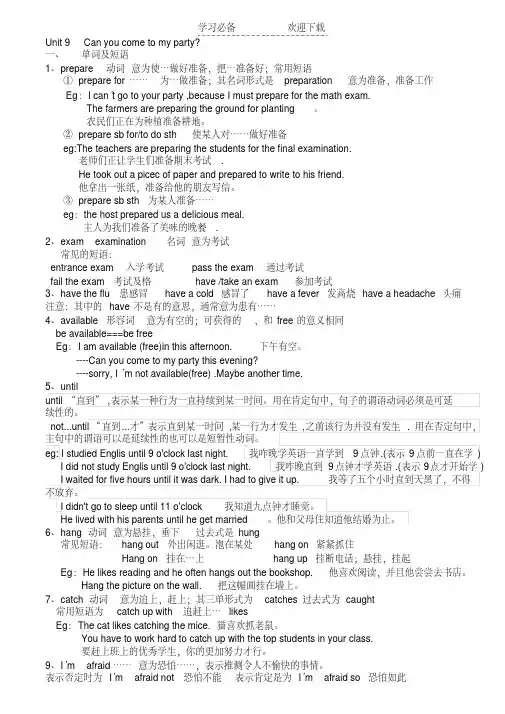
Unit 9 Can you come to my party?一、单词及短语1、prepare 动词意为使…做好准备,把…准备好;常用短语①prepare for……为…做准备;其名词形式是preparation 意为准备,准备工作Eg:I can’t go to your party ,because I must prepare for the math exam.The farmers are preparing the ground for planting。
农民们正在为种植准备耕地。
②prepare sb for/to do sth 使某人对……做好准备eg:The teachers are preparing the students for the final examination.老师们正让学生们准备期末考试.He took out a picec of paper and prepared to write to his friend.他拿出一张纸,准备给他的朋友写信。
③prepare sb sth 为某人准备……eg:the host prepared us a delicious meal.主人为我们准备了美味的晚餐.2、exam examination 名词意为考试常见的短语:entrance exam 入学考试pass the exam 通过考试fail the exam 考试及格have /take an exam 参加考试3、have the flu 患感冒have a cold 感冒了have a fever 发高烧have a headache 头痛注意:其中的have不是有的意思,通常意为患有……4、available 形容词意为有空的;可获得的,和free的意义相同be available===be freeEg:I am available (free)in this afternoon. 下午有空。
八年级上册英语unit9知识点整理
八年级上册英语unit9知识点整理八年级上册英语unit9知识点1单词prepare [pr?'per] v.预备;准备exam [?ɡ'z?m] n.考试available [?'ve?l?bl] a.可得到的;有空的hang [h??] v.悬挂;(使)低垂until [?n't?l] conj./prep.直到 ... 的时候;直到…为止catch [k?t?] v./n.赶上;抓住;捕捉invite [?n'va?t] v.邀请accept [?k'sept] v.接受refuse [r?'fju?z] v.拒绝invitation [??nv?'te??n] n.邀请;邀请函reply[r?'pla?] v./n.答复,回复forward ['f??rw?rd] v.转交;发送 adj.向前的 adv.向前地delete [d?'li?t] v.删除preparation [?prep?'re??n] n.准备,准备工作opening ['o?pn??] n.开幕式,落成典礼guest [ɡest] n.客人concert ['kɑ?ns?rt] n.音乐会headmaster [?hed'm?st?r] n.校长event [?'vent] n.大事,公开活动calendar ['k?l?nd?r] n.日历,日程表八年级上册英语unit9知识点2重点短语1、on Saturday afternoon 在星期六下午2、have to 必须3、 prepare for 准备4、go to the doctor 去看病5、have the flu 患流感6、help my parents 给父母帮助7、e to the party 参加晚会8、meet my friend 见朋友9、go to the party 参加晚会10、too much homework 太多的家庭作业11、go to the movies 去看电影12、another time 下次,另外的时间,别的时间13、last fall 去年秋天14、hang out 闲逛15、after school 放学后16、on the weekend=on weekends 在周末17、study for a test 备考18、visit grandparents 拜访爷爷奶奶19、the day before yesterday 前天20、the day after tomorrow 后天21、have a piano lesson 上钢琴课22、look after 照看23 make an invitation 制定邀请24、accept an invitation 接受邀请 turn down (refuse) an invitation 拒绝邀请25、take a trip to Wuhan 去武汉旅游26、at the end of this month 在本月底27、look forward to + doing 期望/渴望28、the opening of… 开幕/开业29、reply in writing 写回信30、go shopping 购物31、do homework 做作业32、go to the concert 参加音乐会33、not…until… 直到......才......八年级上册英语unit9知识点3重点句型1. --Can you e to my party on Saturday afternoon? 星期六下午你能参加我的晚会吗? --Sure, I’d love to. / Sorry,I can’t. I have to prepare for an exam. 当然,我愿意去。
人教版初中英语八上unit9知识点
人教版初中英语八上unit9知识点以下是人教版初中英语八年级上册第九单元的知识点:1. 重点短语:- on weekend 在周末- have a piano lesson 上钢琴课- look after 照顾;照看- accept an invitation 接受邀请- turn down an invitation 拒绝邀请- take a trip 去旅行- at the end of 在……末尾- help out 帮助摆脱困境- look forward to 期待;盼望- hear from 收到某人的来信- the day before yesterday 前天- the day after tomorrow 后天- have a surprise party 举办一个惊喜派对- reply in writing 书面回复- go to the concert 去听音乐会- not…until… 直到……才……- meet my friend 会见我的朋友- study for a test 为考试学习2. 重点语法:- 用can 来表达邀请- Can you come to my party on Saturday?- Sure, I'd love to.- Sorry, I can't. I have to prepare for an exam.- 用must 来谈论职责和义务- I must finish my homework first.- I have to look after my sister.- 用might 来表示可能性- He might come to the party.- She might not be able to come.3. 重点句型:- Can you come to my party? 你能来参加我的聚会吗?- I'd love to, but I'm afraid I can't. 我很愿意,但恐怕不能。
人教版八年级上册英语Unit 9 知识点语法归纳总结
Unit 9 Can you come to my party?1.短语归纳2.典句必背3.用法集萃(1)—Can you come to my party on Saturday afternoon? 星期六下午你能来参加我的聚会吗?—Sure, I’d love to. 当然了,我很乐意去。
❖“Can you..?”可用来向别人发出邀请或询问对方能否做某事。
肯定答语是:Sure, I’d love to./Certainly./Of course, I can. 等。
否定答语常用:I’d love to, but I have to.../Sorry, I have to.../I’m sorry, I can’t. 等。
例:Can you go to the movies with me tonight? 今晚你能与我一起去看电影吗?Sure, I’d love to. 当然,我很乐意去。
(2)I have to prepare for an exam. 我必须为考试做准备。
❖prepare 意为“(为.....做准备;把....准备好”。
其用法如下:(3)I have too much homework this weekend. 这周末我有太多的家庭作业。
❖too much修饰不可数名词,用来强调其“量”超出了正常的范围。
too用来修饰形容词或副词,表示“太”的意思,其程度比very、so quite要强得多。
例:He sometimes finds his teacher leaves them too much homework to do.他有时发现老师留给他们做的家庭作业太多了。
I don’t want to eat too much food every day. 我不想每天吃太多的食物。
❖辨析(4)I remember we went bike riding together last fall when he visited you.我记得他去年秋天来拜访你的时候我们一起骑自行车兜风了。
人教版八年级英语上册Unit9知识点精讲
Unit 9 Can you come to my party?一、词汇精讲1. prepare forprepare作动词,意为“准备”。
其用法归纳如下:(1)prepare sth.意为“准备……”,宾语是所准备的内容。
例如:Mother was preparing dinner in the kitchen. 妈妈在厨房准备饭菜。
He had a speech to prepare that evening. 那天晚上他得准备一个报告。
(2)prepare to do sth. 表示“准备做某事”。
例如:Taking out a piece of paper, he prepared to write to his parents. 他拿出纸,准备给父母写信。
He is preparing to go on a trip. 他正准备去旅行。
(3)prepare for sth.表示“为……做准备”。
例如:He is busy preparing with great care for the Congress.他们正忙着精心准备这次代表大会。
Hope for the best and prepare for the worst. 抱最好的希望,做最坏的准备。
(4)prepare sth. for... 表示“为……准备某物”。
例如:Please prepare the table for the dinner. 请摆好桌子吃饭。
You must prepare a room for the guest. 你必须为客人准备一个房间。
2. hang outhang out是动副结构的短语,意为“闲逛”。
例如:I hung out with my friends and took lots of photos. 我和朋友们一起闲逛,还拍了许多照片。
【拓展】hang的其他搭配:hang about=hang around 闲逛,徘徊,逗留;hang up挂断(电话);hang on不挂断;hang意为“逗留,悬挂”时,过去式和过去分词都是hung;hang还有“吊死,绞死”的意思,但当hang 意为“吊死,绞死”时,其过去式和过去分词都是hanged。
人教版八年级上册英语Unit9知识点语法总结
人教版八年级上册英语Unit 9 知识点语法总结Unit 9 Can you come to my party?1.短语归纳①on Saturday afternoon 在星期六下午②have to 必须③prepare for 准备④go to the doctor去看病⑤have the flu 患流感⑥help my parents给父母帮忙⑦come to the party 参加晚会⑧meet my friend见朋友⑨go to the party 参加晚会⑩too much homework 太多的家庭作业11go to the movies去看电影12another time下次13last fall 去年秋天14hang out 闲逛15after school 放学后16on the weekend 在周末17study for a test备考18visit grandparents 拜访爷爷奶奶19the day before yesterday 前天20the day after tomorrow后天21have a piano lesson 上钢琴课22look after 照看23accept an invitation 接受邀请24turn down an invitation拒绝邀请25take a trip 参加郊游26at the end of this month在本月底27look forward to 期望/渴望28the opening of… 开幕/开业29reply in writing 写回信30go shopping 购物31do homework 做作业32go to the concert参加音乐会33not...until 直到...才2.典句必背①—Can you come to my party on Saturday afternoon? 星期六下午你能来参加我的聚会吗?—Sure, I’d love to. 当然了,我很乐意去。
人教版八年级上册英语-Unit-9单元知识点总结
Unit 9 Can you come to my party? 情态动词定义: 说话人对某一动作或状态的态度情态动词有一定的词义must 必须can/could 能,会may/might 可以need 需要should 应该would 愿,要have to 不得不情态动词不能单独做谓语——情态动词+do情态动词没有人称,数的变化基本句型:肯定句:主语+情态动词+do+......否定句:主语+情态动词+not+do+......疑问句:情态动词+主语+do+......用法Can 和 could 的用法:表能力、许可、可能性表示能力时一般译为“能、会”例:She can swim fast, but I can’t.她能游得很快,但我不能I can see with my eyes. 我用眼睛看be able to do sth. 常常指经过努力,花费了时间和劳力之后才能做到某事表推测,可能性可能常用于否定句和疑问句中can’t不可能例:Can the news be true? 这个消息会是真的吗?—Can it be our teacher? 那个人有可能是我们老师吗?—No, it can’t be our teacher. He is on a visit to the Great Wall.could 在疑问句中,表示委婉的语气,此时could 没有过去式的意思例:—Could I use your pen? 我能用一下你的钢笔吗?—Yes, you can.可以(用 could 问,不能用 could 答。
)may 和 might 的用法表请求、许可,比 can 正式例:May I borrow your bike? 我可以借你的自行车吗?You may go home now. 现在你可以回家了表推测,谈论可能性可能,或许一般用于肯定句中may not 翻译为“可能不”例:It may rain tomorrow. 明天可能会下雨She may be at home. 她可能在家呢may 的过去式为 might ,表示推测时。
八年级上英语九单元知识点
八年级上英语九单元知识点第一节:词汇1. 复合词指由两个或两个以上字构成的词,如:breakfast,snowman等。
2. 词缀指用来构成词的字根、前缀和后缀,如:unhappy,pretest,careless等。
3. 短语动词指由动词与其后面的介词或副词构成的动词词组,如:look after,come back等。
第二节:语法1. 一般现在时用于表示现在的状态、习惯、事实等,如:I always play football on Sundays.2. 现在进行时用于表示正在进行的动作,如:He is playing basketball now.3. 一般过去时用于表示过去的动作或状态,如:I watched TV last night.4. 过去进行时用于表示过去正在进行的动作,如:He was reading a book at 8 o'clock yesterday evening.5. 一般将来时用于表示将来的动作或状态,如:I will go to the park tomorrow.6. be动词的用法表示人或物的状态或特征,如:He is tall.第三节:阅读理解1. 标题排除法通过排除文章的内容,推断出正确的标题。
2. 线索法通过文章中的明显线索,推断出正确的答案或信息。
3. 推断法通过已知信息和推理,推断出未知信息。
第四节:写作技巧1. 合理安排作文结构作文分明确的开头、中间和结尾。
2. 丰富词汇和句子结构用多种不同的词汇和句型结构来增强文章的表达力。
3. 注意作文的连贯性和逻辑性语言表达应该是连贯的,内容也应该有逻辑性。
八年级英语u9知识点
八年级英语u9知识点
八年级英语的Unit 9主要介绍了一些有关于交通出行和交通规则的内容。
这里将会介绍这个单元的主要知识点。
一、交通工具
在这个单元,我们学习了一些不同的交通工具和它们的特点。
例如,汽车、公共汽车、自行车、船和飞机等。
我们需要了解它们的主要结构、基本用途以及输送方式等。
二、方向和位置
当我们询问某个地点的方向或给出某个地方的方向时,我们需要使用卡片词。
例如,在右边,左边,直走,往前,往后等。
我们也学习了一些关于位置的词汇,如前面、后面、中间、旁边和对面等。
三、询问和给出信息
在交通出行中,询问方向、地点和其他相关信息非常重要。
因此,在这个单元,我们学习了一些有关如何有效地进行信息交流
的语言表达方法。
例如,如何向他人提问和回答问题,如何描述
位置,如何提供和请求帮助等。
四、指示词和冠词
在描述交通工具、位置和方向时,我们需要使用指示词和冠词。
这些词语能够帮助我们更清楚地表达意思,如this、that、these、those、a、an和the等。
五、交通规则
学习关于交通规则是出现意外事故和确保人身安全的关键。
在
这个单元里,我们学习了一些常见的交通规则,如穿过马路时如
何确保自己的安全,如何识别交通标记等等。
总结
通过学习这个单元,我们可以更好地了解有关交通出行及其相关信息的表达方法,同时学习了如何提供和请求帮助,如何保障自己的人身安全以及关于交通规则的知识。
这些知识点不仅适用于英语学习,也将对我们的日常生活有所帮助。
八年级英语上册Unit9Canyouetomyparty知识点归纳(新版)
Unit9 Can you e to my party?短语:1.on Saturday afternoon在周六下午2.prepare for为……做准备prepare to do sth 准备做某事3.go to the doctor去看医生4.have the flu患感冒5.help my parents帮助我的父母6.e to the party来参加聚会7.meet my friend会见我的朋友8..another time其他时间st fall=last autumn去年秋天10.go to the party去聚会11.hang out with sb 和某人一起闲逛12.the day after tomorrow后天the day before yesterday前天13.have a piano lesson上钢琴课14.accept an invitaton接受邀请14.turn down an invitation拒绝邀请15.look for寻找look after=take care of照顾16.take a trip去旅行17 at the end of this month这个月末 18.lookforward to doing盼望;期待19.the opening of… ……的开幕式/落成典礼 20.reply in writing书面回复21.go to the concert去听音乐会not…until直到……才22.too much homework太多作业do homework做家庭作业23.after school放学后24.help out分担工作,解决难题25,hear from sb 收到某人的来信26.any of the party preparations派对准备中的任何事用法:1.invite sb. to do sth.邀请某人做某事invite sb to sp 邀请某人去某地2.what引导的感叹句结构:What+a/an+adj.+可数名词单数(+主语+谓语)!What+adj.+名词复数/不可数名词(+主语+谓语)!5.see sb. do sth. see sb.doing sth.10.What’s today?今天是什么日子?What’s the date today?今天几号?What day is it today?今天星期几?11.Thanks for asking= Thanks for inviting = Thanks for your invitantion谢谢你的邀请12.refuse to do sth 拒绝做某事。