
牛津译林版八年级英语上册《nit 6 Birdwatching Welcome to the unit》赛课导学案_8
英语学科初二年级教案
课题:8A U6 welcome 课型:新授课日期:
主备:
一、教学目标:
1. To get the students to grasp the words used to describe birds’ apprarance and qualaties..
2. To get the students to talk about different kinds of birds.
3. To get the students know the topic of this unit.
二、教学重点:Learn to talk about different kinds of birds.
三、教学方法:结构尝试教学法
四、教学过程
一、感情先行明确目标
Step 1 Warming up
Get the students to talk about something about birds
Students talk about their favourite birds.
1.营造民主的课堂氛围。
2.使学生更明确、具体把握目标,发挥目标的导学功能。
二、知识为例探寻方法
Step 2 Presentation
1.Ask the students some question:
2. Ask : What kinds of birds do you know? Do you like them: Why do you like them?
Step 3 Show time
work in pairs and act out the dialogue.
Step 4 Sum up
Students talk about with their partners. Share their ideas with the whole
在自学中尝试解答问题,进行自我检测,能有效提高自学效果。
·长期的互帮互学能有效促进群体成员之间团结协作,从而形成良好的班级集体。
Step 5 Listening and reading
1. Listen to the tape and answer the following questions:
2.Ask the students to work in groups and talk about themselves.
Answer the questions. some groups show their dialogue to the class.
Language points
1.The birds at the market
2.Join the birdwatching society
3.Have broad wing
4.有效反馈学生自学自检和互帮互学的效果。
只有概括关键特征,揭示内在联系,才能使学习
的知识在新的问题情景中更好地迁移应用。
5.变式训练感悟验证
Step 6 Practice
Listen to the conversation between Eddie and Hobo and see if your answers are right.
1.what is he going to do?
2.Read the postcards and talk to the partners.
3.Explain some LP
students to work in groups and talk about themselves.show their dialogue to the class.
通过变式训练实现量变到质变的飞跃,使学生进一步理解掌握知识概念的关键特征或解决问题的思想方法和操作步骤。
三、当堂检测独立应用
Step 8 Exercises
Do the exercises on the workbook.Make up the new dialogues.
⒈尽可能用好“课本练习题”和“学辅资料”进行当堂检测。
2检测前安排适量时间理解记忆有关内容,努力帮助学生
四整合提高布置作业
Step 9 Homework
Do the exercises.。
牛津译林版八年级上册Unit 6《Bird watching》(Welcome to the Uni

牛津译林版八年级上册Unit 6《Bird watching》(Welcome to the Unit)教学设计一. 教材分析《牛津译林版八年级上册Unit 6 Bird watching》主要介绍鸟类观察这一主题。
通过本单元的学习,学生将能够掌握关于鸟类观察的词汇和表达方式,了解鸟类观察的基本知识和技巧,提高英语听说读写能力。
本单元包括三个部分:Welcometo the Unit、Reading、Exercises。
本教学设计主要针对Welcome to the Unit部分进行设计。
二. 学情分析八年级的学生已具备一定的英语基础,对日常生活中的事物和现象有一定的认识。
但他们对鸟类观察的了解相对较少,因此在教学中需要提供相关的背景知识,帮助他们更好地理解课文内容。
此外,学生对新鲜事物充满好奇,善于观察和发现,因此在学习过程中要充分激发他们的兴趣和积极性。
三. 教学目标1.知识目标:学生能掌握关于鸟类观察的词汇和表达方式,了解鸟类观察的基本知识和技巧。
2.能力目标:学生能听懂、会说、会读、会写关于鸟类观察的句子,提高英语听说读写能力。
3.情感目标:培养学生对鸟类观察的兴趣,提高他们对自然环境的认识和保护意识。
四. 教学重难点1.重点:鸟类观察的词汇和表达方式,如:birdwatcher、binoculars、habitat等。
2.难点:如何运用所学知识进行实际交流,如:描述鸟类的外貌、习性等。
五. 教学方法1.情境教学法:通过设置具体情境,让学生在实际语境中学习鸟类观察的词汇和表达方式。
2.任务型教学法:引导学生参与鸟类观察的实际任务,提高他们的实践能力。
3.游戏教学法:通过趣味游戏,激发学生的学习兴趣,巩固所学知识。
六. 教学准备1.教材:《牛津译林版八年级上册》。
2.多媒体设备:电脑、投影仪、音响等。
3.教学素材:与鸟类观察相关的图片、视频等。
4.教学用具:黑板、粉笔、练习册等。
七. 教学过程1.导入(5分钟)利用投影仪展示一张美丽的鸟类图片,引导学生关注鸟类,激发他们的学习兴趣。
Unit6Birdwatching辅导讲义(学生版)牛津译林版英语八年级上册
The two twins don’t seem to get used to the l 3 now. They are experiencing some culture shock in their new h 4 .The transition (过渡期) is d 5 for the pandas. They don't seem to carefor new food and don't understand our l 6 .Luo Yunhong, a keeper at the panda research center, told the People's Dailythat the twins — like American biscuits s___7_ much that they have to put someAmerican biscuits in the food they eat. They think it is a long time to help thembreak their e 8 habit.The People's Daily also r 9 that Meilun and Meihuan can’tunderstand Sichuan dialect, b 10 they can understand some simple English phrases such as “e here.”【课后巩固训练】一、单项选择()1.Today is awful day because I catch bad cold and cough a lot.A. a; anB. an; aC. a; /D. an; /()2.Do you write a report ______ an animal _______ danger for the club?A. about; onB. on; inC. to; fromD. in; with()3. He found ________ to sleep.A. difficult to getB. it difficult gettingC. it difficult to getD. that difficult to get()4. Many birds die ______ they are ______ their homes.A. because of; lostB.because of; losingC. because; losingD.because; lost()5. — Look, there is a lot of rubbish in the river.—Yes, people say that 80 per cent of fish in this river ______ live long.A. isn’tB. aren’tC. doesn’tD. don’t()6. I think cycling isn’t as exciting as climbing.That’s because you can’t ride well. _______, both of th em are interesting.A. In the beginningB. In factC. As a resultD. At last()7. —Don't be angry with your kid when he makes a mistake again, will you?—No, I won't. I know that of us are perfect after all.A. allB. nobodyC. eachD. none()8. — Who is the man over there? Is it Mr. Wu?— It ________ him, but I am not quite sure.A. may beB. maybeC. must beD. is()9. —How hardworking the boy next door is!—Yes. I always hear him ________ every evening.A. plays the violinB. playing violinC. play the violinD. to play the violin()10.The sentence structure of “I found him very interesting”is ______.A. S+V+PB. S+V+OC. S+V+DO+OCD. S+V+IO+DO()11.The number of the giant pandas in China is getting___________ but there are_____________ redcrowned cranes.A. larger and larger; fewer and fewerB. less and less; smaller and smallerC. more and more; more and moreD. smaller and smaller; fewer and fewer()12.We should advise our students _______hard instead of _______too much time playing games.A. work; spendB. to work; spendC. work; spendingD. to work; spending()13— _____ will the weather______ tomorrow?— I hope it will be _______. There are many wet clothes at home.A. What; be; cloudyB. What; be like; sunnyC. How; be like; fineD. How; be; snowy()14. — ____they are talking to each other!— Yes. They are really ____ to see each other.A. What excited, excitingB. How excited. excitingC. What excitedly, excitedD. How excitedly, excited()15. My mother says that we won’t go on a trip to Malaysia because it is too dangerous.______!You were looking forward to it.A. Never mind.B. Don’t worry about it.C. Enjoy yourselves.D. What a pity.。
牛津译林版八年级英语上册《nit 6 Birdwatching Welcome to the unit》优质课课件_2
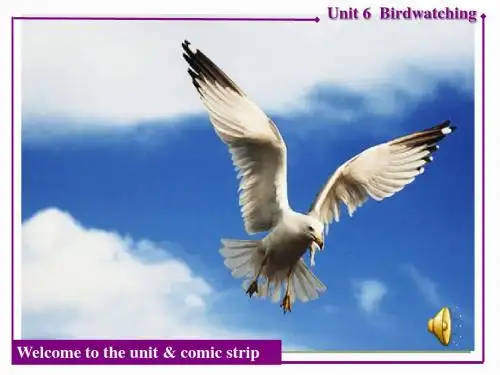
name favorite bird what do ...s look like?
They’re terrific!
1 Learn the new words by heart. 2 Read and act out the dialogue. 3 Describe your favourite bird.
What problems do birds have? (3 sentences)
What can we do for birds? (3 sentences)
WhThyesy’hreotuelrdrifiwc!e do these things for birds? (3 sentences)
about bird. Listen and answer the
questions below:
1 What’s Simon’s favorite bird?
Cranes.
2 What do they look like?
They are tall and they have long legs and a long thin neck.
B: They ...
Name Size
Feather
sparrow small brown and grey feathers
A: What do swans look like?
B: They ...
Name Feathers Neck swan white long, thin
牛津译林版英语八上Unit 6《Birdwatchers》(welcome)教学设计

牛津译林版英语八上Unit 6《Birdwatchers》(welcome)教学设计一. 教材分析牛津译林版英语八上Unit 6《Birdwatchers》主要介绍了关于观鸟的知识。
通过本单元的学习,学生将掌握观鸟的基本技巧、鸟类的主要特征以及如何保护鸟类等知识。
本单元包括两个部分:welcome部分和mn task部分。
welcome部分主要通过一幅漫画引出本课的主题,让学生对观鸟产生兴趣。
mn task部分则是一个关于鸟类观察的实践活动,学生需要运用所学知识完成任务。
二. 学情分析八年级的学生已经具备了一定的英语基础,对于动物类话题也相对熟悉。
然而,他们在阅读长篇文章时可能会遇到一些困难,特别是对于一些专业术语的理解。
因此,在教学过程中,需要帮助学生克服这些困难,提高他们的阅读理解能力。
此外,学生对于观察和实践活动比较感兴趣,可以充分利用这一点激发他们的学习兴趣。
三. 教学目标1.知识目标:学生能够掌握与观鸟相关的词汇和表达方式,如birdwatcher、habitat、protect等;了解鸟类的主要特征,如羽毛、翅膀、喙等;理解观鸟的基本技巧,如观察、记录、保护等。
2.能力目标:学生能够运用所学知识进行简单的阅读理解和口语表达,如描述鸟类特征、表达观鸟经历等。
3.情感目标:培养学生对大自然的热爱,提高他们的环保意识。
四. 教学重难点1.重点:观鸟相关的词汇和表达方式,鸟类的主要特征,观鸟的基本技巧。
2.难点:对于一些专业术语的理解,如habitat、protect等;如何运用所学知识进行实际操作。
五. 教学方法1.任务型教学法:通过设定各种任务,让学生在实际操作中运用所学知识,提高他们的实践能力。
2.情境教学法:创设各种真实的语境,帮助学生更好地理解和学习观鸟的相关知识。
3.合作学习法:鼓励学生分组讨论和合作完成任务,提高他们的团队协作能力。
六. 教学准备1.准备相关图片、视频等教学资源,以便在课堂上进行展示和讲解。
牛津译林版八年级英语上册Unit 6 Bird watching
1 I often go to the market to watch birds. 我经常去市场看鸟。 to watch birds 是动词不定式做目的状语
to protect 如:What action should we take__________(protect) the birds?
● 1) I 'm sorry to hear that.(原因) ● 2) It was too hot to go out.(结果)
当堂达标
用所给词的适当形式填空 1.Every year, we go _b_ir_d_w__at_c_h_in_g__(birdwatch)in the wetlands. 2.Cranes have long ___n_e_c_k_s____(neck). 3.How many ___t_y_p_es____(type) of cranes are there in the world?
Match the birds with the descriptions 1 Crane
tall, long legs
b
long thin neck
2 Sparrow
b
small
a
brown and grey feathers
3 Swan
long thin neck white feathers
Task 7: Discussion
What danger are birds facing? 1. Catching them for money. 2. Raising them at home. 3. Buying them for fun. …
What should we do to protect them? • Never buy them. • Try to tell others to protect them. • Make laws to protect them. …
牛津译林版八年级上册Unit 6《Bird watching》(Study skills)教学设计
牛津译林版八年级上册Unit 6《Bird watching》(Study skills)教学设计一. 教材分析《牛津译林版八年级上册Unit 6 Bird watching》主要介绍了鸟类观察这一主题。
通过本节课的学习,学生将能够掌握与鸟类观察相关的词汇和表达方式,提高听说读写的能力。
教材内容丰富,插图精美,激发了学生学习英语的兴趣。
本节课的教学内容与学生的日常生活紧密相连,有利于他们在实际生活中运用所学知识。
二. 学情分析八年级的学生已经具备了一定的英语基础,对于动物主题的课文较感兴趣。
但部分学生在英语学习中存在发音不准确、词汇量不足、语法掌握不牢固等问题。
因此,在教学过程中,需要关注学生的个体差异,因材施教,提高他们的英语素养。
三. 教学目标1.知识目标:学生能够掌握与鸟类观察相关的词汇和表达方式,理解课文内容。
2.能力目标:学生能够在实际情境中运用所学知识进行交流,提高听说读写的能力。
3.情感目标:培养学生热爱大自然、关注生态环境的意识。
四. 教学重难点1.重点:学生能够掌握与鸟类观察相关的词汇和表达方式。
2.难点:学生能够在实际情境中运用所学知识进行交流。
五. 教学方法1.情境教学法:通过设定鸟类观察的场景,让学生在实际情境中学习英语。
2.任务型教学法:通过完成观察鸟类的任务,提高学生的英语实践能力。
3.小组合作学习:鼓励学生分组讨论,培养团队合作精神。
六. 教学准备1.教师准备:提前熟悉教材内容,了解学生的学习状况。
2.学生准备:预习课文,了解鸟类观察的基本知识。
3.教学资源:准备与鸟类相关的图片、视频等教学素材。
七. 教学过程1.导入(5分钟)教师通过展示鸟类观察的图片,引导学生谈论自己最喜欢的鸟类,激发学生的学习兴趣。
2.呈现(10分钟)教师播放教材中的视频,让学生了解鸟类观察的基本知识。
随后,教师呈现课文标题和图片,引导学生预测课文内容。
3.操练(10分钟)教师引导学生跟读课文,纠正发音。
牛津译林版英语八年级上 Unit 6 Bird watching. (Integrated skil
Unit 6 Birdwatching (Integrated skills & speak up)【学习目标】1、会用本课所学新词汇;2、能听取一段英文广播,把握细节、获取所需的信息;3、会询问参加活动的建议并对别人的询问作出适当的反应。
【学习过程】背景知识:每年的2月2日是世界湿地日。
这是湿地国际联盟组织于1996年3月确定的。
从1997年起每年都确定一个不同的主题,利用这一天,政府机构组织和公民采取各种活动来提高公众对湿地价值和效益的认识,从而更好地保护湿地。
前期准备:1、划出课本75~76页的新词汇,并根据音标和读音规则读一读,不会读的请记录下来:______________________________________________________________ 234、通过预习,你还有哪些方面存在疑问?_____________________________ ____________________________________________________________________ 课堂活动:1、预习情况交流:讨论、解决预习中存在的问题。
2、听力技能训练:a、听第一遍,检查A1的答案;b、听第二遍,完成A3。
3、小组探讨学习76页的Speak up,学会询问参加活动的建议。
4、当堂反馈练习:根据句意和汉语提示,写出正确的词组。
1. The sitting room _________________________(占地面积为)12 square meters.2. His house is ____________________________(在…东北部)this city.3. The land area of China is about 9.6 million_________________(平方公里).4. Beijing___________________(是…所在地)many key universities.5. Would you like to __________________(去观鸟)with us at the wildlife park?world. You can __________them in South American , New Zealand, Australia and South Africa. Many penguins live near __________waters, but some live near warm waters in Galapagos Islands. Penguins cannot fly, but they are fine ____________. Penguins ___________ fish and krill(磷虾).Some kinds of penguins are in danger. The global warming (全球气候变暖)has __________ocean waters warmer. Warmer waters make it difficult for fish and krill to ___________. As a result, many penguins may ____________because they cannot find enough food. Too much fishing and other human activities are also___________ to penguins. The number of penguins is becoming ______________.拓展延伸:There are many different kinds of parrots. Some are quite big, others are very small. Many people like them not only because they often have beautiful colors, but they can “talk”. No one knows why parrots can talk. Most birds cannot. Some people say that parrots can talk because they have big, thin tongues. But some other birds that can talk do not have big, thin tongues. Parrots do not usually know what they are saying when they talk. They are only making sound. However, they know how to say some words, such as “Hello!” and “Goodbye”, and they usually know and can say their names.Most parrots come from hot countries, but they can live anywhere. This is one reason why sailors used to take them on long journeys. Perhaps another reason was that they wanted someone to talk to!1. People like parrots because they _______________________________.2. Parrots don’t know what they are talking, they just ______________________.3. Perhaps sailors took parrots with them on long journeys because ____________________________________.4. Some people say parrots can talk because ______________________________.5、当堂反馈小结:a、交流检查错误订正情况,老师巡视答疑。
牛津译林版八年级英语上册《nit 6 Birdwatching Integrated skills》优质课课件_18
Wuhu Bajiao School Tang Yeting
Step2 listen and get to know more
3. The reserve covers an area of over ____ square kilometres.
a. 453
Wuhu Bajiao School Tang Yeting
Step1 watch and come into the reserve world
1.Yancheng Nature Reserve is in ___Province in ____China.
a.Heilongjiang, North-east b. Hainan, South c. Jiangsu, East
a.453
b.4,530
c. 45,300
4.Yancheng is the ___ home to red-crowned cranes in China.
rgest b. second largest
c. third largest
5.About _____red-crowned cranes fly to Yancheng Nature
a. 100 to 300 b.300 to 1,000 c.1,000 to 3,000
6. In ____,Yancheng Nature Reserve became one of the world’s
most important wetlands.
a.1997
b. 2002
c.1992
Wuhu Bajiao School Tang Yeting
牛津译林版八年级英语上册《nit 6 Birdwatching Welcome to the unit》赛课导学案_2
Unit6 Birdwatching 教学设计Comic strip and Welcome to the unit一.教学目标1. To learn the common names of birds2. To talk about birds on two aspects: characteristics and appearance.3. To arouse the students’ interest in birds in the wild.二.教学重难点To learn the common names of birdsTo talk about birds on two aspects: characteristics and appearance.三.教学准备recorder and pictures四.教学方法Communication and description五.教学过程:Step 1 Presentation二次备课1.Warm- activities upPlay a piece of music called ‘ the seaside voice’(There issound by birds), then get the students to talk about it.e.g. Is it nice? (Yes)Where is the man playing the piano? (Near the sea)What’s near the sea? (Birds)Would you like to go and watch the birds near the sea? (Yes)Let’s go birdwatching. Let’s be birdwatchers.( Teach go birdwatching / birdwatcher)Ask the students to say the English names of some birds.2. Talking about birdsShow the pictures of different kinds of birds and talk aboutthem f ocusing on what’s special about the birds.Learn the new words (Revise some old words at the same time,like wing/ feather/ beak)Do Part AStep 2. Practice1.Show the pictures together and then get the students to givetheir names. Make sure all the students can read the names correctly.2. Play a game : reading and guessing (guess what bird it is.)E.g. I live in wetland. I am very tall. I have long beak, longneck and long legs. I have black and white feathers.Who am I? (a crane)3.Ask the students ‘Which is your favorite bird? Why?Practice Part B in pairsStep 3. ProductionMake up new conversations using Part B as a model and act them out.Step 4. Presentation1.Say: We love birds. Eddie loves birds, too. Listen to the tapeand find the answers to the following questions.1.)What is Eddie going to do?2.)Does he really love birds?3.)What kind of birds does he like best?2.Practice reading in pairs and try to act it outStep 5. Production1.Choose a kind of birds and describe its appearance using thenew words.plete the conversation.3.Translate into English.Homework:1. Copy the new words three times and recite them.2.Look for more information about birds.3.Write a short article about your favorite bird (characteristicsand appearance)4.Preview the new words in Reading (reading and reciting)5.Read ‘ Birds in Zhalong’ twice and try to do Part C1.教学反思:。
牛津译林版八年级英语上册《nit 6 Birdwatching Welcome to the unit》优质课课件_24
1.Please look for more information about bird reserves after class. 2. Preview Reading part.
Read and answer:
1. Why does Eddie often go to the market? He often goes to the market to watch the birds.
2. Does he really like watching the birds? No, he esn’t. He likes eating them.
It's as_w_a_n_, because it has
__l_o_n_g__t_h_i_n___neck_w_h__it_e__feathers
TALK
We’ve talked about many different kinds of birds. Annie and Simon are talking about birds too. Let’s listen to their conversation(对话) and answer these questions.
hen
[hen]
n. 母鸡
market
['mɑ:kit]
n. 市场
birdwatching ['bə:dwɔtʃiŋ] n. 观鸟
yummy
['jʌmi] adj. <口> 美味的,可口的
yeah
[jeə]
excl. <口> 是的
•Which birds do you think Eddie likes? He likes hens and ducks.