
(完整版)译林牛津七年级下学期英语语法总结
(完整版)译林牛津七年级下学期英语语法总结
译林牛津七年级下学期英语语法总结
Unit 1: Present tenses
- Simple Present tense: 一般现在时用于描述现在的常态、惯或真理
- Present Continuous tense: 现在进行时用于描述当前正在发生的动作
- Present Simple vs Present Continuous: 一般现在时和现在进行时的区别
Unit 2: Past tenses
- Simple Past tense: 一般过去时用于描述过去某个时间发生的动作或状态
- Past Continuous tense: 过去进行时用于描述过去某个时间正在进行的动作
- Simple Past vs Past Continuous: 一般过去时和过去进行时的区别
Unit 3: Future tenses
- Will + verb: 表示将来的决定、打算或预测
- Be going to + verb: 表示计划、意图或预测
- Future Continuous tense: 将来进行时用于描述将来某个时间正在进行的动作
- Future Simple vs Be going to: 将来时的两种表达方式的区别
Unit 4: Passive voice
- Active voice vs Passive voice: 主动语态和被动语态的区别
- How to form the passive voice: 构成被动语态的方法
- Passive voice with different tenses: 不同时态的被动语态形式
Unit 5: Modal verbs
- Can, could, may, might: 表示能力、允许或可能性
- Must, have to: 表示必须、责任或推测
- Should, ought to: 表示应该、建议或期望
Unit 6: Conditionals
- Zero conditional: 表示真理、自然法则或普遍情况 - First conditional: 表示可能性、条件或可能的反应
- Second conditional: 表示假设、不太可能的情况或对应的行动
- Third conditional: 表示虚构、过去的假设或悔恨
Unit 7: Reported speech
- Reporting verbs: 常用的引述动词
- Reporting statements: 直接引述陈述句的变化
- Reporting questions: 直接引述疑问句的变化
以上是译林牛津七年级下学期英语语法总结的内容。请根据实际需要进行详细阅读和理解。
牛津译林版英语七年级下册Unit3语法归纳及练习
1 7BU3语法归纳
一. 名词所有格
我们常用名词所有格来表示人或物的所有关系.
1. ‘s所有格
(1) 表示有生命的事物的所有格,一般在名词后加’s,如果名词是 以-s或-es结尾,就直接加”’”
例 the woman’s son
My friends’ hometown
(2) 表示时间\距离\国家\城镇等无生命事物的名词,也可以用’s 所有格
例 The boss gave me two days’ holiday.
China’s weather is quite different from south to north.
(3) 不以-s或-es结尾的不规则变化的名词复数,其所有格形式是在后面加’s
例 Children’s Day
(4) 表示两者或多人共同用有某物时,只在最后一个名词后面加’s, 表示两者或多人各自拥有时,要在每个名词后面加’s.
(5) 表示住宅,诊所,医院等时,名词所有格所修饰的中心词常被忽略.
例 at the doctor’s (office) go to my uncle’s (home)
2. of所有格
表示无生命事物的名词和一些表示动物类名词的所有格,常用of短语,放在中心词后面.
例 the door of the classroom a map of China
2 3. 双重所有格
如果of所有格和’s所有格,名词性物主代词连用,则构成双重所有格.
例 a friend of Li Lei’s several pens of mine
二. 物主代词
物主代词是表示人或物的所有关系的代词,它分为形容词性物主代词和名词性物主代词,有人称和数的变化.
1. 物主代词的种类
单数 复数
第一人称 第二人称 第三人称 第一人称 第二人称 第三人称
形容词性物主代词 my your his her its our your their
牛津译林英语七年级英语下册unit2neighbours知识点归纳
一、知识要点
1. Where are you going? 你打算去哪里?
be going此处为“现在进行时表将来”。现在进行时表将来主要用于表示按计划或安排将要发生的动作,常有“意图”“安排”或“打算”的含义。这种现在进行时比较生动,给人一种期待感。go, come, leave等表示位移的动词,都可以用于现在进行时表将来。
例如:He is going. 他要走了。
I’m coming. 我要来了。
Tom is leaving. 汤姆要走了。
2. I’m going to visit our new neighbours.我打算拜访我们的新邻居。
be going to意为“计划,打算”,后接动词原形,用于表将来。
例如:I’m going to wash the car if I have time. 若有时间我想洗洗车。
Where are we going to stay tonight? 我们今晚住哪里?
3. I’m afraid they won’t welcome visitors like you.恐怕他们不会欢迎像你一样的拜访者。
(1)welcome作及物动词,意为“欢迎’’,可与介‘词to连用;也可作形容词,意为“受欢迎的"。如:
Welcome you to our school! 欢迎到我们学校来!
You’re welcome.不用谢。
(2)句中like是介词,意为“像,相似’’,其反义词是unlike;作动词时,意为“喜欢’’,后可接动名词或不定式作宾语。如:
What is Jim like? 吉姆这个人怎么样?
They like playing football on Sunday.他们喜欢在星期天踢足球。
(3)won’t是will与not的缩略形式。“will+动词原形"也是一般将来时的构成之一。如:
牛津译林版七年级下册Unit知识点归纳
牛津译林版七年级下册Unit知识点归纳
LEKIBM standardization office【IBM5AB- LEKIBMK08- LEKIBM2C】
7B Unit1知识点归纳
一、短语
homes梦想家园 country 哪个国家 from/come from来自
next to紧邻,在…近旁 capital of……的首都 like to do sth/want to do sth想要做某事 in a
palace住在一个宫殿里 to a restaurant靠近一家饭店 favourite我的最爱
town 在镇上 biggest one 最大的那家 12. in Fifth Street在第五大街
13. all around the world在全世界 country每个国家 15. in the center of…在…的中心
16. the names of the countries国家的名字 17. in different countries在不同的国家
18. enjoy a cup of tea享受一杯茶 19. live in a small town住在一个小镇上
miles from London离伦敦15英里 21. watch TV/films看电视/电影
22. a large house一个大房子 a bedroom with my sister和我的姐姐共用一间卧室
to music (in bed)在床上听音乐 listening to music喜欢听音乐
译林版牛津英语七年级下册全册Unit2单元知识点及语法归纳
七年级英语下册知识点总结
Unit 2 Neighbours
一、重点词组、句型用法一、重点词组、句型用法
1. I am afraid they won`t welcome visitors like you.我恐怕他们不会欢迎向你这样的客人。我恐怕他们不会欢迎向你这样的客人。
be afraid to do sth 害怕去做某事害怕去做某事 be afraid of sth /doing sth.害怕某物/做某事做某事 be afraid+(that)从句welcome sb. 欢迎某人迎某人 welcome to sp.欢迎来到某地欢迎来到某地
like (prep)像 He, _______his elder brother, likes chatting with others.
I’m afraid so.恐怕是的。恐怕是的。 I’m afraid not. 恐怕不是这样的。恐怕不是这样的。
2.It`s good to live in a neighbourhood like that. 住在那样一个小区很好。住在那样一个小区很好。
It`s+形容词to do sth
3.What are your neighbours like?= How are you neighbours?你的邻居们(性格品质)如何?你的邻居们(性格品质)如何? What be sb/sth like?你认为…怎么样(性格品质)?(用形容词回答)?(用形容词回答)
What do/does sb. like?某人喜欢什么?某人喜欢什么?
What do/does sb. look like?某人长什么样子(外貌)?
4. They often meet at the community centre and share their different skills.
different +名词复数名词复数 5.Some of them are volunteers.他们中有一些人是志愿者。他们中有一些人是志愿者。
译林版牛津英语七年级下册全册Unites1-8单元知识点及语法归纳-9b69
学优家教学优家教 七年级下册英语七年级下册英语
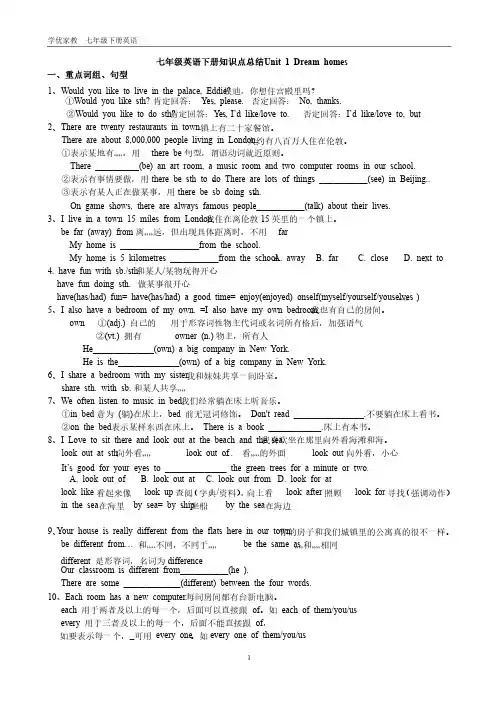
1 七年级英语下册知识点总结Unit 1 Dream homes
一、重点词组、句型
1、Would you like to live in the palace, Eddie? 埃迪,你想住宫殿里吗?埃迪,你想住宫殿里吗?
①Would you like sth? 肯定回答:肯定回答: Yes, please. 否定回答:否定回答: No, thanks.
②Would you like to do sth? 肯定回答:es, Yes, I’I’I’d like/love to. d like/love to. 否定回答:I’I’d like/love to, butd like/love to, but„
2、There are twenty restaurants in town. 镇上有二十家餐馆。镇上有二十家餐馆。
There are about 8,000,000 people living in London. 大约有八百万人住在伦敦。大约有八百万人住在伦敦。
①表示某地有„„,用there be 句型,谓语动词就近原则。句型,谓语动词就近原则。
There __________(be) an art room, a music room and two computer rooms in our school.
②表示有事情要做,用there be sth to do。 There are lots of things ___________(see) in Beijing..
③表示有某人正在做某事,用there be sb doing sth.。
On game shows, there are always famous people___________(talk) about their lives.
3、I live in a town 15 miles from London. 我住在离伦敦15英里的一个镇上。英里的一个镇上。
七年级下册译林版英语语法知识点
七年级下册译林版英语语法知识点
In the seventh grade of the Translated Forest version of English,
students will learn a variety of grammar knowledge points to improve
their language abilities. This article will introduce some of the key
grammar knowledge points in the seventh grade.
1. Simple present tense
The simple present tense is used to describe actions that happen
regularly or frequently. For example, "I brush my teeth every morning."
In this sentence, the simple present tense is used to describe a habit or
routine action.
2. Present continuous tense
The present continuous tense is used to describe actions that are
happening right now or are ongoing. For example, "I am watching a
movie." In this sentence, the present continuous tense is used to
describe an action that is happening at the moment.
3. Simple past tense
牛津译林版七年级英语下册Unit1知识点归纳
牛津译林版七年级英语下册Unit1知识点归纳
1.live in a palace 住在一个宫殿里
2.the capital of.. .的首都
3. share sth. with sb.与某人合用/分享某物
4.in size 在尺寸上
5. be full of 满是
6. some day 将来有一天,总有一天
7. call sb. back 回电话
8.next to 紧邻,在...近旁
9. in the centre of 在...的中心
10.look out at 向外眺望
11.be different from 与...与众不同
12. of one’s own 属于某人自己的
13.take a message 传个话,捎个口信
14.at the foot of 在...的脚下
1.--Would you like to live in a palace, Eddie?
埃迪,你想住宫殿吗?
--No. I’d like to live next to a restaurant.
不。我想住在饭店旁边。
2. Is Tokyo the capital of Japan ?
东京是日本的首都吗?
3. I always have fun with my dog there.
我总是和我的狗在那里玩得很开心。
4. I share a bedroom with my sister.
我和妹妹同住一间卧室。
5. I love to sit there and look out at the beach and the sea.
我喜欢坐在那儿,向外眺望海滩和大海。
6. Hello. May I speak to Daniel, please?
您好。我可以和丹尼尔通电话吗?
牛津七年级下册英语 语法及知识点归纳
1 / 5
牛津英语7B unit2语法
\'no\'and\'none\'
no 1.通常只用作形容词,后面必须跟名词,意思相当于not a (an)或者not
any。
2.不能和另一个限定词(冠词、物主代词或者指示词)连用。否则应该用none of。
1.I can\'t get there----there\'s no bus.
2.There were no letters for this morning.
3.No teachers were there, either.
none
1.通常用作代词,后面无需加名词,意思相当于no +名词。
2.none of…的意思是not any of…。当其用于句首时,如果none指代的是可数名词,那么后面的谓语动词既可以用单数,也可以用复数。
1.There is no milk in this bottle, and there is none in that bottle, either.
2.I like none of the food.
3.None of my friends live(s) near here.
实战演练:根据句意,选用no或none填空。
1. ______ students are in the classroom and there is _____ teacher in it ,either.
2. ---- Are there any books on the desk?---- No, there are ________.
3. Sorry I can\'t stop---- I have ______ time.
4. I\'ve read _______ of these books.
5. ______ of them came in time (按时).
2 / 5
6. She had ______ idea what I meant.
牛津译林版七年级英语下册Unit7语法知识点讲解 情态动词can,could和may的用法及感叹句
牛津译林版七年级英语下册Unit7语法知识点讲解
情态动词can,could和may的用法
情态动词can,could,may的用法
1.情态动词的定义
表示说话人对某一动作或状态的态度或表示主观设想。情态动词没有实际的词义,不能独立作谓语,后接动词原形,一起构成谓语。情态动词可表示命令、可能、请求、义务、能力、需要等。情态动词有can/could,may/might, must,shall/should,need等。如:
Ask Mr Hu. He may tell you the correct answer.
问问胡老师。他可能会告诉你正确的答案。
You shouldn’t do that.你不该做那件事。
Could you swim when you were five?你五岁时会游泳吗?
I must go now.我现在必须走了。
2. 情态动词can, could的用法
①表示能力。
can表示现在的能力,could表示过去的能力。
Last year Daniel couldn't play tennis.去年丹尼尔不会打网球。
—Can you play the piano?你会弹钢琴吗?
一Yes, I can.是的,我会。
②表示可能性。
Man can’t live without air.没有空气,人类不可能生存。
③表示许可(多用于口语)。 Can I sit here? 我可以坐在这里吗?
④表示请求。
比较委婉地向对方提出请求或征求意见时,could不表示过去,它与can此时没有时间上的差别,可以用can来代替,但could的语气比can的语气更委婉、客气。could主要用于疑问句中,不用于肯定句中,因此回答时要改用can,婉言拒绝请求可用“I’m afraid...”。
—Could I smoke here?我可以在这儿吸烟吗?
一I’m afraid you can’t.恐怕你不可以。
苏教版译林牛津初中英语语法总结(初一初二)(优选.)
word
1 / 3oo .. ..
kk...............................................................................................................................................................................................
补充:
1.句子的构成
初中一年级上语法
1.in,on,at表示时间的应用
in +parts of day(evening,morning,etc) /month/season/year
on + day (Sunday, etc)/date(1 July,etc)/parts of a special day( Sunday morning)/special
holidays(Children’s Day)
at + time of day (seven o’clock)/ age(6 years old)
2.频率副词
never, seldom,sometimes,often,usually,always
3.疑问副词的用法
what,which,who,whose,when,why,how
4.可数名词与不可数名词
5.some和any的用法
6.There be句型
7.现在进行时及动词+ing的用法
初中一年级下语法
1.序数词与基数词
2.一般将来时:will与shall、be going to
3.名词所有格
名字+’s,mine,yours,ours,theirs,his,hers,its
4.冠词 a,an, the的用法