
人教版四年级上Unit 4.What can you do
play football
read the book
Who can sing for the party?
Zoom.
What can Amy do for the party?
/u:/
zoo moo too
boot root shoot loot room broom groom loom doom soon moon noon spoon boon loon
/u/
good hood wood stood book cook look foot
/ʌ/
blood血液
Amy can make food.
Guess ! What Fra bibliotekan Mike do?
Mike can draw cartoons(卡通画).
Read, listen and chant.
I’m going to the zoo zoo. I’m going to the zoo. I’m going to look look at the animals. You can come, too too! I’m going to the zoo. I’m going to the zoo. I’m going to play football football. You can come, too!
See you!
• • • • •
字母"oo"读音掌握口诀 "oo"发[u:]最常见,非重音中要短念。 字母"k"前不能长,"好脚站木羊毛"短。 "血"与"水灾"真特殊,"oo"读 /ʌ/ 细分辨。 "oo"加"r"读作/ɔː/,"poor"读 /pɔː/ 好可怜。
flood洪水
oo字母读音口诀
oo读长还是短,记住口诀就简单。 k,t,d前读短音,四长例外很常见。 (boot,food,shoot,mood) 另有两词很特殊,“血(blood)”“洪水(flood)”读/ʌ/ 属少见。 其余都读长音/u:/,不信你去查查看。
1. 听录音,跟读Let’s spell部 分内容。 2.尝试拼读含oo字母组合的生 词。
人教版PEP五年级上册英语《Unit 4What can you do第四课时》教案
人教版PEP五年级上册英语《Unit 4What can you do第四课时》教案一. 教材分析《Unit 4 What can you do》第四课时主要围绕“询问和介绍人们的技能”展开,通过介绍职业和爱好,使学生能够运用所学知识进行简单的交流。
本课时主要涉及到情态动词can的用法,以及一般疑问句的构成。
教材内容丰富,插图形象生动,有利于激发学生的学习兴趣。
二. 学情分析五年级的学生已经具备了一定的英语基础,对于情态动词和一般疑问句已经有了一定的了解。
但是,学生在实际运用中还存在一定的困难,如发音不准确,句子结构混乱等。
因此,在教学过程中,需要注重学生的发音训练和句子结构的指导。
三. 教学目标1.能够听懂、会说、会读本课时的核心词汇和句型。
2.能够运用情态动词can和一般疑问句进行简单的交流。
3.能够正确表达自己的职业和爱好。
4.培养学生的团队协作能力和口语表达能力。
四. 教学重难点1.重点:掌握情态动词can的用法,一般疑问句的构成。
2.难点:正确运用情态动词can和一般疑问句进行实际交流。
五. 教学方法1.情境教学法:通过设定各种情境,让学生在实际环境中运用所学知识。
2.交际法:引导学生进行角色扮演,进行实际交流。
3.任务型教学法:通过完成各种任务,提高学生的综合语言运用能力。
六. 教学准备1.教学课件:制作精美的课件,配合教学内容。
2.人物图片:准备各种职业的人物图片,用于展示和交流。
3.教学道具:准备一些与职业相关的道具,如医生包、厨师帽等。
七. 教学过程1.导入(5分钟)利用课件展示各种职业的人物图片,引导学生谈论他们的职业。
如:“What does he/she do? What can he/she do?”,让学生复习职业词汇和情态动词can的用法。
2.呈现(10分钟)教师展示本课时的核心词汇和句型,如:“I can cook.”、“Can you dance?”等,引导学生跟读并模仿。
(完整版)人教版小学英语目录
英语三年级上册•全部课文o Unit1 Helloo Unit2 Colours!o Unit3 Look at meo Unit4 We Love Animalso Unit5 Let’s eato Unit6 Happy birthday•期中考试•期末考试三年级下册•全部课文o Unit1 Welcome back to school o Unit2 My familyo Unit3 At the zooo Unit4 Where is my car?o Unit5 Do you like pears?o Unit6 How many?•期中考试四年级上册•全部课文o Unit1 My Classroomo Unit2 My Schoolbago Unit3 My Friendso Unit4 My Homeo Unit5 What Would You Likeo Unit6 Meet My Family•期中考试•期末考试四年级下册•全部课文o Unit1 Our Schoolo Unit2 What Time Is It?o Unit3 Is This Your Skirt?o Unit4 It' s Warm Todayo Unit5 How Much Is It?o Unit6 At a Farm•期中考试五年级上册•全部课文o Unit1 My New Teacherso Unit2 My Days of the Weeko Unit3 What's Your favorite food?o Unit4 What Can You Do?o Unit5 My New Roomo Unit6 In a Nature Park•期中考试•期末考试五年级下册•全部课文o Unit1 This Is My Dayo Unit2 My Favourite Seasono Unit3 My Birthdayo Unit4 What Are You Doing?o Unit5 Look at the Monkeys?o Unit6 A Field Trip•期中考试六年级上册•全部课文o Unit1 How Do You Go There?o Unit2 Where Is the Science Museum?o Unit3 What Are You Going to Do?o Unit4 I Have a Pen Palo Unit5 What Does She Do?o Unit6 The Story of Rain•期中考试•期末考试六年级下册•全部课文o Unit1 How Tall Are Youo Unit2 What's the Matter,Mike?o Unit3 Last Weekendo Unit4 My Holidayo Unit5 Let's Take a Trip!o Unit6 A Farewell Party•期中考试期末考试。
人教版五年级英语上册Unit4WhatcanyoudoPartA同步练习
Unit 4 What can you do? Part A【精讲精练】1.询问对方能做什么的句型----What can you do?答语----I/We can +动词原形(+其他)。
【口诀记忆】cɑn表示“能”和“会”,动词原形后面站;不管人物如何换;cɑn的模样永不变。
2.表达会做某事: 人(I/He/She...) + can +动词原形(+其他)表达不会做某事:只需在can后加not(1)I cɑn drɑw cɑrtoons.我会画漫画。
(2)I cɑn't/ can not drɑw cɑrtoons.我不会画漫画。
3.We’ll have an English party next Tuesday!下周二我们将举行一个英语聚会!句中We’ll=We will,will意为“将要”,后面接动词原形例: I will play football next Monday.我下周一要去踢足球。
I’ll (read /reads)books next Wednesday.【课后练习】一、选出不同类的一项。
①________ A. do kung fu B. go to bed C.living room②________ A. party B. draw C. song③________ A. great B. wonderful C.play④________ A. juice B. hot dog C. ice cream⑤________ A. pipa B.basketball C. piano 二、选择填空。
()1.当你想问对方“你会做什么”时,你说:_____________.A. What can you do?B. What do you do?C. What will you do?()2.当你想告诉对方“我会画卡通画”时,你说:_________.A. I can speak English.B. I can sing English songs.C. I can draw cartoons. ()3. — What can you do _____ the party?— I can dance.A. forB. toC. Of()4.My sister can ______English songs.A. singsB. singC. singing()5. Can you play ______ pipa?A. /B. anC. the()6. I ______ play football but I can sing English songs.A. canB. can’tC. am()7. — _______ can you do, Wu Yifan.— I can draw pictures.A. WhoB. WhereC. What()8.当你想告诉对方“下周二我们将会进行英语派对”时,你说: ___________________.A. We will have an English party next Tuesday.B. We have an English party on Tuesday.C. We will have a party next Tuesday.三、选词填空,使句意完整。
人教版英语课本目录(小学初中高中)
人教版英语课本目录(小学初中高中)小学Welcome to English三年级上册Unit 1 HelloUnit 2 Look at meUnit 3 Let's PaintRecycle 1Unit 4 We Love AnimalsUnit 5 Let's EatUnit 6 Happy BirthdayRecycle 2Words in Each Unit(单元词汇表)Vocabulary(词汇表)三年级下册Unit 1 Welcome back to schoolUnit 2 My familyUnit 3 How many?Recycle 1Unit 4 Do you like pears?Unit 5 Where is my ruler?Unit 6 At the zooRecycle 2Word in Each UnitVocabulary 四年级上册Unit 1 My ClassroomUnit 2 My SchollbagUnit 3 My FriendsRecycle 1Unit 4 My HomeUnit 6 Meet My Family!Recycle 2Words in Each Unit(单元词汇表)Vocabulary(词汇表)四年级下册Unit 1 Our SchoolUnit 2 What Time Is It?Unit 3 Is This Your Skirt?Recycle 1Unit 4 It’s Warm TodayUnit 5 How Much Is It?Unit 6 At a FarmRecycle 2Words in Each UnitVocabulary五年级上册Unit 1 My New TeachersUnit 2 My Days of the WeekUnit 3 What's Your Favourite Food?Recycle 1Unit 4 What Can You Do?Unit 5 My New RoomUnit 6 In a Nature ParkRecycle 2Words in Each Unit(单元词汇表)Vocabulary(词汇表)五年级下册Unit 1 This Is My DayUnit 2 My Favourite SeasonUnit 3 My BirthdayRecycle 1Unit 5 Look at the MonkeysUnit 6 A Field TripRecycle 2Words in Each UnitVocabulary六年级上册Unit 1 How Do You Go There?Unit 2 Where Is the Science Museum? Unit 3 What Are You Going to Do? Recycle 1Unit 4 I Have a Pen PalUnit 5 What Does She Do?Unit 6 The Story of RainRecycle 2Words in Each UnitVocabulary六年级下册Unit 1 How Tall Are You?Uni t 2 What’s the Matter, Mike?Unit 3 Last WeekendUnit 4 My HolidayRecycle 1 Let’s Take a Trip!Recycle 2 A Farewell PartyWords in Each Unit(单元词汇表)Vocabulary(词汇表)初中七年级上册预备篇Starter Unit 1 Good morning! Starter Unit 2 What’s this in E nglish? Starter Unit 3 What color is it?Unit 1 My name’s Gina.Unit 3 This is my sister.Unit 4 Where’s my backpack?Unit 5 Do you have a soccer ball?Unit 6 Do you like bananas?Unit 7 How much are these pants? Unit 8 When is your birthday?Unit 9 Do you want to go to a movie? Unit 10 Can you play the guitar?Unit 11 What time do you go to school? Unit 12 My favorite subject is science. Words and Expressions in Each Unit 七年级下册Unit 1 Where’s your pen pal fro m? Unit 2 Where’s the post office?Unit 3 Why do you like koalas?Unit 4 I want to be an actor.Unit 5 I’m watching TV.Unit 6 It’s raining!Unit 7 What does he look like?Unit 8 I ’d like some noodles.Unit 9 How was your weekend?Unit 10 Where did you go on vacation? Unit 11 What do you think of game shows? Unit 12 Don’t eat in class.Words and Expressions in Each Unit八年级上册Unit 1 How often do you exercise?Unit 2 What’s the matter?Unit 3 What are you doing for vacation? Unit 4 How do you get to school?Unit 5 Can you come to my party?Unit 6 I’m more outgoing than my sisiter. Unit 8 How was your school trip?Unit 10 I’m going to be a basketball player. Unit 11 Could you please clean your room? Unit 12 What’s the best radio station? Words and Expressions in Each Unit八年级下册Unit 1 Will people have robots?Unit 2 What should I do?Unit 3 What were you doing when the UFO arrived?Unit 4 He said I was hard-working.Unit 5 If you go to the party, you’ll have a great time!Unit 6 How long have you been collecting shells?Unit 7 Would you mind turning down the music?Unit 8 Why don’t you get her a scarf?Unit 9 Have you ever been to an amusement park?Unit 10 It’s a nice day, isn’t it?Words and Expressions in Each Unit九年级全一册Unit 1 How do you study for a test?Unit 2 I used to be afraid of the dark.Unit 3 Teenagers should be allowed to choose their own clothes.Unit 4 What would you do?Unit 5 It must belong to Carla.Unit 6 I like music that I can dance to.Unit 7 Where would you like to visit?Unit 8 I’ll help clean up the city parks.Unit 9 When was it invented? Unit 10 By the time I got outside, the bus had already left.Unit 11 Could you please tell me where the restrooms are?Unit 12 You’re supposed to shake hands.Unit 13 Rainy days make me sad.Unit 14 Have you packed yet?Unit 15 We’re trying to save the manatees! Words and Expressions in Each Unit高中必修一Unit 1 FriendshipUnit 2 English around the worldUnit 3 Travel journalUnit 4 EarthquakesUnit 5 Nelson Mandela - a modern hero必修二Unit 1 Cultural relicsUnit 2 The Olympic GamesUnit 3 ComputersUnit 4 Wildlife protectionUnit 5 MusicWorkbookUnit 1 Cultural relicsUnit 2 The Olympic GamesUnit 3 ComputersUnit 4 Wildlife protectionUnit 5 MusicAppendices附录Notes to the texts课文注释Grammar语法Words and expressions in each unit各单元生词和习惯用语Vocabulary词汇表Irregular verbs不规则动词Changes in international phonetic symbols for English英语国际音标变化表必修三Unit 1 Festivals around the worldUnit 2 Healthy eatingUnit 3 The Million Pound Bank NoteUnit 4 Astronomy:the science of the stars Unit 5 Canada—"The True North" WorkbookUnit 1 Festivals around the worldUnit 2 Healthy eatingUnit 3 The Million Pound Bank NoteUnit 4 Astronomy: the science of the stars Unit 5 Canada—"The True North" Appendices附录Notes to the texts课文注释Grammar语法Words and expressions in each unit各单元生词和习惯用语Vocabulary总词表Irregular verbs不规则动词Changes in international phonetic symbols for English英语国际音标变化表必修四Unit 1 Women of achievementUnit 2 Working the landUnit 3 A taste of English humourUnit 4 Body languageUnit 5 Theme parks必修五Unit 1 Great scientistsUnit 2 The United KingdomUnit 3 Life in the futureUnit 4 Making the newsUnit 5 First aid WorkbookUnit 1 Great scientistsUnit 2 The United KingdomUnit 3 Life in the futureUnit 4 Making the newsUnit 5 First aidAppendices附录Notes to the textGrammarWord and expressions in each unit VocabularyIrregular vebsChanges in international phonetic symbols for English后记必修六Unit 1 ArtUnit 2 PoemsUnit 3 A healthy lifeUnit 4 Global warmingUnit 5 The power of natureWorkbook Unit 1 ArtWorkbook Unit 2 PoemsWorkbook Unit 3 A healthy life Workbook Unit 4 Global warming Workbook Unit 5 The power of nature Appendices Notes to the texts Appendices GrammarAppendices Words and expressions in each unitAppendices VocabularyIrregular VerbsChanges in international phonetic symbols for English后记必修七Unit 1 Living wellUnit 2 RobotsUnit 3 Under the seaUnit 4 SharingUnit 5 Travelling abroadWorkbookUnit 1 Living wellUnit 2 RobotsUnit 3 Under the seaUnie 4 SharingUnit 5 Travlling abroadAppendices附录Botes to the textGrammarWord and expressions in each unit Vocabulary Irregular verbsChanges in international phonetic symbols for English 后记必修八Unit 1 A land of diversityUnit 2 CloningUnit 2 Inventors and inventionsUnit 4 PygmalionUnit 5 Meeting your ancestorsWorkbookUnit 1 Aland of diversityUnit 2 CloningUnit 3 Inventors and inventionsUnit 4 PygmalionUnit 5 Meeting your ancestors Appendices附录Notes to the textGrammarWords and expressions in each unit VocabularyIrregular verbsChanges in international phonetic symbols for English 后记必修九unit1Breaking recordsunit2Sailing the oceansunit3Australia unit4Exploring plantsunit5Inside advertising必修十Unit1Nothing ventured,nothing gained Unit2King LearUnit3Fairness for allUnit4Learning efficientlyUnit5Enjoying novelsAppendices附录必修十一Unit1New ZealandUnit2Detective storiesUnit3Finding the correct perspective Unit4Legends of ancient GreeceUnit5Launching your career Appendices附录。
小学英语_Unit4Myhome教学设计学情分析教材分析课后反思
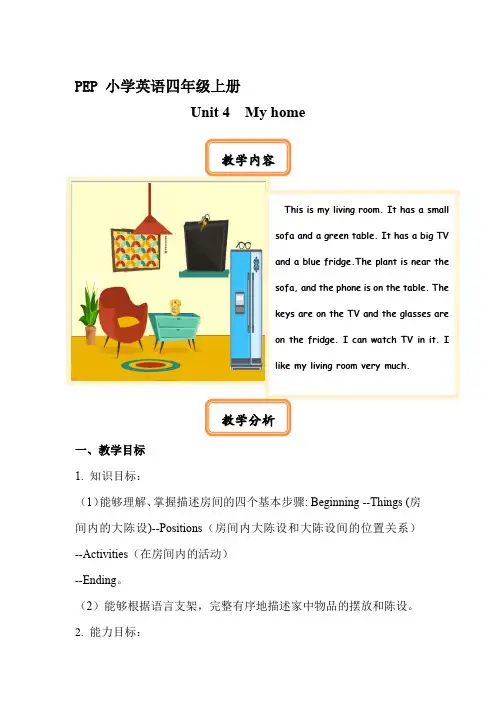
PEP 小学英语四年级上册Unit 4 My home教学内容This is my living room. It has a smallsofa and a green table. It has a big TVand a blue fridge.The plant is near thesofa, and the phone is on the table. Thekeys are on the TV and the glasses areon the fridge. I can watch TV in it. Ilike my living room very much.教学分析一、教学目标1.知识目标:(1)能够理解、掌握描述房间的四个基本步骤: Beginning --Things (房间内的大陈设)--Positions(房间内大陈设和大陈设间的位置关系)--Activities(在房间内的活动)--Ending。
(2)能够根据语言支架,完整有序地描述家中物品的摆放和陈设。
2. 能力目标:(1)能够对如何描述房间有了比较清晰、全面的认识。
(2)能够根据教师的引导,进行完整、有序地口语表达,并在表达时关注语言的逻辑顺序和句式结构。
3. 情感态度、学习策略目标:(1)通过本课的学习,培养和保持学生的英语学习兴趣。
(2)引导学生注重合作学习,培养合作、沟通、交流的意识和能力。
(3)培养学生爱自己的家、爱自己的家人的情感。
二、教学重难点分析1. 教学重点为根据描述房间的步骤,有序地、完整地描述房间中物品的摆放和陈设。
2. 难点为关于房间大陈设与小陈设之间位置关系的描述,即The...is/are..., and the...is/are...是本节课的难点。
三、课前准备CAI,Word cards教学过程What room is it? What’s in the rooms?扣,不仅复习了本单元的重点单词、句型,还激发了学生的学习兴趣,创建和谐快乐的课堂氛围。
《Unit4Whatcanyoudo?》作业设计方案-小学英语人教PEP版五年级上册
《What can you do?》作业设计方案(第一课时)一、作业目标本课时的作业设计旨在巩固学生对“What can you do?”句型的理解与运用,通过实际操作和互动交流,提高学生的英语口语表达能力和实际运用能力,同时增强学生的学习兴趣和合作意识。
二、作业内容作业内容主要包括以下四个部分:1. 口头练习:学生需在家中与家长进行对话练习,使用“What can you do?”句型询问家长能做什么,并记录下至少三个不同的回答。
此环节旨在加强学生的口语表达能力和听力理解能力。
2. 制作任务卡:学生需动手制作一张任务卡,内容包括自己擅长的一项活动或技能,并用英语描述。
例如,“I can dance.” “I can play the piano.”等。
此环节旨在培养学生的动手能力和创意表达能力。
3. 小组互动:学生需在小组内进行角色扮演活动,每个小组选择一个话题,如“家务劳动”、“学校活动”等,小组成员轮流使用“What can you do?”句型进行交流,并记录下小组内每个成员至少一个不同的回答。
此环节旨在提高学生的合作能力和实际运用能力。
4. 家庭调查:学生需在家中进行一次家庭成员的技能调查,记录下家庭成员能做什么,并用英语进行简单描述。
此环节旨在拓展学生的观察能力和社交能力,同时增加家庭互动。
三、作业要求1. 口头练习要求真实、自然,尽量模拟真实生活场景;2. 制作任务卡要求内容具体、清晰,用英语准确描述自己的技能;3. 小组互动要求积极参与、认真倾听,确保每个成员都有发言机会;4. 家庭调查要求细致观察家庭成员的技能,用英语进行简单而准确的描述;5. 所有作业内容需在规定时间内完成,并保持字迹工整、清晰。
四、作业评价教师将根据以下标准对学生的作业进行评价:1. 能否正确使用“What can you do?”句型进行交流;2. 口头练习和家庭调查的内容是否真实、自然;3. 任务卡和小组互动的创意和实用性;4. 作业的完成情况和字迹工整程度。
人教版PEP五年级上册英语《Unit 4What can you do第四课时》教案
人教版PEP五年级上册英语《Unit 4What can you do第四课时》教案一. 教材分析《Unit 4 What can you do》是人教版PEP五年级上册英语第四课时,本课时主要让学生学习并掌握日常交际用语中的“What can you do?”“I can…”等句型,并能够运用这些句型进行简单的问答。
通过本课时学习,学生能够提高自己的语言运用能力和交际能力。
二. 学情分析五年级的学生已经掌握了基本的日常英语交际用语,对于新句型的学习接受能力较强。
但是,部分学生在口语表达和听力理解方面还存在一定的困难,需要教师的耐心引导和反复练习。
三. 教学目标1.知识目标:学生能够掌握并运用“What can you do?”“I can…”等句型进行简单的问答。
2.能力目标:学生能够提高自己的语言运用能力和交际能力。
3.情感目标:学生能够积极参与课堂活动,增强学习英语的兴趣。
四. 教学重难点1.重点:学生能够准确地模仿和运用“What can you do?”“I can…”等句型。
2.难点:学生能够在实际情景中灵活运用所学句型进行问答。
五. 教学方法1.情境教学法:通过设置各种真实的生活情境,让学生在实际语境中学习和运用英语。
2.互动教学法:教师与学生、学生与学生之间的互动,提高学生的参与度和积极性。
3.游戏教学法:通过设计有趣的英语游戏,让学生在轻松愉快的氛围中学习英语。
六. 教学准备1.教学课件:制作与本课时内容相关的课件,包括图片、动画、视频等。
2.教学卡片:准备与本课时相关的单词和句型的卡片。
3.教学道具:准备一些与本课时内容相关的道具,如玩具、图片等。
七. 教学过程1.导入(5分钟)教师通过播放一首英文歌曲,引导学生跟着歌曲一起唱,营造轻松愉快的课堂氛围。
然后,教师提问:“Can you sing? Can you dance?”等问题,引导学生回答:“I can…”句型,引出本课时主题。
人教版(PEP)英语五年级上册《Unit 4 What can you do》( 第一课时)教案
人教版(PEP)英语五年级上册《Unit 4 What can you do》(第一课时)教案一. 教材分析《PEP英语》五年级上册Unit 4 “What can you do?”主要讲述了人们的能力和兴趣。
通过本节课的学习,学生能够掌握询问和描述人们能力和兴趣的交际用语,提高他们的听说能力和语言运用能力。
本节课的主要内容包括:Can you…?Yes, I can./ No, I can’t. What can you do? I can… 以及询问别人喜欢做什么的交际用语。
二. 学情分析五年级的学生已经具备了一定的英语听说能力,对学习英语有较高的兴趣。
在学习过程中,他们能够积极参与课堂活动,但部分学生的语言表达能力和交际能力仍有待提高。
因此,在教学过程中,教师需要关注学生的个体差异,给予他们更多的机会和实践机会。
三. 教学目标1.知识目标:学生能够听懂、会说、会读本节课的主要单词和句型,如“Can you…?”, “Yes, I can./ No, I can’t.”, “What can you do?”等。
2.能力目标:学生能够在真实情境中运用所学语言进行交流,提高他们的语言运用能力。
3.情感目标:培养学生积极学习英语的兴趣,增强他们的自信心。
四. 教学重难点1.重点:学生能够掌握本节课的主要单词和句型,并在实际情境中进行运用。
2.难点:学生能够正确使用“Can you…?”来询问别人的能力和兴趣,并能用“Yes, I can./ No, I can’t.”进行回答。
五. 教学方法1.任务型教学法:通过设置不同的任务,让学生在完成任务的过程中运用所学知识,提高他们的实际运用能力。
2.情境教学法:创设真实的情境,让学生在实际情境中进行交际,提高他们的交际能力。
3.小组合作学习:通过小组合作完成任务,培养学生的团队合作精神,提高他们的语言表达能力。
六. 教学准备1.教学课件:制作精美的课件,辅助教学。
Unit4Whatcanyoudo?知识梳理与单元知识归纳总结(讲义)人教PEP版英语五年级上册
[文档标题]四年级秋季班✓任务单每天读一遍!✓SPEAK LOUD!宝贝儿们,要大声读哦!➢家长+老师+学校共助孩子美好未来!➢让我们的孩子快乐学习,健康成长!人教版Unit4 What can you do?1.swim 游泳【动词ing形式】swimming 【短语】go swimming 去游泳【例句】I often swim in summer .我经常在夏天游泳。
2.speak English 说英语【联想】speak Chinese 说汉语【例句】We sometimes speak English after class .我们有时在课后说英语。
3.play basketball 打篮球【联想】play football 踢足球【例句】We can play basketball . 我们会打篮球。
4.pingpong 乒乓球【短语】play pingpong打乒乓球【例句】She is a good pingpong player .她是一名优秀的乒乓球运动员。
5.sing (动词)唱,唱歌song (名词)歌曲【短语】sing English songs唱英文歌曲【例句】I can sing English songs. 我会唱英文歌。
6. kung fu 功夫,武术【短语】do kung fu练武术【例句】He can do some kung fu. 他会练武术。
7.draw 画【短语】draw cartoons 画漫画draw pictures 画画【例句】She can draw cartoons. 她会画漫画。
8. many许多【例句】There are many students in the classroom.在教室里有许多学生。
9.problem 问题【短语】no problem没问题10.wonderful 极好的,了不起的【短语】a wonderful time 一段美好的时光11. send 邮寄,发送.email电子邮件【短语】send an email 发邮件12.next 下一个的,紧接着的【短语】next weekend 下周末【例句】We will have an English party next weekend.下周末我们将举行一个英语派对。
人教版PEP小学英语五年级上册Unit-4-What-Can-You-Do-教案及教学反思
人教版PEP小学英语五年级上册Unit-4-What-Can-You-Do-教
案及教学反思
一、教学背景
此篇教案是为了五年级英语课程中Unit 4 What Can You Do 的教学而设计,主要针对小学生的实际情况和学习特点,旨在帮助学生快速掌握该课程知识。
二、教学目标与要求
根据小学生的认知特点和学习规律,本课教学的目标和要求如下:
1.语言知识目标
1.认识并能够正确书写五个本单元所学的动词:read、sing、dance、
draw、swim;
2.理解并能够正确表达以下的句子:
•What can you do?
•I can read, sing, dance, draw, swim.
2.语言技能目标
1.培养学生的口语表达能力;
2.提高学生听、说、读英语的能力。
3.情感态度目标
1.通过本课的学习,培养学生对多样化的艺术表达方式的兴趣;
2.培养学生具有积极向上的学习态度和信心。
三、教学内容
本课教学内容主要包括以下三部分:
1.重点词汇
1.read;
2.sing;
3.dance;
4.draw;
5.swim.
2.教学内容
1.教师教授本单元所学的五个动词;
2.教师引导学生口头运用本单元所学的动词,回答。