
小学四年级-一般现在时,进行时,将来时
•用括号内动词的适当形式填空。
1. He ofte n _______ (have) dinner at home.2. Dan iel and Tommy _____ (be) in Class One.3. We ______ (not watch) TV on Mo nday.4. Nick _______ (not go) to the zoo on Sun day.5. _____ they _______ (like) the World Cup?6. What _______ they often ______ (do) on Saturdays?7. _____ your pare nts _______ (read) n ewspapers every day?8. The girl _______ (teach) us En glish on Sun days.9. She and I ______ (take) a walk together every eve ning.10. There _______ (be) some water in the bottle.11. Mike ______ (like) cooki ng.12. They ______ (have) the same hobby.13. My aunt _______ (look) after her baby carefully.14. You always _______ (do) your homework well.15. I _______ (be) ill. I 'm stayi ng in bed.16. She _______ (go) to school from Mon day to Friday.17. Liu Tao ______ (do) not like PE.18. The child ofte n ______ (watch) TV in the eve ning.19. Su Hai and Su Yang _______ (have) eight less ons this term.20. —What day ______ (be) it today? —It's Saturday.二•按照要求改写句子1. Daniel watches TV every evening.( 改为否定句)2. I do my homework every day.(改为一般疑问句,作否定回答)3. She likes milk.(改为一般疑问句,作肯定回答)4. Amy likes playing computer games.( 改为一般疑问句,作否定回答)5. We go to school every morning.(改为否定句)6. He speaks English very well.(改为否定句)7. I like taking photos in the park.(对划线部分提问)8. John comes from Canada.(对划线部分提问)9. She is always a good student.(改为一般疑问句,作否定回答)10. Sim on an d Dan iel like goi ng skati ng.(改为否定句)1 .现在进行时表示现在正在进行或发生的动作,也可表示当前一段时间内的活动或现阶段正在进行的动作。
2 .现在进行时的肯定句基本结构为be (is/am/are)+动词ing.3. 现在进行时的否定句在be后加not。
4. 现在进行时的一般疑问句把be动词调到句首。
eg. He is doing his homework now? ------------ Is he doing his homework now?5. 现在进行时的特殊疑问的基本结构为:疑问词+ be + 主语+ 动词ing? eg. Where are you going?但疑问词当主语时其结构为:疑问词+ be + 动词ing? eg. Who is singing?6. 标志词:Look! Liste n! now动词现在分词的变化见下表:、写出下列动词的现在分词:play _______ run __________ swim __________ make _____ _____ go ________ write _________ski __________ read ________ have _________ dance ____ ____ put _________ see ________buy _________ love ____________ live _______ take ______ ___ come _________ get _________stop _________ sit _________ begin ________ shop ________二、用所给的动词的正确形式填空:1. Listen .Some girls ________________ (sing)in the classr oom .2. What _____ you _______ ( do ) now?3. Look . They ________________ ( have) an English lesson .4. They ___________ (not ,water) the flowers now.5. Look! the girls _________________ (dance )in the classro om .6. What is our granddaughter doing? She _____________ (listen )to music.7. It ' S o' clock now. We ________________ (have)supper no w8. ____ H elen ____________ (wash )clothes? Yes ,she is .三、句型转换:1. They are doing housework .(分别改成一般疑问句和否定2. The students are cleaning the classroom .(改一般疑问句并作肯定和否定回答)3. I ' nplaying the football in the playground .(对划线部分进行提问)4. Tom is reading books in his study .(对划线部分进行提问)一般将来时一、按要求填空1. 我打算明天和朋友去野炊。
I _____________________ have a picnic with my friends. I ________ h ave a pic nic with my frie nds. 2.下个星期一你打算去干嘛?我想去打篮球。
What ____________________________________________ next Monday? I ___________________ p lay basketball. What _________ you do next Mon day? I ________ play basketball.3•你妈妈这个周末去购物吗?是,她要去买一些水果。
your mother go shopping this ? Y es, she . She buy some fruit.4•你们打算什么时候见面。
What time ______ you ____________________ meet?二、改句子。
5. Nancy is going to go camping.(改否定)Nancy _______ going to go camping. 6. ' ll go and join them.(改否定)I ________ go ______ j oin them.7.1 ' m going to get up at 6:30 tomorrow.(改一般疑问句)_____________________________ to get up at 6:30 tomorrow? 8. We will meet at the bus stop at 10:30. (改一般疑问句)meet at the bus stop at 10:30.9. She is going to listen to music after school.(对戈U 线部分提问)she after scho ol? 10. My father and mother are going to see a play the day after tomorr ow.(上) __________________ g oing to see a play the day after tomorro w三、用所给词的适当形式填空11. Today is a sunny day. We ___________________ (have) a pic nic thisafter noon. 12. My brother _______________ (go) to Shan ghai next week13. Tom ofte n _____________ (go) to school on foot. But today is rain.He _____________ (go) to school by bike.14. What do you usually do at weeke nds? I usually ______ (watch) TVand _______ (catch) in sects?15. It 'Friday today. What _____ she ________ (do) this weekend? She_____________ (watch) TV and _____________ (catch) insects.16. What ___________ (d0) you do last Sun day? I ___________ (pick)apples on a farm.What ______________ (do) next Sunday? I ___________ (milk) cows17. Mary ___________ (visit) her gran dpare nts tomorrow. 18. Liu Tao___________ (fly) kites in the playgro und yesterday. 19. David ______ (give) a puppet show n ext Mon day. 20. I _____________________________ ( pla n) for my study now.四、连词成句并按要求改变句式(注意动词的正确形式)1、childre n , at , study , home , will , on, computer , in the future肯定陈述句:一般疑问句:2、back , they , month , later , a , get , will肯定陈述句:否定句:。
人教版小学英语语法--时态总结(一般现在时-一般过去式-现在进行时-一般将来时)
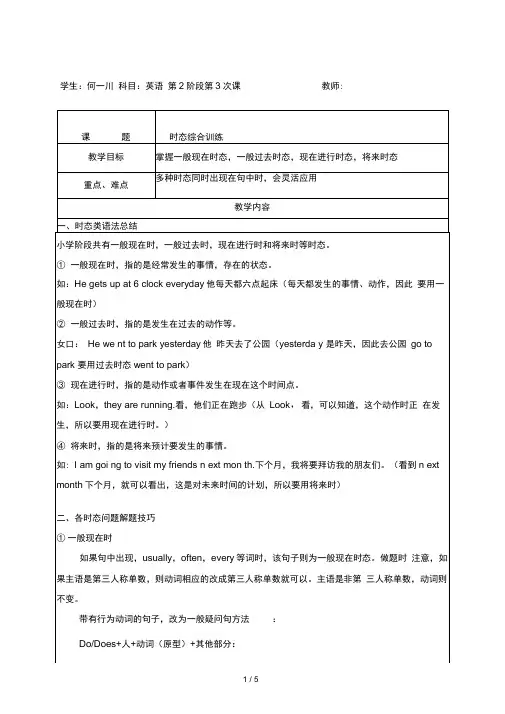
学生:何一川科目:英语第2阶段第3次课教师:学生:何一川科目:英语第2阶段第3次课教师:带有Be动词的句子,改为一般疑问句的方法:Be+人+其他:He is a good student.-----s he a good student?(第三人称单数用does开头,非第三人称单数用do开头,一二人称互换,l--You,We-You)例题:I usually go to school by bike. --------- Do you usually go to school by bike? (该句人称要互换)He ofte n watches TV on Sundays- ------ D oes he ofte n watch TV on Sun days?They often play football after dinner. ----------- Do they often play football after dinn er?②一般过去时女口果句中出现,last week/last weekend/last month/last year yesterday the day before yesterday X days ago (其中,last是“上一” d的意思,ago是“…前”的意思)等词时,该句子则为一般过去时态。
做题时,只要把动词,改成过去时态。
关键是记忆总结不规贝U动词的过去式。
如:go---went,do---did,swim--swam例题:I visited my grandmother last weekend.They bought a new bike10 days ago.He was ill yesterday.改为一般疑冋句:Did +人+动词(原型)+其他?③现在进行时如果句中出现,look,listen,now等词(看,XX正在做某事;听,XX正在做某事;现在,XX正在做某事)。
一般现在时-现在进行时-一般过去时-过去进行时-一般将来---改
2) 表示有迹象表明即将发生的动作。 Look at the clouds in the sky, it’s going to rain . 瞧天上的云, 就要下于了。 3) go , come ,leave等表示位置移动的动词 用进行时表示将来。 He is leaving for Beijing next week . 他下星期将去北京。 I’m going to the teachers’ office. 我打算去老师的办公室。
left 7.They ____(leave) for England two days ago. did you_____(see) see 8.When ____ the film last week?
9.Who helped _______(help) the old man? John did ____(do).
特殊疑问句 疑问词+shall/will+主语+ +动词原形+ (其它成分)? Shall用于第一人称。 Will用于各种人称。 口语中常用will代替shall 。 一般将来时的用法: 1.表示自然的趋势, 如年龄、 气象报告的客 观性预测等。 1)I shall be sixteen years old next month. 下个月我将十六岁。
特殊疑问句: 疑问词+do +主语+动词原形+其它成分)? When do you usually go to bed? 2. 主语为第三人称单数 疑问词+does+主语 +动词原形+(其它成 分)?Where does Jim do his homework on weekdays ? 注动词的第三人称的变化跟名词变复数相同。 如: start-----starts , go-----goes ,do –does study------studies , have ----has
(完整版)小学一般现在时-过去式-现在进行时-将来时讲解
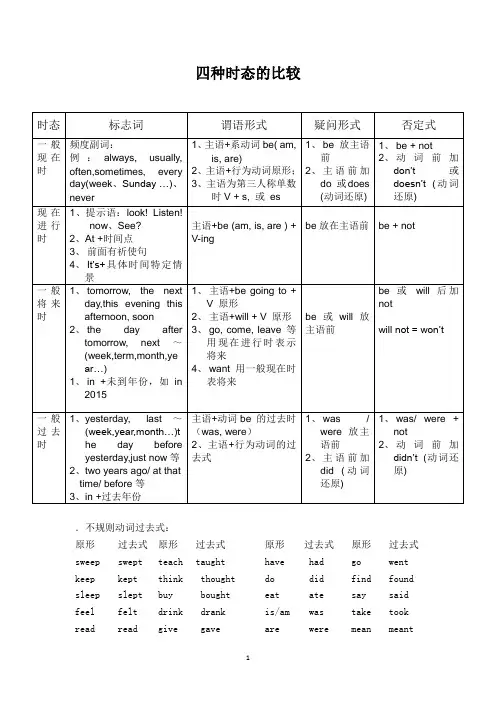
四种时态的比较.不规则动词过去式:原形过去式原形过去式原形过去式原形过去式sweep swept teach taught have had go went keep kept think thought do did find found sleep slept buy bought eat ate say said feel felt drink drank is/am was take took read read give gave are were mean meantput put sing sang drive drove meet met cut cut begin began speak spoke make made let let ring rang write wrote see saw fly flew run ran ride rode come came draw drew sit sat hear heard tell toldgrow grew learn learned/learntget got know knew一、用动词的适当形式填空1. My parents _______ (come) from Shandong.2. Sam _______(not like) playing computer games.3. The beautiful girl _______(wear) glasses.4. The Zhang family _______(live) in a flat in Nanjing.5. My father likes _______(read) newspapers after work.6. What _______her classmates _______(call) her teacher?7. _______ you _______(love) each other in your family?8. _______(be) your cousin very clever at maths?9. She is good at dancing. She ________ (sing) very well, too.11. Amy ________(take) her dog for a walk every afternoon.12. Mr. Li ________(not teach) us maths this term. (学期)13. Mr. Chen ________(not like) tea. He ________(enjoy) drinking coffee.14. ________ your father often ________(play) tennis ?No, he loves ________(read) newspapers.15. Everyone in our class ________(like) P.E. a lot.16. Who else ________(want) to come to Millie’s party? I ________.17. Many of them ________(work) hard at their lessons. They _____ (be) cl ever at them.18. What _______ Mary _______(have) for breakfast ?She _______(have) an egg and a glass of milk.19. Our school ________(be) a big nice school. And our teacher ______(be ) a good teacher.20. Simon and Daniel ________(be) American.二、句型转换。
小学英语的四大时态

小学英语的四大时态小学英语的四大时态是:●一般现在时:表示现在经常或习惯性的动作,或者表示客观事实或普遍真理。
一般现在时的句子通常有频率副词,如 always, usually, often,sometimes, never 等。
一般现在时的动词形式根据主语的单复数而变化,单数主语要加 -s 或 -es,复数主语不变。
例如:○He likes playing soccer. 他喜欢踢足球。
○They go to school every day. 他们每天去上学。
○The earth revolves around the sun. 地球绕着太阳转。
●一般过去时:表示过去某个时间发生的动作或状态,或者表示过去经常或习惯性的动作。
一般过去时的句子通常有过去时间状语,如 yesterday, last week, two days ago, in 2010 等。
一般过去时的动词形式通常是在原形后加 -ed,不规则动词要用过去式。
例如:○She watched a movie yesterday. 她昨天看了一部电影。
○He broke his arm last week. 他上周摔断了胳膊。
○They lived in Beijing in 2010. 他们2010年住在北京。
●一般将来时:表示将来某个时间要发生的动作或状态,或者表示将来经常或习惯性的动作。
一般将来时的句子通常有将来时间状语,如tomorrow, next month, in two years, in the future 等。
一般将来时的动词形式有以下几种方式:○用 will + 动词原形,表示预测或意愿。
例如:■It will rain tomorrow. 明天会下雨。
■I will help you with your homework. 我会帮你做作业。
○用 be going to + 动词原形,表示打算或计划。
例如:■She is going to visit her grandparents next month. 她打算下个月去看她的祖父母。
七个时态:一般现在时、现在进行时、将来时:begoingto(=will)、一般过去时、过去进行时、过去完成时、现在
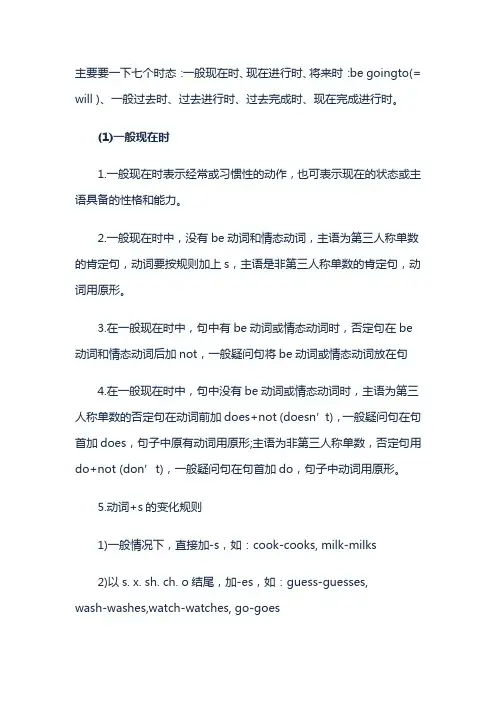
主要要一下七个时态:一般现在时、现在进行时、将来时:be goingto(= will )、一般过去时、过去进行时、过去完成时、现在完成进行时。
(1)一般现在时1.一般现在时表示经常或习惯性的动作,也可表示现在的状态或主语具备的性格和能力。
2.一般现在时中,没有be动词和情态动词,主语为第三人称单数的肯定句,动词要按规则加上s,主语是非第三人称单数的肯定句,动词用原形。
3.在一般现在时中,句中有be动词或情态动词时,否定句在be 动词和情态动词后加not,一般疑问句将be动词或情态动词放在句4.在一般现在时中,句中没有be动词或情态动词时,主语为第三人称单数的否定句在动词前加does+not (doesn’t),一般疑问句在句首加does,句子中原有动词用原形;主语为非第三人称单数,否定句用do+not (don’t),一般疑问句在句首加do,句子中动词用原形。
5.动词+s的变化规则1)一般情况下,直接加-s,如:cook-cooks, milk-milks2)以s. x. sh. ch. o结尾,加-es,如:guess-guesses,wash-washes,watch-watches, go-goes3)以“辅音字母+y”结尾,变y为i, 再加-es,如:study-studies6. 句中be动词和动词一般情况下只能有一种而且也必须有一种。
如:The childrenare very happy on Christmas Day .7.一般现在时中的be动词:一般用原形:am is aream用于第一人称单数(I);is用于第三人称单数(he she it和其他人名或称谓,如:Ben his sister等);are用于第二人称单数(you)和所有复数(包括第一人称复数we、第二人称复数you;第三人称复数they和其他复数,如his parents等)。
8.一般过去时中的动词:有两种情况:第一种情况:主语是第三人称单数(he she it 和其他,如Helen 、her cousin 等),动词后一般加s或es。
一般现在时-现在进行时-一般将来时

1一般现在时( Present Simple)2。
现在进行时(Present Continuous)3. 将来的安排和打算( Future Arrangements and Intentions)一、一般现在时、现在进行时(一)、辨”个性”一般现在时表示经常性或习惯性的动作,以及主语的特征或状态。
1。
表示主语现在的状态或特征。
例如:I am a teacher.We have a very good relationship with our parents.2。
表示经常性或习惯性动作。
例如:My father goes to work by bike every day。
I always leave home for school at 6:303 。
表示自然现象,普遍真理,客观存在或科学事实。
例如:Shanghai lies in the east of China.The earth moves around the sun.现在进行时表示现在或现阶段正在进行的动作。
例如:1。
表示现在(指说话人说话时)正在发生的事情We are waiting for you at the moment。
2. 表示现阶段正在进行或发生的动作President Xi is visiting in the USA these days。
(二)、辨结构一般现在时的结构是:主 + 动词原形或动词的第三人称单数形式 +...。
.。
现在进行时的结构是: 主 + be(are/ is/am),动词的—ing形式+.。
...。
(三)、辨”信息词"一般现在时常和以下这些时间状语连用:always, often, usually=normally, sometimes=at times, regularly, seldom, never, hardly ever, from time to time, once a month, every day, on Sundays。
一般现在时、一般过去时、一般将来时、现在进行时句子结构
题目一般过去时,现在进行时,一般将来时,一般现在时的句子结构答案解析一、一般现在时结构:主语+ 谓语动词(实义动词或者是be动词)+ 宾语当主语是第三人称单数的时候,后面的谓语动词一定要变成动词的第三人称单数形式. 例:He has an English book.句子中的have 是动词原形,has则是have的第三人称单数形式二、现在进行时结构:be + v+ing + sthbe动词包括(am is are) 什么情况用哪个be动词是由主语决定的!当主语是第一人称“I ”的时候be 动词一定只可以用am当主语是单三的时候,be 动词要用is当主语是第二人称you 或者是其他的时候,be动词一定要用arev+ing 表示的是现在分词,也就是动词的ing 形式现在分词的变化形式:1.动词是以字母“e ”结尾的要去掉e 再+ ing2.直接在动词词尾+ing3.词尾是以一个元音字母加上一个辅音字母,且重读闭音节结尾的要双写辅音字母再+ing 例:play- playing take - takingdo - doing leave - leavingput - putting cut - cutting例:I am playing football with my classmates.He is watching TV at home.They are having an English class.三、一般将来时1.结构:be + going to +do sth例:I am going to do my homework tomorrow.He is going to babysit his sister.We are going to go shopping this weekend.2.will + v(原形)例:He will come back later.I will visit my grandparents next week.3.be + doing sth现在进行时也可以表示计划、打算要做的事情例:I am leaving for Shanghai next Sunday.四、一般过去时结构:主语+ 动词过去式(be 动词,或者实义动词) + 宾语例:I was a little girl 10 years ago.He went to the Great Wall last month.I visited my cousins last Saturday.。
小学四年级重要时态总结与用法归纳
小学四年级重要时态总结与用法归纳一、过去时态(Past Tense)过去时态用于表示过去发生、已经结束的动作或状态。
1. 一般过去时(Simple Past Tense)一般过去时用于描述过去的事实或经历,常与表示过去的时间状语连用,动词一般要过去式。
例句:- 我昨天去书店买了一本故事书。
- 他昨晚没有完成作业。
2. 过去进行时(Past Continuous Tense)过去进行时表示过去某个时间正在进行的动作。
由助动词“was/were”和动词的现在分词形式构成。
例句:- 我昨晚七点正在做作业。
- 我们昨天这个时候正在打篮球。
3. 过去完成时(Past Perfect Tense)过去完成时用于强调过去某个时间或动作之前已经发生的动作或状态。
由助动词“had”和动词的过去分词形式构成。
例句:- 我们去看电影之前,已经吃过晚饭了。
- 她回家后,发现她的电话已经被偷走了。
二、现在时态(Present Tense)现在时态用于表示现在正在进行或经常进行的动作,也可以表示客观真理、日程安排等。
1. 一般现在时(Simple Present Tense)一般现在时用于表示经常性的动作或行为,也可用于描述客观真理、日程安排等。
例句:- 我每天早上七点起床。
- 地球是圆的。
2. 现在进行时(Present Continuous Tense)现在进行时用于表示现在正在进行的动作,由助动词“am/is/are”和动词的现在分词形式构成。
例句:- 我正在听音乐。
- 他们正在打扫教室。
3. 现在完成时(Present Perfect Tense)现在完成时表示过去发生的某个动作对现在产生的影响或结果。
由助动词“have/has”和动词的过去分词形式构成。
例句:- 我已经完成了作业。
- 她还没有去过海边。
三、将来时态(Future Tense)将来时态用于表示将来要发生的动作或状态。
1. 一般将来时(Simple Future Tense)一般将来时用于表示将来的某个时间会发生的动作或状态。
一般现在时,现在进行时, 一般将来时
一般现在时定义:表示经常反复发生的动作或习惯性的动作表示自然现象,客观真理,科学事实表示人或事物的自然情况结构:动词原形或三单现标志词:usually,always,often,sometimes(every短语)构成:1.一般的直接加s:Look——looks come——comes2.以o,s,x,ch,sh结尾的加es:Go——goes3.以辅音字母加y结尾的,改y为i加es:Study——studies4.不规则变化:Be——is have——has现在进行时定义:表示现在,此刻(说话时)正在进行,正在发生的动作或所存在的状态结构:be(am is are)+V.ing标志词:now,at the moment,look,listen构成:1、一般的直接加ing:Watch——watching play——playing2、以ie结尾的,改ie为y加ing:Lie——lying die——dying tie——tying3、以重读闭音节结尾的双写最后一个辅音字母加ing:Shop——shopping stop——stopping sit——sitting put——putting Get——getting run——running begin——beginning4、以不发音的e结尾,去e加ing:Take——taking write——writing一般将来时定义:1.表示将来某一时刻的动作或状态,或将来某一段时间内经常的动作或状态。
2.表计划,打算,将来做某事结构:1.肯定式:be(am,is,are)going to+V原2.否定式:be(am,is,are)+not going to+ V原标志词:tomorrow next week from now on in the future。
一般现在时、现在进行时、一般将来时、一般过去时知识点总结
一般现在时、一般将来时、一般过去时、现在进行时知识总结一、一般现在时一般现在时表示经常性或习惯性的动作,常与表示频度的时间状语连用,如often, usually, always, sometimes, never, seldom, every week/day/year/month..., once a week, on Sundays等。
动词用原形。
当主语为第三人称单数时(he, she, it, 一个人名),动词变为三单形式。
第三人称单数的动词变化规则:(只有在第三人称(he, she, it, 一个人名)为主语的肯定句中,动词才用三单式)(1)一般情况下,直接加s runs gets likes(2)结尾是s, x, sh, ch, o,前为辅音字母,结尾加es watches, goes, washes, crosses, mixes, does(3)动词末尾y,前为辅音,将y改为i加es study→studies fly→flies但在y前如果为元音则直接加s buys says plays(4)不规则变形have—has二、一般将来时一般将来时表示将来发生的事。
常与tomorrow, next day/week/month/year..., soon, in a few minutes, the day after tomorrow, in the future等时间状语连用。
Will/shall +动词原形;(shall用语第一人称)be(am/is/are) going to+ 动词原形三、一般过去时一般过去时表示过去某一时候或某一段时间所发生了的事情或存在的状态。
常与过去时间yesterday,ago, this morning,just now,a moment ago,last night / year / week/month,once upon a time,the other day,before,the day before yesterday, in 1989, at the age of five, one day, then(那时), on that day,in the past连用。