
latex中俄文与英文对照表
Latex中俄文与英文对照表
在LaTeX 中,由于其强大的排版能力和跨平台的优势,越来越多的人开始使用LaTeX 来编辑文档。
而对于双语甚至多语言环境下的排版需求,LaTeX 中提供了丰富的工具和相关的语言包,其中最常用的便是中文和英文的组合。
然而,在面临中文和英文混合的排版需求时,我们不仅需要解决中英文字符的混排问题,还需要考虑到中英文排版风格的不同之处。
为了方便LaTeX用户更好的运用中文和英文排版,本文整理了一份LaTeX中俄文与英文对照表,其中包括了常见文本、标点符号、数学符号等的中英文对照,以及相应的LaTeX语法。
一、基本文本与标点符号
LaTeX中俄文 | LaTeX英文 | 中文 | 英文
--- | --- | --- | ---
\textbf{粗体} | \textbf{Bold} | 粗体 | Bold
\textit{斜体} | \textit{Italic} | 斜体 | Italic
\underline{下划线} | \underline{underline} | 下划线 | Underline
\texttt{等宽字体} | \texttt{Monospaced} | 等宽字体 | Monospaced
\textcolor{red}{红色字体} | \textcolor{red}{Red Text} | 红色字体 | Red Text
\begin{quote}引用环境\end{quote} | \begin{quote}Quote Environment\end{quote} | 引用环境 | Quote Environment
“ ” | “ ” | 中文引号 | Chinese Quotes
‘ ’ | ‘ ’ | 中文单引号 | Chinese Single Quotes
' ' | ' ' | 单引号 | Single Quotes
`` '' | `` '' | 双引号 | Double Quotes
,。
!?;:“”‘’ | , . ! ? ; : “ ” ‘ ’ | 中文标点符号 | Chinese Punctuations
, . ! ? ; : " ' | , . ! ? ; : " ' | 英文标点符号 | English Punctuations
二、数学符号与公式
LaTeX中俄文 | LaTeX英文 | 中文 | 英文
--- | --- | --- | ---
\Delta | \Delta | 大写希腊字母"Delta" | Capital Greek Letter "Delta"
\alpha | \alpha | 小写希腊字母"alpha" | Lowercase Greek Letter "alpha"
\sum_{i=1}^{n} | \sum_{i=1}^{n} | 求和符号 | Summation Symbol
\int_{a}^{b}f(x)dx | \int_{a}^{b}f(x)dx | 积分符号 | Integral Symbol
\times | \times | 乘号 | Multiply Sign
\div | \div | 除号 | Division Sign
> | > | 大于号 | Greater Than Sign
< | < | 小于号 | Less Than Sign
\leq | \leq | 小于等于号 | Less Than or Equal to Sign
\geq | \geq | 大于等于号 | Greater Than or Equal to Sign
\sqrt{x} | \sqrt{x} | 开根号 | Square Root
三、页面布局与字体调整
LaTeX中俄文 | LaTeX英文 | 中文 | 英文
--- | --- | --- | ---
\documentclass{article} | \documentclass{article} | 文档类| Document Class
\usepackage{fontspec} | \usepackage{fontspec} | 字体选项 | Font Selection
\usepackage{geometry} | \usepackage{geometry} | 页面尺寸 | Page Layout
\setmainfont{宋体} | \setmainfont{Times New Roman} | 主要字体 | Main Font
\setCJKmainfont{宋体} | \setCJKmainfont{SimSun} | 中文字体 | Chinese Font
\fontsize{12pt}{18pt}\selectfont | \fontsize{12pt}{18pt}\selectfont | 字号字距| Font Size and Spacing
\renewcommand{\baselinestretch}{1.5} | \renewcommand{\baselinestretch}{1.5} | 行距| Line Spacing
\marginparsep0pt\marginparwidth0pt\marginparpush0pt\oddsidemargin0pt\evensidemargin0 pt\textwidth6.5in\textheight9in | \usepackage[margin=1in]{geometry} | 页面边距 | Margin 总结
LaTeX提供了丰富的语言包和工具,使得用户可以轻松地处理多语种排版问题,无论是中英混排还是其他语言组合,都能实现准确、美观的效果。
本文提供了一份完整的LaTeX中俄文与英文对照表,方便用户在编写文档时快速准确地掌握各种语言元素的
LaTeX语法,提高排版效率和质量。
Latex数学符号对应表
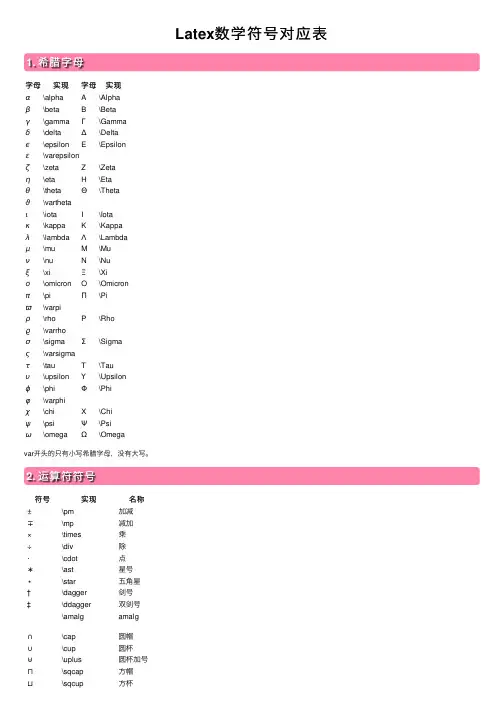
Latex数学符号对应表1. 希腊字母字母实现字母实现α\alpha A\Alphaβ\beta B\Betaγ\gammaΓ\Gammaδ\deltaΔ\Deltaϵ\epsilon E\Epsilonε\varepsilonζ\zeta Z\Zetaη\eta H\Etaθ\thetaΘ\Thetaϑ\varthetaι\iota I\Iotaκ\kappa K\Kappaλ\lambdaΛ\Lambdaµ\mu M\Muν\nu N\Nuξ\xiΞ\Xiο\omicron O\Omicronπ\piΠ\Piϖ\varpiρ\rho P\Rhoϱ\varrhoσ\sigmaΣ\Sigmaς\varsigmaτ\tau T\Tauυ\upsilonΥ\Upsilonϕ\phiΦ\Phiφ\varphiχ\chi X\Chiψ\psiΨ\Psiω\omegaΩ\Omegavar开头的只有⼩写希腊字母,没有⼤写。
2. 运算符符号符号实现名称±\pm加减∓\mp减加×\times乘÷\div除⋅\cdot点∗\ast星号⋆\star五⾓星†\dagger剑号‡\ddagger双剑号\amalg amalg∩\cap圆帽∪\cup圆杯⊎\uplus圆杯加号⊓\sqcap⽅帽⊔\sqcup⽅杯∨\vee正V符号实现名称∧\wedge倒V∖\setminus集差≀\wr环积∘\circ圆圈·\bullet实⼼圆⊘\oslash圆圈斜线⊙\odot圆圈点◯\bigcirc⼤圆圈△\bigtriangleup⼤正三⾓形▽\bigtriangledown⼤倒三⾓形◃\triangleleft左三⾓形▹\triangleright右三⾓形⊕\oplus圆圈加号⊖\ominus圆圈减号⊗\otimes圆圈乘号⊥\bot倒T⊤\top正T∑\sum求和∏\prod乘积∫\int积分\oint\oint围道积分\biguplus\biguplus⼤圆杯加号\bigoplus\bigoplus⼤圆圈加号\bigvee\bigvee⼤V\bigcap\bigcap⼤圆帽\bigotimes\bigotimes⼤圆圈乘号\bigwedge\bigwedge⼤倒V\bigcup\bigcup⼤圆杯\bigodot\bigodot⼤圆圈点\bigsqcup\bigsqcup⼤⽅杯3. 关系符号符号实现名称<<⼩于>>⼤于\leq\leq⼩于等于\geq\geq⼤于等于\ll\ll远⼩于\gg\gg远⼤于\neq\neq不等于\doteq\doteq点等于\sim\sim相似于\simeq\simeq近似等于\approx\approx约等于\asymp\asymp趋于\cong\cong全等于\equiv\equiv恒等于\subset\subset⼦集\supset\supset超集\subseteq\subseteq⼦集或等于\supseteq\supseteq超集或等于\sqsubseteq\sqsubseteq⽅形⼦集或等于\sqsupseteq\sqsupseteq⽅形超集或等于\in\in包含于\ni\ni包含\notin\notin不包含于符号实现名称\models\models Models\vdash\vdash竖线短横\dashv\dashv短横竖线\perp\perp垂直\mid\mid中线\parallel\parallel平⾏\propto\propto成⽐例\bowtie\bowtie领结\prec\prec先于\preceq\preceq先于等于\succ\succ后于\succeq\succeq后于等于\nless\nless不⼩于\ngtr\ngtr不⼤于\nleqslant\nleqslant不⼩于等于\ngeqslant\ngeqslant不⼤于等于\not\equiv\not\equiv不恒等于\not\approx\not\approx不约等于\not\cong\not\cong不全等于\not\sim\not\sim不相似于\not\simeq\not\simeq不近似等于\not\models\not\models Not Models\not\ni\not\ni不包含\not\succ\not\succ不后于\not\succeq\not\succeq不后于等于\not\prec\not\prec不先于\not\preceq\not\preceq不先于等于\not\parallel\not\parallel不平⾏\not\subset\not\subset⾮⼦集\not\supset\not\supset⾮超集\not\subseteq\not\subseteq⾮⼦集或等于\not\supseteq\not\supseteq⾮超集或等于4. 箭头符号符号实现名称\leftarrow\leftarrow左箭头\Leftarrow\Leftarrow左双线箭头\longleftarrow\longleftarrow长左箭头\Longleftarrow\Longleftarrow长双线左箭头\rightarrow\rightarrow右箭头\Rightarrow\Rightarrow右双线箭头\longrightarrow\longrightarrow长右箭头\Longrightarrow\Longrightarrow长双线右箭头\leftrightarrow\leftrightarrow左右双向箭头\Leftrightarrow\Leftrightarrow左右双向双线箭头\longleftrightarrow\longleftrightarrow长左右双向箭头\Longleftrightarrow\Longleftrightarrow长左右双向双线箭头\hookleftarrow\hookleftarrow弯钩左箭头\hookrightarrow\hookrightarrow弯钩右箭头\leftharpoondown\leftharpoondown下半钩左箭头\rightharpoondown\rightharpoondown下半钩右箭头\leftharpoonup\leftharpoonup上半钩左箭头\rightharpoonup\rightharpoonup上半钩右箭头\uparrow\uparrow上箭头\Uparrow\Uparrow上双线箭头\Uparrow\Uparrow上双线箭头符号实现名称\downarrow\downarrow下箭头\Downarrow\Downarrow下双线箭头\updownarrow\updownarrow上下双向箭头\Updownarrow\Updownarrow上下双向双线箭头\swarrow\swarrow左斜下箭头\nearrow\nearrow右斜上箭头\nwarrow\nwarrow左斜上箭头\searrow\searrow右斜下箭头\mapsto\mapsto映射箭头\longmapsto\longmapsto长映射箭头5. 括号符号符号实现名称\lbrace\lbrace左花括号\rbrace\rbrace右花括号\lbrack\lbrack左⽅括号\rbrack\rbrack右⽅括号\langle\langle左尖括号\rangle\rangle右尖括号\lceil\lceil左上半框括号\rceil\rceil右上半框括号\lfloor\lfloor左下半框括号\rfloor\rfloor右下半框括号\vert\vert竖线\Vert\Vert双竖线\backslash\backslash 反斜线6. 其他符号符号实现名称\infty\infty⽆穷\exists\exists存在\forall\forall任取\neg\neg取反号\nabla\nabla劈形\triangle\triangle三⾓形\angle\angle⾓\partial\partial偏导数\emptyset\emptyset空集\prime\prime质数\colon\colon冒号\Re\Re实部\Im\Im虚部\ldots\ldots下三连点\cdots\cdots中三连点\vdots\vdots竖三连点\ddots\ddots斜三连点\surd\surd不尽根号\ldotp\ldotp句点\to\to结论\gets\gets条件\aleph\aleph Aleph\hbar\hbar普朗克常数\wp\wp⼿写体⼤写P\ell\ell⼿写体⼩写l\imath\imath数学⼩写⽆点i\imath\imath数学⼩写⽆点i符号实现名称\jmath\jmath数学⼩写⽆点j7. MATLABlatex(S) returns the LaTeX form of the symbolic expression S.syms x philatex(x^2 + 1/x)latex(sin(pi*x) + phi)ans ='\frac{1}{x}+x^2'ans ='\varphi +\sin\left(\pi \,x\right)'LaTeX can also be used to Format Title, Axis Labels, and Ticks. See doc latex.实时脚本中也可以插⼊Latex公式,如:在这篇中发现了这个,使⽤很⽅便,可以以类似于Mathtype的输⼊⽅式得到Latex格式的输出。
Latex符对应表
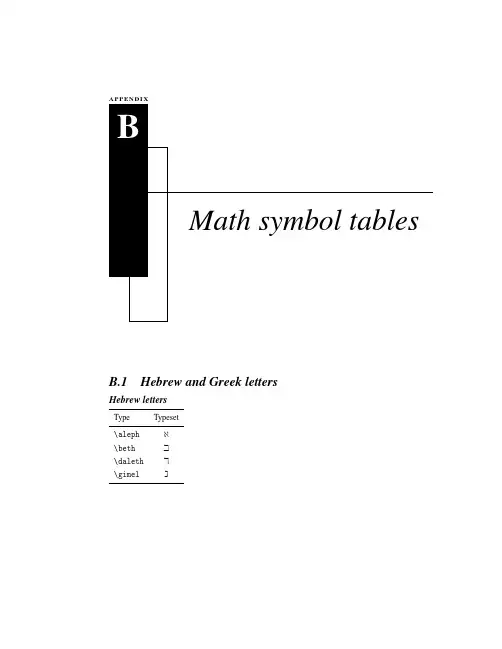
Typeset > :
≥
≈ ∼= =. ⊃ ⊇
|=
\sqsupset
a
Note the \colon command used in f : x → x2, typed as f \colon x \to x^2
504
More binary relations
Type
Typeset
\leqq
\leqslant \eqslantless
Typeset ← ←− ⇐ ⇐= ↔ ⇔ ↑ ⇑
⇐⇒ → ←
Y ⇔
Type
\rightarrow or \to \longrightarrow \Rightarrow \Longrightarrow \longleftrightarrow \Longleftrightarrow \downarrow \Downarrow \Updownarrow \searrow \nwarrow \mapstochar \longmapsto \hookrightarrow \rightharpoonup \rightharpoondown
\varsubsetneq
\subsetneqq
\varsubsetneqq
Type
Typeset
\notin
∈/
\ngtr
≯
\ngeq
\ngeqslant
\ngeqq
\gneq
\gneqq
\gvertneqq
\gnsim
\gnapprox
\nsucc
\nsucceq
\succneqq
\succnsim
Ξ \Phi
Φ
\Delta \Theta
∆ \Pi Θ \Sigma
latex 中英文文献

latex 中英文文献全文共3篇示例,供读者参考篇1LaTeX is a versatile typesetting system commonly used in academic and scientific writing. One of its key features is its robust support for handling citations and references, making it an ideal tool for writing research papers. In this article, we will explore how LaTeX can be used to manage both English and Chinese language references in a document.To include English language references in a LaTeX document, we can use the BibTeX system. BibTeX is a tool that helps format lists of references in a consistent and efficient manner. The first step is to create a .bib file containing the bibliographic information of the sources we want to cite. Each entry in the .bib file corresponds to a unique reference and includes details such as author names, title, publication year, and source.The next step is to insert citations in the LaTeX document using the \cite{} command. For example, \cite{Smith2010} will generate a citation in the document linked to the entry with the key "Smith2010" in the .bib file. To generate a bibliography atthe end of the document, we can use the \bibliography{} command and specify the name of the .bib file.When it comes to including Chinese language references in a LaTeX document, we can utilize the CJK package to support Chinese characters. The CJK package allows us to input Chinese text directly into the document using commands like\begin{CJK*}{UTF8}{gbsn} and \end{CJK*}. We can then create a separate .bib file for Chinese references and follow the same process as with English references to cite them in the document.One important consideration when working with Chinese language references in LaTeX is the encoding. It is essential to make sure that the .bib file and the LaTeX document are both using the same encoding. UTF-8 encoding is commonly used for handling multilingual documents in LaTeX.In conclusion, LaTeX provides a powerful platform for managing both English and Chinese language references in academic writing. By leveraging tools like BibTeX and the CJK package, researchers can easily cite sources in multiple languages and create well-formatted bibliographies in their documents. With its versatility and flexibility, LaTeX continues to be a popular choice for scholars seeking a professional typesetting solution for their research work.篇2LaTeX is a popular typesetting system used for formatting documents, especially in the fields of academia and science. One of the key features of LaTeX is its ability to handle citations and references to academic literature in a systematic and organized way. In this article, we will explore how to effectively cite and reference English language literature in LaTeX documents.To cite a source in a LaTeX document, one typically uses the \cite{} command followed by the key of the reference. For example, if we have a reference with the key "Smith2021", we can cite it in our document by typing \cite{Smith2021}. This will generate a citation in the document that corresponds to the reference at the end of the document.To include the bibliography at the end of the document, one typically uses the \bibliography{} command followed by the name of the bibliography file. This file should contain all the references that are cited in the document, along with their necessary information like author, title, year, and publisher. The bibliography file is usually in a .bib format, which can be easily generated from online citation managers like Zotero or Mendeley.When citing English language literature, it is important to follow the specific formatting style required by the publication or institution. Common styles include APA (American Psychological Association), MLA (Modern Language Association), and Chicago. These styles dictate how the citations and references should be formatted in terms of punctuation, capitalization, and the order of information.In LaTeX, there are various packages available that can help automate the citation and referencing process. The most popular package is BibTeX, which allows users to create a bibliographic database and extract citations and references automatically. Other packages like natbib and biblatex offer more flexibility and customization options for formatting citations and references.Overall, LaTeX provides a powerful and efficient way to cite and reference English language literature in academic documents. By following the proper formatting styles and using the appropriate packages, users can ensure that their citations and references are accurate, consistent, and professional. Whether you are writing a research paper, thesis, or journal article, LaTeX can help streamline the process of managing and formatting your references.篇3IntroductionLaTeX is a popular typesetting system used for creating professional documents, including academic papers, theses, and reports. One key feature of LaTeX is its ability to handle citations and references in a systematic and efficient manner. In this article, we will explore how to manage English and Chinese language references in LaTeX documents.Creating a BibliographyThe first step in managing references in LaTeX is to create a bibliography for your document. This can be done by creatinga .bib file that contains all the references you want to cite in your document. Each reference in the .bib file is defined using a specific format, which includes information such as the author, title, year of publication, and other relevant details.To cite a reference in your document, you simply need to use the \cite{} command followed by the key of the reference in your .bib file. For example, if you want to cite a book by Smith published in 2010, you would use \cite{smith2010} in your LaTeX document.Managing English Language ReferencesWhen citing English language references in your LaTeX document, it is important to follow the appropriate citation style, such as APA or IEEE. These citation styles dictate the format of the reference in the text and the corresponding entry in the bibliography.For example, if you are using APA style, a reference to a journal article should include the author's name, the publication year, the title of the article, the journal name, and the page numbers. Here is an example of how this reference would appear in your .bib file:@article{johnson2015,author = {Johnson, A.},title = {The importance of references in LaTeX documents},journal = {Journal of LaTeX Studies},year = {2015},pages = {10-20}}When citing this reference in your LaTeX document using the \cite{} command, LaTeX will automatically format it according to the APA style guidelines.Managing Chinese Language ReferencesManaging Chinese language references in LaTeX documents can be a bit more challenging, as LaTeX does not natively support Chinese characters. However, there are ways to work around this limitation using packages such as CJK or xeCJK.To cite a Chinese language reference in your LaTeX document, you will need to use a UTF-8 encoded .bib file that contains the Chinese characters. This file can be created using a text editor that supports UTF-8 encoding, such as Notepad++ or Sublime Text.Here is an example of how a Chinese language reference might appear in your .bib file:@book{王2010,author = {王, 小明},title = {LaTeX中文参考文献管理},publisher = {中国出版社},year = {2010}}When citing this reference in your LaTeX document, you can use the \cite{} command as usual. However, you may need to add the CJK or xeCJK package to your document preamble to ensure that the Chinese characters are displayed correctly.ConclusionManaging English and Chinese language references in LaTeX documents requires careful attention to detail and the use of appropriate packages and formatting guidelines. By following the steps outlined in this article, you can ensure that your references are cited correctly and displayed accurately in your LaTeX document. With practice and experience, you will become proficient in managing references in multiple languages using LaTeX.。
latex 中文使用方法和示例

latex 中文使用方法和示例一、引言在科研写作和学术论文编辑中,latex 已经成为了一种非常流行的编辑工具。
它有着优秀的数学公式排版和文档结构管理功能,因此受到了许多科研工作者和学术写作者的青睐。
然而,许多人在使用 latex 时遇到了中文支持和排版的问题。
本文将介绍 latex 中文的使用方法,并给出一些示例,帮助读者更好地掌握 latex 中文排版。
二、latex 中文支持方法1. 使用 CTeX 套装CTeX 套装是一款专门为中文latex用户设计的工具,它包含了完整的中文支持和相关宏包。
在编写latex文档时,用户只需加载 CTeX 宏包即可直接使用中文排版。
CTeX 套装还提供了中文文档模板和示例,对中文用户来说非常方便。
2. 使用 XeTeX 或 LuaTeX 引擎除了 CTeX 套装外,用户还可以选择使用 XeTeX 或 LuaTeX 引擎来编译 latex 文档。
这两种引擎天生具备中文支持,可以直接处理中文字符和字体,因此在使用上更加方便。
使用 XeTeX 或 LuaTeX 编译中文文档时,只需在文档的开头加载 \usepackage{fontspec} 宏包,然后设置中文字体即可。
三、latex 中文排版示例1. 中文文章排版\documentclass{article}\usepackage{ctex}\begin{document}\section{引言}在科研写作和学术论文编辑中,latex 已经成为了一种非常流行的编辑工具...\end{document}2. 中文书籍排版\documentclass{ctexbook}\begin{document}\chapter{前言}本书介绍了如何使用 latex 进行科研写作和学术论文编辑...\end{document}3. 中文演示文稿排版\documentclass{beamer}\usepackage{ctex}\begin{document}\begin{frame}\frametitle{latex 中文排版示例}本文介绍了 latex 中文排版的使用方法和示例...\end{frame}\end{document}四、latex 中文排版注意事项1. 字体设置在使用 latex 编辑中文文档时,用户需要特别注意字体选择和设置。
LaTeX各种命令,符号

LaTeX各种命令,符号转⾃:https:///garfielder007/article/details/51646604函数、符号及特殊字符声调语法效果语法效果语法效果\bar{x}\acute{\eta}\check{\alpha}\grave{\eta}\breve{a}\ddot{y}\dot{x}\hat{\alpha}\tilde{\iota}函数语法效果语法效果语法效果\sin\theta\cos\theta\tan\theta\arcsin\frac{L}{r}\arccos\frac{T}{r}\arctan\frac{L}{T}\sinh g\cosh h\tanh i\operatorname{sh}j\operatorname{argsh}k\operatorname{ch}h\operatorname{argch}l\operatorname{th}i\operatorname{argth}mk'(x)=\lim_{\Delta x\to0}\frac{k(x)-k(x-\Delta\limsup S\liminf I\max H\min L\inf s\sup t\exp\!t\ln X\lg X\log X\log_\alpha X\ker x\deg x\gcd(T,U,V,W,X)\Pr x\det x\hom x\arg x\dim x\lim_{t\to n}T同余语法效果语法效果\pmod{m} a \bmod b微分语法效果语法效果语法效果\nabla\partial x\mathrm{d}x\dot x\ddot y集合语法效果语法效果语法效果语法效果语法效果\forall\exists\empty\emptyset\varnothing\in\ni\not\in\notin\subset\subseteq\supset\supseteq\cap\bigcap\cup\bigcup\biguplus\sqsubset\sqsubseteq\sqsupset\sqsupseteq\sqcap\sqcup\bigsqcup逻辑语法效果语法效果语法效果语法效果p\land\wedge\bigwedge\bar{q} \to p\lor\vee\bigvee\lnot\neg q\setminus\smallsetminus根号语法效果语法效果\sqrt{3}\sqrt[n]{3}关系符号语法效果\Delta ABC\sim\Delta XYZ\sqrt{3}\approx1.732050808\ldots\simeq \cong\dot=\ggg\gg>\ge\geqq =\leq\leqq <\ll\lll(x-y)^2\equiv(-x+y)^2\equiv x^2-2xy+y^2\begin{align}\because\begin{cases}\acute{a}x^2+bx^2+c\gtrless0\gtrless\grave{a}x^2+bx^2+c\\\acute{a}>0>\grave{a}\end{cases}\\\therefore\frac{-b\pm\sqrt{b^2-4\acute{a}c}}{2\acute{a}}{}_\lessgtr^\gtrlessx_\lessgtr^\gtrless\frac{-b\pm\sqrt{b^2-4\grave{a}c}}{2\grave{a}}\end{align}x\not\equiv Nx\ne Ax\neq C t\propto v\pm\mp⼏何符号特征语法效果菱形\Diamond 正⽅形\Box三⾓形Delta \Delta 图型\triangle⾓名\angle\Alpha\Beta\Gamma\sin\!\frac{\pi}{3}=\sin60^\operatorname{\omicron}=\frac{\sqrt{3}}{2}\perp箭头符号语法效果语法效果语法效果\leftarrow \gets \rightarrow\to\leftrightarrow \longleftarrow\longrightarrow \mapsto \longmapsto\hookrightarrow\hookleftarrow\nearrow\searrow \swarrow \nwarrow\uparrow\downarrow\updownarrow语法效果语法效果语法效果语法效果\rightharpoonup \rightharpoondown \leftharpoonup \leftharpoondown \upharpoonleft\upharpoonright\downharpoonleft\downharpoonright 语法效果语法效果语法效果\Leftarrow \Rightarrow \Leftrightarrow\Longleftarrow \Longrightarrow \Longleftrightarrow (or \iff)\Uparrow\Downarrow\Updownarrow特殊符号语法效果语法效果语法效果语法效果语法效果语法效果\eth \S \P \%\dagger \ddagger\star *\ldots \smile \frown \wr语法效果语法效果语法效果\oplus \bigoplus \otimes\bigotimes \times \cdot \div \circ \bullet\bigodot \boxtimes\boxplus语法效果语法效果语法效果语法效果\triangleleft \triangleright \infty \bot\top \vdash \vDash \Vdash\models \lVert\rVert语法效果语法效果语法效果\imath \hbar \ell\mho \Finv \Re\Im\wp \complement语法效果语法效果语法效果语法效果\diamondsuit \heartsuit \clubsuit \spadesuit\Game\flat\natural\sharp上标、下标及等功能语法效果上标a^2下标a_2组合a^{2+2}a_{i,j}结合上下标x_2^3前置上下标{}_1^2\!X_3^4(HTML )x'导数(PNG )x^\prime 导数(错误)x\prime导数点\dot{x}\ddot{y}\vec{c}\overleftarrow{a b}\overrightarrow{c d}\widehat{e f g}上弧(注: 正确应该⽤ \overarc, 但在这⾥⾏不通。
中俄文对照

紫色 ФИОАЕТОВЫЙ
серебр кожа
M193 кремовый
H172 белый
碧绿 Бирюзовый
金色 золотой
Артикул
真皮 нат кожа
羊京 замша
毛里 мех
4寸毛里 еврозима
款号 Артикул
颜色 ЦВЕТ
皮料编号Номер комнатьг
面料材质/漆皮/真皮Материал
配码 Размеры
总双数 Итого
装数/规格Пар вкоробке
件数 Кол вокоробов
备注 Примечания
啡色羊皮/牛皮коричневый
克金羊皮/牛皮черный бронэа
绿色 GREEN
草绿色 GLASS GREEN
橙色 ORANGE
咖啡色 BROWN
粉红 PINK
杏色 APRICOT
米白色 BEIGE
杏黄色 APRICOT
橘黄色 COGLEA
深兰色 DARKBLUE
深紫色 MULBERRY
琥珀色 AMBER
兰色 BLUE
玫瑰色 ROSE
内里 LINING
配码 SIZE
件数 CARTON
双数 QUANTITY
备注 REAMARK
款号 ITEM NO/Article/STYLENO
颜色 Coloure
皮料编号
面料材质/漆皮/真皮MATERIAL
真皮 Leath
备注
M215 чёрный лак
最新俄语字母手写体和印刷体对照表
俄语字母手写体和印刷体对照表
俄语字母手写体和印刷体对照表
俄语字母手写体和印刷体对照表
俄语字母手写体和印刷体对照表
俄语字母手写体和印刷体对照表
俄语字母手写体和印刷体对照表
俄语字母手写体和印刷体对照表
俄语字母手写体和印刷体对照表
俄语字母手写体和印刷体对照表
俄语字母手写体和印刷体对照表
俄语字母手写体和印刷体对照表
俄语字母手写体和印刷体对照表
俄语字母手写体和印刷体对照表
俄语字母手写体和印刷体对照表
俄语字母手写体和印刷体对照表
俄语字母手写体和印刷体对照表
俄语字母手写体和印刷体对照表
俄语字母手写体和印刷体对照表
俄语字母手写体和印刷体对照表
俄语字母手写体和印刷体对照表
3. (шаблон с изображением школьной доски)
俄语字З母а手ве写р体ш和и印т刷ь体п对о照ка表з
Анимированный плакат
Письменные буквы русского алфавита
Чулихина Е.А. учитель начальных классов МОУ «Малодубенская СОШ» Орехово-Зуевского района Московской области
俄语字母手写体和印刷体对照表
俄语字母手写体和印刷体对照表
ቤተ መጻሕፍቲ ባይዱ
俄语字母手写体和印刷体对照表
俄语字母手写体和印刷体对照表
俄语字母手写体和印刷体对照表
俄语字母手写体和印刷体对照表
俄语字母手写体和印刷体对照表
俄语字母手写体和印刷体对照表
俄语字母手写体和印刷体对照表
拉丁字母与希腊字母与俄文字母对照表
序号大写小写读音大写小写英文注音国际音标注音中文读音1A a [a]Ααalpha a:lf 阿尔法2B b[v]Ββbeta bet 贝塔3G g [j] before [e] or ; [ɣ]Γγgamma ga:m 伽马4D d [ð]Γδdelta delt 德尔塔5E e [e]Δεepsilon ep`silon 伊普西龙6Z/S z/s [z]Εδzeta zat 截塔7E e Ζεeta eit 艾塔8TH th [θ]Θζthet ζit 西塔9I i [j] Ηηiot aiot 约塔10K/C k/c [k]Θθkappa kap 卡帕11L l [l]Ιιlambda lambd 兰布达12M m [m]Κκmu mju 缪13N n [n]Λλnu nju 纽14X x,(ks)[ks]Μμxi ksi 克西15O o [o]Ννomicron omik`ron 奥密克戎16P p [p]Ξπpi pai 派17R/RH r/rh [r]Οξrho rou 肉18S/SS s/ss [s]Πζsigma sigma 西格马19T t [t]Ρηtau tau套20U/Y u/y υupsilon jup`silon 宇普西龙21PH ph [f]Φθphi fai 佛爱22CH/K H ch/kh [ç]Σχchi phai 西23PS Ps [ps]Τψpsi psai 普西24O o[o]Υωomegao`miga欧米伽拉丁字母与希腊字母与俄文字母对照拉丁字母希腊字母俄文—拉丁А——A Б——B 意义Г——G 角度;系数Д——D 磁通系数;角度;系数Е,Ё,Э——E 电导系数(小写)З——Z 变动;密度;屈光度И,Й——I 对数之基数К——K 系数;方位角;阻抗;相对粘度;原子序数Л——L 磁滞系数;效率(小写)М——M 温度;相位角Н——N 微小,一点儿О——O 介质常数П——P 波长(小写);体积Р——R 磁导系数微(千分之一)放大因数(小写)С——S 磁阻系数Т——T У——U Ф——F圆周率=圆周÷直径=3.14159 26535 89793Х——H 电阻系数(小写)Ц——C 总和(大写),表面密度;跨导(小写)Ч——CH 时间常数Ш,Щ——SH 位移Ы——Y 磁通;角Ю——IU Я——IA 角速;介质电通量(静电力线);角В——V 欧姆(大写);角速(小写);角Ж——J母对照表字母。
latex中文模板
latex中文模板\documentclass[serif,CJK]{beamer}\usepackage{CJK,ccmap}\usepackage{subfigure}\usepackage{manfnt}%%% Dangerous Bend Symbols}\dbend \lhdbend \reversedvideodbend \textdbend \textlhdbend\useoutertheme{tree}\usecolortheme{dolphin}\usecolortheme{orchid}\useinnertheme{rounded}\beamertemplateshadingbackground{blue!5}{yellow!10}\setbeamertemplate{blocks}[rounded][shadow=true]\usepackage{multicol}\renewcommand{\raggedright}{\leftskip=0pt \rightskip=0pt plus 0cm}\raggedright\setbeamertemplate{navigation symbols}{}\DeclareMathOperator{\arccot}{arccot}%------------------------------------------------------\usepackage{bbding}% 手势\HandRight \HandLeft %\FiveStar \FourStar \SixStar\newcommand{\handr}{\textcolor{magenta}{\HandRight}} % 自定义\handr\def\hilite<#1>{%\temporal<#1>{\color{blue!35}}{\color{magenta}}%{\color{blue!75}}}\def\hidark<#1>{%\temporal<#1>{\color{black!35}}{\color{magenta}}%{\color{black!75}}}\usepackage{wasysym}\graphicspath{{figures/}} %% 图片路径. 本文的图片都放在这个文件夹里了.\usepackage{mflogo} % \MP 得MetaPost 字样%%%%%%%%%%%%%%%%%%%%%%%%%%%%%%%%% %%%%%%%%%%%%%%%%%%%%% %%%%%%%%%%%%% %%%%%%%%%%%%%%%%%%%%%%%%%%%%%%%%%% %%%%% 定义PDF文档属性% %%%%%%%%%%%%%%%%%%%%%%%%%%%%%%%% %%%%%%%%%%%%%%%%%%%%%% %%%%%%%%%%%% %%%%%%%%%%%%%%%%%%%%%%%%%%%%%%%%%% %%%%%\hypersetup{colorlinks={true}}\newcommand{\button}[1]{\raisebox{-0.3ex}{\includegraphics[width=1.0em]{#1.png}}}\newcommand{\jpgbutton}[1]{\raisebox{-0.3ex}{\includegraphics[height=0.9em]{#1.jpg}}}\newcommand{\ctex}{\alert{$\mathbb{C}$}\hspace{-0.1ex}\textcolor{blue}{\TeX{}}}\newcommand{\song}{\CJKfamily{song}}\newcommand{\fs}{\CJKfamily{fs}}\newcommand{\kaishu}{\CJKfamily{kai}}\newcommand{\heiti}{\CJKfamily{hei}}\newcommand{\li}{\CJKfamily{li}}\newcommand{\you}{\CJKfamily{you}}%===================================== ======================================= % \DeclareGraphicsRule{*}{mps}{*}{}\begin{CJK*}{GBK}{fs}\CJKindent\title{中文~\LaTeX~安装与使用}\author[黄正华]{黄~正~华\\[0.5em]Email:~\href{mailto:huangzh@/doc/c21154 9671.html,}{\textcolor{blue!60}{\texttt{huangzh@http://www..co m/doc/c211549671.html,}}}} \institute[武汉大学]{\kaishu 武汉大学~~数学与统计学院}\titlegraphic{\includegraphics[height=1.7cm]{whulogo.1}}\frame{\titlepage}%%%%--------------------------------------------------------------------------------------------------\section{LaTeX~极速体验}%%%%--------------------------------------------------------------------------------------------------\begin{frame}[containsverbatim]\frametitle{听说过~\TeX{} 或~\LaTeX? 想立即体验~\LaTeX?} \begin{itemize}\item 到~/doc/c211549671.html, 下载~\ctex~套装, 安装该软件;\item 在桌面点击图标~\button{WinEdt}, 打开编辑器~WinEdt, 在~WinEdt 窗口点击新建文件按钮~\button{New};\item 把下面这段源文件粘贴为新文件的内容, 保存文件到某个文件夹,比如保存为~\texttt{test.tex}({\kaishu 文件名后缀必须是~\texttt{.tex}});\\\begin{block}{}\begin{verbatim}\documentclass{ctexart}\begin{document}中文文档测试.\end{verbatim}\end{block}\item 在~WinEdt 窗口点击按钮~\button{PdfLaTeX}, 使源文件得以编译;\item 点击~\button{Acroread} 可查看结果文件.\end{itemize}\end{frame}\section{前言}%%%%--------------------------------------------------------------------------------------------------\begin{frame}\frametitle{前言}本文是写给~\LaTeX{} 初学者的, 并且假定读者已经有使用~\LaTeX{} 的需求.\begin{itemize}\item 中文~\TeX{} 软件安装包, 比较重要的有~\ctex~套装、Mic\TeX~套装, 等等.\item 本文默认使用~\ctex~套装.\item 不同的套装, 只是相关软件的配置略有不同, 在~\LaTeX{} 的使用方法上当然是不受影响的.\end{itemize}\end{frame}%%%%--------------------------------------------------------------------------------------------------\section{名词解释}\subsection{TeX, LaTeX, CTeX}%%%%--------------------------------------------------------------------------------------------------\begin{frame}\frametitle{基本知识}%\noindent\begin{description}\item[\TeX{}] 一种电子排版系统, 由~Pascal 语言写成. 特点: 免费、输出质量高、擅长科技排版、有点像编程.\item[\LaTeX] 目前使用最广泛的~\TeX{} 宏集. %它构筑在~Plain \TeX{} 的基础之上, 并加进了很多功能, 使得我们可以更为方便地利用~\TeX{} 的功能.每一个~\LaTeX{} 命令实际上最后都会被转换解释成几个甚至上百个~\TeX{} 命令.%\item[MiK\!\TeX] 是~\TeX{} 在~Windows 操作系统上的实现版本.%目前常见的~Unix/Linux 下的~\TeX{}系统是~te\T eX.\item[\ctex] 国内致力于~\TeX{} 推广的网站:\url{/doc/c211549671.html,/}.该网站提供了~\ctex~套装, 这个安装程序把~MiK\!\TeX{}(\TeX{} 在~Windows 操作系统上的实现版本)和一些相关工具(如~WinEdt、GSview 等)打包在一起, 同时对中文接口进行了配置, 以实现对中文文本的编辑.\end{description}\end{frame}%%%--------------------------------------------------------------------------------------------------\subsection{WinEdt}%%%%--------------------------------------------------------------------------------------------------\begin{frame}\frametitle{}\begin{itemize}\item \hypertarget{target4}{WinEdt}~是~\TeX{} 和~\LaT eX{} 的文本和程序编辑器.\end{itemize}\begin{center}\includegraphics[width=7cm]{winedt.jpg}\end{center}\noindent{\small\alert\textdbend}~~ WinEdt 只是一个编辑器, 它不是~\TeX{} 的一部分.还有很多别的编辑器可以用来编辑~\TeX{} 文档. \ctex~套装选择了~WinEdt 作为编辑器. { }\hfill \hyperlink{target3}{\beamergotobutton{没有~WinEdt 等编辑器也行?}}\end{frame}%%%%--------------------------------------------------------------------------------------------------\section{入门准备}\begin{frame}\frametitle{希望用较少的时间掌握~\LaTeX{}?}总的建议: {\heiti 在用中学}. 边用边学, 建立了基本的概念以后,在使用中根据需求去解决问题.\LaTeX~的功能和宏包有很多, 每个人用到的功能是有限的; 不主张看完一本大部头的书, 才动手上机测试.% 这样有效率得多.\pause\begin{itemize}\item第一步: 把~\ctex~套装安装到你的机器里.\item第二步: 找一份~\LaTeX{} 的入门介绍看看, 对~\LaTeX{} 有一个大概的了解. 一边阅读一边在电脑上测试. 这个时间不用太长, 有一两个下午就够了.\item第三步: 找一个简单的~\LaTeX{} 模版文档, 开始在机器上体验.\end{itemize}%具体的问题我们后面再讨论.\end{frame}%%%%--------------------------------------------------------------------------------------------------\subsection{安装步骤}\begin{frame}[t]\frametitle{安装与注册}\begin{enumerate}\item 安装~\ctex~套装.({\kaishu 下载地址: \url{/doc/c211549671.html,/CTeXDownload}.}) %, 就是``最新下载‘‘所列的那两项.%其中~\ctex~套装分为~Basic 版和~Full 版, 选其中一个下载即可. 我个人偏向使用~Full 版.})\item 注册~{\textcolor{orange}{WinEdt}}.%(Name:Hard Wisdom; Code:1135362106278309830).\item 注册~GSView.%(Name:随便; Code:55555-24868).\end{enumerate}\only<2>{\begin{exampleblock}{问与答}\kaishu\alert{问:} \ctex~套装不是免费下载的吗, 为什么还要注册码?\alert{答:} \TeX~是免费的, 但编辑器~WinEdt 和文件阅读程序~GSView是独立于~\TeX{} 系统之外的, 它们不是免费的.不注册也是可以使用的, 只是会在试用期之后弹出提示注册的信息.\end{exampleblock}}\only<3->{\begin{exampleblock}{问与答}\kaishu\alert{问:} \ctex~不是中文套装吗? 那为什么我的~WinEdt 不是中文界面的?\alert{答:}\ctex~帮我们解决好了中文支持的问题, 使我们能方便地书写中文文档; 但这不意味着软件的``汉化‘‘.而且~WinEdt 并不是~\TeX{} 的一部分, 它是一个独立的文本编辑器.要汉化~WinEdt 的界面当然并不难, 但很快地, 连你自己都会觉得没有这个必要.\end{exampleblock}}\end{frame}%%%%%-------------------------------------------------------------------------------------------------- %%%%%--------------------------------------------------------------------------------------------------\subsection{文档编译的方法}%%%%%--------------------------------------------------------------------------------------------------\begin{frame}\frametitle{几种编译方式: \LaTeX, pdf\LaT eX}\begin{itemize}\item 一般使用~\button{LaTeX}~或~\button{PdfLaTeX} 编译.\begin{itemize}\item 使用~\button{PdfLaTeX} 编译, 点击~\button{Acroread} 预览编译结果.预览时, 双击要修改的地方, 将自动返回到源文件中的对应位置.\item 使用~\button{LaTeX} 编译, 点击~\button{Dvi-Find}~预览编译结果.预览时, 双击要修改的地方, 将自动返回到源文件中的对应位置.\end{itemize}\item 如果文档加入了交叉引用、目录、导航书签等, 需要编译至少两遍.\item 还可以在~DOS 下编译文档. 点击工具栏的~\button{CommandPrompt} (Command Prompt), 可快捷进入~DOS 窗口.假定文件名为~\texttt{mytest.tex},在~DOS 下进入当前目录, 用命令~\texttt{latex mytest}~或~\texttt{pdflatex mytest} 就可编译文档.\end{itemize}\end{frame}%%%%--------------------------------------------------------------------------------------------------\subsection{LaTeX 学习资料}%%%%--------------------------------------------------------------------------------------------------\begin{frame}{\LaTeX~入门资料}\begin{enumerate}\item 一个必看视频: 《\ctex~新手入门系列视频教程》.作者: 盖鹤麟(haginile). 该教程直观、实用, 强烈推荐初学者观看.\url{/doc/c211549671.html,/viewthread.ph p?tid=38928}\item 三个必读文档:\begin{itemize}\item 《一份不太简短的~\LaTeXe~介绍》, 英文名为``The Not So Short Introduction to \LaTeXe‘‘.\item 《\ctex-FAQ (常见问题集)》. 作者: 吴凌云(aloft).({\kaishu \textcolor{gray}{这两份文档已经包含在~CTeX 套装里了.安装~CTeX 后, 在目录~C:/CT eX/CTEX/doc 下就有.或者, 点击``开始~$\dashrightarrow$ 所有程序~$\dashrightarrow$ 中文~TeX 套装~$\dashrigh tarrow$ Help‘‘就可以看到.}})\item 《\LaTeXe~用户手册》的第五章: 数学公式. 作者: 邓建松(\TeX{}Guru).\url{ftp:///doc/c211549671.html,/pub/tex/documents/bible/LaTeX_manual.zip}.\end{itemize}\end{enumerate}\end{frame}%%%%--------------------------------------------------------------------------------------------------\begin{frame}\frametitle{网上资源}\begin{itemize}\item \ctex~及其论坛: \url{/doc/c211549671.html,/},\url{/doc/c211549671.html,/}. 国内最主要的~\TeX{} 网站.\item \LaT eX~编辑部: \url{/doc/c211549671.html,/index.htm}.一个非常好的~\TeX{} 网站, 收集了多而全的~\TeX{} 文档, 有各种学习资料、文档模版.\item LaTeX 科技排版: \url{/doc/c211549671.html,/~latex/}. 华东师范大学数学系~\LaTeX~教学课程网页.\item 李树钧博士(hooklee)的~\T eX{} 主页: \url{/doc/c211549671.html,/tex.html}.提供中文~\TeX{} 套装软件包~China\TeX{} 下载; 收集的一些常用文档和模版, 对初学者会很有帮助.\end{itemize}\end{frame}%%%%--------------------------------------------------------------------------------------------------\begin{frame}\frametitle{学习建议}要清楚的基本问题: 什么是导言区, 环境? 编译的方法?\begin{enumerate}\item 熟悉各种{环境}命令.\item 注意各种{空格}、{距离}命令:\LaTeX~提供的是一张白纸, 一张没有边界的白纸, 你要在一张多大的纸上写东西, 边上空多少, 字距、行距是多少, 等等, 都得你告诉~\LaTeX.%哪里写东西,\item 数学公式指令熟悉一下就可以了, 不必死记.{{\textcolor{orange}{WinEdt}}} 窗口上都有快捷键, 有约~500 个常用的数学符号命令.对于初学者, 数学公式稍微复杂一点的时候,还可以借助~TeXaide 或~\hypertarget{target2}{MathType}.{ }\hfill \hyperlink{target1}{\beamergotobutton{MathType 配置方法}}\end{enumerate}\end{frame}%%%%--------------------------------------------------------------------------------------------------\begin{frame}\frametitle{模板推荐: 清泉的模板}模板是他人已经做好的一个~\LaTeX{} 文档. 借助模板是为了解决一些具体而常见的问题, 方便初学者快速地熟悉~\LaTeX.推荐模板:清泉的硕/博论文~\LaTeX{} 模板, 下载地址: \url{/doc/c211549671.html,/viewthread.php?tid =950}这个模板的特点是: 结构简洁、功能完备, 中文文档书写中的你可能遇到绝大多数问题, 在这个文档里都可以看到解决的方法.在文档中对引用的宏包功能进行了详细注解.建议初学者将文档中的注释完整地看一遍, 特别是~setup 文件夹下的~\texttt{format.tex} 和~\texttt{package.tex} 文件.还有很多别的模板, 可见~\url{/doc/c211549671.html,/forumdisplay.php fid=9&filter=type&typeid=2}.当然, 任何一个模板都只是一个借鉴, 不是依赖, 否则会造成很多误解或局限.\end{frame}\section{LaTeX~究竟强在什么地方}\subsection{数学公式}%%%%--------------------------------------------------------------------------------------------------\begin{frame}\frametitle{数学公式太强了}\TeX~的创立就是为了解决数学公式的排版, 这个是~\TeX{} 天生的强项.\end{frame}%%%%--------------------------------------------------------------------------------------------------\subsection{各种编号}\begin{frame}[containsverbatim]%\frametitle{所有的编号都不用你操心}%对公式、图表、章节、参考文献等的编号, 都是~\LaTeX{} 自动完成的.%一个比较难看的~\LaTeX{} 文档就是把公式、参考文献等手动编号, 然后引用~------~这不是~\LaTeX{} 要做的事情, 这是与~\LaTeX{} 的精神背道而驰的.下例中, 左文档有两节, 右文档在原两节中间插入一个新的节~------~比较编译的结果可以看到: 所有的编号都是自动调整的.\small\begin{columns}\begin{column}[t]{0.50\textwidth}\begin{block}{}\begin{verbatim}\documentclass{article}\begin{document}\section{A test section}\begin{equation}1+1=2.\end{equation}\section{Another section}\begin{equation}1+2=3.\end{equation}\end{document}\end{verbatim}\end{block}\end{column}\begin{column}[t]{0.50\textwidth} \begin{block}{}\begin{verbatim}\documentclass{article}\begin{document}\section{A test section}\begin{equation}1+1=2.\end{equation}\section{A new section}\begin{equation}1+1.5=2.5.\end{equation}\section{Another section}\begin{equation}1+2=3.\end{equation}\end{document}\end{block}\end{column}\end{columns}\end{frame}%%%%--------------------------------------------------------------------------------------------------\subsection{交叉引用}\begin{frame}\frametitle{引用很方便}给在文中将要引用的公式、图表、参考文献取一个名字, 可以很方便地进行引用. 这个正是~\LaTeX{} 的一个特色.\end{frame}%%%%--------------------------------------------------------------------------------------------------\begin{frame}[containsverbatim]\small\begin{columns}\begin{column}[t]{0.45\textwidth}{}{}右边是一个对公式引用的例子. 编译右例({\kaishu 使用~\button{LaT eX} 或~\button{PdfLaT eX} 编译均可}):\begin{enumerate}\item 先编译一遍, 看结果; 编译第二遍, 注意有什么不同.\item 去掉例子中的注释符号~\verb|%|, 再编译两遍, 看编号及引用有何变化.\end{enumerate}\alert{一个重要的常识:}在~\LaTeX{} 中, 公式、图、表等的引用,是通过命令~\verb|\label{name}| 和~\verb|\ref{name}| 的配合使用实现的.一定不要手动编号: 一旦有改动, 后面就都要跟着改, 太麻烦.\end{column}\begin{column}[t]{0.55\textwidth}\begin{block}{}\begin{verbatim}\documentclass{ctexart}\begin{document}\section{A test section}\begin{equation}\label{eq-1}1+1=2.\end{equation}等式~\ref{eq-1} 是众所周知的.%\section{A new section}%\begin{equation}\label{eq-1.5}%1+1.5=2.5.%等式~\ref{eq-1.5} 也不难理解.\section{Another section}\begin{equation}\label{eq-2}1+2=3.\end{equation}等式~\ref{eq-2} 是简单的.\end{document}\end{verbatim}\end{block}\end{column}\end{columns}\end{frame}%%%%--------------------------------------------------------------------------------------------------\begin{frame}[containsverbatim]在实际使用中, 我们调用~\texttt{amsmath} 宏包, 用命令~\verb|\eqref{...}| 使引用公式的编号是带括号的:\begin{block}{}\begin{verbatim}\documentclass{ctexart}\usepackage{amsmath}\begin{document}\section{A test section}\begin{equation}\label{eq-1}1+1=2.\end{equation}等式~\eqref{eq-1} 是众所周知的.\end{document}\end{verbatim}\end{block}\end{frame}%%%%--------------------------------------------------------------------------------------------------\begin{frame}[containsverbatim]\frametitle{好多东西是自动生成的}\LaTeX~文档中好些部分都不是你``手动‘‘写出来的, 给一些简单的指令, \LaTeX~就会帮你完成. 比如\begin{itemize}\item 目录. 在文档中需要加入目录出写上~\verb|\tableofcontents|, 编译就可以了.\item 参考文献. 如果经常写学术文章, 可以建一个自己的参考文献库, 用~Bib\TeX~可以很方便地得到文后的参考文献列表, 无需自己动手写一个字.具体方法请参看~Bib\TeX~的使用方法.\item 索引. 在导言区加~\verb|\makeindex| 和在文档末尾加~\verb|\printindex|. 在正文中需要索引处加入~\verb|\index{词条名}| 就可以了.\item 页眉. 在页眉可以自动加入文章名、作者名、章节名等信息.\end{itemize}\end{frame}%%%%--------------------------------------------------------------------------------------------------\begin{frame}\frametitle{杂志模版真方便}国际知名的学术杂志或出版公司, 一般都提供了自己的~\LaTeX{} 模板, 比如~Elsevier, Springer, IEEE 等等. 国际学术会议的约稿通常也会指定相应的~\LaT eX{} 模板.这些模板就真正实现了, 让作者把注意力集中于文章内容的书写, 而无需理会其排版的外形.\end{frame}%%%%--------------------------------------------------------------------------------------------------\begin{frame}\frametitle{源文档像草稿}\LaTeX~源文档会看起来有些凌乱, 但这完全不会影响到结果文档的美观.\begin{itemize}\item 修改文档时, 不必急于删去认为是多余的文字, 把它们注释掉就行了, 说不定什么时候还想使用这段文字.\item 用注释功能很容易给出文章的简写版, 或回过头来给出完整版.\item 结果文档中的换行、另起一段、换页等是由~\LaTeX{} 自动完成的. 源文件中的换行、空行的随意性不影响结果文档.\end{itemize}\end{frame}%%%%--------------------------------------------------------------------------------------------------\subsection{常见问题}%%%%--------------------------------------------------------------------------------------------------%%%%--------------------------------------------------------------------------------------------------\begin{frame}[containsverbatim]\frametitle{中文文档怎么做?}\small中文的支持有两个解决方案: CJK~和~CCT.\begin{columns}\begin{column}[t]{0.50\textwidth}\begin{block}{}\begin{verbatim}\documentclass{article}\usepackage{CJK}\begin{document}\begin{CJK*}{GBK}{song}\title{中文~\LaTeX{} 测试}\author{姓名}\maketitle\tableofcontents\section{测试}中文测试.\section{再测试}中文测试.\end{CJK*}\end{document}\end{verbatim}\end{block}\end{column}\begin{column}[t]{0.50\textwidth}\begin{block}{}\begin{verbatim}\documentclass[CJK]{cctart}\begin{document}\title{中文~\LaTeX{} 测试}\author{姓名}\maketitle\tableofcontents\section{测试}中文测试.\section{再测试}中文测试.\end{document}\end{verbatim}\end{block}\end{column}\end{columns}\end{frame}%%%%--------------------------------------------------------------------------------------------------\begin{frame}[containsverbatim]\frametitle{怎么加入图形?} \begin{itemize}\item 建议把图片放在一个专门的文件夹里, 使~\TeX{} 源文档所在的文件夹干净、整洁. 图片文件夹与~\TeX{} 源文档在一个文件夹下.\item 建议用命令~\verb|\graphicspath{ }|~在导言区给出图形文件搜索路径.比如~\verb|\graphicspath{{MyFigures/}}|~告诉~\LaTeX{} 从目录~\verb|MyFigures/| 寻找图形文件.可以有多个图片文件夹, 比如使用~\verb|\graphicspath{{MyFigs1/}{MyFigs2/}}|.\item 调用~graphicx 宏包, 用命令~\verb|\includegraphics{filename}| 即可加入图片.% \item\end{itemize}% 图片路径. 图片都放在这个文件夹里. 图形文件搜索路径\end{frame}%%%%--------------------------------------------------------------------------------------------------\begin{frame}\frametitle{纳入~jpg 图片的问题}\small直接用~\button{PdfLaTeX} 编辑没有问题.%, 在《CTeX~FAQ (常见问题集)》\upcite{aloft}有详细的叙述. 这里再罗嗦一下.如果用~\button{LaTeX} 编译, 要把~\texttt{jpg} 图形文件用~\texttt{ebb} 程序处理一下, 得到一个后缀为~\texttt{.bb} 的文件;否则编译时会报错说找不到``Bounding Box‘‘.\texttt{ebb} 程序在~\LaTeX{} 系统里附带了, 见: C:/CT eX/texmf/miktex/bin.处理~\texttt{jpg} 文件的具体步骤:右键点击~\texttt{jpg} 文件~$\dashrightarrow$ ``打开方式‘‘~$\dashrightarrow$``选择程序‘‘~$\dashrightarrow$ (在跳出的窗口中点击)``浏览‘‘~$\dashrightarrow$ 进入目录~C:/CTeX/texmf/miktex/bin, 点击~\texttt{ebb} 程序~$\dashrightarrow$`确定‘‘即可.(以后再用右键点击~\texttt{jpg} 文件时, 在打开方式里面就有一个~Bounding Box Extractor, 点击运行它就行了. 不用重复上面的步骤. )\noindent \handr~\colorbox{yellow!85}{~\button{LaTeX} 编译得到的~dvi 文件和~ps 文件, 图像是变形扭曲的.}要~\button{Dvi2pdf} 得到~pdf 文件才能看到正确的结果.\end{frame}%%%%--------------------------------------------------------------------------------------------------\begin{frame}[containsverbatim]\frametitle{图形纳入举例}\small\begin{block}{}\begin{verbatim}\documentclass{article}\usepackage{CJK,graphicx}\graphicspath{{MyFigures/}}\begin{document}\begin{CJK*}{GBK}{kai}\renewcommand\figurename{图}图形纳入测试:\begin{figure}[h]\centering\includegraphics[width=10cm]{Sunset.jpg}\521 \caption{日落西山红霞飞}\label{fig:Sunset}\end{figure}一个日落的照片, 参见图~\ref{fig:Sunset}. (此图在~Windows 操作系统``图片收藏‘‘的``示例图片‘‘文件夹中.)\end{CJK*}\end{document}\end{verbatim}\end{block}\end{frame}%%%%--------------------------------------------------------------------------------------------------%\begin{frame}\frametitle{可以加入哪些文件类型的图片?}%\begin{itemize}% \item 首先要说明的是: \LaTeX~绝不是只能纳入~\texttt{eps}图形.% \end{itemize}%\end{frame}%%%%%--------------------------------------------------------------------------------------------------%\begin{frame}\frametitle{怎么设定图片的大小、位置?}%\begin{itemize}% \item 在行内可以加入图形, 比如, {\sc Wuhan\includegraphics[height=1.2em]{whulogo.1}University}.% \item% \item%\end{itemize}%\end{frame} %%%%%%%%%%%%%%%%%%%%%%%% %%%%%%%%%%%%%%%%%%%%%%%%%%%%%% %%%% %%%%%%%%%%%%%%%%%%%%%%%%%%%%%%%%%% %%%%%%%%%%%%%%%%% %%%\section{WinEdt~的常用功能} %%%%%%%%%%%%%%%%%%%%%%%%%%%%%%%% %%%%%%%%%%%%%%%%%%%%%% %%%%%%%%%%%% %%%%%%%%%%%%%%%%%%%%%%%%%%%%%%%%%% %%%% %%%%--------------------------------------------------------------------------------------------------\begin{frame}\frametitle{别忘了熟悉~WinEdt 的使用方法}\LaTeX~的入门都看过了, 可是上机时却无从下手, 为什么?因为你要面对的是~WinEdt 等编辑器, 它的使用方法在~\LaTeX{} 的相关资料里没有介绍.要重视熟悉~WinEdt 的使用方法.\pause具体可以参看~WinEdt 的帮助文档,或者阅读中文文档《WinEdt 5.4~使用技巧》(汤银才), \url{/doc/c211549671.html,/texmeeting/doc/tips_WinEdt_pdfscr.pdf}.这里简单介绍一点~WinEdt 常用功能.\end{frame}%%%%--------------------------------------------------------------------------------------------------\begin{frame}[containsverbatim]\frametitle{环境的自动补全} \begin{itemize}\item 输入一个环境名, 比如~\verb|\begin{definiton}|, 紧接着输入一个右括号``\verb| } |‘‘, 即输入\begin{block}{}\begin{verbatim}\begin{definiton}}\end{verbatim}\end{block}窗口会自动出现与之配对的~\verb|\end{definiton}|, 即得到\begin{block}{}\begin{verbatim}\begin{definiton}*\end{definiton}\end{verbatim}\end{block}\item 或者先键入~\verb|\begin{definiton}|, %写完内容, 要键入~\verb|\end{definiton}| 时, 只需键入``\verb|\end{{| ‘‘({\kaishu 后面是两个``\verb|{|‘‘}),{{\textcolor{orange}{WinEdt}}} 会自动补全该环境为~\verb|\end{definiton}|.\end{itemize}\end{frame}%%%%----------------------------------------------------------------------------------------\begin{frame}[containsverbatim]\begin{itemize}\item 在~{{\textcolor{orange}{WinEdt}}} 窗口上方工具栏点击图标~\button{Sigma}(TeX Symbols GUI),%选择``\textcolor{blue}{show GUI page control}‘‘.看看窗口会出现什么? 所以说, 完全不必为记不住常用数学符号命令而担心.\item {{\textcolor{orange}{WinEdt}}} 会使输入的文本自动换行.要阻止自动换行, 在窗口下边框状态栏处,点击蓝色的~\jpgbutton{wrap}~键, 使其变成灰色即可.\item 在~{{\textcolor{orange}{WinEdt}}} 文档窗, 选定文档({\kaishu 鼠标拖蓝}), 点击鼠标右键、选择~\jpgbutton{insertcomment}, 可以快速注释选定的文档, 使其不参加编译.若要恢复, 选择~\jpgbutton{removecomment}.%鼠标右键里的另外几个功能键, 也是很有用的. 比如对已录入的英文进行大小写的切换.\item 用~DVI 预览, 若需要对文档进行修改, 用鼠标双击要修改的文字或公式,鼠标将跳回到源文件相应的位置处.({\kaishu 这一功能对于中文命名的文件不起作用, 除非您使用的是~cct 文档类型}). \end{itemize}\end{frame}%%%%%%%%%%%%%%%%%%%%%%%%%%%%%%%% %%%%%%%%%%%%%%%%%%%%%% %%%%%%%%%%%% %%%%%%%%%%%%%%%%%%%%%%%%%%%%%%%%%% %%%%%%%%% %%%\begin{frame}[containsverbatim]\begin{itemize}\item 在~{{\textcolor{orange}{WinEdt}}} 窗口{\textcolor{blue}{左边框}}点击鼠标右键,在弹出的菜单中选择~\jpgbutton{linenumber}, 可以显示文本行号.% 选有数字~1~和~2~的那一栏: Show Line Numbers. 有什么用?% 编译出错, 点击~\button{Search-Err} 看~log 文档的时候就知道其方便了.\item 在~{{\textcolor{orange}{WinEdt}}} 窗口{\textcolor{blue}{左边框}}点击鼠标右键,在弹出的菜单中选择~\jpgbutton{setbookmark}, 在当前光标所在行出现图标~\jpgbutton{Bookmark1}.其作用是在文本编辑中迅速找回~\jpgbutton{Bookmark1} 所在的行:窗口{\textcolor{blue}{左边框}}点击鼠标右键, 选择~\jpgbutton{gotomark1}, 光标将迅速跳回~\jpgbutton{Bookmark1} 所在的行.还可以标记多个~mark.\item 选定行(Line)或块(Block), 此功能在复制、删除文本时很有用. 在窗口下边框状态栏处, 点击~\includegraphics{line.jpg} 切换到~\includegraphics{block.jpg}. 块复制或删除, 在编辑表格、矩阵时很方便.\end{itemize}\end{frame} %%%%%%%%%%%%%%%%%%%%%%%%% %%%%%%%%%%%%%%%%%%%%%%%%%%%%% %%%%% %%%%%%%%%%%%%%%%%%%%%%%%%%%%%%%%%% %%%%%%%%%%%%%%%% %%%\begin{frame}[containsverbatim]\begin{itemize}\item 如果要检验新近录入的公式或文本能否通过编译, 可以用鼠标选定该部分文本, %这时编译窗口有一个带方框的狮子头像亮起, 点击图标~\button{Compile-Selected-Block}(Compile Selected Block)编译即可.从而避免在文字录入中反复编译、调试大篇幅文档.({\kaishu 此功能不适于中文文本, 除非您使用的是~cct 文档类型}).\item 点击工具条上的调色板图标~\button{Colors}(RGB Color), 会出现颜色面板, 选择相应的颜色并按确定,就在当前光标处插入一条~\verb|\textcolor| 命令, 从而完成文本颜色的设置.\item 编译文档的时候, 在主文档所在的文件夹会出现数个编译信息文档. 如果要清除它们, 可以点击~{{\textcolor{orange}{WinEdt}}} 窗口的``垃圾箱‘‘按钮~\button{Recycle} (Erase Working Files).\end{itemize}\end{frame}%%%%--------------------------------------------------------------------------------------------------\begin{frame}[containsverbatim]\frametitle{查找与替换}\begin{itemize}\item Ctrl+R, 在弹出的窗口填入要查找和替换的对象.\item 用正则表达式(Regular expressions)完成查找和替换.\641 \kaishu 比如要把文中所有形如\642 ~\verb|\url{user@/doc/c211549671.html,}| \643 的文字换成形如\644 erb|\href{mailto:user@/doc/c211549671.html,}{ user@/doc/c211549671.html,}|,\\ 搜索\645 ~\verb| \\url\{\(0*\)\}|\646 替换为\647 ~\verb|\\href\{mailto:\0\}\{\0\}|\\即可.\end{itemize}\end{frame}%%%--------------------------------------------------------------------------------------------------%%%%--------------------------------------------------------------------------------------------------\begin{frame}[containsverbatim]\frametitle{}\begin{itemize}\item 点击工具栏的~\button{CommandPrompt}, 可快捷进入~DOS 窗口. 弹出的~DOS 窗口中, 路径通常指向当前文档所在的目录.若不是, 鼠标右键里选择~\jpgbutton{setfolder}, 使路径指向当前目录.\item 点击工具栏的~\button{WinExp}, 可快捷打开当前文档所在的目录.若不是, 鼠标右键里选择~\jpgbutton{setfolder}, 使路径指向当前目录.\item 或者事先鼠标右键里选择~\jpgbutton{getfolder}, 查看目前路径指向的目录.\end{itemize}\end{frame} %%%%%%%%%%%%%%%%%%%%%%%%% %%%%%%%%%%%%%%%%%%%%%%%%%%%%% %%%%% %%%%%%%%%%%%%%%%%%%%%%%%%%%%%%%%%% %%%%%%%%%%%%%%%% %%%\begin{frame}[containsverbatim]\begin{itemize}\item 可以把一些难记又常用的命令, 放在自己的模板文档最后, 方便复制使用.比如:\666 \begin{verbatim}%常用命令列表%代圈的数字:{\textcircled{\scriptsize 1}}%罗马数字:{\romannumeral 1}%幻影:\phantom{}\end{verbatim}\item 建议开辟一个``测试区‘‘文件夹, 用来调试某段~\LaTeX{} 文档,或者用来学习、测试各种命令的功能.\end{itemize}\end{frame}%%%--------------------------------------------------------------------------------------------------%%--------------------------------------------------------------------------------------------------%%%%--------------------------------------------------------------------------------------------------\section{初学~LaTeX~容易忽视的细节}%%%%--------------------------------------------------------------------------------------------------\begin{frame}[containsverbatim]\frametitle{中英文间隙}有一些初学者容易忽视的小问题, 不能说是错误, 但这些是不规范、不专业的.中文与英文、中文与数字、文字与数学表达式, 之间要有适当的空隙. 例如\begin{block}{}\begin{verbatim}北京奥运会于2008年8月8日开幕.北京奥运会于2008 年8 月8 日开幕.北京奥运会于~2008 年~8 月~8 日开幕.\end{verbatim}\end{block}的编译结果(是指用~\LaTeX{} 或~pdf\LaTeX~编译)分别是\begin{block}{}北京奥运会于2008年8月8日开幕.北京奥运会于2008 年8 月8 日开幕.北京奥运会于~2008 年~8 月~8 日开幕.\end{block}推荐最后一种写法, 并建议养成这个习惯.\end{frame}%%%%--------------------------------------------------------------------------------------------------\begin{frame}[containsverbatim]\frametitle{标点符号}\begin{itemize}\item 建议全文使用半角标点, 无论是中文或英文文章. 英文中不应该有全角标点, 而数学环境中就根本不能有全角标点.假如在数学公式里使用半角逗号, 而在中文里使用全角逗号, 就会很不谐调.\item 存在的问题: 顿号、书名号、破折号等中文特有的标点怎么办? 个人折衷的办法是只在这些特定的情形使用全角标点.\item 英文或数学环境中不能有全角标点, 当然也没有顿号, 表并列关系时只能用逗号. 比如:\begin{block}{}设~$x$, $y$, $z$ 的取值分别为~1, 2, 3.\end{block}\end{itemize}%\begin{itemize}% \item 使用半角标点, 后边要键入一个空格(否则会导致无法正确断行, 特别是在英文书写中要注意此问题!).% \item 半角标点的双引号是由两个左单引号、两个右单引号构成的: \verb|`` ‘‘|. 左单引号在键盘上数字~1 的左边.% %(全角的双引号~\verb|“”| 当然也能编译.)% \item 无论偏向于全角或半角, 强烈建议使用实心的句号, 只要书写的是自然科学的文章.%原因可能是因为, 比如使用全角句号的句子结尾处的``$x$。
Latex符号对应表
a
Note the \colon command used in f : x → x2 , typed as f \colon x \to x^2
504
Appendix B
More binary relations
Type \leqq \leqslant \eqslantless \lesssim \lessapprox \approxeq \lessdot \lll \lessgtr \lesseqgtr \lesseqqgtr \doteqdot \circeq \risingdotseq \backsim \backsimeq \preccurlyeq \curlyeqprec \precsim \precapprox \subseteqq \Subset \vartriangleleft \trianglelefteq \vDash \Vvdash \smallsmile \shortmid \bumpeq \between \varpropto \blacktriangleleft \therefore ∴ ∝ \smallfrown \shortparallel \Bumpeq \pitchfork \backepsilon \blacktriangleright \because ∵ ≪ ≶ \gtrdot \ggg \gtrless \gtreqless \gtreqqless \eqcirc \triangleq \fallingdotseq \thicksim \thickapprox \succcurlyeq \curlyeqsucc \succsim \succapprox \supseteqq \Supset \vartriangleright \trianglerighteq \Vdash ∼ ≈ ≫ ≷ Typeset Type \geqq \geqslant \eqslantgtr \gtrsim \gtrapprox Typeset